Modeling Micro-Doppler Signature of Multi-Propeller Drones in Distributed ISAC
Pith reviewed 2026-05-22 20:38 UTC · model grok-4.3
The pith
An adapted thin-wire model produces micro-Doppler signatures for multi-propeller drones that closely match bistatic measurements in OFDM-based ISAC systems.
A machine-rendered reading of the paper's core claim, the machinery that carries it, and where it could break.
Core claim
The proposed OFDM-based bistatic micro-Doppler model, by adapting the thin-wire model to include bistatic sensing, multiple propellers, and static parts reflectivity, generates signatures that closely resemble those from measurements, serving as a scalable tool for data generation and analysis of bistatic effects.
What carries the argument
The OFDM-based bistatic micro-Doppler model adapted from the thin-wire scattering approach, extended for multiple propellers and static reflectivity.
Load-bearing premise
The adaptation of the classic thin-wire model accurately captures the scattering behavior of real drones under bistatic OFDM sensing with multiple propellers and static parts.
What would settle it
A set of bistatic measurements on a multi-propeller drone using an OFDM-like signal where the generated micro-Doppler signatures show significant mismatch with the model's predictions in time-frequency representation.
Figures


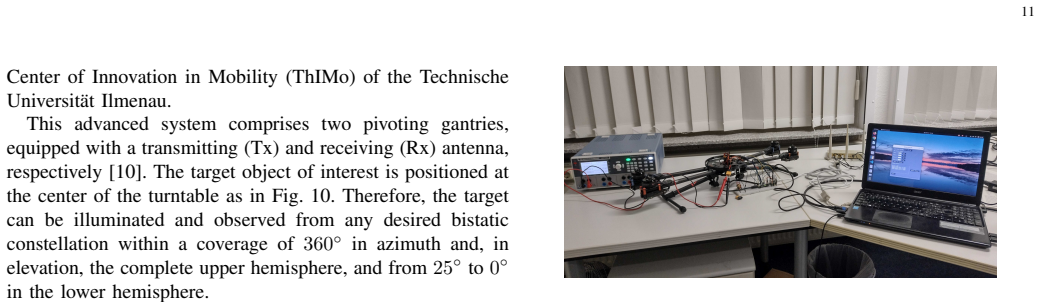
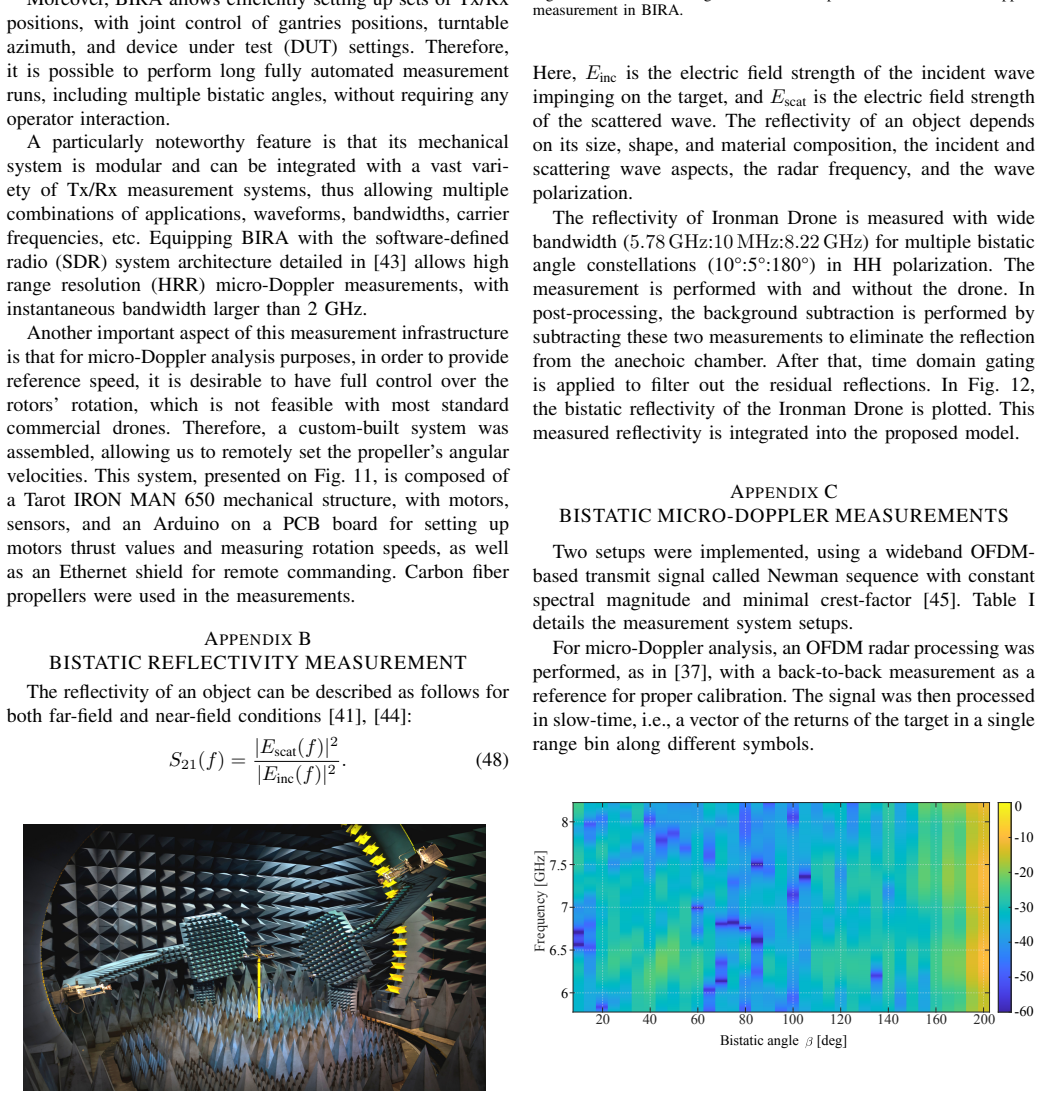
read the original abstract
Integrated Sensing and Communication (ISAC) will be one key feature of future 6G networks, enabling simultaneous communication and radar sensing. The radar sensing geometry of ISAC will be multistatic since that corresponds to the common distributed structure of a mobile communication network. Within this framework, micro-Doppler analysis plays a vital role in classifying targets based on their micromotions, such as rotating propellers, vibration, or moving limbs. However, research on bistatic micro-Doppler effects, particularly in ISAC systems utilizing OFDM waveforms, remains limited. Existing methods, including electromagnetic simulations, often lack scalability for generating the large datasets required to train machine learning algorithms. To address this gap, this work introduces an OFDM-based bistatic micro-Doppler model for multi-propeller drones. The proposed model adapts the classic thin-wire model to include bistatic sensing configuration with an OFDM-like signal. Then, it extends further by incorporating multiple propellers and integrating the reflectivity of the drone's static parts. Measurements were performed to collect ground truth data for verification of the proposed model. Validation results show that the model generates micro-Doppler signatures closely resembling those obtained from measurements, demonstrating its potential as a tool for data generation. In addition, it offers a comprehensive approach to analyzing bistatic micro-Doppler effects.
Editorial analysis
A structured set of objections, weighed in public.
Referee Report
Summary. The manuscript introduces an OFDM-based bistatic micro-Doppler model for multi-propeller drones in distributed ISAC systems. It adapts the classic thin-wire scattering model to incorporate bistatic geometry, an OFDM-like waveform, multiple propellers, and the reflectivity of static drone components. Ground-truth measurements are collected and used to verify the model, with the claim that simulated signatures closely resemble measured ones, positioning the model as a scalable tool for generating synthetic data to train machine-learning classifiers.
Significance. If the fidelity claim holds under quantitative scrutiny, the model would supply an efficient analytical alternative to full-wave electromagnetic simulations for producing the large micro-Doppler datasets required for ML-based target classification in multistatic 6G ISAC networks. The approach builds directly on established thin-wire methods while extending them to the specific combination of bistatic sensing, OFDM waveforms, and multi-propeller targets.
major comments (1)
- [Validation results] Validation section (and abstract claim): the statement that 'validation results show that the model generates micro-Doppler signatures closely resembling those obtained from measurements' is unsupported by any reported quantitative metrics (e.g., spectrogram correlation, Doppler-spread RMSE, or feature-level error statistics). No details are given on the number of tested geometries, SNR conditions, or propeller configurations. Because the central claim is that the model is suitable for synthetic data generation, the absence of these measures is load-bearing.
minor comments (2)
- [Model derivation] The description of how the OFDM waveform is approximated within the micro-Doppler integral should be expanded for reproducibility; the current phrasing 'OFDM-like signal' leaves the exact pulse compression and subcarrier handling ambiguous.
- [Figures] Figure captions for the measured versus simulated spectrograms should include the specific bistatic angle, carrier frequency, and propeller RPM values used in each comparison.
Simulated Author's Rebuttal
We thank the referee for the detailed review and constructive feedback on our manuscript. We address the major comment below and commit to strengthening the validation section in the revised version.
read point-by-point responses
-
Referee: [Validation results] Validation section (and abstract claim): the statement that 'validation results show that the model generates micro-Doppler signatures closely resembling those obtained from measurements' is unsupported by any reported quantitative metrics (e.g., spectrogram correlation, Doppler-spread RMSE, or feature-level error statistics). No details are given on the number of tested geometries, SNR conditions, or propeller configurations. Because the central claim is that the model is suitable for synthetic data generation, the absence of these measures is load-bearing.
Authors: We agree that the current validation relies on qualitative visual comparison of spectrograms and that this is insufficient to fully support the claim of suitability for large-scale synthetic data generation. In the revised manuscript we will add quantitative metrics, including spectrogram correlation coefficients and Doppler-spread RMSE between simulated and measured signatures. We will also explicitly report the number of tested geometries, SNR conditions, and propeller configurations used in the experiments. revision: yes
Circularity Check
No circularity: derivation starts from classic thin-wire model and is validated against independent measurements
full rationale
The paper adapts the established thin-wire scattering model to bistatic OFDM geometry, multi-propeller kinematics, and static-part reflectivity, then compares generated signatures to separately collected measurement data. No equation or claim reduces to a fitted parameter defined by the target result itself, no self-citation supplies a load-bearing uniqueness theorem, and the validation step is external rather than tautological. The central claim therefore remains self-contained against external benchmarks.
Axiom & Free-Parameter Ledger
axioms (1)
- domain assumption The classic thin-wire model can be adapted to bistatic sensing configuration with an OFDM-like signal and multiple propellers
Lean theorems connected to this paper
-
IndisputableMonolith/Cost/FunctionalEquation.leanwashburn_uniqueness_aczel unclear?
unclearRelation between the paper passage and the cited Recognition theorem.
The proposed model adapts the classic thin-wire model to include bistatic sensing configuration with an OFDM-like signal... yi(t, τ) = γ_i ∫ ... sinc(ω0/c · ΔR−_i(t,τ))
-
IndisputableMonolith/Foundation/AbsoluteFloorClosure.leanreality_from_one_distinction unclear?
unclearRelation between the paper passage and the cited Recognition theorem.
Validation results show that the model generates micro-Doppler signatures closely resembling those obtained from measurements
What do these tags mean?
- matches
- The paper's claim is directly supported by a theorem in the formal canon.
- supports
- The theorem supports part of the paper's argument, but the paper may add assumptions or extra steps.
- extends
- The paper goes beyond the formal theorem; the theorem is a base layer rather than the whole result.
- uses
- The paper appears to rely on the theorem as machinery.
- contradicts
- The paper's claim conflicts with a theorem or certificate in the canon.
- unclear
- Pith found a possible connection, but the passage is too broad, indirect, or ambiguous to say the theorem truly supports the claim.
Forward citations
Cited by 1 Pith paper
-
BIRA: A Spherical Bistatic Radar Reflectivity Measurement System
BIRA is a bistatic radar facility for spherical positioning of two probes with sub-millimeter accuracy on up to 7 m diameter and 0.7-260 GHz coverage, enabling Doppler and range characterization of dynamic objects for ISAC.
Reference graph
Works this paper leans on
-
[1]
F. Liu, C. Masouros, and Y . C. Eldar,Integrated Sensing and Commu- nications. Springer, 2023, ISBN-13: 9789819925032
work page 2023
-
[2]
R. S. Thom ¨a, C. Andrich, J. Beuster, H. C. A. Costa, S. Giehl, S. J. Myint, C. Schneider, and G. Sommerkorn, “Characterization of Multi- Link Propagation and Bistatic Target Reflectivity for Distributed Multi- Sensor ISAC,” 2023, arXiv:2210.11840 [eess.SP]
-
[3]
V . Shatov, B. Nuss, S. Schieler, P. K. Bishoyi, L. Wimmer, M. L ¨ubke, N. Keshtiarast, C. Fischer, D. Lindenschmitt, B. Geiger, R. Thom ¨a, A. Fellan, L. Schmalen, M. Petrova, H. D. Schotten, and N. Franchi, “Joint Radar and Communications: Architectures, Use Cases, Aspects of Radio Access, Signal Processing, and Hardware,”IEEE Access, vol. 12, pp. 47 88...
-
[4]
R. Thom ¨a and T. Dallmann, “Distributed ISAC Systems – Mul- tisensor Radio Access and Coordination,” in2023 20th European Radar Conference (EuRAD), 2023, pp. 351–354, doi: 10.23919/Eu- RAD58043.2023.10289611
-
[5]
MIMO Radar with Widely Separated Antennas,
A. M. Haimovich, R. S. Blum, and L. J. Cimini, “MIMO Radar with Widely Separated Antennas,”IEEE Signal Processing Magazine, vol. 25, no. 1, pp. 116–129, 2008, doi: 10.1109/MSP.2008.4408448
-
[6]
Cooperative Passive Coherent Location: A Promising 5G Service to Support Road Safety,
R. S. Thom ¨a, C. Andrich, G. Del Galdo, M. D ¨obereiner, M. A. Hein, M. K ¨aske, G. Sch ¨afer, S. Schieler, C. Schneider, A. Schwind, and P. Wendland, “Cooperative Passive Coherent Location: A Promising 5G Service to Support Road Safety,”IEEE Communications Magazine, vol. 57, no. 9, pp. 86–92, 2019, doi: 10.1109/MCOM.001.1800242
-
[7]
V . C. Chen,The Micro-Doppler Effect in Radar, 2nd ed. Norwood, MA: Artech House, 2019, ISBN-13: 9781630815486
work page 2019
-
[8]
6G Integrated Sensing and Communications Channel Mod- eling: Challenges and Opportunities,
T. Liu, K. Guan, D. He, P. T. Mathiopoulos, K. Yu, Z. Zhong, and M. Guizani, “6G Integrated Sensing and Communications Channel Mod- eling: Challenges and Opportunities,”IEEE V ehicular Technology Mag- azine, vol. 19, no. 2, pp. 31–40, 2024, doi: 10.1109/MVT.2024.3373930
-
[9]
Radar target micro-Doppler signature classification,
G. E. Smith, “Radar target micro-Doppler signature classification,” Ph.D. dissertation, University College London, 2008. [Online]. Available: https://discovery.ucl.ac.uk/id/eprint/18688/1/18688.pdf
work page 2008
-
[10]
BIRA: A Spherical Bistatic Radar Reflectivity Measurement System
C. Andrich, T. F. Nowack, A. Ihlow, S. Giehl, M. Engelhardt, G. Som- merkorn, A. Schwind, W. Hofmann, C. Bornkessel, M. A. Hein, and R. S. Thom ¨a, “BIRA: A Spherical Bistatic Radar Reflectivity Measure- ment System,” 2025, arXiv:2407.13749 [eess.SP]
work page internal anchor Pith review Pith/arXiv arXiv 2025
-
[11]
Next-generation deep learning based on simulators and synthetic data,
C. M. de Melo, A. Torralba, L. Guibas, J. DiCarlo, R. Chellappa, and J. Hodgins, “Next-generation deep learning based on simulators and synthetic data,”Trends in cognitive sciences, vol. 26, no. 2, pp. 174– 187, 2022
work page 2022
-
[12]
Calculation and analysis of electromagnetic scattering by helicopter rotating blades,
P. Pouliguen, L. Lucas, F. Muller, S. Quete, and C. Terret, “Calculation and analysis of electromagnetic scattering by helicopter rotating blades,” IEEE Transactions on Antennas and Propagation, vol. 50, no. 10, 2002, doi: 10.1109/TAP.2002.800693
-
[13]
Micro-Doppler-based classification study on the detections of aerial targets and wind turbines,
O. Karabayır, S. M. Y ¨uceda˘g, O. M. Y ¨uceda˘g, A. F. Cos ¸kun, and H. A. Serim, “Micro-Doppler-based classification study on the detections of aerial targets and wind turbines,” in2016 17th International Radar Symposium (IRS), 2016, pp. 1–4
work page 2016
-
[14]
Numerical RCS and micro-Doppler investi- gations of a consumer UA V,
A. Schr ¨oder, U. Aulenbacher, M. Renker, U. B ¨oniger, R. Oechslin, A. Murk, and P. Wellig, “Numerical RCS and micro-Doppler investi- gations of a consumer UA V,” inTarget and Background Signatures II, vol. 9997, 2016, pp. 35–44
work page 2016
-
[15]
Com- parisons Between Simulated and Measured X-band Signatures of Quad- , Hexa- and Octocopters,
P. J. Speirs, A. Schr ¨oder, M. Renker, P. Wellig, and A. Murk, “Com- parisons Between Simulated and Measured X-band Signatures of Quad- , Hexa- and Octocopters,” in2018 15th European Radar Conference (EuRAD), 2018, pp. 325–328, doi: 10.23919/EuRAD.2018.8546612
-
[16]
Electromagnetic Mod- elling of Micro-Doppler Signatures of Commercial Airborne Drones,
P. Z. Petrovic, S. V . Savic, and M. M. Ilic, “Electromagnetic Mod- elling of Micro-Doppler Signatures of Commercial Airborne Drones,” in2021 29th Telecommunications F orum, TELFOR 2021, 2021, doi: 10.1109/TELFOR52709.2021.9653308
-
[17]
Time frequency signatures of micro- Doppler phenomenon for feature extraction,
V . C. Chen and R. D. Lipps, “Time frequency signatures of micro- Doppler phenomenon for feature extraction,” inWavelet Applications VII, vol. 4056, 2000, pp. 220–226, doi: 10.1117/12.381683
-
[18]
Micro-Doppler effect in radar: phenomenon, model, and simulation study,
V . C. Chen, F. Li, S.-S. Ho, and H. Wechsler, “Micro-Doppler effect in radar: phenomenon, model, and simulation study,”IEEE Transactions on Aerospace and electronic systems, vol. 42, no. 1, pp. 2–21, 2006, doi: 10.1109/TAES.2006.1603402
-
[19]
D. White, M. Jahangir, M. Antoniou, C. Baker, J. Thiyagalingam, S. Harman, and C. Bennett, “Multi-rotor Drone Micro-Doppler Simula- tion Incorporating Genuine Motor Speeds and Validation with L-band Staring Radar,” inProceedings of the IEEE Radar Conference, 2022, doi: 10.1109/RadarConf2248738.2022.9764352
-
[20]
J. Wei, D. Ma, F. He, Q. Zhang, Z. Feng, Z. Liu, and T. Liang, “UA V’s Rotor Micro-Doppler Feature Extraction Using Integrated Sensing and Communication Signal: Algorithm Design and Testbed Evaluation,” pp. 1–13, 2024, arXiv:2408.16415 [eess.SP]
-
[21]
Simulation-based Approach to Classification of Airborne Drones,
L. Lehmann and J. Dall, “Simulation-based Approach to Classification of Airborne Drones,” inIEEE National Radar Conference, 2020, doi: 10.1109/RadarConf2043947.2020.9266405
-
[22]
Simulation of Bistatic Signatures from Rotating Blades of Aerial Targets,
E. Plotnitskaya, E. V orobev, and V . I. Veremyev, “Simulation of Bistatic Signatures from Rotating Blades of Aerial Targets,” inProceedings of the 2021 IEEE Conference of Russian Young Researchers in Electrical and Electronic Engineering, ElConRus 2021, 2021, doi: 10.1109/ElCon- Rus51938.2021.9396233
-
[23]
Simulating UA V micro-Doppler using dynamic point clouds,
M. Moore, D. A. Robertson, and S. Rahman, “Simulating UA V micro-Doppler using dynamic point clouds,” in2022 IEEE Radar Conference (RadarConf22), 2022, pp. 01–06, doi: 10.1109/Radar- Conf2248738.2022.9764284
-
[24]
H. Schneider, “Application of an autoregressive reflection model for the signal analysis of radar echoes from rotating objects,” inICASSP-88., International Conference on Acoustics, Speech, and Signal Processing, 1988, pp. 1236–1239 vol.2, doi: 10.1109/ICASSP.1988.196824
-
[25]
Analysis of the theoretical radar return signal form aircraft propeller blades,
J. Martin and B. Mulgrew, “Analysis of the theoretical radar return signal form aircraft propeller blades,” inIEEE International Conference on Radar, 1990, pp. 569–572
work page 1990
-
[26]
Analysis of recorded helicopter echo,
J. Misiurewicz, K. Kulpa, and Z. Czekala, “Analysis of recorded helicopter echo,” inRadar 97 (Conf. Publ. No. 449), 1997, pp. 449– 453, doi: 10.1049/cp:19971715
-
[27]
D. Jianjiang, Y . Zhiqiang, Y . Dazhi, and R. Chongji, “Modeling and validation of modulated characteristics for aircraft rotating structure in the air surveillance radars,” inIEEE National Radar Conference, vol. 2005-January, 2005, doi: 10.1109/RADAR.2005.1435905
-
[28]
Measuring time between peaks in helicopter classification using continuous wavelet trans- form,
H. C. Costa and M. C. De Matos, “Measuring time between peaks in helicopter classification using continuous wavelet trans- form,” in2008 IEEE Radar Conference, RADAR 2008, 2008, doi: 10.1109/RADAR.2008.4720899
-
[29]
Micro-Doppler analysis and parameter estimation of the rotating linear rigid target,
G. Chen, H. Yu, and X. Yang, “Micro-Doppler analysis and parameter estimation of the rotating linear rigid target,”2012 IEEE International Conference on Computer Science and Automation Engineering (CSAE), vol. 1, no. 4, pp. 94–97, 2012, doi: 10.1109/CSAE.2012.6272556
-
[30]
Modeling of micro-Doppler signatures from rotor blades,
B. Wang, W. Li, L. Du, and H. Shi, “Modeling of micro-Doppler signatures from rotor blades,”IET Conference Publications, vol. 2015, 2015, doi: 10.1049/cp.2015.1133
-
[31]
Radar recognition of multi- propeller drones using micro-doppler linear spectra,
Y . Cai, O. Krasnov, and A. Yarovoy, “Radar recognition of multi- propeller drones using micro-doppler linear spectra,” inEuRAD 2019 - 2019 16th European Radar Conference, 2019
work page 2019
-
[32]
M. Ummenhofer, “Validation of Wind Turbine Doppler Signatures in a Passive Bistatic Radar with a Point Scatterer Model,” in2019 Interna- tional Applied Computational Electromagnetics Society Symposium in Miami, ACES-Miami 2019, 2019
work page 2019
-
[33]
Simple modelling of the radar signature of helicopters,
G. Point and L. Savy, “Simple modelling of the radar signature of helicopters,”IET Conference Publications, vol. 2017, no. CP728, pp. 1–6, 2017, doi: 10.1049/cp.2017.0425
-
[34]
C. Clemente and J. J. Soraghan, “Application of the singular spec- trum analysis for extraction of micro-Doppler signature of heli- copters,”IET Conference Proceedings, pp. 93–93(1), January 2012, doi: 10.1049/cp.2012.1662
-
[35]
Modelling Micro-Doppler Signature of Drone Propellers in Distributed ISAC,
H. C. A. Costa, S. J. Myint, C. Andrich, S. W. Giehl, C. Schneider, and R. S. Thom ¨a, “Modelling Micro-Doppler Signature of Drone Propellers in Distributed ISAC,” in2024 IEEE Radar Conference (RadarConf24), 2024, pp. 1–6, doi: 10.1109/RadarConf2458775.2024.10548468
-
[36]
M. A. Richards,Fundamentals of Radar Signal Processing, 2nd ed. McGraw-Hill, 2014, ch. 2, ISBN-13: 9780071798334
work page 2014
-
[37]
OFDM radar algorithms in mobile communication networks,
K. M. Braun, “OFDM radar algorithms in mobile communication networks,” Ph.D. dissertation, Karlsruher Institut f ¨ur Technologie (KIT),
-
[38]
Available: https://d-nb.info/104838490X/34
[Online]. Available: https://d-nb.info/104838490X/34
-
[39]
X. Qu, K. Li, Q. Zhang, and B. Liang, “Micro-Doppler feature extraction under passive radar based on orthogonal frequency division multiplexing communication signal,”The Journal of Engineering, vol. 2019, pp. 6889–6893, 2019, doi: 10.1049/joe.2019.0592
-
[40]
N. J. Willis,Bistatic radar. SciTech Publishing, 2005, vol. 2, ch. 6, ISBN-13: 9781891121456
work page 2005
-
[41]
Feature extraction of rotating target based on bistatic micro-Doppler analysis,
A. Xiaofeng, Z. Xiaohai, Y . Jianhua, L. Jin, and L. Yongzhen, “Feature extraction of rotating target based on bistatic micro-Doppler analysis,” inProceedings of 2011 IEEE CIE International Conference on Radar , RADAR 2011, vol. 1, 2011, doi: 10.1109/CIE-Radar.2011.6159614
-
[42]
H. C. A. Costa, S. J. Myint, C. Andrich, S. W. Giehl, C. Schneider, and R. S. Thom ¨a, “Bistatic reflectivity and micro-Doppler signatures of drones for integrated communication and sensing,” in2024 International Radar Symposium (IRS), 2024, pp. 194–199
work page 2024
-
[43]
V . C. Chen, D. Tahmoush, and W. J. Miceli,Radar micro-Doppler signatures. Institution of Engineering and Technology, London, UK, 2014, ISBN-13: 9781849197168
work page 2014
-
[44]
M. Engelhardt, S. Giehl, M. Schubert, A. Ihlow, C. Schneider, A. Ebert, M. Landmann, G. Del Galdo, and C. Andrich, “Accelerating Innovation in 6G Research: Real-Time Capable SDR System Architecture for Rapid Prototyping,”IEEE Access, vol. 12, pp. 118 718–118 732, 2024, doi: 10.1109/ACCESS.2024.3447884
-
[45]
Bi-static Reflectivity Measurements of Vulnerable Road Users using Scaled Radar Objects,
A. Schwind, W. Hofmann, R. Stephan, and M. A. Hein, “Bi-static Reflectivity Measurements of Vulnerable Road Users using Scaled Radar Objects,” in2020 Antenna Measurement Techniques Association Symposium (AMTA), 2020, pp. 1–6
work page 2020
-
[46]
Multitone signals with low crest factor,
S. Boyd, “Multitone signals with low crest factor,”IEEE Transactions on Circuits and Systems, vol. 33, no. 10, pp. 1018–1022, 1986, doi: 10.1109/TCS.1986.1085837. 14 Heraldo Cesar Alves Costareceived a B.Sc. de- gree in Electronic Engineering and a M.Sc. degree in Electrical Engineering from the Military Institute of Engineering (IME), Rio de Janeiro, Bra...
-
[47]
He is currently pursuing a Ph.D. degree in Electrical Engineering at Technische Universit ¨at Ilmenau, Germany. His research interests include multistic radar, modeling multistatic reflectivity/RCS of objects, and target classification in Integrated Communication and Sensing (ICAS) applications. Sebastian W. Giehlreceived the B.Sc. and M.Sc. degrees in el...
work page 2020
discussion (0)
Sign in with ORCID, Apple, or X to comment. Anyone can read and Pith papers without signing in.