Constructing wall turbulence using hierarchical hairpin vortices
Pith reviewed 2026-05-22 20:53 UTC · model grok-4.3
The pith
Wall turbulence fields can be built from ensembles of hierarchical hairpin vortex packets.
A machine-rendered reading of the paper's core claim, the machinery that carries it, and where it could break.
Core claim
The central discovery is that wall turbulence can be represented as an ensemble of complex vortices formed by hierarchically organized hairpin vortex packets. With the geometry and organization calibrated to match observations and a height-dependent core-size variation, the model reproduces both attached and detached motions. It matches key statistical and structural features of direct numerical simulations for turbulent channel flow at friction Reynolds numbers from 1,000 to 10,000. The construction further elucidates the roles of vortex geometry, packet organization, and hierarchy in controlling the attached/detached balance, meandering streaks, inclination angles, superstructure alignment
What carries the argument
Hierarchically organized hairpin vortex packets with height-dependent core-size variation, calibrated to observations
If this is right
- Reproduces key statistical and structural features of wall turbulence matching DNS at Re_tau 1000-10000.
- Reveals new insights into how vortex geometry, packet organization, and hierarchy set the attached/detached balance, meandering streaks, inclination angles, and superstructure alignment.
- The constructed turbulence rapidly transitions into fully developed turbulence in DNS.
- Reduces computational costs for turbulence development in high-fidelity simulations.
- Provides a flexible framework for testing and advancing turbulence models based on vortex structures.
Where Pith is reading between the lines
- The calibration approach could be used to explore how changes in vortex hierarchy affect turbulence in flows with different pressure gradients or surface conditions.
- Such constructed fields might serve as test cases for validating large-eddy simulation subgrid models that aim to capture coherent structures.
- Extending the model to include interactions between packets could lead to predictions of energy transfer across scales in wall turbulence.
Load-bearing premise
The geometry and organization of the vortex packets are calibrated to match observations from real flows.
What would settle it
If direct numerical simulation of the constructed fields fails to produce the same Reynolds stress profiles or structural statistics as standard DNS at a friction Reynolds number of 5000, the model's ability to represent wall turbulence would be falsified.
Figures






read the original abstract
Wall-bounded turbulence is characterized by coherent, worm-like structures such as hairpin vortices. The attached-eddy model provides a successful statistical framework for the log-law region, yet the complex geometry and multiscale nature of wall-turbulence vortices remain challenging for physics-based modelling. Here, we model wall turbulence as an ensemble of complex vortices, introducing a systematic approach to constructing turbulence fields enriched with hierarchically organized hairpin vortex packets. The geometry and organization of the vortex packets are calibrated to match observations, enabling the model to reproduce both attached and detached motions through a height-dependent core-size variation. Our model successfully reproduces the key statistical and structural features of wall turbulence, matching direct numerical simulations of turbulent channel flow at friction Reynolds numbers from 1,000 to 10,000. More importantly, it also reveals new insights into the coherent structures, emphasizing the role of vortex geometry, packet organization, and hierarchy in setting the attached/detached balance, meandering streaks and inclination angles, superstructure alignment, and the overall partition of contributions. Moreover, the constructed channel turbulence rapidly transitions into fully developed turbulence in direct numerical simulation, demonstrating its physical self-consistency and practical utility for initializing high-fidelity simulations. This approach significantly reduces computational costs associated with turbulence development while providing a flexible framework for testing and advancing turbulence models based on vortex structures.
Editorial analysis
A structured set of objections, weighed in public.
Referee Report
Summary. The manuscript proposes constructing synthetic wall turbulence as an ensemble of hierarchically organized hairpin vortex packets. The geometry and organization of these packets are calibrated to observations, with a height-dependent core-size variation introduced to reproduce both attached and detached motions. The resulting fields are claimed to reproduce key statistical and structural features of DNS channel flow at Re_τ = 1000–10000, to yield new insights into coherent-structure dynamics (attached/detached balance, meandering streaks, inclination angles, superstructure alignment), and to enable rapid transition to fully developed turbulence when used as initial conditions, thereby reducing computational cost.
Significance. If the reproduction of DNS statistics and structures can be shown to emerge from the hierarchical vortex construction rather than from calibration, the approach would supply a physics-based method for generating realistic initial fields for high-fidelity simulations and a testable framework for exploring the role of vortex geometry and packet organization in wall turbulence. The rapid-transition result, if quantified, would have immediate practical value for reducing the cost of DNS transients.
major comments (3)
- [Abstract] Abstract: the central claim that the model 'successfully reproduces' key statistical and structural features of DNS at Re_τ = 1000–10000 is not accompanied by any quantitative error metrics, error bars, or cross-validation procedure. Without these, it is impossible to judge the quality of the reported agreement or to distinguish genuine prediction from parameter tuning.
- [§3] §3 (Model Construction): the statement that 'the geometry and organization of the vortex packets are calibrated to match observations' and that a 'height-dependent core-size variation' is introduced to enable attached/detached motions raises a circularity concern. It is not specified which DNS statistics (mean profiles, Reynolds stresses, two-point correlations, or structural measures) were used as calibration targets versus independent validation targets. If the reported matches are among the calibration targets, agreement with DNS does not constitute an independent test of the hierarchical hairpin-packet hypothesis.
- [§4] §4 (Results): no tables or figures report quantitative measures (e.g., L2 errors, correlation coefficients, or integrated differences) for the claimed matches to DNS mean velocity, Reynolds stresses, or structural features across the Re_τ range. The absence of such metrics makes the 'matching' assertion difficult to evaluate and weakens the assertion that the model reveals new insights into the attached/detached balance.
minor comments (2)
- [Abstract / §1] The abstract and introduction would benefit from a concise statement of the number of free parameters and how they are determined, to help readers assess the model's parsimony.
- [Figures] Figure captions should explicitly state the Re_τ values and the precise quantities being compared (e.g., which component of the Reynolds stress tensor) to improve clarity.
Simulated Author's Rebuttal
We thank the referee for their constructive comments, which help improve the clarity and rigor of our work. We address each major comment below and will make the necessary revisions to the manuscript.
read point-by-point responses
-
Referee: [Abstract] Abstract: the central claim that the model 'successfully reproduces' key statistical and structural features of DNS at Re_τ = 1000–10000 is not accompanied by any quantitative error metrics, error bars, or cross-validation procedure. Without these, it is impossible to judge the quality of the reported agreement or to distinguish genuine prediction from parameter tuning.
Authors: We agree that including quantitative metrics would strengthen the abstract's claim. In the revised version, we will update the abstract to reference the quantitative agreement measures (such as L2 errors and correlations) that will be added to the results section, allowing readers to assess the reproduction quality more objectively. revision: yes
-
Referee: [§3] §3 (Model Construction): the statement that 'the geometry and organization of the vortex packets are calibrated to match observations' and that a 'height-dependent core-size variation' is introduced to enable attached/detached motions raises a circularity concern. It is not specified which DNS statistics (mean profiles, Reynolds stresses, two-point correlations, or structural measures) were used as calibration targets versus independent validation targets. If the reported matches are among the calibration targets, agreement with DNS does not constitute an independent test of the hierarchical hairpin-packet hypothesis.
Authors: To resolve the circularity concern, we will revise §3 to explicitly state the calibration targets. The packet geometry and hierarchy were calibrated to structural observations from the literature, independent of the specific DNS runs used for validation. The height-dependent core-size variation follows from attached-eddy theory. The mean profiles, Reynolds stresses, and other statistics are validation targets. A new table or list will be added to separate calibration from validation, demonstrating that the model tests the hierarchical hypothesis. revision: yes
-
Referee: [§4] §4 (Results): no tables or figures report quantitative measures (e.g., L2 errors, correlation coefficients, or integrated differences) for the claimed matches to DNS mean velocity, Reynolds stresses, or structural features across the Re_τ range. The absence of such metrics makes the 'matching' assertion difficult to evaluate and weakens the assertion that the model reveals new insights into the attached/detached balance.
Authors: We will add quantitative metrics to §4, including a table with L2 errors, correlation coefficients, and integrated differences for mean velocity, Reynolds stresses, and structural features (e.g., inclination angles, streak meandering) at Re_τ = 1000, 2000, 5000, and 10000. This will enable objective evaluation of the matches and bolster the claims about new insights into the attached/detached balance by providing numerical support for the contributions. revision: yes
Circularity Check
Calibration of vortex geometry and hierarchy to observations makes reproduction of DNS statistics a fitted result
specific steps
-
fitted input called prediction
[Abstract]
"The geometry and organization of the vortex packets are calibrated to match observations, enabling the model to reproduce both attached and detached motions through a height-dependent core-size variation. Our model successfully reproduces the key statistical and structural features of wall turbulence, matching direct numerical simulations of turbulent channel flow at friction Reynolds numbers from 1,000 to 10,000."
Parameters controlling packet geometry, organization, and core-size variation are adjusted to observations so that attached/detached balance and other features are reproduced by design. Agreement with DNS statistics is then reported as a successful outcome, but the match is statistically forced once the calibration targets the same quantities (mean profiles, stresses, correlations) that are later presented as validation.
full rationale
The paper explicitly states that vortex packet geometry and organization are calibrated to observations and that a height-dependent core-size variation is introduced specifically to enable reproduction of attached and detached motions. The subsequent claim of matching DNS statistics and structures at Re_τ = 1000–10000 therefore follows from parameter adjustment rather than emerging independently from the hierarchical construction. This constitutes one instance of fitted_input_called_prediction at the central claim level. No equations, self-citations, or uniqueness theorems are shown to create additional circular reductions. The model remains a useful constructive framework once the calibration step is acknowledged.
Axiom & Free-Parameter Ledger
free parameters (2)
- height-dependent core-size variation function
- packet organization parameters
axioms (1)
- domain assumption Hairpin vortex packets are the dominant coherent structures that can be superposed to recover the essential statistics and structures of wall turbulence.
Reference graph
Works this paper leans on
-
[1]
and experimental observations of packet lengths [4]. We adopt𝑁𝑣 =7 as a baseline because it provides an inter-head spacing𝐿 𝑖/(𝑁 𝑣 −1)=0.5ℎ 𝑖, yielding a compact yet representative packet. In practice,𝑁 𝑣 can be treated as a tunable parameter or vary with scale [30]. The heights of individual sub-level vortices within a level-𝑖packet follow ℎ(𝑗) 𝑖 =ℎ 𝑖𝛼(1...
work page 2048
-
[2]
The shaded grey region highlights the log-law region 3Re1/2 𝜏 < 𝑦 + <0.15Re 𝜏
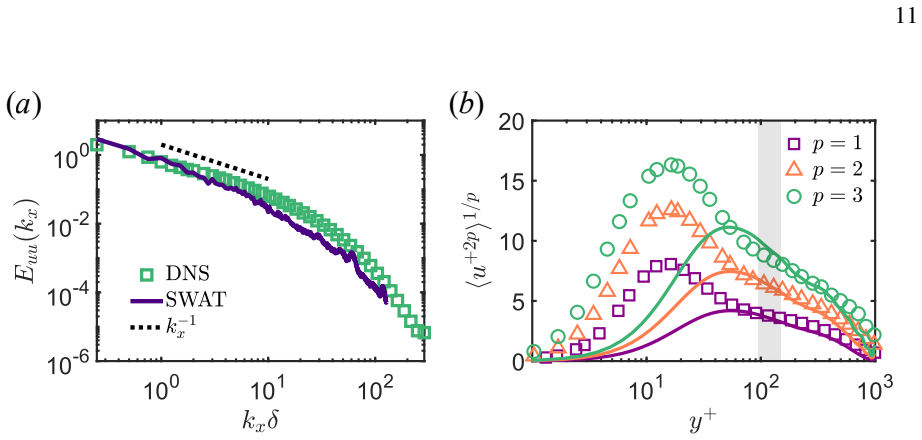
(Re 𝜏 =10000 ), and solid lines in matching colours indicate SWAT results. The shaded grey region highlights the log-law region 3Re1/2 𝜏 < 𝑦 + <0.15Re 𝜏. A. Hairpin vortices and attached/detached structures A central step in SWAT is the construction of realistic hairpin vortices that act as building blocks of wall turbulence. Although these hairpins are d...
work page 2000
-
[3]
have shown that such inflow conditions are both cost-effective and promising. Nevertheless, further detailed investigations are necessary to evaluate the accuracy and fidelity of the downstream turbulence evolution when such synthetic inflow methods are employed. VI. CONCLUSIONS This study presents a systematic approach to constructing wall turbulence usi...
-
[4]
S. B. Pope,Turbulent Flows(Cambridge University Press, 2000). 29
work page 2000
-
[5]
A. A. Townsend,The structure of turbulent shear flow(Cambridge university press, 1976)
work page 1976
-
[6]
I. Marusic and J. P. Monty, Attached eddy model of wall turbulence, Annu. Rev. Fluid Mech.51, 49 (2019)
work page 2019
-
[7]
R. J. Adrian, Hairpin vortex organization in wall turbulence, Phys. Fluids19, 041301 (2007)
work page 2007
-
[8]
K. C. Kim and R. J. Adrian, Very large-scale motion in the outer layer, Phys. Fluids11, 417 (1999)
work page 1999
-
[9]
J. H. Lee and H. J. Sung, Very-large-scale motions in a turbulent boundary layer, J. Fluid Mech.673, 80 (2011)
work page 2011
-
[10]
J. R. Baltzer, R. J. Adrian, and X. Wu, Structural organization of large and very large scales in turbulent pipe flow simulation, J. Fluid Mech.720, 236 (2013)
work page 2013
-
[11]
L. H. O. Hellstr ¨om, I. Marusic, and A. J. Smits, Self-similarity of the large-scale motions in turbulent pipe flow, J. Fluid Mech.792, R1 (2016)
work page 2016
-
[12]
W. J. Baars, N. Hutchins, and I. Marusic, Self-similarity of wall-attached turbulence in boundary layers, J. Fluid Mech.823, R2 (2017)
work page 2017
-
[13]
D. Chandran, R. Baidya, J. P. Monty, and I. Marusic, Two-dimensional energy spectra in high-reynolds- number turbulent boundary layers, J. Fluid Mech.826, R1 (2017)
work page 2017
-
[14]
R. Deshpande, D. Chandran, J. P. Monty, and I. Marusic, Two-dimensional cross-spectrum of the streamwise velocity in turbulent boundary layers, J. Fluid Mech.890, R2 (2020)
work page 2020
-
[15]
R. Hu, X. I. A. Yang, and X. Zheng, Wall-attached and wall-detached eddies in wall-bounded turbulent flows, J. Fluid Mech.885, A30 (2020)
work page 2020
-
[16]
L. Wang, C. Pan, J. Wang, and Q. Gao, Statistical signatures of component wall-attached eddies in proper orthogonal decomposition modes of a turbulent boundary layer, J. Fluid Mech.944, A26 (2022)
work page 2022
-
[17]
A. Lozano-Dur ´an, O. Flores, and J. Jim ´enez, The three-dimensional structure of momentum transfer in turbulent channels, J. Fluid Mech.694, 100 (2012)
work page 2012
-
[18]
J. Hwang and H. J. Sung, Wall-attached structures of velocity fluctuations in a turbulent boundary layer, J. Fluid Mech.856, 958 (2018)
work page 2018
- [19]
- [20]
-
[21]
R. Hu, S. Dong, and R. Vinuesa, General attached eddies: Scaling laws and cascade self-similarity, Phys. Rev. Fluids8, 044603 (2023)
work page 2023
-
[22]
A. E. Perry and I. Maru ˇsi´c, A wall-wake model for the turbulence structure of boundary layers. part 1. extension of the attached eddy hypothesis, J. Fluid Mech.298, 361 (1995)
work page 1995
-
[23]
J. D. Woodcock and I. Marusic, The statistical behaviour of attached eddies, Phys. Fluids27, 015104 (2015)
work page 2015
-
[24]
X. I. A. Yang, I. Marusic, and C. Meneveau, Hierarchical random additive process and logarithmic scaling of generalized high order, two-point correlations in turbulent boundary layer flow, Phys. Rev. Fluids1, 024402 (2016)
work page 2016
-
[25]
W. J. Baars and I. Marusic, Data-driven decomposition of the streamwise turbulence kinetic energy in boundary layers. part 1. energy spectra, J. Fluid Mech.882, A25 (2019)
work page 2019
-
[26]
Wu, Inflow turbulence generation methods, Annu
X. Wu, Inflow turbulence generation methods, Annu. Rev. Fluid Mech.49, 23 (2017)
work page 2017
-
[27]
R. H. Kraichnan, Diffusion by a random velocity field, Phys. Fluids13, 22 (1970)
work page 1970
-
[28]
A. Smirnov, S. Shi, and I. Celik, Random flow generation technique for large eddy simulations and particle-dynamics modeling, J. Fluids Eng.123, 359 (2001)
work page 2001
- [29]
- [30]
-
[31]
A. Spille-Kohoff and H.-J. Kaltenbach, Generation of turbulent inflow data with a prescribed shear- stress profile, inDNS/LES Progress and challenges(2001) p. 319
work page 2001
-
[32]
J. Zhou, R. J. Adrian, S. Balachandar, and T. M. Kendall, Mechanisms for generating coherent packets of hairpin vortices in channel flow, J. Fluid Mech.387, 353 (1999)
work page 1999
-
[33]
R. J. Adrian, C. D. Meinhart, and C. D. Tomkins, Vortex organization in the outer region of the turbulent boundary layer, J. Fluid Mech.422, 1 (2000)
work page 2000
-
[34]
Marusic, On the role of large-scale structures in wall turbulence, Phys
I. Marusic, On the role of large-scale structures in wall turbulence, Phys. Fluids13, 735 (2001)
work page 2001
-
[35]
C. M. de Silva, N. Hutchins, and I. Marusic, Uniform momentum zones in turbulent boundary layers, J. Fluid Mech.786, 309 (2016)
work page 2016
-
[36]
C. M. de Silva, J. D. Woodcock, N. Hutchins, and I. Marusic, Influence of spatial exclusion on the statistical behavior of attached eddies, Phys. Rev. Fluids1, 022401 (2016)
work page 2016
-
[37]
F. Eich, C. M. de Silva, I. Marusic, and C. J. K ¨ahler, Towards an improved spatial representation of a boundary layer from the attached eddy model, Phys. Rev. Fluids5, 034601 (2020)
work page 2020
-
[38]
D. Chandran, J. P. Monty, and I. Marusic, Spectral-scaling-based extension to the attached eddy model of wall turbulence, Phys. Rev. Fluids5, 104606 (2020)
work page 2020
-
[39]
A. E. Perry, S. M. Henbest, and M. S. Chong, A theoretical and experimental study of wall turbulence, J. Fluid Mech.165, 163–199 (1986)
work page 1986
-
[40]
R. Deshpande, C. M. de Silva, M. Lee, J. P. Monty, and I. Marusic, Data-driven enhancement of coherent structure-based models for predicting instantaneous wall turbulence, Int. J. Heat Fluid Flow 92, 108879 (2021)
work page 2021
-
[41]
R. Deshpande, C. M. de Silva, and I. Marusic, Evidence that superstructures comprise self-similar coherent motions in high reynolds number boundary layers, J. Fluid Mech.969, A10 (2023)
work page 2023
-
[42]
S. Xiong and Y. Yang, Construction of knotted vortex tubes with the writhe-dependent helicity, Phys. Fluids31, 047101 (2019)
work page 2019
-
[43]
W. Shen, J. Yao, F. Hussain, and Y. Yang, Role of internal structures within a vortex in helicity dynamics, J. Fluid Mech.970, A26 (2023)
work page 2023
-
[44]
W. Shen, J. Yao, and Y. Yang, Designing turbulence with entangled vortices, Proc. Natl. Acad. Sci. U.S.A.121, e2405351121 (2024)
work page 2024
-
[45]
P. Subbareddy, D. Peterson, G. V. Candler, and I. Marusic, A synthetic inflow generation method using the attached eddy hypothesis, in24th AIAA Applied Aerodynamics Conference, San Francisco, CA, USA(2006) p. 3672
work page 2006
-
[46]
X. Wu, P. Moin, J. M. Wallace, J. Skarda, A. Lozano-Duran, and J. P. Hickey, Transitional-turbulent spots and turbulent-turbulent spots in boundary layers, Proc. Natl. Acad. Sci. U.S.A.114, E5292 (2017)
work page 2017
-
[47]
M. R. Head and P. Bandyopadhyay, New aspects of turbulent boundary-layer structure, J. Fluid Mech. 107, 297 (1981)
work page 1981
-
[48]
A. H. Haidari and C. R. Smith, The generation and regeneration of single hairpin vortices, J. Fluid Mech.277, 135 (1994)
work page 1994
-
[49]
S. K. Robinson, Coherent motions in the turbulent boundary-layer, Annu. Rev. Fluid Mech.23, 601 (1991)
work page 1991
-
[50]
I. Maru ˇsi´c and A. E. Perry, A wall-wake model for the turbulence structure of boundary layers. part 2. further experimental support, J. Fluid Mech.298, 389 (1995)
work page 1995
-
[51]
R. Deshpande, J. P. Monty, and I. Marusic, Streamwise inclination angle of large wall-attached struc- tures in turbulent boundary layers, J. Fluid Mech.877, R4 (2019). 31
work page 2019
- [52]
-
[53]
S. Xiong and Y. Yang, Effects of twist on the evolution of knotted magnetic flux tubes, J. Fluid Mech. 895, A28 (2020)
work page 2020
-
[54]
Y. Zhao, Y. Yang, and S. Chen, Vortex reconnection in the late transition in channel flow, J. Fluid Mech.802, R4 (2016)
work page 2016
-
[55]
Y. Yang and D. I. Pullin, On lagrangian and vortex-surface fields for flows with taylor–green and kida–pelz initial conditions, J. Fluid Mech.661, 446 (2010)
work page 2010
-
[56]
Y. Yang, S. Xiong, and Z. Lu, Applications of the vortex-surface field to flow visualization, modelling and simulation, Flow3, E33 (2023)
work page 2023
-
[57]
A. E. Perry and M. S. Chong, On the mechanism of wall turbulence, J. Fluid Mech.119, 173 (1982)
work page 1982
-
[58]
N. Hutchins and I. Marusic, Evidence of very long meandering features in the logarithmic region of turbulent boundary layers, J. Fluid Mech.579, 1 (2007)
work page 2007
-
[59]
R. J. Adrian and Z. C. Liu, Observation of vortex packets in direct numerical simulation of fully turbulent channel flow, J. Vis.5, 9 (2002)
work page 2002
-
[60]
J. Hwang and J. H. Lee, Meandering features of wall-attached structures in turbulent boundary layer, Phys. Rev. Fluids7, 114603 (2022)
work page 2022
-
[61]
B. Wang and Y. Yang, Transition induced by a bursting vortex ring in channel flow, J. Fluid Mech.986, A11 (2024)
work page 2024
- [62]
-
[63]
M. Oberlack, S. Hoyas, S. V. Kraheberger, F. Alcantara-Avila, and J. Laux, Turbulence statistics of arbitrary moments of wall-bounded shear flows: A symmetry approach, Phys. Rev. Lett.128, 024502 (2022)
work page 2022
-
[64]
I. Marusic, J. P. Monty, M. Hultmark, and A. J. Smits, On the logarithmic region in wall turbulence, J. Fluid Mech.716, R3 (2013)
work page 2013
-
[65]
T. B. Nickels, I. Marusic, S. Hafez, and M. S. Chong, Evidence of the kappa1-1 law in a high-reynolds- number turbulent boundary layer, Phys. Rev. Lett.95, 074501 (2005)
work page 2005
-
[66]
C. Meneveau and I. Marusic, Generalized logarithmic law for high-order moments in turbulent bound- ary layers, J. Fluid Mech.719, R1 (2013)
work page 2013
- [67]
-
[68]
A. J. Smits, B. J. McKeon, and I. Marusic, High–Reynolds number wall turbulence, Annu. Rev. Fluid Mech.43, 353 (2011)
work page 2011
-
[69]
G. Eitel-Amor, R. ¨Orl¨ u, P. Schlatter, and O. Flores, Hairpin vortices in turbulent boundary layers, Phys. Fluids27, 025108 (2015)
work page 2015
-
[70]
A. Lozano-Dur ´an and J. Jim´enez, Effect of the computational domain on direct simulations of turbulent channels up to Re𝜏= 4200, Phys. Fluids26, 011702 (2014)
work page 2014
-
[71]
W. J. Baars and I. Marusic, Data-driven decomposition of the streamwise turbulence kinetic energy in boundary layers. part 2. integrated energy and a1, J. Fluid Mech.882, A26 (2019)
work page 2019
-
[72]
M. Hultmark, M. Vallikivi, S. C. Bailey, and A. J. Smits, Turbulent pipe flow at extreme reynolds numbers, Phys. Rev. Lett.108, 094501 (2012)
work page 2012
-
[73]
R. ¨Orl¨ u, T. Fiorini, A. Segalini, G. Bellani, A. Talamelli, and P. H. Alfredsson, Reynolds stress scaling in pipe flow turbulence-first results from ciclope, Phil. Trans. R. Soc. A375, 20160187 (2017)
work page 2017
-
[74]
Y. Yang and D. I. Pullin, Evolution of vortex-surface fields in viscous taylor-green and kida-pelz flows, J. Fluid Mech.685, 146 (2011). 32
work page 2011
-
[75]
Y. Zhao, Y. Yang, and S. Chen, Evolution of material surfaces in the temporal transition in channel flow, J. Fluid Mech.793, 840 (2016)
work page 2016
-
[76]
J. C. del ´Alamo, J. Jim ´ENez, P. Zandonade, and R. D. Moser, Self-similar vortex clusters in the turbulent logarithmic region, J. Fluid Mech.561, 329 (2006)
work page 2006
-
[77]
M. Yoon, J. Hwang, J. Yang, and H. J. Sung, Wall-attached structures of streamwise velocity fluctuations in an adverse-pressure-gradient turbulent boundary layer, J. Fluid Mech.885, A12 (2019)
work page 2019
-
[78]
J. H. Lee, H. J. Sung, and R. J. Adrian, Space–time formation of very-large-scale motions in turbulent pipe flow, J. Fluid Mech.881, 1010 (2019)
work page 2019
-
[79]
J. Kim, P. Moin, and R. Moser, Turbulence statistics in fully developed channel flow at low Reynolds number, J. Fluid Mech.177, 133 (1987)
work page 1987
-
[80]
M. Wang and T. A. Zaki, Synchronization of turbulence in channel flow, J. Fluid Mech.943, A4 (2022)
work page 2022
discussion (0)
Sign in with ORCID, Apple, or X to comment. Anyone can read and Pith papers without signing in.