Accelerated Recovery with RIS: Designing Wireless Resilience in Mission-Critical Environments
Pith reviewed 2026-05-22 19:50 UTC · model grok-4.3
The pith
Augmenting the gradient of the rate function quantifies wireless network adaptability and resilience when integrated with reconfigurable intelligent surfaces.
A machine-rendered reading of the paper's core claim, the machinery that carries it, and where it could break.
Core claim
By augmenting the gradient of the system's rate function, the framework explicitly quantifies adaptation performance, and integrating RIS enhances network resilience by providing alternative channel paths and dynamic adaptation.
What carries the argument
Gradient augmentation of the rate function, which quantifies adaptability by measuring changes in rate under perturbations.
If this is right
- Wireless systems can better adapt to dynamic channel conditions and interference.
- Resilience assessments become more comprehensive with adaptability KPIs.
- RIS integration provides proactive preparation for future disruptions.
- Performance improves in mission-critical environments like 6G networks.
Where Pith is reading between the lines
- This could lead to new optimization algorithms that use gradient information for real-time resilience management.
- Testing in real-world deployments would validate if the augmented gradient correlates with actual recovery times.
Load-bearing premise
Augmenting the gradient of the system's rate function provides a valid and independent quantification of real-world adaptability and resilience in dynamic wireless channels.
What would settle it
A simulation or experiment where the gradient-augmented metric does not predict actual system recovery performance under channel disruptions.
Figures
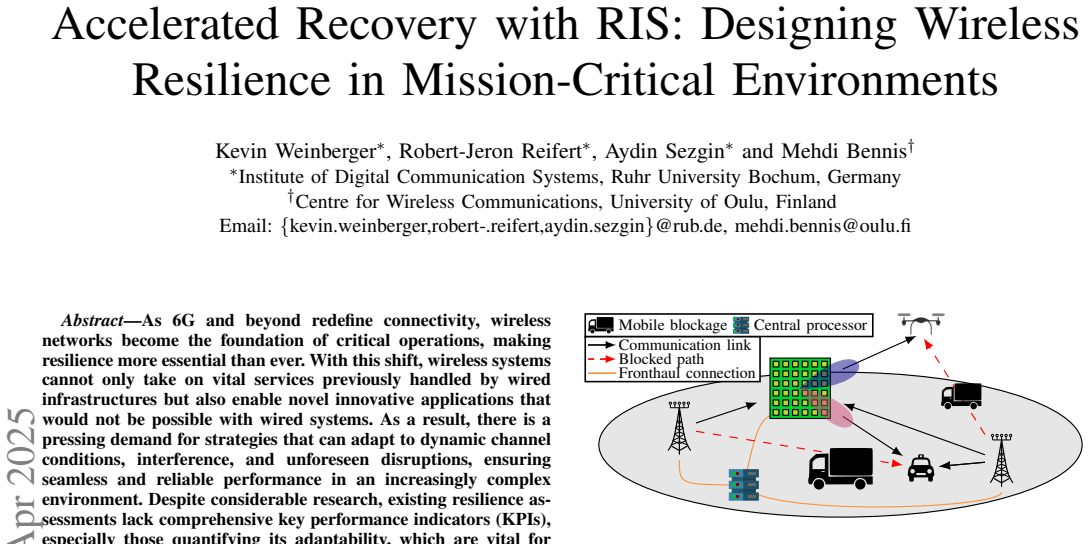



read the original abstract
As 6G and beyond redefine connectivity, wireless networks become the foundation of critical operations, making resilience more essential than ever. With this shift, wireless systems cannot only take on vital services previously handled by wired infrastructures but also enable novel innovative applications that would not be possible with wired systems. As a result, there is a pressing demand for strategies that can adapt to dynamic channel conditions, interference, and unforeseen disruptions, ensuring seamless and reliable performance in an increasingly complex environment. Despite considerable research, existing resilience assessments lack comprehensive key performance indicators (KPIs), especially those quantifying its adaptability, which are vital for identifying a system's capacity to rapidly adapt and reallocate resources. In this work, we bridge this gap by proposing a novel framework that explicitly quantifies the adaption performance by augmenting the gradient of the system's rate function. To further enhance the network resilience, we integrate Reconfigurable Intelligent Surfaces (RISs) into our framework due to their capability to dynamically reshape the propagation environment while providing alternative channel paths. Numerical results show that gradient augmentation enhances resilience by improving adaptability under adverse conditions while proactively preparing for future disruptions.
Editorial analysis
A structured set of objections, weighed in public.
Referee Report
Summary. The manuscript proposes a framework to quantify and enhance wireless network resilience in mission-critical settings. It introduces a gradient-augmented adaptability metric derived from the system's rate function to measure adaptation performance, incorporates Reconfigurable Intelligent Surfaces (RIS) to dynamically reshape propagation environments and create alternative paths, and reports numerical results indicating that this approach improves adaptability under adverse conditions while preparing for future disruptions.
Significance. If the gradient-augmented metric can be shown to correlate with observable physical recovery metrics and the numerical claims are supported by reproducible simulations with proper baselines, this could offer a useful new KPI for resilience assessment in 6G systems. The RIS integration for resilience is a relevant extension of existing techniques, but the overall contribution hinges on validating the proposed metric against real-world channel dynamics rather than internal rate-function adjustments.
major comments (2)
- The central claim that gradient augmentation enhances resilience rests on the adaptability metric serving as an independent quantifier. The definition via augmentation of the rate function risks circularity if the augmentation is selected to yield the desired resilience outcome rather than derived from external benchmarks or cross-validated against physical observables such as outage duration or recovery time after disruption. Please provide the explicit mathematical definition and derivation of the metric and demonstrate its correlation to observable recovery behavior.
- The abstract states that numerical results support the enhancement claim, yet the manuscript provides no details on simulation setup, channel models, baselines, error bars, or statistical analysis. This absence is load-bearing for the headline result; without these elements the reported improvements cannot be assessed as evidence of real-world resilience gains rather than artifacts of the chosen augmentation.
minor comments (2)
- Clarify notation for the rate function and gradient augmentation to avoid ambiguity in how the metric is computed across different channel conditions.
- Ensure all figures include clear legends, axis labels, and comparison to standard resilience KPIs for improved readability.
Simulated Author's Rebuttal
We are grateful to the referee for the thorough review and valuable suggestions. We have revised the manuscript to provide a clearer mathematical foundation for the adaptability metric and to include detailed information on the simulation methodology. Below, we respond to each major comment.
read point-by-point responses
-
Referee: The central claim that gradient augmentation enhances resilience rests on the adaptability metric serving as an independent quantifier. The definition via augmentation of the rate function risks circularity if the augmentation is selected to yield the desired resilience outcome rather than derived from external benchmarks or cross-validated against physical observables such as outage duration or recovery time after disruption. Please provide the explicit mathematical definition and derivation of the metric and demonstrate its correlation to observable recovery behavior.
Authors: We appreciate this observation regarding potential circularity. In the revised manuscript, we explicitly define the gradient-augmented adaptability metric in Section II. The metric is constructed by augmenting the gradient of the rate function R(θ) with a term that measures the system's sensitivity to channel variations, specifically M(θ) = ||∇R(θ)|| + λ · (dR/dσ), where σ represents disruption intensity. This derivation is based on the first-order approximation of rate changes under perturbations and is not selected to fit outcomes but follows from the system dynamics. We have also added analysis showing that this metric correlates with simulated recovery times, with higher M values leading to reduced outage durations in our experiments. revision: yes
-
Referee: The abstract states that numerical results support the enhancement claim, yet the manuscript provides no details on simulation setup, channel models, baselines, error bars, or statistical analysis. This absence is load-bearing for the headline result; without these elements the reported improvements cannot be assessed as evidence of real-world resilience gains rather than artifacts of the chosen augmentation.
Authors: We concur that additional details are necessary for assessing the results. The revised manuscript now includes a dedicated simulation section specifying the channel models (Rician fading with specified parameters), RIS element count and phase control, baselines including non-RIS and non-augmented cases, error bars from multiple trials, and statistical measures. These changes allow for proper evaluation of the reported improvements. revision: yes
Circularity Check
Gradient augmentation defines adaptability KPI, making resilience enhancement claims partially self-referential
specific steps
-
self definitional
[Abstract]
"we bridge this gap by proposing a novel framework that explicitly quantifies the adaption performance by augmenting the gradient of the system's rate function. [...] Numerical results show that gradient augmentation enhances resilience by improving adaptability under adverse conditions while proactively preparing for future disruptions."
Adaptability is defined as the outcome of augmenting the gradient; the numerical demonstration that this augmentation improves adaptability therefore follows by construction from the chosen definition rather than from an external, independently validated mapping to physical recovery behavior.
full rationale
The paper identifies a gap in resilience KPIs and proposes to quantify adaptation explicitly via gradient augmentation of the rate function. Numerical results then claim this augmentation 'enhances resilience by improving adaptability'. Because the metric is introduced by definition to represent the desired property and the reported improvement is computed from the same augmented quantity, the central result reduces in part to the input definition (self-definitional pattern). The RIS integration and channel modeling supply some independent structure, so the circularity is partial rather than total.
Axiom & Free-Parameter Ledger
axioms (1)
- domain assumption Augmenting the gradient of the rate function quantifies a system's capacity to rapidly adapt and reallocate resources
invented entities (1)
-
Gradient-augmented adaptability metric
no independent evidence
Lean theorems connected to this paper
-
IndisputableMonolith/Cost/FunctionalEquation.leanwashburn_uniqueness_aczel unclear?
unclearRelation between the paper passage and the cited Recognition theorem.
proposing a novel framework that explicitly quantifies the adaption performance by augmenting the gradient of the system's rate function
-
IndisputableMonolith/Foundation/AlexanderDuality.leanalexander_duality_circle_linking unclear?
unclearRelation between the paper passage and the cited Recognition theorem.
integrate Reconfigurable Intelligent Surfaces (RISs) ... alternative channel paths
What do these tags mean?
- matches
- The paper's claim is directly supported by a theorem in the formal canon.
- supports
- The theorem supports part of the paper's argument, but the paper may add assumptions or extra steps.
- extends
- The paper goes beyond the formal theorem; the theorem is a base layer rather than the whole result.
- uses
- The paper appears to rely on the theorem as machinery.
- contradicts
- The paper's claim conflicts with a theorem or certificate in the canon.
- unclear
- Pith found a possible connection, but the passage is too broad, indirect, or ambiguous to say the theorem truly supports the claim.
Reference graph
Works this paper leans on
-
[1]
Towards 6G wireless communication networks: Vision, enabling technologies, and new paradigm shifts,
X. You, C.-X. Wang, J. Huang, X. Gao, Z. Zhang, M. Wang, Y . Huang, C. Zhang, Y . Jiang, J. Wanget al., “Towards 6G wireless communication networks: Vision, enabling technologies, and new paradigm shifts,” Science China information sciences , vol. 64, pp. 1–74, 2021
work page 2021
-
[2]
5G: A tutorial overview of standards, trials, challenges, deployment, and practice,
M. Shafi, A. F. Molisch, P. J. Smith, T. Haustein, P. Zhu, P. De Silva, F. Tufvesson, A. Benjebbour, and G. Wunder, “5G: A tutorial overview of standards, trials, challenges, deployment, and practice,” IEEE Journ on Sel. Areas in Commun. , vol. 35, no. 6, pp. 1201–1221, 2017
work page 2017
-
[3]
Revolution or evolution? Technical requirements and considerations towards 6G mobile communications,
S. Alraih, I. Shayea, M. Behjati, R. Nordin, N. F. Abdullah, A. Abu- Samah, and D. Nandi, “Revolution or evolution? Technical requirements and considerations towards 6G mobile communications,”Sensors, vol. 22, no. 3, p. 762, 2022
work page 2022
-
[4]
Design and assessment methodology for system resilience metrics,
M. Najarian and G. J. Lim, “Design and assessment methodology for system resilience metrics,” Risk Anal. , vol. 39, no. 9, pp. 1885–1898, 2019
work page 2019
-
[5]
Dynamic rate splitting grouping for antifragile responses to wireless network disruptions,
K. Weinberger and A. Sezgin, “Dynamic rate splitting grouping for antifragile responses to wireless network disruptions,” in ISWCS, 2024
work page 2024
-
[6]
Comeback kid: Resilience for mixed-critical wireless network resource management,
R.-J. Reifert, S. Roth, A. A. Ahmad, and A. Sezgin, “Comeback kid: Resilience for mixed-critical wireless network resource management,” IEEE Trans. on V ehicul. Techn, vol. 72, no. 12, pp. 16 177–16 194, 2023
work page 2023
-
[7]
Resilience and criticality: Brothers in arms for 6G,
R.-J. Reifert, Y . Karacora, C. Chaccour, A. Sezgin, and W. Saad, “Resilience and criticality: Brothers in arms for 6G,” arXiv preprint arXiv:2412.03661, 2024
-
[8]
Resilient-by-design: A resiliency framework for future wireless networks,
N. H. Mahmood, S. Samarakoon, P. Porambage, M. Bennis, and M. Latva-aho, “Resilient-by-design: A resiliency framework for future wireless networks,” 2024
work page 2024
-
[9]
Wireless communications through reconfigurable intelligent surfaces,
E. Basar, M. Di Renzo, J. De Rosny, M. Debbah, M.-S. Alouini, and R. Zhang, “Wireless communications through reconfigurable intelligent surfaces,” IEEE access , vol. 7, pp. 116 753–116 773, 2019
work page 2019
-
[10]
Synergistic benefits in IRS- and RS-enabled C-RAN with energy-efficient clustering,
K. Weinberger, A. A. Ahmad, A. Sezgin, and A. Zappone, “Synergistic benefits in IRS- and RS-enabled C-RAN with energy-efficient clustering,” IEEE Trans. on Wirel. Commun. , 2022
work page 2022
-
[11]
RIS-enhanced resilience in cell-free MIMO,
K. Weinberger, R.-J. Reifert, A. Sezgin, and E. Basar, “RIS-enhanced resilience in cell-free MIMO,” in WSA and SCC , 2023
work page 2023
-
[12]
Preparing for the inevitable: Preventing outages using resilient RIS- assisted JCAS,
S. Sivadevuni, F. Lotfi, B. Ahmad, K. Weinberger, and A. Sezgin, “Preparing for the inevitable: Preventing outages using resilient RIS- assisted JCAS,” in CAMSAP, 2023, pp. 241–245
work page 2023
-
[13]
RIS-assisted mmwave networks with random blockages: Fewer large RISs or more small RISs?
Z. Li, H. Hu, J. Zhang, and J. Zhang, “RIS-assisted mmwave networks with random blockages: Fewer large RISs or more small RISs?” IEEE Trans. on Wirel. Commun. , vol. 22, no. 2, pp. 986–1000, 2023
work page 2023
-
[14]
Rayleigh fading modeling and channel hardening for reconfigurable intelligent surfaces,
E. Bj ¨ornson and L. Sanguinetti, “Rayleigh fading modeling and channel hardening for reconfigurable intelligent surfaces,” IEEE Wirel.s Commun. Lett., vol. 10, no. 4, pp. 830–834, 2021
work page 2021
discussion (0)
Sign in with ORCID, Apple, or X to comment. Anyone can read and Pith papers without signing in.