Controlling the Transverse Multipole Components in RF Cavity Modes using the Azimuthal Modulation Method
Pith reviewed 2026-05-22 20:03 UTC · model grok-4.3
The pith
Azimuthally modulated RF cavities support modes with exactly user-specified multipoles whose momentum changes vary polynomially with radius.
A machine-rendered reading of the paper's core claim, the machinery that carries it, and where it could break.
Core claim
The multipolar expansion of the longitudinal electric field in azimuthally modulated RF cavities with beam pipes yields explicit polynomial expressions for the radial variation of the longitudinal and transverse momentum changes experienced by ultra-relativistic particles. These expressions are verified by direct comparison with the field map from a 3D simulation of a cavity supporting a prescribed monopole-dipole-quadrupole mode, and the resulting momentum kicks are shown to be usable for beam-dynamics calculations even when the ultra-relativistic limit is relaxed.
What carries the argument
Azimuthal modulation of cavity geometry to enforce transverse magnetic modes composed of user-chosen multipoles
If this is right
- A single-port coupler can be added to an accelerating structure without introducing unwanted transverse multipoles.
- Specific combinations of multipoles can be synthesized to reshape a beam's transverse profile from Gaussian to uniform.
- Momentum changes can be computed directly from the polynomial formulas for rapid beam-dynamics studies.
- The same expansion remains useful when the ultra-relativistic assumption is dropped in tracking simulations.
Where Pith is reading between the lines
- The polynomial form may allow simpler analytic tracking of beam envelopes than numerical evaluation of Bessel functions.
- The method could be combined with existing lattice design tools to cancel multipole-driven emittance growth.
- Further numerical checks could test whether the same modulation technique works for superconducting cavities or lower-energy beams.
Load-bearing premise
Beam pipes attached to azimuthally modulated cavities do not introduce higher-order multipole contamination that would spoil the exact composition of the designed modes.
What would settle it
A 3D electromagnetic simulation or measurement of an azimuthally modulated cavity designed for monopole, dipole and quadrupole content that instead shows substantial higher-order multipole amplitudes.
Figures





read the original abstract
Recent work introduced a systematic method for designing so-called azimuthally modulated RF cavities that support transverse magnetic modes composed of user-desired multipoles, enabling precision control of the magnitude and orientation of multipolar components in RF cavity design. This paper extends this method to practical implementation by deriving the multipolar expansion of the longitudinal electric field in such RF cavities with beam pipes, as well as the momentum change of ultra-relativistic particles traversing these modes. The derived equations explicitly show the radial variation of the change in longitudinal and transverse momentum follows a polynomial rather than Bessel-function relationship. The expression for the longitudinal electric field is then compared to a field map obtained from the 3D electromagnetic simulation of an azimuthally modulated cavity designed to support a mode composed of monopole, dipole, and quadrupole components. Beam dynamics studies are presented to assess the derived expressions for the change in momentum, including the effects of relaxing the ultra-relativistic assumption. Finally, two example applications are presented: the first demonstrates the removal of unwanted transverse multipoles to create a multipole-free accelerating structure with a single-port coupler, whereas the second illustrates the synthesis of desired multipoles to create an RF cavity that transforms the transverse distribution of a beam from Gaussian to uniform.
Editorial analysis
A structured set of objections, weighed in public.
Referee Report
Summary. The paper extends the azimuthal modulation method for designing RF cavities supporting user-specified transverse magnetic multipole modes. It derives the multipolar expansion of the longitudinal electric field E_z inside cavities that include beam pipes, along with the resulting changes in longitudinal and transverse momentum for particles traversing the mode. The derivations show that the radial dependence of the momentum kicks follows a polynomial form rather than the usual Bessel-function behavior. These expressions are compared to 3D electromagnetic field maps from a simulated cavity supporting a combined monopole-dipole-quadrupole mode, beam-dynamics tracking is performed while relaxing the ultra-relativistic limit, and two applications are demonstrated: removal of unwanted transverse multipoles to produce a multipole-free accelerating structure with a single-port coupler, and synthesis of multipoles to convert a Gaussian beam distribution to uniform.
Significance. If the central derivations remain valid in the presence of beam pipes, the work supplies a systematic, analytic route to multipole control in practical RF structures. This is significant for accelerator applications that require precise transverse beam manipulation, such as uniform-beam generation or suppression of unwanted kicks. Credit is due for grounding the polynomial radial dependence in Maxwell-equation mode expansions, for direct comparison against 3D field maps, and for including beam-tracking studies that test the ultra-relativistic approximation.
major comments (2)
- [Comparison to 3D electromagnetic simulation] The comparison between the derived multipolar expansion of E_z and the 3D-simulated field map (described after the derivation of the momentum kicks) must quantify the residual deviation or higher-order azimuthal harmonic content. Without such a metric it is unclear whether pipe-induced evanescent modes or wall perturbations contaminate the assumed exact monopole+dipole+quadrupole composition at a level that would invalidate the polynomial radial dependence of Δp_z and Δp_⊥.
- [Beam dynamics studies] The beam-dynamics tracking section relaxes the ultra-relativistic limit but does not state the range of particle energies or β values at which the analytic momentum expressions begin to deviate from the tracked results. This information is needed to assess the practical domain of validity of the polynomial expressions.
minor comments (2)
- Notation for the azimuthal mode indices and the associated multipole orders should be made uniform between the analytic expressions and the figure legends.
- [Figure captions] Figure captions for the field-map comparisons would benefit from explicit statements of the truncation order used in the multipole sum and the radial range over which the polynomial fit is performed.
Simulated Author's Rebuttal
We thank the referee for the positive assessment of our work and for the constructive comments. We address each major comment below and will revise the manuscript to incorporate the requested information.
read point-by-point responses
-
Referee: [Comparison to 3D electromagnetic simulation] The comparison between the derived multipolar expansion of E_z and the 3D-simulated field map (described after the derivation of the momentum kicks) must quantify the residual deviation or higher-order azimuthal harmonic content. Without such a metric it is unclear whether pipe-induced evanescent modes or wall perturbations contaminate the assumed exact monopole+dipole+quadrupole composition at a level that would invalidate the polynomial radial dependence of Δp_z and Δp_⊥.
Authors: We agree that a quantitative metric is required to confirm the fidelity of the assumed multipole composition. In the revised manuscript we will add the root-mean-square residual between the derived multipolar expansion of E_z and the 3D-simulated field map, together with the amplitudes of any higher-order azimuthal harmonics extracted from the simulation. These quantities will be reported both on-axis and at representative radii inside the beam pipe, thereby demonstrating that pipe-induced evanescent modes and wall perturbations remain negligible and that the polynomial radial dependence of the momentum kicks is not invalidated. revision: yes
-
Referee: [Beam dynamics studies] The beam-dynamics tracking section relaxes the ultra-relativistic limit but does not state the range of particle energies or β values at which the analytic momentum expressions begin to deviate from the tracked results. This information is needed to assess the practical domain of validity of the polynomial expressions.
Authors: We acknowledge the need to delineate the domain of validity. In the revised manuscript we will include a quantitative comparison of the analytic Δp_z and Δp_⊥ expressions against the tracking results over a range of β (e.g., 0.5 ≤ β ≤ 0.999). We will report the β interval within which the relative deviation remains below a stated threshold (for example 1 %) and will add a brief discussion of the physical origin of the observed departure at lower β. revision: yes
Circularity Check
Minor self-citation to prior method; central derivations from Maxwell equations and mode expansion remain independent
specific steps
-
self citation load bearing
[Abstract]
"Recent work introduced a systematic method for designing so-called azimuthally modulated RF cavities that support transverse magnetic modes composed of user-desired multipoles, enabling precision control of the magnitude and orientation of multipolar components in RF cavity design. This paper extends this method to practical implementation by deriving the multipolar expansion of the longitudinal electric field in such RF cavities with beam pipes, as well as the momentum change of ultra-relativistic particles traversing these modes."
The opening sentence anchors the entire approach in the authors' own prior publication. While the new derivations for pipes and polynomial momentum kicks are presented as extensions, the foundational claim that azimuthal modulation produces exactly user-specified multipoles is imported via this self-citation rather than re-derived from Maxwell's equations in the present manuscript.
full rationale
The paper's core derivations begin from Maxwell's equations and a multipolar mode expansion to obtain the longitudinal electric field inside a cavity with beam pipes, then integrate to find polynomial radial dependence of momentum kicks for ultra-relativistic particles. These steps are self-contained and do not reduce to fitted parameters or prior results by construction. The only self-reference is to the authors' recent work that introduced the azimuthal modulation method without pipes; the present extensions for pipes, momentum changes, and simulation comparisons add independent content. No fitted-input predictions, self-definitional loops, or uniqueness theorems imported from the same authors appear in the load-bearing chain. The beam-pipe assumption is an explicit modeling choice whose validity is checked against simulation rather than assumed into the derivation.
Axiom & Free-Parameter Ledger
axioms (2)
- standard math Electromagnetic fields inside the cavity obey Maxwell's equations subject to the boundary conditions imposed by the azimuthally modulated walls and beam pipes.
- domain assumption The cavity geometry can be chosen so that the supported TM modes contain only the user-specified combination of multipoles with negligible higher-order contamination.
Reference graph
Works this paper leans on
-
[1]
The pillbox and its mode are shown in Figure 13, with the electromagnetic field solved in CST
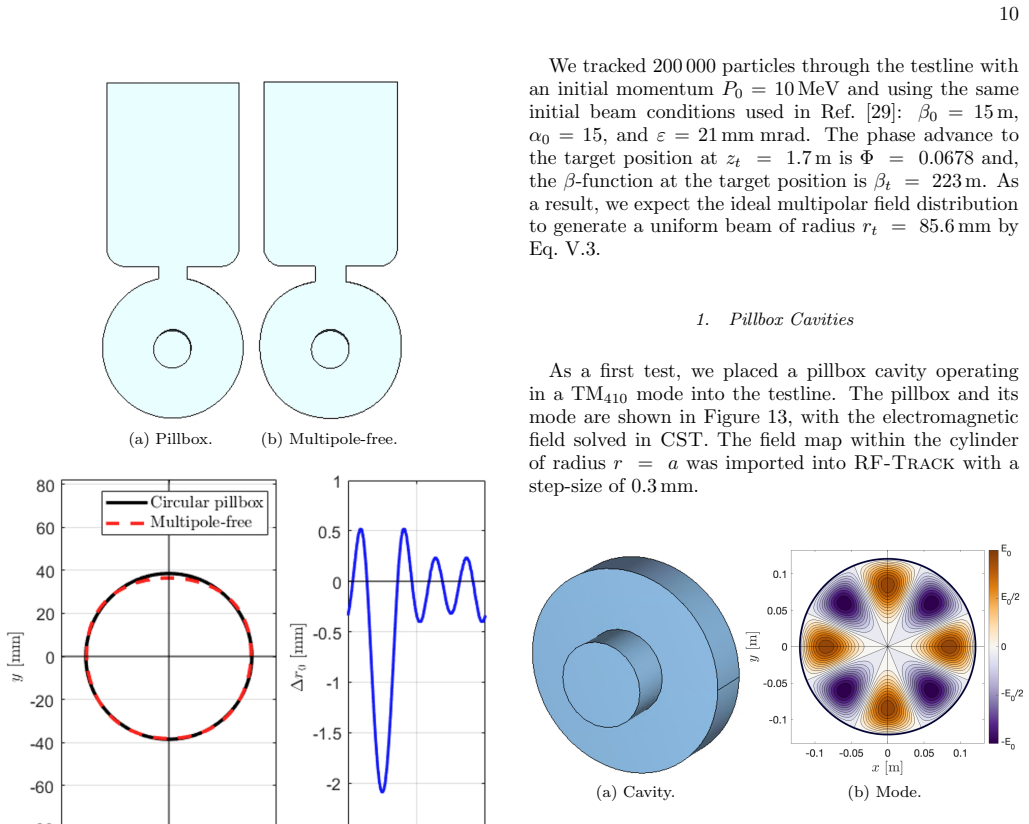
Pillbox Cavities As a first test, we placed a pillbox cavity operating in a TM 410 mode into the testline. The pillbox and its mode are shown in Figure 13, with the electromagnetic field solved in CST. The field map within the cylinder of radius r = a was imported into RF-Track with a step-size of 0 .3 mm. (a) Cavity. (b) Mode. FIG. 13. The azimuthally mo...
-
[2]
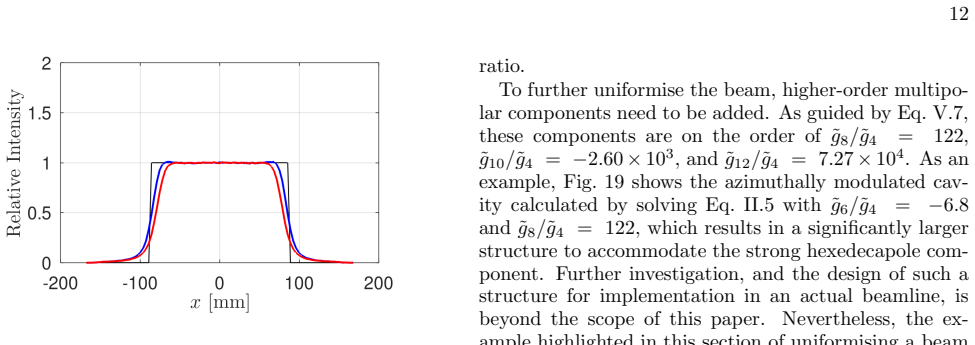
Azimuthally Modulated Cavities Taking the previous result, we solve Eq. II.5 with the optimised ratio ˜g6/˜g4=−6.68 to design an azimuthally modulated cavity that supports a 3 GHz TM{4,6}10 mode. The resultant structure and solved for mode are shown in Fig. 18. In the solved mode, we measure ˜ g6/˜g4 = 7 .10 which 12 FIG. 17. The horizontal distribution a...
-
[3]
E. Adli, R. Ruber, V. Ziemann, R. Corsini, A. Dubrovskiy, and I. Syratchev. x-band rf power production and deceleration in the two-beam test stand of the compact linear collider test facility. Phys. Rev. ST Accel. Beams, 14:081001, Aug 2011
work page 2011
-
[4]
I. V. Konoplev, Ya. Shashkov, A. Bulygin, M. A. Gusarova, and F. Marhauser. Ultimate energy recovery from spent relativistic electron beam in energy recovery linear accelerators. Phys. Rev. Accel. Beams, 23:071601, Jul 2020
work page 2020
-
[5]
B. H. Schaap and P. Musumeci. Tomography of longi- tudinal phase space linearization for the generation of attosecond electron bunches. Phys. Rev. Accel. Beams , 28:012802, Jan 2025
work page 2025
-
[6]
A. Castilla, R. Apsimon, G. Burt, X. Wu, A. Latina, X. Liu, I. Syratchev, W. Wuensch, B. Spataro, and A. W. Cross. Ka-band linearizer structure studies for a compact light source. Phys. Rev. Accel. Beams , 25:112001, Nov 2022
work page 2022
-
[7]
S. G. Anderson, P. Musumeci, J. B. Rosenzweig, W. J. Brown, R. J. England, M. Ferrario, J. S. Jacob, M. C. Thompson, G. Travish, A. M. Tremaine, and R. Yo- der. Velocity bunching of high-brightness electron beams. Phys. Rev. ST Accel. Beams , 8:014401, Jan 2005
work page 2005
-
[8]
Simone Di Mitri. Bunch Length Compressors. CERN Yellow Rep. School Proc., 1:363, 2018
work page 2018
-
[9]
M. Ikegami, S. Nakamura, Y. Iwashita, T. Shirai, H. Souda, Y. Tajima, M. Tanabe, H. Tongu, H. Itoh, H. Shintaku, et al. Radial focusing and energy compres- sion of a laser-produced proton beam by a synchronous rf field. Phys. Rev. ST Accel. Beams, 12:063501, Jun 2009
work page 2009
-
[10]
H. Hahn and H. J. Halama. Design of the deflector for the rf beam separator at the brookhaven ags. Review of Scientific Instruments, 36(12):1788–1796, 12 1965
work page 1965
-
[11]
M. McAshan and R. Wanzenberg. RF Design of a Trans- verse Mode Cavity for Kaon Separation. Technical re- port, Fermi National Accelerator Lab. (FNAL), 3 2001
work page 2001
-
[12]
Xian-Cai Lin, Hao Zha, Jiaru Shi, Liu-Yuan Zhou, Shuang Liu, Jian Gao, and Huai-Bi Chen. Development of a seven-cell s-band standing-wave rf-deflecting cavity for tsinghua thomson scattering x-ray source. Nuclear Science and Techniques, 32:36, 04 2021
work page 2021
-
[13]
P. Craievich, M. Bopp, H.-H. Braun, A. Citterio, R. For- tunati, R. Ganter, T. Kleeb, F. Marcellini, M. Pedrozzi, E. Prat, et al. Novel x-band transverse deflection struc- ture with variable polarization. Phys. Rev. Accel. Beams, 23:112001, Nov 2020
work page 2020
-
[14]
P. Emma, Z. Huang, K.-J. Kim, and P. Piot. Transverse- to-longitudinal emittance exchange to improve perfor- mance of high-gain free-electron lasers. Phys. Rev. ST Accel. Beams, 9:100702, Oct 2006
work page 2006
-
[15]
N. Majernik, G. Andonian, W. Lynn, S. Kim, C. Lorch, R. Roussel, S. Doran, E. Wisniewski, C. Whiteford, P. Piot, J. Power, and J. B. Rosenzweig. Beam shap- ing using an ultrahigh vacuum multileaf collimator and emittance exchange beamline. Phys. Rev. Accel. Beams, 26:022801, Feb 2023
work page 2023
-
[16]
M. Borland. Simulation and analysis of using deflecting cavities to produce short x-ray pulses with the advanced photon source. Phys. Rev. ST Accel. Beams , 8:074001, Jul 2005
work page 2005
-
[17]
H Ghasem, G H Luo, and A Mohammadzadeh. Utiliza- tion of transverse deflecting rf cavities in the designed qba lattice of 3 gev taiwan photon source. Journal of Instrumentation, 5(01):T01001, jan 2010
work page 2010
-
[18]
R. B. Palmer. Energy Scaling, Crab Crossing, and the Pair Problem. eConf, C8806271:613–619, 1988
work page 1988
-
[19]
Coupled beam motion in a storage ring with crab cavities
Xiaobiao Huang. Coupled beam motion in a storage ring with crab cavities. Phys. Rev. Accel. Beams, 19:024001, Feb 2016
work page 2016
-
[20]
A. Grudiev. Radio frequency quadrupole for landau damping in accelerators. Phys. Rev. ST Accel. Beams , 17:011001, Jan 2014
work page 2014
- [21]
-
[22]
L. M. Wroe, S. L. Sheehy, and R. J. Apsimon. Creat- ing exact multipolar fields with azimuthally modulated rf cavities. Phys. Rev. Accel. Beams, 25:062001, Jun 2022
work page 2022
-
[23]
M. S. Chae, J. H. Hong, Y. W. Parc, In Soo Ko, S. J. Park, H. J. Qian, W. H. Huang, and C. X. Tang. Emit- tance growth due to multipole transverse magnetic modes in an rf gun. Phys. Rev. ST Accel. Beams, 14:104203, Oct 2011
work page 2011
-
[24]
R. Akre, D. Dowell, P. Emma, J. Frisch, S. Gilevich, G. Hays, Ph. Hering, R. Iverson, C. Limborg-Deprey, H. Loos, A. Miahnahri, J. Schmerge, J. Turner, J. Welch, W. White, and J. Wu. Commissioning the linac coher- ent light source injector. Phys. Rev. ST Accel. Beams , 14 11:030703, Mar 2008
work page 2008
-
[25]
Reduction of multipole fields in photocathode rf gun
Sungik Moon, Juho Hong, Yongwoon Parc, Moohyun Cho, Won Namkung, In Soo Ko, and Sung-Ju Park. Reduction of multipole fields in photocathode rf gun. Japanese Journal of Applied Physics, 49(8R):086401, aug 2010
work page 2010
-
[26]
J.B. Rosenzweig, A. Cahill, B. Carlsten, G. Castorina, M. Croia, C. Emma, A. Fukusawa, B. Spataro, D. Alesini, V. Dolgashev, et al. Ultra-high brightness electron beams from very-high field cryogenic radiofrequency photocath- ode sources. Nuclear Instruments and Methods in Physics Research Section A: Accelerators, Spectrometers, De- tectors and Associated...
work page 2018
-
[27]
Zijian Zhou, Keyan Sheng, Zhenyi Zhang, Mianzhi Xiong, Haozhe Li, and Jiang Huang. Tunable and compact permanent magnet uniform spreading beamline for electron irradiation accelerators. Phys. Rev. Accel. Beams, 26:092402, Sep 2023
work page 2023
- [28]
-
[29]
Y. Zhao, A. Latina, and Doebert S. Update of the clic positron source. In Proceedings of the International Workshop on Future Linear Colliders (LCWS2023) . Lin- ear Collider Collaboration, 2023. Accessed: April 10, 2025
work page 2023
-
[30]
The Deep Electron FLASH Therapy facility
Carlo Rossi et al. The Deep Electron FLASH Therapy facility. JACoW, LINAC2024:WEYA002, 2024
work page 2024
-
[31]
Uniformization of the transverse beam profile by means of nonlinear focusing method
Yosuke Yuri, Nobumasa Miyawaki, Tomihiro Kamiya, Watalu Yokota, Kazuo Arakawa, and Mitsuhiro Fukuda. Uniformization of the transverse beam profile by means of nonlinear focusing method. Phys. Rev. ST Accel. Beams, 10:104001, Oct 2007
work page 2007
-
[32]
W. K. H. Panofsky and W. A. Wenzel. Some consid- erations concerning the transverse deflection of charged particles in radio-frequency fields. Review of Scientific Instruments, 27(11):967–967, 11 1956
work page 1956
- [33]
-
[34]
S.Y. Lee. Accelerator Physics. World Scientific, 4th edi- tion, 2018
work page 2018
-
[35]
L. M. Wroe. Novel hybrid multipolar RF cavities for transverse beam manipulations . PhD thesis, University of Oxford, 2022
work page 2022
-
[36]
Dan T. Abell. Numerical computation of high-order transfer maps for rf cavities.Phys. Rev. ST Accel. Beams, 9:052001, May 2006
work page 2006
-
[37]
Perry B. Wilson. Introduction to Wake Fields and Wake Potentials. AIP Conf. Proc., 184:525–564, 1989
work page 1989
-
[38]
The Panofsky-wenzel Theorem And General Relations For The wake Potential
S Vaganian and H Henke. The Panofsky-wenzel Theorem And General Relations For The wake Potential. Part. Accel., 48:239–242, 1995
work page 1995
-
[39]
An Introduc- tion to Wake Fields and Impedances
Martin Dohlus and Rainer Wanzenberg. An Introduc- tion to Wake Fields and Impedances. CERN Yellow Rep. School Proc., 3:15, 2017
work page 2017
-
[40]
CST Studio Suite. Cst microwave studio. https://www. cst.com, 2025. Version 2022
work page 2025
-
[41]
Wolfram Research, Inc. Mathematica, Version 14.2. Champaign, IL, 2024
work page 2024
-
[42]
Andrea Latina. Rf-track reference manual. Technical report, CERN, Geneva, Switzerland, 2024
work page 2024
-
[43]
Pierre M. Lapostolle and Albert L. Septier, editors. Lin- ear Accelerators. North Holland Publishing Company, Amsterdam, Netherlands, 1970
work page 1970
discussion (0)
Sign in with ORCID, Apple, or X to comment. Anyone can read and Pith papers without signing in.