REVIEW 4 major objections 7 minor 1 cited by
Implementation of Field Programmable Gate Arrays (FPGAs) in Extremely Cold Environments for Space and Cryogenic Computing Applications
T0 review · 4 major / 7 minor · reviewed 2026-08-16 · deepseek-v4-flash
Pith's one-line read Commercial CMOS FPGAs can operate at liquid-helium temperatures (4 K), with a comparator-based voltage regulator that cold-starts and holds ripple below 5 mV.
desk verdict Useful new 16 nm FinFET FPGA data at 77 K and a cold-starting comparator LDO, but the LDO's wide-range ripple claim outruns its own stability data and the abstract overstates jitter/transceiver results. read the letter →
The pith
A machine-rendered reading of the paper's core claim, the machinery that carries it, and where it could break.
The reading
What carries the argument
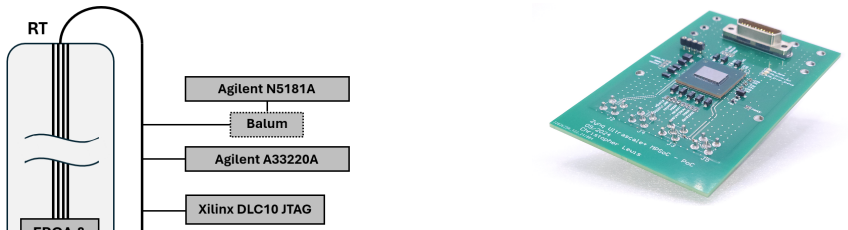
The load-bearing mechanism is a discrete low-dropout regulator built around a comparator IC (MCP6541T-E/OT) instead of an OpAmp, whose cold sensitivity prevented cold start in earlier designs. The comparator drives a pass transistor, and the output is stabilized by a filter network (R3, C, and a deliberately added metal-film resistor RESR) that sets the effective series resistance of the output capacitor; adjusting RESR keeps the regulator stable and ripple below 5 mV at 77 K. For FPGA characterization, the second key object is a 501-stage ring oscillator implemented in the programmable logic, used to measure LUT delay changes with temperature, plus the board-level choices (tantalum polymer/NP0 capacitors, metal-film resistors, no local flash or crystal) that remove known cold-failure points.
What would settle it
Cool a second Zynq Ultrascale+ board to 77 K, program the PS to exercise DDR, USB, GTR, and DMA while sweeping the LDO load from 0 to 900 mA with a fixed 220 mΩ RESR, and monitor for ripple above 5 mV or any PS lockup; either result would contradict the claimed cold operation and regulator stability.
Extended reading notes
Core claim
On its own terms, the paper's central claim is that standard commercial Xilinx FPGAs function at temperatures far below their specified range: the 28 nm Artix-7 is operated at 4 K and the 16 nm FinFET Zynq Ultrascale+ at 77 K, with all PS modules (ARM cores, I/O, DDR controller, gigabit transceivers, DMA) verified working at 77 K. Performance moves in the cold: INT supply power drops, AUX/IO static power rises, and measured LUT delay falls by 1.4% for the Artix-7 at 4 K and 6.5% for the Zynq at 77 K relative to room temperature. The paper also claims that replacing the OpAmp in a discrete LDO regulator with a comparator allows the regulator to power on from an off state while cold, and that tuning the capacitor's equivalent series resistance with a metal-film resistor reduces output ripple to under 5 mV (as low as 1.5 mV) over the tested 0–900 mA load range. The authors are careful to note that the ESR choice is load-dependent and that no single value works for every load case.
Load-bearing premise
The load-bearing premise is that a hand-picked ESR resistor value gives stable, low-ripple regulation for a chosen load and application; the paper demonstrates stability for specific load cases but does not provide a stability model or a fixed value covering all loads.
Editorial extensions
If this is right
- Artix-7-class FPGAs can be treated as usable at liquid-helium temperature, at least for low-power logic and transceiver operations, when clocks and programming come from room temperature.
- The 16 nm FinFET Zynq Ultrascale+ becomes a candidate for 77 K control and readout electronics, since its entire processing system was observed working, including the DDR controller with LPDDR3 memory.
- Cryogenic operation can improve speed: smaller LUT delays in the cold mean timing margins grow or the same logic can run at a higher clock rate after retiming.
- The comparator-based LDO can be powered on from cold, so local voltage regulation can be placed next to cryogenic FPGAs, reducing the number of room-temperature supplies and feedthroughs.
- Cooling-power limits (typically under 600 mW at 4 K) mean these devices fit best at 50–77 K stages; 4 K integration will require power-optimized or device-level cryogenic FPGAs.
Reading between the lines
- Inference: because no single RESR value worked for all loads, a practical deployment would need either a load-adaptive ESR network or a validated stability model; the paper does not supply that model.
- Inference: if the 77 K results replicate across units, spacecraft designers could relax thermal-control budgets, keeping FPGAs cold instead of heating them, provided radiation hardening is added.
- Inference: the different LUT-delay shifts (−1.4% at 4 K vs −6.5% at 77 K) hint that delay-versus-temperature curves are not monotone across all devices, so cryogenic timing models may need per-node characterization rather than a single correction factor.
Signed reviews
Editorial analysis
A structured set of objections, weighed in public.
Referee Report
Summary. The paper reports experimental demonstrations of commercial Xilinx FPGAs at deep-cryogenic temperatures: a 28-nm Artix-7 at 4 K and 77 K, and a 16-nm FinFET Zynq Ultrascale+ MPSoC at 77 K. The authors measure per-domain power, estimate LUT delay changes with a ring oscillator, and verify operation of the Zynq's processing-system modules. A second contribution is a discrete comparator-based low-dropout voltage regulator that cold-starts and whose output ripple is characterized as a function of load current and ESR tuning resistance. The paper concludes with a discussion of the results and their implications for cryogenic and space computing.
Significance. If the measurements are reliable, the demonstration of a 16-nm FinFET MPSoC with all tested PS modules operational at 77 K is a useful empirical data point for cryogenic control/readout and space electronics. The comparator-based LDO's ability to start from cold and provide regulated rails down to 0.6 V is also of practical interest. The paper's main value is in its system-level cold-characterization data and design-guidance examples; however, the current presentation overstates the scope of the LDO's ripple specification and includes abstract claims (jitter, transceiver performance) that are not backed by reported measurements, so the claims must be narrowed or supplemented before the paper can be accepted.
major comments (4)
- [Section III-C] The claim that output ripple was reduced to less than 5 mV and as low as 1.5 mV across the load current range 0 to 900 mA is not supported for a single regulator configuration. The text states that no single value of RESR was found sufficient for all output load cases, and Fig. 6 shows two separate plots for RESR = 680 mΩ (no load) and RESR = 220 mΩ (loads above 50 mA). The 0-900 mA ripple specification is therefore the union of two different compensation settings, not a characteristic of one fixed design. This distinction is load-bearing because the LDO is a central contribution, and the abstract's statement that 'general operating conditions for voltage regulators are widened' is stronger than what the data show. Please revise to clearly state that ripple below 5 mV is achieved only when RESR is switched with load, or present a design rule for choosing a single RESR for a specified load range, including a stability analysis.
- [Abstract and Section III] The abstract claims improved jitter performance and enhanced transceiver performance at extremely low temperatures, but the Results section contains no jitter measurements, eye diagrams, bit-error-rate data, or any transceiver performance characterization. The only performance metrics reported are power, LUT delay changes, and LDO-regulator parameters. Either add the missing measurements to support the abstract claims, or revise the abstract to describe only the metrics actually reported, such as reduced LUT delays and active LDO regulation at low temperatures.
- [Table I] The LUT Delay Change and LUT Spread Change rows are ambiguous: the table has five temperature columns (Artix-7 at 4/77/295 K and Zynq at 77/295 K), but only three numerical entries appear in each of those rows, and the Artix-7 4 K entry is cited from reference [9] rather than being measured in this work. This makes it impossible to separate measured from literature values and leaves unclear whether the Zynq entries are missing or included. Please reformat the table so every device/temperature combination has a clear entry (or a dash for 'not measured') and explicitly mark which values are from this work versus from [9].
- [Section III-B] The quantitative performance claims, such as LUT delay changes of -1.1% to -6.5% and power numbers in Table I, are presented without error bars, repeated trials, or any statement of measurement repeatability. Since these are single-point measurements on presumably one unit per device, the reader cannot assess whether the reported differences are significant relative to measurement noise or process variation. Please add at least the number of trials/devices and an uncertainty estimate, or temper the precision of the claims accordingly.
minor comments (7)
- [Section II-A] The word 'balum' should be 'balun'.
- [Section II-B] The phrase 'output rippage' should be 'output ripple'.
- [Section IV] There are grammatical errors, including 'it’s predecessors' (should be 'its predecessors') and the sentence beginning 'with there being attention most recently on the optimization at the device level', which should be rewritten.
- [Section III-A] The sentence 'In these tests, failures owing to the board’s on-board voltage regulators were seen early at 77 K within liquid nitrogen submersion within these regulated voltages deviating as far as 35% from nominal' is difficult to follow; please split it into two sentences.
- [Section III-C] The rise-time description says 'an approximate slew rate of 539 mV/ms is observed and seen consistent for a target voltage of 1.8 V'; it is unclear whether 539 mV/ms refers to the 600 mV case, the 1.8 V case, or all cases. Please clarify.
- [Fig. 6] The figure caption lists RESR = 220 mΩ as (a) and RESR = 680 mΩ as (b), but the text indicates 680 mΩ is for no load and 220 mΩ for higher loads; consider making the figure order consistent with the discussion in the text.
- [Section II-A] The paper does not state how the FPGA body temperature was measured or verified during submersion; adding a sentence about the temperature sensor or calibration method would strengthen the experimental description.
Circularity Check
No circularity: the paper reports direct cryogenic FPGA and LDO measurements; the LDO tuning limitation is a scope issue, not a derivation that assumes its conclusion.
full rationale
This paper is an experimental demonstration, not a derivation. The central claims—Artix-7 operation at 4 K, Zynq Ultrascale+ PS/PL operation at 77 K, reduced LUT delays, and comparator-based LDO cold-start behavior—are supported by direct measurements reported in Tables I-II and Figures 5-10. There is no fitted parameter that is later renamed as a prediction, no mathematical derivation that reduces to its inputs, and no load-bearing self-citation: the cited prior works are external studies used for context and comparison, and the paper's one comparative percentage change is explicitly anchored to an external reference [9]. The potentially misleading LDO claim (output ripple below 5 mV across 0-900 mA achieved only by switching between 680 mOhm and 220 mOhm RESR values, with no single value for all loads) is a validity or generalization limitation, not circularity. The paper itself concedes this in Section IV, stating that stable solutions 'were found experimentally and vary by multiple factors such as load capacity and current' and that 'further modeling and stability analysis are warranted.' That admission weakens the breadth of the regulator claim but does not make any result equivalent to its own inputs by construction. No circular step is present.
Assumptions & free parameters
free parameters (1)
- RESR (LDO ESR tuning resistor) =
220 mΩ for load > 50 mA; 680 mΩ for no load
assumptions (2)
- domain assumption Ring oscillator delay is a valid proxy for LUT combinational logic delay.
- domain assumption Remote powering and external clocking do not significantly alter measured FPGA behavior relative to onboard regulation and oscillators.
Cite this review
Pith. "Pith review of Implementation of Field Programmable Gate Arrays (FPGAs) in Extremely Cold Environments for Space and Cryogenic Computing Applications." pith.science (2026). https://pith.science/paper/WEVNAMEB
@misc{pith2026250413305,
  author       = {Pith},
  title        = {Pith review of: Implementation of Field Programmable Gate Arrays (FPGAs) in Extremely Cold Environments for Space and Cryogenic Computing Applications},
  year         = {2026},
  howpublished = {\url{https://pith.science/paper/WEVNAMEB}},
  note         = {Machine review of arXiv:2504.13305}
}
read the original abstract
The operation of CMOS Field Programmable Gate Arrays (FPGAs) at extremely cold environments as low as 4 K is demonstrated. Various FPGA and periphery hardware design techniques spanning from HDL design to improvements of peripheral circuitry such as discrete voltage regulators are displayed, and their respective performances are reported. While general operating conditions for voltage regulators are widened, FPGAs see a broader temperature range with improved jitter performance, reduced LUT delays, and enhanced transceiver performance at extremely low temperatures.
Figures


Figures from the paper (4 more)


Forward citations
Cited by 1 Pith paper
-
Stream Decoding with Confidence Scores at Room and Cryogenic Temperatures
A streaming surface-code decoder called Snowflake runs on commercial FPGAs with sub-microsecond simulated throughput up to distance 21, validated in hardware up to distance 9 at room and cryogenic temperatures.
Reference graph
Works this paper leans on
-
[9]
Performance characterization of Altera and Xilinx 28 nm FPGAs at cryogenic temperatures,
H. Homulle and E. Charbon, “Performance characterization of Altera and Xilinx 28 nm FPGAs at cryogenic temperatures,” in 2017 International Conference on Field Programmable Technology (ICFPT), Dec. 2017, pp. 25–31. doi: 10.1109/FPT.2017.8280117
arXiv 2017
-
[1]
An FPGA-based instrumentation platform for use at deep cryogenic temperatures,
I. D. Conway Lamb et al., “An FPGA-based instrumentation platform for use at deep cryogenic temperatures,” Review of Scientific Instruments, vol. 87, no. 1, p. 014701, Jan. 2016, doi: 10.1063/1.4939094
-
[2]
A reconfigurable cryogenic platform for the classical control of quantum processors,
H. Homulle et al., “A reconfigurable cryogenic platform for the classical control of quantum processors,” Review of Scientific Instruments, vol. 88, no. 4, p. 045103, Apr. 2017, doi: 10.1063/1.4979611
-
[3]
Cryogenic Characterization of Commercial Devices for Application of Quantum Computing Electronics,
Z. Jin, X. Wang, F. Liang, and C.-Z. Peng, “Cryogenic Characterization of Commercial Devices for Application of Quantum Computing Electronics,” in 2022 IEEE 65th International Midwest Symposium on Circuits and Systems (MWSCAS), Aug. 2022, pp. 1–5. doi: 10.1109/MWSCAS54063.2022.9859526
-
[4]
An FPGA-Based Quench Detector and Data Acquisition System for Superconducting Insertion Devices,
C.-Y. Wu et al., “An FPGA-Based Quench Detector and Data Acquisition System for Superconducting Insertion Devices,” IEEE Transactions on Applied Superconductivity, vol. 28, no. 3, pp. 1–5, Apr. 2018, doi: 10.1109/TASC.2018.2798634
arXiv 2018
-
[5]
Digital Output Data Links From Superconductor Integrated Circuits,
D. Gupta et al., “Digital Output Data Links From Superconductor Integrated Circuits,” IEEE Transactions on Applied Superconductivity, vol. 29, no. 5, pp. 1–8, Aug. 2019, doi: 10.1109/TASC.2019.2910469
arXiv 2019
-
[6]
Y. Xu et al., “QubiC: An Open-Source FPGA-Based Control and Measurement System for Superconducting Quantum Information Processors,” IEEE Transactions on Quantum Engineering, vol. 2, pp. 1–11, 2021, doi: 10.1109/TQE.2021.3116540
arXiv 2021
-
[7]
A Configurable Ring-Oscillator-Based PUF for Xilinx FPGAs,
X. Xin, J.-P. Kaps, and K. Gaj, “A Configurable Ring-Oscillator-Based PUF for Xilinx FPGAs,” in 2011 14th Euromicro Conference on Digital System Design, Aug. 2011, pp. 651–657. doi: 10.1109/DSD.2011.88
Show all 12 references
-
[8]
Robust, low-cost, and accurate detection of recycled ICs using digital signatures,
M. Alam, S. Chowdhury, M. M. Tehranipoor, and U. Guin, “Robust, low-cost, and accurate detection of recycled ICs using digital signatures,” in 2018 IEEE International Symposium on Hardware Oriented Security and Trust (HOST), Apr. 2018, pp. 209–214. doi: 10.1109/HST.2018.8383917
2018
-
[10]
Break the Cold Barrier: An In-Depth Study on FPGA Performance and Design Optimization At Cryogenic Temperature,
Z. Jiang, M. Zhang, and Q. Liu, “Break the Cold Barrier: An In-Depth Study on FPGA Performance and Design Optimization At Cryogenic Temperature,” Integrated Circuits and Systems, pp. 1–8, 2024, doi: 10.23919/ICS.2024.3499944
2024
-
[11]
write newline
" write newline "" initialize.prev.this.status FUNCTION begin.bib " write newline preamble empty 'skip preamble write newline if " thebibliography " longest.label * " " * write newline " [1] #1 " write newline " url@samestyle " write newline " " write newline " [2] #2 " write ...
-
[12]
Information Markings Guidance: Markings for GOMACTech Papers
11em plus .33em minus .07em 4000 4000 100 4000 4000 500 `\.=1000 = #1 \@IEEEnotcompsoconly \@IEEEcompsoconly #1 * [1] 0pt [0pt][0pt] #1 * [1] 0pt [0pt][0pt] #1 * \| ** #1 \@IEEEauthorblockNstyle \@IEEEcompsocnotconfonly \@IEEEauthorblockAstyle \@IEEEcompsocnotconfonly \@IEEEco...
2023
Reviewed August 16, 2026 · model on record in the stance chip above.
Discussion (0). Continue with ORCID to comment.