REVIEW 3 major objections 5 minor 37 references
Active Learning of Computer Experiment with both Quantitative and Qualitative Inputs
T0 review · 3 major / 5 minor · reviewed 2026-08-16 · deepseek-v4-flash
Pith's one-line read Adaptive designs beat one-shot designs for mixed-input computer experiments.
desk verdict A useful survey plus a modest, plausible first application of prediction-oriented acquisition to mixed inputs, but the empirical case needs error bars and a sensitivity check on the discrete candidate set. read the letter →
The pith
A machine-rendered reading of the paper's core claim, the machinery that carries it, and where it could break.
The reading
What carries the argument
The central object is the EzGP (easy-to-interpret Gaussian process) model, which writes the response as a constant mean plus an overall Gaussian process on the quantitative inputs plus a separate Gaussian process for each level of each qualitative factor, with multiplicative correlation between the qualitative and quantitative parts. This surrogate supplies the predictive mean $\hat{\mu}(w)$ and predictive variance $\hat{\sigma}^2(w)$ that every acquisition criterion consumes. The carrying mechanisms are the acquisition criteria: expected improvement for optimization and contours, lower and upper confidence bounds, the adaptive-region ARSD rule, the region-based cooperative RCC rule that splits the space into confident and uncertain zones, and the EI-MC and EI-SC criteria for prediction, each of which selects the next simulator run by maximizing a goal-specific score. The numerical comparisons then quantify how many simulation runs each criterion saves relative to a one-shot design.
What would settle it
Rerun the three examples with candidate sets of size 10, 100, and 1000 random Latin hypercube points per qualitative level, and also with a continuous optimizer for the quantitative coordinates; if one-shot designs match or beat the adaptive criteria as the candidate set grows, then the paper's superiority claim is an artifact of the coarse search grid rather than a property of the criteria.
Extended reading notes
Core claim
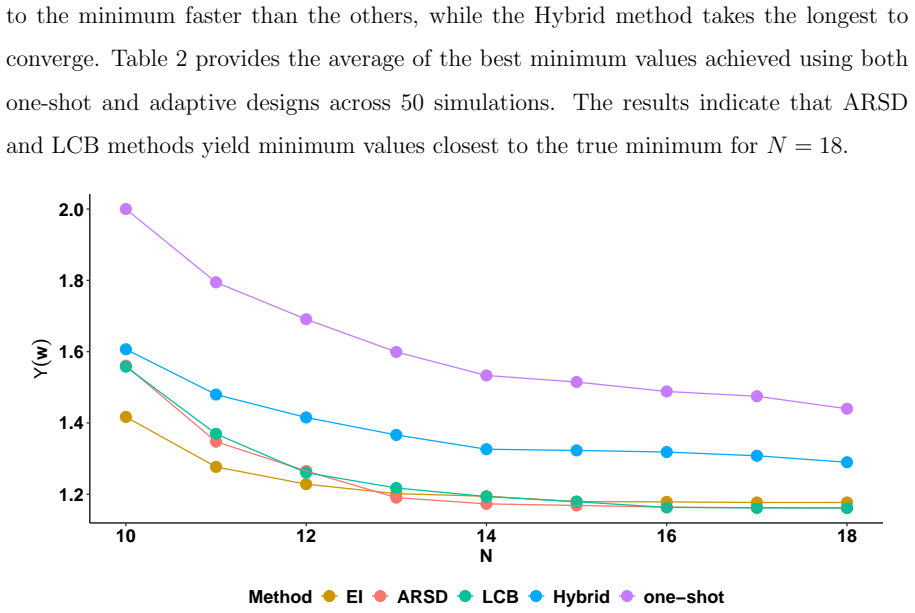
The paper's central claim is that active learning is both feasible and beneficial when the input space mixes continuous quantitative variables with discrete qualitative factors, provided the surrogate is an EzGP model that decomposes the response into an overall Gaussian process plus level-specific Gaussian processes for each qualitative factor. For optimization, the EI, LCB, ARSD, and Hybrid criteria all approach the true minimum more closely than one-shot designs in three test functions, with the best method varying by example. For contour estimation, the RCC, EI-C, ECL, ARSD-C, and LCB-C criteria improve contour accuracy, measured by MC0, the mean absolute prediction error on points near the contour, over one-shot designs in almost all settings, with RCC and ARSD-C being substantially faster. For prediction, the EI-MC and EI-SC criteria, originally proposed for quantitative-only inputs, yield lower log RMSE than one-shot designs. The paper's concluding statement is that adaptive designs outperform one-shot designs for prediction in mixed-input experiments, and it leaves the development of dedicated prediction criteria for mixed inputs as an open problem.
Load-bearing premise
The reported advantage of adaptive designs over one-shot designs assumes that maximizing each acquisition criterion over 100 random Latin hypercube candidates per qualitative level combination finds essentially the same input as maximizing over the whole design space.
Editorial extensions
If this is right
- Practitioners with expensive mixed-input simulators can spend the same budget adaptively and expect better optimization, contour, and prediction accuracy than a one-shot space-filling design.
- Quantitative-only criteria such as EI-MC and EI-SC transfer to mixed inputs when paired with an EzGP surrogate, giving lower RMSE than one-shot designs in all three examples.
- For contour estimation, RCC and ARSD-C match or beat entropy-based and expected-improvement alternatives while requiring much less computation time.
- No single optimization criterion dominates: EI converges fastest in one example, ARSD and LCB are best at the final budget in another, and Hybrid is best in the highest-dimensional example.
- The main practical cost shifts to model fitting and criterion evaluation, so faster parameter estimation for mixed-input Gaussian process models would widen the applicability of these adaptive designs.
Reading between the lines
- Editorial inference: because each acquisition step searches a fixed set of 100 random Latin hypercube candidates per qualitative level, the reported gains are demonstrated against that grid, not against a true continuous maximizer; denser or differently generated grids could change the ranking.
- Editorial inference: replacing the random candidate grid with a continuous optimizer on the quantitative coordinates inside each qualitative level could reduce the computational cost the paper identifies as an open challenge, and would directly test whether the candidate-grid approximation is the bottleneck.
- Editorial inference: the same EI-MC and EI-SC prediction machinery could be pointed at related mixed-input goals such as probability-of-failure estimation or simultaneous estimation of several contours, which the paper does not examine.
Signed reviews
Editorial analysis
A structured set of objections, weighed in public.
Referee Report
Summary. This manuscript reviews active learning and adaptive design methods for computer experiments with mixed quantitative and qualitative inputs. It describes the EzGP surrogate model, surveys adaptive design criteria for optimization (EI, LCB, ARSD, Hybrid), contour estimation (RCC, EI-C, ECL, ARSD-C, LCB-C), and prediction (EI-MC, EI-SC), and reports numerical studies on three test functions with 50 simulations each, comparing adaptive designs against one-shot space-filling designs. The central empirical claim is that adaptive designs outperform one-shot designs for optimization, contour estimation, and prediction. Code and examples are made available in a GitHub repository.
Significance. If the empirical claims hold, the paper provides useful practical guidance for practitioners who need to allocate limited simulation budgets in experiments with mixed inputs: the adaptive criteria, used with the EzGP emulator, can yield substantially better optimization, contour, and prediction accuracy per run than one-shot designs. The manuscript is also valuable as a review of recent developments in this area. Strengths include the breadth of methods compared, the use of 50 replications on several test functions, and the public code repository. The reported computational times provide useful practical information. However, the main comparisons currently lack uncertainty quantification, and the acquisition-optimization step is based on a fixed finite candidate set whose adequacy is not examined; these issues affect the strength of the central claim.
major comments (3)
- [Section 4, first paragraph; Section 5] The numerical studies select the next input by maximizing each acquisition criterion over a finite candidate set consisting of all qualitative level combinations crossed with 100 random Latin hypercube points per level. The paper itself concedes in Section 5 that this is only an approximation to the true maximizer and that the problem of finding optimal inputs for adaptive designs with mixed inputs is 'an open and critical challenge'. Because the reported superiority of adaptive designs over one-shot designs is entirely based on this approximation, the central empirical claim is not fully supported unless the approximation is shown to be adequate. Please provide a sensitivity analysis with respect to the number of candidate points per level (e.g., 100, 200, 500, 1000) or compare against a continuous optimizer for the quantitative dimensions, and report how the relative efficiencies in Tables 4, 6, and 8 change. Without this, the magnitude of the reported advantages, including the 823-fold improvement in Table 4, is difficult to interpret.
- [Tables 1-4, 6, 8; Figures 6-8] All performance summaries are reported as averages over 50 simulations without standard errors, confidence intervals, or any measure of variability. Many of the claimed advantages rely on very small MC0 values, such as the values in Table 4 at N=17 and N=19, where relative efficiencies of 412, 823, or 364 are computed from averages that may be dominated by a few simulations or by numerical noise. Please report standard errors or confidence intervals, and ideally paired comparisons between methods, so that the reader can assess whether the differences are statistically meaningful. This is also needed for the prediction comparisons in Figures 6-8, where the boxplots are not accompanied by numeric summaries.
- [Section 4.2, especially Tables 4, 6, 8; Section 3.2] The contour-estimation comparisons depend on tuning parameters epsilon and delta, which are chosen separately for each example, and the text states that epsilon should be 'carefully chosen based on the complexity of the response function'. The RCC method in particular relies on delta, and the recommended value comes from the authors' prior work. No sensitivity analysis is provided for these choices, so it is unclear whether the relative performance of RCC is robust to the 'neither too large nor too small' recommendation in Section 3.2. Please add a small sensitivity study for epsilon and delta, or provide a principled data-driven rule for setting them, so that the comparisons are not tied to example-specific tuning.
minor comments (5)
- [Section 4.3, Figures 6-8] There is an inconsistency between the budget sizes stated in the text and those given in the figure captions: Example 1 is described with N={15,21} but Figure 6 says N=30; Example 2 is described with N={30,40} but Figure 7 says N=40; Example 3 is described with N={80,100} but Figure 8 says N=100. Please make these consistent and explain which values are being plotted.
- [Section 2.2.3] The sentence beginning 'The values of ymin and ymax are unknown contours in general but it can be estimated by a large input from the design domain. They suggest, 1000p design points.' is grammatically awkward and unclear; please rewrite and give the precise reference for the 1000p recommendation.
- [Section 4.2] The sentence 'It is important to note that the same dataset is utilized for approximating multiple contours in the EI-MC method described in (21)' appears in the contour-estimation section, but EI-MC is described in Section 2.2.3 as a prediction method. This cross-reference is confusing and should be clarified.
- [Throughout] Several equations and algorithms contain formatting artifacts that make them hard to read, for example 'Dn+1 =Dn S(wn+1,yn+1)' in Algorithm 2 and the union symbol appearing as the letter S. Please check the compiled version of the manuscript.
- [Section 1, Abstract] The abstract says the paper 'propose[s] active learning approaches', but for prediction the manuscript applies existing EI-MC and EI-SC criteria to mixed inputs rather than proposing new criteria. The wording could more accurately distinguish the proposed/reviewed contributions from the transferred criteria.
Circularity Check
No significant circularity; empirical claims are benchmarked against external test functions and one-shot designs.
full rationale
The paper's central claim is that adaptive designs outperform one-shot space-filling designs for optimization, contour estimation, and prediction with mixed quantitative/qualitative inputs. That claim is not circular: the optimized criteria (EI, LCB, ARSD, Hybrid, RCC, ECL, EI-MC, EI-SC) are defined from predictive means and variances of the EzGP surrogate, and the reported gains are computed numerically on analytic test functions against one-shot random LHD baselines in Tables 1–4, 6, and 8 and Figures 3–8. No fitted parameter is renamed as a prediction, and no equation reduces to its own input by construction. There is a mild self-referential element in the contour-estimation section: RCC is the authors' own method from Shahrokhian et al. (2024), the evaluation metric MC0 is taken from that same prior paper, and the delta value is chosen as 'the recommended value suggested by Shahrokhian et al. (2024)'. This is a real self-citation, but it is not load-bearing circularity because the comparison is resolved by the simulated MC0 values rather than by the citation itself; the prior work does not assert the numerical outcomes reported here. Similarly, the paper applies EI-MC and EI-SC from Yang et al. (2020) to mixed inputs; these are external prior criteria, not definitions of the paper's own conclusion. The candidate-set discretization in Section 4 (all qualitative level combinations crossed with 100 random LHD points) is a limitation openly acknowledged in Section 5 as 'an open and critical challenge for further research', but approximation error in maximizing an acquisition criterion is not circularity. Overall, the derivation chain is self-contained against external benchmarks, so no circular step meeting the required 'specific reduction' standard is present.
Assumptions & free parameters
free parameters (4)
- rho (LCB/ARSD exploration weight) =
2
- delta (RCC balance parameter) =
0.05 (Example 1), 0.02 (Example 2), 0.1 (Example 3)
- epsilon (MC0 band width) =
0.05 (Examples 1-2), 0.1 (Example 3)
- c (number of contours in EI-MC) =
10
assumptions (3)
- domain assumption The EzGP model with additive qualitative structure and Gaussian correlation adequately approximates the test simulators.
- domain assumption The predictive distribution of the simulator output at unsampled points is Gaussian with the plug-in mean and variance from the fitted GP.
- domain assumption A candidate set of 100 random Latin hypercube points per qualitative level combination is sufficient to approximate the true maximizer of the acquisition function over the continuous input space.
Cite this review
Pith. "Pith review of Active Learning of Computer Experiment with both Quantitative and Qualitative Inputs." pith.science (2026). https://pith.science/paper/T63VTSE7
@misc{pith2026250413441,
  author       = {Pith},
  title        = {Pith review of: Active Learning of Computer Experiment with both Quantitative and Qualitative Inputs},
  year         = {2026},
  howpublished = {\url{https://pith.science/paper/T63VTSE7}},
  note         = {Machine review of arXiv:2504.13441}
}
read the original abstract
Computer experiments refer to the study of real systems using complex simulation models. They have been widely used as alternatives to physical experiments. Design and analysis of computer experiments have attracted great attention in past three decades. The bulk of the work, however, often focus on experiments with only quantitative inputs. In recent years, research on design and analysis for computer experiments have gain momentum. Statistical methodology for design, modeling and inference of such experiments have been developed. In this chapter, we review some of those key developments, and propose active learning approaches for modeling, optimization, contour estimation of computer experiments with both types of inputs. Numerical studies are conducted to evaluate the performance of the proposed methods in comparison with other existing methods.
Figures


Figures from the paper (5 more)


Reference graph
Works this paper leans on
-
[1]
Using confidence bounds for exploitation-exploration trade-offs
Peter Auer. Using confidence bounds for exploitation-exploration trade-offs. Journal of Machine Learning Research, 3: 0 397--422, 2002
work page 2002
-
[2]
Sequential design of computer experiments for the estimation of a probability of failure
Julien Bect, David Ginsbourger, Ling Li, Victor Picheny, and Emmanuel Vazquez. Sequential design of computer experiments for the estimation of a probability of failure. Statistics and Computing, 22: 0 773--793, 2012
work page 2012
-
[3]
Xia Cai, Li Xu, C Devon Lin, Yili Hong, and Xinwei Deng. Adaptive-region sequential design with quantitative and qualitative factors in application to HPC configuration. Journal of Quality Technology, 56 0 (1): 0 5--19, 2024
work page 2024
-
[4]
Moana: Modeling and analyzing I/O variability in parallel system experimental design
Kirk W Cameron, Ali Anwar, Yue Cheng, Li Xu, Bo Li, Uday Ananth, Jon Bernard, Chandler Jearls, Thomas Lux, Yili Hong, et al. Moana: Modeling and analyzing I/O variability in parallel system experimental design. IEEE Transactions on Parallel and Distributed Systems, 30 0 (8): 0 1843--1856, 2019
work page 2019
-
[5]
Rob Carnell. Latin Hypercube Samples. R Foundation for Statistical Computing, 2022. URL https://cran.r-project.org/package=lhs
work page 2022
-
[6]
Entropy-based adaptive design for contour finding and estimating reliability
D Austin Cole, Robert B Gramacy, James E Warner, Geoffrey F Bomarito, Patrick E Leser, and William P Leser. Entropy-based adaptive design for contour finding and estimating reliability. Journal of Quality Technology, 55 0 (1): 0 43--60, 2023
work page 2023
-
[7]
Additive Gaussian process for computer models with qualitative and quantitative factors
X Deng, C Devon Lin, K-W Liu, and RK Rowe. Additive Gaussian process for computer models with qualitative and quantitative factors. Technometrics, 59 0 (3): 0 283--292, 2017
work page 2017
-
[8]
Design for computer experiments with qualitative and quantitative factors
Xinwei Deng, Ying Hung, and C Devon Lin. Design for computer experiments with qualitative and quantitative factors. Statistica Sinica, 25: 0 1567--1581, 2015
work page 2015
Show all 37 references
-
[9]
Surrogates: Gaussian process modeling, design, and optimization for the applied sciences
Robert B Gramacy. Surrogates: Gaussian process modeling, design, and optimization for the applied sciences . Chapman and Hall/CRC, 2020
2020
-
[10]
Prediction for computer experiments having quantitative and qualitative input variables
Gang Han, Thomas J Santner, William I Notz, and Donald L Bartel. Prediction for computer experiments having quantitative and qualitative input variables. Technometrics, 51 0 (3): 0 278--288, 2009
2009
-
[11]
On construction of marginality coupled designs
Yuanzhen He, C Devon Lin, and Fasheng Sun. On construction of marginality coupled designs. Statistica Sinica, 27: 0 665--683, 2017 a
2017
-
[12]
Marginally coupled designs for two-level qualitative factors
Yuanzhen He, C Devon Lin, Fasheng Sun, and Benjian Lv. Marginally coupled designs for two-level qualitative factors. Journal of Statistical Planning and Inference, 187: 0 103--108, 2017 b
2017
-
[13]
Predictive entropy search for efficient global optimization of black-box functions
Jos \'e Miguel Hern \'a ndez-Lobato, Matthew W Hoffman, and Zoubin Ghahramani. Predictive entropy search for efficient global optimization of black-box functions. Advances in Neural Information Processing Systems, 27, 2014
2014
-
[14]
Sliced orthogonal array-based Latin hypercube designs
Youngdeok Hwang, Xu He, and Peter ZG Qian. Sliced orthogonal array-based Latin hypercube designs. Technometrics, 58 0 (1): 0 50--61, 2016
2016
-
[15]
Efficient global optimization of expensive black-box functions
Donald R Jones, Matthias Schonlau, and William J Welch. Efficient global optimization of expensive black-box functions. Journal of Global Optimization, 13 0 (4): 0 455--492, 1998
1998
-
[16]
Bandit based Monte - Carlo planning
Levente Kocsis and Csaba Szepesv \'a ri. Bandit based Monte - Carlo planning. European Conference on Machine Learning, 282--293, 2006
2006
-
[17]
Devon Lin, and Xinwei Deng
Jiayi Li, Qian Xiao, Abhyuday Mandal, C. Devon Lin, and Xinwei Deng. Easy-to-Interpret Gaussian Process Models for Computer Experiments with Both Quantitative and Qualitative Factors . R Foundation for Statistical Computing, 2023. URL https://cran.r-project.org/package=EzGP
2023
-
[18]
Category tree Gaussian process for computer experiments with many-category qualitative factors and application to cooling system design
Wei-Ann Lin, Chih-Li Sung, and Ray-Bing Chen. Category tree Gaussian process for computer experiments with many-category qualitative factors and application to cooling system design. Journal of Quality Technology, 56 0 (5): 0 391--408, 2024
2024
-
[19]
Hybrid parameter search and dynamic model selection for mixed-variable Bayesian optimization
Hengrui Luo, Younghyun Cho, James W Demmel, Xiaoye S Li, and Yang Liu. Hybrid parameter search and dynamic model selection for mixed-variable Bayesian optimization. Journal of Computational and Graphical Statistics, 1--14, 2024
2024
-
[20]
A comparison of three methods for selecting values of input variables in the analysis of output from a computer code
Michael D McKay, Richard J Beckman, and William J Conover. A comparison of three methods for selecting values of input variables in the analysis of output from a computer code. Technometrics, 42 0 (1): 0 55--61, 1979
1979
-
[21]
Genetic Optimization Using Derivatives
Walter R Mebane, Jasjeet Singh Sekhon, and Theo Saarinen. Genetic Optimization Using Derivatives. R Foundation for Statistical Computing, 2011. URL https://cran.r-project.org/package=rgenoud
2011
-
[22]
Cross-validation--based adaptive sampling for Gaussian process models
Hossein Mohammadi, Peter Challenor, Daniel Williamson, and Marc Goodfellow. Cross-validation--based adaptive sampling for Gaussian process models. SIAM/ASA Journal on Uncertainty Quantification, 10 0 (1): 0 294--316, 2022
2022
-
[23]
Quantile-based optimization of noisy computer experiments with tunable precision
Victor Picheny, David Ginsbourger, Yann Richet, and Gregory Caplin. Quantile-based optimization of noisy computer experiments with tunable precision. Technometrics, 55 0 (1): 0 2--13, 2013
2013
-
[24]
Gaussian process models for computer experiments with qualitative and quantitative factors
Peter Z G Qian, Huaiqing Wu, and CF Jeff Wu. Gaussian process models for computer experiments with qualitative and quantitative factors. Technometrics, 50 0 (3): 0 383--396, 2008
2008
-
[25]
Sliced Latin hypercube designs
Peter ZG Qian. Sliced Latin hypercube designs. Journal of the American Statistical Association, 107 0 (497): 0 393--399, 2012
2012
-
[26]
Sequential experiment design for contour estimation from complex computer codes
Pritam Ranjan, Derek Bingham, and George Michailidis. Sequential experiment design for contour estimation from complex computer codes. Technometrics, 50 0 (4): 0 527--541, 2008
2008
-
[27]
Design and analysis of computer experiments
Jerome Sacks, William J Welch, Toby J Mitchell, and Henry P Wynn. Design and analysis of computer experiments. Statistical Science, 4 0 (4): 0 409--423, 1989
1989
-
[28]
Adaptive design for contour estimation from computer experiments with quantitative and qualitative inputs
Anita Shahrokhian, Xinwei Deng, C Devon Lin, Pritam Ranjan, and Li Xu. Adaptive design for contour estimation from computer experiments with quantitative and qualitative inputs. http://arxiv.org/abs/2504.05498, 2024
2024 arXiv
-
[29]
Gaussian process optimization in the bandit setting: No regret and experimental design
Niranjan Srinivas, Andreas Krause, Sham M Kakade, and Matthias Seeger. Gaussian process optimization in the bandit setting: No regret and experimental design. International Conference on Machine Learning, 2010
2010
-
[30]
EzGP : Easy-to-interpret Gaussian process models for computer experiments with both quantitative and qualitative factors
Qian Xiao, Abhyuday Mandal, C Devon Lin, and Xinwei Deng. EzGP : Easy-to-interpret Gaussian process models for computer experiments with both quantitative and qualitative factors. SIAM/ASA Journal on Uncertainty Quantification, 9 0 (2): 0 333--353, 2021
2021
-
[31]
Global fitting of the response surface via estimating multiple contours of a simulator
Feng Yang, C Devon Lin, and Pritam Ranjan. Global fitting of the response surface via estimating multiple contours of a simulator. Journal of Statistical Theory and Practice, 14: 0 1--21, 2020
2020
-
[32]
Doubly coupled designs for computer experiments with both qualitative and quantitative factors
Feng Yang, C Devon Lin, Yongdao Zhou, and Yuanzhen He. Doubly coupled designs for computer experiments with both qualitative and quantitative factors. Statistica Sinica, 33: 0 1923--1942, 2023
1923
-
[33]
Construction of sliced orthogonal Latin hypercube designs
Jian-Feng Yang, C Devon Lin, Peter ZG Qian, and Dennis KJ Lin. Construction of sliced orthogonal Latin hypercube designs. Statistica Sinica, 23: 0 1117--1130, 2013
2013
-
[34]
Mixed-input Gaussian process emulators for computer experiments with a large number of categorical levels
Qiong Zhang, Peter Chien, Qing Liu, Li Xu, and Yili Hong. Mixed-input Gaussian process emulators for computer experiments with a large number of categorical levels. Journal of Quality Technology, 53 0 (4): 0 410--420, 2021
2021
-
[35]
Bayesian optimization for materials design with mixed quantitative and qualitative variables
Yichi Zhang, Daniel W Apley, and Wei Chen. Bayesian optimization for materials design with mixed quantitative and qualitative variables. Scientific Reports, 10 0 (1): 0 1--13, 2020 a
2020
-
[36]
A latent variable approach to Gaussian process modeling with qualitative and quantitative factors
Yichi Zhang, Siyu Tao, Wei Chen, and Daniel W Apley. A latent variable approach to Gaussian process modeling with qualitative and quantitative factors. Technometrics, 62 0 (3): 0 291--302, 2020 b
2020
-
[37]
A simple approach to emulation for computer models with qualitative and quantitative factors
Qiang Zhou, Peter ZG Qian, and Shiyu Zhou. A simple approach to emulation for computer models with qualitative and quantitative factors. Technometrics, 53 0 (3): 0 266--273, 2011
2011
Reviewed August 16, 2026 · model on record in the stance chip above.
Discussion (0). Continue with ORCID to comment.