All finite lattices are stable matching lattices
Pith reviewed 2026-05-22 18:47 UTC · model grok-4.3
The pith
Every finite lattice can be realized as the lattice of stable matchings using path-independent choice functions.
A machine-rendered reading of the paper's core claim, the machinery that carries it, and where it could break.
Core claim
We show that all finite lattices, including non-distributive lattices, arise as stable matching lattices when all agents have path-independent choice functions. This result answers an open question of Blair. In the process, we introduce new tools to reason on general lattices for optimization purposes: the partial representation of a lattice, which partially extends Birkhoff's representation theorem to non-distributive lattices; the distributive closure of a lattice, which gives such a partial representation; and join constraints, which can be added to the distributive closure to obtain a representation for the original lattice. Then, we use these techniques to show that the minimum cost 0-1
What carries the argument
Join constraints added to the distributive closure of the target lattice, which are used to define path-independent choice functions that enforce the original join and meet operations in the stable matching market.
If this is right
- Stable matching lattices are not restricted to distributive lattices.
- The minimum cost stable matching problem is NP-hard even when all choice functions are path-independent.
- General finite lattices can be studied and optimized through stable matching markets.
- The partial representation and distributive closure provide new tools for lattice-based optimization problems.
Where Pith is reading between the lines
- Stable matching markets could serve as a general-purpose model for optimization over arbitrary finite lattices.
- The link to antimatroid theory may allow importing greedy algorithms from choice function theory into matching problems.
- The construction technique might extend to represent other combinatorial structures as stable outcomes.
Load-bearing premise
Path-independent choice functions can be constructed for any finite lattice to enforce its specific join and meet operations through the join constraints on its distributive closure.
What would settle it
A specific finite lattice together with a proof that no market of agents with path-independent choice functions has a stable matching lattice isomorphic to it.
Figures


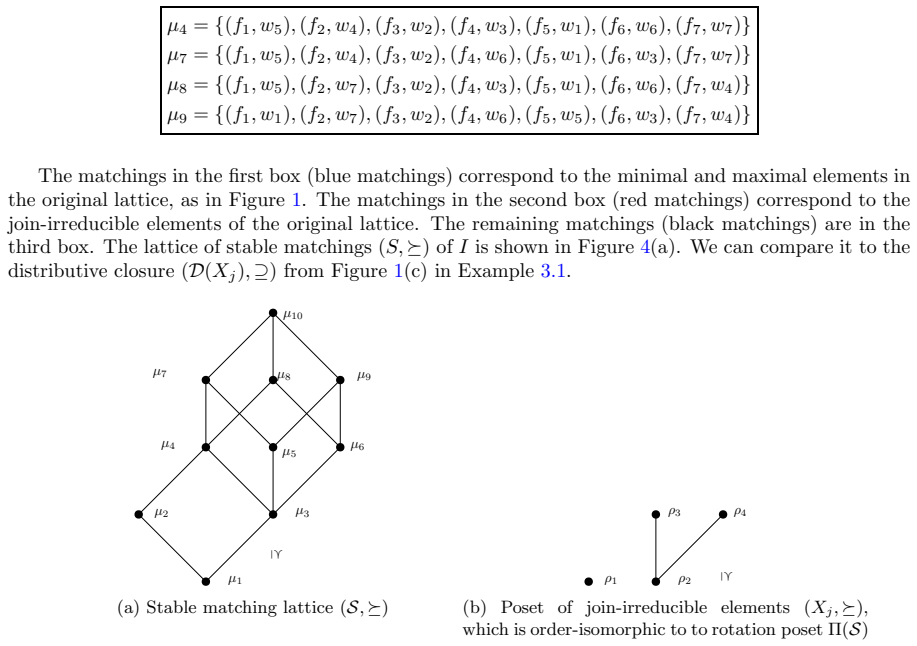

read the original abstract
We show that all finite lattices, including non-distributive lattices, arise as stable matching lattices when all agents have path-independent choice functions. This result answers an open question of Blair~\cite{blair1988lattice}. In the process, we introduce new tools to reason on general lattices for optimization purposes: the \emph{partial representation} of a lattice, which partially extends Birkhoff's representation theorem to non-distributive lattices; the \emph{distributive closure} of a lattice, which gives such a partial representation; and \emph{join constraints}, which can be added to the distributive closure to obtain a representation for the original lattice. Then, we use these techniques to show that the minimum cost stable matching problem under the same standard assumptions on choice functions is NP-hard, by establishing a connection with antimatroid theory.
Editorial analysis
A structured set of objections, weighed in public.
Referee Report
Summary. The manuscript proves that every finite lattice, including non-distributive ones, can be realized as the lattice of stable matchings in a two-sided market in which all agents have path-independent choice functions. This resolves an open question of Blair (1988). The proof proceeds by first forming the distributive closure of the target lattice (which admits a Birkhoff-style representation) and then imposing join constraints, defined via forbidden sub-configurations, to recover the original lattice operations. The paper also establishes NP-hardness of the minimum-cost stable matching problem under the same choice-function assumptions by reduction to antimatroid theory.
Significance. If the central representation theorem holds, the result gives a complete characterization of stable-matching lattices under path-independent choice functions, extending earlier work limited to distributive lattices. The auxiliary notions of partial representation, distributive closure, and join constraints supply new tools for optimization over general lattices. The NP-hardness corollary is a concrete computational consequence with potential implications for algorithmic matching theory.
major comments (2)
- § on join constraints and the reduction from lattice to choice-function market: the claim that join constraints can be realized by path-independent choice functions while producing exactly the target lattice (no extraneous stable matchings, no proper quotient) is load-bearing. The manuscript must supply an explicit argument that the forbidden-subconfiguration constraints preserve path-independence and do not introduce new fixed points of the choice operators; without this, the representation may fail for some non-distributive lattices.
- Proof of the main representation theorem: the construction first takes the distributive closure and then adds join constraints. It is necessary to verify that the resulting stable-matching poset is order-isomorphic to the input lattice rather than a proper extension or quotient. A concrete check for a small non-distributive lattice (e.g., M3 or N5) would make the argument verifiable.
minor comments (2)
- Abstract: the phrase 'path-independent choice functions' is used without a one-sentence reminder of its relation to the standard substitutable-choice assumption; a brief clarification would aid readers.
- Notation: the symbols for the partial representation and distributive closure are introduced without an explicit comparison table to Birkhoff's representation; adding such a table would improve readability.
Simulated Author's Rebuttal
We thank the referee for their careful reading and constructive comments on our manuscript. We agree that the exposition of the join constraints and the verification of the representation theorem can be strengthened with additional explicit arguments and examples. We address each major comment below and will incorporate the suggested revisions.
read point-by-point responses
-
Referee: § on join constraints and the reduction from lattice to choice-function market: the claim that join constraints can be realized by path-independent choice functions while producing exactly the target lattice (no extraneous stable matchings, no proper quotient) is load-bearing. The manuscript must supply an explicit argument that the forbidden-subconfiguration constraints preserve path-independence and do not introduce new fixed points of the choice operators; without this, the representation may fail for some non-distributive lattices.
Authors: We agree that an explicit argument is needed for full rigor. In the revised manuscript we will add a dedicated lemma proving that the forbidden-subconfiguration constraints preserve path-independence: each constraint is defined so that the choice operator on any path remains unchanged outside the forbidden configurations, satisfying the path-independence axiom directly. We further show that no new fixed points are introduced because any candidate matching violating a join constraint is eliminated by the choice functions, while the distributive closure ensures that all original lattice elements remain as stable matchings. This construction works uniformly for non-distributive lattices. revision: yes
-
Referee: Proof of the main representation theorem: the construction first takes the distributive closure and then adds join constraints. It is necessary to verify that the resulting stable-matching poset is order-isomorphic to the input lattice rather than a proper extension or quotient. A concrete check for a small non-distributive lattice (e.g., M3 or N5) would make the argument verifiable.
Authors: We thank the referee for this helpful suggestion. To make the isomorphism verifiable, the revision will include a new subsection with an explicit worked example for the lattice M3. We will compute its distributive closure, specify the join constraints via the forbidden sub-configurations, define the path-independent choice functions, enumerate the resulting stable matchings, and confirm that the induced poset is order-isomorphic to M3 with no extraneous elements or collapsed relations. The same verification for N5 follows by the same steps and can be sketched or included depending on space. revision: yes
Circularity Check
No circularity; construction extends external lattice theory independently
full rationale
The paper constructs a representation of arbitrary finite lattices (including non-distributive ones) as stable matching lattices via the distributive closure of the lattice plus join constraints, building explicitly on Birkhoff's theorem for the distributive case and citing Blair (1988) only for the open question being resolved. The NP-hardness reduction invokes antimatroid theory as an external connection. No equation, definition, or central claim reduces by construction to a fitted parameter, self-citation chain, or renamed input; the proof is self-contained against standard lattice-theoretic benchmarks and does not rely on load-bearing self-references.
Axiom & Free-Parameter Ledger
axioms (2)
- domain assumption Path-independent choice functions exist for any finite lattice and can be constructed via the distributive closure plus join constraints.
- standard math Standard lattice axioms (idempotence, commutativity, associativity of join and meet) hold for the target structure.
invented entities (3)
-
partial representation of a lattice
no independent evidence
-
distributive closure
no independent evidence
-
join constraints
no independent evidence
Lean theorems connected to this paper
-
IndisputableMonolith/Foundation/AbsoluteFloorClosure.leanreality_from_one_distinction unclear?
unclearRelation between the paper passage and the cited Recognition theorem.
We show that all finite lattices, including non-distributive lattices, arise as stable matching lattices when all agents have path-independent choice functions... partial representation of a lattice, distributive closure, join constraints
-
IndisputableMonolith/Cost/FunctionalEquation.leanwashburn_uniqueness_aczel unclear?
unclearRelation between the paper passage and the cited Recognition theorem.
minimum cost stable matching problem ... NP-hard, by establishing a connection with antimatroid theory
What do these tags mean?
- matches
- The paper's claim is directly supported by a theorem in the formal canon.
- supports
- The theorem supports part of the paper's argument, but the paper may add assumptions or extra steps.
- extends
- The paper goes beyond the formal theorem; the theorem is a base layer rather than the whole result.
- uses
- The paper appears to rely on the theorem as machinery.
- contradicts
- The paper's claim conflicts with a theorem or certificate in the canon.
- unclear
- Pith found a possible connection, but the passage is too broad, indirect, or ambiguous to say the theorem truly supports the claim.
Reference graph
Works this paper leans on
-
[1]
As an example, we consider f =f1,f 7. Given a set T of workers, the new choice function C′′ f1 (T ) for f1 is given by the following process: i. If w5∈ T , select w5. ii. Else, select T∩{ w1,w 0}. This is equivalent to the preference list P ′′ f1 given by P ′′ f1 = ({w5},{w0,w 1},{w1},{w0}). The new choice function C′′ f7 (T ) for f7 is given by the follo...
-
[2]
if ρ1 and ρ2 occur, then ρ3 and ρ4 occur
Notice that we can “project” each matching µ ′′ i back to the original instance by taking its intersection µ ′′ i ∩ (F× W ) with the original firms and workers. Then, µ ′′ i∩ (F× W ) = µi, for i∈{ 1, 2, 3, 5, 6, 9, 10}. These are exactly the matchings in the original instance that satisfy the join constraint ( α,β ). In terms of the original target lattice...
-
[3]
That is, one auxiliary worker, and additional copies W ′′ β are added
W ′′=W ′⊎{ w0}⊎ W ′′ β . That is, one auxiliary worker, and additional copies W ′′ β are added
-
[4]
That is, only one firm is added, and this is auxiliary
F ′′=F ′∪{ f0}. That is, only one firm is added, and this is auxiliary
-
[5]
24 We now present proofs omitted from the main body, as well as additio nal intermediate lemmas
For each f∈ F and T⊆ W ′′, C′′ f (T )∩ copy′′(wj )̸=∅ for at most one wj∈ W . 24 We now present proofs omitted from the main body, as well as additio nal intermediate lemmas. We start by showing that the preference lists after the join constra int augmentation satisfy substitutability and consistency. Lemma 47 (Join constraint augmentation satisfies substi...
-
[6]
First, set µ ′′← µ ′
-
[7]
If µ (f )⪯f w, then add ( f,w 0) to µ ′′
For each f∈ Fα , let w∈ Pf be the unique worker such that ( f,w )∈ ρ− for some ρ∈ Πα (see Proposition 21). If µ (f )⪯f w, then add ( f,w 0) to µ ′′
-
[8]
If α (π (Fα\µ ′′(w0))) = 1, then add to µ ′′: (a) (f0,w 0); 26 (b) (µ (w),w ′′) for each w∈ Wβ and w′′∈ W ′′ β ∩ copy(w)
-
[9]
Our goal is to show that µ ′′ is stable in I ′′, and that ζS ′′(µ ′′) = µ ′
Else, add ( f0,w ′′) to µ ′′, for each w′′∈ W ′′ β . Our goal is to show that µ ′′ is stable in I ′′, and that ζS ′′(µ ′′) = µ ′. Individual rationality of µ ′′. First we show individual rationality of µ ′′. It is easily verified by inspection that, for a∈ F ′′∪ W ′′\W ′′ β , µ ′′(a) =C′′ a (µ ′′(a)). Now consider w′′ j∈ W ′′ β ∩ copy(wj). Note that either...
-
[10]
We know by Lemma 47 that all agents in I ′′ have substitutable and consistent choice functions
-
[11]
We know by definition of the join constraint augmentation that the agents in F ′′∪ W ′′ can be partitioned into firms Faux⊎ F and workers Waux⊎ Wreg , and the set of regular workers Wreg can be partitioned into sets ⨄ w∈Wcopy(w)
-
[12]
The preference list P ′′ w forw∈ W ′ are unchanged fromP ′ w, which already satisfied 3. by assumption. For agents w′ j ∈ W ′ β , by definition the preference list P ′′ w′ j is also of the form ( f0,f ℓ,f ℓ+1,...,f k), as desired
-
[13]
By definition, for every f∈ F the choice function C′′ f is a standard choice function
-
[14]
We know by Lemma 49 that ξS ′′ is an order-embedding, and that the maximal and minimal elements ofS are in the image of ξ. C Proofs from Section 5 For the sake of completeness, we reproduce here the proof of Th eorem 36, which appeared in Merckx (2019). Proof. We reduce from the maximum independent set problem, which is well-kn own to be NP-Hard Karp (200...
work page 2019
discussion (0)
Sign in with ORCID, Apple, or X to comment. Anyone can read and Pith papers without signing in.