REVIEW 5 major objections 5 minor 30 references
Probing the Cores of Subdwarf B Stars: How do They Compare to Cores in Helium Core-Burning Red Giants?
T0 review · 5 major / 5 minor · reviewed 2026-08-16 · deepseek-v4-flash
Pith's one-line read The paper claims that all three subdwarf B stars show the same sharp structural glitch at a similar buoyancy radius near the C-O/He transition, farther out and stronger than in helium core-burning red giants, pointing to more extensive…
desk verdict A transparent and careful application of an established glitch model to three sdB stars, but the central physical interpretation is undermined by the inner/outer buoyancy degeneracy, which the paper never resolves. read the letter →
The pith
A machine-rendered reading of the paper's core claim, the machinery that carries it, and where it could break.
The reading
What carries the argument
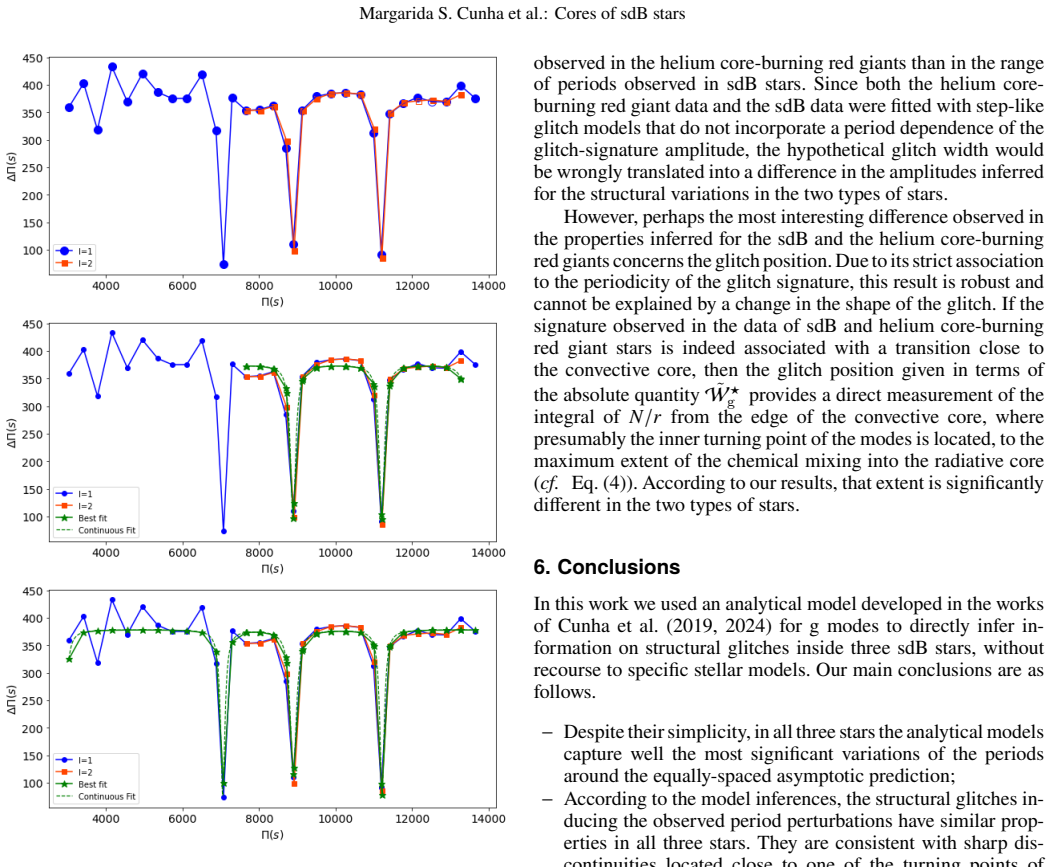
The load-bearing object is the buoyancy glitch. The machinery is a non-perturbative analytical model in which a sharp variation of the buoyancy frequency $N$ at radius $r_*$ adds a phase $\phi$ to the asymptotic period relation, $\Pi \approx \Pi_s - (\Delta\Pi_{as}/\pi)\phi$, with $\phi$ given by an arccotangent expression that takes a step-like or Gaussian-like form. The glitch position enters through the degree-independent buoyancy radius $\tilde{W}^*_g = \int_{r_1}^{r_*} (N/r)\,dr$, measured from the inner turning point (the edge of the adiabatically stratified core), and this quantity fixes the periodicity $\Pi_{sig} = 2\pi^2/\tilde{W}^*_g$ of the dips in the period spacings. That strict periodicity is what makes the inferred position reliable while the amplitude stays poorly constrained. Fitting the predicted period spacings to the Kepler data with a nested-sampling algorithm, with the intrinsic error as a free parameter, yields $\Delta\Pi_{as}$, glitch amplitude, and $\tilde{W}^*_g$ for each star without recourse to stellar models.
What would settle it
One concrete test is to fit the same one-glitch versus two-glitch models to all three stars rather than only KIC 10001893: if the two-glitch alternative matches any other star's dips as well as the one-glitch fit does, or if additional Kepler or TESS data reveal dip spacings that are not strictly periodic, the identification of the dips with a single sharp C-O/He transition fails. Conversely, if the offset persists across a larger sample, with red giants at small buoyancy radius and sdB stars at large buoyancy radius, then the mixing difference is real.
Extended reading notes
Core claim
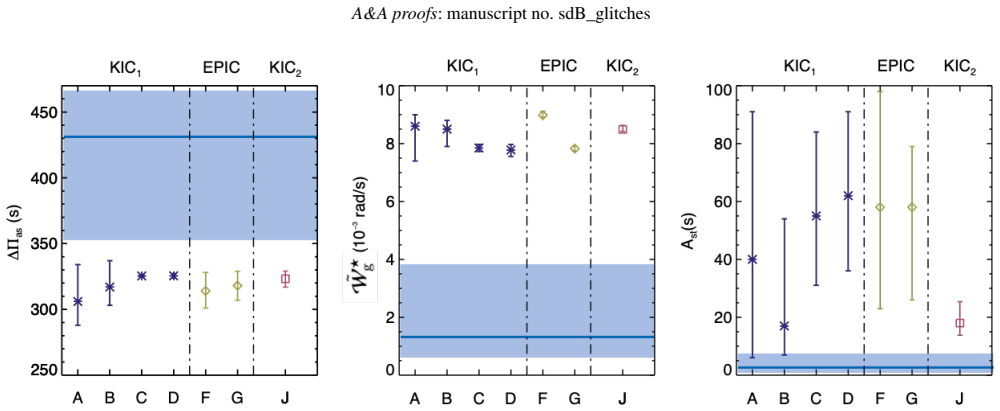
Fitting a glitch-induced phase perturbation to the reduced period spacings of KIC 10553698A, EPIC 211779126, and KIC 10001893, the paper finds that one step-like glitch located just outside the inner turning point of the g-mode propagation cavity reproduces the observed period-spacing dips in all three stars, with inferred buoyancy radii $\tilde{W}^*_g \approx 0.0085$–$0.0090$ rad/s and asymptotic reduced period spacings $\Delta\Pi_{as} \approx 314$–$325$ s. On the basis of the similar positions and the contrast with models of sdB cores, the paper identifies the glitch with the C-O/He transition. Comparing these values with a published analysis of 23 helium core-burning red giants, it finds that the sdB glitches are systematically stronger and, most robustly, sit at a larger buoyancy radius; because the position sets the strict periodicity of the dip pattern, this offset cannot be blamed on glitch shape. The paper concludes that the layers just beyond the convective core are either more extensively mixed in sdB stars than in helium core-burning red giants, or stratified differently.
Load-bearing premise
The comparison rests on treating each star's period-spacing dips as the signature of a single sharp, step-like structural discontinuity, identified as the C-O/He transition just beyond the convective core, so that the fitted buoyancy radius really measures the extent of the mixed region; if the dips come from the He/H transition or from a more complex structure, as the alternative two-glitch fit for KIC 10001893 allows, the inferred position does not measure core-boundary mixing.
Editorial extensions
If this is right
- The inferences provide the first model-independent constraints on the structure of the layers immediately outside the convective core in sdB stars, fixing the sharpness and buoyancy position of the C-O/He transition.
- If the C-O/He identification is correct, the larger buoyancy radius in sdB stars means that mixing beyond the adiabatically stratified core is more extensive there than in helium core-burning red giants, or that the stratification of the mixed region differs.
- A comparison with recent sdB structural models favours evolved stars with a low core-helium abundance and a relatively small core mass, giving a concrete target for evolutionary calculations of stripped stars.
- Because the sdB pulsation periods are roughly five times shorter than the red-giant mixed-mode periods, part of the inferred amplitude difference could come from a finite glitch width being absorbed into the step-like amplitude, a caveat the paper states explicitly.
- The robust position offset provides a direct, model-independent test for non-canonical sdB formation channels and for mixing prescriptions in stellar evolution codes.
Reading between the lines
- If the buoyancy-radius offset holds up in a larger sample, the inferred glitch position could serve as a calibration point for convective overshoot and boundary-mixing prescriptions, because it measures the integral of $N/r$ between the core edge and the chemical transition directly from data.
- The step-versus-Gaussian ambiguity for EPIC 211779126 is testable: a step-like glitch predicts dips of constant depth across periods, while a Gaussian glitch predicts dips that fade at longer periods, so longer or denser monitoring of that star would distinguish the two.
- Some sdB stars may show both the C-O/He and the He/H transition as separate glitches, as the two-glitch fit for KIC 10001893 suggests; resolving both would give a model-independent measure of the helium-layer mass and probe the stripped envelope directly.
- Applying the same pipeline to g-mode pulsators of different masses or envelope properties could map how the post-core mixing region depends on the formation channel, turning a three-star result into a population diagnostic.
Signed reviews
Editorial analysis
A structured set of objections, weighed in public.
Referee Report
Summary. The paper applies the analytical buoyancy-glitch formalism of Cunha et al. (2019, 2024) to g-mode period spacings of three subdwarf B stars observed with Kepler/K2, inferring the asymptotic reduced period spacing, the amplitude, and the buoyancy position of a sharp structural variation in each star. The authors then compare these quantities with the values previously inferred for helium core-burning red giants by Vrard et al. (2022), finding that the sdB glitches have larger amplitudes and are located at larger buoyancy radii. They interpret the common glitch as the C-O/He transition near the edge of the g-mode cavity and conclude that mixing beyond the convective core may be more extensive, or differently stratified, in sdB stars than in red giants. The manuscript is clearly written, the data are tabulated in full, and the fitting procedure, including posterior corner plots, is transparent.
Significance. If the physical identification is correct, the paper would provide the first model-independent asteroseismic constraints on the core-edge structure of sdB stars and a novel comparison with helium core-burning red giants. The authors deserve credit for using a published analytical model that was already benchmarked on red giants, for presenting all input periods in an appendix, and for openly discussing degeneracies in amplitude and in glitch-model choice. However, the central physical claim currently rests on an untested side-of-cavity identification and on several consequential data-selection and model-selection choices. The comparison with red giants therefore remains suggestive rather than established, and the main conclusion should be correspondingly hedged.
major comments (5)
- [Sect. 3.1, Eq. (8)] The glitch phase entering Eq. (6) is invariant under replacing an inner glitch at buoyancy radius W~*g = x by an outer glitch at buoyancy depth W*g = x. Since the fits return only the periodicity Pi_sig = 2 pi^2 / (W~*g or W*g), the data cannot distinguish a sharp feature just beyond the inner turning point (e.g., the C-O/He transition) from a sharp feature at the same buoyancy distance from the outer turning point (e.g., the He/H transition). The paper explicitly states this symmetry in Sect. 3.1, but then reports all positions as W~*g and, in Sect. 5.1, identifies the glitch with the C-O/He transition based on a comparison with Guyot et al. (2025) models. The model-independent comparison with red giants in Sect. 5.2 therefore rests on an assumption that the period-spacing data themselves do not test. I ask the authors to fit the outer-half formulation as an explicit alternative and to state, if possible, what observable discriminates the two interpretations.
- [Sect. 4.1, Table 1, cases C and E] For KIC 10553698A, restricting the fit to reduced periods below 11100 s gives W~*g = 0.00785 +/- 0.00012 rad/s (case C), whereas including all listed periods gives W~*g = 0.00707 +/- 0.00020 rad/s (case E), a shift of roughly 3-4 sigma. The exclusion of the high-period data is motivated by mode-identification concerns, but the value used in the cross-star comparison in Fig. 6 depends on this cut. The impact of this cut on the comparison with the red-giant sample should be quantified, and a less ad hoc criterion for excluding the high-period data should be provided.
- [Sect. 4.2, Table 2, cases F and G] For EPIC 211779126, the l=1 and l=2 fits give W~*g = 0.00898 +/- 0.00014 and 0.00783 +/- 0.00008 rad/s, respectively, which differ by more than 7 sigma even though the adopted asymptotic model predicts the same glitch position for both degrees. Fitting the two degrees separately and then using only the l=1 result in Fig. 6 discards a direct inconsistency that the model cannot accommodate. The paper should either identify a cause, such as misidentified modes in the original catalogue, or treat the l=1/l=2 disagreement as a dominant systematic uncertainty in the inferred position.
- [Sect. 4.3, Table 4, cases J and K; Sect. 5.1] For KIC 10001893, the one-glitch fit to the overlapping l=1/l=2 region (case J) gives W~*g = 0.00849 rad/s, while the two-glitch fit to all data (case K) places a glitch at W~*g = 0.00473 rad/s, nearly half the single-glitch value. The paper prefers case J in Fig. 6 partly because it yields positions comparable to the other two stars; this reasoning is circular when the goal is to demonstrate a common phenomenon. A quantitative model comparison, such as Bayesian evidence or an information criterion, should be reported, and the physical consequences of the two-glitch solution should be discussed rather than set aside.
- [Sect. 5.2] The comparison of glitch amplitudes between sdB stars and red giants is weakened by the finite-width effect that the authors themselves describe. If the sdB glitch is sharp and the red-giant glitch has a finite width, fitting both samples with a step-like model would translate the width into a smaller inferred amplitude at the longer red-giant periods. Since the paper's own discussion allows this explanation, the abstract's statement that the sdB structural variations have 'larger amplitudes' should be qualified, or a quantitative estimate of the effect should be added, for example by fitting a Gaussian-glitch model to the red-giant data.
minor comments (5)
- [Sect. 4.1] The text 'restricting the data to reduced periods smaller than 111000 s' appears to contain a typo; the context and Table 1 indicate 11100 s.
- [Fig. 6] The caption does not define what the blue shaded region represents; it should state whether it is the full range, the 68 per cent interval, or the interquartile range of the Vrard et al. (2022) sample, and should give the number of red giants and the corresponding numerical values.
- [Appendix C] The table headers in Appendix C reuse case labels A-D that do not correspond to the case labels in the main text, which makes cross-referencing difficult.
- [Abstract] The phrase 'model-independent' should be qualified as 'independent of stellar-structure models' to match the content of the paper, since the analysis still assumes a specific glitch shape and a specific choice of which structural transition produces the observed signature.
- [Sect. 4.1 and 4.2] There are minor typographical errors, including 'pyhton' for 'Python' and 'struture' for 'structure'.
Circularity Check
No significant circularity: the analytical model is stated in full, the fit parameters are inferred, and the comparison uses an independent red-giant sample.
full rationale
The paper's derivation chain is an inference from data, not a fit-then-prediction loop. The glitch model (Eqs. 5-11) is written out in the text, and the two-glitch extension is re-derived from the wave equation in Appendix B, so the appeal to Cunha et al. (2019, 2024) is attribution rather than unverified load-bearing authority. The quantities ΔΠas, A_st (or A_G), and the glitch position are free parameters determined by nested-sampling fits to observed period spacings; they are not constructed from the paper's conclusions. The comparison with helium-core-burning red giants uses the previously published Vrard et al. (2022) results, and the C-O/He identification is presented as a model comparison with Guyot et al. (2025), not as a consequence of the fitting equations. The paper explicitly flags the inner/outer cavity degeneracy in Sect. 3.1 ('the expression for the phase φ is independent of the side of the cavity in which the glitch is located') and the difficulty constraining the second glitch in Sect. 4.3; these are identifiability and interpretation caveats, not circular reductions. No fitted parameter is renamed as a prediction, and no conclusion is built into the definition of an input. Score 0.
Assumptions & free parameters
free parameters (6)
- Delta Pi_as (asymptotic reduced period spacing) =
306-336 s depending on star and case
- W~*g (glitch buoyancy radius) =
0.0078 to 0.0090 rad/s for preferred one-glitch fits
- A_st or A_G (glitch amplitude) =
17-96 (step) or 0.06-0.12 rad/s (Gaussian)
- delta (phase) =
0.7 to 3.3
- sigma (noise/error scale) =
median values around 19-60 s in the discussed cases
- Pi_s,min (first reduced period) =
e.g., 3616 s for KIC 10553698A period fits
assumptions (5)
- standard math High-radial-order g modes in a spherically symmetric star with a convective core are asymptotically equally spaced in reduced period (Tassoul 1980, Eq. 1).
- domain assumption The glitch phase functions in Eqs (5)-(7) correctly describe period perturbations for step-like and Gaussian-like buoyancy glitches (from Cunha et al. 2019, 2024; Appendix B extends to two glitches).
- domain assumption The listed mode identifications (degree and radial order) from the original Kepler analyses are correct.
- domain assumption The inner turning point of the g-mode cavity is at the edge of the adiabatically stratified convective core, so the inferred buoyancy radius W~*g measures the distance from that edge to the glitch.
- domain assumption Rotation and other departures from spherical symmetry have a negligible effect on the reduced period spacings in the fitted range.
Cite this review
Pith. "Pith review of Probing the Cores of Subdwarf B Stars: How do They Compare to Cores in Helium Core-Burning Red Giants?." pith.science (2026). https://pith.science/paper/V3G3VMGU
@misc{pith2026250501381,
  author       = {Pith},
  title        = {Pith review of: Probing the Cores of Subdwarf B Stars: How do They Compare to Cores in Helium Core-Burning Red Giants?},
  year         = {2026},
  howpublished = {\url{https://pith.science/paper/V3G3VMGU}},
  note         = {Machine review of arXiv:2505.01381}
}
read the original abstract
The mixing of material from stellar convective cores into their adjacent radiative layers has been a matter of long-standing debate. Pulsating subdwarf B stars offer excellent conditions to advance our understanding of this problem. In this work we use a model-independent approach to infer information about the cores of three subdwarf B stars and compare it with similar inferences from earlier analysis of red giants in the helium core-burning phase. This is achieved by fitting an analytical description of the gravity-mode pulsation periods to pulsation data collected by the Kepler satellite. From the fits we infer the reduced asymptotic period spacings and the amplitude and position of sharp structural variations associated with chemical discontinuities in the stellar interiors. Our results indicate the presence of sharp structural variations with similar properties in all three stars, located near the edge of the gravity-mode propagation cavity and likely associated with the C-O/He transition. We find that these structural variations differ systematically from those of helium core-burning red giant stars, having larger amplitudes and being located at a larger buoyancy radius. This suggests that chemical mixing beyond the adiabatically stratified core into the radiatively stratified layers may be more extensive in subdwarf B stars than in helium core-burning red giants. Alternatively, the stratification of the mixing region beyond the adiabatically stratified core may differ significantly between the two types of stars. The model-independent constraints set on the structural variations inside these three stars are the first of a kind and will be key to enhance the modelling of layers adjacent to stellar convective cores and to test non-canonical stellar evolution channels leading to the formation of hot subdwarf stars.
Figures


Figures from the paper (3 more)

Reference graph
Works this paper leans on
-
[1]
, " * write output.state after.block = add.period write newline
ENTRY address archiveprefix author booktitle chapter edition editor howpublished institution eprint journal key month note number organization pages publisher school series title type volume year label extra.label sort.label short.list INTEGERS output.state before.all mid.sentence after.sentence after.block FUNCTION init.state.consts #0 'before.all := #1 ...
-
[2]
write newline
" write newline "" before.all 'output.state := FUNCTION n.dashify 't := "" t empty not t #1 #1 substring "-" = t #1 #2 substring "--" = not "--" * t #2 global.max substring 't := t #1 #1 substring "-" = "-" * t #2 global.max substring 't := while if t #1 #1 substring * t #2 global.max substring 't := if while FUNCTION word.in bbl.in " " * FUNCTION format....
- [3]
-
[4]
Baran , A. S., Reed , M. D., stensen , R. H., Telting , J. H., & Jeffery , C. S. 2017, , 597, A95
work page 2017
-
[5]
S., Van Grootel , V., stensen , R
Baran , A. S., Van Grootel , V., stensen , R. H., et al. 2023, , 669, A48
work page 2023
-
[6]
2014, in Astronomical Society of the Pacific Conference Series, Vol
Charpinet , S., Brassard , P., Van Grootel , V., & Fontaine , G. 2014, in Astronomical Society of the Pacific Conference Series, Vol. 481, 6th Meeting on Hot Subdwarf Stars and Related Objects, ed. V. van Grootel , E. Green , G. Fontaine , & S. Charpinet , 179
work page 2014
-
[7]
Charpinet , S., Fontaine , G., Brassard , P., & Dorman , B. 2000, , 131, 223
work page 2000
-
[8]
Charpinet , S., Fontaine , G., Brassard , P., & Dorman , B. 2002, , 139, 487
work page 2002
Show all 30 references
-
[9]
& Wade , R
Clausen , D. & Wade , R. A. 2011, , 733, L42
2011
-
[10]
Cunha , M. S. 2020, in Astrophysics and Space Science Proceedings, Vol. 57, Dynamics of the Sun and Stars; Honoring the Life and Work of Michael J. Thompson, ed. M. J. P. F. G. Monteiro , R. A. Garc \' a , J. Christensen-Dalsgaard , & S. W. McIntosh , 185--196
2020
-
[11]
S., Aerts , C., Christensen-Dalsgaard , J., et al
Cunha , M. S., Aerts , C., Christensen-Dalsgaard , J., et al. 2007, Astronomy and Astrophysics Review, 14, 217
2007
-
[12]
S., Avelino , P
Cunha , M. S., Avelino , P. P., Christensen-Dalsgaard , J., et al. 2019, , 490, 909
2019
-
[13]
S., Damasceno , Y
Cunha , M. S., Damasceno , Y. C., Amaral , J., et al. 2024, , 687, A100
2024
-
[14]
S., Stello , D., Avelino , P
Cunha , M. S., Stello , D., Avelino , P. P., Christensen-Dalsgaard , J., & Townsend , R. H. D. 2015, , 805, 127
2015
-
[15]
2017, , 465, 1518
Ghasemi , H., Moravveji , E., Aerts , C., Safari , H., & Vu c kovi \'c , M. 2017, , 465, 1518
2017
-
[16]
Gough , D. O. 2007, Astronomische Nachrichten, 328, 273
2007
-
[17]
2025, , 696, A13
Guyot , N., Van Grootel , V., Charpinet , S., et al. 2025, , 696, A13
2025
-
[18]
2016, , 128, 082001
Heber , U. 2016, , 128, 082001
2016
-
[19]
2018, Statistics and Computing, 29, 891–913
Higson, E., Handley, W., Hobson, M., & Lasenby, A. 2018, Statistics and Computing, 29, 891–913
2018
-
[20]
Mazumdar , A., Monteiro , M. J. P. F. G., Ballot , J., et al. 2014, , 782, 18
2014
-
[21]
H., Telting , J
stensen , R. H., Telting , J. H., Reed , M. D., et al. 2014, , 569, A15
2014
-
[22]
S., Sanjayan , S., & Sahoo , S
Ostrowski , J., Baran , A. S., Sanjayan , S., & Sahoo , S. K. 2021, , 503, 4646
2021
-
[23]
D., Kawaler , S
Reed , M. D., Kawaler , S. D., stensen , R. H., et al. 2010, , 409, 1496
2010
-
[24]
Rui , N. Z. & Fuller , J. 2024, The Open Journal of Astrophysics, 7, 81
2024
-
[25]
1980, , 43, 469
Tassoul , M. 1980, , 43, 469
1980
-
[26]
S., stensen , R
Uzundag , M., Baran , A. S., stensen , R. H., et al. 2017, , 472, 700
2017
-
[27]
2024, , 684, A118
Uzundag , M., Krzesinski , J., Pelisoli , I., et al. 2024, , 684, A118
2024
-
[28]
2021, , 651, A121
Uzundag , M., Vu c kovi \'c , M., N \'e meth , P., et al. 2021, , 651, A121
2021
-
[29]
S., Bossini , D., et al
Vrard , M., Cunha , M. S., Bossini , D., et al. 2022, Nature Communications, 13, 7553
2022
-
[30]
D., Jeffery , C
Zhang , X., Hall , P. D., Jeffery , C. S., & Bi , S. 2017, , 835, 242
2017
Reviewed August 16, 2026 · model on record in the stance chip above.
Discussion (0). Continue with ORCID to comment.