REVIEW 5 major objections 5 minor 24 references
Meta-reasoning Using Attention Maps and Its Applications in Cloud Robotics
T0 review · 5 major / 5 minor · reviewed 2026-08-15 · deepseek-v4-flash
Pith's one-line read Meta-reasoning with semantic attention maps lets cloud robots adapt offloading and edge-switching policies in unexpected situations without manually redefining symbolic context.
desk verdict A promising architectural idea for meta-reasoning in cloud robotics, but the evaluation is too thin to support the 'unsupervised scalability' claim. read the letter →
The pith
A machine-rendered reading of the paper's core claim, the machinery that carries it, and where it could break.
The reading
What carries the argument
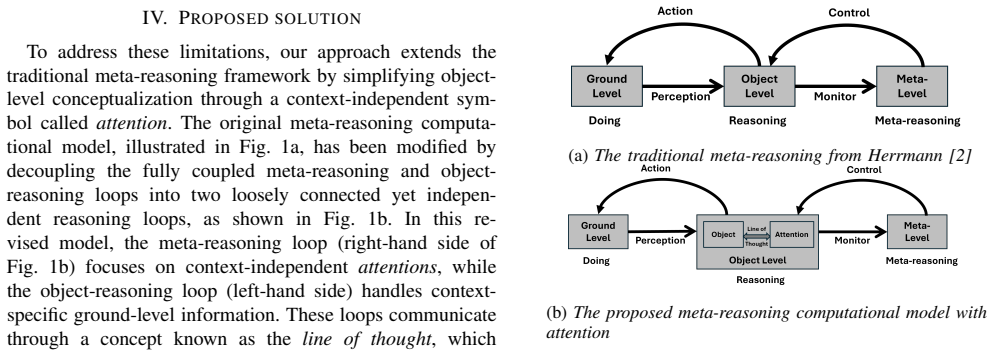
The central object is the semantic attention map, a grid map in which each cell carries a belief distribution over the utility of paying attention there, represented by a mean and variance and updated by a Beta-Bernoulli rule from observed successes and failures. The line of thought is a logical chain of IF-THEN rules that binds context-specific objects at the ground level to abstract attentions at the meta level; it supplies the origin and destination objects for attention updates and establishes the initial distribution. The decisive architectural move is splitting the fully coupled meta/object reasoning loop into two loops, so meta-attention can be updated from the experienced overall reward without requiring that reward to be attributed to a known symbol at every step.
What would settle it
Run the Case Study 1 scenario again but make the failure come from a contributor that is not in the pre-defined decomposition, such as suddenly degrading lighting instead of radio signal quality; if the attention map does not shift to expose the true cause and success rate stays near the generic baseline, the claim that unsupervised attention updates scale to unexpected situations fails.
Extended reading notes
Core claim
The central claim is that when the Value of Computation cannot be computed because the new situation does not ground into existing symbolic objects, the computation can be deferred: the robot stores the dynamics of reward in a probabilistic attention value, a mean and variance per map cell or object, updates it in an unsupervised way with a Beta-Bernoulli update, and only later translates the accumulated attention back into control objects once confidence is sufficient. This is made possible by decoupling object-level and meta-level reasoning into two loosely connected loops. In the cloud-robotics setting, the framework decides when to offload object detection and when to switch between edge networks, and the experiments show it recognizes a relocated base station and a switch-thrashing boundary without being told about them in advance.
Load-bearing premise
To update attention correctly, the robot must know in advance how to split the single observable overall reward into per-object contributions, because if the true cause of a failure is not represented in that pre-defined decomposition, the attention updates will point at the wrong place.
Editorial extensions
If this is right
- Offloading and edge-switching decisions can be driven by learned attention values rather than manually set signal-quality thresholds, so relocating or degrading infrastructure does not require rewriting the robot's policy.
- In any unexpected situation whose overall reward can be decomposed, a robot can keep meta-level adaptation running even when no symbolic grounding exists for what changed.
- The attention map doubles as a continuously updated memory of which places or objects mattered for past outcomes, giving operators a visible explanation of why the robot changed strategy.
- Because meta-attention is object-independent, the same architecture should extend to other meta-level choices, such as which sensor modality to trust, without redesign.
Reading between the lines
- A testable extension beyond the paper is to make the pre-defined decomposition itself learnable: if the impact weights in Algorithm 1 were adapted online from experience rather than fixed in advance, the framework would no longer need any manual decomposition of the reward.
- The paper does not quantify how operators perceive the attention map, but its green/yellow regions could plausibly serve as a trust interface, reducing the number of human interventions by making the robot's meta-level reasoning legible.
- The 50-episode convergence check with impact-weight adjustment is a free parameter; sweeping it across environments would show whether the method's robustness depends on that threshold rather than on the attention mechanism itself.
Signed reviews
Editorial analysis
A structured set of objections, weighed in public.
Referee Report
Summary. The paper proposes a revised meta-reasoning framework for robots operating in unexpected situations, centered on "semantic attention maps" and "lines of thought." The key architectural idea is to decouple object-level reasoning from meta-level reasoning into two loosely connected loops, where the meta-loop maintains Bayesian attention distributions over abstract symbols rather than requiring pre-grounded symbolic objects. The authors claim this enables unsupervised attention updates and scalable reasoning when the conventional Value of Computation (VoC) is undefined. The approach is evaluated in two cloud-robotics case studies: object detection with offloading decisions under varying radio signal quality, and edge-switching between two networks. Performance is compared for three reasoners: R1 (generic meta-reasoning), R2 (meta-reasoning with manually defined signal-quality knowledge), and R3 (the proposed attention-based reasoner). Reported results show R3 improving success rate, robustness, and availability over R1 and, in some cases, a small gain over R2. The conclusion claims the framework improves adaptability in unexpected situations through the proposed decoupling and unsupervised attention updates.
Significance. If the mechanism were fully specified and the empirical claims were statistically supported, the two-loop decoupling could be a useful architectural contribution for cloud robotics in dynamic radio environments. The paper deserves credit for implementing the framework on a real robot with a 5G testbed, for using explicit KPIs, and for trying to move meta-reasoning beyond hand-crafted symbolic grounding. However, the current significance is considerably tempered: the core credit-assignment step is left as an undefined subroutine, the experimental comparison lacks any measure of variability, and the system is initialized with a line of thought that already encodes the hypothesis the experiments are meant to demonstrate. The central "unsupervised scalability" claim is therefore not yet established.
major comments (5)
- [Section IV-C and Algorithm 1] The 'pre-defined decomposition between ground-level capabilities and meta-level attentions' is never given a functional form. Algorithm 1 invokes 'Impact calculation(line of thought, status of origin, impact weight)' and 'update(impact weight)' as opaque subroutines, and the impact weight is listed as a free parameter. Because Section III states that only the overall reward is directly observable, the per-object impact values that drive the attention update cannot be learned from the reward without a specification of this decomposition. As it stands, the 'unsupervised' update is driven by an arbitrary credit-assignment rule, and the scalability claim in Section VI collapses if the assumed decomposition is wrong. Please provide the explicit update equations, a validation of the decomposition assumption, or an experiment that varies the decomposition.
- [Section V-A, Table II] The comparison between R2 and R3 rests on differences of 2 percentage points in success rate (70 vs. 72) and 3 points in robustness (96 vs. 99), yet no number of trials, variance, confidence intervals, or significance tests are reported. Similarly, Table III reports a single availability value per reasoner with no supporting statistics. The conclusion that R3 'outperforms' R2 and scales better is not supported by the evidence as presented. Please report run-to-run statistics or justify why the point estimates are decisive.
- [Section V-A, Eq. (5)] The robustness metric penalizes unrecognized interventions by a factor of 3 (100 - RI - UI*3), but this weight is not derived from any stated principle or domain cost. Also, the counting rules for RI and UI are not specified. Because Table II uses this metric as a KPI, an arbitrary weight can change the ranking between reasoners; please justify the weight and report the raw RI/UI counts.
- [Section IV-B and Algorithm 1] There is an unresolved inconsistency between the Beta-distribution description and the Gaussian update. Eq. (2) and Eqs. (6)-(7) describe a Beta/Binomial update of (alpha, beta), while Algorithm 1 Step 5 calls a 'gaussian update' and maintains (mu, sigma), and Section V reports initial mu = 0.9, sigma^2 = 0.05. The two parameterizations are not interchangeable without an explicit conversion; please specify exactly which update is executed and how the reported means and variances are derived.
- [Section V-A, Situation 2] The experiment does not isolate the effect of the attention-update mechanism from the manually supplied line of thought. The initial line of thought already contains 'IF MAIN HALL THEN GOOD SIGNAL,' which is exactly the signal-quality hypothesis hand-coded into R2. Thus R3's advantage over R2 may be inherited from the prior rather than produced by the claimed unsupervised updates. Please include an ablation with a neutral or uninformative initial attention distribution, or otherwise show that the updates, not the prior, drive the improvement.
minor comments (5)
- [Section IV] The phrase 'final Value of Control (V oC)' is inconsistent with the earlier usage of VoC as 'Value of Computation' (Eq. 3); please use one term consistently.
- [Algorithm 1] The variable 'counter episode' is incremented twice per iteration and reset to zero inside the loop, so the convergence check at episode 50 cannot work as intended; please correct the loop logic.
- [Section V-A vs. Table II] KPI2 and KPI3 are swapped between the definition list and Table II: the text defines KPI2 as Battery Consumption and KPI3 as Robustness, but the table labels KPI2 as Robustness and KPI3 as Battery Consumption. Please align the numbering.
- [Section V-A] KPI1 is defined in the overview as a general success rate, but the case-study text says it is the number of successfully detected unique objects per task; please align the definition with the reported percentages.
- [Section IV-A, Eq. (1)] Equation (1) writes the Bayesian update in terms of a likelihood P(D|A) and prior P(A), but the relation to the Beta/Binomial model of Eqs. (2) and (6)-(7) is not stated; a short derivation or explanation would improve readability.
Circularity Check
No significant circularity: attention updates are Bayesian belief revisions driven by observed reward, not fitted to the final KPIs.
full rationale
The paper's central mechanism (Algorithm 1) is a closed-loop Bayesian update: attention beliefs are revised using an impact signal derived from the observed overall reward, and the resulting attention values feed the VoC comparison. This is a standard online credit-assignment loop, not a prediction that reduces to its inputs by construction. The KPIs (success rate, robustness, availability) are measured empirically, not generated from the attention-map equations. The main weaknesses are assumptions rather than circularities: Section IV-C states that the individual impact of attention must be extracted from the overall VoC 'using pre-defined decomposition between ground-level capabilities and meta-level attentions,' and Algorithm 1's 'impact weight' is adjusted when convergence fails; these are unspecified inputs or tuned parameters. In addition, R3's initial line of thought already encodes the signal-quality hypothesis ('IF MAIN HALL THEN GOOD SIGNAL'), so the 'unsupervised' label overstates the system's prior knowledge. However, none of these steps equates a derived quantity with an input by construction: the Bayesian updates can override the prior, and the reported performance gains are empirical. Self-citations ([13], [14]) supply map-generation and offloading-benchmark components but are not load-bearing for the meta-reasoning derivation. Overall, no circular step meeting the quoted-equation threshold was found; the paper's limitations are missing specification and unverified assumptions, not circular derivation.
Assumptions & free parameters
free parameters (5)
- initial attention mean and variance (mu0, sigma0^2) =
mu0 = 0.9, sigma0^2 = 0.05
- intervention penalty weight in robustness metric =
3 (multiplier on unrecognized interventions)
- impact weight update rule =
unspecified
- convergence episode threshold =
50
- VoC cost function =
unspecified
assumptions (4)
- domain assumption A predefined reward function is available and provides success/failure signals for attention updates.
- domain assumption The overall reward can be decomposed into ground-level and meta-level contributions via a predefined decomposition.
- ad hoc to paper The initial attention distribution should match the distribution of the line of thought.
- domain assumption Robot capabilities are well-defined and have fewer unexpected situations than the environment.
invented entities (2)
-
Semantic attention map
independent evidence
-
Line of thought
independent evidence
Cite this review
Pith. "Pith review of Meta-reasoning Using Attention Maps and Its Applications in Cloud Robotics." pith.science (2026). https://pith.science/paper/DTXLGEZL
@misc{pith2026250503587,
  author       = {Pith},
  title        = {Pith review of: Meta-reasoning Using Attention Maps and Its Applications in Cloud Robotics},
  year         = {2026},
  howpublished = {\url{https://pith.science/paper/DTXLGEZL}},
  note         = {Machine review of arXiv:2505.03587}
}
read the original abstract
Metareasoning, a branch of AI, focuses on reasoning about reasons. It has the potential to enhance robots' decision-making processes in unexpected situations. However, the concept has largely been confined to theoretical discussions and case-by-case investigations, lacking general and practical solutions when the Value of Computation (VoC) is undefined, which is common in unexpected situations. In this work, we propose a revised meta-reasoning framework that significantly improves the scalability of the original approach in unexpected situations. This is achieved by incorporating semantic attention maps and unsupervised 'attention' updates into the metareasoning processes. To accommodate environmental dynamics, 'lines of thought' are used to bridge context-specific objects with abstracted attentions, while meta-information is monitored and controlled at the meta-level for effective reasoning. The practicality of the proposed approach is demonstrated through cloud robots deployed in real-world scenarios, showing improved performance and robustness.
Figures


Figures from the paper (1 more)

Reference graph
Works this paper leans on
- [1]
-
[2]
J. W. Herrmann, Metareasoning for Robots Adapting in Dynamic and Uncertain Environments, 1st ed. Springer, 2023
work page 2023
-
[3]
S. Russell and E. Wefald, “Principles of metareasoning,” Artificial Intelligence, vol. 49, pp. 361–395, 1990
work page 1990
-
[4]
M. T. Cox and A. Raja, Metareasoning: Thinking about Thinking . MIT Press, 2013
work page 2013
-
[5]
Doing more with less: meta-reasoning and meta-learning in humans and machines,
T. L. Griffiths, F. Callaway, M. B. Chang, E. Grant, P. M. Krueger, and F. Lieder, “Doing more with less: meta-reasoning and meta-learning in humans and machines,” Current Opinion in Behavioral Sciences , vol. 29, pp. 24–30, 2019
work page 2019
-
[6]
Metareasoning as a formal computational problem,
V . Conitzer, “Metareasoning as a formal computational problem,” in Metareasoning: Thinking about Thinking . MIT Press, 2013
work page 2013
-
[7]
Integration of symbolic task planning into operations within an unstructured environment,
R. Qiu, A. Noyvirt, Z. Ji, A. Soroka, D. Li, B. Liu, G. Arbeiter, F. Weisshardt, and S. Xu, “Integration of symbolic task planning into operations within an unstructured environment,” International Journal of Intelligent Mechatronics and Robotics , vol. 2, p. 38, 2012
work page 2012
-
[8]
Fuzzy optimisation based symbolic grounding for service robots,
B. Liu, D. Li, R. Qiu, Y . Yue, C. Maple, and S. Gu, “Fuzzy optimisation based symbolic grounding for service robots,” in IEEE International Conference on Intelligent Robots and Systems , 2012
work page 2012
Show all 24 references
-
[9]
Meta-analysis and the science of research synthesis,
J. Gurevitch, J. Koricheva, and S. Nakagawa, “Meta-analysis and the science of research synthesis,” Nature, vol. 555, p. 175–182, 2018
2018
-
[10]
Learning expertise with bounded rationality and self-awareness,
S. L. Epstein and S. Petrovic, “Learning expertise with bounded rationality and self-awareness,” 2013
2013
-
[11]
Meta-learning for real-world class incremental learning: a transformer-based approach,
S. Kumar, A. Sharma, and V . e. a. Shokeen, “Meta-learning for real-world class incremental learning: a transformer-based approach,” Scientific Reports, vol. 14, p. 23092, 2024
2024
-
[12]
To- wards life-long adaptive agents: using metareasoning for combining knowledge-based planning with situated learning,
P. Parashar, A. K. Goel, B. Sheneman, and H. I. Christensen, “To- wards life-long adaptive agents: using metareasoning for combining knowledge-based planning with situated learning,” The Knowledge Engineering Review, 2018
2018
-
[13]
Enhancing 5G-enabled Robots Autonomy by Radio- Aware Semantic Maps,
A. Lendinez, L. Zanzi, S. Moreno, G. Gari, X. Li, R. Qiu, and X. Costa-Perez, “Enhancing 5G-enabled Robots Autonomy by Radio- Aware Semantic Maps,” IEEE IROS, Oct. 2023
2023
-
[14]
PPDR healthcare netapp verification report,
5G-ERA Consortium, “PPDR healthcare netapp verification report,” 5G-ERA Project, Tech. Rep. D6.2, 2024. [On- line]. Available: https://5g-era.eu/wp-content/uploads/2024/09/D6. 2 PPDR-healthcare-NetApp-verification-report v1.1.pdf
2024
-
[15]
Retrieval-augmented generation for knowledge-intensive nlp tasks,
P. Lewis, E. Perez, A. Piktus, F. Petroni, V . Karpukhin, N. Goyal, H. K ¨uttler, M. Lewis, W. tau Yih, T. Rockt ¨aschel, S. Riedel, and D. Kiela, “Retrieval-augmented generation for knowledge-intensive nlp tasks,” in NIPS’20: Proceedings of the 34th International Con- ference...
2020
-
[16]
(2025) SUMMIT-XL Mobile Robot
Robotnik. (2025) SUMMIT-XL Mobile Robot. Accessed on Feb
2025
-
[17]
(2025) AMARI Callbox Mini
AmariSoft. (2025) AMARI Callbox Mini. Accessed on Feb 2025. [On- line]. Available: https://www.amarisoft.com/test-and-measurement/ device-testing/device-products/amari-callbox-mini
2025
-
[18]
Connected robotics platform,
ROS Wiki, “Connected robotics platform,” Retrieved February 26, 2025, from http://wiki.ros.org/Connected%20Robotics%20Platform, 2024
2025
-
[19]
(2025) Signal Quality Network Application ROS2
5G-ERA. (2025) Signal Quality Network Application ROS2. Accessed on Mar 2025. [Online]. Available: https://github.com/ 5G-ERA/signalQualityNetworkApplicationRos2
2025
-
[20]
Impact of video streaming quality on bandwidth in humanoid robot nao connected to the cloud,
H. Aagela, V . Holmes, M. Dhimish, and D. Wilson, “Impact of video streaming quality on bandwidth in humanoid robot nao connected to the cloud,” in Proceedings of the Second International Conference on Internet of things, Data and Cloud Computing ; Conference date: 22-03-2017 ...
2017
-
[21]
Network offloading policies for cloud robotics: A learning-based approach,
S. Chinchali, A. Sharma, J. Harrison, A. Elhafsi, D. Kang, E. Perga- ment, E. Cidon, S. Katti, and M. Pavone, “Network offloading policies for cloud robotics: A learning-based approach,” Autonomous Robots, no. 45, 2021
2021
-
[22]
Networking for cloud robotics: The dewros platform and its application,
A. Botta, J. Cacace, R. De Vivo, B. Siciliano, and G. Ventre, “Networking for cloud robotics: The dewros platform and its application,” Journal of Sensor and Actuator Networks , vol. 10, no. 2,
-
[2021]
Available: https://www.mdpi.com/2224-2708/10/2/34
[Online]. Available: https://www.mdpi.com/2224-2708/10/2/34
-
[2025]
Available: https://robotnik.eu/products/mobile-robots/ summit-xl-en-2/
[Online]. Available: https://robotnik.eu/products/mobile-robots/ summit-xl-en-2/
Reviewed August 15, 2026 · model on record in the stance chip above.
Discussion (0). Continue with ORCID to comment.