REVIEW 4 major objections 7 minor 58 references
mmMirror: Device Free mmWave Indoor NLoS Localization Using Van-Atta-Array IRS
T0 review · 4 major / 7 minor · reviewed 2026-08-15 · deepseek-v4-flash
Pith's one-line read mmMirror claims that a single 24 GHz FMCW radar and a Van Atta-array IRS can localize an untagged human around an indoor corner with median errors of 4.63 cm at 2 m, 8.61 cm at 3 m, and 11.83 cm at 4 m total path length.
desk verdict Solid prototype paper with a genuinely new integrated VAA-IRS design, but the centimeter-level claim is only demonstrated for targets sitting on one of four discrete beam angles. read the letter →
The pith
A machine-rendered reading of the paper's core claim, the machinery that carries it, and where it could break.
The reading
What carries the argument
The load-bearing piece of hardware is a non-retro-reflective Van Atta array: paired patch antennas joined by switched microstrip transmission lines whose lengths set a phase gradient, so the surface reflects an incoming 24 GHz wave at one of four discrete angles (30°, 45°, 60°, 75°) instead of straight back at the radar. With the switches off it reverts to true retro-reflection, which lets the radar locate the IRS and receive OOK-modulated identity and angle bits, and with the switches on it steers energy into the NLoS region. The load-bearing math is the two-segment geometry of Eqs. (2)-(5): given the radar-IRS position from range and angle of arrival, the IRS-target distance from the 2D-MUSIC total path length minus $D_{RS}$, and the broadcast reflection angle $\alpha_i$, the target position follows directly. The paper's communication and scheduling layers, amplitude-modulated antenna encoding, envelope detection, and greedy area-of-interest time-slot allocation, exist to make that geometry usable in real time, but the VAA steering and the two-segment trigonometry are what carry the localization claim.
What would settle it
Run the same L-corridor experiment with the radar raised or lowered by 10 cm relative to the IRS while the target stays at 3 m total path length: if the median error remains near 8.6 cm, the coplanar assumption is not doing the work; if it jumps to tens of centimeters, the geometry's load-bearing premise is confirmed. A second check is to place a large metal cabinet near the IRS and see whether 2D-MUSIC still selects the radar-IRS-target path rather than a multipath return.
Extended reading notes
Core claim
The paper's central claim is that a Van Atta array, normally a passive retro-reflector that sends energy back to its source, can be turned into a controllable non-line-of-sight (NLoS) mirror by switching the lengths of transmission lines between paired antennas, and that this mirror plus a single FMCW radar is enough for device-free localization around a corner. The radar first finds the IRS from its retro-reflected signal and decodes the IRS's identity and current reflection angle via on-off keying (OOK) modulation. It then applies the 2D-MUSIC algorithm to the two-segment reflected path to estimate the total radar-IRS-target length, subtracts the known radar-IRS distance, and uses the trigonometric relations in Eqs. (2)-(5) with the decoded reflection angle to produce target coordinates. The reported outcome is centimeter-level localization for a human moving at 0.5-1 m/s in three indoor environments, with median overall errors of 4.63 cm at 2 m, 8.61 cm at 3 m, and 11.83 cm at 4 m total path length; the abstract cites 8.93 cm at 3 m.
Load-bearing premise
The equations assume the radar, the reflector, and the target all sit in one horizontal plane with the radar and reflector at the same height, and that the strongest path the radar's angle-and-range estimator picks out is exactly the two-segment path that bounces off the reflector; a height mismatch or a competing strong reflector would distort the computed position.
Editorial extensions
If this is right
- A robot with line of sight to a corner-mounted IRS can detect and localize an untagged human on the other side before line of sight exists, with median errors of 5-12 cm over 2-4 m total paths.
- The IRS and the radar exchange all needed information through the same FMCW waveform, so deployment requires no extra wireless link between them.
- Adaptive time-slot allocation lowers average full-scan time from 7.15 s to 1.80 s for one target and 4.13 s for multiple targets, which the paper says is fast enough for its 6.25 s robot-stop collision scenario.
- Multiple radars can share one IRS by choosing distinct antenna-switching frequencies, and the IRS supports several targets as long as no two occupy the same reflection angle.
- Because the target carries nothing and the radar only sees reflected energy, the same hardware offers a privacy-preserving alternative to cameras in factories, warehouses, and healthcare spaces.
Reading between the lines
- If the reported error is dominated by the 15° angular quantization and 2D-MUSIC resolution rather than noise, adding more switched line lengths or a 3D Van Atta array should push accuracy toward the radar's range resolution without changing the architecture.
- The 6-bit OOK packet and BER below $10^{-1}$ at 2 m leave room for the radar-IRS link to carry extra data, such as which IRS is active or a sensor reading, at negligible cost.
- The reported 183.9 µW average power and 566-day battery estimate suggest the IRS could be deployed untethered at corners, making the system practical for retrofit rather than wired installation.
- The coplanar assumption predicts a specific failure mode: vertical misalignment between radar and IRS should inflate error mainly along the y-axis, so measuring error as a function of height offset would give a direct, quantitative test of the model.
Signed reviews
Editorial analysis
A structured set of objections, weighed in public.
Referee Report
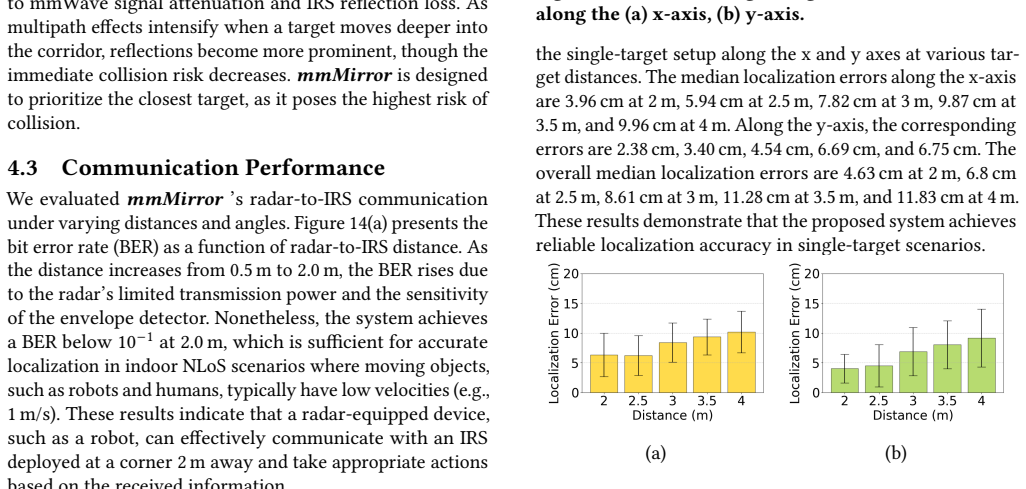
Summary. The paper proposes mmMirror, a device-free NLoS localization system built around a 24 GHz FMCW radar and a PCB-based Van Atta Array (VAA) IRS. The IRS retro-reflects to identify itself to the radar, then switches to one of four discrete reflection angles (30 degrees, 45 degrees, 60 degrees, 75 degrees) to redirect radar energy around a corner. The radar estimates the total path length via 2D-MUSIC and combines it with the known IRS position and the broadcast reflection angle to compute the target location (Eqs. 4-5). The paper also contributes an OOK-based radar-to-IRS communication scheme using two transmit antennas and envelope detection, a multi-radar frequency-division approach based on antenna switching frequencies, and an adaptive time-slot allocation algorithm to scan only areas of interest. Experiments in three indoor environments report median overall localization errors of 4.63 cm at 2 m, 6.8 cm at 2.5 m, 8.61 cm at 3 m, 11.28 cm at 3.5 m, and 11.83 cm at 4 m total radar-target distance for single targets, with somewhat worse errors for multiple targets. Communication bit error rates remain below 10^-1 at up to 2.0 m and 60 degrees. The adaptive scanning reduces average scan time from 7.15 s to 1.80 s for a single target.
Significance. If the reported results hold, mmMirror is one of the few working prototypes of device-free centimeter-level NLoS localization with commodity radar hardware. The experimental evaluation uses a real PCB IRS prototype and a COTS radar, and the localization metrics are measured rather than curve-fit to model parameters, which is a strength. The radar-IRS communication design is novel in that it reuses the FMCW signal as the carrier for OOK data, avoiding additional RF chains at the IRS. The adaptive time-slot algorithm is a sensible system contribution for reducing scan time. However, the significance is currently qualified by the fact that all localization experiments place targets exactly on the discrete IRS beam axes; the general 2D localization claim is not yet supported.
major comments (4)
- [Section 4.2 and Eqs. (4)-(5)] The localization method is fundamentally a 1D range measurement along a known IRS ray, not a 2D positioning of an arbitrary target. The radar measures only the total path length D_RS + D_ST via 2D-MUSIC; the target angle is taken to be the nominal IRS reflection angle alpha_i that the IRS broadcasts. Equations (4) and (5) then project D_ST along that fixed ray. The manuscript explicitly states in Section 4.2 that "we selected four target positions aligned with the mmMirror beam angle," and no experiment places a target between beams. For a target at D_ST = 3 m midway between adjacent beams (offset 7.5 degrees), the lateral position error would be about 39 cm, which is an order of magnitude larger than the reported median 3 m error of 8.61 cm. Thus the headline claim of centimeter-level 2D NLoS localization is unsupported for the general case; the paper should either add an interpolation or secondary measurement to determine the target's angular offset, or restrict its claims to localization along predefined beams.
- [Section 3.2] The statement "This reduces the maximum angular mismatch error to 10.4 cm" is only consistent with a target at approximately 0.8 m from the IRS (0.8 m * tan(7.5 degrees) = 10.5 cm). At the distances evaluated in Section 4.4 (IRS-target distances of 1.0-3.0 m), the same 7.5-degree half-beam spacing produces angular mismatch errors of roughly 13-39 cm. The claim is therefore numerically misleading and should be corrected to state the range at which the 10.4 cm figure applies.
- [Section 3.3 and Figure 14] The radar-to-IRS communication BER reaches about 10^-1 at a distance of 2.0 m and at an angle of 60 degrees. This is a high error rate for a control link that conveys the IRS reflection angle and the area-of-interest commands; a single bit error could cause the IRS to use the wrong beam direction or scan set. The paper does not explain how bit errors are handled (e.g., retransmissions, coding, or acknowledgment), nor whether the localization experiments in Section 4.4 were conducted with error-free communication. Without this information, the end-to-end reliability of mmMirror under realistic operating conditions is not established. The authors should add an error-control mechanism or quantify the impact of communication errors on localization.
- [Section 3.3 and Figure 7] The multi-radar demonstration uses antenna switching frequencies of 1 Hz and 2 Hz, which correspond to data rates of about 1 bit per second per radar; even at the maximum prototype switching frequency of 20 Hz, the data rate is only 10 bps with N_r=1. With an 11-bit packet, a single radar-to-IRS command takes more than 2 seconds at the 10 Hz setting used in the single-radar experiments. This communication latency is not included in the scanning-time reduction numbers in Section 4.5 (Table 3), so the claimed 75% latency reduction for single targets does not account for the full system response time. The authors should include the communication overhead in the latency analysis.
minor comments (7)
- [Abstract and Section 4.4] The abstract says "localization error of 8.93 cm at a 3 m range" while Section 4.4 reports a median overall error of 8.61 cm at a total radar-target distance of 3 m. Please clarify the exact definition of "range" (total path vs. IRS-target distance) and reconcile the two numbers.
- [Section 2.4, Eqs. (4)-(5)] The angle conventions in these equations are not fully defined; in particular, the offset (alpha_i - phi) and the sign of the y-term should be derived from the geometry in Figure 2 so that readers can reproduce the coordinate computation.
- [Section 3.3] The FFT threshold for radar identification is described as "the half of the first peak," which may not be robust when multiple radars have unequal received powers or when a radar is much closer than another. A calibration or normalization procedure would strengthen the evaluation.
- [Section 4.5, Algorithm 3] The constraint in line 23 (D_i >= (r_max_energy^4 / r_i^4) * D_max_energy) is introduced without derivation. Please justify the exponent 4 and explain how reflection energy maps to the required number of chirps.
- [Section 5] The assumption that the radar and IRS are at the same height is stated as a limitation, but the paper does not quantify the sensitivity of localization accuracy to height mismatch. A short robustness experiment or simulation would help the reader judge deployability.
- [Figure 17] The CDFs aggregate over all target distances; per-distance CDFs would be more informative since the error clearly grows with range.
- [General] There are minor typos: "withe" in the Algorithm 1 explanation (Section 3.4) and the broken "˝len(T)" symbol in Algorithm 3 should be fixed.
Circularity Check
No circularity found: the localization accuracy is experimentally measured and the geometric derivation is self-contained.
full rationale
The paper's localization chain is not circular. The target position is computed from a measured radar path length and a known IRS reflection angle: 2D-MUSIC supplies D_RS + D_ST, the radar-to-IRS distance D_RS is separately estimated, and the IRS broadcasts the selected discrete reflection angle alpha_i, which is a switch-configuration state from Table 2 rather than a fitted parameter. Equations (2)-(5) are a geometric projection using these quantities, and none of the reported localization errors is produced by inverting a model fitted to those same errors. The empirically chosen thresholds in Section 3.3 (0.6 amplitude ratio for OOK bits and FFT peak threshold at half of the first peak for radar identification) affect only the communication demodulation link, not the localization position computation. The time-slot allocation evaluation compares the proposed scheduler against its own full-scan baseline and reports measured scanning times and CDFs; this is a performance comparison, not a self-referential prediction. The VAA and IRS principles are attributed to external prior work (e.g., references [3], [35], [37]) with no detectable author-overlapping self-citation chain or imported uniqueness theorem. The main validity concern—that Section 4.2 places targets 'aligned with the mmMirror beam angle' and only four discrete beams are supported, so off-beam targets are not experimentally demonstrated—is an evaluation-scope and generalizability limitation, not a definitional circularity. Therefore no circular step can be exhibited under the required evidence standard.
Assumptions & free parameters
free parameters (3)
- Bit detection amplitude threshold =
0.6 (received amplitude for Bit 0 is less than 0.6 times Bit 1 amplitude)
- FFT peak threshold for radar identification =
Half of the first peak amplitude
- Angular scanning resolution and number of reflection angles =
Four angles: 30, 45, 60, 75 degrees
assumptions (5)
- standard math FMCW beat frequency model: f_b = beta * 2R/c
- standard math Van Atta array reciprocity enables retro-reflection and controlled reflection angles
- domain assumption 2D-MUSIC provides the total path length D_RS + D_ST as the strongest multipath component
- domain assumption Radar and IRS are at the same height and the 2D geometry of Figure 2 applies
- domain assumption The IRS retro-reflection mode can be distinguished from static reflectors by the radar
Cite this review
Pith. "Pith review of mmMirror: Device Free mmWave Indoor NLoS Localization Using Van-Atta-Array IRS." pith.science (2026). https://pith.science/paper/RIM5L5JO
@misc{pith2026250510816,
  author       = {Pith},
  title        = {Pith review of: mmMirror: Device Free mmWave Indoor NLoS Localization Using Van-Atta-Array IRS},
  year         = {2026},
  howpublished = {\url{https://pith.science/paper/RIM5L5JO}},
  note         = {Machine review of arXiv:2505.10816}
}
read the original abstract
Industry 4.0 is transforming manufacturing and logistics by integrating robots into shared human environments, such as factories, warehouses, and healthcare facilities. However, the risk of human-robot collisions, especially in Non-Line-of-Sight (NLoS) scenarios like around corners, remains a critical challenge. Existing solutions, such as vision-based and LiDAR systems, often fail under occlusion, lighting constraints, or privacy concerns, while RF-based systems are limited by range and accuracy. To address these limitations, we propose mmMirror, a novel system leveraging a Van Atta Array-based millimeter-wave (mmWave) reconfigurable intelligent reflecting surface (IRS) for precise, device-free NLoS localization. mmMirror integrates seamlessly with existing frequency-modulated continuous-wave (FMCW) radars and offers: (i) robust NLoS localization with centimeter-level accuracy at ranges up to 3 m, (ii) seamless uplink and downlink communication between radar and IRS, (iii) support for multi-radar and multi-target scenarios via dynamic beam steering, and (iv) reduced scanning latency through adaptive time slot allocation. Implemented using commodity 24 GHz radars and a PCB-based IRS prototype, mmMirror demonstrates its potential in enabling safe human-robot interactions in dynamic and complex environments.
Figures


Figures from the paper (13 more)




Reference graph
Works this paper leans on
-
[1]
2015.{Multi-Person} Localization via{RF} Body Reflections
Fadel Adib, Zachary Kabelac, and Dina Katabi. 2015.{Multi-Person} Localization via{RF} Body Reflections. In12th USENIX Symposium on Networked Systems Design and Implementation (NSDI 15). 279–292
work page 2015
-
[2]
Fadel Adib and Dina Katabi. 2013. See through walls with WiFi!. InProceedings of the ACM SIGCOMM 2013 conference on SIGCOMM. 75–86
work page 2013
-
[3]
Paris Ang and George V Eleftheriades. 2018. A passive redirecting Van Atta-type reflector.IEEE Antennas and Wireless Propagation Letters17, 4 (2018), 689–692
work page 2018
-
[4]
Albin Antony and P Sivraj. 2018. Food delivery automation in restau- rants using collaborative robotics. In2018 International Conference on Inventive Research in Computing Applications (ICIRCA). IEEE, 111–117
work page 2018
-
[5]
Roshan Ayyalasomayajula, Aditya Arun, Chenfeng Wu, Sanatan Sharma, Abhishek Rajkumar Sethi, Deepak Vasisht, and Dinesh Bhara- dia. 2020. Deep learning based wireless localization for indoor navi- gation. InProceedings of the 26th Annual International Conference on Mobile Computing and Networking. 1–14
work page 2020
-
[6]
Kang Min Bae, Namjo Ahn, Yoon Chae, Parth Pathak, Sung-Min Sohn, and Song Min Kim. 2022. OmniScatter: extreme sensitivity mmWave backscattering using commodity FMCW radar. InProceedings of the 20th Annual International Conference on Mobile Systems, Applications and Services. 316–329
work page 2022
-
[7]
Kang Min Bae, Hankyeol Moon, and Song Min Kim. 2024. SuperSight: Sub-cm NLOS Localization for mmWave Backscatter. InProceedings of the 22nd Annual International Conference on Mobile Systems, Appli- cations and Services. 278–291
work page 2024
-
[8]
Kang Min Bae, Hankyeol Moon, Sung-Min Sohn, and Song Min Kim
Show all 58 references
-
[9]
Mathieu Bouet and Aldri L Dos Santos. 2008. RFID tags: Positioning principles and localization techniques. In2008 1st IFIP Wireless Days. Ieee, 1–5
2008
-
[10]
Hou-Tong Chen, Antoinette J Taylor, and Nanfang Yu. 2016. A review of metasurfaces: physics and applications.Reports on progress in physics79, 7 (2016), 076401
2016
-
[11]
Analog Devices. 2024. ADL6010ACPZN. https://www.analog.com/ media/en/technical-documentation/data-sheets/ADL6010.pdf
2024
-
[12]
Analog Devices. 2024. EV-TINYRAD24G. https://www.analog.com/ en/resources/evaluation-hardware-and-software/evaluation-boards- kits/eval-tinyrad.html
2024
-
[13]
Analog Devices. 2024. HMC1084. https://www.analog.com/media/ en/technical-documentation/data-sheets/hmc1084.pdf
2024
-
[14]
Laura Dodds, Hailan Shanbhag, Junfeng Guan, Saurabh Gupta, and Haitham Hassanieh. 2024. Around the Corner mmWave Imaging in Practical Environments. InProceedings of the 30th Annual International Conference on Mobile Computing and Networking(Washington D.C., DC, USA)(ACM MobiCo...
2024 doi
-
[15]
Zahra Esmaeilbeig, Kumar Vijay Mishra, and Mojtaba Soltanalian
-
[16]
KM Goher, Naz Mansouri, and SO Fadlallah. 2017. Assessment of per- sonal care and medical robots from older adults’ perspective.Robotics and biomimetics4 (2017), 1–7
2017
-
[17]
Marco Gunia, Adrian Zinke, Niko Joram, and Frank Ellinger. 2023. Analysis and design of a MuSiC-based angle of arrival positioning system.ACM Transactions on Sensor Networks19, 3 (2023), 1–41
2023
-
[18]
Doyeon Han, Moon Young Park, Junsuk Choi, Heonseop Shin, and Sungsoo Rhim. 2021. Analysis of human-robot physical interaction at collision. In2021 IEEE International Conference on Intelligence and Safety for Robotics (ISR). IEEE, 153–156
2021
-
[19]
Texas Instruments. 2024. AWR6843. https://www.ti.com/product/ AWR6843
2024
-
[20]
Texas Instruments. 2025. AWR2544. https://www.ti.com/product/ AWR2544
2025
-
[21]
Texas Instruments. 2025. IWRL6432W. https://www.ti.com/product/ IWRL6432W
2025
-
[22]
Minseok Kim, Namjo Ahn, and Song Min Kim. 2024. NR-Surface: NextG-ready𝜇W-reconfigurable mmWave Metasurface.. InNSDI
2024
-
[23]
Jonathan Y Lau and Sean V Hum. 2012. Reconfigurable transmitarray design approaches for beamforming applications.IEEE Transactions on Antennas and Propagation60, 12 (2012), 5679–5689
2012
-
[24]
Shengjie Li, Zhaopeng Liu, Yue Zhang, Qin Lv, Xiaopeng Niu, Leye Wang, and Daqing Zhang. 2020. WiBorder: Precise Wi-Fi based bound- ary sensing via through-wall discrimination.Proceedings of the ACM on Interactive, Mobile, Wearable and Ubiquitous Technologies4, 3 (2020), 1–30
2020
-
[25]
Yue Li, Jiayong Peng, Juntian Ye, Yueyi Zhang, Feihu Xu, and Zhiwei Xiong. 2023. Nlost: Non-line-of-sight imaging with transformer. In Proceedings of the IEEE/CVF Conference on Computer Vision and Pattern Recognition. 13313–13322
2023
-
[26]
David B Lindell, Gordon Wetzstein, and Matthew O’Toole. 2019. Wave- based non-line-of-sight imaging using fast fk migration.ACM Trans- actions on Graphics (ToG)38, 4 (2019), 1–13
2019
-
[27]
Chenxi Liu, Xiaoling Hu, Mugen Peng, and Caijun Zhong. 2022. Sens- ing for beamforming: An IRS-enabled integrated sensing and com- munication framework. InICC 2022-IEEE International Conference on Communications. IEEE, 5567–5572
2022
-
[28]
Anagh Malik, Parsa Mirdehghan, Sotiris Nousias, Kyros Kutulakos, and David Lindell. 2024. Transient neural radiance fields for lidar view synthesis and 3d reconstruction.Advances in Neural Information Processing Systems36 (2024)
2024
-
[29]
Felix Naser, Igor Gilitschenski, Alexander Amini, Christina Liao, Guy Rosman, Sertac Karaman, and Daniela Rus. 2019. Infrastructure-free NLoS obstacle detection for autonomous cars. In2019 IEEE/RSJ In- ternational Conference on Intelligent Robots and Systems (IROS). IEEE, 250–257
2019
-
[30]
Allison M Okamura, Maja J Matarić, and Henrik I Christensen. 2010. Medical and health-care robotics.IEEE Robotics & Automation Maga- zine17, 3 (2010), 26–37. Yihe Yan, Zhenguo Shi, Yanxiang Wang, Cheng Jiang, Chun Tung Chou, and Wen Hu
2010
-
[31]
Ryu Okubo, Luke Jacobs, Jinhua Wang, Steven Bowers, and Elahe Soltanaghai. 2024. Integrated two-way radar backscatter communica- tion and sensing with low-power iot tags. InProceedings of the ACM SIGCOMM 2024 Conference. 327–339
2024
-
[32]
Alexander Orth, Patrick Kwiatkowski, and Nils Pohl. 2019. A novel approach for a MIMO FMCW radar system with frequency steered antennas for 3D target localization. In2019 16th European Radar Con- ference (EuRAD). IEEE, 37–40
2019
-
[33]
Sandra Robla-Gómez, Victor M Becerra, José Ramón Llata, Esther Gonzalez-Sarabia, Carlos Torre-Ferrero, and Juan Perez-Oria. 2017. Working together: A review on safe human-robot collaboration in industrial environments.Ieee Access5 (2017), 26754–26773
2017
-
[34]
Nordic Semiconductor. 2024. Power Profiler Kit II. https: //www.nordicsemi.com/Products/Development-hardware/Power- Profiler-Kit-2
2024
-
[35]
E Sharp and M Diab. 1960. Van Atta reflector array.IRE Transactions on Antennas and Propagation8, 4 (1960), 436–438
1960
-
[36]
Sebastjan Šlajpah, Kristina Rakinić, Kristina Nikolovska, Luka Komi- dar, Anja Podlesek, Gaja Zager Kocjan, Marko Munih, and Matjaž Mihelj. 2021. Effect of speed, speed differences, and motion type on perceived safety of collaborative robots. In2021 20th International Conferen...
2021
-
[37]
Elahe Soltanaghaei, Akarsh Prabhakara, Artur Balanuta, Matthew Anderson, Jan M Rabaey, Swarun Kumar, and Anthony Rowe. 2021. Millimetro: mmWave retro-reflective tags for accurate, long range localization. InProceedings of the 27th Annual International Conference on Mobile Comp...
2021
-
[38]
Xianxin Song, Jie Xu, Fan Liu, Tony Xiao Han, and Yonina C Eldar
-
[39]
Microchip Technology. 2024. ATmega328P. https://www.microchip. com/en-us/product/atmega328p
2024
-
[40]
Kamil Trzebiatowski, Mateusz Rzymowski, Lukasz Kulas, and Krzysztof Nyka. 2022. Simple Millimeter Wave Identification Sys- tem Based on 60 GHz Van Atta Arrays.Sensors22, 24 (2022), 9809
2022
-
[41]
In2022 IEEE Globecom Workshops (GC Wkshps)
Intelligent reflecting surface enabled sensing: Cramér-Rao lower bound optimization. In2022 IEEE Globecom Workshops (GC Wkshps). IEEE, 413–418
-
[42]
Jue Wang and Dina Katabi. 2013. Dude, where’s my card? RFID posi- tioning that works with multipath and non-line of sight. InProceedings of the ACM SIGCOMM 2013 conference on SIGCOMM. 51–62
2013
-
[43]
Shunjun Wei, Jinshan Wei, Xinyuan Liu, Mou Wang, Shan Liu, Fan Fan, Xiaoling Zhang, Jun Shi, and Guolong Cui. 2021. Nonline-of-sight 3-D imaging using millimeter-wave radar.IEEE Transactions on Geoscience and Remote Sensing60 (2021), 1–18
2021
-
[44]
Andreas Velten, Thomas Willwacher, Otkrist Gupta, Ashok Veer- araghavan, Moungi G Bawendi, and Ramesh Raskar. 2012. Recovering three-dimensional shape around a corner using ultrafast time-of-flight imaging.Nature communications3, 1 (2012), 745
2012
-
[45]
Timothy Woodford, Kun Qian, and Xinyu Zhang. 2023. Metasight: High-Resolution NLoS Radar with Efficient Metasurface Encoding. In Proceedings of the 21st ACM Conference on Embedded Networked Sensor Systems. 308–321
2023
-
[46]
Timothy Woodford, Xinyu Zhang, Eugene Chai, and Karthikeyan Sundaresan. 2022. Mosaic: Leveraging diverse reflector geometries for omnidirectional around-corner automotive radar. InProceedings of the 20th Annual International Conference on Mobile Systems, Applications and Servi...
2022
-
[47]
Fangqing Wen, Han Wang, Guan Gui, Hikmet Sari, and Fumiyuki Adachi. 2024. Polarized intelligent reflecting surface aided 2D-DOA estimation for NLoS sources.IEEE Transactions on Wireless Communi- cations(2024)
2024
-
[48]
You Xu, Guanghua Liu, and Tao Jiang. 2023. Leveraging Rough-Relay- Surface Scattering for Non-Line-of-Sight mmWave Radar Sensing. IEEE Internet of Things Journal(2023)
2023
-
[49]
Zhiyun Yao, Xuanzhi Wang, Kai Niu, Rong Zheng, Junzhe Wang, and Daqing Zhang. 2024. WiProfile: Unlocking Diffraction Effects for Sub-Centimeter Target Profiling Using Commodity WiFi Devices. InProceedings of the 30th Annual International Conference on Mobile Computing and Netw...
2024
-
[50]
Qingqing Wu and Rui Zhang. 2019. Towards smart and reconfigurable environment: Intelligent reflecting surface aided wireless network. IEEE communications magazine58, 1 (2019), 106–112
2019
-
[51]
Juntian Ye, Yu Hong, Xiongfei Su, Xin Yuan, and Feihu Xu. 2024. Plug- and-Play Algorithms for Dynamic Non-line-of-sight Imaging.ACM Transactions on Graphics(2024)
2024
-
[52]
Adam B Yedidia, Manel Baradad, Christos Thrampoulidis, William T Freeman, and Gregory W Wornell. 2019. Using unknown occluders to recover hidden scenes. InProceedings of the IEEE/CVF Conference on Computer Vision and Pattern Recognition. 12231–12239
2019
-
[53]
Jia Ye, Shuaishuai Guo, and Mohamed-Slim Alouini. 2020. Joint re- flecting and precoding designs for SER minimization in reconfigurable intelligent surfaces assisted MIMO systems.IEEE Transactions on Wireless Communications19, 8 (2020), 5561–5574
2020
-
[54]
Shichao Yue, Hao He, Peng Cao, Kaiwen Zha, Masayuki Koizumi, and Dina Katabi. 2022. CornerRadar: RF-based indoor localization around corners.Proceedings of the ACM on Interactive, Mobile, Wearable and Ubiquitous Technologies6, 1 (2022), 1–24
2022
-
[55]
Rudolf Zetik, Marcus Eschrich, Snezhana Jovanoska, and Reiner S Thoma. 2015. Looking behind a corner using multipath-exploiting UWB radar.IEEE Transactions on aerospace and electronic systems51, 3 (2015), 1916–1926
2015
-
[56]
Yue Yu, Ruizhi Chen, Liang Chen, Xingyu Zheng, Dewen Wu, Wei Li, and Yuan Wu. 2021. A novel 3-D indoor localization algorithm based on BLE and multiple sensors.IEEE Internet of Things Journal8, 11 (2021), 9359–9372
2021
-
[2022]
In2022 IEEE 12th Sensor Array and Multichannel Signal Processing Workshop (SAM)
IRS-aided radar: Enhanced target parameter estimation via intelligent reflecting surfaces. In2022 IEEE 12th Sensor Array and Multichannel Signal Processing Workshop (SAM). IEEE, 286–290
-
[2023]
InProceedings of the 21st Annual International Conference on Mobile Systems, Applications and Services
Hawkeye: Hectometer-range subcentimeter localization for large-scale mmWave backscatter. InProceedings of the 21st Annual International Conference on Mobile Systems, Applications and Services. 303–316
Reviewed August 15, 2026 · model on record in the stance chip above.
Discussion (0). Continue with ORCID to comment.