REVIEW 5 major objections 5 minor 1 cited by
DesignFromX: Empowering Consumer-Driven Design Space Exploration through Feature Composition of Referenced Products
T0 review · 5 major / 5 minor · reviewed 2026-08-15 · deepseek-v4-flash
Pith's one-line read The paper claims that clicking on parts of reference images and composing the detected features into one's own product lets consumers explore more design options than manually prompting an image generator.
desk verdict A useful integration of off-the-shelf GenAI components for consumer design, with a genuine measurement confound undercutting its headline 'features explored' result. read the letter →
The pith
A machine-rendered reading of the paper's core claim, the machinery that carries it, and where it could break.
The reading
What carries the argument
The central mechanism is the feature-composition pipeline. A click-driven segmentation model (SAM 2) extracts the component a user points to; a large-language-model agent (GPT-4o) analyzes that component into eight named design features—color, style, texture, shape, structure, mechanism, electronic, and ergonomic; and a second language-model step rewrites the initial design description, which an image-editing model (DALL·E 2) uses to visualize the updated product. This pipeline converts a visual reference into structured, composable attributes, so users can iterate by adding features from different products without writing prompts from scratch.
What would settle it
A think-aloud study in which novice consumers freely describe what they would change about a product, without being shown the eight-category list, would settle the taxonomy question: if more than about a quarter of the changes they name cannot be mapped onto color, style, texture, shape, structure, mechanism, electronic, or ergonomic features, the system's feature analysis and its 'features explored' metric are biased toward the system's own ontology rather than consumers' actual preferences.
Extended reading notes
Core claim
DesignFromX's central claim is that a click-to-compose pipeline lets consumers explore more of a product's design space than manually describing reference features and prompting an image generator. In the within-subject user study (N=24), DesignFromX significantly increased the number of design features explored (M=8.333 vs 6.625, p=0.023) and the number of new designs generated (M=81.667 vs 66.25, p=0.042), and significantly raised self-reported enjoyment (p=0.002) and immersion (p=0.003) while lowering effort (p=0.037). The paper reads these results as evidence that lowering the barrier to feature analysis and prompt formulation reduces frustration and supports consumer-driven design space exploration.
Load-bearing premise
The load-bearing premise is that the fixed eight-category feature list—color, style, texture, shape, structure, mechanism, electronic, and ergonomic—is a valid and sufficiently complete map of the design features consumers care about, so that counting those categories measures how much design space was explored.
Editorial extensions
If this is right
- Consumers will explore more functional features—especially mechanism and ergonomics—because the system translates visual references into selectable terms they would not otherwise know how to name.
- Novices can generate many more candidate designs per session, giving them a larger design space to choose from and increasing satisfaction with their final design.
- Design support tools can offload prompt formulation from the user to an LLM chain, reducing the effort needed to drive text-to-image models.
- Because expert ratings of final designs were similar across conditions, the system's advantage lies in the process and experience of exploration rather than in producing objectively better products.
- Treating design as incremental local edits rather than full regeneration lets consumers build step by step and keep earlier choices intact.
Reading between the lines
- A direct extension would be to replace the fixed eight-category taxonomy with an open-ended vocabulary generated per product, which would test whether the taxonomy itself or the act of structured decomposition drives the exploration gains.
- The logged chains of features users select could be aggregated across participants to reveal preference patterns, effectively turning the tool into a lightweight market-research instrument for designers.
- The study measured exploration and experience, not manufacturability; coupling feature composition with parametric CAD or physical constraints would test whether broader exploration translates into buildable products.
- Several participants wanted to edit or refine the system's suggested features and prompts, suggesting that a hybrid mode with direct prompt or parameter control might combine the exploration benefits with the controllability expert designers need.
Signed reviews
Editorial analysis
A structured set of objections, weighed in public.
Referee Report
Summary. The paper presents DesignFromX, a GenAI-based design support system that lets consumers explore product design space by clicking on components in reference images, receiving LLM-generated feature analyses organized into an eight-category taxonomy, and composing selected features into a base design via DALL-E image editing, with optional 3D model generation. The authors report a formative study (N=8), a module-quality evaluation (segmentation accuracy, feature-analysis ratings), and a within-subject user study (N=24) comparing DesignFromX with a manual-prompt baseline that shares the same interface and underlying image-generation model. They report that DesignFromX significantly increased the number of features explored and the number of new designs generated, and that participants reported higher enjoyment, immersion, and transparency, with lower effort. The abstract additionally claims that DesignFromX lowers frustration, although the reported frustration comparison is not significant.
Significance. The contribution is timely: consumer participation in product design through generative AI is an active HCI topic, and the proposed workflow—interactive segmentation, LLM-driven feature decomposition, and visual feature composition—is a plausible way to reduce articulation barriers for novice users. The two-phase evaluation, including expert ratings of module outputs and a counterbalanced within-subject comparison, is a serious empirical effort. The paper also provides concrete interaction examples and failure cases (Fig. 10) and discusses trade-offs such as user control versus exploration in a balanced way. However, the headline quantitative claims rest on a non-invariant measure and on uncorrected multiple comparisons, and one reported significant result (effort) is contradicted by the direction of the means as reported. The central claim is therefore plausible but not yet established.
major comments (5)
- [5.4.2, Table 1] The dependent variable 'number of features explored' is not measured in the same way in the two conditions. In DesignFromX, the count comes from selections in the system's own feature table (pop-up C in Fig. 3), whereas in the baseline it is derived post hoc from free-text prompts (Section 5.4.2: 'we classified the design features identified by participants by analyzing the prompts'). The DesignFromX interface makes the eight feature categories salient and selection a one-click action, while the baseline requires spontaneous recall and articulation. The reported difference (8.333 vs 6.625, p=0.023) may therefore reflect the measurement instrument rather than a genuine difference in exploration behavior. This measurement-invariance issue is more fundamental than taxonomy completeness: even if the eight categories are a perfect representation, the two conditions are still measured with different instruments. Please use condition-blind coding of interaction logs or of the final products for both conditions, and report inter-rater reliability.
- [Abstract, 6.2.3, Appendix A.3] The abstract states that DesignFromX 'lowers the barriers and frustration,' and the conclusion repeats the engagement/enjoyment framing, but the NASA-TLX frustration comparison is not significant (DesignFromX M=1.917, SD=1.176; Baseline M=2.167, SD=0.963; p=0.265; r=-0.271), and the other workload subscales except effort are also non-significant. The claim of frustration reduction is not supported by the reported data and should be removed or reframed as a directional trend.
- [5.4.4, Tables 1-2, Figures 9-11] Many Wilcoxon signed-rank tests are reported (Tables 1-2, Figures 9-11), but no correction for multiple comparisons (e.g., FDR or Bonferroni) is applied. With roughly 20 tests, p-values such as 0.042 and 0.038 would not survive correction, and even p=0.023 is not robust. Please report the total number of comparisons, apply a correction or pre-registered hypotheses, and interpret marginal effects accordingly.
- [6.2.3, Figure 11] The effort result is internally inconsistent. The text says DesignFromX significantly reduced effort and reports a negative effect size (r=-0.729), which the paper defines as DesignFromX having a lower score. However, the reported means are DesignFromX M=3.042 vs Baseline M=2.471 on the NASA-TLX effort subscale, where higher scores conventionally mean more effort. Either the scale direction is reversed or the conclusion is the opposite; please clarify the coding and verify the reported comparison.
- [Table 2] The significant increase in the number of new designs generated (81.667 vs 66.25, p=0.042) is potentially confounded with time on task: time spending is marginally non-significant (25.694 vs 20.885 minutes, p=0.056), and minutes per image generated is not significant (p=0.229). If participants simply used DesignFromX longer, a higher raw count of generated images would follow. Please report a rate-based analysis (designs per minute) or otherwise control for time on task.
minor comments (5)
- [5.3.1] There is an unfinished placeholder, 'nnnn period.', after the participant recruitment paragraph; please remove or complete it.
- [Throughout] Typos remain, including 'desgin' in Section 3.3, 'atheistic' in Section 2.2, and 'metrices' in Appendix A.3; a copyedit pass is needed.
- [5.4.3] The questionnaire items described as 'qualitative data' are Likert-scale ratings (quantitative self-report measures); please use the term 'subjective ratings' or distinguish these from the interview data.
- [Figure 12] The SUS figure reports only descriptive results for DesignFromX with no baseline comparison and no explicit scale in the caption; please state the SUS scoring range, sample size, and whether a statistical comparison was performed.
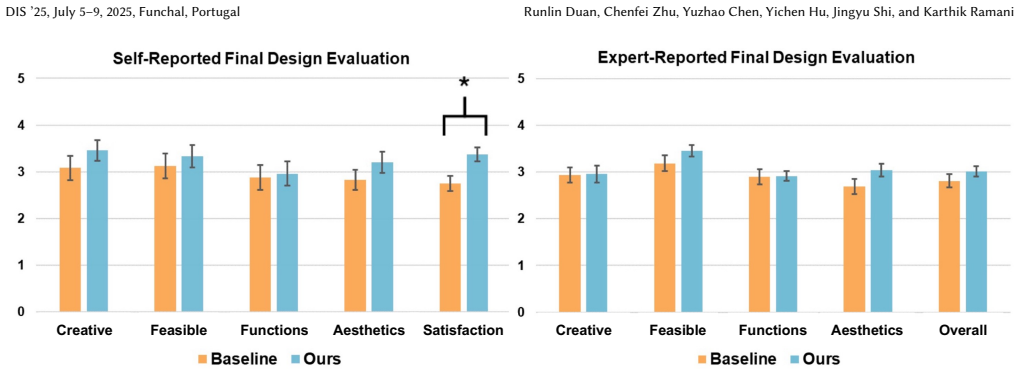
- [6.3.2, Figure 13] The caption of Figure 13 does not clearly distinguish the self-reported and expert-reported panels; please label each panel and state which rows correspond to which rater group.
Circularity Check
The headline 'features explored' metric is measured from the system's own feature-selection checklist in the treatment but from free-text prompts in the baseline, making the increase partly an artifact of the measurement procedure.
-
self definitional
[Sections 4.3, 5.4.2, and 6.1.1; Table 1]
"the system decomposes and analyzes the queried component, extracting its aesthetic (i.e., Color, Style, Texture, and Shape) and functional (i.e., Structure, Electronic, Mechanism, and Ergonomic) design features... Users can explore these features and select the ones they find appealing. ... we measured the number of design features identified by participants... Additionally, we classified the design features identified by participants by analyzing the prompts used to generate images of new designs. ..."
'Features explored' is scored with different instruments across the two arms. In DesignFromX it is the count of items selected from the system's own eight-category feature table, which is generated by the system's feature-analysis module and presented as a clickable checklist. In the baseline it is a post hoc classification of free-text prompts. The treatment thus supplies the answer categories and makes selecting one a trivial action, while the baseline requires recall and articulation under time pressure.
full rationale
The paper is not circular in the sense of deriving its central outputs from a self-citation chain. The feature taxonomy is grounded in external product-design references ([22], [21], [53], [7]); the module-quality evaluation uses human-annotated ground truth; the self-report results (enjoyment, immersion, effort, transparency) come from independent questionnaire items; and no load-bearing uniqueness theorem is imported from the authors' prior work. The one substantive circularity is in the operationalization of the primary process metric, 'features explored.' In the DesignFromX condition the count is the number of selections from the system-generated eight-category feature table; in the baseline the count is obtained by post hoc classification of participants' free-text prompts. These are not equivalent measures: one is a recognition/click task on the treatment's own output, the other is a recall/articulation task. Therefore the significant difference in Table 1 and the category-level comparisons for mechanism and ergonomic are partly an artifact of the intervention defining the dependent variable. This is a partial circularity, not a total one: the engagement/experience findings and the number-of-designs finding are measured with comparable procedures and retain independent content.
Assumptions & free parameters
assumptions (6)
- domain assumption The eight-category design feature taxonomy (color, style, texture, shape, structure, mechanism, electronic, ergonomic) is a valid and sufficiently complete representation of consumer-relevant product features.
- domain assumption GPT-4o zero-shot analysis of masked component images produces accurate, consistent feature descriptions.
- domain assumption DALL-E 2 image editing can faithfully visualize composed design features in the designated region without unintended changes elsewhere.
- domain assumption The user study sample (24 university-recruited participants without design training) is representative of the target 'consumer' population.
- domain assumption The formative study (N=8) yields insights that generalize to the broader novice-consumer population.
- standard math Wilcoxon signed-rank test assumptions (paired data, symmetric differences under the null) are met.
Cite this review
Pith. "Pith review of DesignFromX: Empowering Consumer-Driven Design Space Exploration through Feature Composition of Referenced Products." pith.science (2026). https://pith.science/paper/MM4CGLN5
@misc{pith2026250511666,
  author       = {Pith},
  title        = {Pith review of: DesignFromX: Empowering Consumer-Driven Design Space Exploration through Feature Composition of Referenced Products},
  year         = {2026},
  howpublished = {\url{https://pith.science/paper/MM4CGLN5}},
  note         = {Machine review of arXiv:2505.11666}
}
read the original abstract
Industrial products are designed to satisfy the needs of consumers. The rise of generative artificial intelligence (GenAI) enables consumers to easily modify a product by prompting a generative model, opening up opportunities to incorporate consumers in exploring the product design space. However, consumers often struggle to articulate their preferred product features due to their unfamiliarity with terminology and their limited understanding of the structure of product features. We present DesignFromX, a system that empowers consumer-driven design space exploration by helping consumers to design a product based on their preferences. Leveraging an effective GenAI-based framework, the system allows users to easily identify design features from product images and compose those features to generate conceptual images and 3D models of a new product. A user study with 24 participants demonstrates that DesignFromX lowers the barriers and frustration for consumer-driven design space explorations by enhancing both engagement and enjoyment for the participants.
Figures


Figures from the paper (10 more)



Forward citations
Cited by 1 Pith paper
-
An Exploratory Study on Multi-modal Generative AI in AR Storytelling
The paper maps how storytellers prefer to use AI-generated text, audio, images, videos, and 3D content to augment AR stories, based on a 223-video analysis and two user studies with 30 participants.
Reference graph
Works this paper leans on
-
[1]
Suyun Sandra Bae, Oh-Hyun Kwon, Senthil Chandrasegaran, and Kwan-Liu Ma. 2020. Spinneret: Aiding creative ideation through non-obvious concept associations. InProceedings of the 2020 CHI Conference on Human Factors in Computing Systems. 1–13
2020
-
[2]
Yuntao Bai, Andy Jones, Kamal Ndousse, Amanda Askell, Anna Chen, Nova DasSarma, Dawn Drain, Stanislav Fort, Deep Ganguli, Tom Henighan, et al
-
[3]
Leif P Berg and Judy M Vance. 2017. Industry use of virtual reality in product design and manufacturing: a survey.Virtual reality21 (2017), 1–17
2017
-
[4]
Gregor Betz, Kyle Richardson, and Christian Voigt. 2021. Thinking aloud: Dynamic context generation improves zero-shot reasoning performance of gpt-2.arXiv preprint arXiv:2103.13033(2021)
arXiv 2021
-
[5]
Rishi Bommasani, Drew A Hudson, Ehsan Adeli, Russ Altman, Simran Arora, Sydney von Arx, MS Bernstein, J Bohg, A Bosselut, E Brunskill, et al . 2021. DIS ’25, July 5–9, 2025, Funchal, Portugal Runlin Duan, Chenfei Zhu, Yuzhao Chen, Yichen Hu, Jingyu Shi, and Karthik Ramani On the opportunities and risks of foundation models. arXiv.arXiv preprint arXiv:2108...
arXiv 2021
-
[6]
Stephen Brade, Bryan Wang, Mauricio Sousa, Sageev Oore, and Tovi Gross- man. 2023. Promptify: Text-to-image generation through interactive prompt exploration with large language models. InProceedings of the 36th Annual ACM Symposium on User Interface Software and Technology. 1–14
2023
-
[7]
Ole Broberg. 1997. Integrating ergonomics into the product development process. International journal of industrial ergonomics19, 4 (1997), 317–327
1997
-
[8]
Tom B Brown. 2020. Language models are few-shot learners.arXiv preprint arXiv:2005.14165(2020)
arXiv 2020
Show all 115 references
-
[9]
Zhenyao Cai, Seehee Park, Nia Nixon, and Shayan Doroudi. 2024. Advancing Knowledge Together: Integrating Large Language Model-based Conversational AI in Small Group Collaborative Learning. InExtended Abstracts of the CHI Conference on Human Factors in Computing Systems. 1–9
2024
-
[10]
Erin A Carroll and Celine Latulipe. 2012. Triangulating the personal creative experience: self-report, external judgments, and physiology. InProceedings of Graphics Interface 2012. 53–60
2012
-
[11]
Hsi-Jen Chen, Chen Yan-Ting, and Yang Chia-Han. 2022. Behaviors of novice and expert designers in the design process: From discovery to design.International Journal of Design16, 3 (2022)
2022
-
[12]
Qing Chen, Wei Shuai, Jiyao Zhang, Zhida Sun, and Nan Cao. 2024. Beyond Numbers: Creating Analogies to Enhance Data Comprehension and Commu- nication with Generative AI. InProceedings of the CHI Conference on Human Factors in Computing Systems. 1–14
2024
-
[13]
Ting-Ju Chen, Ronak R Mohanty, Miguel A Hoffmann Rodriguez, and Vinayak R Krishnamurthy. 2019. Collaborative mind-mapping: a study of patterns, strate- gies, and evolution of maps created by peer-pairs. InInternational Design Engi- neering Technical Conferences and Computers a...
2019
-
[14]
Ting-Ju Chen, Sai Ganesh Subramanian, and Vinayak R Krishnamurthy. 2019. Mini-map: Mixed-initiative mind-mapping via contextual query expansion. In AIAA Scitech 2019 Forum. 2347
2019
-
[15]
Ting-Ju Chen, Sai Ganesh Subramanian, and Vinayak R Krishnamurthy. 2020. Qcue: Queries and cues for computer-facilitated mind-mapping. InGraphics Interface 2020
2020
-
[16]
Yuexi Chen, Vlad I Morariu, Anh Truong, and Zhicheng Liu. 2024. TutoAI: a cross-domain framework for AI-assisted mixed-media tutorial creation on phys- ical tasks. InProceedings of the CHI Conference on Human Factors in Computing Systems. 1–17
2024
-
[17]
Erin Cherry and Celine Latulipe. 2014. Quantifying the creativity support of digital tools through the creativity support index.ACM Transactions on Computer-Human Interaction (TOCHI)21, 4 (2014), 1–25
2014
-
[18]
Lydia B Chilton, Ecenaz Jen Ozmen, Sam H Ross, and Vivian Liu. 2021. VisiFit: Structuring iterative improvement for novice designers. InProceedings of the 2021 CHI Conference on Human Factors in Computing Systems. 1–14
2021
-
[19]
DaEun Choi, Sumin Hong, Jeongeon Park, John Joon Young Chung, and Juho Kim. 2024. CreativeConnect: Supporting Reference Recombination for Graphic Design Ideation with Generative AI. InProceedings of the CHI Conference on Human Factors in Computing Systems. 1–25
2024
-
[20]
John Joon Young Chung and Eytan Adar. 2023. Promptpaint: Steering text-to- image generation through paint medium-like interactions. InProceedings of the 36th Annual ACM Symposium on User Interface Software and Technology. 1–17
2023
-
[21]
Del Coates. 2003. Watches tell more than time: Product design, information, and the quest for elegance.(No Title)(2003)
2003
-
[22]
Nathan Crilly, James Moultrie, and P John Clarkson. 2004. Seeing things: con- sumer response to the visual domain in product design.Design studies25, 6 (2004), 547–577
2004
-
[23]
Ioana Croitoru, Simion-Vlad Bogolin, Samuel Albanie, Yang Liu, Zhaowen Wang, Seunghyun Yoon, Franck Dernoncourt, Hailin Jin, and Trung Bui. 2023. Moment detection in long tutorial videos. InProceedings of the IEEE/CVF international conference on computer vision. 2594–2604
2023
-
[24]
Robert E Cummings, Stephen M Monroe, and Marc Watkins. 2024. Generative AI in first-year writing: An early analysis of affordances, limitations, and a framework for the future.Computers and Composition71 (2024), 102827
2024
-
[25]
Hai Dang, Lukas Mecke, and Daniel Buschek. 2022. Ganslider: How users control generative models for images using multiple sliders with and without feedforward information. InProceedings of the 2022 CHI Conference on Human Factors in Computing Systems. 1–15
2022
-
[26]
Richard Lee Davis, Thiemo Wambsganss, Wei Jiang, Kevin Gonyop Kim, Tanja Käser, and Pierre Dillenbourg. 2024. Fashioning Creative Expertise with Gener- ative AI: Graphical Interfaces for GAN-Based Design Space Exploration Beter Support Ideation Than Text Prompts for Difusion M...
2024
-
[27]
Fernanda De La Torre, Cathy Mengying Fang, Han Huang, Andrzej Banburski- Fahey, Judith Amores Fernandez, and Jaron Lanier. 2024. Llmr: Real-time prompt- ing of interactive worlds using large language models. InProceedings of the CHI Conference on Human Factors in Computing Sys...
2024
-
[28]
Xin Dong, Evgeniy Gabrilovich, Geremy Heitz, Wilko Horn, Ni Lao, Kevin Murphy, Thomas Strohmann, Shaohua Sun, and Wei Zhang. 2014. Knowledge vault: A web-scale approach to probabilistic knowledge fusion. InProceedings of the 20th ACM SIGKDD international conference on Knowledg...
2014
-
[29]
Anil R Doshi and Oliver Hauser. 2023. Generative artificial intelligence enhances creativity.A vailable at SSRN(2023)
2023
-
[30]
Runlin Duan, Shao-Kang Hsia, Yuzhao Chen, Yichen Hu, Ming Yin, and Karthik Ramani. 2025. Investigating Creativity in Humans and Generative AI Through Circles Exercises.arXiv preprint arXiv:2502.07292(2025)
2025 arXiv
-
[31]
Runlin Duan, Xiyun Hu, Min Liu, Jingyu Shi, and Karthik Ramani. 2025. pARa- metric: Empowering In Situ Parametric Modeling in Augment Reality for Per- sonal Fabrication.Journal of Computing and Information Science in Engineering 25, 4 (2025), 041001
2025
-
[32]
Runlin Duan, Nachiketh Karthik, Jingyu Shi, Rahul Jain, Maria C Yang, and Karthik Ramani. 2024. ConceptVis: Generating and Exploring Design Con- cepts for Early-Stage Ideation Using Large Language Model. InInternational Design Engineering Technical Conferences and Computers an...
2024
-
[33]
M Fabian, Kasneci Gjergji, WEIKUM Gerhard, et al . 2007. Yago: A core of semantic knowledge unifying wordnet and wikipedia. In16th International world wide web conference, WWW. 697–706
2007
-
[34]
Jonas Frich, Midas Nouwens, Kim Halskov, and Peter Dalsgaard. 2021. How digital tools impact convergent and divergent thinking in design ideation. In Proceedings of the 2021 CHI conference on human factors in computing systems. 1–11
2021
-
[35]
Tianyu Gao, Adam Fisch, and Danqi Chen. 2020. Making pre-trained language models better few-shot learners.arXiv preprint arXiv:2012.15723(2020)
2020 arXiv
-
[36]
Frederic Gmeiner, Humphrey Yang, Lining Yao, Kenneth Holstein, and Nikolas Martelaro. 2023. Exploring challenges and opportunities to support designers in learning to co-create with AI-based manufacturing design tools. InProceedings of the 2023 CHI Conference on Human Factors ...
2023
-
[37]
Ashok K Goel and Susan Craw. 2005. Design, innovation and case-based rea- soning.The Knowledge Engineering Review20, 3 (2005), 271–276
2005
-
[38]
Johann Felipe Gonzalez, Danny Kieken, Thomas Pietrzak, Audrey Girouard, and Géry Casiez. 2023. Introducing bidirectional programming in constructive solid geometry-based CAD. InProceedings of the 2023 ACM symposium on spatial user interaction. 1–12
2023
-
[39]
Henrik Hagtvedt and Vanessa M Patrick. 2014. Consumer response to over- styling: Balancing aesthetics and functionality in product design.Psychology & Marketing31, 7 (2014), 518–525
2014
-
[40]
Ji Han, Hannah Forbes, and Dirk Schaefer. 2021. An exploration of how creativity, functionality, and aesthetics are related in design.Research in Engineering Design 32, 3 (2021), 289–307
2021
-
[41]
Ji Han, Serhad Sarica, Feng Shi, and Jianxi Luo. 2022. Semantic networks for engineering design: state of the art and future directions.Journal of Mechanical Design144, 2 (2022), 020802
2022
-
[42]
SG Hart. 1988. Development of NASA-TLX (Task Load Index): Results of empir- ical and theoretical research.Human mental workload/Elsevier(1988)
1988
-
[43]
Yihan Hou, Manling Yang, Hao Cui, Lei Wang, Jie Xu, and Wei Zeng. 2024. C2Ideas: Supporting Creative Interior Color Design Ideation with a Large Lan- guage Model. InProceedings of the CHI Conference on Human Factors in Comput- ing Systems. 1–18
2024
-
[44]
Youngseung Jeon, Seungwan Jin, Patrick C Shih, and Kyungsik Han. 2021. Fash- ionQ: an ai-driven creativity support tool for facilitating ideation in fashion design. InProceedings of the 2021 CHI Conference on Human Factors in Computing Systems. 1–18
2021
-
[45]
Peiling Jiang, Jude Rayan, Steven P Dow, and Haijun Xia. 2023. Graphologue: Exploring large language model responses with interactive diagrams. InPro- ceedings of the 36th Annual ACM Symposium on User Interface Software and Technology. 1–20
2023
-
[46]
Jian Jin, Ying Liu, Ping Ji, and Hongguang Liu. 2016. Understanding big con- sumer opinion data for market-driven product design.International Journal of Production Research54, 10 (2016), 3019–3041
2016
-
[47]
Rupinder P Jindal, Kumar R Sarangee, Raj Echambadi, and Sangwon Lee. 2016. Designed to succeed: Dimensions of product design and their impact on market share.Journal of Marketing80, 4 (2016), 72–89
2016
-
[48]
Eunkyung Jo, Yuin Jeong, SoHyun Park, Daniel A Epstein, and Young-Ho Kim
-
[49]
Rubaiat Habib Kazi, Tovi Grossman, Hyunmin Cheong, Ali Hashemi, and George W Fitzmaurice. 2017. DreamSketch: Early Stage 3D Design Explorations with Sketching and Generative Design.. InUIST, Vol. 14. 401–414
2017
-
[50]
Bernhard Kerbl, Georgios Kopanas, Thomas Leimkühler, and George Drettakis
-
[51]
Shahroz Khan, Panagiotis Kaklis, and Kosa Goucher-Lambert. 2023. How does agency impact human-AI collaborative design space exploration? A case study on ship design with deep generative models. InInternational Design Engineering Technical Conferences and Computers and Informat...
2023
-
[52]
Hongbin Kim and Kwangsoo Kim. 2012. Causality-based function network for identifying technological analogy.Expert Systems with Applications39, 12 (2012), 10607–10619
2012
-
[53]
Seung Jin Kim and Sami Kara. 2012. Impact of technology on product life cycle design: Functional and environmental perspective. InLeveraging Technology for a Sustainable World: Proceedings of the 19th CIRP Conference on Life Cycle Engineering, University of California at Berke...
2012
-
[54]
Janin Koch, Andrés Lucero, Lena Hegemann, and Antti Oulasvirta. 2019. May AI? Design ideation with cooperative contextual bandits. InProceedings of the 2019 CHI Conference on Human Factors in Computing Systems. 1–12
2019
-
[55]
Barry Matthew Kudrowitz and David Wallace. 2013. Assessing the quality of ideas from prolific, early-stage product ideation.Journal of Engineering Design 24, 2 (2013), 120–139
2013
-
[56]
Jaewook Lee, Jun Wang, Elizabeth Brown, Liam Chu, Sebastian S Rodriguez, and Jon E Froehlich. 2024. GazePointAR: A Context-Aware Multimodal Voice Assis- tant for Pronoun Disambiguation in Wearable Augmented Reality. InProceedings of the CHI Conference on Human Factors in Compu...
2024
-
[57]
Mina Lee, Megha Srivastava, Amelia Hardy, John Thickstun, Esin Durmus, Ashwin Paranjape, Ines Gerard-Ursin, Xiang Lisa Li, Faisal Ladhak, Frieda Rong, et al. 2022. Evaluating human-language model interaction.arXiv preprint arXiv:2212.09746(2022)
2022 arXiv
-
[58]
Seung Won Lee, Tae Hee Jo, Semin Jin, Jiin Choi, Kyungwon Yun, Sergio Bromberg, Seonghoon Ban, and Kyung Hoon Hyun. 2024. The Impact of Sketch- guided vs. Prompt-guided 3D Generative AIs on the Design Exploration Process. InProceedings of the CHI Conference on Human Factors in...
2024
-
[59]
Xiang Lisa Li and Percy Liang. 2021. Prefix-tuning: Optimizing continuous prompts for generation.arXiv preprint arXiv:2101.00190(2021)
2021 arXiv
-
[60]
Zhuoyan Li, Chen Liang, Jing Peng, and Ming Yin. 2024. The Value, Benefits, and Concerns of Generative AI-Powered Assistance in Writing. InProceedings of the CHI Conference on Human Factors in Computing Systems. 1–25
2024
-
[61]
Yuyu Lin, Jiahao Guo, Yang Chen, Cheng Yao, and Fangtian Ying. 2020. It is your turn: Collaborative ideation with a co-creative robot through sketch. In Proceedings of the 2020 CHI conference on human factors in computing systems. 1–14
2020
-
[62]
Hugo Liu and Push Singh. 2004. ConceptNet—a practical commonsense reason- ing tool-kit.BT technology journal22, 4 (2004), 211–226
2004
-
[63]
Vivian Liu, Han Qiao, and Lydia Chilton. 2022. Opal: Multimodal image genera- tion for news illustration. InProceedings of the 35th Annual ACM Symposium on User Interface Software and Technology. 1–17
2022
-
[64]
Vivian Liu, Jo Vermeulen, George Fitzmaurice, and Justin Matejka. 2023. 3DALL- E: Integrating text-to-image AI in 3D design workflows. InProceedings of the 2023 ACM designing interactive systems conference. 1955–1977
2023
-
[65]
Ziyi Liu, Zhengzhe Zhu, Lijun Zhu, Enze Jiang, Xiyun Hu, Kylie A Peppler, and Karthik Ramani. 2024. ClassMeta: Designing Interactive Virtual Classmate to Promote VR Classroom Participation. InProceedings of the CHI Conference on Human Factors in Computing Systems. 1–17
2024
-
[66]
Michael Luchs and K Scott Swan. 2011. Perspective: The emergence of product design as a field of marketing inquiry.Journal of Product Innovation Management 28, 3 (2011), 327–345
2011
-
[67]
Jianxi Luo, Serhad Sarica, and Kristin L Wood. 2019. Computer-aided design ideation using InnoGPS. InInternational design engineering technical conferences and computers and information in engineering conference, Vol. 59186. American Society of Mechanical Engineers, V02AT03A011
2019
-
[68]
Jianxi Luo, Binyang Song, Lucienne Blessing, and Kristin Wood. 2018. Design opportunity conception using the total technology space map.Ai Edam32, 4 (2018), 449–461
2018
-
[69]
Atefeh Mahdavi Goloujeh, Anne Sullivan, and Brian Magerko. 2024. Is It AI or Is It Me? Understanding Users’ Prompt Journey with Text-to-Image Generative AI Tools. InProceedings of the CHI Conference on Human Factors in Computing Systems. 1–13
2024
-
[70]
Ben Mildenhall, Pratul P Srinivasan, Matthew Tancik, Jonathan T Barron, Ravi Ramamoorthi, and Ren Ng. 2021. Nerf: Representing scenes as neural radiance fields for view synthesis.Commun. ACM65, 1 (2021), 99–106
2021
-
[71]
George A Miller. 1995. WordNet: a lexical database for English.Commun. ACM 38, 11 (1995), 39–41
1995
-
[72]
OpenAI. 2023. GPT-4. https://openai.com/research/gpt-4. Accessed: 2025-01-18
2023
-
[73]
OpenAI. 2024. DALL·E 3. https://openai.com/research/dall-e. Accessed: 2025- 01-18
2024
-
[74]
Savvas Petridis, Nicholas Diakopoulos, Kevin Crowston, Mark Hansen, Keren Henderson, Stan Jastrzebski, Jeffrey V Nickerson, and Lydia B Chilton. 2023. Anglekindling: Supporting journalistic angle ideation with large language mod- els. InProceedings of the 2023 CHI conference o...
2023
-
[75]
Cecil Piya, Vinayak , Senthil Chandrasegaran, Niklas Elmqvist, and Karthik Ramani. 2017. Co-3Deator: A team-first collaborative 3D design ideation tool. In Proceedings of the 2017 CHI conference on human factors in computing systems
2017
-
[76]
Vesna Popovic. 2000. Expert and novice user differences and implications for product design and useability. InProceedings of the Human Factors and Ergonomics Society Annual Meeting, Vol. 44. SAGE Publications Sage CA: Los Angeles, CA, 933–936
2000
-
[77]
Lena Qian and John S Gero. 1996. Function–behavior–structure paths and their role in analogy-based design.AI EDAM10, 4 (1996), 289–312
1996
-
[78]
Nikhila Ravi, Valentin Gabeur, Yuan-Ting Hu, Ronghang Hu, Chaitanya Ryali, Tengyu Ma, Haitham Khedr, Roman Rädle, Chloe Rolland, Laura Gustafson, Eric Mintun, Junting Pan, Kalyan Vasudev Alwala, Nicolas Carion, Chao-Yuan Wu, Ross Girshick, Piotr Dollár, and Christoph Feichtenh...
2024 arXiv
-
[79]
Robin Rombach, Andreas Blattmann, Dominik Lorenz, Patrick Esser, and Björn Ommer. 2022. High-resolution image synthesis with latent diffusion models. In Proceedings of the IEEE/CVF conference on computer vision and pattern recognition. 10684–10695
2022
-
[80]
Serhad Sarica and Jianxi Luo. 2021. Design knowledge representation with technology semantic network.Proceedings of the Design Society1 (2021), 1043– 1052
2021
-
[81]
Serhad Sarica, Jianxi Luo, and Kristin L Wood. 2020. TechNet: Technology semantic network based on patent data.Expert Systems with Applications142 (2020), 112995
2020
-
[82]
Orit Shaer, Angelora Cooper, Osnat Mokryn, Andrew L Kun, and Hagit Ben Shoshan. 2024. AI-Augmented Brainwriting: Investigating the use of LLMs in group ideation. InProceedings of the CHI Conference on Human Factors in Computing Systems. 1–17
2024
-
[83]
Chuyi Shang, Emi Tran, Medhini Narasimhan, Sanjay Subramanian, Dan Klein, and Trevor Darrell. 2023. LUSE: Using LLMs for Unsupervised Step Extraction in Instructional Videos
2023
-
[84]
Feng Shi, Liuqing Chen, Ji Han, and Peter Childs. 2017. A data-driven text mining and semantic network analysis for design information retrieval.Journal of Mechanical Design139, 11 (2017), 111402
2017
-
[85]
Jingyu Shi, Rahul Jain, Hyungjun Doh, Ryo Suzuki, and Karthik Ramani. 2023. An HCI-centric survey and taxonomy of human-generative-AI interactions. arXiv preprint arXiv:2310.07127(2023)
2023 arXiv
-
[86]
Jingyu Shi, Rahul Jain, Runlin Duan, and Karthik Ramani. 2023. Understanding Generative AI in Art: An Interview Study with Artists on G-AI from an HCI Perspective.arXiv preprint arXiv:2310.13149(2023)
2023 arXiv
-
[87]
Yang Shi, Yechun Peng, Shengqi Dang, Nanxuan Zhao, and Nan Cao. 2024. Personalizing Products with Stylized Head Portraits for Self-Expression. In Proceedings of the CHI Conference on Human Factors in Computing Systems. 1–18
2024
-
[88]
Kihoon Son, DaEun Choi, Tae Soo Kim, Young-Ho Kim, and Juho Kim. 2024. Genquery: Supporting expressive visual search with generative models. In Proceedings of the CHI Conference on Human Factors in Computing Systems. 1–19
2024
-
[89]
Feifan Song, Bowen Yu, Minghao Li, Haiyang Yu, Fei Huang, Yongbin Li, and Houfeng Wang. 2024. Preference ranking optimization for human alignment. InProceedings of the AAAI Conference on Artificial Intelligence, Vol. 38. 18990– 18998
2024
-
[90]
Hyeonik Song and Katherine Fu. 2022. Design-by-analogy: Effects of exploration- based approach on analogical retrievals and design outcomes.Journal of Me- chanical Design144, 6 (2022), 061401
2022
-
[91]
Robyn Speer, Joshua Chin, and Catherine Havasi. 2017. Conceptnet 5.5: An open multilingual graph of general knowledge. InProceedings of the AAAI conference on artificial intelligence, Vol. 31
2017
-
[92]
Sangho Suh, Meng Chen, Bryan Min, Toby Jia-Jun Li, and Haijun Xia. 2024. Luminate: Structured generation and exploration of design space with large language models for human-ai co-creation. InProceedings of the 2024 CHI Con- ference on Human Factors in Computing Systems. 1–26
2024
-
[93]
Brian Sylcott, Jonathan Cagan, and Golnaz Tabibnia. 2013. Understanding con- sumer tradeoffs between form and function through metaconjoint and cognitive neuroscience analyses.Journal of Mechanical Design135, 10 (2013), 101002
2013
-
[94]
Romal Thoppilan, Daniel De Freitas, Jamie Hall, Noam Shazeer, Apoorv Kul- shreshtha, Heng-Tze Cheng, Alicia Jin, Taylor Bos, Leslie Baker, Yu Du, et al. 2022. Lamda: Language models for dialog applications.arXiv preprint arXiv:2201.08239 (2022)
2022 arXiv
-
[95]
Josh Urban Davis, Fraser Anderson, Merten Stroetzel, Tovi Grossman, and George Fitzmaurice. 2021. Designing co-creative ai for virtual environments. In Proceedings of the 13th Conference on Creativity and Cognition. 1–11
2021
-
[96]
A Vaswani. 2017. Attention is all you need.Advances in Neural Information Processing Systems(2017). DIS ’25, July 5–9, 2025, Funchal, Portugal Runlin Duan, Chenfei Zhu, Yuzhao Chen, Yichen Hu, Jingyu Shi, and Karthik Ramani
2017
-
[97]
Mathias Peter Verheijden and Mathias Funk. 2023. Collaborative diffusion: Boosting designerly co-creation with generative AI. InExtended abstracts of the 2023 CHI conference on human factors in computing systems. 1–8
2023
-
[98]
Samangi Wadinambiarachchi, Ryan M Kelly, Saumya Pareek, Qiushi Zhou, and Eduardo Velloso. 2024. The Effects of Generative AI on Design Fixation and Divergent Thinking. InProceedings of the CHI Conference on Human Factors in Computing Systems. 1–18
2024
-
[99]
Boheng Wang, Haoyu Zuo, Zebin Cai, Yuan Yin, Peter Childs, Lingyun Sun, and Liuqing Chen. 2023. A Task-Decomposed AI-Aided Approach for Generative Conceptual Design. InInternational Design Engineering Technical Conferences and Computers and Information in Engineering Conferenc...
2023
-
[100]
Shun-Yu Wang, Wei-Chung Su, Serena Chen, Ching-Yi Tsai, Marta Misztal, Katherine M Cheng, Alwena Lin, Yu Chen, and Mike Y Chen. 2024. Room- Dreaming: Generative-AI Approach to Facilitating Iterative, Preliminary Interior Design Exploration. InProceedings of the CHI Conference ...
2024
-
[101]
Ye Wang, Nicole Goridkov, Vivek Rao, Dixun Cui, Daniele Grandi, and Kosa Goucher-Lambert. 2023. Embedding experiential design knowledge in interac- tive knowledge graphs.Journal of Mechanical Design145, 4 (2023), 041412
2023
-
[102]
Yufei Wang, Wanjun Zhong, Liangyou Li, Fei Mi, Xingshan Zeng, Wenyong Huang, Lifeng Shang, Xin Jiang, and Qun Liu. 2023. Aligning large language models with human: A survey.arXiv preprint arXiv:2307.12966(2023)
2023 arXiv
-
[103]
Zhijie Wang, Yuheng Huang, Da Song, Lei Ma, and Tianyi Zhang. 2024. PromptCharm: Text-to-Image Generation through Multi-modal Prompting and Refinement. InProceedings of the CHI Conference on Human Factors in Computing Systems. 1–21
2024
-
[104]
Tongshuang Wu, Ellen Jiang, Aaron Donsbach, Jeff Gray, Alejandra Molina, Michael Terry, and Carrie J Cai. 2022. Promptchainer: Chaining large language model prompts through visual programming. InCHI Conference on Human Factors in Computing Systems Extended Abstracts. 1–10
2022
-
[105]
Tongshuang Wu, Michael Terry, and Carrie Jun Cai. 2022. Ai chains: Transpar- ent and controllable human-ai interaction by chaining large language model prompts. InProceedings of the 2022 CHI conference on human factors in computing systems. 1–22
2022
-
[106]
Jiale Xu, Weihao Cheng, Yiming Gao, Xintao Wang, Shenghua Gao, and Ying Shan. 2024. Instantmesh: Efficient 3d mesh generation from a single image with sparse-view large reconstruction models.arXiv preprint arXiv:2404.07191 (2024)
2024 arXiv
-
[107]
Maria C Yang. 2009. Observations on concept generation and sketching in engineering design.Research in Engineering Design20 (2009), 1–11
2009
-
[108]
Hongbo Zhang, Pei Chen, Xuelong Xie, Chaoyi Lin, Lianyan Liu, Zhuoshu Li, Weitao You, and Lingyun Sun. 2024. ProtoDreamer: A Mixed-prototype Tool Combining Physical Model and Generative AI to Support Conceptual Design. InProceedings of the 37th Annual ACM Symposium on User Int...
2024
-
[109]
Lvmin Zhang, Anyi Rao, and Maneesh Agrawala. 2023. Adding conditional control to text-to-image diffusion models. InProceedings of the IEEE/CVF inter- national conference on computer vision. 3836–3847
2023
-
[110]
Yue Zhang, Yafu Li, Leyang Cui, Deng Cai, Lemao Liu, Tingchen Fu, Xinting Huang, Enbo Zhao, Yu Zhang, Yulong Chen, et al . 2024. Siren’s song in the AI ocean: A survey on hallucination in large language models, 2023.URL https://arxiv. org/abs/2309.01219(2024)
2024 arXiv
-
[111]
Tongyu Zhou, Jeff Huang, and Gromit Yeuk-Yin Chan. 2024. Epigraphics: Message-Driven Infographics Authoring. InProceedings of the CHI Conference on Human Factors in Computing Systems. 1–18
2024
-
[112]
IQ2:"When designing a product, what do you consider the most important factor and why?
Qihao Zhu and Jianxi Luo. 2023. Generative transformers for design concept generation.Journal of Computing and Information Science in Engineering23, 4 (2023), 041003. A Appendix A.1 Evaluation Result on the Quality of System Modules We present the evaluation result on the qual...
2023
-
[2022]
Training a helpful and harmless assistant with reinforcement learning from human feedback.arXiv preprint arXiv:2204.05862(2022)
2022 arXiv
-
[2023]
DFX DIS ’25, July 5–9, 2025, Funchal, Portugal Graph.42, 4 (2023), 139–1
3D Gaussian splatting for real-time radiance field rendering.ACM Trans. DFX DIS ’25, July 5–9, 2025, Funchal, Portugal Graph.42, 4 (2023), 139–1
2023
-
[2024]
InProceedings of the CHI Conference on Human Factors in Computing Systems
Understanding the Impact of Long-Term Memory on Self-Disclosure with Large Language Model-Driven Chatbots for Public Health Intervention. InProceedings of the CHI Conference on Human Factors in Computing Systems. 1–21
Reviewed August 15, 2026 · model on record in the stance chip above.
Discussion (0). Continue with ORCID to comment.