A fast and automated approach for urban CFD simulations: integration with meteorological predictions and its application to drone flights
Pith reviewed 2026-05-22 16:08 UTC · model grok-4.3
The pith
A CFD method that imports LiDAR and cadastral data directly with meteorological boundary conditions reproduces observed urban winds and supports faster drone interaction tests.
A machine-rendered reading of the paper's core claim, the machinery that carries it, and where it could break.
Core claim
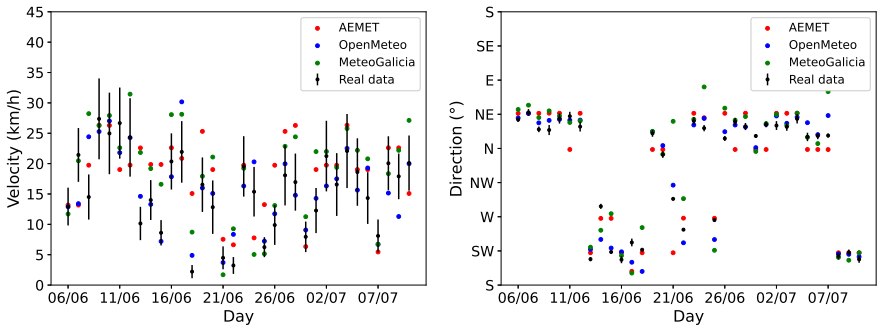
By importing LiDAR and cadastral data without intermediate manual refinement to define the simulation geometry and by using meteorological predictions to set boundary conditions, the CFD model produces urban wind fields whose direction and speed agree with station measurements to concordance correlation coefficients of 0.985 and 0.853; these fields then validate a wind-tunnel representation of a moving drone that reproduces the same interactions at far lower computational cost than a full urban-domain run.
What carries the argument
Direct import of LiDAR and cadastral data to generate terrain, building, vegetation, water, and ground geometry inside the CFD domain, coupled with meteorological predictions as inflow boundary conditions.
If this is right
- Urban wind fields can be generated without labor-intensive geometry cleanup steps.
- Drone-wind interaction studies can be performed by extracting currents from the city model and testing them in a separate wind-tunnel simulation.
- Computation time for drone path validation drops substantially compared with embedding the vehicle inside the full urban mesh.
- Meteorological forecasts can be used directly as time-varying boundary conditions for city-scale airflow predictions.
Where Pith is reading between the lines
- Frequent LiDAR updates could enable near-real-time urban wind maps for operational drone routing.
- The same automated pipeline might be applied to wind-load assessment on bridges, towers, or pedestrian zones.
- Coupling the extracted wind fields with trajectory optimizers could produce safer autonomous flight corridors in variable urban winds.
- Extension to larger metropolitan domains would require only parallel computing resources rather than new modeling techniques.
Load-bearing premise
LiDAR and cadastral data imported without further manual refinement or detailed vegetation modeling still produce a geometry accurate enough to capture the dominant wind interactions with urban features.
What would settle it
A side-by-side comparison at the meteorological station location that yields concordance correlations well below the reported 0.985 for direction or 0.853 for speed would falsify the claim that the model reproduces real urban winds.
Figures




read the original abstract
In past years, several studies have proposed new methods and applications for urban wind simulations. In this article, we present a fast and automatic methodology for reconstructing airflows within urban environments using LiDAR and cadastral data coupled with Computational Fluid Dynamics (CFD) simulations. Our approach integrates meteorological predictions with computational techniques to simulate the complex interactions between wind currents, buildings, vegetation, water zones and terrain morphology within urban environments. Accurate boundary conditions based on meteorological predictions are introduced into a coupled methodology that directly creates the terrain shape inside the simulation environment, simplifying the geometry creation process, which is one of the most prevalent problems in CFD urban simulations. The simulation results are confronted against ground-truth real data obtained from a meteorological station, showing strong agreement with the outcomes generated by the proposed CFD model, with a concordance correlation coefficient up to $\rho_c = 0.985$ for the wind direction and $\rho_c = 0.853$ for the wind speed. The results from these simulations are then used for validating a wind tunnel approach that mimics the interaction between a moving drone and the extracted wind currents, demonstrating a great improvement in computation times when compared to the most straightforward approach that consists in embedding the drone within the full urban landscape. This research contributes to the advancement of urban CFD modeling, and it has significant implications for various applications, providing valuable insights for urban development.
Editorial analysis
A structured set of objections, weighed in public.
Referee Report
Summary. The manuscript presents an automated pipeline for urban CFD wind simulations that directly imports LiDAR and cadastral data to generate terrain, buildings, vegetation, water zones, and morphology inside the solver, couples this geometry with meteorological boundary conditions, validates the resulting wind fields against an independent meteorological station (reporting concordance correlation coefficients up to ρ_c = 0.985 for direction and 0.853 for speed), and then employs the simulated wind fields to validate a reduced-order wind-tunnel model for drone–wind interactions that yields substantial computational savings relative to embedding the drone in the full-city domain.
Significance. If the validation evidence is robust, the work would provide a practical, low-setup-time route to urban wind modeling with direct relevance to drone flight planning and urban planning. The integration of real meteorological predictions and the reported speed-up for the drone application are clear strengths; however, the evidential weight of the station comparison hinges on whether the direct-import geometry adequately represents the dominant drag and turbulence sources.
major comments (1)
- [Methods / Geometry creation] The central validation claim (concordance with station data) rests on the premise that direct LiDAR + cadastral import produces a geometry that correctly captures wind interactions with vegetation. The manuscript states that the approach simulates “complex interactions between wind currents, buildings, vegetation, water zones and terrain morphology” yet provides no description of how vegetation is represented (solid obstacle, porous-media zone, or volumetric drag term parameterized by leaf-area density). In urban CFD this choice is load-bearing; omission or incorrect treatment would systematically under-predict drag and turbulence production, undermining the interpretation of the reported ρ_c values. A concrete statement of the vegetation modeling (or a justification that it is negligible at the station location) is required.
minor comments (2)
- [Abstract and Results] The abstract reports ρ_c values but supplies neither error bars, the number of data points, nor any mention of data exclusion criteria; these details should appear in the validation section or a supplementary table.
- [Validation section] Notation for the concordance coefficient is introduced without reference to the standard definition (Lin, 1989) or to the precise implementation used; a short methods paragraph or citation would remove ambiguity.
Simulated Author's Rebuttal
We thank the referee for their careful and constructive review of our manuscript. The single major comment identifies a genuine omission in the description of vegetation representation within the automated geometry pipeline. We have revised the manuscript to supply the requested concrete statement, thereby strengthening the interpretation of the station validation results without altering the underlying methodology or reported metrics.
read point-by-point responses
-
Referee: [Methods / Geometry creation] The central validation claim (concordance with station data) rests on the premise that direct LiDAR + cadastral import produces a geometry that correctly captures wind interactions with vegetation. The manuscript states that the approach simulates “complex interactions between wind currents, buildings, vegetation, water zones and terrain morphology” yet provides no description of how vegetation is represented (solid obstacle, porous-media zone, or volumetric drag term parameterized by leaf-area density). In urban CFD this choice is load-bearing; omission or incorrect treatment would systematically under-predict drag and turbulence production, undermining the interpretation of the reported ρ_c values. A concrete statement of the vegetation modeling (or a justification that it is negligible at the station location) is required.
Authors: We agree that an explicit description of vegetation treatment is necessary to support the validation claims. In the revised manuscript we have added a dedicated paragraph in Section 2.2 (Geometry generation) stating that vegetation is modeled as a volumetric porous-medium zone. Leaf-area density is derived directly from the classified LiDAR returns within each grid cell; a quadratic drag term with coefficients taken from the literature for urban canopy elements is then applied to the momentum equations. We have also confirmed and now report that the meteorological station used for validation lies in a largely open area with negligible local vegetation cover, so that any modeling uncertainty in the vegetation term has minimal influence on the measured ρ_c values. These additions are presented without changing the numerical results or the overall conclusions. revision: yes
Circularity Check
No significant circularity; validation uses external station data and direct time comparisons
full rationale
The paper derives urban wind fields from LiDAR/cadastral geometry plus meteorological boundary conditions, then validates the resulting fields against independent ground-truth measurements from a meteorological station (concordance coefficients ρ_c = 0.985 direction, 0.853 speed). This agreement is an external benchmark rather than a fitted or self-defined quantity. The drone-related claim is a straightforward wall-clock comparison between a wind-tunnel surrogate and a full-city embedding simulation; neither step reduces by the paper's own equations to a parameter that was tuned on the target result. No self-citation is invoked as a uniqueness theorem or load-bearing premise, and no ansatz or renaming is presented as a derivation. The chain therefore remains self-contained against external data.
Axiom & Free-Parameter Ledger
axioms (1)
- domain assumption Standard turbulence closure models in CFD are adequate to represent urban-scale wind flows when geometry is supplied by LiDAR and cadastral data.
Lean theorems connected to this paper
-
IndisputableMonolith/Cost/FunctionalEquation.leanwashburn_uniqueness_aczel unclear?
unclearRelation between the paper passage and the cited Recognition theorem.
realizable k-ε turbulent Reynolds-Averaged Navier-Stokes (RANS) model... neutral Atmospheric Boundary Layer (ABL) logarithmic approximation... variable roughness wall parameter
What do these tags mean?
- matches
- The paper's claim is directly supported by a theorem in the formal canon.
- supports
- The theorem supports part of the paper's argument, but the paper may add assumptions or extra steps.
- extends
- The paper goes beyond the formal theorem; the theorem is a base layer rather than the whole result.
- uses
- The paper appears to rely on the theorem as machinery.
- contradicts
- The paper's claim conflicts with a theorem or certificate in the canon.
- unclear
- Pith found a possible connection, but the passage is too broad, indirect, or ambiguous to say the theorem truly supports the claim.
Reference graph
Works this paper leans on
-
[1]
Influence of surrounding buildings on wind flow around a building predicted by CFD simulations
Sumei Liu, Wuxuan Pan, Xingwang Zhao, Hao Zhang, Xionglei Cheng, Zhengwei Long, and Qingyan Chen. Influence of surrounding buildings on wind flow around a building predicted by CFD simulations. Building and Environment , 140:1–10, 2018
work page 2018
-
[2]
Im- pacts of orography on large-scale atmospheric circulation
Irina Sandu, Annelize van Niekerk, Theodore G Shepherd, Simon B Vosper, Ayrton Zadra, Julio Bacmeister, Anton Beljaars, Andrew R Brown, Andreas D¨ ornbrack, Norman McFarlane, et al. Im- pacts of orography on large-scale atmospheric circulation. npj Climate and Atmospheric Science , 2(1):10, 2019
work page 2019
-
[3]
A review on the CFD analysis of urban microclimate
Yasin Toparlar, Bert Blocken, Bino Maiheu, and Gertjan Jan F van Heijst. A review on the CFD analysis of urban microclimate. Renewable and Sustainable Energy Reviews , 80:1613–1640, 2017
work page 2017
-
[4]
The dynamics of global urban expansion
Shlomo Angel, Stephen Sheppard, Daniel L Civco, Robert Buckley, Anna Chabaeva, Lucy Gitlin, Alison Kraley, Jason Parent, Micah Perlin, et al. The dynamics of global urban expansion . World Bank, Transport and Urban Development Department Washington, DC, 2005. 14
work page 2005
-
[5]
Philippe Bocquier. World Urbanization Prospects: an alternative to the UN model of projection compatible with the mobility transition theory. Demographic Research, 12:197–236, 2005
work page 2005
-
[6]
CFD modeling of micro and urban climates: Problems to be solved in the new decade
Parham A Mirzaei. CFD modeling of micro and urban climates: Problems to be solved in the new decade. Sustainable Cities and Society , 69:102839, 2021
work page 2021
-
[7]
CFD model to study pm 10 dispersion in large-scale open spaces
V´ ıctor Manuel Fern´ andez-Pacheco, Eduardo´Alvarez-´Alvarez, Eduardo Blanco-Marigorta, and T Ackermann. CFD model to study pm 10 dispersion in large-scale open spaces. Scientific Reports, 13(1):5966, 2023
work page 2023
-
[8]
AKM Chu, Ron Chi-Wai Kwok, and KN Yu. Study of pollution dispersion in urban areas using Computational Fluid Dynamics (CFD) and Geographic Information System (GIS).Environmental Modelling & Software , 20(3):273–277, 2005
work page 2005
-
[9]
Jonas Allegrini, Viktor Dorer, and Jan Carmeliet. Coupled CFD, radiation and building energy model for studying heat fluxes in an urban environment with generic building configurations. Sustainable Cities and Society , 19:385–394, 2015
work page 2015
-
[10]
Ventilation time recommendation system incorporating local meteorological data
Alberto P Mu˜ nuzuri, Alberto Otero-Cacho, and Jorge Mira. Ventilation time recommendation system incorporating local meteorological data. Indoor and Built Environment , 31(5):1418–1437, 2022
work page 2022
-
[11]
CFD simulation research on residential indoor air quality
Li Yang, Miao Ye, et al. CFD simulation research on residential indoor air quality. Science of the Total Environment, 472:1137–1144, 2014
work page 2014
-
[12]
CFD methods in architecture and city planning
SA Valger and NN Fedorova. CFD methods in architecture and city planning. In Journal of Physics: Conference Series , volume 1425, page 012124. IOP Publishing, 2019
work page 2019
-
[13]
Bert Blocken, WD Janssen, and Twan van Hooff. CFD simulation for pedestrian wind comfort and wind safety in urban areas: General decision framework and case study for the Eindhoven University campus. Environmental Modelling & Software , 30:15–34, 2012
work page 2012
-
[14]
CFD simulation of urban microclimate: Validation using high-resolution field measurements
Nestoras Antoniou, Hamid Montazeri, Marina Neophytou, and Bert Blocken. CFD simulation of urban microclimate: Validation using high-resolution field measurements. Science of the total environment, 695:133743, 2019
work page 2019
-
[15]
Blanca de Miguel Molina and Marival Segarra O˜ na. The drone sector in Europe.Ethics and Civil Drones: European Policies and Proposals for the Industry , pages 7–33, 2018
work page 2018
-
[16]
Drone trans- portation of blood products
Timothy Amukele, Paul M Ness, Aaron AR Tobian, Joan Boyd, and Jeff Street. Drone trans- portation of blood products. Transfusion, 57(3):582–588, 2017
work page 2017
-
[17]
Locating AED enabled medical drones to enhance cardiac arrest response times
Aaron Pulver, Ran Wei, and Clay Mann. Locating AED enabled medical drones to enhance cardiac arrest response times. Prehospital Emergency Care, 20(3):378–389, 2016
work page 2016
-
[18]
The economic and operational value of using drones to transport vaccines
Leila A Haidari, Shawn T Brown, Marie Ferguson, Emily Bancroft, Marie Spiker, Allen Wilcox, Ramya Ambikapathi, Vidya Sampath, Diana L Connor, and Bruce Y Lee. The economic and operational value of using drones to transport vaccines. Vaccine, 34(34):4062–4067, 2016
work page 2016
-
[19]
Benjamin Koger, Adwait Deshpande, Jeffrey T Kerby, Jacob M Graving, Blair R Costelloe, and Iain D Couzin. Quantifying the movement, behaviour and environmental context of group-living animals using drones and computer vision. Journal of Animal Ecology , 92(7):1357–1371, 2023
work page 2023
-
[20]
Computer-automated bird detection and counts in high-resolution aerial images: a review
Dominique Chabot and Charles M Francis. Computer-automated bird detection and counts in high-resolution aerial images: a review. Journal of Field Ornithology , 87(4):343–359, 2016
work page 2016
-
[21]
Drone-surveillance for search and rescue in natural disaster
Balmukund Mishra, Deepak Garg, Pratik Narang, and Vipul Mishra. Drone-surveillance for search and rescue in natural disaster. Computer Communications, 156:1–10, 2020
work page 2020
-
[22]
Drone applications for supporting disaster management
Agoston Restas. Drone applications for supporting disaster management. World Journal of Engineering and Technology, 3(3):316–321, 2015
work page 2015
-
[23]
Use of drones in sports broadcasting
Zehra Betul Ayranci. Use of drones in sports broadcasting. Ent. & Sports Law. , 33:79, 2016. 15
work page 2016
-
[24]
Taha Benarbia and Kyandoghere Kyamakya. A literature review of drone-based package delivery logistics systems and their implementation feasibility. Sustainability, 14(1):360, 2021
work page 2021
-
[25]
Drone delivery systems and energy management: a review and future trends
Mohammad Sadra Rajabi, Pedram Beigi, and Sina Aghakhani. Drone delivery systems and energy management: a review and future trends. Handbook of smart energy systems , pages 1–19, 2023
work page 2023
-
[26]
CFD simulations of wind distribution in an urban community with a full-scale geometrical model
Sumei Liu, Wuxuan Pan, Hao Zhang, Xionglei Cheng, Zhengwei Long, and Qingyan Chen. CFD simulations of wind distribution in an urban community with a full-scale geometrical model. Building and environment , 117:11–23, 2017
work page 2017
-
[27]
Investigation of multi-level wind flow characteristics and pedestrian comfort in a tropical city
AZ Dhunny, N Samkhaniani, MR Lollchund, and SDDV Rughooputh. Investigation of multi-level wind flow characteristics and pedestrian comfort in a tropical city. Urban Climate, 24:185–204, 2018
work page 2018
-
[28]
The effect of an urban park on the microclimate in its vicinity: a case study for Antwerp, Belgium
Y Toparlar, B Blocken, B v Maiheu, and GJF Van Heijst. The effect of an urban park on the microclimate in its vicinity: a case study for Antwerp, Belgium. International Journal of Climatology, 38:e303–e322, 2018
work page 2018
-
[29]
Johannes Brozovsky, Are Simonsen, and Niki Gaitani. Validation of a CFD model for the evalu- ation of urban microclimate at high latitudes: A case study in Trondheim, Norway. Building and Environment, 205:108175, 2021
work page 2021
-
[30]
Towards automatic reconstruction of 3d city models tailored for urban flow simulations
Ivan Paden, Clara Garc´ ıa-S´ anchez, and Hugo Ledoux. Towards automatic reconstruction of 3d city models tailored for urban flow simulations. front. Built Environ, 8:899332, 2022
work page 2022
-
[31]
Automatic high-detailed building reconstruction workflow for urban microscale simulations
Ivan Pa den, Ravi Peters, Clara Garc´ ıa-S´ anchez, and Hugo Ledoux. Automatic high-detailed building reconstruction workflow for urban microscale simulations. Building and Environment , 265:111978, 2024
work page 2024
-
[32]
Review of research advances in CFD techniques for the simulation of urban wind environments
Pengfei Ju, Mingrui Li, and Jingying Wang. Review of research advances in CFD techniques for the simulation of urban wind environments. Fluid Dynamics and Materials Processing, 18(2):449– 462, 2021
work page 2021
-
[33]
Bert Blocken. Computational Fluid Dynamics for urban physics: Importance, scales, possibili- ties, limitations and ten tips and tricks towards accurate and reliable simulations. Building and Environment, 91:219–245, 2015
work page 2015
-
[34]
Satellite imagery classification with LiDAR data
MC Alonso and JA Malpica. Satellite imagery classification with LiDAR data. Trees (A), 2106(19):11, 2010
work page 2010
-
[35]
Simcenter STAR-CCM+ User Guide v
Siemens Digital Industries Software. Simcenter STAR-CCM+ User Guide v. 2021.1, Siemens 2021
work page 2021
-
[36]
Joel H Ferziger, Milovan Peri´ c, and Robert L Street.Computational methods for fluid dynamics . springer, 2019
work page 2019
-
[37]
Pijush K Kundu, Ira M Cohen, David R Dowling, and Jesse Capecelatro. Fluid mechanics . Elsevier, 2024
work page 2024
-
[38]
Xin Wang and Kevin F McNamara. Evaluation of CFD simulation using RANS turbulence models for building effects on pollutant dispersion. Environmental Fluid Mechanics, 6:181–202, 2006
work page 2006
-
[39]
Alessandro Parente, Catherine Gorl´ e, Jeroen van Beeck, and Carlo Benocci. A comprehensive modelling approach for the neutral atmospheric boundary layer: consistent inflow conditions, wall function and turbulence model. Boundary-layer meteorology, 140(3):411–428, 2011
work page 2011
-
[40]
Wolfgang Rodi. Experience with two-layer models combining the k-epsilon model with a one- equation model near the wall. In 29th Aerospace sciences meeting, page 216, 1991
work page 1991
-
[41]
Nikolai Shurupov, Ram´ on Molinero-Parejo, V´ ıctor M Rodr´ ıguez-Espinosa, Francisco Aguilera- Benavente, et al. Clasificador Catastral: complemento de QGIS para la clasificaci´ on de los usos del suelo urbano a nivel de parcela. Bolet´ ın de la Asociaci´ on de Ge´ ografos Espa˜ noles, (97), 2023. 16
work page 2023
-
[42]
An improved LOD specification for 3D building models
Filip Biljecki, Hugo Ledoux, and Jantien Stoter. An improved LOD specification for 3D building models. Computers, environment and urban systems , 59:25–37, 2016
work page 2016
-
[43]
A Ricci, I Kalkman, Bert Blocken, M Burlando, A Freda, and MP Repetto. Local-scale forcing effects on wind flows in an urban environment: Impact of geometrical simplifications. Journal of wind engineering and industrial aerodynamics , 170:238–255, 2017
work page 2017
-
[44]
David Eberly. Triangulation by ear clipping. Geometric Tools, pages 2002–2005, 2008
work page 2002
-
[45]
CFD simulation of the wind field in Jinjiang City using a building data generalization method
Mengxi Li, Xinfa Qiu, Juanjun Shen, Jinqin Xu, Bo Feng, Yongjian He, Guoping Shi, and Xi- aochen Zhu. CFD simulation of the wind field in Jinjiang City using a building data generalization method. Atmosphere, 10(6):326, 2019
work page 2019
-
[46]
Amir A Aliabadi, Nikolaos Veriotes, and Gon¸ calo Pedro. A Very Large-Eddy Simulation (VLES) model for the investigation of the neutral atmospheric boundary layer. Journal of Wind Engi- neering and Industrial Aerodynamics, 183:152–171, 2018
work page 2018
-
[47]
CFD simulation of the atmospheric boundary layer: wall function problems
Bert Blocken, Ted Stathopoulos, and Jan Carmeliet. CFD simulation of the atmospheric boundary layer: wall function problems. Atmospheric environment, 41(2):238–252, 2007
work page 2007
-
[48]
Improved k–εmodel and wall function formulation for the RANS simulation of ABL flows
Alessandro Parente, Catherine Gorl´ e, J Van Beeck, and Carlo Benocci. Improved k–εmodel and wall function formulation for the RANS simulation of ABL flows. Journal of wind engineering and industrial aerodynamics, 99(4):267–278, 2011
work page 2011
-
[49]
Updating the Davenport roughness classification
Jon Wieringa. Updating the Davenport roughness classification. Journal of Wind Engineering and Industrial Aerodynamics, 41(1-3):357–368, 1992
work page 1992
-
[50]
Runnan Fu, Ivan Pa den, and Clara Garc´ ıa-S´ anchez. Should we care about the level of detail in trees when running urban microscale simulations? Sustainable Cities and Society , 101:105143, 2024
work page 2024
-
[51]
A new approach for roughness representation within urban dispersion models
F Di Nicola, E Brattich, and S Di Sabatino. A new approach for roughness representation within urban dispersion models. Atmospheric Environment, 283:119181, 2022
work page 2022
-
[52]
CFD analysis on airfoil at high angles of attack
P PrabhakaraRao and V Sampath. CFD analysis on airfoil at high angles of attack. International Journal of Engineering Research, 3(7):430–434, 2014
work page 2014
-
[53]
Numerical investigation of medium range re number aerodynamics characteristics for NACA0018 airfoil
Gasser E Hassan, Amany Hassan, and M Elsayed Youssef. Numerical investigation of medium range re number aerodynamics characteristics for NACA0018 airfoil. CFD letters, 6(4):175–187, 2014
work page 2014
-
[54]
Simcenter STAR-CCM+ User Guide, version 17.02.007
Siemens Digital Industries Software. Simcenter STAR-CCM+ User Guide, version 17.02.007. In Overset Mesh, pages 3158–3240. Siemens, 2024
work page 2024
-
[55]
C. Paz, E. Su´ arez, C. Gil, and C. Baker. CFD analysis of the aerodynamic effects on the stability of the flight of a quadcopter UAV in the proximity of walls and ground.Journal of Wind Engineering and Industrial Aerodynamics, 206:104378, 2020
work page 2020
-
[56]
C. Paz, E. Su´ arez, C. Gil, and J. Vence. Assessment of the methodology for the CFD simulation of the flight of a quadcopter UAV. Journal of Wind Engineering and Industrial Aerodynamics , 218:104776, 2021. 17 SUPPLEMENTARY MATERIAL: A fast and automated approach for urban CFD simulations: integration with meteorological predictions and its application to...
work page internal anchor Pith review Pith/arXiv arXiv 2021
discussion (0)
Sign in with ORCID, Apple, or X to comment. Anyone can read and Pith papers without signing in.