High-order adaptive discontinuous finite elements for the shallow water equations with sub-grid irregular bathymetry
Pith reviewed 2026-05-22 01:35 UTC · model grok-4.3
The pith
High-order discontinuous Galerkin method for shallow water equations preserves key properties over irregular bathymetry.
A machine-rendered reading of the paper's core claim, the machinery that carries it, and where it could break.
Core claim
The authors construct a high-order Discontinuous Galerkin discretization of the shallow water equations that accepts arbitrary high-resolution bathymetry data with no regularity assumption. They prove the scheme remains well-balanced, globally mass-conserving, and positivity-preserving under a mild CFL condition even when wet-dry fronts and sub-grid irregularities are present, and they include a consistent conservative treatment for passive tracers. The method is realized in deal.II with native support for non-conforming adaptive meshes and is demonstrated on both idealized irregular-bathymetry tests and a realistic coastal benchmark.
What carries the argument
High-order Discontinuous Galerkin finite element discretization equipped with specialized numerical fluxes and reconstructions that enforce well-balancing and positivity while directly incorporating sub-grid irregular bathymetry data.
If this is right
- High-order simulations of coastal flows become feasible with raw, irregular high-resolution bathymetry without preprocessing for smoothness.
- Physical invariants such as exact mass conservation and non-negative water depth are maintained near dry areas under only a mild time-step restriction.
- Passive tracers are transported in a fully conservative manner consistent with the underlying flow.
- Adaptive refinement on non-conforming meshes allows efficient resolution of complex coastal domains and localized flow features.
Where Pith is reading between the lines
- The same well-balancing and positivity techniques could be adapted to other hyperbolic systems with rough topography or source terms.
- Operational coastal models could ingest raw LiDAR or satellite bathymetry directly, reducing preprocessing overhead.
- Targeted adaptive refinement near moving wet-dry fronts would further lower the cost of large-domain flooding forecasts.
Load-bearing premise
The method assumes high-resolution bathymetry data is supplied as input and that a mild CFL condition suffices to guarantee positivity preservation near wet-dry fronts and sub-grid irregularities.
What would settle it
A numerical test with extreme sub-grid bathymetry irregularity in which water height becomes negative or total mass is lost while the mild CFL condition is still satisfied would falsify the positivity and conservation claims.
Figures




read the original abstract
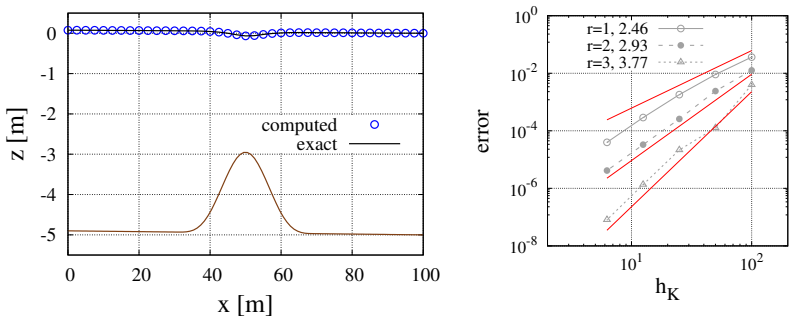
We present a discontinuous finite element method for the shallow water equations which exploits high-resolution realistic bathymetry data without any regularity assumption, also in the case of high-order discretizations. We prove a number of mathematical properties specific to the proposed method that is well-balanced, mass-conserving and positivity-preserving under a mild CFL condition also in the presence of wet-dry fronts. The method includes a consistent conservative discretization for passive tracers. We use a high-order Discontinuous Galerkin (DG) method as implemented in the deal.II library. This environment provides efficient and native parallelization techniques and automatically handles non-conforming meshes to implement adaptive strategies which are tested in a coastal environment. Idealized test cases show the robustness in presence of irregular bathymetries also with under-resolved features at the grid scale. A benchmark with realistic bathymetry and a complex domain shows the potential of the proposed discretization for adaptive simulations of coastal flows.
Editorial analysis
A structured set of objections, weighed in public.
Referee Report
Summary. The paper introduces a high-order discontinuous Galerkin method for the shallow water equations designed to handle high-resolution irregular bathymetry data without assuming regularity, even for high-order approximations. It establishes proofs for the method being well-balanced, mass-conserving, and positivity-preserving under a mild CFL condition in the presence of wet-dry fronts. A consistent conservative discretization for passive tracers is also provided. The implementation leverages the deal.II library for efficient parallelization and adaptive mesh refinement, with tests on idealized cases featuring under-resolved bathymetry and a realistic coastal benchmark demonstrating robustness.
Significance. If the claimed mathematical properties are verified, this work would be significant for advancing numerical simulations in coastal engineering and environmental modeling, where irregular and under-resolved bathymetry is common. The use of adaptive DG in deal.II and the inclusion of passive tracers enhance its applicability. The mathematical proofs for key properties represent a strong point, distinguishing it from purely numerical approaches.
major comments (2)
- [Mathematical properties proofs] The positivity-preserving property under mild CFL for sub-grid irregular bathymetry is load-bearing for the central claim. Please specify in the derivation how the bathymetry is discretized (e.g., via L2 projection or quadrature) and how this interacts with the source term to maintain non-negativity in high-order elements without additional limiting, as large internal gradients could violate the property despite the CFL condition.
- [Numerical experiments section] In the idealized test cases with irregular bathymetries, the results should include explicit checks for positivity preservation (e.g., minimum water height values) and mass conservation errors to corroborate the theoretical claims, particularly for under-resolved features.
minor comments (2)
- [Abstract] The sentence 'We prove a number of mathematical properties specific to the proposed method that is well-balanced...' has a grammatical issue; it should be rephrased for clarity.
- [Method section] Ensure that all equations for the discretization of the bathymetry and source terms are clearly numbered and referenced in the proofs.
Simulated Author's Rebuttal
We thank the referee for the positive assessment of our work and for the constructive major comments, which help clarify key aspects of the method and strengthen the numerical validation. We address each point below and will incorporate the suggested clarifications and additions in the revised manuscript.
read point-by-point responses
-
Referee: [Mathematical properties proofs] The positivity-preserving property under mild CFL for sub-grid irregular bathymetry is load-bearing for the central claim. Please specify in the derivation how the bathymetry is discretized (e.g., via L2 projection or quadrature) and how this interacts with the source term to maintain non-negativity in high-order elements without additional limiting, as large internal gradients could violate the property despite the CFL condition.
Authors: We appreciate the referee drawing attention to this detail. The bathymetry is discretized via nodal interpolation of the high-resolution data onto the DG nodes using a quadrature rule that is exact for polynomials up to degree 2p (Gauss-Lobatto quadrature with p+1 points per direction for polynomial degree p). This choice ensures that the source term discretization, which involves the product of the test function gradient and the bathymetry, remains consistent with the flux terms at the discrete level. In the positivity proof (Section 3.3), the update for the water height at each node is expressed as a convex combination of the previous time-step values plus a source contribution; the mild CFL condition guarantees that this combination stays non-negative even when internal gradients arise from under-resolved bathymetry, without requiring additional limiting. We will add an explicit paragraph in the derivation subsection detailing the quadrature and its role in preserving the convex-combination structure. revision: yes
-
Referee: [Numerical experiments section] In the idealized test cases with irregular bathymetries, the results should include explicit checks for positivity preservation (e.g., minimum water height values) and mass conservation errors to corroborate the theoretical claims, particularly for under-resolved features.
Authors: We agree that explicit numerical corroboration strengthens the presentation of the theoretical results. In the revised manuscript we will augment the idealized test cases (Sections 4.2 and 4.3) with tables reporting the minimum water height attained over the full simulation interval (remaining at or above machine epsilon) and the relative mass conservation error (remaining below 10^{-12} even for under-resolved bathymetry features). These quantities will be added to the existing result figures and discussed briefly to directly link the experiments to the proved properties. revision: yes
Circularity Check
Mathematical proofs of well-balancedness, conservation and positivity are independent of fitted inputs or self-referential definitions
full rationale
The paper derives and proves specific properties (well-balanced, mass-conserving, positivity-preserving under mild CFL, consistent tracer discretization) for its DG discretization of the shallow-water equations with irregular bathymetry. These properties are established directly from the chosen numerical scheme, quadrature rules, and limiting strategy rather than by fitting parameters to data or by renaming prior results. No load-bearing step reduces to a self-citation chain, an ansatz smuggled via prior work, or a fitted input relabeled as a prediction; the central claims rest on explicit mathematical arguments applied to the discretization itself. The use of the deal.II library and adaptive non-conforming meshes is standard infrastructure, not a circular premise. Idealized tests and a realistic benchmark serve as verification, not as the source of the claimed properties.
Axiom & Free-Parameter Ledger
axioms (2)
- standard math Standard mathematical properties of DG methods for conservation laws hold, including quadrature rules and basis function choices.
- domain assumption Bathymetry data is provided at resolution sufficient to capture sub-grid features without additional smoothing.
Reference graph
Works this paper leans on
-
[1]
The deal.II library, Version 9.5
D. Arndt et al. “The deal.II library, Version 9.5”. Journal of Numerical Mathe- matics 31 (2023), pp. 231–246
work page 2023
-
[2]
An interior penalty finite element method with discontinuous ele- ments
D.N. Arnold. “An interior penalty finite element method with discontinuous ele- ments”. SIAM journal on numerical analysis 19 (1982), pp. 742–760
work page 1982
-
[3]
r-adaptation for Shallow Water flows: conservation, well balancedness, efficiency
L. Arpaia and M. Ricchiuto. “ r-adaptation for Shallow Water flows: conservation, well balancedness, efficiency”. Computers & Fluids 160 (2018), pp. 175–203
work page 2018
-
[4]
L. Arpaia et al. “An efficient covariant frame for the spherical shallow water equa- tions: Well balanced DG approximation and application to tsunami and storm surge”. Ocean Modelling 169 (2022), p. 101915
work page 2022
-
[5]
M. Bajo. ISSOS Sistemi di Previsione Laguna Venezia . https : / / issos . ve . ismar.cnr.it/. 2021
work page 2021
-
[6]
deal.II: a general-purpose object- oriented finite element library
W. Bangerth, R. Hartmann, and G. Kanschat. “deal.II: a general-purpose object- oriented finite element library”. ACM Transactions on Mathematical Software (TOMS) 33 (2007), pp. 24–51
work page 2007
-
[7]
F. Bassi and S. Rebay. “A high-order accurate discontinuous finite element method for the numerical solution of the compressible Navier-Stokes equations”. Journal of Computational Physics 131 (1997), pp. 267–279
work page 1997
-
[8]
Metrics for Performance Quantifi- cation of Adaptive Mesh Refinement
N. Beisiegel, Castro C. E., and J. Behrens. “Metrics for Performance Quantifi- cation of Adaptive Mesh Refinement”. Journal of Scientific Computing 87.36 (2021)
work page 2021
-
[9]
B. Bonev et al. “Discontinuous Galerkin scheme for the spherical shallow wa- ter equations with applications to tsunami modeling and prediction”. Journal of Computational Physics 362 (2018), pp. 425–448
work page 2018
-
[10]
Mathematical justification of a shallow water model
D. Bresch and P. Noble. “Mathematical justification of a shallow water model”. Methods and Applications of Analysis 14 (2007), pp. 87–118. 29
work page 2007
-
[11]
S. Bunya et al. “A wetting and drying treatment for the Runge–Kutta discontin- uous Galerkin solution to the shallow water equations”. Comput. Methods Appl. Mech. Engrg. 198.17-20 (2009), 1548–1562
work page 2009
-
[12]
S. Busto and M. Dumbser. “A staggered semi-implicit hybrid finite volume/finite element scheme for the shallow water equations at all Froude numbers”. Applied Numerical Mathematics 175 (2022), pp. 108–132
work page 2022
-
[13]
J. Butcher. Numerical Methods for Ordinary Differential Equations . 2nd ed. Wi- ley, 2008
work page 2008
-
[14]
Semi-implicit finite difference methods for the two dimensional shal- low water equations
V. Casulli. “Semi-implicit finite difference methods for the two dimensional shal- low water equations.” Journal of Computational Physics 86 (1990), pp. 56–74
work page 1990
-
[15]
A high-resolution wetting and drying algorithm for free-surface hy- drodynamics
V. Casulli. “A high-resolution wetting and drying algorithm for free-surface hy- drodynamics”. International Journal of Numerical Methods in Fluids 60 (2009), pp. 391–408
work page 2009
-
[16]
Semi-implicit finite difference methods for three- dimensional shallow water flow
V. Casulli and R. T. Cheng. “Semi-implicit finite difference methods for three- dimensional shallow water flow”. International Journal of Numerical Methods in Fluids 15 (1992), pp. 629–648
work page 1992
-
[17]
Asymptotic derivation of the section-averaged shallow wa- ter equations for natural river hydraulics
A. Decoene et al. “Asymptotic derivation of the section-averaged shallow wa- ter equations for natural river hydraulics”. Mathematical Models and Methods in Applied Sciences 19 (2009), pp. 387–417
work page 2009
-
[18]
Well-Balanced Adaptive Mesh Refinement for shallow water flows
R. Donat et al. “Well-Balanced Adaptive Mesh Refinement for shallow water flows”. Journal of Computational Physics 257 (2014), pp. 937–953
work page 2014
-
[19]
A staggered semi-implicit spectral discontinuous Galerkin scheme for the shallow water equations
M. Dumbser and V. Casulli. “A staggered semi-implicit spectral discontinuous Galerkin scheme for the shallow water equations”.Applied Mathematics and Com- putation 219 (2013), pp. 8057–8077
work page 2013
-
[20]
Modelling fluxes of water and sediment between Venice Lagoon and the sea
C. Ferrarin et al. “Modelling fluxes of water and sediment between Venice Lagoon and the sea”. Continental Shelf Research 30 (2010), pp. 904–914
work page 2010
-
[21]
An operational discontinuous Galerkin shallow water model for coastal flood assessment
A.G. Filippini et al. “An operational discontinuous Galerkin shallow water model for coastal flood assessment”. Ocean Modelling 192 (2024), p. 102447
work page 2024
-
[22]
Multiwavelet-based grid adaptation with discontinuous Galerkin schemes for shallow water equations
N. Gerhard et al. “Multiwavelet-based grid adaptation with discontinuous Galerkin schemes for shallow water equations”. Journal of Computational Physics 301 (2015), pp. 265–288
work page 2015
-
[23]
F.X. Giraldo. An Introduction to Element-Based Galerkin Methods on Tensor- Product Bases. Springer Nature, 2020
work page 2020
-
[24]
Nodal high-order discontinuous Galerkin methods for the spherical shallow water equations
F.X. Giraldo, J.S. Hesthaven, and T. Warburton. “Nodal high-order discontinuous Galerkin methods for the spherical shallow water equations”. J. Comput. Phys 181.2 (2002), 499–525
work page 2002
-
[25]
F.X. Giraldo, J.F. Kelly, and E.M. Constantinescu. “Implicit-Explicit Formula- tions Of A Three-Dimensional Nonhydrostatic Unified Model Of The Atmosphere (NUMA)”. SIAM Journal of Scientific Computing 35 (2013), pp. 1162–1194
work page 2013
-
[26]
Strong stability-preserving high-order time discretization methods
S. Gottlieb, C.W. Shu, and E. Tadmor. “Strong stability-preserving high-order time discretization methods”. SIAM Rev. 43 (2001), pp. 89–112. 30
work page 2001
-
[27]
Consistency with continuity in conservative advection schemes for free-surface models
E.S. Gross, L. Bonaventura, and G. Rosatti. “Consistency with continuity in conservative advection schemes for free-surface models.” International Journal of Numerical Methods in Fluids 38 (2002), pp. 307–327
work page 2002
-
[28]
A high-order explicit Runge-Kutta approximation technique for the shallow water equations
J.-L. Guermond, M. Maier, and E.J. Tovar. “A high-order explicit Runge-Kutta approximation technique for the shallow water equations”. Computers & Fluids 288 (2025), p. 106493
work page 2025
-
[29]
Analysis and implementation of TR-BDF2
M.E. Hosea and L.F. Shampine. “Analysis and implementation of TR-BDF2”. Applied Numerical Mathematics 20 (1996), pp. 21–37
work page 1996
-
[30]
Additive Runge-Kutta schemes for convection- diffusion-reaction equations
C.A. Kennedy and M.H. Carpenter. “Additive Runge-Kutta schemes for convection- diffusion-reaction equations”. Applied Numerical Mathematics 44 (2003), pp. 139– 181
work page 2003
-
[31]
C.A. Kennedy and M.H. Carpenter. Diagonally implicit Runge-Kutta methods for ordinary differential equations. A review . Tech. rep. NASA, 2016
work page 2016
-
[32]
G. Kesserwani and M.K. Sharifian. “(Multi) wavelet-based Godunov-type simu- lators of flood inundation: Static versus dynamic adaptivity”. Advances in Water Resources 171 (2023), p. 104357
work page 2023
-
[33]
Fast matrix-free evaluation of discontinuous Galerkin finite element operators
M. Kronbichler and K. Kormann. “Fast matrix-free evaluation of discontinuous Galerkin finite element operators”. ACM Transactions on Mathematical Software (TOMS) 45 (2019), pp. 1–40
work page 2019
-
[34]
M. Kronbichler et al. “Comparison of implicit and explicit hybridizable discon- tinuous Galerkin methods for the acoustic wave equation”. International Journal for Numerical Methods in Engineering 106 (2016), pp. 712–739
work page 2016
-
[35]
Hp discontinuous Galerkin meth- ods for advection dominated problems in shallow water flow
E.J. Kubatko, J.J. Westerink, and C. Dawson. “Hp discontinuous Galerkin meth- ods for advection dominated problems in shallow water flow”. Comput. Methods Appl. Mech. Engrg. 196.1 (2006), 437–451
work page 2006
-
[36]
Central-upwind schemes for the Saint-Venant sys- tem
A. Kurganov and D. Levy. “Central-upwind schemes for the Saint-Venant sys- tem”. ESAIM: Mathematical Modelling and Numerical Analysis 36 (2002), pp. 397– 425
work page 2002
-
[37]
J.D. Lambert. Numerical methods for ordinary differential systems: the initial value problem. Wiley, 1991
work page 1991
-
[38]
Tsunami modelling with adaptively refined finite volume methods
R.J. LeVeque, D.L. George, and M.J. Berger. “Tsunami modelling with adaptively refined finite volume methods”. Acta Numerica 20 (2011), pp. 211–289
work page 2011
-
[39]
Q. Liang, J. Hou, and X. Xia. “Contradiction between the C-property and mass conservation in adaptive grid based shallow flow models: cause and solution”. International Journal for Numerical Methods in Fluids 78 (2015), pp. 17–36
work page 2015
-
[40]
Multidimensional flux-form semi-Lagrangian transport schemes
S.J. Lin and R.B. Rood. “Multidimensional flux-form semi-Lagrangian transport schemes.” Monthly Weather Review 124 (1996), pp. 2046–2070
work page 1996
-
[41]
A filtering monotonization approach for DG discretizations of hy- perbolic problems
G. Orlando. “A filtering monotonization approach for DG discretizations of hy- perbolic problems”. Computers & Mathematics with Applications 129 (2023), pp. 113–125
work page 2023
-
[42]
Modelling and simulations of two-phase flows including geometric variables
G. Orlando. “Modelling and simulations of two-phase flows including geometric variables”. http://hdl.handle.net/10589/198599 . PhD thesis. Politecnico di Milano, 2023. 31
work page 2023
-
[43]
An efficient IMEX-DG solver for the compressible Navier-Stokes equations for non-ideal gases
G. Orlando, P.F. Barbante, and L. Bonaventura. “An efficient IMEX-DG solver for the compressible Navier-Stokes equations for non-ideal gases.” Journal of Computational Physics 471 (2022), p. 111653
work page 2022
-
[44]
An IMEX-DG solver for atmo- spheric dynamics simulations with adaptive mesh refinement
G. Orlando, T. Benacchio, and L. Bonaventura. “An IMEX-DG solver for atmo- spheric dynamics simulations with adaptive mesh refinement.” Journal of Com- putational and Applied Mathematics 427 (2023), p. 115124
work page 2023
-
[45]
Robust and accurate simulations of flows over orography using non-conforming meshes
G. Orlando, T. Benacchio, and L. Bonaventura. “Robust and accurate simulations of flows over orography using non-conforming meshes”. Quarterly Journal of the Royal Meteorological Society 150 (2024), pp. 4750–4770
work page 2024
-
[46]
Implicit-explicit Runge-Kutta schemes and applica- tions to hyperbolic systems with relaxation
L. Pareschi and G. Russo. “Implicit-explicit Runge-Kutta schemes and applica- tions to hyperbolic systems with relaxation”. Journal of Scientific computing 25 (2005), pp. 129–155
work page 2005
-
[47]
Quadtree-adaptive tsunami modelling
S. Popinet. “Quadtree-adaptive tsunami modelling”. Ocean Dynamics 61 (2011), pp. 1261–1285
work page 2011
-
[48]
Stabilized residual distribution for shallow water simulations
M. Ricchiuto and A. Bollermann. “Stabilized residual distribution for shallow water simulations”. Journal of Computational Physics 228 (2009), pp. 1071–1115
work page 2009
-
[49]
M. Ricchiuto and D. Torlo. Analytical travelling vortex solutions of hyperbolic equations for validating very high order schemes. 2021. arXiv: 2109.10183 [math.NA]. url: https://arxiv.org/abs/2109.10183
-
[50]
Adaptive Q-tree Godunov-type scheme for shallow water equations
B. Rogers, M. Fujihara, and A.G.L. Borthwick. “Adaptive Q-tree Godunov-type scheme for shallow water equations”. International Journal for Numerical Meth- ods in Fluids 35 (2001), pp. 247–280
work page 2001
-
[51]
An accurate and efficient semi-implicit method for section- averaged free-surface flow modelling
G. Rosatti et al. “An accurate and efficient semi-implicit method for section- averaged free-surface flow modelling.” International Journal of Numerical Meth- ods in Fluids 65 (2011), pp. 448–473
work page 2011
-
[52]
The calculation of the interaction of non-stationary shock waves and obstacles
V. Rusanov. “The calculation of the interaction of non-stationary shock waves and obstacles”. USSR Computational Mathematics and Mathematical Physics 1 (1962), pp. 304–320
work page 1962
-
[53]
P.A. Tassi and C.A. Bokhove O. Vionnet. “Space discontinuous Galerkin method for shallow water flows—kinetic and HLLC flux, and potential vorticity genera- tion”. Adv. Water Resour. 30.4 (2007), 998–1015
work page 2007
-
[54]
G. Tumolo and L. Bonaventura. “A semi-implicit, semi-Lagrangian discontinu- ous Galerkin framework for adaptive numerical weather prediction”. Quarterly Journal of the Royal Meteorological Society 141 (2015), pp. 2582–2601
work page 2015
-
[55]
G. Tumolo, L. Bonaventura, and M. Restelli. “A semi-implicit, semi-Lagrangian, p-adaptive Discontinuous Galerkin method for the shallow water equations”. Journal of Computational Physics 232 (2013), pp. 46–67
work page 2013
-
[56]
A finite element model for the Venice Lagoon. Development, set up, calibration and validation
G. Umgiesser et al. “A finite element model for the Venice Lagoon. Development, set up, calibration and validation”.Journal of Marine Systems 51 (2004), pp. 123– 145
work page 2004
-
[57]
S. Vater, N. Beisiegel, and J. Behrens. “A limiter-based well-balanced discontinu- ous Galerkin method for shallow-water flows with wetting and drying: Triangular grids”. Internat. J. Numer. Methods Fluids 91.8 (2019), 395–418. 32
work page 2019
-
[58]
M. E. V´ azquez-Cend´ on. “Improved treatment of source terms in upwind schemes for the shallow water equations in channels with irregular geometry”. Journal of Computational Physics 148 (1999), pp. 497–526
work page 1999
-
[59]
Y. Xing, X. Zhang, and C.W. Shu. “Positivity-preserving high order well-balanced discontinuous Galerkin methods for the shallow water equations”. Adv. Water Resour. 33 (2010), pp. 1476–1493. 33
work page 2010
discussion (0)
Sign in with ORCID, Apple, or X to comment. Anyone can read and Pith papers without signing in.