REVIEW 4 major objections 5 minor 1 cited by
MFA-KWS: Effective Keyword Spotting with Multi-head Frame-asynchronous Decoding
T0 review · 4 major / 5 minor · reviewed 2026-08-07 · deepseek-v4-flash
Pith's one-line read A joint CTC-Transducer keyword spotter with independent frame skipping sets state-of-the-art recall on three benchmarks while decoding 47%-63% faster than frame-synchronous baselines.
desk verdict Solid internal ablation for a joint CTC-TDT KWS decoder; the SOTA claim rests on unmatched external baselines. read the letter →
The pith
A machine-rendered reading of the paper's core claim, the machinery that carries it, and where it could break.
The reading
What carries the argument
The load-bearing object is frame-asynchronous decoding: a decoding schedule in which each branch advances by variable-length jumps instead of one step per 10 ms frame. Two mechanisms create the jumps: phone-synchronous decoding (PSD) for the CTC branch, which drops frames whose blank posterior meets the threshold $\lambda_\phi$ under the approximation of Eq. (13) that discarded frames contribute probability $\approx 1$; and the Token-and-Duration Transducer (TDT), whose joiner outputs a joint token-and-duration distribution $P(v, d|t, u)$, so the Transducer search advances by the predicted duration $d$. A Placeholder (PH) state marks skipped frames, and the fusion module decides what a PH means: zero, the other branch's score, or, in the best-performing CDC-Last, the nearest previous non-skipped score, with the two branches weighted by the cosine similarity of their recent score trends. The threshold $\lambda_\phi$ is the single knob that trades skipped-frame ratio against recall.
What would settle it
Run the trained model's CTC branch on the same utterances in clean and 0 dB SNR conditions, with PSD enabled and disabled at the same skip ratio, and measure the recall gap at a fixed false-alarm count: if the gap grows sharply with noise, the Eq. (13) assumption that high-blank frames contribute probability $\approx 1$ is what breaks. A complementary check uses forced alignment to count how often frames PSD skips overlap keyword-phoneme frames; a non-negligible overlap would show the skipped frames were informative.
Extended reading notes
Core claim
The central claim is that CTC and Transducer branches, which make errors in complementary ways, are best used as two asynchronous keyword detectors rather than one locked-step pipeline. The paper replaces the usual RNN-T with the Token-and-Duration Transducer (TDT), whose joiner predicts the next token together with its duration in frames, letting the Transducer search jump ahead by $d$ frames; and it replaces frame-wise CTC decoding with phone-synchronous decoding (PSD), which skips any frame whose CTC blank posterior is at or above a threshold $\lambda_\phi$, justified by the approximation in Eq. (13) that such frames contribute probability close to 1. Skipped frames leave a Placeholder (PH) in the score stream, so the remaining question is when and how to fuse: single-frame dominance rules and two consistency-based rules are compared, and the consistency-based CDC-Last, which pads a skipped frame with the nearest preceding non-skipped score and weights the branches by the cosine similarity of their score trends over a 20-frame window, gives the best recall throughout. Trained jointly with a weighted CTC plus TDT loss, the 3.3M-parameter system reports the best recall on Hey Snips, MobvoiHotwords, and the 20-keyword LibriKWS-20, retains most of its advantage from 0 to 20 dB SNR, and runs 47%-63% faster than the frame-synchronous MFS-KWS baseline.
Load-bearing premise
The speed gain rests on the assumption that frames the CTC branch labels as high-blank carry no keyword information, so dropping them costs almost no recall; that assumption is strained when noise flattens posterior probabilities.
Editorial extensions
If this is right
- Wake-word decoders can adopt a single 3.3M-parameter model for both fixed wake words and arbitrary user keywords, with recall at or above dedicated end-to-end systems at the same false-alarm rates.
- At strict false-alarm rates (0.02-0.05 per hour) on Hey Snips, joint CTC-TDT training alone cuts the miss rate by roughly 70% relative to TDT-only training, and adding MFA decoding cuts it further to about 72%-83%.
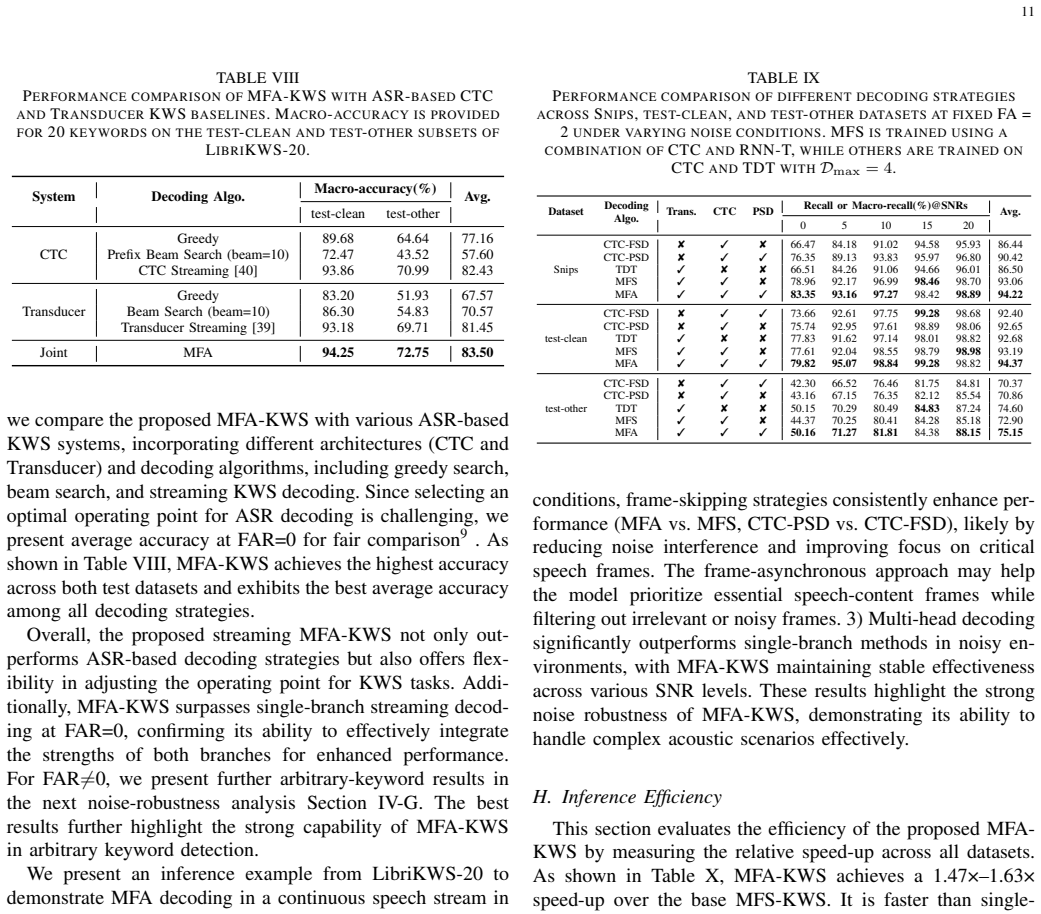
- Frame skipping is not only a speed device: under noise mixed from WHAM! at 0 to 20 dB SNR, MFA-KWS consistently beats the frame-synchronous MFS-KWS and both single branches on all three test sets.
- The CDC-Last fusion rule, carrying the last score through skipped frames, is the repeatable choice, outperforming zero-padding and single-frame dominance strategies across English, Mandarin, fixed-keyword, and arbitrary-keyword settings.
- The 47%-63% decoding speed-up over MFS-KWS puts the system in the same efficiency class as the fastest single-branch decoders while keeping the higher accuracy of the joint system, which matters for on-device latency budgets.
Reading between the lines
- The $\lambda_\phi$ threshold is tuned per dataset to skip roughly 35% of frames; an untested extension is to adapt the threshold on the fly to an estimated noise level, since the paper fixes the threshold and lets SNR vary.
- Because TDT skips by predicted duration and PSD skips by blank confidence, the two branches skip for different reasons; a testable consequence is that their skip patterns are mostly disjoint, which is why consensus fusion works, and measuring that overlap would predict when CDC-Last stops helping.
- The noise robustness is demonstrated with ambient WHAM! noise; whether frame skipping still helps under babble or impulsive noise, where blank posteriors flatten differently, is an open question.
- The frame-asynchronous recipe is not tied to CTC and Transducer specifically: any pair of decoders with per-frame confidence scores, such as an embedding-based matcher and an ASR branch, could be merged with the same Placeholder and CDC-Last machinery.
Editorial analysis
A structured set of objections, weighed in public.
Referee Report
Summary. The paper proposes MFA-KWS, a streaming keyword spotting system that combines CTC and Token-and-Duration Transducer (TDT) branches under joint multi-task training, and decodes them with multi-head frame-asynchronous decoding. The CTC branch uses phone-synchronous decoding (PSD) with blank-frame skipping, the Transducer branch uses TDT duration prediction, and the branch scores are fused with several strategies, including the proposed CDC-Last consistency-based fusion. Experiments on Hey Snips, MobvoiHotwords, and a newly defined LibriKWS-20 arbitrary-keyword benchmark report improved recall over single-branch and frame-synchronous baselines, improved noise robustness, and a 1.47x-1.63x decoding speed-up over the frame-synchronous MFS-KWS system. The authors claim state-of-the-art results on fixed-keyword and arbitrary-keyword datasets and release their decoding code.
Significance. The internal experimental design is a clear strength: the comparisons between single-branch and joint training (Table III), between MFS and MFA decoding (Table V), and among fusion strategies (Table IV) are controlled and consistently favor the proposed system. The release of the streaming decoding code is a useful community contribution. The frame-asynchronous, keyword-specific decoding idea is interesting and the efficiency gains are plausibly real. However, the external state-of-the-art claim is not yet supported as stated, because the comparisons against published end-to-end systems mix training data recipes, false-alarm test sets, and evaluation protocols. The central engineering contribution is sound, but the headline SOTA claim needs matched-baseline experiments or careful recasting before publication.
major comments (4)
- [Section IV-E, Tables VI and VII] The external state-of-the-art claim is not supported by the current comparisons. In Table VI, MFA-KWS is pre-trained on LibriSpeech-960h and fine-tuned on Snips positives plus an equal number of LibriSpeech negatives, whereas the published RIL-KWS, WaveNet, and MDTC results were obtained from models trained on the specific KWS corpora under their original false-alarm protocols. The paper's own reimplementation of MDTC under the new protocol (row 4 of Table VI) drops from 99.88% to 98.85% at FAR=0.5/h and from 99.92% to 99.29% at FAR=1.0/h, showing that the protocol difference is of the same order as the margins MFA-KWS claims over the official numbers. Table VII reports no baseline retrained with the AISHELL-2 pre-training and pseudo-transcription fine-tuning recipe used for MFA-KWS. A matched-protocol rerun of the strongest E2E baselines under the exact fine-tuning and false-alarm evaluation conditions is required before the 'SOTA' label is justified.
- [Section IV-D, Table V] The maximum duration hyperparameter Dmax appears to be selected on the test sets that are later used for the headline comparisons. The text states that 'optimizing the maximum duration Dmax in TDT improves keyword detection, with Dmax = 4 yielding the best results across all datasets,' but no development-set selection procedure is described for Dmax, in contrast to the statement in Section IV-A that lambda_phi is searched on the development set. Since the same Snips, test-clean, and test-other sets are used both for selecting Dmax = 4 and for reporting the final comparisons in Tables VI-IX, the reported numbers are optimistically biased. Dmax should be chosen on held-out data or a nested validation procedure should be reported.
- [Tables III-X] All reported recall and speed-up numbers come from single runs, without confidence intervals, bootstrap estimates, or significance tests. Many of the claims rest on small margins (e.g., 99.96 vs. 99.88 in Table VI, 99.66 vs. 99.53 in Table VII, and 83.50 vs. 82.43 in Table VIII). Without variance information, it is impossible to tell whether these differences are meaningful, especially given the protocol differences noted above. Please report mean and standard deviation over multiple seeds, or at least bootstrap confidence intervals for the central comparisons.
- [Section II-C, Eq. (13) and Section IV-G] The efficiency claim rests on the PSD approximation in Eq. (13), which replaces the contribution of skipped CTC frames by 1. Table II shows that this approximation is lossy even at the chosen operating point: at a 35% skip ratio, recall drops from 98.89% to 98.10% at FAR=0.02. The paper does not report how the skipped-frame ratio behaves under the noisy conditions of Table IX, where blank posteriors are likely less peaky, so the 1.47x-1.63x speed-ups in Table X may not transfer to the noisy settings used to claim robustness. Please report the actual skip ratios and measured speed-ups under noisy conditions, or qualify the efficiency claim accordingly.
minor comments (5)
- [Section IV-C, Table IV] The conclusion that CDC-Last 'consistently outperforms' CDC-Zero is too strong. In the RNN-T + PSD block on Snips, CDC-Last achieves 98.73% while CDC-Zero achieves 99.57%, a 0.84% absolute deficit; the advantage appears only on averages and on the LibriKWS-20 sets. Please qualify the claim or analyze when CDC-Last helps and when it hurts.
- [Algorithm 1, line 10] The update for delta(t,u) has an unbalanced closing parenthesis and a stray semicolon inside the max expression: 'max(delta(t,u-1) * ..., delta(t-d,u) * p_{t-d,u}(phi_RNN-T) ;'. This should be corrected to a single closing parenthesis and no interior semicolon.
- [Table III] The row for 'CTC (CDC-KWS [40])' reports only one recall value; the unavailable FAR entries are shown as '-', but it would be helpful to state explicitly which results were not reported in the original paper. Also, the two rows labeled 'CTC + TDT' differ only in the decoding head; this should be made visually explicit, for example by grouping the rows by decoding head.
- [Section III-A] For the LibriKWS-20 false-alarm set, the text says '3 hours separately' but does not specify whether this is 3 hours per test subset or 3 hours total for both. Please clarify the construction of the false-alarm sets and report their exact durations.
- [Section IV-H, Table X] The speed-up table reports relative factors but not absolute real-time factors or hardware conditions. A sentence stating the hardware, batch size, and whether the comparison is single-stream or batched would make the efficiency numbers more interpretable and reproducible.
Circularity Check
No significant circularity: the reported recall and speed-up results are empirical measurements on public datasets, not identities derived from fitted constants or self-citation chains.
full rationale
The paper's central claims are empirical: recall on Hey Snips, MobvoiHotwords, and LibriKWS-20, plus measured decoding speed-up. The formal derivation chain consists of standard loss definitions (CTC, RNN-T, TDT), the PSD frame-skipping approximation in Eqs. (9)-(13), and fusion score formulas in Eqs. (14)-(16). None of these equations encodes the reported test-set recall or wall-clock speed-up; those numbers come from running trained models on held-out data. Hyperparameters (alpha=0.3, lambda_phi chosen to skip 35% of frames, window length 20, Dmax=4) are tuned on development or analysis sets and are not used to synthesize the final metrics by construction. The paper cites prior work from the same group (TDT-KWS [39], CDC-KWS [40], NTC-KWS [42]) for building blocks and baselines, but these are independently published algorithms with their own experimental evaluations, not unpublished uniqueness theorems or ansatze whose only support is the present paper. The external SOTA comparisons do involve protocol differences (ASR pretraining, different false-alarm denominators), which is a legitimate experimental-validity concern, but protocol mismatch is not circularity: the compared numbers are not equal to the paper's inputs by definition. No fitted parameter is renamed as a prediction, and no equation reduces to itself via self-citation. Therefore the circularity score is 0.
Assumptions & free parameters
free parameters (6)
- CTC loss weight alpha =
0.3
- PSD blank threshold lambda_phi =
0.9993 for 35% skip on Snips
- TDT maximum duration Dmax =
4
- CDC fusion window length =
20
- Bonus score SBonus =
not stated
- Timeout Tout =
not stated
assumptions (4)
- domain assumption CTC blank posteriors are peaky enough that frames with blank probability at or above lambda_phi can be skipped with negligible path-probability loss.
- domain assumption TDT factorizes the token and duration distributions as P(v,d|t,u) = PT(v|t,u) * PD(d|t,u).
- ad hoc to paper Nearest previous non-placeholder score is the correct way to fill skipped frames in CDC-Last fusion.
- domain assumption The keyword text is known at inference and the predictor only receives the keyword token sequence, not partial ASR hypotheses.
Cite this review
Pith. "Pith review of MFA-KWS: Effective Keyword Spotting with Multi-head Frame-asynchronous Decoding." pith.science (2026). https://pith.science/paper/SNNPJJWA
@misc{pith2026250519577,
  author       = {Pith},
  title        = {Pith review of: MFA-KWS: Effective Keyword Spotting with Multi-head Frame-asynchronous Decoding},
  year         = {2026},
  howpublished = {\url{https://pith.science/paper/SNNPJJWA}},
  note         = {Machine review of arXiv:2505.19577}
}
read the original abstract
Keyword spotting (KWS) is essential for voice-driven applications, demanding both accuracy and efficiency. Traditional ASR-based KWS methods, such as greedy and beam search, explore the entire search space without explicitly prioritizing keyword detection, often leading to suboptimal performance. In this paper, we propose an effective keyword-specific KWS framework by introducing a streaming-oriented CTC-Transducer-combined frame-asynchronous system with multi-head frame-asynchronous decoding (MFA-KWS). Specifically, MFA-KWS employs keyword-specific phone-synchronous decoding for CTC and replaces conventional RNN-T with Token-and-Duration Transducer to enhance both performance and efficiency. Furthermore, we explore various score fusion strategies, including single-frame-based and consistency-based methods. Extensive experiments demonstrate the superior performance of MFA-KWS, which achieves state-of-the-art results on both fixed keyword and arbitrary keywords datasets, such as Snips, MobvoiHotwords, and LibriKWS-20, while exhibiting strong robustness in noisy environments. Among fusion strategies, the consistency-based CDC-Last method delivers the best performance. Additionally, MFA-KWS achieves a 47% to 63% speed-up over the frame-synchronous baselines across various datasets. Extensive experimental results confirm that MFA-KWS is an effective and efficient KWS framework, making it well-suited for on-device deployment.
Figures


Figures from the paper (1 more)
Forward citations
Cited by 1 Pith paper
-
Masked Self-distilled Transducer-based Keyword Spotting with Semi-autoregressive Decoding
Masked self-distillation training plus semi-autoregressive decoding improves RNN-T keyword spotting recall at low false alarm rates, especially in noisy conditions.
Reference graph
Works this paper leans on
-
[1]
Alexa, siri, cortana, and more: an introduction to voice assistants,
M. B. Hoy, “Alexa, siri, cortana, and more: an introduction to voice assistants,” Medical reference services quarterly, vol. 37, no. 1, pp. 81– 88, 2018
work page 2018
-
[2]
Deep spoken keyword spotting: An overview,
I. L ´opez-Espejo, Z.-H. Tan, J. H. L. Hansen, and J. Jensen, “Deep spoken keyword spotting: An overview,” IEEE Access, pp. 4169–4199, 2022
work page 2022
-
[3]
Speechgpt: Empowering large language models with intrinsic cross- modal conversational abilities,
D. Zhang, S. Li, X. Zhang, J. Zhan, P. Wang, Y . Zhou, and X. Qiu, “Speechgpt: Empowering large language models with intrinsic cross- modal conversational abilities,” in Findings of the Association for Computational Linguistics: EMNLP , H. Bouamor, J. Pino, and K. Bali, Eds., pp. 15 757–15 773
-
[4]
A survey on speech large language models,
J. Peng, Y . Wang, Y . Xi, X. Li, X. Zhang, and K. Yu, “A survey on speech large language models,” arXiv preprint arXiv:2410.18908, 2024
arXiv 2024
-
[5]
Llama- omni: Seamless speech interaction with large language models,
Q. Fang, S. Guo, Y . Zhou, Z. Ma, S. Zhang, and Y . Feng, “Llama- omni: Seamless speech interaction with large language models,” CoRR, vol. abs/2409.06666, 2024
arXiv 2024
-
[6]
Omniflatten: An end-to-end GPT model for seamless voice conversation,
Q. Zhang, L. Cheng, C. Deng, Q. Chen, W. Wang, S. Zheng, J. Liu, H. Yu, and C. Tan, “Omniflatten: An end-to-end GPT model for seamless voice conversation,” CoRR, vol. abs/2410.17799, 2024
arXiv 2024
-
[7]
Moshi: a speech-text foundation model for real-time dialogue,
A. D ´efossez, L. Mazar ´e, M. Orsini, A. Royer, P. P ´erez, H. J ´egou, E. Grave, and N. Zeghidour, “Moshi: a speech-text foundation model for real-time dialogue,” CoRR, vol. abs/2410.00037, 2024
arXiv 2024
-
[8]
Glm-4-voice: Towards intelligent and human-like end-to-end spoken chatbot,
A. Zeng, Z. Du, M. Liu, K. Wang, S. Jiang, L. Zhao, Y . Dong, and J. Tang, “Glm-4-voice: Towards intelligent and human-like end-to-end spoken chatbot,” CoRR, vol. abs/2412.02612, 2024
arXiv 2024
Show all 80 references
-
[9]
Query-by-example keyword spotting using long short-term memory networks,
G. Chen, C. Parada, and T. N. Sainath, “Query-by-example keyword spotting using long short-term memory networks,” Proc. IEEE ICASSP, pp. 5236–5240, 2015
2015
-
[10]
Query-by-example search with discriminative neural acoustic word embeddings,
S. Settle, K. D. Levin, H. Kamper, and K. Livescu, “Query-by-example search with discriminative neural acoustic word embeddings,” in Proc. Interspeech, 2017, pp. 2874–2878
2017
-
[11]
DONUT: CTC-based query- by-example keyword spotting,
L. Lugosch, S. Myer, and V . S. Tomar, “DONUT: CTC-based query- by-example keyword spotting,” ArXiv, vol. abs/1811.10736, 2018
2018 arXiv
-
[12]
Open-vocabulary keyword spotting with audio and text embeddings,
N. Sacchi, A. Nanchen, M. Jaggi, and M. Cernak, “Open-vocabulary keyword spotting with audio and text embeddings,” in Proc. Interspeech, 2019, pp. 3362–3366
2019
-
[13]
A stage match for query-by-example spoken term detection based on structure information of query,
J. Zhan, Q. He, J. Su, and Y . Li, “A stage match for query-by-example spoken term detection based on structure information of query,” in Proc. IEEE ICASSP, 2021, pp. 6833–6837
2021
-
[14]
Query-by-example keyword spotting system using multi-head attention and soft-triple loss,
J. Huang, W. Gharbieh, H. S. Shim, and E. Kim, “Query-by-example keyword spotting system using multi-head attention and soft-triple loss,” in Proc. IEEE ICASSP , 2021, pp. 6858–6862
2021
-
[15]
Generalized keyword spotting using asr embeddings,
K. R., V . Kurmi, V . Namboodiri, and C. V . Jawahar, “Generalized keyword spotting using asr embeddings,” in Proc. Interspeech 2022 , 2022, pp. 126–130
2022
-
[16]
Learning audio-text agreement for open-vocabulary keyword spotting,
H.-K. Shin, H. Han, D. Kim, S.-W. Chung, and H.-G. Kang, “Learning audio-text agreement for open-vocabulary keyword spotting,” in Proc. Interspeech, 2022, pp. 1871–1875
2022
-
[17]
Multilingual query- by-example keyword spotting with metric learning and phoneme-to- embedding mapping,
P. M. Reuter, C. Rollwage, and B. T. Meyer, “Multilingual query- by-example keyword spotting with metric learning and phoneme-to- embedding mapping,” in Proc. IEEE ICASSP . IEEE, 2023, pp. 1–5
2023
-
[18]
Metric learning for user-defined keyword spotting,
J. Jung, Y . Kim, J. Park, Y . Lim, B.-Y . Kim, Y . Jang, and J. S. Chung, “Metric learning for user-defined keyword spotting,” in Proc. IEEE ICASSP. IEEE, 2023, pp. 1–5
2023
-
[19]
Matching Latent Encoding for Audio- Text based Keyword Spotting,
K. Nishu, M. Cho, and D. Naik, “Matching Latent Encoding for Audio- Text based Keyword Spotting,” in Proc. Interspeech, 2023, pp. 1613– 1617
2023
-
[20]
PhonMatchNet: Phoneme-Guided Zero-Shot Keyword Spotting for User-Defined Keywords,
Y .-H. Lee and N. Cho, “PhonMatchNet: Phoneme-Guided Zero-Shot Keyword Spotting for User-Defined Keywords,” in Proc. Interspeech, 2023, pp. 3964–3968
2023
-
[21]
Contrastive learning with audio discrimination for customizable keyword spotting in continuous speech,
Y . Xi, B. Yang, H. Li, J. Guo, and K. Yu, “Contrastive learning with audio discrimination for customizable keyword spotting in continuous speech,” in Proc. IEEE ICASSP , 2024, pp. 11 666–11 670
2024
-
[22]
Flexible keyword spotting based on homogeneous audio-text embedding,
K. Nishu, M. Cho, P. Dixon, and D. Naik, “Flexible keyword spotting based on homogeneous audio-text embedding,” in Proc. IEEE ICASSP . IEEE, 2024, pp. 5050–5054
2024
-
[23]
Small-footprint keyword spotting using deep neural networks,
G. Chen, C. Parada, and G. Heigold, “Small-footprint keyword spotting using deep neural networks,” in Proc. IEEE ICASSP , 2014, pp. 4087– 4091
2014
-
[24]
Automatic gain control and multi-style training for robust small- footprint keyword spotting with deep neural networks,
R. Prabhavalkar, R. Alvarez, C. Parada, P. Nakkiran, and T. N. Sainath, “Automatic gain control and multi-style training for robust small- footprint keyword spotting with deep neural networks,” in Proc. IEEE ICASSP. IEEE, 2015, pp. 4704–4708
2015
-
[25]
Efficient keyword spotting using dilated convolutions and gating,
A. Coucke, M. Chlieh, T. Gisselbrecht, D. Leroy, M. Poumeyrol, and T. Lavril, “Efficient keyword spotting using dilated convolutions and gating,” in Proc. IEEE ICASSP , 2019, pp. 6351–6355
2019
-
[26]
Re-weighted interval loss for handling data imbalance problem of end- to-end keyword spotting,
K. Zhang, Z. Wu, D. Yuan, J. Luan, J. Jia, H. Meng, and B. Song, “Re-weighted interval loss for handling data imbalance problem of end- to-end keyword spotting,” in Proc. ISCA Interspeech , 2020, pp. 2567– 2571
2020
-
[27]
End-to-end multi-look keyword spotting,
M. Yu, X. Ji, B. Wu, D. Su, and D. Yu, “End-to-end multi-look keyword spotting,” in Proc. ISCA Interspeech, H. Meng, B. Xu, and T. F. Zheng, Eds. ISCA, 2020, pp. 66–70
2020
-
[28]
WeKWS: A production first small-footprint end-to-end keyword spot- ting toolkit,
J. Wang, M. Xu, J. Hou, B. Zhang, X. Zhang, L. Xie, and F. Pan, “WeKWS: A production first small-footprint end-to-end keyword spot- ting toolkit,” in Proc. IEEE ICASSP , 2023, pp. 1–5
2023
-
[29]
Temporal convolution shrinkage network for keyword spotting,
H. Zhu, X. Wang, K. Wang, and H. Zhan, “Temporal convolution shrinkage network for keyword spotting,” in Proc. IEEE ICASSP, 2024, pp. 10 161–10 165
2024
-
[30]
Convolutional neural networks for small- footprint keyword spotting,
T. N. Sainath and C. Parada, “Convolutional neural networks for small- footprint keyword spotting,” in Proc. ISCA Interspeech, 2015, pp. 1478– 1482
2015
-
[31]
Online word-spotting in continuous speech with recurrent neural networks,
P. Baljekar, J. F. Lehman, and R. Singh, “Online word-spotting in continuous speech with recurrent neural networks,” in Proc. IEEE SLT, 2014, pp. 536–541
2014
-
[32]
Max-pooling loss train- ing of long short-term memory networks for small-footprint keyword spotting,
M. Sun, A. Raju, G. Tucker, S. Panchapagesan, G. Fu, A. Mandal, S. Matsoukas, N. Strom, and S. Vitaladevuni, “Max-pooling loss train- ing of long short-term memory networks for small-footprint keyword spotting,” in Proc. IEEE SLT , 2016, pp. 474–480
2016
-
[33]
Attention-based end-to-end models for small-footprint keyword spotting,
C. Shan, J. Zhang, Y . Wang, and L. Xie, “Attention-based end-to-end models for small-footprint keyword spotting,” inProc. ISCA Interspeech, 2018, pp. 2037–2041
2018
-
[34]
Adversarial examples for improving end-to-end attention-based small- footprint keyword spotting,
X. Wang, S. Sun, C. Shan, J. Hou, L. Xie, S. Li, and X. Lei, “Adversarial examples for improving end-to-end attention-based small- footprint keyword spotting,” in Proc. IEEE ICASSP , 2019, pp. 6366– 6370
2019
-
[35]
Unrestricted vocabulary keyword spotting using LSTM-CTC,
Y . Zhuang, X. Chang, Y . Qian, and K. Yu, “Unrestricted vocabulary keyword spotting using LSTM-CTC,” in Proc. Interspeech, 2016, pp. 938–942
2016
-
[36]
Rnn-t based open-vocabulary keyword spotting in mandarin with multi-level detection,
Z. Liu, T. Li, and P. Zhang, “Rnn-t based open-vocabulary keyword spotting in mandarin with multi-level detection,” in Proc. IEEE ICASSP, 2021, pp. 5649–5653
2021
-
[37]
CaTT- KWS: A multi-stage customized keyword spotting framework based on cascaded transducer-transformer,
Z. Yang, S. Sun, J. Li, X. Zhang, X. Wang, L. Ma, and L. Xie, “CaTT- KWS: A multi-stage customized keyword spotting framework based on cascaded transducer-transformer,” in Proc. ISCA Interspeech , 2022, pp. 1681–1685
2022
-
[38]
U2-KWS: Unified two-pass open-vocabulary keyword spotting with keyword bias,
A. Zhang, P. Zhou, K. Huang, Y . Zou, M. Liu, and L. Xie, “U2-KWS: Unified two-pass open-vocabulary keyword spotting with keyword bias,” in Proc. IEEE ASRU, 2023, pp. 1–8
2023
-
[39]
TDT-KWS: Fast and accurate keyword spotting using token-and-duration transducer,
Y . Xi, H. Li, B. Yang, H. Li, H. Xu, and K. Yu, “TDT-KWS: Fast and accurate keyword spotting using token-and-duration transducer,” in Proc. IEEE ICASSP , 2024, pp. 11 351–11 355
2024
-
[40]
Streaming keyword spotting boosted by cross-layer discrimination consistency,
Y . Xi, H. Li, X. Gu, H. Li, Y . Jiang, and K. Yu, “Streaming keyword spotting boosted by cross-layer discrimination consistency,” in Proc. IEEE ICASSP, 2025, pp. 1–5
2025
-
[41]
Text-aware speech separation for multi-talker keyword spotting,
H. Li, B. Yang, Y . Xi, L. Yu, T. Tan, H. Li, and K. Yu, “Text-aware speech separation for multi-talker keyword spotting,” in Interspeech 2024, 2024, pp. 337–341
2024
-
[42]
NTC-KWS: Noise-aware ctc for robust keyword spotting,
Y . Xi, H. Li, H. Li, J. Guo, X. Li, W. Ding, and K. Yu, “NTC-KWS: Noise-aware ctc for robust keyword spotting,” in Proc. IEEE ICASSP , 2025, pp. 1–5
2025
-
[43]
Text adaptive detection for customizable keyword spotting,
Y . Xi et al., “Text adaptive detection for customizable keyword spotting,” in Proc. IEEE ICASSP , 2022, pp. 6652–6656. 13
2022
-
[44]
Multi-task learning and weighted cross-entropy for dnn-based keyword spotting,
S. Panchapagesan, M. Sun, A. Khare, S. Matsoukas, A. Mandal, B. Hoffmeister, and S. Vitaladevuni, “Multi-task learning and weighted cross-entropy for dnn-based keyword spotting,” in Proc. Interspeech , 2016, pp. 760–764
2016
-
[45]
Compressed time delay neural network for small-footprint keyword spotting,
M. Sun, D. Snyder, Y . Gao, V . K. Nagaraja, M. Rodehorst, S. Pan- chapagesan, N. Strom, S. Matsoukas, and S. Vitaladevuni, “Compressed time delay neural network for small-footprint keyword spotting,” inProc. Interspeech, 2017, pp. 3607–3611
2017
-
[46]
Streaming small-footprint keyword spotting using sequence-to- sequence models,
Y . He, R. Prabhavalkar, K. Rao, W. Li, A. Bakhtin, and I. Mc- Graw, “Streaming small-footprint keyword spotting using sequence-to- sequence models,” in Proc. IEEE ASRU, 2017, pp. 474–481
2017
-
[47]
Monophone-based background modeling for two-stage on-device wake word detection,
M. Wu et al. , “Monophone-based background modeling for two-stage on-device wake word detection,” inProc. IEEE ICASSP, 2018, pp. 5494– 5498
2018
-
[48]
Adaptation of rnn transducer with text-to-speech technology for keyword spotting,
E. Sharma, G. Ye, W. Wei, R. Zhao, Y . Tian, J. Wu, L. He, E. Lin, and Y . Gong, “Adaptation of rnn transducer with text-to-speech technology for keyword spotting,” in Proc. IEEE ICASSP , 2020, pp. 7484–7488
2020
-
[49]
Improving rnn transducer modeling for small-footprint keyword spotting,
Y . Tian, H. Yao, M. Cai, Y . Liu, and Z. Ma, “Improving rnn transducer modeling for small-footprint keyword spotting,” in Proc. IEEE ICASSP, 2021, pp. 5624–5628
2021
-
[50]
Sequence transduction with recurrent neural networks,
A. Graves, “Sequence transduction with recurrent neural networks,” in ICML — Workshop on Representation Learning , 2012
2012
-
[51]
Self-attention transducers for end-to-end speech recognition,
Z. Tian, J. Yi, J. Tao, Y . Bai, and Z. Wen, “Self-attention transducers for end-to-end speech recognition,” in Proc. ISCA Interspeech, G. Kubin and Z. Kacic, Eds., 2019, pp. 4395–4399
2019
-
[52]
Transformer-transducer: End-to-end speech recognition with self-attention,
C. Yeh, J. Mahadeokar, K. Kalgaonkar, Y . Wang, D. Le, M. Jain, K. Schubert, C. Fuegen, and M. L. Seltzer, “Transformer-transducer: End-to-end speech recognition with self-attention,” CoRR, vol. abs/1910.12977, 2019. [Online]. Available: http://arxiv.org/abs/1910. 12977
1910 arXiv
-
[53]
Transformer transducer: A streamable speech recognition model with transformer encoders and rnn-t loss,
Q. Zhang, H. Lu, H. Sak, A. Tripathi, E. McDermott, S. Koo, and S. Kumar, “Transformer transducer: A streamable speech recognition model with transformer encoders and rnn-t loss,” in Proc. IEEE ICASSP, 2020, pp. 7829–7833
2020
-
[54]
ContextNet: Improving Convolutional Neural Networks for Automatic Speech Recognition with Global Context,
W. Han, Z. Zhang, Y . Zhang, J. Yu, C.-C. Chiu, J. Qin, A. Gulati, R. Pang, and Y . Wu, “ContextNet: Improving Convolutional Neural Networks for Automatic Speech Recognition with Global Context,” in Proc. ISCA Interspeech , 2020, pp. 3610–3614
2020
-
[55]
Tiny transducer: A highly-efficient speech recognition model on edge devices,
Y . Zhang, S. Sun, and L. Ma, “Tiny transducer: A highly-efficient speech recognition model on edge devices,” Proc. IEEE ICASSP , pp. 6024– 6028, 2021
2021
-
[56]
Joint ctc-attention based end-to-end speech recognition using multi-task learning,
S. Kim, T. Hori, and S. Watanabe, “Joint ctc-attention based end-to-end speech recognition using multi-task learning,” in Proc. IEEE ICASSP , 2017, pp. 4835–4839
2017
-
[57]
Joint ctc/attention decoding for end-to-end speech recognition,
T. Hori, S. Watanabe, and J. R. Hershey, “Joint ctc/attention decoding for end-to-end speech recognition,” in Proc. ACL, R. Barzilay and M. Kan, Eds. Association for Computational Linguistics, 2017, pp. 518–529
2017
-
[58]
Hy- brid ctc/attention architecture for end-to-end speech recognition,
S. Watanabe, T. Hori, S. Kim, J. R. Hershey, and T. Hayashi, “Hy- brid ctc/attention architecture for end-to-end speech recognition,” IEEE Journal of Selected Topics in Signal Processing , vol. 11, no. 8, pp. 1240–1253, 2017
2017
-
[59]
Espnet: End-to-end speech processing toolkit,
S. Watanabe, T. Hori, S. Karita, T. Hayashi, J. Nishitoba, Y . Unno, N. E. Y . Soplin, J. Heymann, M. Wiesner, N. Chen, A. Renduchintala, and T. Ochiai, “Espnet: End-to-end speech processing toolkit,” in Proc. ISCA Interspeech. ISCA, 2018, pp. 2207–2211
2018
-
[60]
Nemo: a toolkit for building ai applications using neural modules,
O. Kuchaiev, J. Li, H. Nguyen, O. Hrinchuk, R. Leary, B. Ginsburg, S. Kriman, S. Beliaev, V . Lavrukhin, J. Cook, P. Castonguay, M. Popova, J. Huang, and J. M. Cohen, “Nemo: a toolkit for building ai applications using neural modules,” in NeurIPS Workshop on Systems for ML , 2019
2019
-
[61]
Keyword search using attention-based end-to-end asr and frame-synchronous phoneme alignments,
R. Yang, G. Cheng, H. Miao, T. Li, P. Zhang, and Y . Yan, “Keyword search using attention-based end-to-end asr and frame-synchronous phoneme alignments,” IEEE/ACM Transactions on Audio, Speech and Language Processing, pp. 3202–3215, 2021
2021
-
[62]
Connec- tionist temporal classification: labelling unsegmented sequence data with recurrent neural networks,
A. Graves, S. Fern ´andez, F. J. Gomez, and J. Schmidhuber, “Connec- tionist temporal classification: labelling unsegmented sequence data with recurrent neural networks,” in Proc. ICML , W. W. Cohen and A. W. Moore, Eds., vol. 148, 2006, pp. 369–376
2006
-
[63]
Phone synchronous decoding with CTC lattice,
Z. Chen, W. Deng, T. Xu, and K. Yu, “Phone synchronous decoding with CTC lattice,” in Proc. ISCA Interspeech. ISCA, 2016, pp. 1923–1927
2016
-
[64]
Phone synchronous speech recognition with ctc lattices,
Z. Chen, Y . Zhuang, Y . Qian, and K. Yu, “Phone synchronous speech recognition with ctc lattices,”IEEE/ACM Transactions on Audio, Speech, and Language Processing , vol. 25, no. 1, pp. 90–101, 2017
2017
-
[65]
Efficient sequence transduction by jointly predicting tokens and dura- tions,
H. Xu, F. Jia, S. Majumdar, H. Huang, S. Watanabe, and B. Ginsburg, “Efficient sequence transduction by jointly predicting tokens and dura- tions,” in Proc. ICML, 2023, pp. 38 462–38 484
2023
-
[66]
Region proposal network based small-footprint keyword spotting,
J. Hou, Y . Shi, M. Ostendorf, M. Hwang, and L. Xie, “Region proposal network based small-footprint keyword spotting,” IEEE Signal Process. Letter, vol. 26, no. 10, pp. 1471–1475, 2019
2019
-
[67]
Librispeech: an asr corpus based on public domain audio books,
V . Panayotov, G. Chen, D. Povey, and S. Khudanpur, “Librispeech: an asr corpus based on public domain audio books,” in Proc. IEEE ICASSP, 2015, pp. 5206–5210
2015
-
[68]
Aishell-2: Transforming mandarin asr research into industrial scale,
J. Du, X. Na, X. Liu, and H. Bu, “Aishell-2: Transforming mandarin asr research into industrial scale,” CoRR, 2018
2018
-
[69]
Wham!: Extending speech separation to noisy environments,
G. Wichern, J. Antognini, M. Flynn, L. R. Zhu, E. McQuinn, D. Crow, E. Manilow, and J. L. Roux, “Wham!: Extending speech separation to noisy environments,” in Proc. ISCA Interspeech , 2019, pp. 1368–1372
2019
-
[70]
Paraformer: Fast and accurate parallel transformer for non-autoregressive end-to-end speech recognition,
Z. Gao, S. Zhang, I. McLoughlin, and Z. Yan, “Paraformer: Fast and accurate parallel transformer for non-autoregressive end-to-end speech recognition,” in INTERSPEECH, 2022
2022
-
[71]
Audio augmentation for speech recognition
T. Ko, V . Peddinti, D. Povey, and S. Khudanpur, “Audio augmentation for speech recognition.” in Proc. ISCA Interspeech , 2015, p. 3586
2015
-
[72]
Specaugment: A simple data augmentation method for automatic speech recognition,
D. S. Park, W. Chan, Y . Zhang, C.-C. Chiu, B. Zoph, E. D. Cubuk, and Q. V . Le, “Specaugment: A simple data augmentation method for automatic speech recognition,” in Proc. ISCA Interspeech , 2019, pp. 2613–2617
2019
-
[73]
Bifsmn: Binary neural network for keyword spotting,
H. Qin, X. Ma, Y . Ding, X. Li, Y . Zhang, Y . Tian, Z. Ma, J. Luo, and X. Liu, “Bifsmn: Binary neural network for keyword spotting,” in Proceedings of the Thirty-First International Joint Conference on Artificial Intelligence, IJCAI-22 , 2022, pp. 4346–4352
2022
-
[74]
Text adaptive detection for customizable keyword spotting,
Y . Xi, T. Tan, W. Zhang, B. Yang, and K. Yu, “Text adaptive detection for customizable keyword spotting,” in Proc. IEEE ICASSP , 2022, pp. 6652–6656
2022
-
[75]
Joint ego-noise suppression and keyword spotting on sweeping robots,
Y . Na, Z. Wang, L. Wang, and Q. Fu, “Joint ego-noise suppression and keyword spotting on sweeping robots,” in Proc. IEEE ICASSP , 2022, pp. 7547–7551
2022
-
[76]
The CMU pronouncing dictionary,
“The CMU pronouncing dictionary,” http://www.speech.cs.cmu.edu/ cgi-bin/cmudict
-
[77]
Decoupled weight decay regularization,
I. Loshchilov and F. Hutter, “Decoupled weight decay regularization,” in ICLR, 2019
2019
-
[78]
Wake word detection with streaming transformers,
Y . Wang, H. Lv, D. Povey, L. Xie, and S. Khudanpur, “Wake word detection with streaming transformers,” in Proc. IEEE ICASSP , 2021, pp. 5864–5868
2021
-
[79]
Wake word detection with alignment-free lattice-free mmi,
——, “Wake word detection with alignment-free lattice-free mmi,” in Proc. ISCA Interspeech , 2020, pp. 4258–4262
2020
-
[80]
Wake word detection based on Res2Net,
Q. Yu and R. Zhou, “Wake word detection based on Res2Net,” arXiv preprint arXiv:2209.15296, 2022
2022 arXiv
Reviewed August 7, 2026 · model on record in the stance chip above.
Discussion (0). Sign in to comment.