Charting circumstellar chemistry of carbon-rich asymptotic giant branch stars. II. Abundances and spatial distributions of CS
Pith reviewed 2026-05-22 01:24 UTC · model grok-4.3
The pith
Five carbon-rich AGB stars show CS abundance profiles similar to IRC+10216 except for density-driven variations.
A machine-rendered reading of the paper's core claim, the machinery that carries it, and where it could break.
Core claim
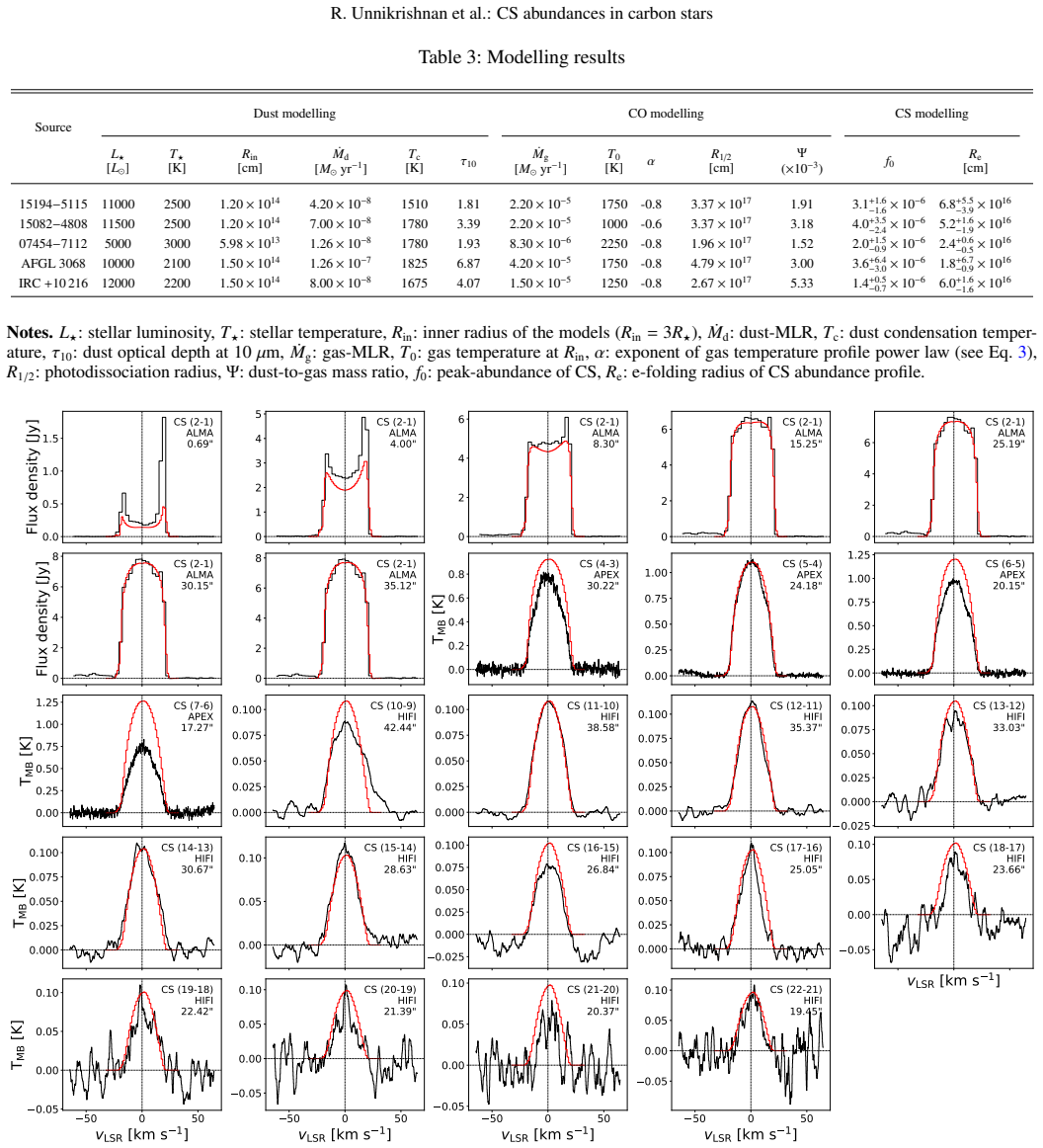
After modeling five carbon-rich AGB stars, the derived CS fractional abundance profiles show peaks between 1 times 10 to the -6 and 4 times 10 to the -6 with e-folding radii from 1.8 times 10 to the 16 cm to 6.8 times 10 to the 16 cm. These profiles exhibit no significant differences from those of IRC+10216 apart from variations driven by envelope density. The modeling also produces reliable 12C/13C and 32S/34S ratios and improves the uncertainty on the CS e-folding radius for IRAS 07454-7112 by a factor of about 2.5.
What carries the argument
Radiative transfer modeling of CS lines across multiple transitions and apertures, with stellar and outflow parameters fixed from prior SED and CO fits and further constrained by ALMA spatial data.
If this is right
- Chemical models are corroborated because they reproduce the observed CS radial extents through the photodissociation framework.
- Previous single-dish estimates of CS abundances are refined with the added spatial constraints.
- The relative uncertainty on the CS e-folding radius for IRAS 07454-7112 improves by a factor of roughly 2.5.
- Isotopologue line modeling supplies reliable 12C/13C and 32S/34S ratios for the sample stars.
Where Pith is reading between the lines
- If CS similarity holds, molecular abundance patterns established for IRC+10216 may generalize to other carbon-rich AGB envelopes.
- Density variations appear to dominate the chemical differences, pointing to mass-loss rate as the primary control on envelope chemistry.
- Targeted mapping of additional species at comparable resolution could reveal whether subtle chemical distinctions exist beyond what CS alone shows.
Load-bearing premise
The stellar and outflow parameters derived from SED and CO modeling are sufficiently accurate to serve as fixed inputs for the subsequent CS radiative transfer calculations without introducing large systematic errors.
What would settle it
New high-resolution observations of CS emission from an additional carbon-rich AGB star with mass-loss rate comparable to the sample but yielding a peak abundance or radial extent lying well outside the reported ranges would settle the uniformity claim.
Figures


read the original abstract
The circumstellar envelopes (CSEs) of asymptotic giant branch (AGB) stars harbour a rich variety of molecules and are sites of complex chemistry. Our current understanding of the circumstellar chemical processes of carbon-rich AGB stars is predominantly based on observations of a single star, IRC+10216, often regarded as an archetypical carbon star. We aim to estimate stellar and circumstellar properties for five carbon stars, and constrain their circumstellar CS abundances. This study compares the CS abundances among the sources, informs circumstellar chemical models, and helps to assess if IRC+10216 is a good representative of the physics and chemistry of carbon star CSEs. We modelled the spectral energy distributions (SEDs) and CO line emission to derive the stellar and outflow properties. Using these, we then retrieved CS abundance profiles with detailed radiative transfer modelling, imposing spatial and excitation constraints from ALMA and single-dish observations. We obtain good fits to the SEDs and CO lines for all sources and reproduce the CS line emission across various transitions and apertures, yielding robust estimates of the CS abundance profiles. Peak CS fractional abundances range from 1$\times$10$^{-6}$ - 4$\times$10$^{-6}$, with e-folding radii of 1.8$\times$10$^{16}$ - 6.8$\times$10$^{16}$ cm. We also derive reliable $^{12}$C/$^{13}$C and $^{32}$S/$^{34}$S ratios from CS isotopologue modelling. Our results refine previous single-dish CS abundance estimates and improve the relative uncertainty on the CS e-folding radius for IRAS 07454$-$7112 by a factor of $\sim$2.5. Chemical models reproduce our estimates of the CS radial extent, corroborating the CS photodissociation framework used therein. We find no significant differences between the derived CS abundance profiles for IRC+10216 and the rest of the sample, apart from the expected density-driven variations.
Editorial analysis
A structured set of objections, weighed in public.
Referee Report
Summary. The manuscript models the spectral energy distributions (SEDs) and CO line emission for five carbon-rich AGB stars to derive stellar and outflow parameters. These are then used as fixed inputs for detailed radiative transfer modeling of multiple CS transitions, incorporating spatial constraints from ALMA observations and single-dish data. The authors retrieve CS abundance profiles with peak fractional abundances of 1–4 × 10^{-6} and e-folding radii of 1.8–6.8 × 10^{16} cm, derive isotopic ratios, and compare the results to chemical models. They conclude that the CS profiles show no significant differences from those of IRC+10216 beyond density-driven variations.
Significance. If the results hold, this work meaningfully extends circumstellar chemistry studies beyond the single archetype IRC+10216 by providing multi-source constraints on CS abundances and radial distributions. The good fits to SEDs, CO lines, and CS transitions with ALMA spatial information, plus agreement with chemical models on the radial extent, strengthen the photodissociation framework. Refinement of the e-folding radius uncertainty for IRAS 07454−7112 by a factor of ~2.5 and the isotopic ratio derivations are clear strengths.
major comments (1)
- §4 (CS radiative transfer modeling): The stellar and outflow parameters (mass-loss rate, expansion velocity, temperature structure) derived from SED and CO modeling are adopted as fixed inputs for the CS abundance retrieval. The manuscript does not quantify how uncertainties in these parameters propagate into the retrieved peak CS abundances or e-folding radii. This is load-bearing for the central claim in §5 that there are no significant differences from IRC+10216 apart from density-driven variations, as source-dependent systematics could shift the profiles without being captured in the reported fits.
minor comments (2)
- Table 1: The reported uncertainties on the CO-derived parameters could explicitly note which are statistical versus systematic to aid interpretation of the downstream CS results.
- Figure 4: The CS line profile overlays would benefit from a quantitative goodness-of-fit metric (e.g., reduced χ² per transition) to complement the visual assessment.
Simulated Author's Rebuttal
We thank the referee for their positive evaluation and recommendation for minor revision. We address the single major comment below.
read point-by-point responses
-
Referee: §4 (CS radiative transfer modeling): The stellar and outflow parameters (mass-loss rate, expansion velocity, temperature structure) derived from SED and CO modeling are adopted as fixed inputs for the CS abundance retrieval. The manuscript does not quantify how uncertainties in these parameters propagate into the retrieved peak CS abundances or e-folding radii. This is load-bearing for the central claim in §5 that there are no significant differences from IRC+10216 apart from density-driven variations, as source-dependent systematics could shift the profiles without being captured in the reported fits.
Authors: We agree that a quantitative assessment of uncertainty propagation from the SED/CO-derived parameters would further support the robustness of the CS results and the comparison to IRC+10216. The stellar and outflow parameters were tightly constrained by independent multi-wavelength SED modeling and multiple CO transitions, yielding good fits across the sample. The subsequent CS radiative transfer modeling reproduces the observed line intensities, excitation, and ALMA spatial distributions for several transitions, providing additional constraints. To directly address the concern, we will add a sensitivity analysis subsection to §4 in the revised manuscript. This will test variations in mass-loss rate, expansion velocity, and temperature structure within their 1σ uncertainties (typically 10–30% depending on the source) and show the resulting impact on peak CS abundances and e-folding radii. These tests confirm that the derived profiles remain consistent with the reported values and that differences relative to IRC+10216 are dominated by density effects rather than parameter systematics. revision: yes
Circularity Check
No significant circularity; derivation relies on independent observational constraints
full rationale
The paper first fits stellar and outflow parameters (mass-loss rate, velocity, temperature) to SED and CO line data, then holds those fixed while fitting parameterized CS abundance profiles (peak value and e-folding radius) to separate CS line intensities and spatial constraints from ALMA and single-dish observations. The central claim of no significant differences across sources (apart from density scaling) follows directly from comparing these independently constrained fits; it does not reduce to the input parameters by definition, nor does any step rename a fit as a first-principles prediction. External chemical models are invoked only for post-hoc corroboration of the radial extent, providing an independent benchmark rather than a self-referential loop.
Axiom & Free-Parameter Ledger
free parameters (2)
- peak CS fractional abundance
- CS e-folding radius
axioms (2)
- domain assumption The density and temperature structure derived from CO lines and SEDs is an accurate representation of the envelope for CS excitation calculations.
- standard math Standard non-LTE radiative transfer with collisional rates from the literature applies to CS in these envelopes.
Reference graph
Works this paper leans on
-
[1]
Agúndez, M. & Cernicharo, J. 2006, ApJ, 650, 374 Agúndez, M., Cernicharo, J., Quintana-Lacaci, G., et al. 2017, A&A, 601, A4 Agúndez, M., Cernicharo, J., Quintana-Lacaci, G., et al. 2015, ApJ, 814, 143 Agúndez, M., Fonfría, J. P., Cernicharo, J., et al. 2012, A&A, 543, A48 Agúndez, M., Martínez, J. I., de Andres, P. L., Cernicharo, J., & Martín-Gago, J. A...
work page 2006
-
[2]
Anand, R. K., Rastogi, S., & Kumar, B. 2023, Journal of Astrophysics and As- tronomy, 44, 47
work page 2023
-
[3]
C., Höfner, S., & Gautschy-Loidl, R
Andersen, A. C., Höfner, S., & Gautschy-Loidl, R. 2003, A&A, 400, 981
work page 2003
-
[4]
Andriantsaralaza, M., Ramstedt, S., Vlemmings, W. H. T., et al. 2021, A&A, 653, A53
work page 2021
-
[5]
Andriantsaralaza, M., Ramstedt, S., Vlemmings, W. H. T., & De Beck, E. 2022, A&A, 667, A74
work page 2022
-
[6]
Aringer, B., Girardi, L., Nowotny, W., Marigo, P., & Bressan, A. 2016, MNRAS, 457, 3611
work page 2016
-
[7]
Aringer, B., Marigo, P., Nowotny, W., et al. 2019, MNRAS, 487, 2133
work page 2019
-
[8]
Asplund, M., Grevesse, N., Sauval, A. J., & Scott, P. 2009, ARA&A, 47, 481 Astropy Collaboration, Price-Whelan, A. M., Lim, P. L., et al. 2022, ApJ, 935, 167 Astropy Collaboration, Price-Whelan, A. M., Sip˝ocz, B. M., et al. 2018, AJ, 156, 123 Astropy Collaboration, Robitaille, T. P., Tollerud, E. J., et al. 2013, A&A, 558, A33
work page 2009
-
[9]
Becklin, E. E., Frogel, J. A., Hyland, A. R., Kristian, J., & Neugebauer, G. 1969, ApJ, 158, L133
work page 1969
-
[10]
Belitsky, V ., Lapkin, I., Fredrixon, M., et al. 2018, A&A, 612, A23
work page 2018
-
[11]
2012, IEEE Transactions on Tera- hertz Science and Technology, 2, 208
Billade, B., Nystrom, O., Meledin, D., et al. 2012, IEEE Transactions on Tera- hertz Science and Technology, 2, 208
work page 2012
- [12]
-
[13]
Boothroyd, A. I., Sackmann, I. J., & Ahern, S. C. 1993, ApJ, 416, 762
work page 1993
-
[14]
Brunner, M., Danilovich, T., Ramstedt, S., et al. 2018, A&A, 617, A23
work page 2018
- [15]
-
[16]
Cernicharo, J., Marcelino, N., Agúndez, M., & Guélin, M. 2015, A&A, 575, A91
work page 2015
- [17]
- [18]
- [19]
-
[20]
Cordiner, M. A. & Millar, T. J. 2009, ApJ, 697, 68
work page 2009
-
[21]
Cutri, R. M., Skrutskie, M. F., van Dyk, S., et al. 2003, 2MASS All Sky Catalog of point sources
work page 2003
-
[22]
Danilovich, T., Bergman, P., Justtanont, K., et al. 2014, A&A, 569, A76
work page 2014
-
[23]
H., Olofsson, H., & Justtanont, K
Danilovich, T., De Beck, E., Black, J. H., Olofsson, H., & Justtanont, K. 2016, A&A, 588, A119
work page 2016
-
[24]
Danilovich, T., Ramstedt, S., Gobrecht, D., et al. 2018, A&A, 617, A132
work page 2018
-
[25]
Danilovich, T., Richards, A. M. S., Karakas, A. I., et al. 2019, MNRAS, 484, 494
work page 2019
-
[26]
Danilovich, T., Teyssier, D., Justtanont, K., et al. 2015, A&A, 581, A60
work page 2015
-
[27]
2017, A&A, 606, A124 De Beck, E., Decin, L., de Koter, A., et al
Danilovich, T., Van de Sande, M., De Beck, E., et al. 2017, A&A, 606, A124 De Beck, E., Decin, L., de Koter, A., et al. 2010, A&A, 523, A18 De Beck, E., Lombaert, R., Agúndez, M., et al. 2012, A&A, 539, A108 de Graauw, T., Helmich, F. P., Phillips, T. G., et al. 2010, A&A, 518, L6
work page 2017
- [28]
-
[29]
Denis-Alpizar, O., Stoecklin, T., Guilloteau, S., & Dutrey, A. 2018, MNRAS, 478, 1811
work page 2018
-
[30]
Dharmawardena, T. E., Kemper, F., Wouterloot, J. G. A., et al. 2019, MNRAS, 489, 3492 Di Francesco, J., Johnstone, D., Kirk, H., MacKenzie, T., & Ledwosinska, E. 2008, ApJS, 175, 277 Dinh-V-Trung & Lim, J. 2008, ApJ, 678, 303
work page 2019
-
[31]
P., Schlemmer, S., Schilke, P., Stutzki, J., & Müller, H
Endres, C. P., Schlemmer, S., Schilke, P., Stutzki, J., & Müller, H. S. P. 2016, Journal of Molecular Spectroscopy, 327, 95
work page 2016
-
[32]
Feast, M. W., Whitelock, P. A., & Marang, F. 2003, MNRAS, 346, 878 Fonfría, J. P., Fernández-López, M., Agúndez, M., et al. 2014, MNRAS, 445, 3289 Fonfría, J. P., Santander-García, M., Cernicharo, J., et al. 2019, A&A, 622, L14 Gaia Collaboration, Vallenari, A., Brown, A. G. A., et al. 2023, A&A, 674, A1 23 http://www.iram.fr/IRAMFR/GILDAS/ 24 https://cas...
work page 2003
-
[33]
P., Wetzel, S., Pucci, A., & Tamanai, A
Gail, H. P., Wetzel, S., Pucci, A., & Tamanai, A. 2013, A&A, 555, A119
work page 2013
- [34]
-
[35]
Groenewegen, M. A. T., Barlow, M. J., Blommaert, J. A. D. L., et al. 2012, A&A, 543, L8
work page 2012
-
[36]
A., Ramos-Larios, G., Toalá, J
Guerrero, M. A., Ramos-Larios, G., Toalá, J. A., Balick, B., & Sabin, L. 2020, MNRAS, 495, 2234 Güsten, R., Nyman, L. Å., Schilke, P., et al. 2006, A&A, 454, L13
work page 2020
-
[37]
Habing, H. J. & Olofsson, H. 2004, Asymptotic Giant Branch Stars
work page 2004
-
[38]
H., Dinh-V-Trung, Kwok, S., et al
He, J. H., Dinh-V-Trung, Kwok, S., et al. 2008, ApJS, 177, 275
work page 2008
-
[39]
Helou, G. & Walker, D. W., eds. 1988, Infrared Astronomical Satellite (IRAS) Catalogs and Atlases.V olume 7: The Small Scale Structure Catalog., V ol. 7
work page 1988
-
[40]
2005, ARA&A, 43, 435 Höfner, S
Herwig, F. 2005, ARA&A, 43, 435 Höfner, S. 2009, in Astronomical Society of the Pacific Conference Series, V ol. 414, Cosmic Dust - Near and Far, ed. T. Henning, E. Grün, & J. Steinacker, 3 Höfner, S. & Olofsson, H. 2018, A&A Rev., 26, 1
work page 2005
- [41]
-
[42]
Hrodmarsson, H. R. & van Dishoeck, E. F. 2023, A&A, 675, A25
work page 2023
-
[43]
Huggins, P. J. & Glassgold, A. E. 1982, ApJ, 252, 201
work page 1982
-
[44]
Hughes, G. L., Gibson, B. K., Carigi, L., et al. 2008, MNRAS, 390, 1710
work page 2008
- [45]
-
[46]
Justtanont, K., Bergman, P., Larsson, B., et al. 2005, A&A, 439, 627
work page 2005
-
[47]
Karakas, A. I. & Lugaro, M. 2016, ApJ, 825, 26
work page 2016
- [48]
-
[49]
Khouri, T., Olofsson, H., Vlemmings, W. H. T., et al. 2024, A&A, 685, A11
work page 2024
-
[50]
Kim, H., Lee, H.-G., Mauron, N., & Chu, Y .-H. 2015, ApJ, 804, L10
work page 2015
-
[51]
2017, Nature Astronomy, 1, 0060
Kim, H., Trejo, A., Liu, S.-Y ., et al. 2017, Nature Astronomy, 1, 0060
work page 2017
-
[52]
Kobayashi, C., Karakas, A. I., & Umeda, H. 2011, MNRAS, 414, 3231 Leão, I. C., de Laverny, P., Mékarnia, D., de Medeiros, J. R., & Vandame, B. 2006, A&A, 455, 187
work page 2011
- [53]
-
[54]
Lykou, F., Zijlstra, A. A., Kluska, J., et al. 2018, MNRAS, 480, 1006
work page 2018
-
[55]
Maercker, M., Schöier, F. L., Olofsson, H., et al. 2009, A&A, 494, 243
work page 2009
-
[56]
L., Olofsson, H., Bergman, P., & Ramstedt, S
Maercker, M., Schöier, F. L., Olofsson, H., Bergman, P., & Ramstedt, S. 2008, A&A, 479, 779
work page 2008
-
[57]
Maes, S., Van de Sande, M., Danilovich, T., De Ceuster, F., & Decin, L. 2023, MNRAS, 522, 4654
work page 2023
- [58]
- [59]
-
[60]
Matsuura, M., Barlow, M. J., Zijlstra, A. A., et al. 2009, MNRAS, 396, 918
work page 2009
- [61]
- [62]
-
[63]
McGuire, B. A. 2022, ApJS, 259, 30
work page 2022
-
[64]
Menten, K. M., Reid, M. J., Kami ´nski, T., & Claussen, M. J. 2012, A&A, 543, A73
work page 2012
-
[65]
Millar, T. J., Herbst, E., & Bettens, R. P. A. 2000, MNRAS, 316, 195
work page 2000
-
[66]
J., Walsh, C., Van de Sande, M., & Markwick, A
Millar, T. J., Walsh, C., Van de Sande, M., & Markwick, A. J. 2024, A&A, 682, A109
work page 2024
-
[67]
P., Dominik, C., de Koter, A., & Hovenier, J
Min, M., Dullemond, C. P., Dominik, C., de Koter, A., & Hovenier, J. W. 2009, A&A, 497, 155
work page 2009
-
[68]
2014, The HIFI Beam: Release 1, Release Note for Astronomers, Tech
Mueller, M., Jellema, W., Olberg, M., Moreno, R., & Teyssier, D. 2014, The HIFI Beam: Release 1, Release Note for Astronomers, Tech. rep., Tech. Rep. HIFI-ICC-RP-2014-001, v1. 1, HIFI-ICC Müller, H. S., Schlöder, F., Stutzki, J., & Winnewisser, G. 2005, Journal of Molecular Structure, 742, 215
work page 2014
-
[69]
Nanni, A., Marigo, P., Groenewegen, M. A. T., et al. 2016, MNRAS, 462, 1215
work page 2016
-
[70]
Norris, B. R. M., Tuthill, P. G., Ireland, M. J., et al. 2012, Nature, 484, 220
work page 2012
-
[71]
Nowotny, W., Aringer, B., Höfner, S., & Lederer, M. T. 2011, A&A, 529, A129
work page 2011
- [72]
-
[73]
1999, Symposium - International Astronomical Union, 191, 3–18
Olofsson, H. 1999, Symposium - International Astronomical Union, 191, 3–18
work page 1999
-
[74]
Olofsson, H., Eriksson, K., Gustafsson, B., & Carlstroem, U. 1993, ApJS, 87, 305
work page 1993
-
[75]
R., Cernicharo, J., Velilla Prieto, L., et al
Pardo, J. R., Cernicharo, J., Velilla Prieto, L., et al. 2018, A&A, 615, L4
work page 2018
-
[76]
R., De Breuck, C., Muders, D., et al
Pardo, J. R., De Breuck, C., Muders, D., et al. 2025, A&A, 693, A148
work page 2025
- [77]
-
[78]
Patel, N. A., Young, K. H., Wilson, R. W., et al. 2008, in American Astronomical Society Meeting Abstracts, V ol. 212, American Astronomical Society Meet- ing Abstracts #212, 17.09
work page 2008
-
[79]
J., Cieszewski, R., Stancil, P
Pattillo, R. J., Cieszewski, R., Stancil, P. C., et al. 2018, ApJ, 858, 10
work page 2018
-
[80]
Pilbratt, G. L., Riedinger, J. R., Passvogel, T., et al. 2010, A&A, 518, L1 Planck Collaboration, Ade, P. A. R., Aghanim, N., et al. 2011, A&A, 536, A7
work page 2010
discussion (0)
Sign in with ORCID, Apple, or X to comment. Anyone can read and Pith papers without signing in.