REVIEW 4 major objections 6 minor 2 cited by
Kaon Gluon Parton Distribution and Momentum Fraction from 2+1+1 Lattice-QCD with High Statistics
T0 review · 4 major / 6 minor · reviewed 2026-08-07 · deepseek-v4-flash
Pith's one-line read Kaon gluons carry about twice the pion's momentum fraction: $\langle x\rangle_g^{K}=0.557(18)(24)(56)$ at $\mu=2$ GeV, with ratio $1.92(18)$.
desk verdict A careful, high-statistics kaon gluon moment and PDF, but the headline ratio rests on an uncomputed quark-gluon mixing term. read the letter →
The pith
A machine-rendered reading of the paper's core claim, the machinery that carries it, and where it could break.
The reading
What carries the argument
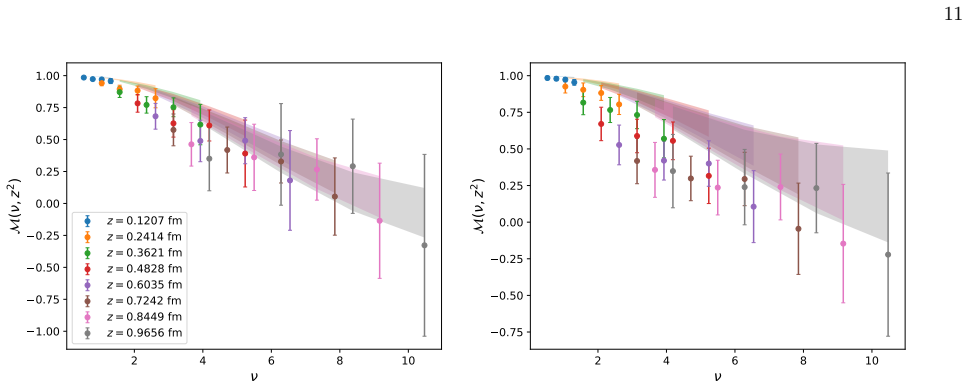
The argument is carried by the reduced pseudo–Ioffe-time distribution (RpITD), a double ratio of fitted ground-state gluon matrix elements $\mathcal{M}(\nu,z^2)=\frac{M(z\cdot P_z,z^2)/M(0\cdot P_z,0)}{M(z\cdot0,z^2)/M(0\cdot0,0)}$ that cancels renormalization factors and ultraviolet divergences. The gluon operator $F^{ti}(z)W(z,0)F^t_i(0)-F^{ij}(z)W(z,0)F_{ij}(0)$, with a gauge-invariant Wilson line $W$, produces the matrix elements; for the first moment a separate OPE gluon operator is used and related to $\langle x\rangle_g$ by a kinematic factor. The RpITD is matched to the light-cone gluon PDF through a convolution with the gluon-gluon kernel $R_{gg}$, using the model $x^\alpha(1-x)^\beta/B(\alpha+1,\beta+1)$ with Bayesian priors. A smearing study over hypercubic, Stout, and Wilson-flow steps leads to the choice of five steps of HYP smearing as the conservative balance between noise reduction and preservation of the physics. Quark-gluon mixing in the renormalization is not computed; it is replaced by a 10 percent systematic error.
What would settle it
Compute the quark disconnected diagrams and the $Z_{gq}\langle x\rangle_q$ mixing contribution on the same ensemble and renormalize with the full mixing matrix: if the resulting $\langle x\rangle_g^{\overline{\text{MS}},K}$ moves by more than 0.056, or if the kaon-to-pion ratio moves outside $1.92(18)$, the central claim is falsified. A physical-continuum extrapolation with full mixing that brings the kaon moment down to the earlier value near 0.42 would also falsify the factor-of-two conclusion.
Extended reading notes
Core claim
The paper's central claim is that, on a 2+1+1-flavor HISQ ensemble with $a\approx0.12$ fm and $M_\pi\approx310$ MeV, the nonperturbatively renormalized kaon gluon momentum fraction is $\langle x\rangle_g^{\overline{\text{MS}},K}=0.557(18)_{\text{stat}}(24)_{\text{NPR}}(56)_{\text{mixing}}$ at $\mu=2$ GeV. Taking the pion's value from the same ensemble, the paper finds $\langle x\rangle_g^K/\langle x\rangle_g^\pi=1.92(18)$, which is in tension with earlier lattice and Dyson-Schwinger results that put the two moments nearly equal. Using the pseudo-PDF method, the paper extracts the kaon gluon PDF and reports that its shape, divided by the first moment, agrees with the Dyson-Schwinger prediction for $x\gtrsim0.4$ and with the pion's shape within one standard deviation; the absolute distributions differ because of the factor-of-two momentum fraction. Higher normalized moments are $\langle x^2\rangle_g^K/\langle x\rangle_g^K=0.123(16)$ and $\langle x^3\rangle_g^K/\langle x\rangle_g^K=0.0277(46)$.
Load-bearing premise
The load-bearing premise is that neglecting the quark-gluon mixing term $Z_{gq}$ in the renormalization and absorbing it into a 10 percent systematic error is adequate; if the true mixing for the kaon exceeds 10 percent, the central value 0.557 and the kaon-to-pion ratio shift by more than the quoted mixing uncertainty.
Editorial extensions
If this is right
- If the kaon-to-pion ratio $1.92(18)$ is confirmed, the kaon's gluon momentum fraction is about twice the pion's, so by the momentum sum rule the quark momentum fraction in the kaon is correspondingly smaller.
- The extracted gluon PDF, matched at $\mu=2$ GeV, gives a lattice prediction for kaon gluon distributions that future electron-ion collider measurements can test directly for $x\gtrsim0.4$.
- The high-statistics data reveal low-momentum contamination in the RpITD that was not visible at lower statistics, so future pseudo-PDF analyses should exclude or model the smallest $P_z$ points.
- The result provides a single-ensemble data point toward a physical-continuum extrapolation of the kaon gluon moment; combining it with other ensembles would sharpen the comparison with earlier continuum-extrapolated lattice results.
- The smearing study identifies five steps of HYP smearing as a conservative default for gluonic matrix elements, which can inform the design of future gluon-PDF calculations.
Reading between the lines
- One consequence the paper does not pursue: if the factor-of-two ratio survives the physical-continuum limit, then SU(3) flavor breaking in the gluonic sector is much larger than in the quark sector, which would be a new constraint on models of emergent hadronic mass.
- A direct test is to compute the quark disconnected diagrams and the full quark-gluon mixing term on the same ensemble; if the correction exceeds the assumed 10 percent, both the central moment and the kaon-to-pion ratio would move, possibly reconciling the result with earlier near-equality predictions.
- The observation that the normalized kaon and pion gluon PDF shapes agree within 1$\sigma$, while the absolute fractions differ by a factor of two, suggests the $x$-dependence of gluon distributions in light pseudoscalar mesons may be approximately universal even when the total gluon momentum share is not; a physical-pion-mass comparison would test this.
- The small-$P_z$ contamination identified in the RpITD data implies that previous lower-statistics pseudo-PDF results may have underestimated similar systematics; re-analyzing older ensembles with the same fit-window and momentum cuts would quantify that.
Signed reviews
Editorial analysis
A structured set of objections, weighed in public.
Referee Report
Summary. The paper reports a high-statistics lattice-QCD calculation of the kaon gluon momentum fraction and gluon PDF on a single MILC 2+1+1 HISQ ensemble at a≈0.12 fm and Mπ≈310 MeV. Using 1,296,640 kaon-correlator measurements, the authors extract bare gluon matrix elements via two-state fits to three-point correlators, study the dependence on HYP, Stout, and Wilson smearing, and quote a nonperturbatively renormalized kaon gluon momentum fraction ⟨x⟩_g^{MS,K}=0.557(18)_stat(24)_NPR(56)_mixing at μ=2 GeV in the MS scheme. They also extract the kaon gluon PDF from reduced pseudo-Ioffe-time distributions (RpITDs) using pseudo-PDF matching, compare it with a DSE prediction and with a pion gluon PDF from the same ensemble, and report a kaon-to-pion gluon momentum fraction ratio of 1.92(18)_stat.
Significance. If the result withstands scrutiny, the kaon-to-pion ratio ⟨x⟩_g^K/⟨x⟩_g^π≈1.92 would be a notable finding, contradicting the near-equality suggested by ETMC and DSE and with implications for emergent-mass phenomenology. The paper has clear strengths: the statistics are very large for gluonic observables; the smearing study is systematic and informative; the ground-state matrix-element extractions are checked against variations in fit windows; the OPE-based moment is independent of the PDF model; and the error budget is reported transparently. The main caveat is that the central renormalized value and the PDF both rest on an uncomputed quark-gluon mixing term that is replaced by an ad hoc 10% systematic, and the ratio is quoted without propagating that uncertainty.
major comments (4)
- [III.A, Eq. (14)] The headline moment 0.557(18)_stat(24)_NPR(56)_mixing is obtained by setting Z_gq⟨x⟩_q^bare to zero and assigning a 10% systematic based on Refs. [18,20,31]. The paper itself cites those works as reporting mixing between 2% and 20%, so the quoted 56_mixing uncertainty is not an envelope of the cited range but a choice near its lower end. A 20% mixing contribution would shift the central value by roughly ±0.11, nearly twice the quoted mixing error. The authors should either compute Z_gq⟨x⟩_q^bare, or quote the central value with a conservative uncertainty derived from the full cited range, and should state explicitly that the current 10% is an assumption rather than a derived systematic.
- [III.A, ratio paragraph] The ratio ⟨x⟩_g^K/⟨x⟩_g^π = 1.92(18)_stat is quoted with only the statistical error. The kaon moment has additional 24_NPR and 56_mixing uncertainties, and the pion moment from Ref. [21] carries its own 13_NPR uncertainty; none of these are propagated into the ratio. Adding just the kaon mixing uncertainty in quadrature changes the ratio uncertainty to about 0.19, and including the NPR terms brings the total to roughly 0.29. The conclusion that the kaon gluon carries significantly more momentum than the pion is therefore not supported by the quoted error. The ratio must be accompanied by a full uncertainty budget, including the quadrature combination or, preferably, an estimate of the correlation between the two moments.
- [III.B, Eq. (15)] The pseudo-PDF matching used to extract the kaon gluon PDF drops the quark-gluon kernel R_gq, and the paper justifies this by citing previous nucleon and pion gluon PDF studies [23,24,29]. Those studies do not automatically cover the kaon, whose quark disconnected contributions can differ. Because the same neglected mixing term affects both the renormalized moment and the RpITD entering the fit, the comparisons with DSE for x≳0.4 and the higher-moment ratios are not independent of the mixing assumption. The authors should provide a quantitative estimate of the R_gq contribution to M(ν,z²), or propagate a corresponding systematic into the extracted PDF band.
- [III.B, fit-range paragraph] The fit excludes Pz=1 because those data cannot be properly described by the matching, yet no systematic uncertainty is assigned to this exclusion. The paper itself notes that small-Pz contamination has become visible only at the present statistics, which suggests that the remaining Pz∈[2,5] data may also carry a residual, smaller version of the same effect. At minimum, the authors should report a fit that includes Pz=1 with a modified treatment, or vary the minimum Pz in the fit and include the spread in the quoted PDF uncertainties.
minor comments (6)
- [Abstract and Sec. I] There are typos that should be corrected, including 'in in the MS scheme' in the abstract and 'koan' for 'kaon' in Sec. I.
- [Sec. II, Fig. 5 discussion] The text refers to 'WILSON2' although the labels used elsewhere are WILSON1 and WILSON3; also, the Wilson-flow labels should be explicitly defined (flow time in units of a²) since the text states Nsteps=100 for both chosen flow times.
- [III.B, Eq. (20)] Equation (20) as written displays ⟨x^n⟩_g on the left-hand side, but the expression B(α+n,β+1)/B(α+1,β+1) actually gives the normalized ratio ⟨x^n⟩_g/⟨x⟩_g. The notation should be corrected to avoid implying that the quoted numbers are absolute moments.
- [Fig. 8] The y-axis label appears as 'M( , z2)' with the Ioffe-time variable ν missing; this should be fixed for clarity.
- [III.B, PDF fit] The fitted values of α and β, along with the χ²/dof of the RpITD fits, are not reported. Reporting these values would greatly improve reproducibility and allow readers to judge the influence of the Bayesian priors.
- [Fig. 10 and surrounding text] The bands in Fig. 10 exclude the uncertainties in ⟨x⟩_g; this is stated in the caption but should be emphasized in the main text, and ideally a version with those uncertainties propagated should be provided so that the visual separation between pion and kaon curves is not overinterpreted.
Circularity Check
Minor circularity: higher moments labeled 'predictions' are analytic functions of the fit parameters; the central momentum fraction is an independent OPE extraction.
-
fitted input called prediction
[Section III.B, Eq. (20) and surrounding text]
"In addition to the kaon gluon momentum fraction, we make predictions for its normalized higher moments using the jackknife ensemble of fitted parameters (α, β) obtained from fitting the RpITD data. Given the model PDF defined in Eq. 16, the nth moment can be written analytically in terms of beta functions: ⟨xn⟩g = B(α + n, β + 1)/B(α + 1, β + 1)."
The normalized higher moments are exact closed-form functions of α and β, which are the parameters obtained from minimizing χ² against the same RpITD lattice data (Eqs. 16–17). Therefore ⟨x²⟩/⟨x⟩ = 0.123(16) and ⟨x³⟩/⟨x⟩ = 0.0277(46) are propagated fit outputs, not independent lattice predictions. The subsequent comparison with DSE — 'Our findings deviate from these DSE results by approximately 2.1σ... and 1.3σ...' — is a comparison of a transformed fit result to DSE rather than a fresh first-principles prediction. The headline first moment is unaffected because it comes from the OPE operator (Eqs. 5, 13–14), but calling the higher moments 'predictions' overstates their independence.
full rationale
The central claim, the kaon gluon momentum fraction ⟨x⟩_g^{MS,K} = 0.557(18)_stat(24)_NPR(56)_mixing, is derived from the bare matrix element of the OPE operator (Eq. 5, Eq. 13) divided by the nonperturbative renormalization constant Z_gg^{MS} = 1.512(65) from Ref. [19]. This is a direct lattice measurement of the gluon moment and is independent of the PDF model, the priors, and the RpITD fit. Reusing the published renormalization constant from the same group is standard practice and carries its own quoted NPR error, so it is not circular. The PDF shape is extracted by fitting the model of Eq. 16 to the RpITD data with Bayesian priors; comparing that fitted shape with DSE is a legitimate, falsifiable result rather than a definitional reduction. The only clear circularity is the labeling of the higher moments in Eq. 20 as 'predictions': they are analytic functions of the α, β fitted to the same data, so the quoted moment ratios and the DSE deviation are transformed fit outputs. The neglected quark-gluon mixing (Z_gq in Eq. 14 and R_gq in Eq. 15) is an external systematic assumption with a 10% error based on prior works; this is an uncertainty estimate, not a derivation that reduces to its own inputs, though it does warrant a correctness-risk note that the 10% may not cover the cited 20% upper end.
Assumptions & free parameters
free parameters (5)
- alpha (PDF shape parameter) =
not quoted in text
- beta (PDF shape parameter) =
not quoted in text
- prior centers and widths for alpha, beta =
alpha_bar = -0.5, beta_bar = 5, sigma_alpha = sigma_beta = 5
- mixing systematic (10%) =
0.10
- HYP5 smearing steps =
5
assumptions (6)
- domain assumption The nonperturbative renormalization factor Z_MS_gg = 1.512(65) from Ref. [19] applies to this kaon calculation.
- domain assumption The pseudo-PDF matching relation Eq. 15 with only the gluon-gluon kernel Rgg describes the kaon RpITD data.
- domain assumption The double ratio Eq. 12 is free of significant higher-twist or kinematic contamination for the included Pz = 2 to 5 data.
- domain assumption A single ensemble at a = 0.1207 fm and M_pi = 310 MeV is representative enough for the quoted kaon gluon moment and PDF comparison.
- ad hoc to paper The Gaussian priors in Eq. 19 reflect the physically expected range for the PDF parameters.
- domain assumption Two-state fits to the two- and three-point correlators in Eqs. 9 and 10 capture excited-state contamination.
Cite this review
Pith. "Pith review of Kaon Gluon Parton Distribution and Momentum Fraction from 2+1+1 Lattice-QCD with High Statistics." pith.science (2026). https://pith.science/paper/FWMI3SCO
@misc{pith2026250603002,
  author       = {Pith},
  title        = {Pith review of: Kaon Gluon Parton Distribution and Momentum Fraction from 2+1+1 Lattice-QCD with High Statistics},
  year         = {2026},
  howpublished = {\url{https://pith.science/paper/FWMI3SCO}},
  note         = {Machine review of arXiv:2506.03002}
}
abstract
We present a high-statistics lattice-QCD determination of the kaon gluon parton distribution function and gluon momentum fraction. We use clover valence fermion action to take 1,296,640 kaon-correlator measurements on a HISQ ensemble with $a \approx 0.12$~fm and 310-MeV pion mass, generated by the MILC collaboration. A detailed investigation into the impact of gauge-link smearing on the gluonic matrix elements indicates that five steps of hypercubic smearing offer an effective balance between signal quality and preservation of long-distance physics. We report a nonperturbatively renormalized kaon gluon momentum fraction of $\langle x \rangle_g^{\overline{\text{MS}}, K} = 0.557(18)_\text{stat}(24)_\text{NPR}(56)_\text{mixing}$ at $\mu = 2$ GeV in in the $\overline{\text{MS}}$ scheme. Using reduced pseudo-ITD matrix elements and pseudo-PDF matching, we extract the kaon gluon PDF and compare with the prediction from the Dyson-Schwinger equation and with the pion PDF obtained from the same ensemble.
Figures


Figures from the paper (6 more)




Forward citations
Cited by 2 Pith papers
-
Pionic gluons from global QCD analysis of experimental and lattice data
A global fit of pion parton distributions including lattice gluon data reduces uncertainties on the high-x gluon PDF and indicates a gluon enhancement in the pion over the proton.
-
Decoding the proton's gluonic density with lattice QCD-informed machine learning
A variational autoencoder inverse mapper extracts the proton's gluon PDF from lattice QCD pseudo-Ioffe-time distributions, yielding results consistent with global fits.
Reference graph
Works this paper leans on
-
[21]
Gluon moment and parton distribution func- tion of the pion from Nf=2+1+1 lattice QCD
William Good, Kinza Hasan, Allison Chevis, and Huey- Wen Lin. Gluon moment and parton distribution func- tion of the pion from Nf=2+1+1 lattice QCD. Phys. Rev. D, 109(11):114509, 2024
work page 2024
-
[1]
P. Achenbach et al. The present and future of QCD. Nucl. Phys. A, 1047:122874, 2024
work page 2024
-
[2]
J. Arrington et al. Revealing the structure of light pseu- doscalar mesons at the electron–ion collider. J. Phys. G, 48(7):075106, 2021
work page 2021
-
[3]
Arlene C. Aguilar et al. Pion and Kaon Structure at the Electron-Ion Collider. Eur. Phys. J. A, 55(10):190, 2019
work page 2019
-
[4]
Parton Physics on a Euclidean Lattice
Xiangdong Ji. Parton Physics on a Euclidean Lattice. Phys. Rev. Lett., 110:262002, 2013
2013
-
[5]
Gluon Pseudo-Distributions at Short Distances: Forward Case
Ian Balitsky, Wayne Morris, and Anatoly Radyushkin. Gluon Pseudo-Distributions at Short Distances: Forward Case. Phys. Lett. B, 808:135621, 2020
work page 2020
-
[6]
Kaon Distribution Amplitude from Lattice QCD and the Flavor SU(3) Symmetry
Jian-Hui Zhang, Luchang Jin, Huey-Wen Lin, Andreas Sch¨ afer, Peng Sun, Yi-Bo Yang, Rui Zhang, Yong Zhao, and Jiunn-Wei Chen. Kaon Distribution Amplitude from Lattice QCD and the Flavor SU(3) Symmetry. Nucl. Phys. B, 939:429–446, 2019
work page 2019
-
[7]
Pion and kaon distribution amplitudes in the continuum limit
Rui Zhang, Carson Honkala, Huey-Wen Lin, and Jiunn- Wei Chen. Pion and kaon distribution amplitudes in the continuum limit. Phys. Rev. D, 102(9):094519, 2020
work page 2020
Show all 37 references
-
[8]
Pion and Kaon Distribution Amplitudes from Lattice QCD
Jun Hua et al. Pion and Kaon Distribution Amplitudes from Lattice QCD. Phys. Rev. Lett., 129(13):132001, 2022
2022
-
[9]
Lattice QCD calculation of x-dependent meson distribution amplitudes at physical pion mass with threshold logarithm resummation
Ian Cloet, Xiang Gao, Swagato Mukherjee, Sergey Syrit- syn, Nikhil Karthik, Peter Petreczky, Rui Zhang, and Yong Zhao. Lattice QCD calculation of x-dependent meson distribution amplitudes at physical pion mass with threshold logarithm resummation. Phys. Rev. D, 110(11):114502, 2024
2024
-
[10]
Valence-Quark Distribution of the Kaon and Pion from Lattice QCD
Huey-Wen Lin, Jiunn-Wei Chen, Zhouyou Fan, Jian-Hui Zhang, and Rui Zhang. Valence-Quark Distribution of the Kaon and Pion from Lattice QCD. Phys. Rev. D, 103(1):014516, 2021
2021
-
[11]
Mellin moments ⟨x⟩ and ⟨x2⟩ for the pion and kaon from lattice QCD
Constantia Alexandrou, Simone Bacchio, Ian Cloet, Martha Constantinou, Kyriakos Hadjiyiannakou, Gian- nis Koutsou, and Colin Lauer. Mellin moments ⟨x⟩ and ⟨x2⟩ for the pion and kaon from lattice QCD. Phys. Rev. D, 103(1):014508, 2021
2021
-
[12]
Pion and kaon ⟨x3⟩ from lattice QCD and PDF reconstruction from Mellin mo- ments
Constantia Alexandrou, Simone Bacchio, Ian Clo¨ et, Martha Constantinou, Kyriakos Hadjiyiannakou, Gian- nis Koutsou, and Colin Lauer. Pion and kaon ⟨x3⟩ from lattice QCD and PDF reconstruction from Mellin mo- ments. Phys. Rev. D, 104(5):054504, 2021
2021
-
[13]
Quark and Gluon Momen- tum Fractions in the Pion and in the Kaon
Constantia Alexandrou et al. Quark and Gluon Momen- tum Fractions in the Pion and in the Kaon. Phys. Rev. Lett., 134(13):131902, 2025
2025
-
[14]
First glimpse into the kaon gluon parton distribution using lattice QCD
Alejandro Salas-Chavira, Zhouyou Fan, and Huey-Wen Lin. First glimpse into the kaon gluon parton distribution using lattice QCD. Phys. Rev. D, 106(9):094510, 2022
2022
-
[15]
Follana, Q
E. Follana, Q. Mason, C. Davies, K. Hornbostel, G. P. Lepage, J. Shigemitsu, H. Trottier, and K. Wong. Highly improved staggered quarks on the lattice, with applica- tions to charm physics. Phys. Rev. D, 75:054502, 2007
2007
-
[16]
Bazavov et al
A. Bazavov et al. Lattice QCD Ensembles with Four Fla- vors of Highly Improved Staggered Quarks. Phys. Rev. D, 87(5):054505, 2013
2013
-
[17]
P. E. Shanahan and W. Detmold. Gluon gravitational form factors of the nucleon and the pion from lattice QCD. Phys. Rev. D, 99(1):014511, 2019
2019
-
[18]
Quark and Gluon Momen- tum Fractions in the Pion from Nf=2+1+1 Lattice QCD
Constantia Alexandrou et al. Quark and Gluon Momen- tum Fractions in the Pion from Nf=2+1+1 Lattice QCD. Phys. Rev. Lett., 127(25):252001, 2021
2021
-
[19]
Nonperturbatively renormalized nucleon gluon momen- tum fraction in the continuum limit of Nf=2+1+1 lattice QCD
Zhouyou Fan, Huey-Wen Lin, and Matthew Zeilbeck. Nonperturbatively renormalized nucleon gluon momen- tum fraction in the continuum limit of Nf=2+1+1 lattice QCD. Phys. Rev. D, 107(3):034505, 2023
2023
-
[20]
Hackett, Patrick R
Daniel C. Hackett, Patrick R. Oare, Dimitra A. Pe- fkou, and Phiala E. Shanahan. Gravitational form fac- tors of the pion from lattice QCD. Phys. Rev. D , 108(11):114504, 2023
2023
-
[22]
Unpolarized gluon distribution in the nucleon from lattice quantum chromodynamics
Tanjib Khan et al. Unpolarized gluon distribution in the nucleon from lattice quantum chromodynamics. Phys. Rev. D, 104(9):094516, 2021
2021
-
[23]
Gluon parton distribution of the nucleon from (2+1+1)-flavor lattice QCD in the physical-continuum limit
Zhouyou Fan, William Good, and Huey-Wen Lin. Gluon parton distribution of the nucleon from (2+1+1)-flavor lattice QCD in the physical-continuum limit. Phys. Rev. D, 108(1):014508, 2023
2023
-
[24]
Gluon PDF of the proton using twisted mass fermions
Joseph Delmar, Constantia Alexandrou, Krzysztof Cichy, Martha Constantinou, and Kyriakos Hadjiyiannakou. Gluon PDF of the proton using twisted mass fermions. Phys. Rev. D, 108(9):094515, 2023
2023
-
[25]
Properties and uses of the Wilson flow in lattice QCD
Martin L¨ uscher. Properties and uses of the Wilson flow in lattice QCD. JHEP, 08:071, 2010. [Erratum: JHEP 03, 092 (2014)]
2014
-
[26]
Flavor sym- metry and the static potential with hypercubic blocking
Anna Hasenfratz and Francesco Knechtli. Flavor sym- metry and the static potential with hypercubic blocking. 14 Phys. Rev. D, 64:034504, 2001
2001
-
[27]
Colin Morningstar and Mike J. Peardon. Analytic smear- ing of SU(3) link variables in lattice QCD. Phys. Rev. D, 69:054501, 2004
2004
-
[28]
How Gluon Pseudo- PDF Matrix Elements Depend on Gauge Smearing
William Good and Huey-Wen Lin. How Gluon Pseudo- PDF Matrix Elements Depend on Gauge Smearing. PoS, LATTICE2023:330, 2024
2024
-
[29]
Gluon parton distri- bution of the pion from lattice QCD
Zhouyou Fan and Huey-Wen Lin. Gluon parton distri- bution of the pion from lattice QCD. Phys. Lett. B, 823:136778, 2021
2021
-
[30]
Toward the first gluon parton distribution from the LaMET
William Good, Kinza Hasan, and Huey-Wen Lin. Toward the first gluon parton distribution from the LaMET. J. Phys. G, 52(3):035105, 2025
2025
-
[31]
Gluon momentum frac- tion of the nucleon from lattice QCD
Constantia Alexandrou, Martha Constantinou, Kyriakos Hadjiyiannakou, Karl Jansen, Haralambos Panagopou- los, and Christian Wiese. Gluon momentum frac- tion of the nucleon from lattice QCD. Phys. Rev. D, 96(5):054503, 2017
2017
-
[32]
Kaon and pion parton distributions
Zhu-Fang Cui, Minghui Ding, Fei Gao, Kh´ epani Raya, Daniele Binosi, Lei Chang, Craig D Roberts, Jose Rodr ´ ıguez-Quintero, and Sebastian M Schmidt. Kaon and pion parton distributions. Eur. Phys. J. C , 80(11):1064, 2020
2020
-
[33]
Investigating Gluonic Operators in Coordinate Space
Wayne Henry Morris III. Investigating Gluonic Operators in Coordinate Space. PhD thesis, Old Dominion U., 2022
2022
-
[34]
P. C. Barry, N. Sato, W. Melnitchouk, and Chueng- Ryong Ji. First Monte Carlo Global QCD Analy- sis of Pion Parton Distributions. Phys. Rev. Lett., 121(15):152001, 2018
2018
-
[35]
P. C. Barry, Chueng-Ryong Ji, N. Sato, and W. Mel- nitchouk. Global QCD Analysis of Pion Parton Distri- butions with Threshold Resummation. Phys. Rev. Lett., 127(23):232001, 2021
2021
-
[36]
First Nu- cleon Gluon PDF from Large Momentum Effective The- ory
William Good, Fei Yao, and Huey-Wen Lin. First Nu- cleon Gluon PDF from Large Momentum Effective The- ory. 5 2025
2025
-
[37]
Edwards and Balint Joo
Robert G. Edwards and Balint Joo. The Chroma soft- ware system for lattice QCD. Nucl. Phys. B Proc. Suppl., 140:832, 2005
2005
Reviewed August 7, 2026 · model on record in the stance chip above.
Discussion (0). Continue with ORCID to comment.