REVIEW 5 major objections 7 minor 42 references
Bistable random momentum transfer in a linear on-chip resonator
T0 review · 5 major / 7 minor · reviewed 2026-08-07 · deepseek-v4-flash
Pith's one-line read A passive silicon-nitride microring seeded with silicon nanocrystals converts a periodic optical clock into high-contrast binary random bits through linear temporal bifurcation between chaotic modes and whispering-gallery modes, without…
desk verdict A well-characterized passive microring that turns periodic input into binary output, but the advertised 'linear stochastic bifurcation' is not established; the evidence points to laser phase noise converted on the resonance slope. read the letter →
The pith
A machine-rendered reading of the paper's core claim, the machinery that carries it, and where it could break.
The reading
What carries the argument
The load-bearing object is the nanocrystal-clad multimode microring: ~3.5 nm silicon nanocrystals at ~4.4 nm spacing raise the local cladding index to about 2.2 and seed mode diffusion between the bus waveguide, chaotic modes, and whispering-gallery modes. The paper models the conversion with a two-state coupled-mode theory (Eqs. S1–S2) in which the chaotic field amplitude $a_{ch}$ and WGM amplitude $a_m$ exchange energy at a rate $\kappa$ and decay at rates $1/\tau_{ch}$ and $1/\tau_m$; a fast rising edge favors tunneling into the WGM, a slow rising edge favors chaotic dissipation. This two-path competition is what puts the output on a '0' or '1' branch and makes the system bistable in time rather than in power.
What would settle it
Replace the tunable input laser with an ultralow-phase-noise source whose intensity is servo-locked, drive the same nanocrystal-clad ring, and monitor the through-port output; if the 0/1 switching disappears or its statistics track the residual input noise spectrum, then the bifurcation is not intrinsic to the passive resonator.
Extended reading notes
Core claim
The paper's central claim is that a passive multimode microring resonator, perturbed by densely packed silicon nanocrystals in its cladding, exhibits stochastic but digitized transmission: under periodic intensity-modulated input, the output occupies only two levels, corresponding to two dynamical paths. In the '1' state the pulse couples into chaotic modes and then dissipates, so the through-port transmission stays high; in the '0' state the pulse tunnels into a stable whispering-gallery mode near critical coupling, so the transmitted light is strongly attenuated. The paper argues that this bifurcation is linear, not nonlinear, because it persists across a >20 dB input-power range, appears symmetrically on both sides of the cavity resonance, and is independent of input power, while being sensitive to the rising edge of the input clock. It demonstrates open-eye return-to-zero patterns, extinction ratios above 12.3 dB, threshold-insensitive bit statistics, and an absence of autocorrelation over 16 Mbit time series, presenting the device as a direct optical random bit generator.
Load-bearing premise
The binary switching is caused by the passive ring's own mode dynamics, rather than by noise or drift from the input laser or the measurement electronics.
Editorial extensions
If this is right
- A periodic optical clock can be converted directly into a binary random stream with no analog-to-digital conversion, no threshold tuning, and no active stabilization of the operating point.
- The random bit statistics are stable against input power over a >20 dB dynamic range and against laser-cavity detuning on both sides of resonance, distinguishing this from nonlinear or thermal bistability.
- The on/off probability can be biased by the clock's rising-edge duration, giving a simple physical knob for the output statistics.
- Because the output is high-contrast on/off with extinction greater than 12.3 dB and shows open eye diagrams, it can be read by a standard optical-communication receiver.
- The device footprint is about 400 square micrometers on a CMOS-compatible silicon photonics process, so many channels could be integrated on one chip.
Reading between the lines
- Beyond the paper: if the resonator is truly linear, the entropy that decides '0' versus '1' must enter through the input field's initial conditions; this predicts the random bit rate scales with the input phase-noise bandwidth, a scaling the paper does not test.
- Beyond the paper: the demonstrated tuning of switch-on probability from about 0.2 to about 0.8 with rising-edge duration suggests the same passive element could serve as an all-optical probabilistic bit (p-bit) for stochastic or reservoir computing, not only as a random number source.
- Beyond the paper: since the mechanism relies on generic chaotic-to-WGM mode mixing rather than on the specific material, the same bistable momentum transfer might be reproduced in other wave-chaotic multimode cavities, such as deformed microdisks, with different fabrication routes.
Signed reviews
Editorial analysis
A structured set of objections, weighed in public.
Referee Report
Summary. The paper reports stochastic binary switching in a passive multimode silicon nitride microring resonator whose cladding is loaded with densely packed silicon nanocrystals. When driven by a periodic intensity-modulated input (triangular, rectangular, or sinusoidal), the transmitted output is claimed to populate only two discrete levels ('0' and '1') with contrast exceeding 12.3 dB, bit rates up to 10^7 bits per second, and a 20 dB input power dynamic range. The authors interpret the effect as a new 'linear temporal bifurcation response' resulting from the coupling of chaotic modes to a whispering gallery mode (WGM), with the bus waveguide first exciting chaotic modes that either dissipate or tunnel into WGMs. Support includes 3D FDTD simulations of a 5-micron-radius toy ring, a two-mode coupled-mode theory (CMT) model, time-domain measurements on two independent setups, detuning and polarization scans, a silicon-nanocrystal removal control, and statistical characterization of the output bits.
Significance. If the proposed mechanism were established, the device would be a compact, fully passive, linear on-chip random bit generator, a result with clear practical value for photonic random-number generation and probabilistic computing. The paper's strengths are in the breadth of experimental data: two independent measurement setups, large datasets (up to 16 Mbits), systematic detuning/polarization dependence, a silicon-nanocrystal removal control, and power-independence measurements up to 0.5 mW. These data constitute a solid empirical demonstration of the switching phenomenon. However, the central mechanistic claim is currently underdetermined: the CMT model is linear, deterministic, and noiseless, while the observed randomness is attributed in the Discussion to amplified quantum phase noise from the input laser. The paper therefore does not yet demonstrate that the passive resonator itself acts as an entropy source rather than as a resonant FM-to-AM noise converter.
major comments (5)
- [Discussion; Supplementary Section S2 (Eqs. S1-S3)] The two-mode CMT in Eqs. S1-S2 is a deterministic, linear system. For a periodic deterministic input, such a system possesses a unique periodic steady state, so it cannot generate random binary switching without an injected stochastic term. The Discussion attributes the non-deterministic outputs to 'chaotic ring amplified quantum phase noise from the laser source', but no noise term appears in the model and no Langevin formulation is provided. The central claim of 'linear temporal bifurcation responses' is therefore not derived from the model. I ask for a stochastic model that includes the measured laser phase-noise spectrum, or an explicit demonstration that the device's own mode structure (e.g., bistable dissipation-versus-tunneling pathway) produces the bifurcation when driven by noise.
- [Optical simulations; Supplementary Section S3 (Eq. S3)] The parameters gamma_m=0.009, gamma_c=0.02, and kappa=0.0005 are extracted by fitting the WGM proportion formula Eq. S3 to a 3D FDTD simulation of a 5-micron-radius toy ring, not to the fabricated devices (20-70 micron diameter). The same CMT is then used to interpret the experimental switching statistics, e.g., 'modeled P0 and t0 versus switch-on probability' in Fig. S8 is fit to measured trends. This creates a circularity concern: the model parameters are not independently measured on the actual devices. The authors should either measure the relevant mode decay and coupling rates on the fabricated rings, or explicitly label the model as illustrative and relegate its quantitative comparison to the toy FDTD only.
- [Results, Fig. 3a; Discussion] The Discussion states that the stochastic switching is 'independent of modulated drive laser detuning, wavelength power, and polarization', but Fig. 3a shows the on/off switching ratio closely following the Lorentzian cavity transmission lineshape and maximizing near resonance. A lineshape-tracking response is the classic signature of frequency-noise-to-intensity-noise conversion on the resonance slope, a mechanism that does not require chaotic modes or integer momentum tunneling. The paper should include a control experiment with an ultra-low-phase-noise laser (or a direct measurement of the input phase-noise spectrum under the same modulation conditions) to disentangle the device-intrinsic mechanism from simple FM-to-AM conversion.
- [Results, Extended Data Fig. 5] The thermal stability measurement in Fig. 5 establishes that slow resonance drift is small (about 0.8 dB over 10 minutes, normalized detuning fluctuation ~0.03), which is useful for excluding thermal bistability. However, this measurement does not address fast (MHz-scale) noise in the input laser, which is the timescale of the 13 MHz stochastic switching. The paper must characterize the input laser's phase and intensity noise under the identical periodic modulation and show that the output's random binary transitions are not already present in the optical input or in the photodetector/oscilloscope chain. Without that, the attribution of the randomness to 'quantum phase noise from the laser source' is both untested and in tension with the claim that the device itself realizes random bit generation.
- [Introduction and Discussion] The paper presents the device as a hardware random number generator, but the statistical evidence is limited to autocorrelation and 2D bit-pattern visualizations. These are necessary but not sufficient for cryptographic randomness; standard tests such as NIST SP 800-22 or Diehard should be applied. In addition, if the entropy ultimately originates from the input laser phase noise, the device is better described as a passive noise amplifier/converter rather than an entropy source. The text should be revised to state this distinction clearly, or the authors should provide evidence that the resonator's chaotic-mode dynamics themselves inject the stochasticity.
minor comments (7)
- [Abstract, Fig. 2, Fig. 4] The bit-rate claims are inconsistent: the abstract states '10^7 bits per second' while the full text and Figure 2 discuss '10 MHz' and '100 Mbits per second'; please reconcile these numbers.
- [Abstract, page 2] The phrase 'In vivo measurements' is inappropriate for an on-chip device; use 'on-chip' or 'in situ' instead.
- [Eq. (1), main text] Equation (1) appears garbled due to missing fonts; please provide a properly typeset version of the CMT equations.
- [Supplementary Eq. S3] Equation S3 contains the expression 'cothcoth' with an unresolved parenthesis; correct the formula.
- [Page 3, first paragraph] The text refers to 'Raleigh scatterers'; the correct spelling is 'Rayleigh scatterers'.
- [Reference [7]] The reference list spells the author as 'Matthews' while the body text uses 'Matthews' with a different spelling; please standardize.
- [Figure 6 caption] The caption states that the dissipation possibility 'reduces from 56% to 8% and 0% for non-etched, partially removed and totally removed NCs samples'; clarify whether '0%' corresponds to the 'totally removed' case and define how 'possibility' is computed.
Circularity Check
Statistical validation of P0/t0 is a self-fit; device mechanism is underdetermined rather than independently predicted.
-
fitted input called prediction
[Main text, statistics paragraph near Fig. 4; Supplementary Fig. S7 caption]
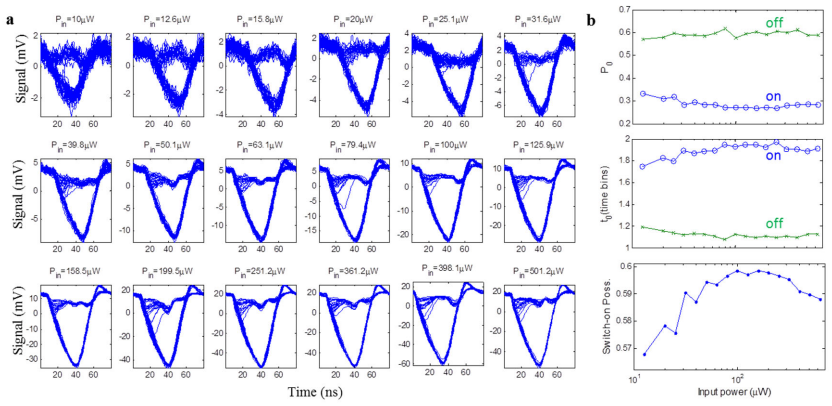
"The time-bin of the stochastic switching is then simulated by random binary bits sequences, with probatility density versus state duration for both on- and off-states. We obtain similar trends in the modeled P0 and t0 versus switch-on probability as in the measurements."
The 'modeled' P0 and t0 are not obtained from an independent stochastic first-principles model. The Supplementary caption states that the measured histograms are fit to an exponential: 'The distribution follows exponential decay: P=P0e-t/t0 (c) f=13MHz: P0_ON=0.130, T0_ON=2.01, P0_OFF=0.165, T0_OFF=1.53; (d) f=200Hz: P0_ON=0.196, T0_ON=1.53, P0_OFF=0.103, T0_OFF=4.03.' The model curves in Fig. S8 are then generated from the same exponential statistics and compared with the measured fitted values. The agreement is therefore enforced by construction, since the model parameters are the measured fit parameters; this is a self-comparison, not a prediction.
full rationale
The paper's core experimental observations—two-state switching, polarization selectivity, NC-removal control, power independence—are self-contained and not circular. The coupled-mode equations (S1-S2) are linear, deterministic, and contain no noise term, so they cannot derive the stochastic bifurcation; the paper itself attributes the randomness to 'the chaotic ring amplified quantum phase noise from the laser source.' That is a mechanistic underdetermination rather than a circular derivation, and I do not score it as a circular step. The load-bearing circularity is in the statistical validation: P0 and t0 are extracted by fitting the measured exponential histograms, and the 'modeled' P0/t0 trends are then compared with the same measured fits. This is a fitted input presented as a modeled agreement, reducing that validation step to a restatement of the fit. Self-citations are present but not load-bearing: the CMT framework is attributed to external refs [21]/[SR8], and the self-cited fabrication/CMT refs do not uniquely force the central claim. Overall, the central mechanistic claim remains underdetermined and is only partially circular, hence score 6.
Assumptions & free parameters
free parameters (4)
- gamma_m (WGM decay rate) =
0.009 (normalized)
- gamma_c (chaotic mode decay rate) =
0.02 (normalized)
- kappa (chaotic-to-WGM tunneling rate) =
0.0005
- Effective index of Si NC-loaded oxide cladding =
2.2
assumptions (4)
- domain assumption The resonator dynamics are adequately described by only two modes (WGM and one chaotic mode) with coupling kappa.
- ad hoc to paper Densely packed Si nanocrystals on the SiN surface induce mode conversion and chaotic states, and modify the tunneling rate kappa.
- ad hoc to paper The nondeterministic output is attributed to the chaotic ring amplifying quantum phase noise from the laser source.
- domain assumption Dynamics from a 5 micrometer radius FDTD 'toy model' with artificial scatterers transfer to fabricated 20-70 micrometer radius rings.
invented entities (1)
-
Bistable dissipation-versus-tunneling pathway
Cite this review
Pith. "Pith review of Bistable random momentum transfer in a linear on-chip resonator." pith.science (2026). https://pith.science/paper/OUVITMRR
@misc{pith2026250611859,
  author       = {Pith},
  title        = {Pith review of: Bistable random momentum transfer in a linear on-chip resonator},
  year         = {2026},
  howpublished = {\url{https://pith.science/paper/OUVITMRR}},
  note         = {Machine review of arXiv:2506.11859}
}
read the original abstract
Optical switches and bifurcation rely on the nonlinear response of materials. Here, we demonstrate linear temporal bifurcation responses in a passive multimode microresonator, with strongly coupled chaotic and whispering gallery modes or WGMs. In microdisks, the chaotic modes exhibit broadband transfer within the deformed cavities, but their transient response is less explored and yields a random output of the analog signal distributed uniformly from 0 to 1. Here, we build chaotic states by perturbing the multi-mode microring resonators with densely packed silicon nanocrystals on the waveguide surface. In vivo measurements reveal random and digitized output that ONLY populates around 0 and 1 intensity levels. The bus waveguide mode couples firstly to chaotic modes, then either dissipates or tunnels into stable WGMs. This binary pathway generates high-contrast, digitized outputs. The fully passive device enables real-time conversion of periodic clock signals into binary outputs with contrasts exceeding 12.3 dB, data rates of up to 100 Mbits per second, and 20dB dynamic range.
Figures


Figures from the paper (3 more)


Reference graph
Works this paper leans on
-
[1]
R. G. Gallager, Principles of digital communication, Cambridge University Press (2008)
work page 2008
-
[2]
S. Asmussen and P. W. Glynn, Stoc hatic simulation: algorithms and analysis, Springer-Verlag (2007)
work page 2007
-
[3]
K. P. Murphy, Probabilistic Machine Learning: An Introduction (MIT Press, 2022)
work page 2022
-
[4]
Ghahramani, Probabilistic machine learning and artificial intelligence
Z. Ghahramani, Probabilistic machine learning and artificial intelligence. Nature 521, 452–459 (2015)
work page 2015
-
[5]
Y. Song, J. Sohl-Dickstein, D. P. Kingma, A. Kumar, S. Ermon, and B. Poole, Score-based generative modeling through stochastic differential equations. arXiv preprint arXiv:2011.13456 (2020)
arXiv 2020
-
[6]
S. Choi, Y. Salamin, C. Roques-Carmes, R. Dangovski, D. Luo, Z. C hen, M. Horodynski, J. Sloan, S. Z. Uddin, and M. Soljačić, Photonic probabilistic machine learning using quantum vacuum noise. Nature Communication 15, 7760 (2024)
work page 2024
-
[7]
F. Raffaelli, P. Sibson, J. E. Kennard, D. H. Mahler, M. G. Thompson, and J. CF Matthews. Generation of random numbers by measuring phase fluctuations from a laser diode with a silicon- on-insulator chip. Optics Express 26, 19730-19741 (2018). 7
work page 2018
-
[8]
A. Argyris, D. Syvridis, L. Larger, V. Annovazzi-Lodi, P. Colet, I. Fischer, J. García-Ojalvo, C. R. Mirasso, L. Pesquera, and K. A. Shore, Chaos-based communications at high bit rates using com- mercial fibre-optic links, Nature 438, 343 (2005)
work page 2005
Show all 42 references
-
[9]
Reidler, Y
I. Reidler, Y. Aviad, M. Rosenbluh, and I. Kanter, Ultrahigh-speed random number generation based on a chaotic semiconductor laser, Physics Review Letter 103, 024102 (2009)
2009
-
[10]
Uchida, K
A. Uchida, K. Amano, M. Inoue, K. Hirano, S. Naito, H. Someya, I. Oowada, T. Kurashige, M. Shiki, S. Yoshimori, K. Yoshimura, and P. Davis, Fast physical random bit generation with chaotic semiconductor lasers, Nature Photonics 2, 728 (2008)
2008
-
[11]
D. S. Wiersma, Disordered photonics, Nature Photonics 7, 188 (2013)
2013
-
[12]
J. G. Wu, G.-Q. Xia, X. Tang, X.-D. Lin, T. Deng, L. Fan, and Z.-M. Wu. Time delay signature concealment of optical feedback induced chaos in an external cavity semiconductor laser, Optics Express 18, 6661-6666 (2010)
2010
-
[13]
Abellán, W
C. Abellán, W. Amaya, M. Jofre, M. Curty, A. Acín, J. Capmany, V. Pruneri, and M. W. Mitchell, Ultra-fast quantum randomness generation by accelerated phase diffusion in a pulsed laser diode. Optics express 22, 1645-1654 (2014)
2014
-
[14]
K. Kim, S. Bittner, Y. Zeng, S. Guazzotti, O. Hess, Q. J. Wang, and H. Cao. Massively parallel ultrafast random bit generation with a chip-scale laser. Science 371, 948-952 (2021)
2021
-
[15]
Jennewein, U
T. Jennewein, U. Achleitner, G. Weihs, H. Weinfurter, A. Zeilinger, A fast and compact quantum random number generator, Review of Scientific Instruments 71, 1675 (2000)
2000
-
[16]
Stefanov, N
A. Stefanov, N. Gisin, O. Guinnard, L. Guinnard, and H. Zbinden, Optical quantum random number generator, Journal of Modern Optics 47, 595 (2000)
2000
-
[17]
Herrero-Collantes, and J
M. Herrero-Collantes, and J. C. Garcia-Escartin, Quantum random number generators. Re- views of Modern Physics 89, p.015004 (2017)
2017
-
[18]
Cao, and Y
H. Cao, and Y. Eliezer. Harnessing disorder for photonic device applications. Applied Physics Reviews 9, 1 (2022)
2022
-
[19]
Türeci, H
H.E. Türeci, H. G. Schwefel, P. Jacquod, and A. D. Stone, Modes of wave-chaotic dielectric resonators. In Progress in Optics 47, 75-137 (2005)
2005
-
[20]
Yu, C.-W
S. Yu, C.-W. Qiu, Y. Cho ng, S. Torquato, and N. Park. E ngineered disorder in photonics." Nature Reviews Materials 6, 226-243 (2021)
2021
-
[21]
Jiang, L
X. Jiang, L. Shao, S. X. Zhang, X. Yi, J. Wiersig, L. Wang, Q. Gong, M. Lončar, L. Yang, and Y. F. Xiao, Chaos-assisted broadband momentum transformation in optical microresonators. Sci- ence 358, 344-347 (2017)
2017
-
[22]
Jiang, S
X. Jiang, S. Yin, H. Li, J. Quan, H. Goh, M. Cotrufo, J. Kullig, J. Wiersig, and A. Alù. Coherent control of chaotic optical microcavity with reflectionless scattering modes. Nature Physics 20, 109- 115 (2024)
2024
-
[23]
Liu, and Y.-C
Z. Liu, and Y.-C. Lai. Chaotic scattering in deformed optical microlasing cavities. Physical Re- view E 65, 046204 (2002)
2002
-
[24]
Y.-J. Qian, H. Liu, Q.-T. Cao, J. Kullig, K. Rong, C.-W. Qiu, J. Wiersig, Q. Gong, J. Chen, and Y.-F. Xiao. Regulated photon transport in chaotic microcavities by tailoring phase space. Physical Review Letters 127, 273902 (2021)
2021
-
[25]
C.-H. Yi, J. Kullig, & J. Wiersig, Pair of exceptional points in a microdisk cavity under an ex- tremely weak deformation. Phys. Rev. Lett. 120, 093902 (2018)
2018
-
[26]
Bittner, S
S. Bittner, S. Guazzotti, Y. Zeng, X. Hu, H. Yılmaz, K. Kim, S. S. Oh, Q. J. Wang, O. Hess, and H. Cao, Suppressing spatiotemp oral lasing instabilities with wave-chaotic microcavities. Science 361, 1225–1231 (2018)
2018
-
[27]
S. Wang, S. Liu, Y. Liu, S. Xiao, Z. Wang, Y. Fan, J. Han, L. Ge, and Q. Song. Direct obser- vation of chaotic resonances in optical microcavities. Light: Science & Applications 10, 135 (2021)
2021
-
[28]
Zhang, K
Y. Zhang, K. Zhong, X. Zhou, & H. K. Tsang, Broadband high-Q multimode silicon concentric racetrack resonators for widely tunable Raman lasers. Nature Commun 13, 3534 (2022)
2022
-
[29]
F. Xia, K. Kim, Y. Elieze r, S. Han, L. Shaughnessy, S. Gi gan, and H. Cao, Nonlinear optical encoding enabled by recurrent linear scattering. Nature Photonics 18, 1067-1075 (2024)
2024
-
[30]
S. C. Mao, S. H. Tao, Y. L. Xu, X. W. S un, M. B. Yu, G. Q. Lo, and D. L. Kwong, Low propa- gation loss SiN optical waveguide prepared by optimal low-hydrogen module, Optics Express 16, 20809–20816 (2008). 8
2008
-
[31]
T. Gu, M. Yu, D.-L. Kwong, and C. W. Wong. Molecular-absorption-induced thermal bistability in PECVD silicon nitride microring resonators. Optics Express 22, 18412-18420 (2014)
2014
-
[32]
J. N. Milgram, J. Wojcik, P. Mascher, and A. P. Knights, Optically pumped Si nanocrystal emit- ter integrated with low loss silicon nitride waveguides. Optics Express 15, 14679-14688 (2007)
2007
-
[33]
Tsubata, K
R. Tsubata, K. Gotoh, M. Matsumi, M. W ilde, T. Inoue, Y. Kurokawa, K. Fukutani, and N. Usami, Silicon nanocrystals embedded in nanolayer ed silicon oxide for crystalline silicon solar cells. ACS Applied Nano Materials 5, 1820-1827 (2022)
2022
-
[34]
H. Cao, A. P. Mosk, and S. Rotter. Shaping the propagation of light in complex media. Nature Physics 18, 994-1007 (2022)
2022
-
[35]
Kanter, Y
I. Kanter, Y. Aviad, I. Reidle, E. Cohen, an d M. Rosenbluh, An optic al ultrafast random bit generator, Nature Photonics 4, 58 (2010)
2010
-
[36]
Wu, G.-Q
J.-G. Wu, G.-Q. Xia, and Z.-M. Wu, Suppression of time delay signatures of chaotic output in a semiconductor laser with double optical feedback, Optics Express 17, 20124-20133 (2009)
2009
-
[37]
Z. Ge, T. Hao, J. Capmany, W. Li, N. Zhu, and M. Li. Broadband random optoelectronic oscil- lator. Nature Communications 11, 1-8 (2020)
2020
-
[38]
Moreno, S
D. Moreno, S. Fujii, A. Na kashima, D. Lemcke, A. Uchida, P. Sanchis, and T. Tanabe, Syn- chronization of two chaotic microresonator frequency combs. Optics Express 32, 2460-2472 (2024)
2024
-
[39]
Mancinelli, M
M. Mancinelli, M. Borghi, F. Ramiro-Manzano, J. M. Fedeli, and L. Pavesi, Chaotic dynamics in coupled resonator sequences. Optics Express 22, 14505-14516 (2014)
2014
-
[40]
Carmon, L
T. Carmon, L. Yang and K. J. Vahala, Dynamical thermal behavior and thermal self-stability of microcavities, Optics Express 12, 4742 (2004)
2004
-
[41]
Laje, & D
R. Laje, & D. V. Buonomano, Robust timing an d motor patterns by taming chaos in recurrent neural networks. Nature Neuroscience 16, 925–933 (2013)
2013
-
[42]
1” (red) and “0
Lumerical Solutions, Inc., www.lumerical.com/tcad-products/fdtd/ Author Contributions: T. G., Y. K., and P. D. carried out optical experiments. L. C., J. W., H. L. and T.G. developed the models and analyzed the data. L. C. and M. R. performed full-field numer- ical simulation....
2008
Reviewed August 7, 2026 · model on record in the stance chip above.
Discussion (0). Continue with ORCID to comment.