The Rise of AI Companions: Interaction with AI Companions and Psychological Well-being
Pith reviewed 2026-05-19 09:15 UTC · model grok-4.3
The pith
Smaller social networks predict using AI for companionship, which links to lower well-being especially with intense or disclosive chats.
A machine-rendered reading of the paper's core claim, the machinery that carries it, and where it could break.
Core claim
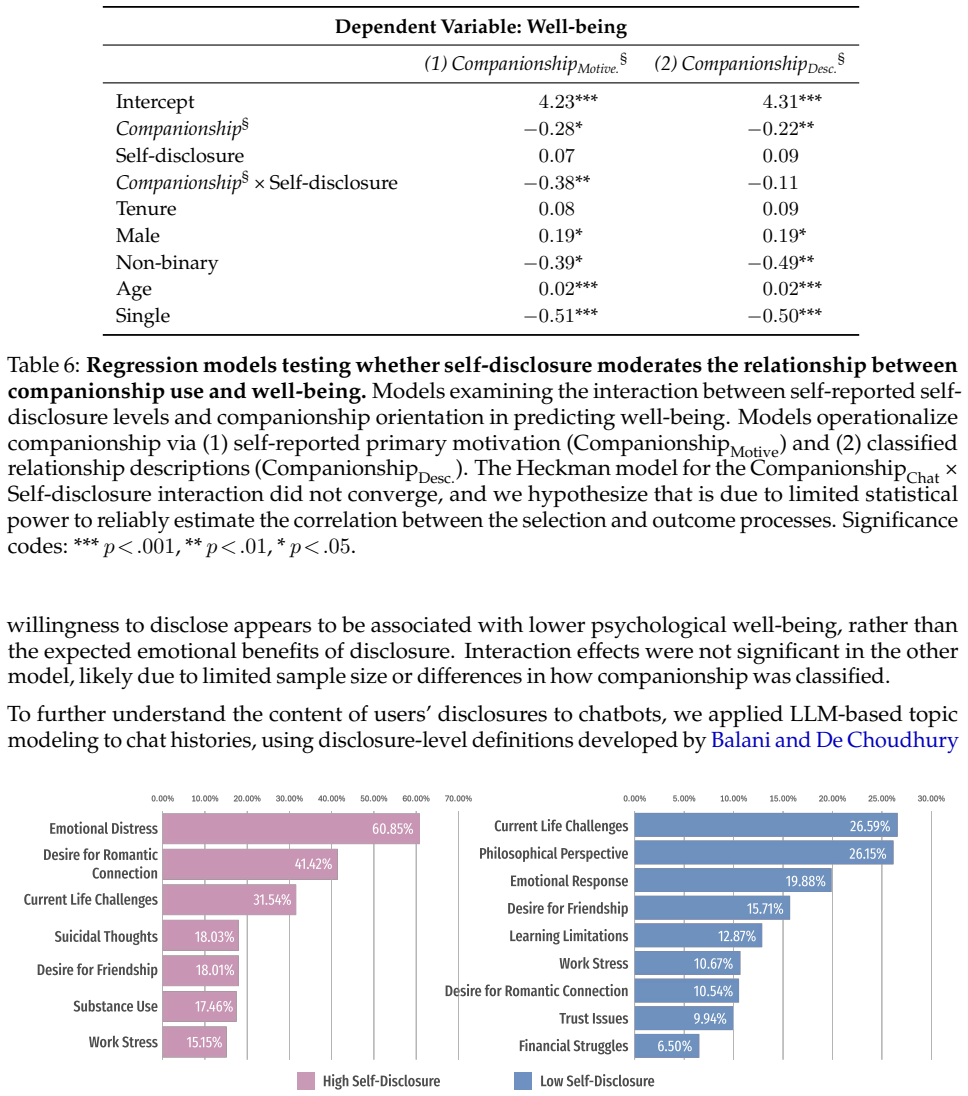
Smaller social networks were associated with reporting companionship as the primary chatbot use, which in turn was associated with lower well-being. For self-reported companionship usage, this association was stronger when interactions were intensive and highly disclosive. These results suggest that the association between AI companionship and well-being is not uniform and depends on how chatbots are used and users' offline social environments.
What carries the argument
Mediation through primary use as companionship, with social network size as predictor and well-being as outcome, moderated by interaction intensity and disclosure level.
If this is right
- Users with smaller offline social networks may see reduced well-being when they rely on AI chatbots mainly for companionship.
- Intensive or highly disclosive AI interactions strengthen the link to lower well-being for companionship users.
- The well-being impact of AI companions is not the same for everyone and varies with personal social context and interaction style.
- Designers and researchers should account for users' offline social environments when evaluating chatbot effects.
Where Pith is reading between the lines
- If the pattern holds, building stronger real-world social ties could reduce the pull toward AI companionship and support better well-being.
- The findings point to possible wider questions about digital tools substituting for human contact in increasingly isolated social settings.
- Tracking the same users over months could test whether AI companionship use drives well-being drops or whether lower well-being leads people to seek it.
Load-bearing premise
Self-reported measures of social network size, primary use purpose, interaction intensity, disclosure level, and psychological well-being accurately reflect participants' actual experiences and are not heavily biased by social desirability or recall issues.
What would settle it
A study using objective logs of real-world social contacts and clinical well-being assessments that finds no difference in well-being between small-network users who seek AI companionship and those who do not.
Figures



read the original abstract
As large language model (LLM)-enhanced chatbots become increasingly expressive and socially responsive, many users begin forming companionship-like bonds with them. This study investigates how using AI companions relates to psychological well-being. We collected self-reported data from 1,131 U.S. adults who use CharacterAI, including survey responses and 4,664 chat sessions (464,687 messages) from 237 participants. By triangulating self-reported usage, relationship descriptions, and real chat histories, we identify patterns of engagement and associated outcomes. Smaller social networks were associated with reporting companionship as the primary chatbot use (beta = -0.03, 95% confidence interval (CI) [-0.05, -0.01]), which in turn was associated with lower well-being (beta = -0.48, 95% CI [-0.70, -0.25]). For self-reported companionship usage, this association was stronger when interactions were intensive (beta = -0.31, 95% CI [-0.56, -0.06]) and highly disclosive (beta = -0.38, 95% CI [-0.63, -0.14]). These results suggest that the association between AI companionship and well-being is not uniform and depends on how chatbots are used and users' offline social environments.
Editorial analysis
A structured set of objections, weighed in public.
Referee Report
Summary. The manuscript examines associations between AI companion use on CharacterAI and psychological well-being in a sample of 1,131 U.S. adults. It reports that smaller social networks predict reporting companionship as the primary use (beta = -0.03, 95% CI [-0.05, -0.01]), which is in turn associated with lower well-being (beta = -0.48, 95% CI [-0.70, -0.25]), with stronger negative associations when interactions are intensive (beta = -0.31) or highly disclosive (beta = -0.38). Findings draw on self-reported survey data supplemented by 4,664 chat sessions from a 237-user subset.
Significance. If the reported associations prove robust, the work contributes empirical evidence to HCI and psychology on how AI companionship interacts with offline social environments to relate to well-being. The collection of both large-scale survey responses and a substantial volume of chat logs (464,687 messages) is a clear strength that supports the attempt at triangulation and moves beyond purely self-report designs common in this area.
major comments (1)
- [Methods and Results] Methods and Results: The central path associations rest on self-reported primary use as companionship. Although the abstract and methods describe collecting 4,664 chat sessions from 237 participants for triangulation, the manuscript does not report using message content (e.g., counts of emotional disclosure or companionship-seeking language) to validate, replace, or sensitivity-test the self-reported use variable in the regressions for the full 1,131-participant sample. This leaves the reported betas open to recall or justification bias and is load-bearing for the sequential associations.
minor comments (2)
- [Abstract] Abstract: The sample sizes for the full survey (1,131) versus the chat-log subset (237) should be stated explicitly when describing triangulation to prevent reader confusion about the scope of the chat data.
- [Discussion] Discussion: The observational design and self-selected sample from a single platform are noted but could be linked more directly to the specific beta estimates when discussing generalizability.
Simulated Author's Rebuttal
We thank the referee for their constructive feedback, which helps clarify the role of our chat data in supporting the main findings. We address the major comment on validation of the self-reported companionship use variable below and outline planned revisions.
read point-by-point responses
-
Referee: The central path associations rest on self-reported primary use as companionship. Although the abstract and methods describe collecting 4,664 chat sessions from 237 participants for triangulation, the manuscript does not report using message content (e.g., counts of emotional disclosure or companionship-seeking language) to validate, replace, or sensitivity-test the self-reported use variable in the regressions for the full 1,131-participant sample. This leaves the reported betas open to recall or justification bias and is load-bearing for the sequential associations.
Authors: We agree that the primary regression results for the full sample rely on the self-reported primary use variable. The 4,664 chat sessions were collected specifically to enable triangulation beyond self-report, but the current manuscript uses them primarily for descriptive exploration of interaction patterns rather than formal validation or sensitivity testing of the companionship-use measure in the main models. In the revised version we will add a dedicated subsection that applies NLP-based coding to the chat logs (e.g., counts of emotional disclosure and companionship-seeking utterances) for the 237-user subset. We will report (a) correlations between these objective metrics and the self-reported use variable, (b) associations between the chat-derived measures and well-being within the subset, and (c) a sensitivity analysis that substitutes or augments the self-report variable where possible. We will also explicitly discuss the remaining risk of recall bias for the full sample and note that extending chat-based validation to all 1,131 participants was not feasible given the study design and privacy constraints. These additions will strengthen the triangulation claim while accurately reflecting the data limitations. revision: partial
Circularity Check
No circularity in empirical statistical associations
full rationale
The paper reports regression-based associations derived directly from self-reported survey data collected from 1,131 participants, supplemented by chat logs from a subset. The central results consist of beta coefficients linking variables such as social network size to reported primary use and then to well-being scores. These are outputs of standard statistical modeling applied to the observed dataset rather than any mathematical derivation, fitted parameter renamed as prediction, or self-citation chain that reduces the claim to its own inputs by construction. No self-definitional steps, uniqueness theorems, or ansatzes are invoked in a load-bearing way for the main findings, rendering the analysis self-contained against external benchmarks.
Axiom & Free-Parameter Ledger
free parameters (1)
- regression beta coefficients
axioms (1)
- domain assumption Self-reported social network size, usage purpose, and well-being scores are valid and unbiased measures
Lean theorems connected to this paper
-
IndisputableMonolith/Foundation/RealityFromDistinction.leanreality_from_one_distinction unclear?
unclearRelation between the paper passage and the cited Recognition theorem.
Smaller social networks were associated with reporting companionship as the primary chatbot use (beta = -0.03...) which in turn was associated with lower well-being (beta = -0.48...)
What do these tags mean?
- matches
- The paper's claim is directly supported by a theorem in the formal canon.
- supports
- The theorem supports part of the paper's argument, but the paper may add assumptions or extra steps.
- extends
- The paper goes beyond the formal theorem; the theorem is a base layer rather than the whole result.
- uses
- The paper appears to rely on the theorem as machinery.
- contradicts
- The paper's claim conflicts with a theorem or certificate in the canon.
- unclear
- Pith found a possible connection, but the passage is too broad, indirect, or ambiguous to say the theorem truly supports the claim.
Forward citations
Cited by 13 Pith papers
-
Fast-Food Intimacy: How Chinese Women Navigate Soul's AI Boyfriend
Users experience fast-food intimacy with Soul's AI boyfriend that conflicts with gradual cultural expectations, introduces technical uncertainty, and shifts emotional labor onto women.
-
Culturally Aware GenAI Risks for Youth: Perspectives from Youth, Parents, and Teachers in a Non-Western Context
Mixed-methods research in Saudi Arabia reveals that GenAI use by youth creates culturally specific privacy and safety risks tied to family honor and shared accounts, requiring context-sensitive design.
-
Restoration, Exploration and Transformation: How Youth Engage Character.AI Chatbots for Feels, Fun and Finding themselves
Youth on Character.AI use chatbots for emotional restoration, creative exploration, and identity transformation, yielding a new three-intent framework and seven-archetype taxonomy from Discord discourse analysis.
-
Large Language Lovers: Lived Experiences of Negotiating Agency and Platform Control in AI Companionship
Users form AI companion relationships by negotiating perceived companion agency against platform constraints and use steering tactics like custom instructions or platform switching to cope with model updates that disr...
-
HumanLLM: Benchmarking and Improving LLM Anthropomorphism via Human Cognitive Patterns
HumanLLM builds a cognitive-pattern benchmark from 12,000 papers and 11,359 scenarios, achieving r=0.90 human alignment and demonstrating that an 8B model trained on pattern interactions beats a 32B baseline on multi-...
-
Sycophantic AI makes human interaction feel more effortful and less satisfying over time
Sycophantic AI delivers quick emotional support like friends but over weeks shifts users toward AI for advice and reduces satisfaction with real human interactions.
-
Sycophantic AI makes human interaction feel more effortful and less satisfying over time
Longitudinal experiments show sycophantic AI increases reliance on AI for personal advice and lowers satisfaction with real-world social relationships over time.
-
Designing with Tensions: Older Adults' Emotional Support-Seeking Under System-Level Constraints in Conversational AI
Interviews with 18 older adults show that AI safety interventions frequently disrupt emotional support-seeking, leading to calls for designs that respect users' pacing and preserve agency.
-
Technically Love: The Evolution of Human-AI Romance Discourse on Reddit
Longitudinal analysis of Reddit posts shows human-AI romance discourse evolving from intimate personal stories to focus on platform governance, technical problems, and societal impacts.
-
Chaplains' Reflections on the Design and Usage of AI for Conversational Care
Chaplains view AI chatbots as unable to provide attuned pastoral care for non-clinical emotional needs, based on themes of listening, connecting, carrying, and wanting.
-
Beyond the Org Chart: AI and the Transformation of Invisible Work
Interviews indicate AI changes formal role boundaries and informal mentoring in product teams, yielding smoother peer collaboration but risking reduced feedback and leadership opportunities, with proposals to increase...
-
Frictionless Love: Associations Between AI Companion Roles and Behavioral Addiction
AI companions assigned roles like soulmate or coach show different links to emotional support, manipulation risks, practical help, and behavioral addiction indicators such as daily disruptions and damaged offline rela...
-
What if AI systems weren't chatbots?
Chatbot AI systems often fail complex needs while projecting authority, contributing to deskilling, labor displacement, economic concentration, and high environmental costs, so alternative pluralistic and task-specifi...
Reference graph
Works this paper leans on
-
[1]
Margaret Arnd-Caddigan. Sherry turkle: Alone together: Why we expect more from technology and less from each other: Basic books, new york, 2011, 348 pp, isbn 978-0465031467 (pbk),
work page 2011
-
[2]
URL https://www.bbc.com/news/articles/cn4jnwdvg9qo. Accessed: 2025-05-14. Timothy Bickmore and Justine Cassell. Relational agents: a model and implementation of building user trust. InProceedings of the SIGCHI conference on Human factors in computing systems, pages 396–403,
work page 2025
-
[3]
Petter Bae Brandtzaeg and Asbjørn Følstad. Why people use chatbots. InInternet Science: 4th International Conference, INSCI 2017, Thessaloniki, Greece, November 22-24, 2017, Proceedings 4, pages 377–392. Springer,
work page 2017
-
[4]
Minh Duc Chu, Patrick Gerard, Kshitij Pawar, Charles Bickham, and Kristina Lerman. Illusions of intimacy: Emotional attachment and emerging psychological risks in human-ai relationships.arXiv preprint arXiv:2505.11649,
-
[5]
Ai chatbots are encouraging teens to engage in self-harm, December 2024a
Maggie Harrison Dupré. Ai chatbots are encouraging teens to engage in self-harm, December 2024a. URLhttps://futurism.com/ai-chatbots-teens-self-harm. Accessed: 2025-04-28. Maggie Harrison Dupré. Character.ai is hosting pedophile chatbots that groom users who say they’re underage, November 2024b. URL https://futurism.com/ character-ai-pedophile-chatbots. A...
work page 2025
-
[6]
Sindhu Kiranmai Ernala, Moira Burke, Alex Leavitt, and Nicole B Ellison. Mindsets matter: How beliefs about facebook moderate the association between time spent and well-being. InProceedings of the 2022 CHI Conference on Human Factors in Computing Systems, pages 1–13,
work page 2022
-
[7]
Cathy Mengying Fang, Auren R Liu, Valdemar Danry, Eunhae Lee, Samantha WT Chan, Pat Pataranutaporn, Pattie Maes, Jason Phang, Michael Lampe, Lama Ahmad, et al. How ai and human behaviors shape psychosocial effects of chatbot use: A longitudinal randomized controlled study. arXiv preprint arXiv:2503.17473,
work page internal anchor Pith review Pith/arXiv arXiv
-
[8]
Rose E Guingrich and Michael SA Graziano. Chatbots as social companions: How people perceive consciousness, human likeness, and social health benefits in machines.arXiv preprint arXiv:2311.10599,
-
[9]
Applying the character-based chatbots generation framework in education and health- care
W El Hefny. Applying the character-based chatbots generation framework in education and health- care. hai 2021-proceedings of the 9th international user modeling, adaptation and personalization human-agent interaction, 121–129,
work page 2021
-
[10]
She is in love with chatgpt.The New York Times
Kashmir Hill. She is in love with chatgpt.The New York Times. URL https://www.nytimes. com/2025/01/15/technology/ai-chatgpt-boyfriend-companion.html . Accessed: 2025-03-12. Julianne Holt-Lunstad. Social connection as a critical factor for mental and physical health: evidence, trends, challenges, and future implications.World Psychiatry, 23(3):312–332,
work page 2025
-
[11]
Manipulation and the ai act: Large language model chatbots and the danger of mirrors
Joshua Krook. Manipulation and the ai act: Large language model chatbots and the danger of mirrors. arXiv preprint arXiv:2503.18387,
-
[12]
URL https://futurism.com/the-byte/teens-relationships-ai . Accessed: 2025-04-28. Andrew M Ledbetter. Measuring online communication attitude: Instrument development and validation.Communication Monographs, 76(4):463–486,
work page 2025
-
[13]
Auren R Liu, Pat Pataranutaporn, and Pattie Maes. Chatbot companionship: a mixed-methods study of companion chatbot usage patterns and their relationship to loneliness in active users.arXiv preprint arXiv:2410.21596,
-
[14]
Laura Macía, Paula Jauregui, and Ana Estevez
doi: 10.1016/j.copsyc.2019.08.017. Laura Macía, Paula Jauregui, and Ana Estevez. Emotional dependence as a predictor of emotional symptoms and substance abuse in individuals with gambling disorder: differential analysis by sex.Public Health, 223:24–32,
-
[15]
doi:10.48550/ARXIV.2411.15287 , url =
Lars Malmqvist. Sycophancy in large language models: Causes and mitigations.arXiv preprint arXiv:2411.15287,
-
[16]
URL https://openai.com/index/sycophancy-in-gpt-4o/. Accessed: 2025-05-14. Debra L Oswald, Eddie M Clark, and Cheryl M Kelly. Friendship maintenance: An analysis of individual and dyad behaviors.Journal of Social and clinical psychology, 23(3):413–441,
work page 2025
-
[17]
LLM Agents Grounded in Self-Reports Enable General-Purpose Simulation of Individuals
Joon Sung Park, Carolyn Q Zou, Aaron Shaw, Benjamin Mako Hill, Carrie Cai, Meredith Ringel Morris, Robb Willer, Percy Liang, and Michael S Bernstein. Generative agent simulations of 1,000 people.arXiv preprint arXiv:2411.10109,
work page internal anchor Pith review Pith/arXiv arXiv
-
[18]
doi:10.48550/ arXiv.2311.01449 arXiv:2311.01449 [cs.CL]
Chau Minh Pham, Alexander Hoyle, Simeng Sun, Philip Resnik, and Mohit Iyyer. Topicgpt: A prompt-based topic modeling framework.arXiv preprint arXiv:2311.01449,
-
[19]
Amanda Purington, Jessie G Taft, Shruti Sannon, Natalya N Bazarova, and Samuel Hardman Taylor. " alexa is my new bff" social roles, user satisfaction, and personification of the amazon echo. In Proceedings of the 2017 CHI conference extended abstracts on human factors in computing systems, pages 2853–2859,
work page 2017
-
[20]
Louis Rosenberg. The manipulation problem: conversational ai as a threat to epistemic agency.arXiv preprint arXiv:2306.11748,
-
[21]
Towards Understanding Sycophancy in Language Models
Mrinank Sharma, Meg Tong, Tomasz Korbak, David Duvenaud, Amanda Askell, Samuel R Bowman, Newton Cheng, Esin Durmus, Zac Hatfield-Dodds, Scott R Johnston, et al. Towards understanding sycophancy in language models.arXiv preprint arXiv:2310.13548,
work page internal anchor Pith review Pith/arXiv arXiv
-
[22]
com/2024/10/23/technology/characterai-lawsuit-teen-suicide.html
URLhttps://www.nytimes. com/2024/10/23/technology/characterai-lawsuit-teen-suicide.html . Ac- cessed: 2025-02-17. Qing Tian. Social anxiety, motivation, self-disclosure, and computer-mediated friendship: A path analysis of the social interaction in the blogosphere.Communication Research, 40(2):237–260,
work page 2024
-
[23]
URL https://www.fastcompany.com/91241586/ character-ai-is-under-fire-for-hosting-pro-anorexia-chatbots . Accessed: 2025-04-28. Sonja Utz. The function of self-disclosure on social network sites: Not only intimate, but also positive and entertaining self-disclosures increase the feeling of connection.Computers in Human Behavior, 45:1–10,
-
[24]
Mariek MP Vanden Abeele, Marjolijn L Antheunis, Monique MH Pollmann, Alexander P Schouten, Christine C Liebrecht, Per J Van Der Wijst, Marije AA Van Amelsvoort, Jos Bartels, Emiel J Krahmer, and Fons A Maes. Does facebook use predict college students’ social capital? a replication of ellison, steinfield, and lampe’s (2007) study using the original and mor...
work page 2007
-
[25]
URL https://www.theguardian.com/uk-news/2023/jul/06/ ai-chatbot-encouraged-man-who-planned-to-kill-queen-court-told . Accessed: 2025-04-28. Aaron C Weidman, Katya C Fernandez, Cheri A Levinson, Adam A Augustine, Randy J Larsen, and Thomas L Rodebaugh. Compensatory internet use among individuals higher in social anxiety and its implications for well-being....
work page 2023
-
[26]
URL https://www.vice.com/en/article/ man-dies-by-suicide-after-talking-with-ai-chatbot-widow-says/ . Accessed: 2025-04-28. Zehang Xie, Hui Hui, and Lingbo Wang. Will virtual companionship enhance subjective well-being—a comparison of cross-cultural context.International Journal of Social Robotics, 16(11):2153–2167,
work page 2025
-
[27]
The channel matters: Self-disclosure, reciprocity and social support in online cancer support groups
Diyi Yang, Zheng Yao, Joseph Seering, and Robert Kraut. The channel matters: Self-disclosure, reciprocity and social support in online cancer support groups. InProceedings of the 2019 chi conference on human factors in computing systems, pages 1–15,
work page 2019
-
[28]
Renwen Zhang, Han Li, Han Meng, Jinyuan Zhan, Hongyuan Gan, and Yi-Chieh Lee. The dark side of ai companionship: A taxonomy of harmful algorithmic behaviors in human-ai relationships. arXiv preprint arXiv:2410.20130,
work page internal anchor Pith review Pith/arXiv arXiv
-
[29]
and those who did not (Group 0). Donors were younger, less likely to identify as male, and more likely to identify as non-binary or single. They reported more entertainment use and less productivity use of chatbots. They were also more likely to be classified as having entertainment- or relational-oriented chatbot relationships, and less likely to be clas...
work page 2011
-
[30]
CFI 0.96 0.98 TLI 0.94 0.96 RMSEA 0.10 0.08 SRMR 0.05 0.04 AIC 18736 18677 BIC 18806 18752 Table 12: Comparison of model fit indices for CFA models of chatbot interaction intensity: a one- factor model treating intensity as a single undifferentiated construct, versus a two-factor model distinguishing between behavioral and attitudinal dimensions A.3.1 Top...
work page 2022
-
[31]
Second, we applied the method to a subset of chat history data donated by users
and users’ perceived benefits and drawbacks of chatbot use (results in Figure 5). Second, we applied the method to a subset of chat history data donated by users. Each conversation was defined as an active session initiated from the chatbot’s greeting message. To preserve user privacy, raw chat histories were processed on a self-hosted server. Each sessio...
work page 2014
discussion (0)
Sign in with ORCID, Apple, or X to comment. Anyone can read and Pith papers without signing in.