REVIEW 1 major objections 3 minor 18 references
Neighbor Connectivity of Undirected Toroidal Meshes
T0 review · 1 major / 3 minor · reviewed 2026-08-07 · deepseek-v4-flash
Pith's one-line read The paper proves that the neighbor connectivity of every $n$-dimensional undirected toroidal mesh $C(d_1,\dots,d_n)$ with $d_i \ge 3$ is exactly $n$, so it takes $n$ source failures (each also disabling its neighbors) to knock the network…
desk verdict Genuine extension of neighbor connectivity from k-ary n-cubes to unequal-side toroidal meshes, with a solid lower-bound architecture but a patchable gap in the n=2 base case of the main induction. read the letter →
The pith
A machine-rendered reading of the paper's core claim, the machinery that carries it, and where it could break.
The reading
What carries the argument
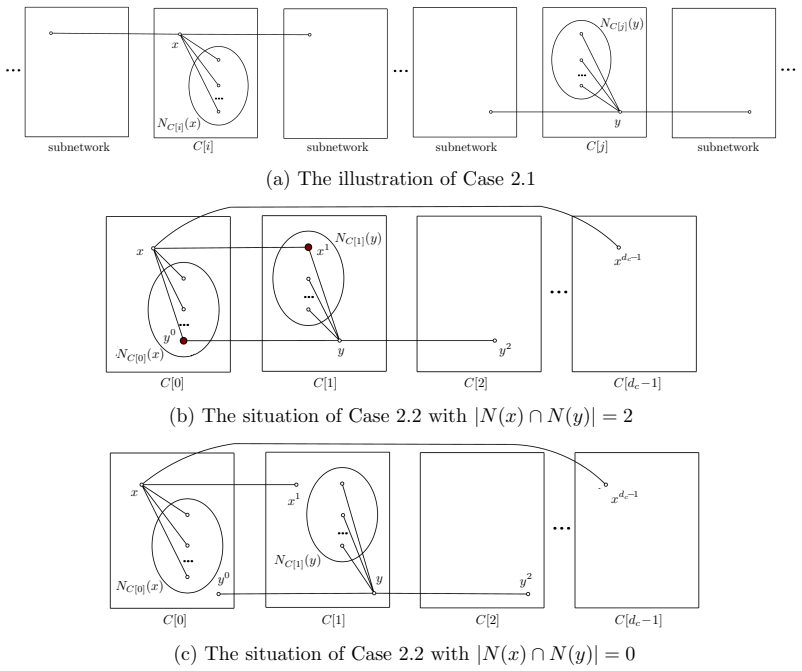
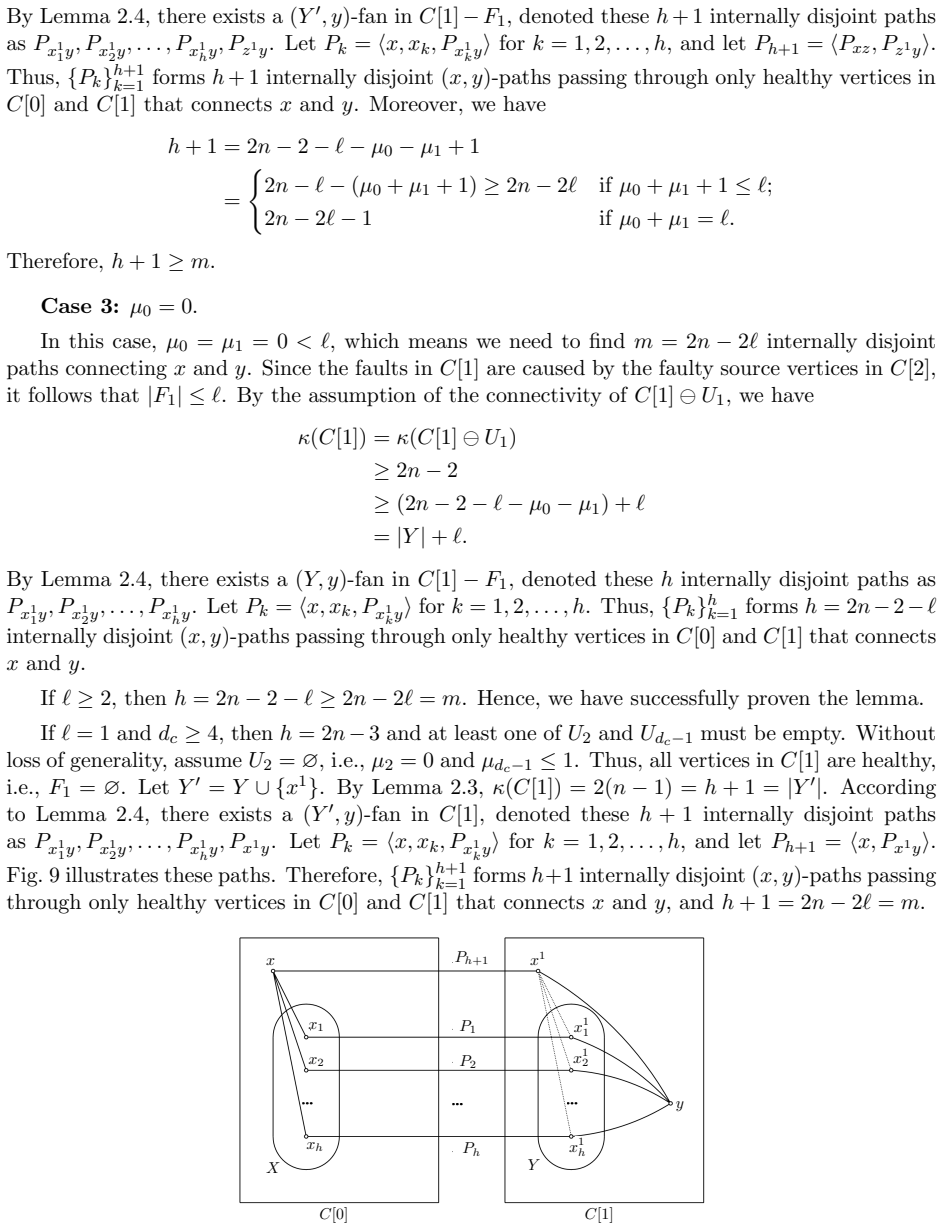
The load-bearing mechanism is dimensional slicing, a counting lemma, and a path-construction lemma. The mesh is sliced along a chosen dimension $c$ into subgraphs $C[0],\dots,C[d_c-1]$, each isomorphic to an $(n-1)$-dimensional toroidal mesh. Lemma 3.3 counts, for two adjacent slices $C[i]$ and $C[j]$, the set $H$ of vertices $v$ in $C[i]$ such that both $v$ and its outer neighbor $v^j$ in $C[j]$ are healthy, and asserts $|H|$ strictly exceeds $h = 2n-2-\ell-\mu_i-\mu_j$, where $\mu_i$ and $\mu_j$ are the numbers of source faults in the two slices. Lemma 3.4 converts that surplus into $h+1$ internally disjoint healthy $(x,y)$-paths between a healthy vertex in $C[i]$ and one in $C[j]$, and Theorem 3.5 assembles these across slices to prove $\kappa(C \ominus U) \ge 2n-2\ell$.
What would settle it
On a small mesh such as $C(3,3,3)$, enumerate every set $U$ of $\ell = 2$ source vertices and check Lemma 3.3 directly: if any adjacent pair of slices has $|H| \le h$, the lemma fails and the lower-bound argument collapses. A more direct test is to compute the true vertex connectivity of $C(3,3,3) \ominus U$ for every $U$ of size less than $3$ and look for any survival graph with connectivity below $2n-2\ell$; such a graph would be a counterexample to Theorem 3.5 and hence to $\kappa_{NB} = n$.
Extended reading notes
Core claim
The central claim is the equality $\kappa_{NB}(C(d_1,d_2,\dots,d_n)) = n$ for all $n \ge 2$ and all $d_i \ge 3$, where $\kappa_{NB}$ is the minimum size of a set $U$ whose closed-neighborhood deletion leaves a disconnected, complete, or empty graph. The proof is carried out through a stronger conditional bound: for every set $U$ of $\ell$ faulty source vertices with $\ell \le n$, the survival graph $C \ominus U$ has vertex connectivity at least $2n - 2\ell$. The argument inducts on dimension, slicing the mesh along one dimension into $d_c$ copies of an $(n-1)$-dimensional toroidal mesh, routing disjoint healthy paths through adjacent slices, and using the induction hypothesis to handle each slice's interior.
Load-bearing premise
The proof collapses if Lemma 3.3's count is wrong: it needs, for any two adjacent slices, strictly more than $h = 2n-2-\ell-\mu_i-\mu_j$ vertices whose outer neighbor is also healthy, and that count drives the construction of every disjoint path in the induction.
Editorial extensions
If this is right
- Because $\kappa_{NB} = n$, an $n$-dimensional toroidal mesh with side lengths at least $3$ survives any set of $n-1$ spreading-fault sources without its healthy part becoming disconnected, empty, or complete.
- The stronger bound $\kappa(C \ominus U) \ge 2n-2\ell$ quantifies how connectivity degrades: each additional source fault costs the survival graph $2$ in connectivity until two fault sources would already force a bound of $2$.
- The result generalizes the known neighbor-connectivity values for $k$-ary $n$-cubes and hypercubes, which are the equal-side-length special cases of toroidal meshes.
- For fault-tolerant design, the message is that the dimension $n$, not the side lengths $d_i$, is the parameter that determines resilience to cascading neighbor failures.
Reading between the lines
- One could test whether the formula survives when some side length $d_i = 2$, where the paired-outer-neighbor structure used in Lemma 3.3 changes; the counting inequality may fail and the true value could drop below $n$.
- Because the proof's core is a counting surplus in pairs of adjacent slices, the same technique might yield dimension-dependent neighbor-connectivity formulas for other Cartesian products of cycles, such as partial toroidal meshes with boundary conditions.
- The reported simulation could be extended to directly verify Lemma 3.3's strict inequality on small meshes, such as $C(3,3,3)$ with all two-fault configurations, which would localize whether the counting bound is ever tight.
Editorial analysis
A structured set of objections, weighed in public.
Referee Report
Summary. The paper studies the neighbor connectivity κ_NB of the undirected toroidal mesh C(d1,d2,...,dn), where a set U of faulty source vertices removes the closed neighborhood N[U] and the survival graph G⊖U must be disconnected, complete, or empty. The main claim is that κ_NB(C(d1,...,dn)) = n for all n ≥ 2 and d_i ≥ 3. The lower bound is proved through a nested induction: Theorem 3.5 asserts that for any |U| = ℓ ≤ n, the survival graph satisfies κ(C⊖U) ≥ 2n - 2ℓ; Theorem 3.6 then converts this into κ_NB ≥ n. The proof decomposes the mesh into (n-1)-dimensional subnetworks, uses a Menger-type lemma (Lemma 2.4), and relies on prior results of Park and of Dvořák and Gu. The upper bound, together with a corroborating simulation, appears in the later sections.
Significance. If the theorem is correct, it provides an exact, clean formula for the neighbor connectivity of all undirected toroidal meshes, generalizing the known result for the k-ary n-cube. The lower-bound proof is a substantial piece of case analysis: Lemma 3.1 pins down common-neighbor counts, Lemma 3.2 guarantees healthy vertices in every layer, Lemma 3.3 supplies the counting bound |H| > h, and Lemma 3.4 constructs internally disjoint paths. The manuscript makes appropriate use of standard tools (Menger's theorem and cited prior work) and does not appear to define the target parameter in terms of fitted values. The simulation is explicitly corroborative and does not fix any constants in the proof. These are genuine strengths.
major comments (1)
- [Theorem 3.5, base case n = 2] The base case of the induction is not established. The proof states that after removing vertex 00 and its neighbors, the graph is 'neither empty nor complete, and it is connected', and concludes that κ(C⊖U) ≥ 2. For classical vertex connectivity this conclusion does not follow: connectedness gives only κ ≥ 1, and the graph being neither complete nor empty is irrelevant to whether a single vertex deletion disconnects the graph. This gap is load-bearing because the induction step for n = k + 1 applies Lemma 3.4 to (k-dimensional) subnetworks; when k = 2 and µ_i = 1, Lemma 3.4 requires κ(C[i]⊖U_i) ≥ 2n - 2 - 2µ_i = 2. The base case must therefore prove that the survival graph is 2-connected, not merely connected. The authors should supply a rigorous argument for this 2-connectivity (for example, an explicit case analysis over d1, d2, or a citation to a known 2-connectedness result for this deletion).
minor comments (3)
- [Lemma 3.1] In Case 1.1 the text reads 'One the other hand'; this should be 'On the other hand'.
- [Throughout] The notation 'κN B' and 'κN B(C)' is awkwardly spaced; the subscript should be formatted consistently, e.g., κ_NB.
- [Theorem 3.6] The assertion that the toroidal mesh is K4-free is used to conclude that the survival graph is never complete; a short justification or reference would improve readability.
Circularity Check
No circularity: the derivation chain is self-contained and rests on standard Menger-style facts and prior external results.
full rationale
The paper's derivation chain is not circular. The lower-bound proof proceeds through Lemma 3.3 (a counting estimate), Lemma 3.4 (construction of internally disjoint healthy paths), and Theorem 3.5 (an induction on dimension), ultimately yielding Theorem 3.6. The quantitative engine, Lemma 3.3, is derived from Lemma 2.2 (degree counts) and Lemma 3.1 (common-neighbor bounds), not from the target value n or from a fitted parameter. Lemma 3.4 invokes Lemma 2.4, which is a standard Menger-type fan lemma credited to Dvorak and Gu [5], and Lemma 2.3, the connectivity of toroidal meshes credited to Park [17]; both are prior external results rather than self-citations carrying the argument. The final lower bound Theorem 3.6 combines Theorem 3.5 with the K4-freeness of the toroidal mesh to exclude complete survival graphs, and nothing in this step defines the target parameter in terms of itself. The computer simulation is corroborative and is not used to set constants or to replace a proof step. There is no self-citation chain that forces the conclusion, no uniqueness claim imported from the authors' own prior work, and no fitted input renamed as a prediction. The base case n=2 in Theorem 3.5, where connectedness of the survival graph is used to infer κ≥2, is a potential correctness gap since connectedness alone gives only κ≥1; however, that is an invalid inference, not a circular reduction of the theorem to its assumptions. It therefore does not affect the circularity score.
Assumptions & free parameters
assumptions (3)
- standard math Lemma 2.4 (cited from [5]): in an (f+k)-connected graph, after deleting f vertices, one can route k disjoint paths or an (x,Y)-fan.
- domain assumption Lemma 2.3 (cited from [17]): kappa(C(d1,...,dn)) = 2n for n >= 2 and d_i >= 3.
- domain assumption C(d1,...,dn) is K4-free.
Cite this review
Pith. "Pith review of Neighbor Connectivity of Undirected Toroidal Meshes." pith.science (2026). https://pith.science/paper/5PDMKMAZ
@misc{pith2026250614240,
  author       = {Pith},
  title        = {Pith review of: Neighbor Connectivity of Undirected Toroidal Meshes},
  year         = {2026},
  howpublished = {\url{https://pith.science/paper/5PDMKMAZ}},
  note         = {Machine review of arXiv:2506.14240}
}
abstract
In this paper, we examine the neighbor connectivity, denoted as $\kappa_{NB}$, of the undirected toroidal mesh $C(d_1,d_2,\ldots,d_n)$. We demonstrate that $\kappa_{NB}(C(d_1,d_2,\ldots,d_n)) = n$ for all $n \ge 2$ and $d_i \ge 3$ (for $1 \le i \le n$). Additionally, we perform a computer simulation experiment on neighbor connectivity in undirected toroidal meshes. This experiment not only supports our theoretical findings with empirical results but also provides a deeper understanding of neighbor structure failures in undirected toroidal meshes.
Figures


Figures from the paper (17 more)






Reference graph
Works this paper leans on
-
[1]
Neighbor connectivity of the alternating group graph
Abdallah, M., Hung, C.-N., 2021. Neighbor connectivity of the alternating group graph. Jour- nal of Interconnection Networks 21 (3), 2150014
work page 2021
-
[2]
Bhuyan, L. N., Agrawal, D. P., 1984. Generalized hypercube and hyperbus structures for a computer network. IEEE Transactions on computers 100 (4), 323–333
work page 1984
- [3]
-
[4]
Doty, L. L., Goldstone, R. J., Suffel, C. L., 1996. Cayley graphs with neighbor connectivity one. SIAM Journal on Discrete Mathematics 9 (4), 625–642
work page 1996
-
[5]
Neighbor connectivity ofk-ary n-cubes
Dvoˇ r´ ak, T., Gu, M.-M., 2020. Neighbor connectivity ofk-ary n-cubes. Applied Mathematics and Computation 379, 125237
work page 2020
-
[6]
Neighbor connectivity of pancake graphs and burnt pancake graphs
Gu, M.-M., Chang, J.-M., 2023. Neighbor connectivity of pancake graphs and burnt pancake graphs. Discrete Applied Mathematics 324, 46–57
work page 2023
-
[7]
Subversion analyses of hierarchical networks based on (edge) neighbor connectivity
Gu, M.-M., Pai, K.-J., Chang, J.-M., 2023. Subversion analyses of hierarchical networks based on (edge) neighbor connectivity. Journal of Parallel and Distributed Computing 171, 54–65
work page 2023
-
[8]
Neighbour-connectivity in regular graphs
Gunther, G., 1985. Neighbour-connectivity in regular graphs. Discrete Applied Mathematics 11 (3), 233–243. 22
work page 1985
Show all 18 references
-
[9]
L., 1978
Gunther, G., Hartnell, B. L., 1978. On minimizing the effects of betrayals in a resistance movement. In: Proc. Eighth Manitoba Conference on Numerical Mathematics and Computing. pp. 285–306
1978
-
[10]
L., 1980
Gunther, G., Hartnell, B. L., 1980. Optimal k-secure graphs. Discrete Applied Mathematics 2 (3), 225–231
1980
-
[11]
L., 1991
Gunther, G., Hartnell, B. L., 1991. On m-connected and k-neighbour-connected graphs. Graph Theory, Combinatorics, and Applications 2, 585–596
1991
-
[12]
L., Nowakowski, R., 1987
Gunther, G., Hartnell, B. L., Nowakowski, R., 1987. Neighbor-connected graphs and projective planes. Networks An International Journal 17 (2), 241–247
1987
-
[13]
S.-T., Ciou, H.-C., Lin, M.-J., 2025
Juan, J. S.-T., Ciou, H.-C., Lin, M.-J., 2025. The one-fault dimension-balanced hamiltonian problem in toroidal mesh graphs. Symmetry 17 (1), 93
2025
-
[14]
On the neighborhood-connectivity of locally twisted cube networks
Kung, T.-L., Lin, C.-K., Hung, C.-N., 2022. On the neighborhood-connectivity of locally twisted cube networks. In: Innovative Mobile and Internet Services in Ubiquitous Computing: Proceedings of the 15th International Conference on Innovative Mobile and Internet Services in Ub...
2022
-
[15]
Two-disjoint-cycle-cover vertex bipancyclicity of the bipartite generalized hypercube
Niu, R.-C., Xu, M., Lai, H.-J., 2021. Two-disjoint-cycle-cover vertex bipancyclicity of the bipartite generalized hypercube. Applied Mathematics and Computation 400, 126090
2021
-
[16]
Queue layouts of toroidal grids
Pai, K.-J., Chang, J.-M., Wang, Y.-L., Wu, R.-Y., 2014. Queue layouts of toroidal grids. IEICE Transactions on Fundamental of Electronics, Communications and Computer Sciences E97-A (6), 1180–1186
2014
-
[17]
Torus-like graphs and their paired many-to-many disjoint path covers
Park, J.-H., 2021. Torus-like graphs and their paired many-to-many disjoint path covers. Discrete Applied Mathematics 289, 64–77
2021
-
[18]
Neighbor connectivity of two kinds of cayley graphs
Shang, Y.-j., Hao, R.-x., Gu, M.-M., 2018. Neighbor connectivity of two kinds of cayley graphs. Acta Mathematicae Applicatae Sinica, English Series 34 (2), 386–397. 23
2018
Reviewed August 7, 2026 · model on record in the stance chip above.
Discussion (0). Continue with ORCID to comment.