Novel zsim~10 auroral line measurements extend the gradual offset of the FMR deep into the first Gyr of cosmic time
Pith reviewed 2026-05-19 08:48 UTC · model grok-4.3
The pith
Direct auroral-line metallicities at z≈10 are three times lower than at z=0-3, extending the FMR offset into the first Gyr.
A machine-rendered reading of the paper's core claim, the machinery that carries it, and where it could break.
Core claim
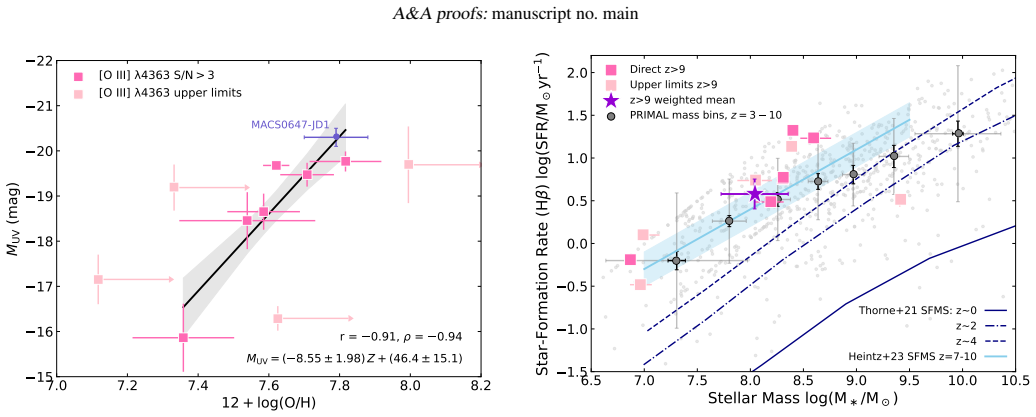
Extending NIRSpec Prism coverage and calibration enables detection of the auroral [OIII] λ4363 line in z≈10 galaxies, delivering direct Te-based oxygen abundances that lie well below the values measured at z=0-3; together with literature data these measurements trace a gradual decrease in the MZR and a break in the FMR at z≈3, most naturally explained by dilution from massive pristine-gas inflows during early galaxy assembly.
What carries the argument
Direct Te-based metallicity from the auroral [OIII] λ4363 line, which provides an empirical calibration-independent measure of oxygen abundance at high redshift.
If this is right
- The mass-metallicity relation continues to decrease gradually out to z=10.
- The fundamental metallicity relation breaks near z≈3, with metallicities dropping by a factor of approximately three by z=10.
- Early galaxies at cosmic dawn experience significant dilution of metals by inflows of pristine gas.
- The sample galaxies exhibit high ionization parameters, elevated electron temperatures, and evidence of bursty star formation while remaining typical star-forming systems.
- An empirical M_UV–metallicity relation derived at z≈10 can be applied to estimate abundances in still higher-redshift galaxies.
Where Pith is reading between the lines
- Galaxy-formation simulations will need to sustain higher pristine-gas accretion rates at early times to reproduce the observed dilution.
- The bursty star-formation signature may link to the scatter seen in the high-redshift UV luminosity function.
- If the offset persists to even higher redshift, it could alter predictions for the timing of reionization and the metal content of the intergalactic medium.
- The new M_UV–metallicity calibration offers a practical tool for interpreting photometric samples at z>10 where spectroscopy remains limited.
Load-bearing premise
That extending the NIRSpec Prism wavelength coverage to 5.5 μm with improved calibration produces reliable, uncontaminated detections of the faint auroral [OIII] λ4363 line, yielding accurate direct Te-based metallicities without large systematic bias.
What would settle it
Independent deeper spectroscopy or re-reduction of the same spectra that fails to detect the [OIII] λ4363 line or attributes it to contamination, returning metallicities consistent with the local FMR.
Figures




read the original abstract
The mass assembly and chemical enrichment of the first galaxies provide key insights into their star-formation histories and the earliest stellar populations at cosmic dawn. Here we compile and utilize new, high-quality spectroscopic JWST/NIRSpec Prism observations from the JWST archive. We extend the wavelength coverage beyond the standard pipeline cutoff up to 5.5$\mu$m, enabling a detailed examination of the rest-frame optical emission-line properties for galaxies at $z\approx 10$. The improved calibration allows us to detect H$\beta$ and the [OIII]$\lambda\lambda 4959,5007$ doublet and resolve the auroral [OIII]$\lambda 4363$ line for the 11 galaxies in our sample ($z=9.3-10.0$) to obtain direct $T_e$-based metallicity measurements. We find that all galaxies show high ionisation fields and electron temperatures, with derived metallicities in the range $12+\log {\rm (O/H)} = 7.1 - 8.3$, consistent with previous strong-line diagnostics at high-z. We derive an empirical relation for $M_{\rm UV}$ and 12+log(O/H) at $z\approx 10$, useful for future higher-z studies, and show that the sample galaxies are `typical' star-forming galaxies though with relatively high specific star-formation rates and with evidence for bursty star formation. Combining the rest-frame optical line analysis and detailed UV to optical SED modelling, we determine the mass-metallicity relation and the fundamental-metallicity relation of the sample, pushing the redshift frontier of these measurements to $z=10$. These results, together with literature measurements, point to a gradually decreasing MZR at higher redshifts, with a break in the FMR at $z\approx 3$, decreasing to metallicities $\approx 3\times$ lower at $z=10$ than observed during the majority of cosmic time at $z=0-3$, likely caused by massive pristine gas inflows diluting the observed metal abundances during early galaxy assembly at cosmic dawn.
Editorial analysis
A structured set of objections, weighed in public.
Referee Report
Summary. The manuscript compiles new JWST/NIRSpec Prism observations of 11 galaxies at z=9.3–10.0, extends the wavelength coverage to 5.5 μm with improved calibration, and reports detections of Hβ, the [OIII] λλ4959,5007 doublet, and the auroral [OIII] λ4363 line. This enables direct Te-based metallicities in the range 12+log(O/H)=7.1–8.3, an empirical M_UV vs. 12+log(O/H) relation at z≈10, and extensions of the mass-metallicity relation (MZR) and fundamental metallicity relation (FMR) to z=10. The authors conclude a gradual decrease in the MZR at higher redshifts, a break in the FMR at z≈3, and metallicities ≈3× lower at z=10 than at z=0–3, attributing this to massive pristine gas inflows during early galaxy assembly.
Significance. If the auroral-line detections prove robust, the work would be significant for pushing direct Te-based metallicity measurements to z≈10 using JWST archive data, providing new empirical constraints on chemical enrichment at cosmic dawn. The presentation of a ready-to-use M_UV–metallicity relation and the consistency check against prior strong-line diagnostics are clear strengths for future high-z studies.
major comments (1)
- [Abstract] Abstract: The central claim that metallicities are ≈3× lower at z=10 (and the implied FMR break and pristine-gas-inflow interpretation) rests on the direct Te-based abundances for the 11 galaxies. These abundances require clean detection and flux measurement of the faint auroral [OIII] λ4363 line after the custom extension of NIRSpec Prism coverage to 5.5 μm and application of improved calibration. Any residual flux-calibration error, sky-subtraction artifact, or line-blending bias in the extended range would systematically shift Te and therefore 12+log(O/H), directly altering the reported MZR offset.
minor comments (1)
- [Abstract] The abstract states that the sample galaxies are 'typical' star-forming galaxies with relatively high specific star-formation rates; a brief quantitative comparison (e.g., to the main-sequence scatter at z≈10) would strengthen this statement.
Simulated Author's Rebuttal
We thank the referee for their careful reading and for recognizing the potential significance of extending direct Te-based metallicity measurements to z≈10. We address the single major comment below, focusing on the robustness of the auroral-line detections and associated systematics. We agree that additional validation details will strengthen the manuscript.
read point-by-point responses
-
Referee: [Abstract] Abstract: The central claim that metallicities are ≈3× lower at z=10 (and the implied FMR break and pristine-gas-inflow interpretation) rests on the direct Te-based abundances for the 11 galaxies. These abundances require clean detection and flux measurement of the faint auroral [OIII] λ4363 line after the custom extension of NIRSpec Prism coverage to 5.5 μm and application of improved calibration. Any residual flux-calibration error, sky-subtraction artifact, or line-blending bias in the extended range would systematically shift Te and therefore 12+log(O/H), directly altering the reported MZR offset.
Authors: We agree that the reliability of the [OIII] λ4363 detections is central to the results and that residual calibration or subtraction errors could affect the derived Te and metallicities. In Section 2 we detail the custom wavelength extension to 5.5 μm and the improved calibration steps applied to the archival NIRSpec Prism data. To mitigate the concerns raised, we performed the following checks: (i) direct comparison of Te-based metallicities with multiple strong-line calibrations, which agree within the uncertainties; (ii) visual inspection of 2D spectra and residual maps to rule out sky-subtraction artifacts near 4363 Å; and (iii) confirmation that no significant line blending occurs at the observed redshifts for the [OIII] doublet and auroral line. The auroral line is detected at S/N ≥ 5 in 9 of the 11 galaxies. While we cannot eliminate every possible systematic at the level of archival data, the internal consistency of these tests supports the reported abundances. In the revised manuscript we will add a dedicated subsection (and supplementary figures) quantifying these validation steps and residual spectra. This constitutes a partial revision that clarifies but does not change the main conclusions. revision: partial
Circularity Check
No significant circularity: results from new observations and standard diagnostics
full rationale
The paper's derivation chain begins with new JWST/NIRSpec Prism data, extends wavelength coverage to 5.5 μm, detects the auroral [OIII] λ4363 line, and applies standard direct Te-based metallicity calculations to obtain 12+log(O/H) values. These feed into empirical MZR and FMR constructions that are compared against external literature measurements. No load-bearing step reduces by construction to a fitted parameter, self-citation, or ansatz imported from the authors' prior work. The derived empirical M_UV–metallicity relation is explicitly presented as a product for future studies rather than used to predict or define the input abundances. The central claims of a gradual MZR offset and FMR break rest on the observational sample plus independent literature points, making the chain self-contained against external benchmarks.
Axiom & Free-Parameter Ledger
free parameters (1)
- parameters of the empirical M_UV vs 12+log(O/H) relation
axioms (1)
- domain assumption Standard nebular emission-line diagnostics relating [OIII] auroral and nebular lines to electron temperature and oxygen abundance hold at z≈10.
Lean theorems connected to this paper
-
IndisputableMonolith/Cost/FunctionalEquation.leanwashburn_uniqueness_aczel unclear?
unclearRelation between the paper passage and the cited Recognition theorem.
We determine the metallicities using the direct ‘Te-based’ method … with the [O iii]λ4363/[O iii]λ5007 ratio, using the getTemDen routine in PyNeb
-
IndisputableMonolith/Foundation/RealityFromDistinction.leanreality_from_one_distinction unclear?
unclearRelation between the paper passage and the cited Recognition theorem.
These results … point to a gradually decreasing MZR at higher redshifts, with a break in the FMR at z≈3
What do these tags mean?
- matches
- The paper's claim is directly supported by a theorem in the formal canon.
- supports
- The theorem supports part of the paper's argument, but the paper may add assumptions or extra steps.
- extends
- The paper goes beyond the formal theorem; the theorem is a base layer rather than the whole result.
- uses
- The paper appears to rely on the theorem as machinery.
- contradicts
- The paper's claim conflicts with a theorem or certificate in the canon.
- unclear
- Pith found a possible connection, but the passage is too broad, indirect, or ambiguous to say the theorem truly supports the claim.
Forward citations
Cited by 4 Pith papers
-
Metal Mayhem at $\rm z \sim 7-10$: Diversity and Evolution of Gas-Phase Metallicity Gradients
Galaxies at z~7-10 display diverse metallicity gradients often flattened by tidal interactions or feedback, and sit well below the local fundamental metallicity relation due to pristine gas accretion.
-
Shape of Direct-Method Mass-Metallicity Relation with JWST: Fast-Track Nitrogen and Helium Enrichment
JWST auroral-line selected galaxies at high redshift show an MZR slope of 0.38 with selection biases favoring high-SFR low-metallicity systems, while stacked non-detections lie closer to the fundamental metallicity relation.
-
Paschen Jumps in Little Red Dots: Evidence for Nebular Continua
Paschen jumps in Little Red Dots indicate their continua originate from free-bound recombination emission in low-temperature nebular gas rather than thermalized or AGN components.
-
On the quenching of LRD X-ray emission by both Compton-thick gas and high accretion rates
LRDs require Compton-thick gas at moderate metallicity plus high accretion rates producing weak X-rays to explain their non-detection, implying they are not chemically pristine.
Reference graph
Works this paper leans on
-
[1]
Abdurro’uf, Larson, R. L., Coe, D., et al. 2024, ApJ, 973, 47, doi: 10.3847/ 1538-4357/ad6001 Aggarwal, K. M., & Keenan, F. P. 1999, ApJS, 123, 311, doi:10.1086/313232 Aihara, H., Allende Prieto, C., An, D., et al. 2011, ApJS, 193, 29, doi:10.1088/ 0067-0049/193/2/29 Andrews, B. H., & Martini, P. 2013, ApJ, 765, 140, doi:10.1088/0004-637X/ 765/2/140 Arave...
-
[2]
1093/mnras/stac3144 Austin, D., Conselice, C. J., Adams, N. J., et al. 2024, arXiv e-prints, arXiv:2404.10751, doi: 10.48550/arXiv.2404.10751 Backhaus, B. E., Cleri, N. J., Trump, J. R., et al. 2025, arXiv e-prints, arXiv:2502.03519, doi: 10.48550/arXiv.2502.03519 Baker, W. M., Maiolino, R., Belfiore, F., et al. 2023, MNRAS, 518, 4767, doi: 10.1093/mnras/...
-
[3]
1086/130766 Berg, D. A., Chisholm, J., Erb, D. K., et al. 2021, ApJ, 922, 170, doi: 10.3847/ 1538-4357/ac141b Bezanson, R., Labbe, I., Whitaker, K. E., et al. 2022, arXiv e-prints, arXiv:2212.04026, doi: 10.48550/arXiv.2212.04026 —. 2024, ApJ, 974, 92, doi: 10.3847/1538-4357/ad66cf Boyett, K., Bunker, A. J., Curtis-Lake, E., et al. 2024, MNRAS, 535, 1796,...
- [4]
-
[5]
1093/mnras/stae1547 Carnall, A. C., McLure, R. J., Dunlop, J. S., & Davé, R. 2018, MNRAS, 480, 4379, doi: 10.1093/mnras/sty2169 Article number, page 11 of 13 A&A proofs: manuscript no. main Carnall, A. C., McLure, R. J., Dunlop, J. S., et al. 2019, MNRAS, 490, 417, doi: 10.1093/mnras/stz2544 Castellano, M., Fontana, A., Treu, T., et al. 2023, ApJ, 948, L1...
work page internal anchor Pith review doi:10.1093/mnras/sty2169 2018
-
[6]
3847/1538-4357/ad9a6a Cullen, F., McLeod, D. J., McLure, R. J., et al. 2024, MNRAS, 531, 997, doi:10. 1093/mnras/stae1211 Cullen, F., Carnall, A. C., Scholte, D., et al. 2025, arXiv e-prints, arXiv:2501.11099, doi: 10.48550/arXiv.2501.11099 Curti, M., Mannucci, F., Cresci, G., & Maiolino, R. 2020, MNRAS, 491, 944, doi: 10.1093/mnras/stz2910 Curti, M., D’E...
-
[7]
1093/mnras/stac2737 Curti, M., Maiolino, R., Curtis-Lake, E., et al. 2024, A&A, 684, A75, doi:
work page 2024
-
[8]
2025, A&A, 697, A89, doi: 10.1051/ 0004-6361/202451410 Daddi, E., Dickinson, M., Morrison, G., et al
1051/0004-6361/202346698 Curti, M., Witstok, J., Jakobsen, P., et al. 2025, A&A, 697, A89, doi: 10.1051/ 0004-6361/202451410 Daddi, E., Dickinson, M., Morrison, G., et al. 2007, ApJ, 670, 156, doi:
work page 2025
-
[9]
1086/521818 de Graa ff, A., Brammer, G., Weibel, A., et al. 2024, arXiv e-prints, arXiv:2409.05948, doi: 10.48550/arXiv.2409.05948 Dessauges-Zavadsky, M., Ginolfi, M., Pozzi, F., et al. 2020, A&A, 643, A5, doi: 10.1051/0004-6361/202038231 D’Eugenio, F., Maiolino, R., Carniani, S., et al. 2024, A&A, 689, A152, doi:10. 1051/0004-6361/202348636 Díaz, A. I., ...
-
[10]
1093/mnras/stad1627 Garnett, D. R. 1992, AJ, 103, 1330, doi: 10.1086/116146 Gelli, V ., Mason, C., & Hayward, C. C. 2024, ApJ, 975, 192, doi: 10.3847/ 1538-4357/ad7b36 Giménez-Arteaga, C., Oesch, P. A., Brammer, G. B., et al. 2023, ApJ, 948, 126, doi: 10.3847/1538-4357/acc5ea Hainline, K. N., D’Eugenio, F., Jakobsen, P., et al. 2024, arXiv e-prints, arXiv...
-
[11]
3847/2041-8213/ac8057 Heintz, K. E., Brammer, G. B., Giménez-Arteaga, C., et al. 2023a, Nature As- tronomy, doi: 10.1038/s41550-023-02078-7 Heintz, K. E., Giménez-Arteaga, C., Fujimoto, S., et al. 2023b, ApJ, 944, L30, doi: 10.3847/2041-8213/acb2cf Heintz, K. E., Watson, D., Brammer, G., et al. 2024, Science, 384, 890, doi:10. 1126/science.adj0343 Heintz,...
-
[12]
1051/0004-6361/202347133 Lee, H., Skillman, E. D., Cannon, J. M., et al. 2006, ApJ, 647, 970, doi:
work page 2006
-
[13]
1086/505573 Lee, N., Sanders, D. B., Casey, C. M., et al. 2015, ApJ, 801, 80, doi: 10.1088/ 0004-637X/801/2/80 Leja, J., Carnall, A. C., Johnson, B. D., Conroy, C., & Speagle, J. S. 2019, ApJ, 876, 3, doi: 10.3847/1538-4357/ab133c Lequeux, J., Peimbert, M., Rayo, J. F., Serrano, A., & Torres-Peimbert, S. 1979, A&A, 80, 155 Li, S., Wang, X., Chen, Y ., et ...
work page internal anchor Pith review doi:10.3847/1538-4357/ab133c 2015
-
[14]
1051/0004-6361/202450407 Møller, P., Fynbo, J. P. U., Ledoux, C., & Nilsson, K. K. 2013, MNRAS, 430, 2680, doi: 10.1093/mnras/stt067 Morishita, T., Stiavelli, M., Grillo, C., et al. 2024, ApJ, 971, 43, doi: 10.3847/ 1538-4357/ad5290 Nakajima, K., Ouchi, M., Isobe, Y ., et al. 2023, arXiv e-prints, arXiv:2301.12825, doi: 10.48550/arXiv.2301.12825 Nakajima,...
-
[15]
1038/s41586-023-05994-w Roberts-Borsani, G., Treu, T., Shapley, A., et al. 2024, arXiv e-prints, arXiv:2403.07103, doi: 10.48550/arXiv.2403.07103 Rowland, L. E., Stefanon, M., Bouwens, R., et al. 2025, arXiv e-prints, arXiv:2501.10559, doi: 10.48550/arXiv.2501.10559 Salim, S., Boquien, M., & Lee, J. C. 2018, ApJ, 859, 11, doi: 10.3847/ 1538-4357/aabf3c Ar...
-
[16]
3847/0004-637X/816/1/23 Sanders, R. L., Shapley, A. E., Jones, T., et al. 2021, ApJ, 914, 19, doi:
work page 2021
-
[17]
2025, ApJ, 978, 136, doi: 10.3847/1538-4357/ad8f32
3847/1538-4357/abf4c1 Sarkar, A., Chakraborty, P., V ogelsberger, M., et al. 2025, ApJ, 978, 136, doi: 10.3847/1538-4357/ad8f32 Saxena, A., Bunker, A. J., Jones, G. C., et al. 2024, A&A, 684, A84, doi:
-
[18]
2022, , 665, L4, 10.1051/0004-6361/202244556
1051/0004-6361/202347132 Schaerer, D., Marques-Chaves, R., Barrufet, L., et al. 2022, A&A, 665, L4, doi: 10.1051/0004-6361/202244556 Scholte, D., Cullen, F., Carnall, A. C., et al. 2025, arXiv e-prints, arXiv:2502.10499, doi: 10.48550/arXiv.2502.10499 Shapley, A. E., Reddy, N. A., Sanders, R. L., Topping, M. W., & Brammer, G. B. 2023a, ApJ, 950, L1, doi: ...
-
[19]
3847/1538-4357/aaa4b4 Thorne, J. E., Robotham, A. S. G., Davies, L. J. M., et al. 2021, MNRAS, 505, 540, doi: 10.1093/mnras/stab1294 Topping, M. W., Stark, D. P., Endsley, R., et al. 2022, MNRAS, 516, 975, doi: 10.1093/mnras/stac2291 —. 2024, MNRAS, 529, 4087, doi: 10.1093/mnras/stae800 Topping, M. W., Sanders, R. L., Shapley, A. E., et al. 2025, arXiv e-...
-
[20]
3847/1538-4357/acbefa Valentino, F., Heintz, K. E., Brammer, G., et al. 2025, arXiv e-prints, arXiv:2503.01990, doi: 10.48550/arXiv.2503.01990 Walter, F., Carilli, C., Neeleman, M., et al. 2020, ApJ, 902, 111, doi: 10.3847/ 1538-4357/abb82e Whitaker, K. E., van Dokkum, P. G., Brammer, G., & Franx, M. 2012, ApJ, 754, L29, doi: 10.1088/2041-8205/754/2/L29 W...
-
[21]
1126/science.adf5307 Witstok, J., Smit, R., Maiolino, R., et al. 2021, MNRAS, 508, 1686, doi:
work page 2021
-
[22]
2024, arXiv e-prints, arXiv:2408.16608, doi: 10.48550/arXiv.2408.16608 Zavala, J
1093/mnras/stab2591 Witstok, J., Jakobsen, P., Maiolino, R., et al. 2024, arXiv e-prints, arXiv:2408.16608, doi: 10.48550/arXiv.2408.16608 Zavala, J. A., Castellano, M., Akins, H. B., et al. 2025, Nature Astronomy, 9, 155, doi: 10.1038/s41550-024-02397-3 Zitrin, A., Zheng, W., Broadhurst, T., et al. 2014, ApJ, 793, L12, doi:10.1088/ 2041-8205/793/1/L12 Ar...
discussion (0)
Sign in with ORCID, Apple, or X to comment. Anyone can read and Pith papers without signing in.