REVIEW 4 major objections 4 minor 1 cited by
A System Level Compiler for Massively-Parallel, Spatial, Dataflow Architectures
T0 review · 4 major / 4 minor · reviewed 2026-08-15 · deepseek-v4-flash
Pith's one-line read This paper claims that a compiler named MACH can translate NumPy tensor programs into executable kernels for wafer-scale, spatial dataflow hardware by lowering through a controller/worker virtual machine.
desk verdict A detailed design description of a WSE-targeting compiler with genuinely useful new mapping ideas; the printed demonstration doesn't cohere and there is no evaluation, so treat the existence claim as plausible but unverified. read the letter →
The pith
A machine-rendered reading of the paper's core claim, the machinery that carries it, and where it could break.
The reading
What carries the argument
The central object is the Virtual Machine (VM), a hardware-agnostic division of roles in which a controller owns global control flow and issues Remote Procedure Calls (RPCs) while workers own program data and RPC definitions. On the WSE this is mapped to a physical layout: a controller strip of processing elements (an executive PE plus response PEs holding compiled control and arguments vectors), a merge PE that recolors and broadcasts control wavelets, worker PEs holding tensor data, and two dedicated rows of reduction PEs. The other load-bearing mechanism is the compiler pipeline built around the Intermediate Representation Graph (IRG): nodes are operations with memory locations, edges are data accesses, and a liveness analysis assigns static addresses so that memory is reused and the resulting address vectors drive the broadcast control system. Together these let a single NumPy statement become a set of RPCs whose arguments are precomputed address offsets.
What would settle it
Compile the Listing 1 NumPy program with MACH, load the emitted Tungsten and Paint files onto a wafer-scale engine without any manual edits, and check both correctness (the loop sum and conditional break behave as in Python) and the quoted timing (roughly 10 cycles from executive broadcast to first worker wavelet and 50-60 cycles of kernel setup). If the generated code requires hand adjustment, produces a wrong result, or the measured latencies are far from the quoted values, the paper's central claim fails.
Extended reading notes
Core claim
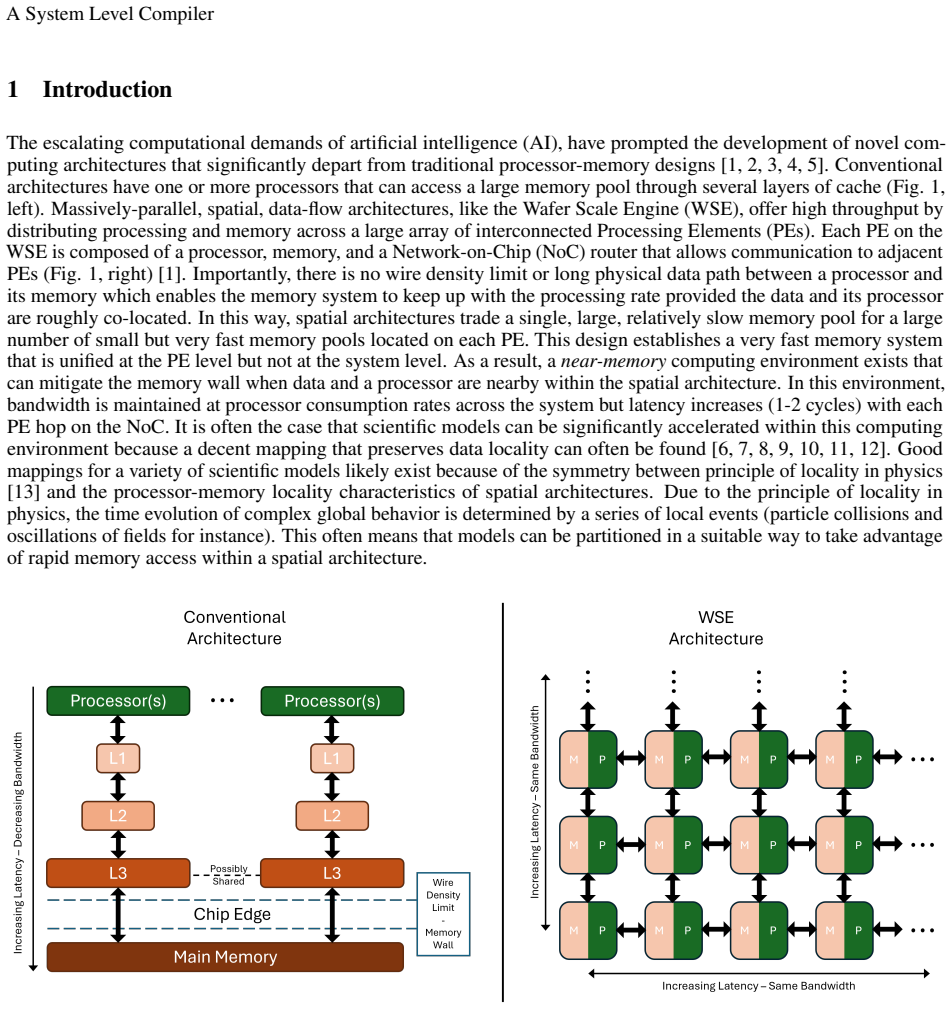
The central claim is that a single compiler can own the whole stack for a spatial architecture: assigning processing elements to roles, placing data in their local memories, scheduling control flow, and emitting per-PE programs. MACH does this by defining a Virtual Machine in which a controller and workers exchange Remote Procedure Calls, then mapping that VM onto the Wafer Scale Engine as a controller strip, a merge PE, worker PEs, and dedicated reduction rows. From NumPy source it builds an intermediate-language program, then a static Intermediate Representation Graph whose nodes carry memory locations and whose edges carry data accesses; a memory manager runs liveness analysis on this graph and fixes every value to a static address within the roughly 48KB per-PE budget. The generated Tungsten and Paint listings for a loop with conditional break, a sliced tensor add, and a global sum are the evidence that this lowering is complete rather than schematic.
Load-bearing premise
The whole design depends on the wafer hardware behaving as documented: 24 virtual communication colors with reliable, FIFO-ordered message delivery, backpressure that propagates rather than dropping data, roughly 48KB of memory per processing element, and router behavior that supports the systolic drain and in-router reduction patterns; the paper cites vendor documentation and personal communication for these properties rather than presenting measurements.
Editorial extensions
If this is right
- If MACH works as described, dense tensor programs written in NumPy and validated on an ordinary CPU can be compiled to wafer-scale hardware without hand-written processing-element code, with the compiler generating control, worker, and reduction kernels from one source.
- Fine-grained operations become practical: the distributed control system's roughly 10-cycle broadcast latency and 50-60 cycle kernel setup let individual unary/binary tensor operations run efficiently, scaling down to about 50 elements per processing element.
- Global reductions no longer block workers: data is pushed into dedicated reduction strips and workers continue other work while the systolic accumulation proceeds, which aids pipelined linear solvers.
- Programs can remain entirely on the wafer after loading: control flow lives on the controller PE strip while hosts act only as workers for I/O, avoiding host round-trips for control decisions.
- The same VM and DSL abstraction should extend beyond the WSE to CPUs, GPUs, and other spatial architectures, since the intermediate language and graph representation are hardware-agnostic.
Reading between the lines
- The paper leaves implicit that the 24-color, reliable-message hardware model may make the compiler portable to other network-on-chip-based spatial arrays with similar guarantees, with the vendor-specific router behavior isolated in the Paint configuration step.
- A ready testable extension is to apply the local-memory-slicing and fused gather/scatter loopback machinery to a small molecular-dynamics or unstructured-grid kernel and measure whether per-PE variable loop lengths preserve the quoted 50-60 cycle setup overhead.
- Because the quoted 10-cycle and 50-60 cycle numbers are not measured in the paper, a natural next step is a hardware-counter benchmark of the generated kernels; until then those numbers are best read as design targets.
- The in-router chained reduction on the newer CS-3 hardware could let the two dedicated reduction rows be repurposed as workers, effectively increasing usable PE count, but the paper notes the option without quantifying the tradeoff.
Signed reviews
Editorial analysis
A structured set of objections, weighed in public.
Referee Report
Summary. This manuscript describes MACH, a compiler framework for massively parallel spatial dataflow architectures, with the Cerebras Wafer Scale Engine as the primary target. It proposes a hardware-agnostic virtual machine with an executive controller, response PEs, worker PEs, and reduction PEs; a NumPy-based domain-specific language with object-oriented data structures; an intermediate language and an intermediate representation graph; a liveness-based memory manager; and lowering to Cerebras' Tungsten and Paint languages. The central claim is that MACH lowers high-level NumPy programs to machine-specific WSE kernels, and the evidence consists mainly of annotated compiler-output listings (Listings 1-14), architectural discussion, and citations of prior WSE work. The paper does not contain an evaluation section with runtimes, correctness tests, or scaling measurements.
Significance. If the central claim were fully substantiated, MACH would be an important systems contribution: it would provide a high-level NumPy front end for a non-unified-memory, spatially distributed architecture and demonstrate a concrete controller/worker compilation strategy with local memory slicing and loopback-based gather/scatter. The paper deserves credit for spelling out a complete stack from VM to code generation, for presenting a concrete memory-manager algorithm, and for including several detailed listings that illustrate the lowering. However, the significance as presented is conditional: the listings are not internally consistent, and the performance and scaling statements are not measured in this manuscript. The result is closer to a detailed design report than to a verified compiler claim.
major comments (4)
- [Sections 6.1.2 and 6.1.4, Listings 4, 5, and 7] The argument streams declared on the R-PEs do not match the worker kernels' receive counts. For the addition section, R-PE1's arguments_0 has n=2 and R-PE2's arguments_0 has n=4, so six values are sent on args_color, yet the worker addition kernel ar_ar_addiii_float32_center reads exactly five values (arg_recv[n=5], Listing 7 lines 18-21). For the reduction section, R-PE1's arguments_1 has n=2 and R-PE2's arguments_1 has n=4, totaling six values, but the reduction kernel reads only four values (arg_recv[n=4], Listing 7 line 49). Since these listings are the only concrete evidence that MACH produces executable kernels, this mismatch must be resolved by correcting the listings, documenting the actual packing or consumption rule, or supplying a buildable artifact.
- [Section 6.1.1, Listing 3 line 24] The E-PE code indexes myGA_ga with fl_0_global_enum_gs.data, but no declaration of fl_0_global_enum_gs appears in the listing or anywhere else in the manuscript. As printed, the kernel cannot compile, which further weakens the demonstration that the generated code is executable.
- [Sections 4.1, 4.2, 7.1, and 7.2] The manuscript has no evaluation section. Quantitative assertions such as the 10-cycle control latency, the 50-60 cycle setup cost, the 1-2 cycles per PE hop, and the 'about two cycles per element' fused gather claim are presented without any measurement methodology, benchmark description, or instrumented count. A systems paper whose central claim is a working compiler should at least report build success and correctness on the advertised NumPy example, and preferably also report cycle counts or runtimes; otherwise these assertions should be explicitly labeled as projections.
- [Section 7.1 and references [6, 10, 9, 8]] The scaling statements in Section 7.1, including the claim of 'very good strong and weak scaling' for structured grid problems, cite the authors' prior WSE papers rather than measurements obtained from MACH-generated code. Similarly, the in-router reduction discussion in Section 4.2 and the message-passing semantics in Section 7.3 rely on vendor documentation and personal communication [1, 19] rather than on tests performed in this work. These citations are useful background, but they are not substitute evidence for the performance or correctness of the compiler being presented.
minor comments (4)
- [Throughout] Please correct typographical errors, including 'implimentation' in Section 4.3, 'Exectutive' in the Section 6.1.1 heading, and 'Elemnet' in the Listing 6 caption.
- [Section 7.1, Listing 13] The meaning of the per-PE slice bound in dst[:,:,:stop] should be stated explicitly in terms of the IL/IRG lowering; as written, it is not clear how the AST compiler converts a runtime local scalar in a slice bound without additional runtime bookkeeping.
- [Figure 2] Figure 2 is essential to understanding the VM layout, but the caption's labeling of the expandable 'Response PEs' and the ellipsis in panel (a) is ambiguous; a legend or a short pseudocode description of the layout would improve reproducibility.
- [Section 6.1.4, Listing 7 line 63] The hard-coded offset 24568 in the reduction kernel should be explained or generated from a named symbol, since its relation to the memory manager's layout is currently opaque to the reader.
Circularity Check
No circular derivation: the compiler-lowering claims rest on listings and hardware assumptions, not on fitted equations or self-defined predictions.
full rationale
The paper contains no fitted parameters, no equations whose outputs are defined by their inputs, and no prediction derived from a self-referential construction. The central claim is that MACH lowers NumPy through an IRG to Tungsten/Paint for the WSE; the supporting evidence is a set of compiler-generated listings and descriptions of a VM mapping. The listings may be internally inconsistent (for example, the argument-stream lengths in Listings 4 and 5 appear not to match the consumption counts in Listing 7), but inconsistency is a correctness or completeness defect, not circularity. The paper's performance and scaling statements cite prior WSE work by the same and co-author groups, but those citations are external results about the hardware and hand-written or earlier kernels, not consequences of MACH's own lowering; they do not make the paper's derivation equivalent to its inputs. The hardware properties (24 colors, reliable FIFO-ordered messaging, backpressure, per-PE memory, router reduction) are taken from vendor documentation and personal communication, which is an external-support dependency rather than a circular step. No uniqueness theorem, ansatz smuggled by citation, or renamed-known-result pattern is present. Therefore, no circular step can be exhibited, and the honest finding is no significant circularity.
Assumptions & free parameters
assumptions (3)
- domain assumption The WSE provides 24 virtual communication colors, reliable FIFO-ordered message delivery, and backpressure propagation across the NoC (Section 4, Figure 2).
- domain assumption Each PE has about 48KB of memory for code and data, and the router supports mixed-precision chained reduction on CS-3 (Section 4.2).
- domain assumption Tungsten and Paint expose the language features used, including wavelet indexing, loopback sockets, geo-vars, and RPC task tables (Sections 6 and 7.2).
Cite this review
Pith. "Pith review of A System Level Compiler for Massively-Parallel, Spatial, Dataflow Architectures." pith.science (2026). https://pith.science/paper/CTPLLB4X
@misc{pith2026250615875,
  author       = {Pith},
  title        = {Pith review of: A System Level Compiler for Massively-Parallel, Spatial, Dataflow Architectures},
  year         = {2026},
  howpublished = {\url{https://pith.science/paper/CTPLLB4X}},
  note         = {Machine review of arXiv:2506.15875}
}
read the original abstract
We have developed a novel compiler called the Multiple-Architecture Compiler for Advanced Computing Hardware (MACH) designed specifically for massively-parallel, spatial, dataflow architectures like the Wafer Scale Engine. Additionally, MACH can execute code on traditional unified-memory devices. MACH addresses the complexities in compiling for spatial architectures through a conceptual Virtual Machine, a flexible domain-specific language, and a compiler that can lower high-level languages to machine-specific code in compliance with the Virtual Machine concept. While MACH is designed to be operable on several architectures and provide the flexibility for several standard and user-defined data mappings, we introduce the concept with dense tensor examples from NumPy and show lowering to the Wafer Scale Engine by targeting Cerebras' hardware specific languages.
Figures


Figures from the paper (2 more)


Forward citations
Cited by 1 Pith paper
-
Unstructured Hydrodynamics on Spatial Dataflow Architectures: A Joint Code and Data Decomposition Approach
A joint code-and-data decomposition pipeline maps the LULESH proxy application onto the Cerebras WSE, measured up to 4.8x faster than an NVIDIA A100, with analytical models predicting runtime within ~50%.
Reference graph
Works this paper leans on
-
[1]
Cerebras architecture deep dive: First look inside the hardware/software co-design for deep learning
Sean Lie. Cerebras architecture deep dive: First look inside the hardware/software co-design for deep learning. IEEE Micro, 43(3):18–30, 2023. 24 A System Level Compiler
work page 2023
-
[2]
The microarchitecture of dojo, teslaâ ˘A ´Zs exa-scale computer.IEEE Micro, 43(3):31–39, 2023
Emil Talpes, Debjit Das Sarma, Doug Williams, Sahil Arora, Thomas Kunjan, Benjamin Floering, Ankit Jalote, Christopher Hsiong, Chandrasekhar Poorna, Vaidehi Samant, John Sicilia, Anantha Kumar Nivarti, Raghuvir Ramachandran, Tim Fischer, Ben Herzberg, Bill McGee, Ganesh Venkataramanan, and Pete Banon. The microarchitecture of dojo, teslaâ ˘A ´Zs exa-scale...
work page 2023
-
[3]
Raghu Prabhakar, Yaqi Zhang, David Koeplinger, Matt Feldman, Tian Zhao, Stefan Hadjis, Ardavan Pedram, Christos Kozyrakis, and Kunle Olukotun. Plasticine: A reconfigurable architecture for parallel paterns.ACM SIGARCH Computer Architecture News, 45(2):389–402, 2017
work page 2017
-
[4]
Think fast: A tensor streaming processor (tsp) for accelerating deep learning workloads
Dennis Abts, Jonathan Ross, Jonathan Sparling, Mark Wong-VanHaren, Max Baker, Tom Hawkins, Andrew Bell, John Thompson, Temesghen Kahsai, Garrin Kimmell, et al. Think fast: A tensor streaming processor (tsp) for accelerating deep learning workloads. In2020 ACM/IEEE 47th Annual International Symposium on Computer Architecture (ISCA), pages 145–158. IEEE, 2020
2020
-
[5]
Tenstorrent documentation, 2025
Tenstorrent. Tenstorrent documentation, 2025. This is the official documentation for the Tenstorrent
work page 2025
-
[6]
Disruptive changes in field equation modeling: A simple interface for wafer scale engines, 2022
Mino Woo, Terry Jordan, Robert Schreiber, Ilya Sharapov, Shaheer Muhammad, Abhishek Koneru, Michael James, and Dirk Van Essendelft. Disruptive changes in field equation modeling: A simple interface for wafer scale engines, 2022
work page 2022
-
[7]
Fast stencil-code computation on a wafer-scale processor
Kamil Rocki, Dirk Van Essendelft, Ilya Sharapov, Robert Schreiber, Michael Morrison, Vladimir Kibardin, Andrey Portnoy, Jean Francois Dietiker, Madhava Syamlal, and Michael James. Fast stencil-code computation on a wafer-scale processor. InSC20: International Conference for High Performance Computing, Networking, Storage and Analysis, pages 1–14. IEEE, 2020
work page 2020
-
[8]
Matrix-free finite volume kernels on a dataflow architecture
Ryuichi Sai, François P Hamon, John Mellor-Crummey, and Mauricio Araya-Polo. Matrix-free finite volume kernels on a dataflow architecture. InSC24: International Conference for High Performance Computing, Networking, Storage and Analysis, pages 1–11. IEEE, 2024
work page 2024
Show all 19 references
-
[9]
Massively distributed finite-volume flux computation
Ryuichi Sai, Mathias Jacquelin, Francois Hamon, Mauricio Araya-Polo, and Randolph R Settgast. Massively distributed finite-volume flux computation. InProceedings of the SC’23 Workshops of the International Conference on High Performance Computing, Network, Storage, and Analysi...
2023
-
[10]
Dirk Van Essendelft, Hayl Almolyki, Wei Shi, Terry Jordan, Mei-Yu Wang, and Wissam A. Saidi. Record acceleration of the two-dimensional ising model using high-performance wafer scale engine, 2024
2024
-
[11]
Kalchev, Danny Perez, Robert Schreiber, Scott Pakin, Edgar A
Kylee Santos, Stan Moore, Tomas Oppelstrup, Amirali Sharifian, Ilya Sharapov, Aidan Thompson, Delyan Z. Kalchev, Danny Perez, Robert Schreiber, Scott Pakin, Edgar A. Leon, James H. Laros, Michael James, and Sivasankaran Rajamanickam. Breaking the molecular dynamics timescale b...
2024
-
[12]
Efficient algorithms for monte carlo particle transport on ai accelerator hardware.Computer Physics Communications, 298:109072, 2024
John Tramm, Bryce Allen, Kazutomo Yoshii, Andrew Siegel, and Leighton Wilson. Efficient algorithms for monte carlo particle transport on ai accelerator hardware.Computer Physics Communications, 298:109072, 2024
2024
-
[13]
Springer Berlin Heidelberg, Berlin, Heidelberg, 1992
Rudolf Haag.The Principle of Locality in Classical Physics and the Relativity Theories, pages 9–27. Springer Berlin Heidelberg, Berlin, Heidelberg, 1992
1992
-
[14]
Van Essendelft, T
D. Van Essendelft, T. Jordan, M. Woo, Wei Shi, Leebyn Chong, Ali Zidane, and Hyoungkeun Kim. The wafer scale engine, field equation, application programming interface, 2023
2023
-
[15]
Harris, K
Charles R. Harris, K. Jarrod Millman, Stéfan J. van der Walt, Ralf Gommers, Pauli Virtanen, David Cournapeau, Eric Wieser, Julian Taylor, Sebastian Berg, Nathaniel J. Smith, Robert Kern, Matti Picus, Stephan Hoyer, Marten H. van Kerkwijk, Matthew Brett, Allan Haldane, Jaime Fe...
2020
-
[16]
Near- optimal wafer-scale reduce
Piotr Luczynski, Lukas Gianinazzi, Patrick Iff, Leighton Wilson, Daniele De Sensi, and Torsten Hoefler. Near- optimal wafer-scale reduce. InProceedings of the 33rd International Symposium on High-Performance Parallel and Distributed Computing, HPDC â ˘A ´Z24, page 334â ˘A¸ S34...
2024
-
[17]
Llvm: A compilation framework for lifelong program analysis & transformation
Chris Lattner and Vikram Adve. Llvm: A compilation framework for lifelong program analysis & transformation. Technical report, 2003. Technical Report
2003
-
[18]
pearson Education, 2007
V Aho Alfred, S Lam Monica, and D Ullman Jeffrey.Compilers principles, techniques & tools. pearson Education, 2007
2007
-
[19]
Cerebras-netl weekly development meeting
Michael James, Amirali Sharifian, Nick Giamblanco, Dirk Van Essendelft, Terry Jordan, Patrick Wingo, Wei Shi, and Ryan Smith. Cerebras-netl weekly development meeting. personal communication. 25 A System Level Compiler Appendix: List of Acronyms AST– Abstract Syntax Tree CM– C...
Reviewed August 15, 2026 · model on record in the stance chip above.
Discussion (0). Continue with ORCID to comment.