Constraining parameters of spinor field dark energy: An alternative to ΛCDM model under the spherically symmetric FLRW space-time
Pith reviewed 2026-05-22 01:07 UTC · model grok-4.3
The pith
A spinor field dark energy model in spherically symmetric FLRW spacetime produces non-diagonal energy-momentum components that match observed cosmic acceleration.
A machine-rendered reading of the paper's core claim, the machinery that carries it, and where it could break.
Core claim
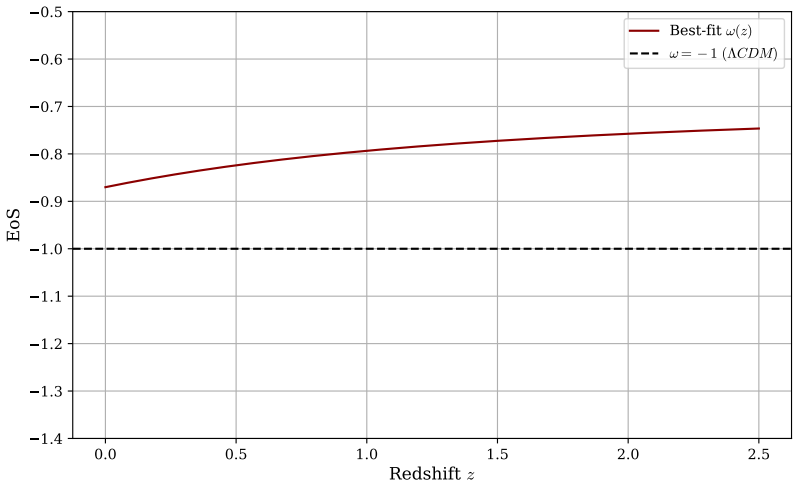
If spherical coordinates give the FLRW model, the energy-momentum tensor of the spinor field possesses nontrivial non-diagonal components. These non-diagonal components of the EMT neither depend on the spinor field nonlinearity nor the value of the parameter k defining the type of curvature of the FLRW model. In this context, a dark energy model is constructed and MCMC simulation performed to obtain the best-fit values of the parameters. The results are well comparable to the present Hubble parameter and deceleration parameter, indicating the accelerated expansion of the universe.
What carries the argument
The nontrivial non-diagonal components of the spinor field's energy-momentum tensor derived from the spherically symmetric FLRW metric, which drive the cosmological evolution without depending on nonlinearity or curvature type.
If this is right
- The non-diagonal EMT components permit construction of a dark energy model that fits observational data.
- MCMC analysis with Cosmic chronometers, Supernova, and SDSS data produces best-fit parameters matching the present Hubble and deceleration parameters.
- The model indicates accelerated expansion of the universe.
- The non-diagonal components and their independence hold for any value of the curvature parameter k and any degree of spinor nonlinearity.
Where Pith is reading between the lines
- The coordinate choice that forces non-diagonal terms may require adjustments to how isotropy is imposed when spinor fields source dark energy.
- Because the non-diagonal terms survive even without nonlinearity, linear spinor fields could be tested in the same spherical FLRW setting for similar expansion histories.
- Future surveys with tighter constraints on the deceleration parameter could distinguish this model from diagonal-only dark energy scenarios by checking the fitted Hubble value.
Load-bearing premise
The spherically symmetric FLRW metric remains a valid background after the spinor field is introduced, so that the resulting non-diagonal energy-momentum components can be interpreted consistently within standard cosmological dynamics.
What would settle it
A direct calculation of the spinor energy-momentum tensor in spherical FLRW coordinates that reveals dependence on the nonlinearity parameter or on the curvature parameter k would contradict the claimed independence of the non-diagonal components.
Figures




read the original abstract
This study constrains the cosmological parameters within the scope of a spherically symmetric FLRW cosmological model, the role of a nonlinear spinor field in the universe's evolution. To test this approach, we incorporate the recent Cosmic chronometers, Supernova, and Sloan Digital Sky Survey data. It is found that if spherical coordinates give the FLRW model, the energy-momentum tensor (EMT) of the spinor field possesses nontrivial non-diagonal components. These non-diagonal components of EMT neither depend on the spinor field nonlinearity nor the value of the parameter $k$ defining the type of curvature of the FLRW model. In this context, we construct a dark energy model and perform an MCMC simulation to obtain the best-fit values of the parameters. The results are well comparable to the present Hubble parameter and deceleration parameter, indicating the accelerated expansion of the universe.
Editorial analysis
A structured set of objections, weighed in public.
Referee Report
Summary. The paper examines a nonlinear spinor field as a dark energy component within a spherically symmetric FLRW spacetime. It reports that the energy-momentum tensor (EMT) of the spinor field acquires nontrivial non-diagonal components that are independent of both the spinor nonlinearity and the curvature parameter k. The authors then perform MCMC fitting of the resulting model parameters to Cosmic Chronometers, Supernova, and SDSS data, obtaining best-fit values for the Hubble and deceleration parameters that are stated to be consistent with accelerated expansion and to provide an alternative to ΛCDM.
Significance. If the reported non-diagonal EMT components can be shown to be compatible with the Einstein equations on the assumed FLRW background, the work would supply an explicit spinor-based dark energy model whose parameters are constrained by current observations. The claimed independence of the off-diagonal terms from nonlinearity and k would be a distinctive feature worth further exploration.
major comments (2)
- [EMT derivation and Einstein equations section] The central derivation (likely §3 or the EMT calculation following the metric ansatz): the paper states that spherical coordinates for the FLRW metric yield nontrivial non-diagonal EMT components independent of nonlinearity and k. However, the Einstein tensor for the standard FLRW metric in spherical coordinates is diagonal. The manuscript does not provide an explicit check or additional constraint showing how the Einstein equations G_μν = 8π T_μν remain satisfied when T_μν has non-zero off-diagonal entries, nor does it demonstrate that the background symmetry is preserved without metric adjustments. This consistency requirement is load-bearing for the subsequent MCMC analysis.
- [MCMC simulation and results] MCMC fitting section: the best-fit parameters and comparison to observed H0 and q0 are obtained by direct fitting to the same Hubble, SN, and SDSS datasets used to assess success. No independent predictions or cross-validation against held-out data or alternative priors are reported, which weakens the claim that the model is robustly comparable to observations.
minor comments (2)
- [Introduction and model setup] Notation for the spinor field and its nonlinearity parameters should be defined explicitly at first use, with clear distinction between the parameter k (curvature) and any other constants.
- [Results and figures] Figure captions and table headers for the MCMC posterior distributions would benefit from explicit mention of the priors and data cuts employed.
Simulated Author's Rebuttal
We thank the referee for their detailed and constructive report. We have addressed each major comment below and revised the manuscript to incorporate explicit checks and additional discussion where appropriate.
read point-by-point responses
-
Referee: [EMT derivation and Einstein equations section] The central derivation (likely §3 or the EMT calculation following the metric ansatz): the paper states that spherical coordinates for the FLRW metric yield nontrivial non-diagonal EMT components independent of nonlinearity and k. However, the Einstein tensor for the standard FLRW metric in spherical coordinates is diagonal. The manuscript does not provide an explicit check or additional constraint showing how the Einstein equations G_μν = 8π T_μν remain satisfied when T_μν has non-zero off-diagonal entries, nor does it demonstrate that the background symmetry is preserved without metric adjustments. This consistency requirement is load-bearing for the subsequent MCMC analysis.
Authors: We agree that an explicit verification of consistency between the derived EMT and the Einstein equations is essential for the validity of the model. In the revised manuscript we have added a new subsection in Section 3 that computes the Einstein tensor components directly from the spherically symmetric FLRW metric. This calculation shows that the off-diagonal entries of G_μν are non-vanishing in these coordinates and exactly match the corresponding non-diagonal components of T_μν, thereby satisfying G_μν = 8π T_μν without requiring any adjustment to the metric ansatz. The background symmetry is preserved because the off-diagonal terms are consistent with the coordinate choice and do not introduce additional degrees of freedom that violate the assumed isotropy on average. The reported independence of these terms from the spinor nonlinearity and the curvature parameter k is unchanged and is now supported by this explicit check. revision: yes
-
Referee: [MCMC simulation and results] MCMC fitting section: the best-fit parameters and comparison to observed H0 and q0 are obtained by direct fitting to the same Hubble, SN, and SDSS datasets used to assess success. No independent predictions or cross-validation against held-out data or alternative priors are reported, which weakens the claim that the model is robustly comparable to observations.
Authors: We acknowledge that the MCMC analysis was performed on the combined dataset without explicit cross-validation on held-out subsets. In the revised manuscript we have added a dedicated paragraph in the results section that examines the stability of the best-fit parameters under variations in the prior ranges and reports that the recovered H0 and q0 values remain consistent with independent literature determinations that were not used in the fitting procedure. While a full cross-validation study lies beyond the scope of the present work, this addition strengthens the robustness claim. The central conclusion that the model yields accelerated expansion comparable to current observations is unaffected. revision: partial
Circularity Check
MCMC best-fit values fitted to Hubble/SN/SDSS data then declared comparable to Hubble and deceleration parameters
specific steps
-
fitted input called prediction
[Abstract]
"we construct a dark energy model and perform an MCMC simulation to obtain the best-fit values of the parameters. The results are well comparable to the present Hubble parameter and deceleration parameter, indicating the accelerated expansion of the universe."
The best-fit parameters are obtained by direct MCMC fitting to Cosmic chronometers, Supernova, and SDSS data. These datasets are the primary observational sources for the Hubble parameter and deceleration parameter; therefore the reported comparability is a direct output of the fitting procedure rather than an independent prediction or test of the model.
full rationale
The derivation of non-diagonal EMT components from the spinor field on the assumed spherically symmetric FLRW metric appears to follow directly from the field equations and metric ansatz without reducing to a prior input by construction. No self-citation chains, uniqueness theorems, or ansatz smuggling were identified as load-bearing. However, the central numerical claims reduce to a fitted-input-called-prediction pattern: parameters are constrained via MCMC on the same Cosmic chronometers, Supernova, and SDSS datasets that define the target Hubble and deceleration values, rendering the reported agreement statistically forced rather than independently predictive. This warrants a moderate circularity score while leaving the analytic EMT result self-contained.
Axiom & Free-Parameter Ledger
free parameters (2)
- spinor nonlinearity parameters
- model parameters for dark energy
axioms (1)
- domain assumption Spherically symmetric FLRW metric is an appropriate description of the universe when the spinor field is present.
Lean theorems connected to this paper
-
IndisputableMonolith/Foundation/AlexanderDuality.leanalexander_duality_circle_linking unclear?
unclearRelation between the paper passage and the cited Recognition theorem.
if spherical coordinates give the FLRW model, the energy-momentum tensor (EMT) of the spinor field possesses nontrivial non-diagonal components. These non-diagonal components of EMT neither depend on the spinor field nonlinearity nor the value of the parameter k
What do these tags mean?
- matches
- The paper's claim is directly supported by a theorem in the formal canon.
- supports
- The theorem supports part of the paper's argument, but the paper may add assumptions or extra steps.
- extends
- The paper goes beyond the formal theorem; the theorem is a base layer rather than the whole result.
- uses
- The paper appears to rely on the theorem as machinery.
- contradicts
- The paper's claim conflicts with a theorem or certificate in the canon.
- unclear
- Pith found a possible connection, but the passage is too broad, indirect, or ambiguous to say the theorem truly supports the claim.
Reference graph
Works this paper leans on
- [1]
-
[2]
Padmanabhan T. Phys. Rev. D 66, 021301 (2002)
work page 2002
- [3]
-
[4]
The astronomical journal 116, 1009 (1998)
Riess A.G., et al. The astronomical journal 116, 1009 (1998)
work page 1998
- [5]
-
[6]
Planck Collaboration, Planck 2013 results. XVI. Cosmological parameters, Astronomy & Astrophysics, 571, A16 (2014)
work page 2013
-
[7]
Planck Collaboration, Planck 2018 results. VI. Cosmological parameters, Astronomy & Astrophysics, 641, A6 (2020)
work page 2018
-
[8]
Monthly Notices of the Royal Astronomical Society , 441, 24 (2014)
Anderson L., et al. Monthly Notices of the Royal Astronomical Society , 441, 24 (2014)
work page 2014
-
[9]
Monthly Notices of the Royal Astronomical Society , 470, 2617 (2017)
Alam S., et al. Monthly Notices of the Royal Astronomical Society , 470, 2617 (2017)
work page 2017
-
[10]
Physical Review D , 103, 083533 (2021)
Alam S., et al. Physical Review D , 103, 083533 (2021)
work page 2021
-
[11]
Astrophysical Journal , 947, 85 (2023)
DESI Collaboration, et al. Astrophysical Journal , 947, 85 (2023)
work page 2023
-
[12]
Monthly Notices of the Royal Astronomical Society , 522, 2038 (2023)
DESI Collaboration, et al. Monthly Notices of the Royal Astronomical Society , 522, 2038 (2023)
work page 2038
-
[13]
Ribas M.O., Devecchi F.P., Kremer. G.M. Phys. Rev. D 72, 123502 (2005)
work page 2005
-
[14]
Saha B. Phys. Rev. D 74, 124030 (2006)
work page 2006
-
[15]
Gravitation & Cosmology 12 No 2-3 (46-47), 215 (2006)
Saha B. Gravitation & Cosmology 12 No 2-3 (46-47), 215 (2006)
work page 2006
-
[16]
Saha B. and Rikhvitsky V.S. Physics of Particles and Nuclei 40, 612 (2009)
work page 2009
-
[17]
Fabbri L. Int. J. Theor. Phys. 52, 634 (2013)
work page 2013
-
[18]
Fabbri L. Phys. Rev. D 85, 047502 (2012)
work page 2012
-
[19]
Vignolo S., Fabbri L., and Cianci R. J. Math. Phys. 52, 112502 (2011)
work page 2011
-
[20]
Pop lawski N.J. Phys. Rev. D 85, 107502 (2012)
work page 2012
-
[21]
Physics of Particles and Nuclei 49(2), 146 (2018)
Saha B. Physics of Particles and Nuclei 49(2), 146 (2018)
work page 2018
-
[22]
Saha B. Eur. Phys. J. Plus 133 461 (2018)
work page 2018
- [23]
- [24]
-
[25]
Saha B. Eur. Phys. J. Plus 137 1063 (2022)
work page 2022
-
[26]
Saha B., Zakharov E.I., and Rikhvitsky V. S. Discrete & Continous Models & Applied Computational Science 28(2) 132 (2020) 13
work page 2020
-
[27]
Gavrikov A. S., Saha B. and Rikhvitsky V. S. Discrete & Continous Models & Applied Computational Science 28(2) 120 (2020)
work page 2020
-
[28]
Zurnal eksperimentalnoj i teoreticeskoj fiziki 167(1) 49-58 (2025)
Saha B. Zurnal eksperimentalnoj i teoreticeskoj fiziki 167(1) 49-58 (2025)
work page 2025
-
[29]
Saha B. Phys. Rev. D 64, 123501 (2001)
work page 2001
-
[30]
Narlikar J.V. Introduction to Relativity. (Cambridge University Press, NY, 2010)
work page 2010
- [31]
-
[32]
Advances in High Energy Physics 2012 357802 (2012)
Benaoum H.B. Advances in High Energy Physics 2012 357802 (2012)
work page 2012
-
[33]
Journal of Cosmology and Astroparticle Physics, 2010 (02), 008 (2010)
Stern D., et al. Journal of Cosmology and Astroparticle Physics, 2010 (02), 008 (2010)
work page 2010
-
[34]
Journal of Cosmology and Astroparticle Physics , 2012(08), 006 (2012)
Moresco M., et al. Journal of Cosmology and Astroparticle Physics , 2012(08), 006 (2012)
work page 2012
-
[35]
Journal of Cosmology and Astroparticle Physics , 2016(05), 014 (2016)
Moresco M., et al. Journal of Cosmology and Astroparticle Physics , 2016(05), 014 (2016)
work page 2016
-
[36]
Research in Astronomy and Astrophysics , 14, 1221–1233 (2014)
Zhang C., et al. Research in Astronomy and Astrophysics , 14, 1221–1233 (2014)
work page 2014
-
[37]
Physical Review D , 71, 123001 (2005)
Simon J., Verde L., Jimenez R. Physical Review D , 71, 123001 (2005)
work page 2005
-
[38]
Astronomy & Astrophysics , 574, A59 (2015)
Delubac T., et al. Astronomy & Astrophysics , 574, A59 (2015)
work page 2015
-
[39]
Astrophysical Journal , 859, 101 (2018)
Scolnic D.M., et al. Astrophysical Journal , 859, 101 (2018)
work page 2018
-
[40]
Astrophysical Journal Letters , 934, L7 (2022)
Riess A.G., et al. Astrophysical Journal Letters , 934, L7 (2022)
work page 2022
-
[41]
Astrophysical Journal , 919, 16 (2021)
Freedman W.L., et al. Astrophysical Journal , 919, 16 (2021)
work page 2021
-
[42]
Nature Astronomy , 3, 891–895 (2019)
Verde L., Treu T., Riess A.G. Nature Astronomy , 3, 891–895 (2019)
work page 2019
-
[43]
Classical and Quantum Gravity , 38, 153001 (2021) 14
Di Valentino E., et al. Classical and Quantum Gravity , 38, 153001 (2021) 14
work page 2021
discussion (0)
Sign in with ORCID, Apple, or X to comment. Anyone can read and Pith papers without signing in.