REVIEW 3 major objections 4 minor 43 references
Inferring viscoplastic models from velocity fields: a physics-informed neural network approach
T0 review · 3 major / 4 minor · reviewed 2026-08-15 · deepseek-v4-flash
Pith's one-line read A physics-informed neural network can recover viscoplastic rheological parameters from a single noisy two-dimensional velocity snapshot without knowing boundary conditions.
desk verdict A solid PINN study that recovers dimensionless flow-curve shape from velocity snapshots, but the absolute viscosity scale is unidentifiable from Stokes data and the paper should say so. read the letter →
The pith
A machine-rendered reading of the paper's core claim, the machinery that carries it, and where it could break.
The reading
What carries the argument
The load-bearing object is a physics-informed neural network whose output is not the velocity directly but a stream function $\psi_\theta$, so the incompressibility condition $\nabla\cdot U^* = 0$ is satisfied by construction. Automatic differentiation of the network produces velocity gradients and pressure gradients needed to evaluate the non-dimensional Stokes residual $L_{\mathrm{phy}} = \|-\kappa\nabla P^*_\theta + \nabla\cdot(2\eta^*_\alpha S^*_\theta)\|$, where $\eta^*_\alpha$ is one of the three parameterized constitutive laws; minimizing this residual jointly with the data loss is what turns raw velocity samples into rheological parameters. For model selection, the machinery is the AIC-style total physical loss $L_{\mathrm{phy,tot}} = \sum_i \beta_i(L_{\mathrm{phy},i} + \|\eta_i\|_0)$ with learned activation weights $\beta_i$ and a sparsity loss $L_\beta = 2\max_i(n_i)|1-\sum_i \beta_i|$, which forces convergence to a single candidate model without always selecting the most complex one.
What would settle it
Take a two-dimensional creeping microchannel flow of a well-characterized viscoplastic gel, measure the velocity field by particle image velocimetry, and run the algorithm with the three candidate models; compare the inferred yield stress and power-law index with independent rheometer measurements. If the selected model is wrong or the inferred parameters fall outside the rheometer confidence intervals, the claim that rheology can be inferred from velocity fields alone outside synthetic benchmarks is disproved.
Extended reading notes
Core claim
Working in the creeping Stokes regime and assuming incompressibility, the paper treats rheology inference as an inverse problem: find a generalized-Newtonian viscosity function $\eta(\dot\gamma)$ and a pressure field $P$ such that the non-dimensional momentum balance $\nabla P^* = \nabla\cdot(2\eta^* S^*)$ is satisfied by the observed velocity samples. A fully connected network outputs a stream function $\psi_\theta$ and pressure; the velocity is recovered as $u_\theta = \partial\psi_\theta/\partial y^*$ and $v_\theta = -\partial\psi_\theta/\partial x^*$, which enforces incompressibility exactly. The total loss combines a data-fidelity term on the measured velocities, a physical residual built from the Stokes equation using automatic differentiation, and a positivity constraint on the inferred rheological parameters. The paper demonstrates on lattice-Boltzmann synthetic velocity fields that the parameters of Herschel–Bulkley, Carreau, and Papanastasiou models can be recovered from a few hundred sample points, that inference tolerates Gaussian or uniform noise up to roughly 10–20% amplitude, and that a shear-rate-biased sampling strategy improves accuracy by widening the interquartile range of probed shear rates. A model-selection extension introduces per-model weights $\beta_i$, an AIC-like complexity penalty $\|\eta_i\|_0$, and a sparsity loss; in 30-run tests it selects the generating model for each of the three candidates, with occasional confusion only between Herschel–Bulkley and its regularized Papanastasiou limit.
Load-bearing premise
The benchmark velocity fields are exact solutions of the same two-dimensional steady Stokes equations and generalized-Newtonian viscosity laws that are encoded in the network's physical loss, so the tests never check the method against a flow whose true physics differs from the candidate models; an experimental flow with inertia, three-dimensionality, wall slip, or a different constitutive behavior could break the inference.
Editorial extensions
If this is right
- Given a correct model family, rheological parameters can be recovered from a single two-dimensional velocity snapshot, with the pressure field reconstructed as a by-product and no boundary conditions supplied.
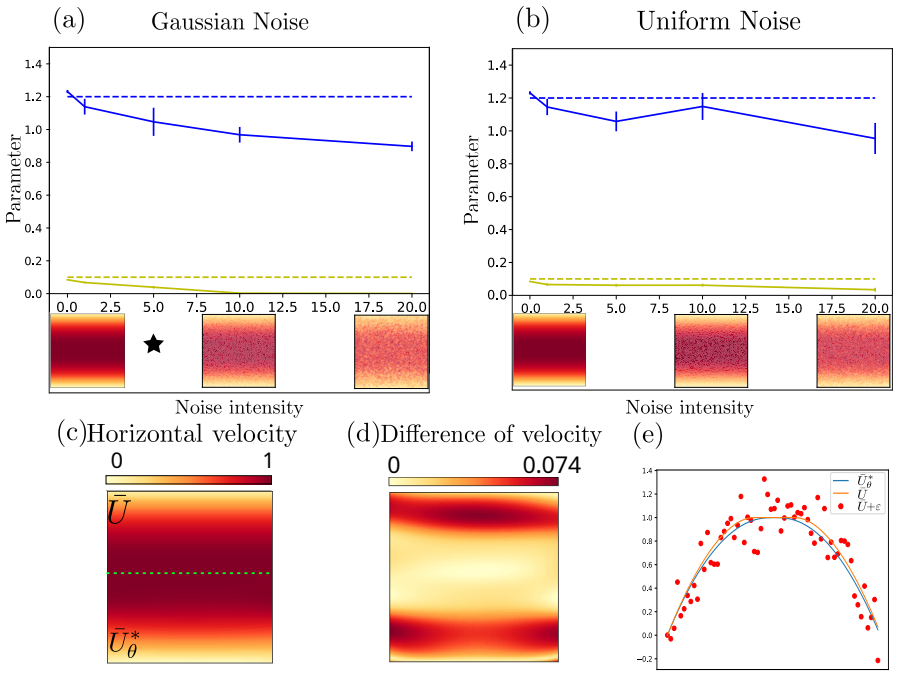
- The method tolerates significant measurement noise: with up to 10–20% artificial Gaussian or uniform noise on velocity samples, inferred parameters stay close to their true values and the network output is a denoised velocity field.
- Sampling strategy matters: biased sampling toward high-shear regions increases the shear-rate interquartile range and consistently lowers the viscosity inference error across uniform-channel, wavy-channel, and obstacle geometries.
- Model selection among Herschel–Bulkley, Carreau, and Papanastasiou candidates picks the correct law in most runs, with the only systematic confusion occurring between Herschel–Bulkley and its regularized Papanastasiou limit.
- Because boundary conditions are not needed, the approach is positioned for experimental velocimetry data in microfluidic and geophysical contexts where stress boundary conditions are unknown.
Reading between the lines
- A natural next test beyond the paper is to apply the same pipeline to experimental particle-image-velocimetry fields of a well-characterized viscoplastic gel and compare the inferred yield stress and power-law index with rheometer measurements; the present benchmark cannot say whether the method survives real measurement noise and boundary slip.
- The AIC-style selection loss suggests a Bayesian reading: the weights $\beta_i$ could be interpreted as posterior model probabilities, so a practical extension would be to report uncertainty in model choice from repeated runs rather than a single winning model.
- The shear-rate-distribution result implies a concrete experimental-design guideline: choose channel geometries and obstacle placements that maximize the range of shear rates sampled, for example by combining a wide channel and a narrow constriction in the same field of view.
- If the method generalizes to three dimensions and inertial corrections, it could become a non-contact rheometer that maps viscosity heterogeneities spatially, which the paper hints at but does not demonstrate.
Signed reviews
Editorial analysis
A structured set of objections, weighed in public.
Referee Report
Summary. The manuscript proposes a physics-informed neural network (PINN) framework for inferring generalized-Newtonian/viscoplastic constitutive laws from planar velocity field data. The network represents the velocity through a streamfunction and also outputs pressure; the loss combines a data term (Eq. 11) with the residual of the dimensionless Stokes momentum balance (Eq. 12), while the viscosity is parameterized by one of three candidate models: Herschel-Bulkley (Eq. 5), Carreau (Eq. 7), or Papanastasiou (Eq. 9). The rheological parameters and the network weights are optimized jointly. The authors validate the method on lattice-Boltzmann synthetic velocity fields in several confined geometries, study the effect of collocation point number and noise, propose a shear-rate-biased sampling strategy to improve inference, and introduce an AIC-like model-selection loss (Eq. 18) to choose among candidate constitutive laws. They report accurate recovery of the dimensionless rheological parameters, robustness to artificial noise, and correct model selection in most runs.
Significance. If the claims hold, the paper offers a practical, code-available tool for estimating dimensionless constitutive parameters from a single noisy velocity snapshot without explicit boundary-condition knowledge, and its analysis of shear-rate sampling is a useful practical contribution. The model-selection mechanism with an explicit complexity penalty is a meaningful step beyond simple parameter fitting. The principal caveats are that the absolute viscosity scale is not identifiable from Stokes velocity data, so only dimensionless ratios such as σ0/(kγdot_c^n), η∞/η0, and τ0/(μ0γdot_c) are recovered, and that the validation is entirely in-distribution, generated by the same PDE family used in the physical loss. These caveats do not invalidate the method but materially bound what the title and abstract can claim, and they should be stated explicitly.
major comments (3)
- [§2.1–2.2, Table 1] The inference target is the set of dimensionless ratios α_i, not dimensional material constants. Equation (1b) is invariant under the simultaneous rescaling (U, P, η) → (U, cP, cη), so neither the consistency k in the Herschel-Bulkley model, nor η0 in the Carreau model, nor μ0 in the Papanastasiou model can be identified from velocity data alone; only α0 = σ0/(kγdot_c^n), η∞/η0, and τ0/(μ0γdot_c) are identifiable. The manuscript never states this limitation explicitly, and the title and abstract can be read as promising dimensional constitutive parameters. This is a mathematical property of the inverse problem, not a training or noise artifact, so the authors should add an explicit identifiability statement and qualify the claims accordingly.
- [§2.3, Eq. (12)] The pressure rescaling for the Herschel-Bulkley model is κ = γdot_c^{n−1}, and n is precisely the inferred parameter α1. If κ is evaluated with the true n, the Herschel-Bulkley inference experiments in Section 3 use the answer in the loss; if κ is evaluated with the current estimate of n, the physical loss is not the non-dimensional Stokes residual (3b), and after minimization over the unconstrained pressure network the residual carries an n-dependent prefactor that can bias the inference of n independently of the constitutive fit. For γdot_c ≠ 1 the formula is also not dimensionless. Please specify whether κ uses the true or current n, justify the choice, or set κ to a constant independent of the inferred parameters (e.g., κ = 1).
- [§2.4 and §6] The validation is entirely synthetic and in-distribution: the lattice-Boltzmann benchmark solves the same steady Stokes equations and the same three constitutive laws used in the physical loss (12), so the experiments never probe robustness to model-form error such as inertia, three-dimensionality, boundary slip, or a rheology outside the candidate set. The Section 6 claim that the method is 'particularly promising for analyzing experimental data' therefore goes beyond what is demonstrated. The AIC-like penalty in Eq. (18) is an appropriate external criterion and mitigates circularity for the model-selection part, but the parameter-inference experiments would benefit from at least one out-of-distribution test, for example data from a mildly inertial or 3D flow, a slip boundary, or a constitutive law not in the candidate set, or an explicit statement that experimental applicability is untested.
minor comments (4)
- [Figure 3] The pressure comparison uses an ad hoc scaling factor a chosen to minimize the absolute difference; since the pressure level and scale are arbitrary in this inverse problem, the reported pressure error should be defined after this optimal rescaling and the normalization should be stated in the caption.
- [Eq. (18)] The notation ∥η_i∥0 for the number of parameters of model i is misleading because η_i is a function, not a vector; please rename this quantity n_i or |α_i|.
- [Global] There are several typos and placeholder fields: 'Panastasiou' in the abstract, 'Taken togher' in Section 5, 'IRQ' for IQR in the Figure 7 caption, and PACS/MSC codes '0000, 1111' in the header.
- [Section 4] The biased-sampling discussion would benefit from clarifying that the inter-quartile range is computed on the sampled shear-rate values after resampling, not on the full shear-rate field; the current text mentions binning the field but the distinction is important for reproducibility.
Circularity Check
No significant circularity: the inference pipeline is a genuine inversion benchmark, and the main caveats are identifiability and validation limitations, not circular reductions.
full rationale
The derivation chain is self-contained rather than circular. The velocity data are produced by an independent lattice-Boltzmann forward solver ([36]) using Herschel-Bulkley, Carreau, and Papanastasiou models, while the PINN minimizes a data term (11) and the nondimensional Stokes residual (12) with respect to parameters α that are not defined from the target snapshots. This is a standard forward-model/inverse-problem pairing, not a prediction equivalent to its input by construction. The κ prefactor in Eq. (12) is a pure gauge: because pressure is an unconstrained network output, replacing P* by κP* leaves the physical loss unchanged for any constant κ, so the choice κ=γdot_c^{n-1} cannot smuggle the true n into the inference. The model-selection penalty ∥η_i∥0 in Eq. (18) is an external AIC-like regularizer, not a fitted quantity. The self-citations ([30], [31], [36]) concern experimental platforms and a numerical method; none is invoked as authority for the inference claim. The genuine caveats are that benchmarks use synthetic data generated from the same constitutive family as the loss, and that Stokes flow has an absolute-scale degeneracy (η→cη, P→cP with U fixed), so only dimensionless parameter ratios are identifiable; the paper itself defers experimental application to future work and calls for deeper identifiability studies in Section 6.
Assumptions & free parameters
free parameters (5)
- Pressure rescaling factor κ (Herschel-Bulkley) =
γ̇c^(n-1) (text ambiguous; n is the true power-law index)
- Loss-balance weight W =
10^w-1 with w = floor(log10(Ldata/Lphy))+1 at initialization
- Shear-bias exponent c =
0, 1, 4 in Section 4
- Model-selection slope r =
10
- Network architecture and learning rate =
4 hidden layers of 20 tanh neurons; learning rate 0.0025
assumptions (5)
- domain assumption Flows are steady, incompressible, two-dimensional creeping flows obeying ∇·U=0 and ∇P=∇·(2ηS(U)) (Eq. 1).
- domain assumption The true viscosity belongs to one of the three candidate laws (Herschel-Bulkley, Carreau, Papanastasiou).
- domain assumption Lattice-Boltzmann simulations (Ref [36]) faithfully solve Stokes flow with the prescribed viscosity.
- domain assumption A 4x20 tanh network represents velocity and pressure accurately enough that automatic-differentiation gradients are reliable, including in unyielded plug regions.
- domain assumption Artificial noise is additive and zero-mean Gaussian or uniform (Section 3.2).
Cite this review
Pith. "Pith review of Inferring viscoplastic models from velocity fields: a physics-informed neural network approach." pith.science (2026). https://pith.science/paper/BLP2M5CX
@misc{pith2026250617681,
  author       = {Pith},
  title        = {Pith review of: Inferring viscoplastic models from velocity fields: a physics-informed neural network approach},
  year         = {2026},
  howpublished = {\url{https://pith.science/paper/BLP2M5CX}},
  note         = {Machine review of arXiv:2506.17681}
}
read the original abstract
Fluid-like materials are ubiquitous, spanning from living biological tissues to geological formations, and across scales ranging from micrometers to kilometers. Inferring their rheological properties remains a major challenge, particularly when traditional rheometry fails to capture their complex, three-dimensional, and often heterogeneous behavior. This difficulty is exacerbated by system size, boundary conditions, and other material-specific physical, chemical, or thermal constraints. In this work, we explore whether rheological laws can be inferred directly from flow observations. We propose a physics-informed neural network (PINN) framework designed to learn constitutive viscoplastic laws from velocity field data alone. Our method uses a neural network to interpolate the velocity field, enabling the computation of velocity gradients via automatic differentiation. These gradients are used to estimate the residuals of the governing conservation laws, which implicitly depend on the unknown rheology. We jointly optimize both the constitutive model and the velocity field representation by minimizing the physical residuals and discrepancies from observed data. We validate our approach on synthetic velocity fields generated from numerical simulations using Herschel-Bulkley, Carreau and Panastasiou models under various flow conditions. The algorithm reliably infers rheological parameters, even in the presence of significant noise. We analyze the dependence of inference performance on flow geometry and sampling, highlighting the importance of shear rate distribution in the dataset. Finally, we explore preliminary strategies for model-agnostic inference via embedded model selection, demonstrating the potential of PINNs for identifying the most suitable rheological law from candidate models.
Figures


Figures from the paper (5 more)



Reference graph
Works this paper leans on
- [1]
-
[2]
A. Davaille, P. Carrez, P. Cordier, Fat plumes may reflect the complex rheology of the lower mantle, Geophysical Research Letters 45 (3) (2018) 1349–1354
work page 2018
-
[3]
A. Tommasi, D. Mainprice, G. Canova, Y. Chastel, Viscoplastic self-consistent and equilibrium-based modeling of olivine lattice preferred orientations: Implications for the upper mantle seismic anisotropy, Journal of Geophysical Research: Solid Earth 105 (B4) (2000) 7893–7908
work page 2000
-
[4]
P. Jop, Y. Forterre, O. Pouliquen, A constitutive law for dense granular flows, Nature 441 (7094) (2006) 727–730
2006
-
[5]
Guazzelli, O
´E. Guazzelli, O. Pouliquen, Rheology of dense granular suspensions, Journal of Fluid Mechanics 852 (2018) P1
2018
-
[6]
B. Etcheverry, Y. Forterre, B. Metzger, Capillary-stress controlled rheometer reveals the dual rheology of shear-thickening suspensions, Physical Review X 13 (1) (2023) 011024
work page 2023
-
[7]
S. L. Brunton, S. L. Brunton, J. L. Proctor, J. L. Proctor, J. N. Kutz, J. N. Kutz, Discovering governing equations from data by sparse identification of nonlinear dynam- ical systems, Proceedings of the National Academy of Sciences of the United States of America (2016). doi:10.1073/pnas.1517384113
-
[8]
J. Bongard, H. Lipson, Automated reverse engineering of nonlinear dynamical systems, Proceedings of the National Academy of Sciences 104 (24) (2007) 9943–9948
work page 2007
Show all 43 references
-
[9]
S. H. Rudy, S. L. Brunton, J. L. Proctor, J. N. Kutz, Data-driven discovery of partial differential equations, Science advances 3 (4) (2017) e1602614. 18
2017
-
[10]
Kaheman, J
K. Kaheman, J. N. Kutz, S. L. Brunton, Sindy-pi: a robust algorithm for parallel implicit sparse identification of nonlinear dynamics, Proceedings of the Royal Society A 476 (2242) (2020) 20200279
2020
-
[11]
Z. Chen, Y. Liu, H. Sun, Physics-informed learning of governing equations from scarce data, Nature communications 12 (1) (2021) 6136
2021
-
[12]
Colen, M
J. Colen, M. Han, R. Zhang, S. A. Redford, L. M. Lemma, L. Morgan, P. V. Ruijgrok, R. Adkins, Z. Bryant, Z. Dogic, et al., Machine learning active-nematic hydrodynamics, Proceedings of the National Academy of Sciences 118 (10) (2021) e2016708118
2021
-
[13]
J. D. Christopher, N. T. Wimer, C. Lapointe, T. R. Hayden, I. Grooms, G. B. Rieker, P. E. Hamlington, Parameter estimation for complex thermal-fluid flows using approx- imate bayesian computation, Physical Review Fluids 3 (10) (2018) 104602
2018
-
[14]
Kontogiannis, R
A. Kontogiannis, R. Hodgkinson, E. L. Manchester, Learning rheological parameters of non-newtonian fluids from velocimetry data, arXiv preprint arXiv:2408.02604 (2024)
2024 arXiv
-
[15]
T. Fan, K. Xu, J. Pathak, E. Darve, Solving inverse problems in steady-state navier- stokes equations using deep neural networks, arXiv preprint arXiv:2008.13074 (2020)
2020 arXiv
-
[16]
K. Xu, A. M. Tartakovsky, J. Burghardt, E. Darve, Learning viscoelasticity models from indirect data using deep neural networks, Computer Methods in Applied Mechanics and Engineering 387 (2021) 114124
2021
-
[17]
S. L. Brunton, B. R. Noack, P. Koumoutsakos, Machine learning for fluid mechanics, Annual review of fluid mechanics 52 (1) (2020) 477–508
2020
-
[18]
Raissi, P
M. Raissi, P. Perdikaris, G. E. Karniadakis, Physics-informed neural networks: A deep learning framework for solving forward and inverse problems involving nonlinear partial differential equations, Journal of Computational physics 378 (2019) 686–707
2019
-
[19]
I. E. Lagaris, A. Likas, D. I. Fotiadis, Artificial neural networks for solving ordinary and partial differential equations, IEEE transactions on neural networks 9 (5) (1998) 987–1000
1998
-
[20]
A. G. Baydin, B. A. Pearlmutter, A. A. Radul, J. M. Siskind, Automatic differentiation in machine learning: a survey, Journal of machine learning research 18 (153) (2018) 1–43
2018
-
[21]
S. Cai, Z. Mao, Z. Wang, M. Yin, G. E. Karniadakis, Physics-informed neural networks (pinns) for fluid mechanics: A review, Acta Mechanica Sinica 37 (12) (2021) 1727–1738
2021
-
[22]
Raissi, A
M. Raissi, A. Yazdani, G. E. Karniadakis, Hidden fluid mechanics: Learning velocity and pressure fields from flow visualizations, Science 367 (6481) (2020) 1026–1030
2020
-
[23]
Q. Lou, X. Meng, G. E. Karniadakis, Physics-informed neural networks for solving forward and inverse flow problems via the boltzmann-bgk formulation, Journal of Com- putational Physics 447 (2021) 110676. 19
2021
-
[24]
R. Zhai, D. Yin, G. Pang, A deep learning framework for solving forward and inverse problems of power-law fluids, Physics of Fluids 35 (9) (2023)
2023
-
[25]
Thakur, M
S. Thakur, M. Raissi, A. M. Ardekani, Viscoelasticnet: A physics informed neural network framework for stress discovery and model selection, Journal of Non-Newtonian Fluid Mechanics (2024) 105265
2024
-
[26]
Mahmoudabadbozchelou, S
M. Mahmoudabadbozchelou, S. Jamali, Rheology-informed neural networks (rhinns) for forward and inverse metamodelling of complex fluids, Scientific reports 11 (1) (2021) 12015
2021
-
[27]
Mahmoudabadbozchelou, K
M. Mahmoudabadbozchelou, K. M. Kamani, S. A. Rogers, S. Jamali, Digital rheometer twins: Learning the hidden rheology of complex fluids through rheology-informed graph neural networks, Proceedings of the National Academy of Sciences 119 (20) (2022) e2202234119
2022
-
[28]
Cheddadi, P
I. Cheddadi, P. Saramito, B. Dollet, C. Raufaste, F. Graner, Understanding and pre- dicting viscous, elastic, plastic flows, The European Physical Journal E 34 (2011) 1–15
2011
-
[29]
Golovkova, L
I. Golovkova, L. Montel, E. Wandersman, T. Bertrand, A. M. Prevost, L.-L. Pontani, Depletion attraction impairs the plasticity of emulsions flowing in a constriction, Soft Matter 16 (13) (2020) 3294–3302
2020
-
[30]
Tlili, M
S. Tlili, M. Durande, C. Gay, B. Ladoux, F. Graner, H. Delano¨ e-Ayari, Migrating epithelial monolayer flows like a maxwell viscoelastic liquid, Physical Review Letters 125 (8) (2020) 088102
2020
-
[31]
S. L. Tlili, F. Graner, H. Delano¨ e-Ayari, A microfluidic platform to investigate the role of mechanical constraints on tissue reorganization 149 (20) dev200774. doi:10.1242/ dev.200774
-
[32]
T. C. Papanastasiou, Flows of materials with yield, Journal of rheology 31 (5) (1987) 385–404
1987
-
[33]
D. Bonn, M. M. Denn, L. Berthier, T. Divoux, S. Manneville, Yield stress materials in soft condensed matter, Reviews of Modern Physics 89 (3) (2017) 035005
2017
-
[34]
D. P. Kingma, J. Ba, Adam: A method for stochastic optimization, arXiv preprint arXiv:1412.6980 (2014)
2014 arXiv
-
[35]
https://github.com/martinLARD/Pinn.git
-
[36]
Gsell, U
S. Gsell, U. d’Ortona, J. Favier, Lattice-boltzmann simulation of creeping generalized newtonian flows: theory and guidelines, Journal of Computational Physics 429 (2021) 109943
2021
-
[37]
Gsell, J
S. Gsell, J. Favier, Direct-forcing immersed-boundary method: a simple correction pre- venting boundary slip error, Journal of Computational Physics 435 (2021) 110265. 20
2021
-
[38]
F. Chen, Y. Meng, K. Li, C. Yang, J. Yang, Global physics-informed neural networks (gpinns): from local point-wise constraint to global nodal association, arXiv preprint arXiv:2503.06403 (2025)
2025 arXiv
-
[39]
K. P. Murphy, Machine learning: a probabilistic perspective, MIT press, 2012
2012
-
[40]
Weston, A
J. Weston, A. Elisseeff, B. Sch¨ olkopf, M. Tipping, Use of the zero-norm with linear models and kernel methods, Journal of machine learning research 3 (Mar) (2003) 1439– 1461
2003
-
[41]
T. Pang, F. Nie, J. Han, X. Li, Efficient feature selection vial2,0-norm constrained sparse regression, IEEE Transactions on Knowledge and Data Engineering 31 (5) (2018) 880– 893
2018
-
[42]
Narasimhan, Learning with complex loss functions and constraints, in: International Conference on Artificial Intelligence and Statistics, PMLR, 2018, pp
H. Narasimhan, Learning with complex loss functions and constraints, in: International Conference on Artificial Intelligence and Statistics, PMLR, 2018, pp. 1646–1654
2018
-
[43]
Cotter, H
A. Cotter, H. Jiang, M. Gupta, S. Wang, T. Narayan, S. You, K. Sridharan, Optimiza- tion with non-differentiable constraints with applications to fairness, recall, churn, and other goals, Journal of Machine Learning Research 20 (172) (2019) 1–59. 21
2019
Reviewed August 15, 2026 · model on record in the stance chip above.
Discussion (0). Continue with ORCID to comment.