REVIEW 7 minor 26 references
Invariants of toric double determinantal rings
T0 review · 0 major / 7 minor · reviewed 2026-08-06 · deepseek-v4-flash
Pith's one-line read This paper proves that the quotient $R/I^r_{mn}$ by all $2$-minors of the horizontal and vertical concatenations of $r$ generic $m\times n$ matrices is isomorphic to the Hibi ring of the distributive lattice…
desk verdict Solid Hibi-ring realization of toric double determinantal rings with closed formulas; worth refereeing, only minor exposition gaps. read the letter →
The pith
A machine-rendered reading of the paper's core claim, the machinery that carries it, and where it could break.
The reading
What carries the argument
The central object is the Hibi ring $K[L]$ of a finite distributive lattice $L$, together with its realization as a toric ring generated by sortable monomials. For $L_{mnr}=\mathcal{J}(P_{mnr})$, the monomial model is $\{x_i y_j z_k:1\le i\le m,\,1\le j\le n,\,1\le k\le r\}$, with the sorting map sending an unsorted pair to the meet and join of the corresponding lattice elements. The load-bearing mechanism is the equality of two descriptions of the same ideal: the $2$-minors of the two concatenated matrices generate the same kernel as the sorting relations, which are the Hibi relations of $L_{mnr}$. Once this equality is in place, invariants of the double determinantal ring become lattice-theoretic counts of elements, chains, linear extensions, and order-preserving maps.
What would settle it
Compute the kernel of $\phi(x^k_{ij})=x_i y_j z_k$ for a small instance such as $m=n=r=3$ and compare it with the ideal generated by all 2-minors of $H$ and $V$: the central claim is true exactly if the two ideals coincide, and any 2-minor with nonzero image under $\phi$ would refute it.
Extended reading notes
Core claim
On the paper's own terms, the discovery is that the quotient ring $R/I^r_{mn}$ is exactly the Hibi ring $K[L_{mnr}]$, so every invariant of the ring can be read off from the three-chain poset $P_{mnr}$. Concretely, the map sending the variable $x^k_{ij}$ to the monomial $x_i y_j z_k$ has kernel equal to $I^r_{mn}$; the sorting relations of the monomial set $\{x_i y_j z_k\}$ coincide with the Hibi relations of the lattice of order ideals of $P_{mnr}$. The paper then reads off: $\mu(I^r_{mn})=\binom{mnr+1}{2}-\binom{m+1}{2}\binom{n+1}{2}\binom{r+1}{2}$ minimal generators; dimension $m+n+r-2$; multiplicity $\frac{(m+n+r-3)!}{(m-1)!(n-1)!(r-1)!}$; regularity $m+n+r-2-\max\{m,n,r\}$; $a$-invariant $-\max\{m,n,r\}$; Hilbert function $\binom{m-1+d}{d}\binom{n-1+d}{d}\binom{r-1+d}{d}$; and Gorensteinness exactly when $\{m,n,r\}\subseteq\{1,\max\{m,n,r\}\}$.
Load-bearing premise
The argument leans on the unexpanded assertion that every 2-minor of the two concatenated matrices lies in the kernel of the map $x^k_{ij}\mapsto x_i y_j z_k$; if that inclusion failed for even one minor, the identification with the Hibi ring and all formulas built on it would collapse.
Editorial extensions
If this is right
- The symmetry $R/I^r_{mn}\cong R/I^{\sigma(r)}_{\sigma(m)\sigma(n)}$ for any permutation $\sigma$ of $\{m,n,r\}$ means all computed invariants are unchanged by permuting the three parameters.
- Since Hibi rings of distributive lattices are normal Cohen--Macaulay domains, the ring $R/I^r_{mn}$ is a normal Cohen--Macaulay domain of dimension $m+n+r-2$ for all positive integers $m,n,r$.
- The Hilbert function is the product $\binom{m-1+d}{d}\binom{n-1+d}{d}\binom{r-1+d}{d}$, so the $h$-polynomial is the descent polynomial of multiset permutations of $\{1^{m-1},2^{n-1},3^{r-1}\}$.
- The ring $R/I^r_{mn}$ is Gorenstein exactly when $\{m,n,r\}\subseteq\{1,\max\{m,n,r\}\}$; equivalently, at most one of the three parameters exceeds $1$.
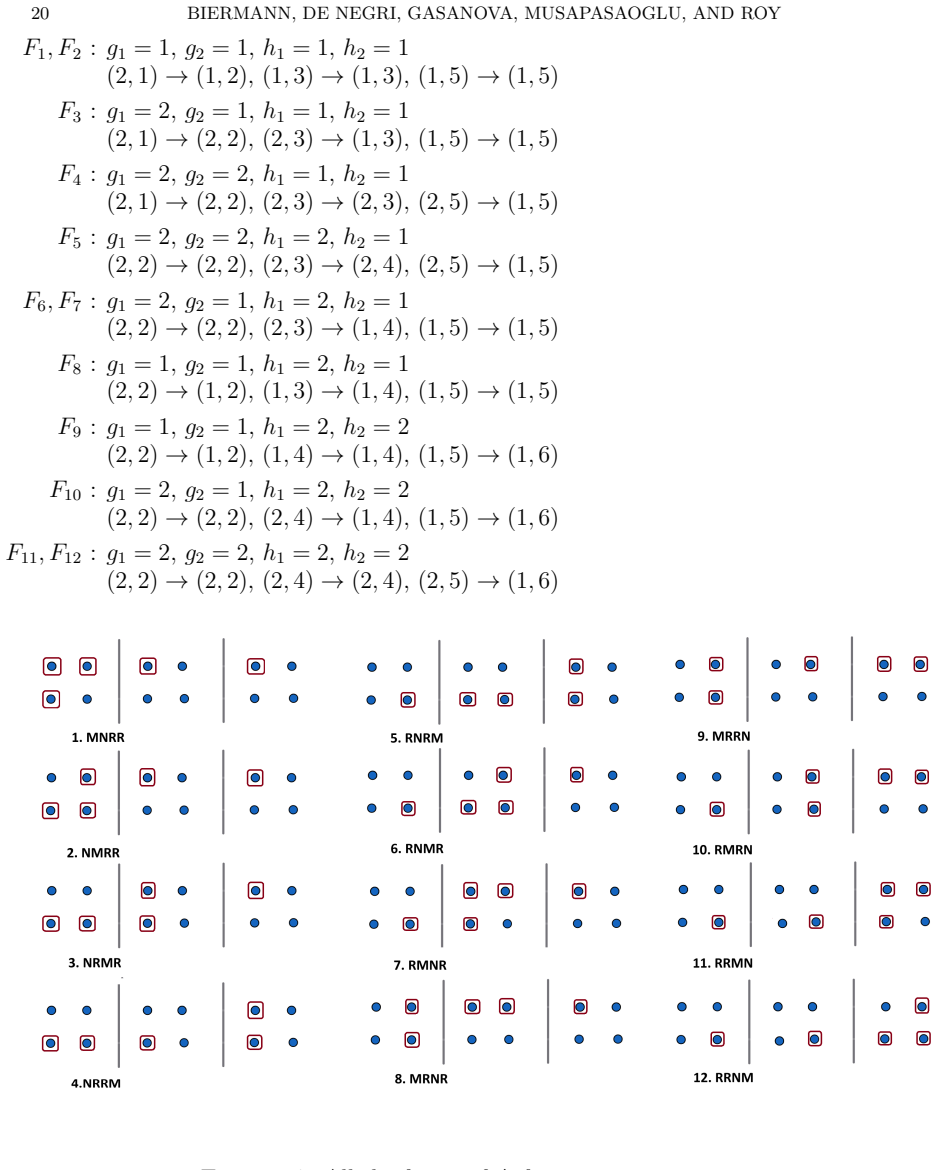
- The facets of the Stanley--Reisner complex of the initial ideal with respect to a diagonal term order are in bijection with words on $\{M^{m-1},N^{n-1},R^{r-1}\}$, making that complex pure of dimension $m+n+r-3$.
Reading between the lines
- Beyond the paper, the same sortable-monomial model suggests that the 2-minor construction for three concatenated chains is one instance of a general identification with Hibi rings of products of chains; replacing three chains by $s$ chains should give analogous formulas with $s$ parameters.
- Beyond the paper, the failure of the isomorphism for minors of size at least $3$, noted in the paper's Remark 4.2, indicates that the Hibi-ring dictionary is specific to the 2-minor case and that different tools would be needed for larger minors.
- Beyond the paper, the word encoding of facets raises the possibility that ordering facets by adjacent-letter exchanges gives a shelling order, which would yield a purely combinatorial proof that the quotient by the initial ideal is Cohen--Macaulay; the paper leaves this as an open question.
Signed reviews
Editorial analysis
A structured set of objections, weighed in public.
Referee Report
Summary. This paper studies the quotient R/I^r_mn of the polynomial ring R = K[x^k_{ij}] by the ideal generated by all 2-minors of the horizontal concatenation (X_1 ... X_r) and the vertical concatenation of r generic m x n matrices. The main structural result is Theorem 3.4 and Corollary 3.5: R/I^r_mn is isomorphic to the Hibi ring K[L_mnr] of the distributive lattice L_mnr = J(P_mnr), where P_mnr is the disjoint union of three chains of lengths m-1, n-1, and r-1. From this identification the paper derives explicit formulas for the minimal number of generators, dimension, multiplicity, regularity, a-invariant, Hilbert function, and h-polynomial, proves a symmetry isomorphism under permutations of m, n, r, characterizes when the ring is Gorenstein, and describes the facets of the Stanley-Reisner complex of the diagonal initial ideal.
Significance. If the Hibi-ring identification is correct, it provides a clean conceptual explanation of the previously known normality and Cohen-Macaulayness of toric double determinantal rings and yields closed, parameter-free formulas for their basic invariants, answering Li's questions in the toric case. The paper is largely self-contained, makes careful use of the sortable-set presentation of Hibi rings, and includes several internal consistency checks, such as Remark 4.4(1) and Remark 4.8. I regard the central claim as sound: the one potentially load-bearing step, the inclusion I^r_mn subset of I_A in Theorem 3.4, is true and easily verified, so the omitted verification is an exposition issue rather than a mathematical gap.
minor comments (7)
- [Theorem 3.4] The inclusion I^r_mn subset of I_A is asserted with the words "it is not so hard to directly check that any minor belongs to ker phi" and no verification is displayed. Because this inclusion is load-bearing for the identification with the Hibi ring, please add the two-line check: under phi(x^k_ij) = x_i y_j z_k, the two terms of every 2-minor of H and V map to the same monomial (for a same-block minor both terms map to x_{i_1}x_{i_2}y_{j_1}y_{j_2}z_k^2, and for a cross-block minor both map to x_{i_1}x_{i_2}y_{j_1}y_{j_2}z_{k_1}z_{k_2}).
- [Theorem 4.3(6)] There is a typo in the Hilbert-function formula: the factor should be binom(n-1+d, d), not binom(n-1+d, t).
- [Remark 4.2(2)] The parenthetical "see Section 4 for the definition" is inaccurate: diagonal term orders are defined in Section 5, not Section 4.
- [Definition 5.2] The notation "(g_1,h_1) - -> (g_s,h_s)" should presumably be "(g_1,h_1) - -> (g_t,h_t)", since the path has t points.
- [Theorem 3.3 and Section 3.1] The symbol R is used both for the polynomial ring and for one of the four generating sets in Theorem 3.3; using a different letter for the set (for example S or \mathcal{R}) would avoid confusion.
- [Section 5, before Question 5.10] There is a typo in "the the facets" in the paragraph preceding Question 5.10.
- [Section 4.3 (regularity)] The application of [9, Theorem 1.1] to the non-pure poset P_mnr is a point the authors could clarify with one sentence; I see no correctness issue, since the resulting formula agrees with the degree of the h-polynomial obtained in Corollary 4.7.
Circularity Check
No significant circularity: R/I^r_mn is identified with a Hibi ring by direct match-up of sorting relations with 2-minors, and all invariant formulas are imported from external Hibi-ring theorems rather than from the quantities being computed.
full rationale
The central derivation is self-contained. Theorem 3.3 gives an explicit generating set for ker phi using Sturmfels' sorting relations (Theorem 1.2, external), and Theorem 3.4 proves I^r_mn = ker phi by matching these generators to minors of the horizontal and vertical concatenations. The inclusion I^r_mn ⊆ ker phi is asserted in Theorem 3.4 with the words 'it is not so hard to directly check that any minor belongs to ker phi'; although this verification is abbreviated, it is a routine check (each 2-minor's two terms map to the same monomial x_i y_j z_k product) and is not an invocation of the target isomorphism. Corollary 3.5 then follows immediately. The invariant computations in Theorem 4.3 use standard, external Hibi-ring facts: dim K[J(P)] = |P|+1, multiplicity equals the number of linear extensions, regularity is |P|-rank(P)-1 from [9], the Hilbert function counts order-preserving maps, and Theorem 4.9 uses Hibi's Gorenstein criterion (poset purity). These are not restatements of the formulas being derived. The only self-citation is Theorem 2.1 from [10], whose proof is outlined in the text and whose content is a general realization of Hibi rings as algebras generated by sortable monomial sets; it is independent support, not a fitted input or a premise that already contains the target results. No fitted parameters, no predictions forced by construction, and no uniqueness claim imported from the authors' prior work were found. The minor proof gap of the unexpanded inclusion check is a brevity issue, not circularity.
Assumptions & free parameters
assumptions (6)
- standard math Sorting relations generate the toric ideal of a sortable set of monomials (Theorem 1.2, Sturmfels).
- standard math Hibi relations generate the presentation ideal of a Hibi ring and form a Grobner basis for any Hibi order (Theorem 1.6).
- standard math A Hibi ring K[J(P)] is Gorenstein if and only if P is pure (Hibi [14]).
- standard math Formula for the regularity of Hibi rings from Ene, Herzog, and Saeedi Madani [9].
- domain assumption The natural minors are a Grobner basis for any diagonal order (Fieldsteel and Klein [17, Theorem 3.2]).
- domain assumption Dimension and Cohen-Macaulayness of double determinantal rings (Proposition 3.1, from [17] and [19]).
Cite this review
Pith. "Pith review of Invariants of toric double determinantal rings." pith.science (2026). https://pith.science/paper/XX3FMXBY
@misc{pith2026250622730,
  author       = {Pith},
  title        = {Pith review of: Invariants of toric double determinantal rings},
  year         = {2026},
  howpublished = {\url{https://pith.science/paper/XX3FMXBY}},
  note         = {Machine review of arXiv:2506.22730}
}
abstract
We study a class of double determinantal ideals denoted $I_{mn}^r$, which are generated by minors of size 2, and show that they are equal to the Hibi rings of certain finite distributive lattices. We compute the number of minimal generators of $I_{mn}^r$, as well as the multiplicity, regularity, a-invariant, Hilbert function, and $h$-polynomial of the ring $R/I_{mn}^r$, and we give a new proof of the dimension of $R/I_{mn}^r$. We also characterize when the ring $R/I_{mn}^r$ is Gorenstein, thereby answering a question of Li in the toric case. Finally, we give combinatorial descriptions of the facets of the Stanley-Reisner complex of the initial ideal of $I_{mn}^r$ with respect to a diagonal term order.
Figures


Figures from the paper (1 more)
Reference graph
Works this paper leans on
-
[1]
Birkhoff, Lattice Theory (3rd ed.), Amer
G. Birkhoff, Lattice Theory (3rd ed.), Amer. Math. Soc. Colloq. Publ. No. 25. Providence, R. I.: Amer. Math. Soc
- [2]
- [3]
-
[4]
Cohen-Macaulay rings, Cambridge Stud
W.Bruns, J.Herzog. Cohen-Macaulay rings, Cambridge Stud. Adv. Math., 39 Cambridge University Press, Cambridge, 1993
work page 1993
-
[5]
L. Carlitz, V. Hoggatt, Generalized Eulerian numbers and polynomials, Fibonacci Quart. 16 (1978), no. 2, 138–146
work page 1978
-
[6]
Conca, Ladder determinantal rings, J
A. Conca, Ladder determinantal rings, J. Pure Appl. Algebra 98 (1995), no. 2, 119–134
work page 1995
- [7]
-
[8]
Ene, V. Syzygies of Hibi Rings. Acta Math Vietnam 40, 403–446 (2015)
work page 2015
Show all 26 references
-
[9]
V. Ene, J. Herzog, and S. Saeedi Madani, A note on the regularity of Hibi rings. Manuscripta Math., 148(3-4):501–506, 2015
2015
-
[10]
Gasanova, L
O. Gasanova, L. Nicklasson, Chain algebras of finite distributive lattices, J. Algebraic Combin. 59 (2024), no. 2, 473–494
2024
-
[11]
Gonciulea and C
N. Gonciulea and C. Miller, Mixed ladder determinantal varieties, J. Algebra 231 (2000), no. 1, 104–137
2000
-
[12]
Gorla, Mixed ladder determinantal varieties from two-sided ladders, J
E. Gorla, Mixed ladder determinantal varieties from two-sided ladders, J. Pure Appl. Algebra 211 (2007), no. 2, 433–444
2007
-
[13]
Herzog, T
J. Herzog, T. Hibi, Monomial Ideals, Graduate Texts in Mathematics, volume 260, Springer, 2011. 22 BIERMANN, DE NEGRI, GASANOV A, MUSAPASAOGLU, AND ROY
2011
-
[14]
Com- mutative Algebra and Combinatorics
T. Hibi, Distributive lattices, affine semigroup rings and algebras with straightening laws, In: “Com- mutative Algebra and Combinatorics” (M. Nagata and H. Matsumura, Eds.), Adv. Stud. Pure Math. 11, North–Holland, Amsterdam, (1987), 93–109
1987
-
[15]
Hibi, Hilbert functions of Cohen-Macaulay integral domains and chain conditions of finite partially ordered sets, J
T. Hibi, Hilbert functions of Cohen-Macaulay integral domains and chain conditions of finite partially ordered sets, J. Pure Appl. Algebra, 72:265–273, 1991
1991
-
[16]
Illian, L
J. Illian, L. Li, Gr¨ obner bases for bipartite determinantal ideals, Comm. Algebra 53 (2025), no. 1, 124–147
2025
-
[17]
Klein, N
P. Klein, N. Fieldsteel, Gr¨ obner bases and the Cohen–Macaulay property of Li’s double determinantal varieties, Proceedings of the AMS, Series B, 7 (2020), 142–158
2020
-
[18]
Li, Nakajima’s quiver varieties and triangular bases of rank-2 cluster algebras, J
L. Li, Nakajima’s quiver varieties and triangular bases of rank-2 cluster algebras, J. of Algebra 634 (2023), 97–164
2023
-
[19]
Li, Bipartite determinantal ideals and concurrent vertex maps, J
L. Li, Bipartite determinantal ideals and concurrent vertex maps, J. of Algebraic combinatorics 60 (2024), 735–780
2024
-
[20]
Z. Lin, X. Xu, T. Zhao, On the γ-positivity of multiset Eulerian polynomials, European Journal of Combinatorics, 102 (2022), Paper No. 103491, 18 pp
2022
-
[21]
MacMahon, Combinatory Analysis, Two Volumes (Bound As One), Chelsea Publishing Co., New York, 1960
P.A. MacMahon, Combinatory Analysis, Two Volumes (Bound As One), Chelsea Publishing Co., New York, 1960
1960
-
[22]
Ma, Jun, Pan, Kaiying, ( M, i)-multiset Eulerian polynomials, Adv. in Appl. Math. 149 (2023), Paper No. 102547, 36 pp
2023
-
[23]
Grayson, M
D. Grayson, M. Stillman, Macaulay2, a software system for research in algebraic geometry. Available at http://www.math.uiuc.edu/Macaulay2/
-
[24]
R. P. Stanley, Enumerative combinatorics, vol. 1, 2nd edition, Cambridge University Press, Cam- bridge, 1996
1996
-
[25]
Sturmfels, Gr¨ obner bases and convex polytopes, University Lecture Series, 9, American Mathe- matical Soc., 1996
B. Sturmfels, Gr¨ obner bases and convex polytopes, University Lecture Series, 9, American Mathe- matical Soc., 1996
1996
-
[26]
Svanes, Coherent cohomology on schubert subschemes of flag schemes and applications, Advances in Math
T. Svanes, Coherent cohomology on schubert subschemes of flag schemes and applications, Advances in Math. 14 (1974), 369–453. Department of Mathematics and Computer Science, Hobart and William Smith Col- leges, Geneva, NY 14456 Email address : biermann@hws.edu Dipartimento di ...
1974
Reviewed August 6, 2026 · model on record in the stance chip above.
Discussion (0). Continue with ORCID to comment.