REVIEW 5 major objections 4 minor 4 cited by
The birth of young radio jets in changing-look AGN: a population study
T0 review · 5 major / 4 minor · reviewed 2026-08-06 · deepseek-v4-flash
Pith's one-line read Most changing-look AGN do not launch long-lived radio jets after their broad-line state changes.
desk verdict First population-level radio variability study of CLAGN, but the 'no jets' claim is sensitivity-limited for 14 of 20 objects; still worth citing and reviewing. read the letter →
The pith
A machine-rendered reading of the paper's core claim, the machinery that carries it, and where it could break.
The reading
What carries the argument
The argument is carried by monthly-cadence 887.5 MHz VAST light curves spanning 2019 to 2025, together with two-epoch VLASS 3 GHz flux measurements. Variability is quantified by the normalized excess variance (NEV) of each light curve, with a threshold of 0.02 separating varying from unvarying CLAGN, and by a greater-than-10% flux change between VLASS epochs. The paper also compares power-law versus concave, peaked-spectrum shapes of radio SEDs from quasi-simultaneous VLA observations to distinguish CLAGN from young radio jets. These metrics, applied with the 2 mJy VAST sensitivity limit, define what a detectable post-event flare would look like and support the conclusion that most CLAGN lack such flares.
What would settle it
Repeated deep 887.5 MHz observations of the 14 higher-redshift CLAGN that reach below 1 mJy would show whether faint post-changing-look flares are present; detecting several such flares would overturn the claim that radio flaring after changing-look events is atypical.
Extended reading notes
Core claim
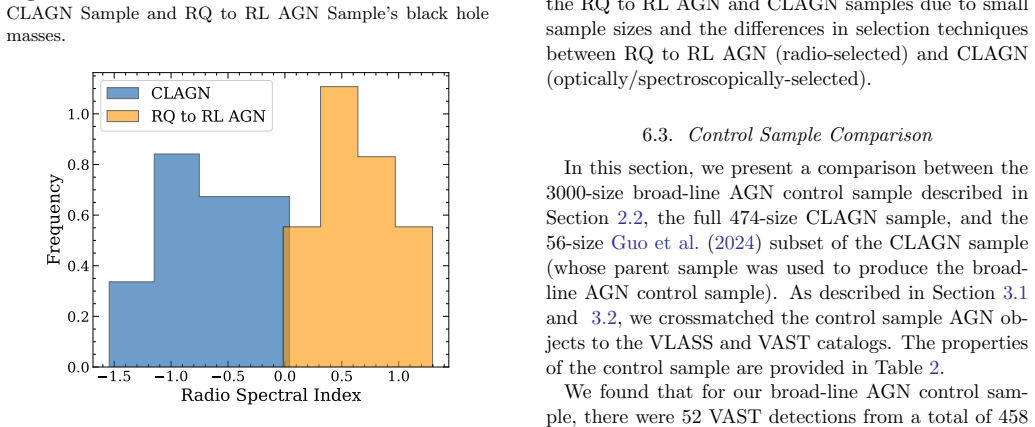
The paper's central claim is that changing-look AGN, as a population, do not show the appearance of new radio jets after the changing-look event. For 20 newly studied compact VAST-detected CLAGN, no statistically significant fading is seen in the decade following the event; for 6 low-redshift, high-mass CLAGN a Mrk 590-like flare is ruled out, while a fainter NGC 1566-like flare cannot be excluded. The population differs from a redshift-matched control AGN sample in having higher VAST and VLASS detection rates, a lower fraction of radio-loud objects, and a higher fraction of 887.5 MHz variable sources. VLA observations of four CLAGN show power-law radio SEDs rather than the concave, peaked-spectrum shapes typical of young radio jets, and Magellan spectroscopy finds no appearance of broad lines in the radio-quiet-to-radio-loud AGN comparison sample. The authors conclude that changing-look events may launch temporary jets for some objects, but the majority do not initiate an episode of long-term radio activity, favoring temporary disk instabilities as the driving mechanism.
Load-bearing premise
The conclusion rests on the ability of the VAST 887.5 MHz light curves to detect a Mrk 590-like or 1ES 1927+654-like flare, and for 14 of the 20 newly studied CLAGN such a flare would fall below the 2 mJy sensitivity.
Editorial extensions
If this is right
- The well-studied radio flaring of Mrk 590, NGC 1566, and 1ES 1927+654 is atypical, so results from those objects should not be extrapolated to all CLAGN.
- The absence of sustained radio activity favors variable accretion and disk instabilities as the driver of changing-look events over models invoking a lasting change in fuel supply.
- CLAGN and AGN that switched from radio-quiet to radio-loud over a decade are probably distinct populations, since their radio SED shapes and variability behavior differ.
- CLAGN show higher radio detection rates but a lower fraction of radio-loud objects than a redshift-matched control AGN sample, indicating a different radio production mechanism.
- Monitoring campaigns that begin promptly after a changing-look event are needed to catch any short-lived jet before it fades.
Reading between the lines
- If deeper radio surveys find faint NGC 1566-like flares among the currently undetected higher-redshift CLAGN, the 'no jet' conclusion would need to be weakened to 'no bright jet' rather than 'no jet at all.'
- A testable extension is to compare the timing of radio flares with the exact epoch of the broad-line change: disk-instability models would predict flares that track the optical event, while jet models would predict delayed, longer-lived emission.
- The absence of broad lines in the radio-quiet-to-radio-loud AGN suggests that radio-selected state changes and optically selected changing-look events may trace different physical mechanisms even though both are fast accretion-state transitions.
Editorial analysis
A structured set of objections, weighed in public.
Referee Report
Summary. This paper presents a radio time-domain population study of 474 spectroscopically confirmed changing-look AGN (CLAGN), using ASKAP VAST and VLASS data. The authors identify 68 radio-detected CLAGN, construct VAST light curves for 22 compact sources, and classify sources by compactness, radio loudness, spectral index, and variability. They compare the CLAGN sample with a broad-line AGN control sample and with 52 AGN that transitioned from radio-quiet to radio-loud in VLASS. The central claim is that most CLAGN do not launch long-lived radio jets after the changing-look event: no new radio fading events are found in the 20 newly studied VAST-detected CLAGN, and a Mrk 590-like flare can be ruled out for only 6 low-redshift objects. The paper also reports VLA spectral energy distributions and Magellan spectra for subsets of sources, and concludes that CLAGN are distinct from the radio-quiet-to-radio-loud AGN population.
Significance. If the central claim is supported, the paper provides an important population-level counterpoint to the dramatic radio flaring and fading seen in individual CLAGN such as 1ES 1927+654, Mrk 590, and NGC 1566, and it would favor temporary disk instabilities over sustained jet production as the typical driver of changing-look events. The compiled 474-object sample, the use of VAST monthly-cadence light curves, and the explicit detectability calculation for Mrk 590-like flares in Section 7 are valuable contributions. However, the strength of the population-level conclusion is currently limited by the sensitivity of the VAST data and by the matching of the control sample, as detailed below.
major comments (5)
- [Section 7 and Conclusions] The paper's central negative claim is not supported for 14 of the 20 newly studied CLAGN. Section 7 states that for the 14 CLAGN with z>0.05, Mrk 590-like luminosities would be below the VAST 2 mJy limit, so their non-detection of fading does not constrain the flare model. The conclusions in Section 8 and the abstract that 'the majority of these events do not appear to initiate an episode of long term radio activity' therefore rest on only 6 objects with z<0.05, and even for those only a Mrk 590-like flare is excluded, not a fainter NGC 1566-like flare. The claim should be restricted accordingly, or the analysis should treat non-detections as censored data and present upper limits on the incidence of such flares.
- [Sections 2.2 and 6.3] The 3000-object control sample is constructed by matching redshifts to the 56-object Guo et al. (2024) CLAGN subset, but Section 6.3 compares this control sample to the full 474-object CLAGN sample for detection rate, radio loudness, luminosity, and variability. Because the full CLAGN sample includes objects from other surveys with different redshift and luminosity distributions, these comparisons are not properly matched. The control should be matched to the full CLAGN sample, or the population-level comparison should be restricted to the Guo et al. subset.
- [Section 6.3] The text states that 'We find statistically significant evidence indicating that the CLAGN population has a higher fraction of variable objects in VAST 887.5 MHz frequencies compared to the broad-line control AGN sample.' With 2 of 22 CLAGN variable and 0 of 35 control AGN variable, a Fisher exact test gives p approximately 0.15, so the claimed significance is not supported at the 95% level. No test statistic or p-value is reported for this comparison. Please provide the specific test used or soften the claim.
- [Sections 3.3.5 and 6.2] There is an internal contradiction in the 1.3675 GHz variability counts. Section 3.3.5 states that none of the 10 VAST-detected CLAGN are variable at 1.3675 GHz, while Section 6.2 states that '1 of our 5 V AST-detected CLAGN were classified as variable in the 1.3675 GHz frequency.' These statements cannot both be correct, and the discrepancy affects the reported variability fractions and the consistency of Table 5. Please correct the counts and ensure the table entries are consistent with the text.
- [Sections 3.3.5 and 4, Eq. (2)] The variability classifications depend on hand-chosen thresholds: NEV>0.02 for VAST, NEV>0.04 for ZTF, and >10% flux change for VLASS. These thresholds are justified by visual inspection, but because the paper's main negative result is an absence of radio variability, the analysis should demonstrate robustness to threshold choice. I recommend reporting variable fractions for a range of NEV cutoffs or using a statistical test that propagates measurement errors into the variability classification.
minor comments (4)
- [Section 4] The two-sample Anderson-Darling statistic is reported as A2=-0.94, but the Anderson-Darling statistic is non-negative by definition. Please check the implementation and report the correct value.
- [Figure 16 caption] The caption refers to a '0.20 radio variability cutoff,' but the text and the rest of the paper use a cutoff of 0.02. This appears to be a typo and should be corrected.
- [Section 2.2] The procedure for generating the 3000-object control sample does not specify whether sampling is done with replacement and whether duplicate control objects are removed. If duplicates remain, statistical tests need to account for the reduced effective sample size.
- [Abstract and Section 7] The abstract says that for '6 CLAGN with a sufficiently low redshift and high enough mass' a Mrk 590-like flare is ruled out, but Section 7 says only '6 other z<0.05 VAST-detected CLAGN' and does not describe a mass criterion. Please align these statements and specify the mass threshold used.
Circularity Check
No circularity: the radio population analysis is based on survey data and externally published benchmarks, with sensitivity limitations but no reduction of conclusions to inputs.
full rationale
The paper's derivation chain is self-contained against external benchmarks. The central negative claim is obtained by direct comparison of VAST/VLASS light curves to published flare behaviors of Mrk 590, NGC 1566, and 1ES 1927+654, with detectability assessed against the stated VAST 2 mJy sensitivity limit. No parameter is fitted to the target conclusion, and no prediction is statistically forced by a fitted input. The RQ-to-RL comparison sample is taken from independently published FIRST-to-VLASS studies; the fact that one of those studies has an overlapping author is not load-bearing because the cited results are externally anchored observations, not a self-justifying uniqueness theorem or ansatz. The variability cutoffs (NEV > 0.02, VLASS 10% change) are chosen by visual inspection and are not fitted to produce the no-fading result. The acknowledged z>0.05 sensitivity limitation weakens the population-level conclusion for 14 of 20 objects, but this is a support problem, not circularity: the non-detections are not equivalent to the conclusion by construction. No equation in the paper reduces to an input, and no self-citation supplies the central load-bearing step.
Assumptions & free parameters
free parameters (5)
- Radio NEV variability cutoff =
0.02
- Optical ZTF NEV variability cutoff =
0.04
- VLASS variability threshold =
10% flux change
- Spectral index for 5 GHz extrapolation =
-0.7
- Compactness classification thresholds =
2 (VLASS), 5 (VAST)
assumptions (4)
- domain assumption VLASS and VAST radio surveys provide complete and unbiased coverage of the CLAGN sample within their footprints.
- domain assumption A single power-law radio SED (S_nu ~ nu^alpha) is adequate for extrapolating fluxes to 5 GHz for all compact CLAGN.
- domain assumption Redshifts and black hole masses from the literature are reliable.
- domain assumption The Guo et al. (2024) parent sample regeneration faithfully reproduces the original selection.
Cite this review
Pith. "Pith review of The birth of young radio jets in changing-look AGN: a population study." pith.science (2026). https://pith.science/paper/DKYNXVG2
@misc{pith2026250701355,
  author       = {Pith},
  title        = {Pith review of: The birth of young radio jets in changing-look AGN: a population study},
  year         = {2026},
  howpublished = {\url{https://pith.science/paper/DKYNXVG2}},
  note         = {Machine review of arXiv:2507.01355}
}
read the original abstract
Changing-Look Active Galactic Nuclei (CLAGN) are a rare subset of AGN that show significant changes to the flux of broad Balmer emission lines. Recent studies of CLAGN, such as 1ES 1927+654 and Mrk 590, have revealed that changes in the optically observed accretion rate are accompanied by changes in radio activity. We present a time-domain population study of 474 spectroscopically confirmed CLAGN at radio wavelengths using the Australia SKA Pathfinder Variable and Slow Transients Survey and the Very Large Array Sky Survey. We compare the radio properties of this CLAGN sample to a control sample of AGN that have not had recent changing-look events, and to AGN that were found to have transitioned from radio-quiet to radio-loud over 10-year timescales in VLASS. For 20 newly studied CLAGN detected in ASKAP VAST, we do not detect Mrk 590 or 1ES 1927+654-like fading of the radio flux in the 10 years following changing-look events. For 6 CLAGN with a sufficiently low redshift and high enough mass, we rule out a Mrk 590-like flare. We find that at the population level, CLAGN have higher VAST/VLASS detection rates, lower fractions of radio loudness, and higher variability rates in the 1 GHz frequency compared to the control AGN. Through VLA observations of radio SEDs and Magellan spectroscopic observations, we do not find evidence of a link between CLAGN and AGN that transitioned from radio-loud to radio-quiet in VLASS. We discuss the implications of this study for the physical mechanisms that drive enhanced accretion episodes.
Figures


Figures from the paper (12 more)




Forward citations
Cited by 4 Pith papers
-
Radio and X-ray flux rebrightening six years after outburst in a partially-obscured extreme changing-look AGN
SDSS J1548+2208 is a rare partially-obscured extreme CLAGN that launched a radio outflow, with late-time rebrightening explained by interaction with dense circumnuclear clouds.
-
Simultaneous radio, optical and X-ray monitoring of hard X-ray selected AGN: a variability study
In 14 hard-X-ray-selected AGN monitored for two years, variability is strongest in X-rays and weakest in radio, and source variability explains only ~2-3% of the scatter in the Fundamental Plane.
-
Radio Activity Across Accretion State Changes in Changing-look AGNs: Insights from FIRST and VLASS over Two Decades
Radio activity in CL-AGNs tracks long-term accretion history and jet evolution more than instantaneous state changes, with rare radio turn-on/off events and one possible TDE-like flare.
-
The spectral state transition of Mkn 590, a potential link between AGNs and X-ray binaries?
Mkn 590 shows a V-shaped X-ray-loudness versus Eddington-ratio track over a decade, with a break at ~2% Eddington, interpreted as an AGN analog of X-ray binary state transitions.
Reference graph
Works this paper leans on
-
[1]
Abbott, T. M. C., Abdalla, F. B., Allam, S., et al. 2018, The Astrophysical Journal Supplement Series, 239, 18, doi: 10.3847/1538-4365/aae9f0
-
[2]
G., Aguilar, J., Ahlen, S., et al
Adame, A. G., Aguilar, J., Ahlen, S., et al. 2024, The Astronomical Journal, 168, 58, doi: 10.3847/1538-3881/ad3217
-
[3]
Ahumada, R., Prieto, C. A., Almeida, A., et al. 2020, The Astrophysical Journal Supplement Series, 249, 3, doi: 10.3847/1538-4365/ab929e
-
[4]
2022, ApJS, 263, 24, doi: 10.3847/1538-4365/ac9523
Ajello, M., Baldini, L., Ballet, J., et al. 2022, ApJS, 263, 24, doi: 10.3847/1538-4365/ac9523
-
[5]
Amirkhanian, V. R. 1985, Ap&SS, 108, 125, doi: 10.1007/BF00650124
-
[6]
Bellm, E. C., Kulkarni, S. R., Graham, M. J., et al. 2019, Publications of the Astronomical Society of the Pacific, 131, 018002, doi: 10.1088/1538-3873/aaecbe D’Abrusco, R., Massaro, F., Paggi, A., et al. 2014, ApJS, 215, 14, doi: 10.1088/0067-0049/215/1/14
-
[7]
Dekany, R., Smith, R. M., Riddle, R., et al. 2020, Publications of the Astronomical Society of the Pacific, 132, 038001, doi: 10.1088/1538-3873/ab4ca2
-
[9]
D., De Rosa, G., Croxall, K., et al
Denney, K. D., De Rosa, G., Croxall, K., et al. 2014, The Astrophysical Journal, 796, 134, doi: 10.1088/0004-637X/796/2/134
Show all 55 references
- [10]
-
[11]
C., & Trump, J
Elitzur, M., Ho, L. C., & Trump, J. R. 2014, Monthly Notices of the Royal Astronomical Society, 438, 3340, doi: 10.1093/mnras/stt2445
2014 doi
-
[12]
C., Secrest, N
Fernandez, L. C., Secrest, N. J., Johnson, M. C., et al. 2022, The Astrophysical Journal, 927, 18, doi: 10.3847/1538-4357/ac4b5f
2022 doi
-
[13]
2005, Space Science Reviews, 116, 523, doi: 10.1007/s11214-005-3947-6
Ferrarese, L., & Ford, H. 2005, Space Science Reviews, 116, 523, doi: 10.1007/s11214-005-3947-6
2005 doi
-
[14]
A., Magnier, E
Flewelling, H. A., Magnier, E. A., Chambers, K. C., et al. 2020, The Astrophysical Journal Supplement Series, 251, 7, doi: 10.3847/1538-4365/abb82d
2020 doi
-
[15]
J., et al
Frederick, S., Gezari, S., Graham, M. J., et al. 2019, The Astrophysical Journal, 883, 31, doi: 10.3847/1538-4357/ab3a38
2019 doi
-
[16]
J., Kulkarni, S
Graham, M. J., Kulkarni, S. R., Bellm, E. C., et al. 2019, Publications of the Astronomical Society of the Pacific, 131, 078001, doi: 10.1088/1538-3873/ab006c
2019 doi
-
[17]
J., Ross, N
Graham, M. J., Ross, N. P., Stern, D., et al. 2020, Monthly Notices of the Royal Astronomical Society, 491, 4925, doi: 10.1093/mnras/stz3244
2020 doi
-
[18]
J., Pulgarin-Duque, L., Anderson, S
Green, P. J., Pulgarin-Duque, L., Anderson, S. F., et al. 2022, The Astrophysical Journal, 933, 180, doi: 10.3847/1538-4357/ac743f
2022 doi
-
[19]
A., et al
Guo, W.-J., Zou, H., Fawcett, V. A., et al. 2024, The Astrophysical Journal Supplement Series, 270, 26, doi: 10.3847/1538-4365/ad118a
2024 doi
-
[20]
2021, Monthly Notices of the Royal Astronomical Society, 508, 144, doi: 10.1093/mnras/stab2550
Guolo, M., Ruschel-Dutra, D., Grupe, D., et al. 2021, Monthly Notices of the Royal Astronomical Society, 508, 144, doi: 10.1093/mnras/stab2550
2021 doi
- [21]
-
[22]
2022, MNRAS, 511, 54, doi: 10.1093/mnras/stab3694 Ivezi´ c, v., Kahn, S
Auchettl, K. 2022, MNRAS, 511, 54, doi: 10.1093/mnras/stab3694 Ivezi´ c, v., Kahn, S. M., Tyson, J. A., et al. 2019, The Astrophysical Journal, 873, 111, doi: 10.3847/1538-4357/ab042c
2022 doi
- [23]
-
[24]
2025, ApJ, 979, 192, doi: 10.3847/1538-4357/ad9a85
Kaaz, N., Lithwick, Y., Liska, M., & Tchekhovskoy, A. 2025, ApJ, 979, 192, doi: 10.3847/1538-4357/ad9a85
2025 doi
-
[25]
I., & Pauliny-Toth, I
Kellermann, K. I., & Pauliny-Toth, I. I. K. 1969, ApJL, 155, L71, doi: 10.1086/180305
1969 doi
-
[26]
Y., Vestergaard, M., Bignall, H
Koay, J. Y., Vestergaard, M., Bignall, H. E., Reynolds, C., & Peterson, B. M. 2016, Monthly Notices of the Royal Astronomical Society, 460, 304, doi: 10.1093/mnras/stw975
2016 doi
-
[27]
1995, Annual Review of Astronomy and Astrophysics, 33, 581, doi: 10.1146/annurev.aa.33.090195.003053 Koz lowski, S
Kormendy, J., & Richstone, D. 1995, Annual Review of Astronomy and Astrophysics, 33, 581, doi: 10.1146/annurev.aa.33.090195.003053 Koz lowski, S. 2017, ApJS, 228, 9, doi: 10.3847/1538-4365/228/1/9
1995
-
[28]
A., Chandler, C
Lacy, M., Baum, S. A., Chandler, C. J., et al. 2020, Publications of the Astronomical Society of the Pacific, 132, doi: 10.1088/1538-3873/ab63eb
2020 doi
-
[29]
2019, ApJS, 243, 21, doi: 10.3847/1538-4365/ab298b
Liu, H.-Y., Liu, W.-J., Dong, X.-B., et al. 2019, ApJS, 243, 21, doi: 10.3847/1538-4365/ab298b
2019 doi
-
[30]
2018, Monthly Notices of the Royal Astronomical Society, 478, 5651, doi: 10.1093/mnras/sty1436
Marinucci, A., Bianchi, S., Braito, V., et al. 2018, Monthly Notices of the Royal Astronomical Society, 478, 5651, doi: 10.1093/mnras/sty1436
2018 doi
-
[31]
J., Laher, R
Masci, F. J., Laher, R. R., Rusholme, B., et al. 2019, Publications of the Astronomical Society of the Pacific, 131, 1, doi: 10.1088/1538-3873/aae8ac
2019 doi
-
[32]
2015, Ap&SS, 357, 75, doi: 10.1007/s10509-015-2254-2 A multiwavelength study of CLAGN29
Massaro, E., Maselli, A., Leto, C., et al. 2015, Ap&SS, 357, 75, doi: 10.1007/s10509-015-2254-2 A multiwavelength study of CLAGN29
2015 doi
-
[33]
D., Gupta, A., et al
Mathur, S., Denney, K. D., Gupta, A., et al. 2018, The Astrophysical Journal, 866, 123, doi: 10.3847/1538-4357/aadd91
2018 doi
-
[34]
L., Lenc, E., et al
McConnell, D., Hale, C. L., Lenc, E., et al. 2020, PASA, 37, e048, doi: 10.1017/pasa.2020.41
2020 doi
-
[35]
T., Laha, S., Shuvo, O
Meyer, E. T., Laha, S., Shuvo, O. I., et al. 2025, ApJL, 979, L2, doi: 10.3847/2041-8213/ad8651
2025 doi
-
[36]
L., et al
Murphy, T., Chatterjee, S., Kaplan, D. L., et al. 2013, V AST: An ASKAP survey for variables and slow transients, doi: 10.1017/pasa.2012.006
2013 doi
-
[37]
L., Stewart, A
Murphy, T., Kaplan, D. L., Stewart, A. J., et al. 2021, Publications of the Astronomical Society of Australia, 38, e054, doi: 10.1017/pasa.2021.44
2021 doi
-
[38]
Z., Patil, P., et al
Nyland, K., Dong, D. Z., Patil, P., et al. 2020, The Astrophysical Journal, 905, 74, doi: 10.3847/1538-4357/abc341
2020 doi
-
[39]
L., Winkler, H., Tsygankov, S
Oknyansky, V. L., Winkler, H., Tsygankov, S. S., et al. 2019, MNRAS, 483, 558, doi: 10.1093/mnras/sty3133
2019 doi
-
[40]
Pacucci, F., Mezcua, M., & Regan, J. A. 2021, The Astrophysical Journal, 920, 134, doi: 10.3847/1538-4357/ac1595
2021 doi
-
[41]
L., Schartel, N., Grupe, D., et al
Parker, M. L., Schartel, N., Grupe, D., et al. 2019, MNRAS, 483, L88, doi: 10.1093/mnrasl/sly224
2019 doi
-
[42]
V., Kovalev, Y
Plavin, A. V., Kovalev, Y. Y., & Pushkarev, A. B. 2022, ApJS, 260, 4, doi: 10.3847/1538-4365/ac6352
2022 doi
-
[43]
2023, Nature Astronomy, 7, 1282, doi: 10.1038/s41550-023-02108-4
Ricci, C., & Trakhtenbrot, B. 2023, Nature Astronomy, 7, 1282, doi: 10.1038/s41550-023-02108-4
2023 doi
- [44]
-
[45]
Schawinski, K., Koss, M., Berney, S., & Sartori, L. F. 2015, Monthly Notices of the Royal Astronomical Society, 451, 2517, doi: 10.1093/mnras/stv1136
2015 doi
-
[46]
J., Ravi, V., Dong, D., et al
Somalwar, J. J., Ravi, V., Dong, D., et al. 2022, The Astrophysical Journal, 929, 184, doi: 10.3847/1538-4357/ac5e29
2022 doi
-
[47]
2025, askap-vast/vast-tools: v3.2.0, v3.2.0, Zenodo, doi: 10.5281/zenodo.8365236 The Astropy Collaboration, Price-Whelan, A
Stewart, A., Dobie, D., O’Brien, A., & Kaplan, D. 2025, askap-vast/vast-tools: v3.2.0, v3.2.0, Zenodo, doi: 10.5281/zenodo.8365236 The Astropy Collaboration, Price-Whelan, A. M., Lim, P. L., et al. 2022, The Astrophysical Journal, 935, 167, doi: 10.3847/1538-4357/ac7c74
2025 doi
-
[48]
L., et al
Trakhtenbrot, B., Arcavi, I., MacLeod, C. L., et al. 2019, The Astrophysical Journal, 883, 94, doi: 10.3847/1538-4357/ab39e4
2019 doi
-
[49]
Tripathi, P., & Dewangan, G. C. 2022, ApJ, 930, 117, doi: 10.3847/1538-4357/ac610f
2022 doi
-
[50]
2011, A&A, 536, A84, doi: 10.1051/0004-6361/201118072
Vagnetti, F., Turriziani, S., & Trevese, D. 2011, A&A, 536, A84, doi: 10.1051/0004-6361/201118072
2011 doi
-
[51]
Walker, M. A. 1998, MNRAS, 294, 307, doi: 10.1046/j. 1365-8711.1998.01238.x10.1111/j.1365-8711.1998.01238.x Wo lowska, A., Kunert-Bajraszewska, M., Mooley, K. P., et al. 2021, The Astrophysical Journal, 914, 22, doi: 10.3847/1538-4357/abe62d
1998
- [52]
-
[53]
2021a, Monthly Notices of the Royal Astronomical Society: Letters, 502, L61, doi: 10.1093/mnrasl/slab005
Yang, J., van Bemmel, I., Paragi, Z., et al. 2021a, Monthly Notices of the Royal Astronomical Society: Letters, 502, L61, doi: 10.1093/mnrasl/slab005
-
[54]
J., et al
Yang, J., Paragi, Z., Beswick, R. J., et al. 2021b, Monthly Notices of the Royal Astronomical Society, 503, 3886, doi: 10.1093/mnras/stab706
-
[55]
2024, The Astrophysical Journal, 966, 85, doi: 10.3847/1538-4357/ad2f30
Zeltyn, G., Trakhtenbrot, B., Eracleous, M., et al. 2024, The Astrophysical Journal, 966, 85, doi: 10.3847/1538-4357/ad2f30
2024 doi
-
[56]
2022, The Astrophysical Journal, 938, 43, doi: 10.3847/1538-4357/ac8a9a
Zhang, F., Shu, X., Sun, L., et al. 2022, The Astrophysical Journal, 938, 43, doi: 10.3847/1538-4357/ac8a9a
2022 doi
Reviewed August 6, 2026 · model on record in the stance chip above.
Discussion (0). Sign in to comment.