REVIEW 3 major objections 3 minor 1 cited by
MeV cosmic-ray electrons modify the TeV pair-beam plasma instability
T0 review · 3 major / 3 minor · reviewed 2026-08-06 · deepseek-v4-flash
Pith's one-line read A population of MeV cosmic-ray electrons in the intergalactic medium can boost the energy loss of blazar-induced pair beams to plasma instabilities by more than an order of magnitude.
desk verdict LLD by MeV electrons plausibly shifts pair-beam instability to quasi-parallel modes and boosts energy loss in the quasilinear model, but the quantitative gain remains conditional on omitted nonlinear caps. read the letter →
The pith
A machine-rendered reading of the paper's core claim, the machinery that carries it, and where it could break.
The reading
What carries the argument
The mechanism is the coupled quasilinear system: the wave spectrum equation (equation 2) for the electric-field fluctuation energy $W(k,t)$, with growth from the pair beam, damping from Coulomb collisions, and the new linear Landau damping rate (equation 9) evaluated from the MeV cosmic-ray electron distribution; and the Fokker–Planck transport equation (equation 11) for the pair-beam distribution $f(p,\theta)$, with the angular diffusion coefficient $D_{\theta\theta}$ of equation 12. The resonance condition $\omega_p - \mathbf{k}\cdot\mathbf{v}=0$ couples the two, and the beam's energy-loss rate follows from equation 6. What does the work is the $k_\perp$ hierarchy: LLD removes the large-$k_\perp$ oblique modes that scatter the beam most efficiently, so the small-$k_\perp$ quasi-parallel modes must reach higher energy densities to broaden the beam, making the instability a more effective energy sink.
What would settle it
A particle-in-cell or Vlasov simulation that includes the IGM's density fluctuations and ions, and that shows quasi-parallel modes saturating at amplitudes well below those reached in this quasilinear calculation, would erase the predicted enhancement. Observationally, a Fermi-LAT measurement of the unresolved GeV cascade from 1ES 0229+200 that is not suppressed at the 10–20 percent level within about 20 Mpc would also contradict the claim.
Extended reading notes
Core claim
The central discovery is that including linear Landau damping from the isotropic MeV cosmic-ray electron population in the IGM suppresses the oblique electrostatic modes ($c k_\perp/\omega_p \sim 10^{-2}$–$1$) that previously dominated the pair-beam instability and scattered the beam without draining much energy. Because the angular diffusion coefficient scales as $D_{\theta\theta} \propto k_\perp^4$ while the wave energy density of a mode scales as $k_\perp^2$, the surviving quasi-parallel modes must grow to larger amplitudes to achieve the same beam broadening, and the integrated loss rate computed from the paper's equation (6) rises by more than an order of magnitude. In the quasilinear simulations for a 1ES 0229+200-like blazar, the instability-induced energy-loss rate reaches roughly 10–20 percent of the inverse-Compton loss rate within 1–20 Mpc of the source and stays non-negligible out to about 100 Mpc. The enhancement is only weakly sensitive to the assumed MeV gamma-ray background: reducing the LLD rate by an order of magnitude lowers the instability loss rate by less than a factor of two.
Load-bearing premise
The prediction rests on the assumption that the quasi-parallel plasma waves can grow to large amplitudes without being capped by two processes the model leaves out: nonlinear scattering off ions in the intergalactic medium and patchiness in the plasma density.
Editorial extensions
If this is right
- If the conclusion holds, the beam-plasma instability becomes competitive with weak intergalactic magnetic fields as an explanation for the missing GeV cascade from hard-spectrum TeV blazars.
- The GeV cascade flux from 1ES 0229+200-like sources should be suppressed by roughly 10–20 percent on scales of 1–20 Mpc, with smaller suppression continuing out to about 100 Mpc.
- Because the saturated angular spread of the beam changes little, the predicted arrival-time delays of the cascade are only 2–4 percent shorter than in the no-LLD case.
- The predicted enhancement changes little across the plausible range of the MeV gamma-ray background: a tenfold reduction in that background lowers the instability energy-loss rate by less than a factor of two.
- More luminous TeV sources inject denser pair beams and show a moderate increase in the loss fraction, rising from 6.5 percent to roughly 15 percent at 50 Mpc for a tenfold luminosity increase.
Reading between the lines
- A natural next test is whether the same LLD suppression operates on pair beams from other IGM-crossing sources, such as gamma-ray bursts or decaying dark matter, where the beam Lorentz factors and ambient densities differ.
- Because the paper does not subtract the wave energy from the beam when computing the loss rate, the 10–20 percent figure should be treated as an upper bound on the instability's direct effect until a fully self-consistent run is done.
- The growing enhancement with distance suggests the instability would preferentially suppress the outer portions of the cascade, possibly reshaping the GeV spectrum rather than dimming it uniformly.
Editorial analysis
A structured set of objections, weighed in public.
Referee Report
Summary. This paper studies the effect of linear Landau damping (LLD) by MeV-scale cosmic-ray electrons on the electrostatic beam-plasma instability driven by TeV-blazar-induced pair beams in the IGM. The authors integrate the quasilinear wave kinetic equation (Eq. 2) together with a Fokker–Planck beam transport equation (Eq. 11), with and without the LLD term, for a 1ES 0229+200-like source. They find that LLD suppresses moderately oblique electrostatic modes, allowing quasi-parallel (low k_perp) modes to grow to larger wave energy densities, and that this increases the instability-induced energy-loss rate relative to inverse-Compton cooling by more than an order of magnitude. For a 1ES 0229+200-like source, the instability loss fraction is reported as roughly 10–20% within 1–20 Mpc with LLD, compared to below 2% without LLD. The paper frames this as a new ingredient in the debate over the missing GeV cascade from hard-spectrum TeV blazars.
Significance. If the central claim is correct, the paper overturns a recent conclusion that beam-plasma instabilities are an inefficient energy-loss channel for TeV pair beams, and it adds a concrete microphysical mechanism—LLD by an isotropic MeV cosmic-ray electron population—that could make the instability relevant for the missing-cascade problem. The paper's controlled with/without-LLD comparison and its explicit bracketing of the MeV background uncertainty (fiducial, high, low models) are strengths, as is the reliance on a standard quasilinear framework and on the publicly available LLD computation of Yang et al. (2024). The claimed order-of-magnitude enhancement, however, rests on the behavior of quasi-parallel modes at amplitudes that the model's omitted nonlinear processes could cap, and on a numerical domain choice that needs scrutiny; those issues must be addressed before the quantitative result can be taken as established.
major comments (3)
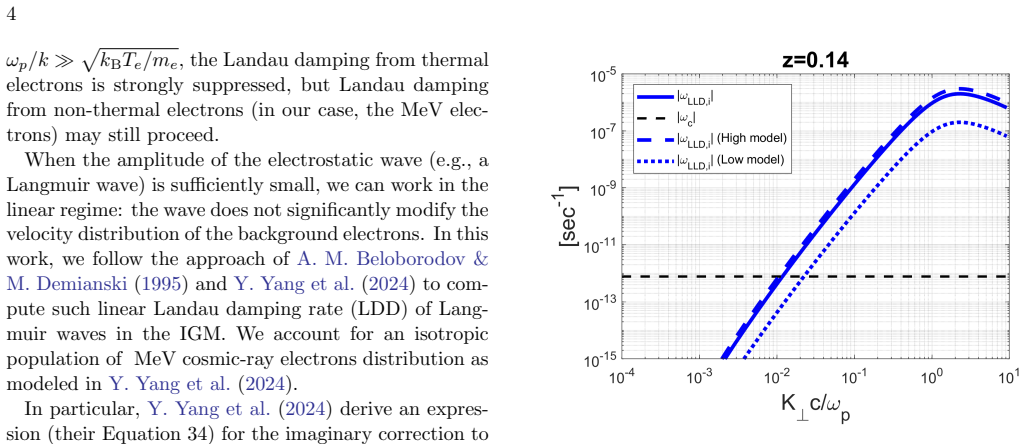
- [§4, Fig. 2] The numerical domain differs between the two runs in a way that may pre-determine the main result. The text states that when omitting LLD the perpendicular wavenumber grid spans ck_perp/omega_p = 10^-3 to 10^1, whereas when including LLD the grid spans only 10^-4 to 2×10^-2. Figure 2 then shows that with LLD only low-k_perp modes survive. But a mode that is absent from the integration domain cannot grow regardless of whether LLD would suppress it. The paper should show that the excluded oblique modes are actually damped by LLD when present in the domain, or otherwise justify that they are completely negligible before any feedback develops. As written, the claimed 'suppression of oblique modes by LLD' is partially an artifact of restricting the grid, and the order-of-magnitude enhancement in Fig. 5 may be inflated by this domain truncation.
- [§1, §5, Eq. (2)] The paper acknowledges in the introduction that the efficacy of the pair-beam instability may be limited by nonlinear Landau scattering on IGM ions and by IGM density inhomogeneity (citing Miniati & Elyiv 2013, Sironi & Giannios 2014, Vafin et al. 2019), but Sections 2–5 neither include these processes nor provide a quantitative argument that they are negligible at the LLD-modified wave spectrum. This is load-bearing because the enhancement mechanism relies on quasi-parallel modes growing to W/nT ~ 10^-5 at 5 Mpc (stated in Section 5); nonlinear Landau scattering rates grow with wave energy density and can act at much smaller W/nT than the W/nT << 1 quasilinear validity bound. The authors should estimate the nonlinear Landau scattering rate at the saturated wave spectrum (e.g., compare omega_NL(k) with the linear growth rate) and either show it is negligible or include its effect. Without this, the factor-of-ten enhancement in Fig. 5 is not established.
- [§5, Fig. 4, Eq. (11)] The beam energy lost to waves is not fed back into the beam evolution: Eq. (11) contains angular diffusion and inverse-Compton cooling, while the instability loss is computed post hoc from Eq. (6). The paper acknowledges this in Sections 5 and 6, but the claimed loss fraction is 10–20% of the IC loss, which is not a small correction. Neglecting the loss of beam energy to waves will leave the beam more energetic than it should be, potentially overestimating both the growth rate and the saturated wave energy. The authors should quantify the magnitude of this omission (for example, by comparing the integrated instability loss over the saturation timescale with the beam energy, or by implementing the loss self-consistently) to show that the reported enhancement is not substantially reduced by beam-energy depletion.
minor comments (3)
- [Abstract and §1] There are several typographical errors: 'scandary gamma-ray photons' should be 'secondary', 'Thompson cross-section' should be 'Thomson', and 'red shift' should be 'redshift'.
- [§2.1, Eq. (9)-(10)] The notation is inconsistent: the paper uses both 'LLD' and 'LDD' for linear Landau damping, and the caption of Fig. 1 refers to 'ωLLD,r' where the imaginary part is meant. Also, Eq. (10) and the surrounding text define the phase velocity as 'vφ = ωp/v'; this should be vφ = ωp/k, and the resonance condition in Eq. (1) should be stated consistently with the wave vector k.
- [§3, Eq. (11)] The text says the momentum diffusion from instability feedback is neglected because angular diffusion dominates; this is a reasonable simplification, but it should be stated as an assumption with a reference or a qualitative justification, since it is part of the quasilinear closure that ultimately determines the energy-loss rate.
Circularity Check
No significant circularity: the LLD-enhanced energy-loss fraction is a numerical prediction from the coupled quasilinear equations, not an input or a fit.
full rationale
The paper's central claim is that linear Landau damping by MeV cosmic-ray electrons suppresses oblique electrostatic modes, allowing quasi-parallel modes to grow to larger amplitudes and thereby increasing the instability-induced energy-loss fraction by more than an order of magnitude. This is obtained by numerically integrating the coupled wave and beam transport equations (Eqs. 2 and 11) with and without the LLD term, using otherwise identical setups (Section 4). The LLD rates themselves are imported from Yang, Long, and Hirata (2024), which shares three co-authors with this paper, but that cited work is an independent, code-reproduced calculation based on standard kinetic plasma theory and an observationally anchored MeV gamma-ray background model; it is not fitted to produce the enhancement, and the low/high background scalings are presented as uncertainty brackets rather than tuning parameters. The pair-injection source terms from Alawashra et al. (2024) are similarly external inputs. No equation in the derivation defines the predicted loss fraction in terms of the LLD input in a way that makes the outcome true by construction; the factor-of-ten increase emerges from the time-dependent simulation. The paper explicitly notes that wave energy is not subtracted from the beam in the evolution (Section 5) and that a quantitative cascade prediction would require self-consistent energy-loss feedback; this is an acknowledged modeling limitation, not a circular step. The possible omission of nonlinear Landau scattering and IGM density inhomogeneity is a physical robustness concern, but it does not mean the paper's derivation chain reduces to its inputs. Accordingly, no circular step can be exhibited, and the appropriate score is 0.
Assumptions & free parameters
free parameters (2)
- MeV gamma-ray background scaling factor (high) =
1.5
- MeV gamma-ray background scaling factor (low) =
0.1
assumptions (5)
- domain assumption Quasilinear approximation is valid for the beam-wave system (Eqs. 2, 3, 11, 12).
- domain assumption The linear Landau damping rate (Eq. 9) from Yang et al. 2024 correctly represents damping by MeV cosmic-ray electrons.
- ad hoc to paper Nonlinear Landau scattering on IGM ions and IGM density inhomogeneity do not limit the growth of quasi-parallel modes at their larger amplitudes.
- domain assumption The pair injection term Qee for a 1ES 0229+200-like blazar from Alawashra et al. 2024 is accurate.
- ad hoc to paper Beam energy lost to waves can be neglected in the beam evolution when computing steady-state loss rates.
Cite this review
Pith. "Pith review of MeV cosmic-ray electrons modify the TeV pair-beam plasma instability." pith.science (2026). https://pith.science/paper/UXL7FNGI
@misc{pith2026250702423,
  author       = {Pith},
  title        = {Pith review of: MeV cosmic-ray electrons modify the TeV pair-beam plasma instability},
  year         = {2026},
  howpublished = {\url{https://pith.science/paper/UXL7FNGI}},
  note         = {Machine review of arXiv:2507.02423}
}
read the original abstract
Relativistic pair beams created in the intergalactic medium (IGM) by TeV gamma rays from blazars are expected to produce a detectable GeV-scale electromagnetic cascade, but the cascade component is absent in the spectra of many hard-spectrum TeV-emitting blazars. One common explanation is that weak intergalactic magnetic fields deflect the electron-positron pairs away from our line of sight. An alternative possibility is that electrostatic beam-plasma instabilities drain the energy of these pairs before a cascade can develop. Recent studies have shown that beam scattering by oblique electrostatic modes leads to minimal energy loss. But these modes might be suppressed by linear Landau damping (LLD) due to MeV-scale cosmic-ray electrons in the IGM. In this work, we explore the impact of LLD on the energy-loss efficiency of plasma instabilities in pair beams associated with 1ES 0229+200. We find that LLD effectively suppresses oblique electrostatic modes, while quasi-parallel ones grow to larger amplitudes. In this way, LLD enhances the energy-loss efficiency of the instability by more than an order of magnitude.
Figures


Figures from the paper (2 more)


Forward citations
Cited by 1 Pith paper
-
On the contribution of galaxies to the magnetic field in cosmic voids
Superposition of static galactic magnetic dipoles is screened by intergalactic plasma and cannot account for lower bounds on magnetic fields in cosmic voids from blazar gamma-ray data.
Reference graph
Works this paper leans on
-
[1]
2023, The Astrophysical Journal Letters, 950, L16, doi: 10.3847/2041-8213/acd777
Aharonian, F., Aschersleben, J., Backes, M., et al. 2023, The Astrophysical Journal Letters, 950, L16, doi: 10.3847/2041-8213/acd777
-
[2]
2024, doctoralthesis, Universit¨ at Potsdam, doi: 10.25932/publishup-63013
Alawashra, M. 2024, doctoralthesis, Universit¨ at Potsdam, doi: 10.25932/publishup-63013
-
[3]
2024, The Astrophysical Journal, 964, 82, doi: 10.3847/1538-4357/ad24ea
Alawashra, M., & Pohl, M. 2024, The Astrophysical Journal, 964, 82, doi: 10.3847/1538-4357/ad24ea
-
[4]
Alawashra, M., Vovk, I., & Pohl, M. 2024, The Astrophysical Journal, 978, 95, doi: 10.3847/1538-4357/ad98f9 Alves Batista, R., Saveliev, A., & de Gouveia Dal Pino, E. M. 2019, Mon. Not. Roy. Astron. Soc., 489, 3836, doi: 10.1093/mnras/stz2389
-
[5]
Beloborodov, A. M., & Demianski, M. 1995, PhRvL, 74, 2232, doi: 10.1103/PhysRevLett.74.2232
-
[6]
2023, arXiv e-prints, arXiv:2303.01524, doi: 10.48550/arXiv.2303.01524
Blanco, C., Ghosh, O., Jacobsen, S., & Linden, T. 2023, arXiv e-prints, arXiv:2303.01524, doi: 10.48550/arXiv.2303.01524
-
[7]
2023, JCAP, 2023, 003, doi: 10.1088/1475-7516/2023/02/003
Blanco, C., & Linden, T. 2023, JCAP, 2023, 003, doi: 10.1088/1475-7516/2023/02/003
-
[8]
1974, Nuclear Fusion, 14, 873–907, doi: 10.1088/0029-5515/14/6/012
Brejzman, B., & Ryutov, D. 1974, Nuclear Fusion, 14, 873–907, doi: 10.1088/0029-5515/14/6/012
Show all 32 references
-
[9]
E., Chang, P., & Pfrommer, C
Broderick, A. E., Chang, P., & Pfrommer, C. 2012, The Astrophysical Journal, 752, 22, doi: 10.1088/0004-637x/752/1/22
2012 doi
-
[10]
E., Pfrommer, C., Puchwein, E., & Chang, P
Broderick, A. E., Pfrommer, C., Puchwein, E., & Chang, P. 2014, ApJ, 790, 137, doi: 10.1088/0004-637X/790/2/137
2014 doi
-
[11]
E., Pfrommer, C., et al
Chang, P., Broderick, A. E., Pfrommer, C., et al. 2014, The Astrophysical Journal, 797, 110, doi: 10.1088/0004-637x/797/2/110
2014 doi
-
[12]
E., Pfrommer, C., et al
Chang, P., Broderick, A. E., Pfrommer, C., et al. 2016, ApJ, 833, 118, doi: 10.3847/1538-4357/833/1/118
2016 doi
-
[13]
1999, Monthly Notices of the Royal Astronomical Society, 306, 551, doi: 10.1046/j.1365-8711.1999.02538.x
Chiaberge, M., & Ghisellini, G. 1999, Monthly Notices of the Royal Astronomical Society, 306, 551, doi: 10.1046/j.1365-8711.1999.02538.x
1999
-
[14]
Fixsen, D. J. 2009, The Astrophysical Journal, 707, 916, doi: 10.1088/0004-637X/707/2/916
2009 doi
-
[15]
2016, Astronomy & Astrophysics, 585, A132, doi: 10.1051/0004-6361/201527521
Kempf, A., Kilian, P., & Spanier, F. 2016, Astronomy & Astrophysics, 585, A132, doi: 10.1051/0004-6361/201527521
2016 doi
-
[16]
2019, Monthly Notices of the Royal Astronomical Society, 484, 4174, doi: 10.1093/mnras/stz174
Khaire, V., & Srianand, R. 2019, Monthly Notices of the Royal Astronomical Society, 484, 4174, doi: 10.1093/mnras/stz174
2019 doi
-
[17]
C., Horiuchi, S., & Beacom, J
Lacki, B. C., Horiuchi, S., & Beacom, J. F. 2014, The Astrophysical Journal, 786, 40, doi: 10.1088/0004-637X/786/1/40
2014 doi
-
[18]
Landau, L. 1946, J. Phys. USSR, 10, 25
1946
-
[19]
2013, The Astrophysical Journal, 770, 54, doi: 10.1088/0004-637x/770/1/54
Miniati, F., & Elyiv, A. 2013, The Astrophysical Journal, 770, 54, doi: 10.1088/0004-637x/770/1/54
2013 doi
-
[20]
2010, Science, 328, 73, doi: 10.1126/science.1184192
Neronov, A., & Vovk, I. 2010, Science, 328, 73, doi: 10.1126/science.1184192
2010 doi
-
[21]
2021, MNRAS, 503, 2215, doi: 10.1093/mnras/stab324
Perry, R., & Lyubarsky, Y. 2021, MNRAS, 503, 2215, doi: 10.1093/mnras/stab324
2021 doi
-
[22]
2017, Astronomy & Astrophysics, 607, A112, doi: 10.1051/0004-6361/201731127
Rafighi, I., Vafin, S., Pohl, M., & Niemiec, J. 2017, Astronomy & Astrophysics, 607, A112, doi: 10.1051/0004-6361/201731127
2017 doi
-
[23]
Rudakov, L. I. 1971, Soviet Journal of Experimental and Theoretical Physics, 32, 1134
1971
-
[24]
2012, The Astrophysical Journal, 758, 102, doi: 10.1088/0004-637x/758/2/102
Schlickeiser, R., Ibscher, D., & Supsar, M. 2012, The Astrophysical Journal, 758, 102, doi: 10.1088/0004-637x/758/2/102
2012 doi
-
[25]
2013, The Astrophysical Journal, 777, 49, doi: 10.1088/0004-637x/777/1/49
Schlickeiser, R., Krakau, S., & Supsar, M. 2013, The Astrophysical Journal, 777, 49, doi: 10.1088/0004-637x/777/1/49
2013 doi
-
[26]
E., Chang, P., et al
Shalaby, M., Broderick, A. E., Chang, P., et al. 2020, Journal of Plasma Physics, 86, 535860201, doi: 10.1017/S0022377820000215
2020 doi
-
[27]
2014, The Astrophysical Journal, 787, 49, doi: 10.1088/0004-637x/787/1/49
Sironi, L., & Giannios, D. 2014, The Astrophysical Journal, 787, 49, doi: 10.1088/0004-637x/787/1/49
2014 doi
-
[28]
2014, The Astrophysical Journal, 783, 96, doi: 10.1088/0004-637x/783/2/96
Supsar, M., & Schlickeiser, R. 2014, The Astrophysical Journal, 783, 96, doi: 10.1088/0004-637x/783/2/96
2014 doi
-
[29]
F., Yoon, P
Tigik, S. F., Yoon, P. H., & Ziebell, L. F. 2019, Plasma Physics and Controlled Fusion, 61, 125008, doi: 10.1088/1361-6587/ab4aad
2019 doi
-
[30]
J., Pohl, M., & Bohdan, A
Vafin, S., Deka, P. J., Pohl, M., & Bohdan, A. 2019, The Astrophysical Journal, 873, 10, doi: 10.3847/1538-4357/ab017b
2019 doi
-
[31]
2018, The Astrophysical Journal, 857, 43, doi: 10.3847/1538-4357/aab552
Vafin, S., Rafighi, I., Pohl, M., & Niemiec, J. 2018, The Astrophysical Journal, 857, 43, doi: 10.3847/1538-4357/aab552
2018 doi
-
[32]
Yang, Y., Long, H., & Hirata, C. M. 2024, The Astrophysical Journal, 965, 111, doi: 10.3847/1538-4357/ad3237
2024 doi
Reviewed August 6, 2026 · model on record in the stance chip above.
Discussion (0). Sign in to comment.