REVIEW 4 major objections 5 minor 122 references
Massive Interacting Binaries Enhance Feedback in Star-Forming Regions
T0 review · 4 major / 5 minor · reviewed 2026-08-06 · deepseek-v4-flash
Pith's one-line read This paper claims that feedback from massive interacting binaries, not single stars, can dominate the disruption of star-forming gas, because mass transfer exposes hot stellar cores and raises ionizing output by roughly three orders of…
desk verdict A useful framework paper with a real radiative effect, but the headline attribution to ionizing radiation is not isolated from the mechanical mass-injection channel. read the letter →
The pith
A machine-rendered reading of the paper's core claim, the machinery that carries it, and where it could break.
The reading
What carries the argument
The load-bearing mechanism is the treatment of mass transfer and common-envelope ejection in a rapid binary stellar evolution code coupled to collisional stellar dynamics and radiation magnetohydrodynamics. Because mass-transfer events can last less than a century, shorter than the simulation timestep, the scheme detects interactions by comparing each binary's binding energy before and after every stellar-evolution step, and by checking for semi-detached or contact binaries, shrinking semimajor axes, or accreted mass. Mass lost through non-conservative mass transfer is injected as a stellar wind, while systems whose binding energy increased are treated as common-envelope ejections with an energy-formalism ejecta velocity. The physical amplifier is that stripping a star's hydrogen envelope exposes its hot core, raising ionizing luminosity by up to three orders of magnitude, which shifts the H II region expansion from radiation-pressure dominated to thermal-pressure dominated.
What would settle it
Rerun the cluster simulations with a stellar-evolution subcycle short enough to resolve the sub-century mass-transfer and common-envelope events directly, and check whether the H II region radii, gas energies, and ionizing luminosities still exceed the single-star runs by the same factors; if the boost collapses when events are resolved, the interaction-injection scheme is producing the effect. Alternatively, compare the predicted thousandfold ionizing-luminosity boost against observed ionizing photon rates of a sample of mass-transferring massive binaries.
Extended reading notes
Core claim
The paper's central claim is that feedback from massive interacting binaries couples efficiently with the interstellar medium and is an important source of pre-supernova feedback in cluster-forming regions. Concretely, the claim is that treating stars as binaries, with conservative and non-conservative mass transfer and common-envelope ejection, raises a stellar population's ionizing luminosity by up to three orders of magnitude relative to single-star evolution, because stripped stars expose hot cores and accretors are rejuvenated. As a result, H II regions in the binary runs are larger, the gas gains more kinetic and thermal energy, and the pressure inside the H II regions is higher, with expansion driven by thermal pressure of ionized gas rather than by radiation pressure. The paper further claims that stellar dynamics and the gravitational potential of the background gas alter the orbits of binaries enough to change the timing and efficiency of mass transfer, so that binaries in a cluster do not follow the secular evolution predicted by isolated population-synthesis models.
Load-bearing premise
The load-bearing premise is that short mass-transfer and common-envelope events, some lasting under a century, are faithfully captured by comparing the binary's binding energy before and after each roughly 31-year simulation step, and that the injected ejecta amount and velocity, set by an uncalibrated parameter, are close enough to reality to drive the reported differences.
Editorial extensions
If this is right
- Cluster formation simulations that evolve massive stars as single stars underestimate pre-supernova feedback and therefore predict smaller, cooler H II regions and more bound gas.
- In regions with massive interacting binaries, H II region expansion is driven by thermal pressure of ionized gas rather than radiation pressure, changing the predicted timescales for gas removal from young massive clusters.
- Dynamical interactions with other stars and the background gas alter binary orbits enough to change the timing and efficiency of mass transfer, so isolated population-synthesis predictions are not reliable in dense cluster environments.
- Binary evolution can promote few-body interactions that eject fast-moving binaries from clusters, linking binary feedback to the production of runaway massive stars.
- The enhanced feedback is strong across background gas densities from disk-like to starburst-like surface densities, making it relevant to young massive clusters from roughly 1e4 to 1e6 solar masses.
Reading between the lines
- If the ionizing boost is robust, unresolved galaxy-scale and cluster-scale simulations should add a subgrid term mimicking stripped-star radiation even when they cannot resolve binaries, for example by turning a fraction of post-main-sequence O stars into hot stripped stars.
- An observational test would be to check whether H II regions around young massive clusters show larger ionized radii and thermal-pressure-dominated expansion than single-star population-synthesis models predict, using infrared and radio recombination-line measurements.
- The simulation setup likely understates the effect because it was designed for Case B mass transfer; dense clusters repeatedly harden binaries and raise eccentricity, so Case A mass transfer should occur in many systems and may boost the feedback further.
- A computationally cheaper proxy suggested by the paper, injecting post-main-sequence mass loss for half the O stars and evolving them as hot Wolf-Rayet stars, could be tested directly in existing single-star cluster formation codes.
Editorial analysis
A structured set of objections, weighed in public.
Referee Report
Summary. The paper presents a new framework, implemented in the Torch/AMUSE suite, that couples the SeBa binary stellar evolution code to the Flash magnetohydrodynamics code and the PeTar collisional stellar dynamics code, enabling radiative and mechanical feedback from massive interacting binaries to be injected into simulations of star-forming regions. The model accounts for mass transfer, common-envelope ejection, changes in ionizing and FUV luminosity, and modified supernova timing, and it injects non-conservative mass-transfer and common-envelope ejecta into the ISM. The authors demonstrate the framework on isolated binaries undergoing conservative mass transfer, non-conservative mass transfer, and common-envelope ejection, and on 50 kyr simulations of ten massive binaries in turbulent gas at two surface densities. Their central claim is that binary evolution enhances feedback relative to single-star evolution: H II regions are larger, gas kinetic and thermal energies are higher, and thermal pressure dominates over radiation pressure, with the differences attributed to ionizing radiation that increases by up to three orders of magnitude.
Significance. If the central attribution holds, this is a valuable step toward including binary interactions in cluster-formation simulations, which typically adopt single-star feedback recipes. The framework is clearly described, the code is version-tagged and publicly available, and the test suite provides a useful demonstration at both the isolated-binary and cluster level. The radiative enhancement of stripped stars is physically plausible and consistent with population-synthesis expectations, and the conservative-mass-transfer isolated runs provide a clean demonstration that the radiative channel alone can produce larger H II regions. The main weakness is that the cluster-level attribution of the feedback enhancement specifically to ionizing radiation is not cleanly separated from the mechanical injection of mass-transfer and common-envelope ejecta.
major comments (4)
- [§4.6.3 and Abstract] The claim that the differences 'arise from the ionizing radiation' is not isolated in the cluster simulations. The binary runs in Table 2 inject up to roughly 300 M_sun of non-conservative mass-transfer and common-envelope ejecta through Equations (3) and (7), and the pressure comparison in Equations (13)-(14) shows that thermal pressure dominates but does not identify the source of that thermal pressure; shocked mechanical ejecta can also contribute thermal energy. The isolated conservative-mass-transfer runs in Section 3.2 are a valid radiative-only control, but no equivalent control is presented for the cluster runs. Please add cluster control runs with binary evolution but with mechanical mass-transfer/common-envelope injection disabled, or quantitatively decompose the thermal energy into radiative and mechanical contributions, and adjust the wording of the abstract and Section 5 so that the attribution is not overstated.
- [§2.7.3, Eq. (7)] The common-envelope ejecta velocity depends on the uncalibrated parameter vCE=1, and the isolated CE run (CE-LD-B) has no single-star counterpart in Table 1. The runs with the largest excess mass loss also produce the largest H II regions (e.g., C1-LD-B: Delta M = 297 M_sun versus 16.4 M_sun, r_ion = 9.69 pc versus 2.93 pc), so the quantitative contribution of common-envelope mechanical feedback to the reported radii and energies is unknown. A small sensitivity study over vCE (for example vCE = 0.1, 1, and 3) is needed to show that the main conclusions are not controlled by this parameter.
- [§2.6, Eq. (1)] The interaction detection scheme does not distinguish Roche-lobe overflow from common-envelope evolution when the binding energy increases, and events with decreased binding energy are always injected as stellar winds (Sections 2.6 and 2.7). Since mass-transfer and common-envelope timescales can be shorter than the 31.25 yr Timestep, the before/after binding-energy comparison may misclassify events and misassign ejecta velocities. The paper acknowledges this as an approximation, but it directly affects the mechanical feedback budget that underpins the attribution issue raised in the first major comment; a justification or calibration of the criterion would strengthen the paper.
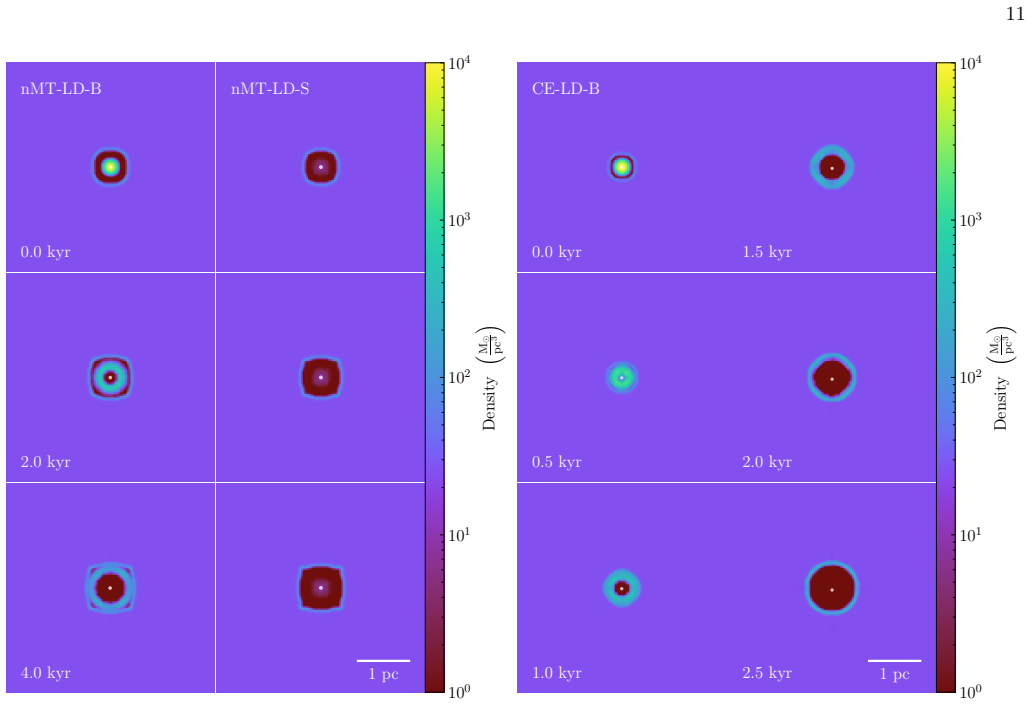
- [§3.4, Table 1] The common-envelope demonstration would benefit from a single-star control simulation using the same initial stellar masses or with the donor evolved as a single star. Without CE-LD-S, it is difficult to separate the mechanical bubble created by the common-envelope ejecta from the H II region created by the stripped star's enhanced ionizing luminosity (L_ion = 4.66e5 L_sun in Table 1), which weakens the interpretation of the CE gas morphology and the claimed thermal-pressure-driven expansion.
minor comments (5)
- [Figure 5] The legend label 'nMT-LD-L' in the bottom panel appears to be a typo; it should read 'nMT-LD-S' for consistency with the other runs.
- [§4.1] The sentence 'Each simulation contains 10 massive binaries (20 massive stars). and are run for 50 kyr.' contains a sentence fragment and a subject-verb agreement error; it should read 'Each simulation contains 10 massive binaries (20 massive stars) and is run for 50 kyr.'
- [§5] The text contains a typo: 'We have futher presented' should be 'We have further presented'.
- [§2.7.3, Eq. (7)] The variable v is used both for the ejecta velocity and for the wind velocity in Equation (3); using a distinct symbol such as v_ej would avoid confusion, and the units or dimensionless nature of vCE should be stated explicitly.
- [Table 2] The column headers Nstr, Nacc, Na_down, and Na_up are not defined in the table caption; their definitions currently appear only in the text and should be added to the caption or a table note for readability.
Circularity Check
No significant circularity: the binary-feedback enhancement is an emergent result of a controlled model comparison, not a repackaging of the inputs.
full rationale
The paper's central claim is that binary stellar evolution, through mass transfer, increases ionizing luminosity and thereby enlarges HII regions and raises gas thermal and kinetic energy relative to single-star evolution. This is a genuine model comparison: SeBa supplies stellar properties (luminosities, masses, mass-loss rates) under independent binary-evolution prescriptions, and the Torch/Flash simulations then evolve the gas in response. The reported quantities -- r_ion from Equation 8, kinetic and thermal energies from Equations 9-10, and thermal pressure from Equation 13 -- are emergent diagnostics of the hydrodynamics, not identities with the input luminosities or mass-loss rates. No fitted parameter is relabeled as a prediction: the vCE=1 choice is an explicit model assumption, and the interaction-detection criteria in Section 2.6 determine how mass is injected, but they do not by construction set the size or energy of the resulting HII regions. The comparison between B and S runs uses identical initial stellar and gas conditions, so the differences are consequences of the binary-evolution physics rather than of a self-defined quantity. Self-citations appear for initial conditions, binary sampling, and prior Torch implementations, but none is load-bearing for the central feedback claim; SeBa itself is a public rapid binary-evolution code with externally documented prescriptions. The skeptic's concern -- that mechanical mass-transfer/common-envelope injection is not isolated from the radiative channel, so the causal attribution to ionizing radiation alone is not fully demonstrated -- is a numerical-attribution and control-run limitation, not circularity: the result would not be true by definition even if that attribution were wrong. The radiation-pressure comparison uses r_ion in Equation 14, but r_ion is itself measured from the simulation, so the claim that thermal pressure dominates is a diagnostic statement, not a tautology. Overall, the derivation chain is self-contained and non-circular.
Assumptions & free parameters
free parameters (1)
- vCE =
1
assumptions (5)
- domain assumption SeBa's prescriptions for stellar winds, mass transfer, and supernovae are accurate enough for feedback purposes
- domain assumption The energy formalism (Eq. 6) with alpha=1 describes common envelope ejection
- ad hoc to paper The binding-energy criterion in Section 2.6 correctly identifies all interaction events despite time steps longer than MT/CE timescales
- domain assumption Gas remains at solar metallicity with no enrichment from winds or SNe
- domain assumption HII region radius computed from >99% ionized volume assuming spherical symmetry (Eq. 8)
Cite this review
Pith. "Pith review of Massive Interacting Binaries Enhance Feedback in Star-Forming Regions." pith.science (2026). https://pith.science/paper/W4U4AP6G
@misc{pith2026250702780,
  author       = {Pith},
  title        = {Pith review of: Massive Interacting Binaries Enhance Feedback in Star-Forming Regions},
  year         = {2026},
  howpublished = {\url{https://pith.science/paper/W4U4AP6G}},
  note         = {Machine review of arXiv:2507.02780}
}
read the original abstract
We present a new framework to incorporate feedback from massive interacting binaries in simulations of star cluster formation. Our new feedback model adds binary stellar evolution to the cluster formation code Torch, and couples it in AMUSE to the pre-existing modules for collisional stellar dynamics, magnetohydrodynamics, and mechanical and radiative feedback. Our model accounts for the effects of mass transfer on the stars' mass loss rates, their radiation spectra, and the timing of core-collapse supernovae. It also injects mass lost through non-conservative mass transfer and common envelope ejection into the interstellar medium. We demonstrate the use of our feedback model through simulations of isolated binaries in a gaseous medium, and of embedded clusters of massive binaries. Feedback from interacting binaries efficiently couples with the surrounding interstellar medium. It increases the size of HII regions, increases the kinetic and thermal energy of the gas, and increases the pressure within HII regions compared to models that use single star stellar evolution. Those differences arise from the ionizing radiation, which increases by three orders of magnitude, resulting in HII regions that expand due to thermal pressure rather than radiation pressure. The effects of stellar dynamics and the gravitational potential of the background gas cause the evolution of individual binaries to deviate from the predictions made by secular evolution, impacting the subsequent feedback from the binary. We conclude that massive interacting binaries are an important source of feedback in cluster-forming regions, and must be considered when studying the emerging timescales of young star clusters.
Figures


Figures from the paper (9 more)


Reference graph
Works this paper leans on
-
[1]
Adamo, A., Bradley, L. D., Vanzella, E., et al. 2024, Nature, 632, 513, doi: 10.1038/s41586-024-07703-7
-
[2]
A., Sana, H., Taylor, W., et al
Almeida, L. A., Sana, H., Taylor, W., et al. 2017, A&A, 598, A84, doi: 10.1051/0004-6361/201629844
-
[3]
Antoniadis, J., Aguilera-Dena, D. R., Vigna-G´ omez, A., et al. 2022, A&A, 657, L6, doi: 10.1051/0004-6361/202142322
-
[4]
Baczynski, C., Glover, S. C. O., & Klessen, R. S. 2015, MNRAS, 454, 380, doi: 10.1093/mnras/stv1906
-
[5]
Barnes, A. T., Longmore, S. N., Dale, J. E., et al. 2020, MNRAS, 498, 4906, doi: 10.1093/mnras/staa2719
-
[6]
Barnes, A. T., Glover, S. C. O., Kreckel, K., et al. 2021, MNRAS, 508, 5362, doi: 10.1093/mnras/stab2958 26
-
[7]
1986, Nature, 324, 446, doi: 10.1038/324446a0
Barnes, J., & Hut, P. 1986, Nature, 324, 446, doi: 10.1038/324446a0
doi:10.1038/324446a0 1986
-
[8]
Belczynski, K., Bulik, T., Fryer, C. L., et al. 2010, ApJ, 714, 1217, doi: 10.1088/0004-637X/714/2/1217
Show all 122 references
-
[9]
Bestenlehner, J. M. 2020, MNRAS, 493, 3938, doi: 10.1093/mnras/staa474
2020 doi
-
[10]
M., Gr¨ afener, G., Vink, J
Bestenlehner, J. M., Gr¨ afener, G., Vink, J. S., et al. 2014, A&A, 570, A38, doi: 10.1051/0004-6361/201423643 Bj¨ orklund, R., Sundqvist, J. O., Puls, J., & Najarro, F. 2021, A&A, 648, A36, doi: 10.1051/0004-6361/202038384
2014 doi
-
[11]
A., de Koter, A., Bestenlehner, J
Brands, S. A., de Koter, A., Bestenlehner, J. M., et al. 2022, A&A, 663, A36, doi: 10.1051/0004-6361/202142742
2022 doi
-
[12]
M., Umbreit, S., & Rasio, F
Chatterjee, S., Fregeau, J. M., Umbreit, S., & Rasio, F. A. 2010, ApJ, 719, 915, doi: 10.1088/0004-637X/719/1/915
2010 doi
-
[13]
Chevance, M., Kruijssen, J. M. D., Krumholz, M. R., et al. 2022, MNRAS, 509, 272, doi: 10.1093/mnras/stab2938
2022 doi
-
[14]
Ritchie, B. W. 2023, MNRAS, 521, 4473, doi: 10.1093/mnras/stad449
2023 doi
-
[15]
Wilhelm, M. J. C. 2024a, ApJ, 975, 207, doi: 10.3847/1538-4357/ad7f50
-
[16]
2021, MNRAS, 501, 4464, doi: 10.1093/mnras/staa3902
Cournoyer-Cloutier, C., Tran, A., Lewis, S., et al. 2021, MNRAS, 501, 4464, doi: 10.1093/mnras/staa3902
2021 doi
-
[17]
E., et al
Cournoyer-Cloutier, C., Sills, A., Harris, W. E., et al. 2023, MNRAS, 521, 1338, doi: 10.1093/mnras/stad568
2023 doi
-
[18]
E., et al
Cournoyer-Cloutier, C., Sills, A., Harris, W. E., et al. 2024b, ApJ, 977, 203, doi: 10.3847/1538-4357/ad90b3 de Mink, S. E., Pols, O. R., & Hilditch, R. W. 2007, A&A, 467, 1181, doi: 10.1051/0004-6361:20067007
2007 doi
-
[19]
T., Calzetti, D., et al
Deshmukh, S., Linden, S. T., Calzetti, D., et al. 2024, ApJL, 974, L24, doi: 10.3847/2041-8213/ad7ba9
2024 doi
-
[20]
C., et al
Dubey, A., Antypas, K., Calder, A. C., et al. 2014, The International Journal of High Performance Computing Applications, 28, 225, doi: 10.1177/1094342013505656
2014 doi
-
[21]
Eggleton, P. P. 1983, ApJ, 268, 368, doi: 10.1086/160960
1983 doi
-
[22]
J., & Stanway, E
Eldridge, J. J., & Stanway, E. R. 2022, ARA&A, 60, 455, doi: 10.1146/annurev-astro-052920-100646
2022 doi
-
[23]
2023, ApJ, 948, 111, doi: 10.3847/1538-4357/acc315
Justham, S. 2023, ApJ, 948, 111, doi: 10.3847/1538-4357/acc315
2023 doi
-
[24]
C., & Klessen, R
Federrath, C., Banerjee, R., Clark, P. C., & Klessen, R. S. 2010, ApJ, 713, 269, doi: 10.1088/0004-637X/713/1/269
2010 doi
-
[25]
J., Bavera, S
Fragos, T., Andrews, J. J., Bavera, S. S., et al. 2023, ApJS, 264, 45, doi: 10.3847/1538-4365/ac90c1
2023 doi
-
[26]
L., Belczynski, K., Wiktorowicz, G., et al
Fryer, C. L., Belczynski, K., Wiktorowicz, G., et al. 2012, ApJ, 749, 91, doi: 10.1088/0004-637X/749/1/91
2012 doi
-
[27]
2000, ApJS, 131, 273, doi: 10.1086/317361
Fryxell, B., Olson, K., Ricker, P., et al. 2000, ApJS, 131, 273, doi: 10.1086/317361
2000 doi
-
[28]
2007, PASJ, 59, 1095, doi: 10.1093/pasj/59.6.1095
Fujii, M., Iwasawa, M., Funato, Y., & Makino, J. 2007, PASJ, 59, 1095, doi: 10.1093/pasj/59.6.1095
2007 doi
-
[29]
S., Saitoh, T
Fujii, M. S., Saitoh, T. R., Hirai, Y., & Wang, L. 2021, PASJ, 73, 1074, doi: 10.1093/pasj/psab061
2021 doi
-
[30]
S., Saitoh, T
Fujii, M. S., Saitoh, T. R., & Portegies Zwart, S. F. 2012, ApJ, 753, 85, doi: 10.1088/0004-637X/753/1/85
2012 doi
-
[31]
2021, MNRAS, 501, 1352, doi: 10.1093/mnras/staa3705 G¨ otberg, Y., de Mink, S
Geen, S., Bieri, R., Rosdahl, J., & de Koter, A. 2021, MNRAS, 501, 1352, doi: 10.1093/mnras/staa3705 G¨ otberg, Y., de Mink, S. E., Groh, J. H., et al. 2018, A&A, 615, A78, doi: 10.1051/0004-6361/201732274 G¨ otberg, Y., de Mink, S. E., McQuinn, M., et al. 2020, A&A, 634, A134...
2021 doi
-
[32]
C., Whitmore, B
Hannon, S., Lee, J. C., Whitmore, B. C., et al. 2022, MNRAS, 512, 1294, doi: 10.1093/mnras/stac550
2022 doi
-
[33]
R., Millman, K
Harris, C. R., Millman, K. J., van der Walt, S. J., et al. 2020, Nature, 585, 357, doi: 10.1038/s41586-020-2649-2
2020 doi
-
[34]
2022, ApJ, 928, 57, doi: 10.3847/1538-4357/ac5628
He, H., Wilson, C., Brunetti, N., et al. 2022, ApJ, 928, 57, doi: 10.3847/1538-4357/ac5628
2022 doi
-
[35]
Heggie, D. C. 1975, MNRAS, 173, 729, doi: 10.1093/mnras/173.3.729
1975 doi
-
[36]
C., & Rasio, F
Heggie, D. C., & Rasio, F. A. 1996, MNRAS, 282, 1064, doi: 10.1093/mnras/282.3.1064
1996 doi
-
[37]
Heitsch, F., Mac Low, M.-M., & Klessen, R. S. 2001, ApJ, 547, 280, doi: 10.1086/318335
2001 doi
-
[38]
Hills, J. G. 1975, AJ, 80, 809, doi: 10.1086/111815
1975 doi
-
[39]
Hollenbach, D., & McKee, C. F. 1989, ApJ, 342, 306, doi: 10.1086/167595
1989 doi
-
[40]
S., Pudritz, R
Howard, C. S., Pudritz, R. E., & Harris, W. E. 2017, MNRAS, 470, 3346, doi: 10.1093/mnras/stx1363
2017 doi
-
[41]
Hunter, J. D. 2007, Computing in Science & Engineering, 9, 90, doi: 10.1109/MCSE.2007.55
2007 doi
-
[42]
R., Pols, O
Hurley, J. R., Pols, O. R., & Tout, C. A. 2000, MNRAS, 315, 543, doi: 10.1046/j.1365-8711.2000.03426.x
2000
-
[43]
R., Tout, C
Hurley, J. R., Tout, C. A., & Pols, O. R. 2002, MNRAS, 329, 897, doi: 10.1046/j.1365-8711.2002.05038.x
2002
-
[44]
2013, MNRAS, 429, 1221, doi: 10.1093/mnras/sts415
Hypki, A., & Giersz, M. 2013, MNRAS, 429, 1221, doi: 10.1093/mnras/sts415
2013 doi
-
[45]
2019, MNRAS, 490, 2550, doi: 10.1093/mnras/stz2756
Iaconi, R., & De Marco, O. 2019, MNRAS, 490, 2550, doi: 10.1093/mnras/stz2756
2019 doi
-
[46]
2018, ApJL, 858, L24, doi: 10.3847/2041-8213/aac101
Ivanova, N. 2018, ApJL, 858, L24, doi: 10.3847/2041-8213/aac101
2018 doi
-
[47]
Lombardi, J. C. 2013, Science, 339, 433, doi: 10.1126/science.1225540
2013 doi
-
[48]
2015, MNRAS, 447, 2181, doi: 10.1093/mnras/stu2582
Ivanova, N., Justham, S., & Podsiadlowski, P. 2015, MNRAS, 447, 2181, doi: 10.1093/mnras/stu2582
2015 doi
-
[49]
2016, PASJ, 68, 54, doi: 10.1093/pasj/psw053
Iwasawa, M., Tanikawa, A., Hosono, N., et al. 2016, PASJ, 68, 54, doi: 10.1093/pasj/psw053
2016 doi
-
[50]
Joung, M. K. R., & Mac Low, M.-M. 2006, ApJ, 653, 1266, doi: 10.1086/508795 27
2006 doi
-
[51]
1967, ZA, 65, 251 K¨ ortgen, B., Seifried, D., Banerjee, R., V´ azquez-Semadeni, E., & Zamora-Avil´ es, M
Kippenhahn, R., & Weigert, A. 1967, ZA, 65, 251 K¨ ortgen, B., Seifried, D., Banerjee, R., V´ azquez-Semadeni, E., & Zamora-Avil´ es, M. 2016, MNRAS, 459, 3460, doi: 10.1093/mnras/stw824
1967 doi
-
[52]
2001, MNRAS, 322, 231, doi: 10.1046/j.1365-8711.2001.04022.x
Kroupa, P. 2001, MNRAS, 322, 231, doi: 10.1046/j.1365-8711.2001.04022.x
2001
-
[53]
R., McKee, C
Krumholz, M. R., McKee, C. F., & Bland-Hawthorn, J. 2019, ARA&A, 57, 227, doi: 10.1146/annurev-astro-091918-104430
2019 doi
-
[54]
2000, ARA&A, 38, 613, doi: 10.1146/annurev.astro.38.1.613 Lah´ en, N., Rantala, A., Naab, T., et al
Kudritzki, R.-P., & Puls, J. 2000, ARA&A, 38, 613, doi: 10.1146/annurev.astro.38.1.613 Lah´ en, N., Rantala, A., Naab, T., et al. 2025, MNRAS, 538, 2129, doi: 10.1093/mnras/staf350
2000 doi
-
[55]
Bryan, G. L. 2024, ApJ, 970, 18, doi: 10.3847/1538-4357/ad47f6
2024 doi
-
[56]
C., Kim, J.-G., & Kim, C.-G
Lancaster, L., Ostriker, E. C., Kim, J.-G., & Kim, C.-G. 2021a, ApJL, 922, L3, doi: 10.3847/2041-8213/ac3333
-
[57]
C., Kim, J.-G., & Kim, C.-G
Lancaster, L., Ostriker, E. C., Kim, J.-G., & Kim, C.-G. 2021b, ApJ, 914, 90, doi: 10.3847/1538-4357/abf8ac
-
[58]
2003, ApJS, 146, 417, doi: 10.1086/374373
Lanz, T., & Hubeny, I. 2003, ApJS, 146, 417, doi: 10.1086/374373
2003 doi
-
[59]
Laplace, E., Schneider, F. R. N., & Podsiadlowski, P. 2025, A&A, 695, A71, doi: 10.1051/0004-6361/202451077
2025 doi
-
[60]
Lau, M. Y. M., Hirai, R., Gonz´ alez-Bol ´ ıvar, M., et al. 2022, MNRAS, 512, 5462, doi: 10.1093/mnras/stac049
2022 doi
-
[61]
1970, A&A, 7, 150
Lauterborn, D. 1970, A&A, 7, 150
1970
- [62]
-
[63]
K., Bolatto, A
Leroy, A. K., Bolatto, A. D., Ostriker, E. C., et al. 2018, ApJ, 869, 126, doi: 10.3847/1538-4357/aaecd1
2018 doi
-
[64]
C., Bolatto, A
Levy, R. C., Bolatto, A. D., Mayya, D., et al. 2024, ApJL, 973, L55, doi: 10.3847/2041-8213/ad7af3
2024 doi
-
[65]
1987, Comput
Lohner, R. 1987, Comput. Methods Appl. Mech. Eng., 61, 323, doi: 10.1016/0045-7825(87)90098-3
1987 doi
-
[66]
A., Krumholz, M
Lopez, L. A., Krumholz, M. R., Bolatto, A. D., et al. 2014, ApJ, 795, 121, doi: 10.1088/0004-637X/795/2/121
2014 doi
-
[67]
E., Bonnell, I
Lucas, W. E., Bonnell, I. A., & Dale, J. E. 2020, MNRAS, 493, 4700, doi: 10.1093/mnras/staa451
2020 doi
-
[68]
1967, MNRAS, 136, 101, doi: 10.1093/mnras/136.1.101
Lynden-Bell, D. 1967, MNRAS, 136, 101, doi: 10.1093/mnras/136.1.101
1967 doi
-
[69]
Makino, J., & Aarseth, S. J. 1992, PASJ, 44, 141
1992
-
[70]
2024, ARA&A, 62, 21, doi: 10.1146/annurev-astro-052722-105936
Marchant, P., & Bodensteiner, J. 2024, ARA&A, 62, 21, doi: 10.1146/annurev-astro-052722-105936
2024 doi
-
[71]
D., & Jumper, P
Matzner, C. D., & Jumper, P. H. 2015, ApJ, 815, 68, doi: 10.1088/0004-637X/815/1/68
2015 doi
-
[72]
H., Federrath, C., & Krumholz, M
Menon, S. H., Federrath, C., & Krumholz, M. R. 2023, MNRAS, 521, 5160, doi: 10.1093/mnras/stad856
2023 doi
-
[73]
Miyoshi, T., & Kusano, K. 2005, J. Comput. Phys., 208, 315, doi: 10.1016/j.jcp.2005.02.017
2005 doi
-
[74]
2017, ApJS, 230, 15, doi: 10.3847/1538-4365/aa6fb6
Moe, M., & Di Stefano, R. 2017, ApJS, 230, 15, doi: 10.3847/1538-4365/aa6fb6
2017 doi
-
[75]
2001, A&A, 365, 491, doi: 10.1051/0004-6361:20000147
Verbunt, F. 2001, A&A, 365, 491, doi: 10.1051/0004-6361:20000147
2001 doi
-
[76]
A., Lepp, S., & Melnick, G
Neufeld, D. A., Lepp, S., & Melnick, G. J. 1995, ApJS, 100, 132, doi: 10.1086/192211
1995 doi
-
[77]
2024, ApJ, 969, 18, doi: 10.3847/1538-4357/ad4a61
Nguyen, M., & Sills, A. 2024, ApJ, 969, 18, doi: 10.3847/1538-4357/ad4a61
2024 doi
-
[78]
1990, A&A, 231, 134
Nieuwenhuijzen, H., & de Jager, C. 1990, A&A, 231, 134
1990
-
[79]
2025, A&A, 695, A117, doi: 10.1051/0004-6361/202451564
Nuijten, M., & Nelemans, G. 2025, A&A, 695, A117, doi: 10.1051/0004-6361/202451564
2025 doi
- [80]
-
[81]
1976, in IAU Symposium, Vol
Paczynski, B. 1976, in IAU Symposium, Vol. 73, Structure and Evolution of Close Binary Systems, ed. P. Eggleton, S. Mitton, & J. Whelan, 75
1976
-
[82]
Pavlovskii, K., Ivanova, N., Belczynski, K., & Van, K. X. 2017, MNRAS, 465, 2092, doi: 10.1093/mnras/stw2786
2017 doi
-
[83]
2011, Journal of Machine Learning Research, 12, 2825
Pedregosa, F., Varoquaux, G., Gramfort, A., et al. 2011, Journal of Machine Learning Research, 12, 2825
2011
-
[84]
I., van Elteren, A., de Vries, N., et al
Pelupessy, F. I., van Elteren, A., de Vries, N., et al. 2013, A&A, 557, A84, doi: 10.1051/0004-6361/201321252
2013 doi
-
[85]
L., Arce, H
Plunkett, A. L., Arce, H. G., Corder, S. A., et al. 2015, ApJ, 803, 22, doi: 10.1088/0004-637X/803/1/22
2015 doi
-
[86]
S., et al
Polak, B., Mac Low, M.-M., Klessen, R. S., et al. 2024a, A&A, 690, A207, doi: 10.1051/0004-6361/202450774
-
[87]
S., et al
Polak, B., Mac Low, M.-M., Klessen, R. S., et al. 2024b, A&A, 690, A94, doi: 10.1051/0004-6361/202348840 Portegies Zwart, S., & McMillan, S. L. W. 2019, Astrophysical Recipes: The Art of Amuse (Bristol: Institute of Physics Publishing) Portegies Zwart, S., McMillan, S. L. W., ...
2019 doi
-
[88]
2013, Computer Physics Communications, 184, 456, doi: 10.1016/j.cpc.2012.09.024 Portegies Zwart, S., McMillan, S., Harfst, S., et al
Pelupessy, I., & de Vries, N. 2013, Computer Physics Communications, 184, 456, doi: 10.1016/j.cpc.2012.09.024 Portegies Zwart, S., McMillan, S., Harfst, S., et al. 2009, NewA, 14, 369, doi: 10.1016/j.newast.2008.10.006 Portegies Zwart, S., van Elteren, A., Pelupessy, I., et al...
2013 doi
-
[89]
1999, A&A, 348, 117, doi: 10.48550/arXiv.astro-ph/9812006 28 Portegies Zwart, S
Hut, P. 1999, A&A, 348, 117, doi: 10.48550/arXiv.astro-ph/9812006 28 Portegies Zwart, S. F., McMillan, S. L. W., & Gieles, M. 2010, ARA&A, 48, 431, doi: 10.1146/annurev-astro-081309-130834 Portegies Zwart, S. F., & Verbunt, F. 1996, A&A, 309, 179
-
[90]
2025, MNRAS, doi: 10.1093/mnrasl/slaf064
Rantala, A., & Naab, T. 2025, MNRAS, doi: 10.1093/mnrasl/slaf064
2025 doi
-
[91]
2024, MNRAS, 531, 3770, doi: 10.1093/mnras/stae1413
Rantala, A., Naab, T., & Lah´ en, N. 2024, MNRAS, 531, 3770, doi: 10.1093/mnras/stae1413
2024 doi
-
[92]
1975, Memoires of the Societe Royale des Sciences de Liege, 8, 369
Reimers, D. 1975, Memoires of the Societe Royale des Sciences de Liege, 8, 369
1975
-
[93]
Ricker, P. M. 2008, ApJS, 176, 293, doi: 10.1086/526425
2008 doi
-
[94]
W., Clark, J
Ritchie, B. W., Clark, J. S., Negueruela, I., & Najarro, F. 2022, A&A, 660, A89, doi: 10.1051/0004-6361/202142405
2022 doi
-
[95]
L., Weatherford, N
Rodriguez, C. L., Weatherford, N. C., Coughlin, S. C., et al. 2022, ApJS, 258, 22, doi: 10.3847/1538-4365/ac2edf Rodr ´ ıguez-Segovia, N., Ruiter, A. J., & Seitenzahl, I. R. 2025, PASA, 42, e012, doi: 10.1017/pasa.2024.135
2022 doi
-
[96]
Rogers, H., & Pittard, J. M. 2013, MNRAS, 431, 1337, doi: 10.1093/mnras/stt255 R¨ opke, F. K., & De Marco, O. 2023, Living Reviews in Computational Astrophysics, 9, 2, doi: 10.1007/s41115-023-00017-x
2013 doi
-
[97]
E., de Koter, A., et al
Sana, H., de Mink, S. E., de Koter, A., et al. 2012, Science, 337, 444, doi: 10.1126/science.1223344
2012 doi
-
[98]
E., et al
Sana, H., de Koter, A., de Mink, S. E., et al. 2013, A&A, 550, A107, doi: 10.1051/0004-6361/201219621
2013 doi
-
[99]
H., H´ enault-Brunet, V., et al
Sana, H., Ram ´ ırez-Agudelo, O. H., H´ enault-Brunet, V., et al. 2022, A&A, 668, L5, doi: 10.1051/0004-6361/202244677
2022 doi
-
[100]
Schneider, F. R. N., Izzard, R. G., de Mink, S. E., et al. 2014, ApJ, 780, 117, doi: 10.1088/0004-637X/780/2/117
2014 doi
-
[101]
Sigurdsson, S., & Phinney, E. S. 1993, ApJ, 415, 631, doi: 10.1086/173190
1993 doi
-
[102]
M., Bryan, G
Simpson, C. M., Bryan, G. L., Hummels, C., & Ostriker, J. P. 2015, ApJ, 809, 69, doi: 10.1088/0004-637X/809/1/69
2015 doi
- [103]
-
[104]
R., & Eldridge, J
Stanway, E. R., & Eldridge, J. J. 2023, MNRAS, 522, 4430, doi: 10.1093/mnras/stad1185
2023 doi
-
[105]
K., Schruba, A., et al
Sun, J., Leroy, A. K., Schruba, A., et al. 2018, ApJ, 860, 172, doi: 10.3847/1538-4357/aac326
2018 doi
-
[106]
2012, A&A, 546, A70, doi: 10.1051/0004-6361/201218966
Toonen, S., Nelemans, G., & Portegies Zwart, S. 2012, A&A, 546, A70, doi: 10.1051/0004-6361/201218966
2012 doi
-
[107]
J., Smith, B
Turk, M. J., Smith, B. D., Oishi, J. S., et al. 2011, The Astrophysical Journal Supplement Series, 192, 9, doi: 10.1088/0067-0049/192/1/9 van den Heuvel, E. P. J. 1976, in IAU Symposium, Vol. 73, Structure and Evolution of Close Binary Systems, ed. P. Eggleton, S. Mitton, & J....
2011 doi
-
[108]
2023, ApJ, 945, 53, doi: 10.3847/1538-4357/acb59a
Vanzella, E., Claeyssens, A., Welch, B., et al. 2023, ApJ, 945, 53, doi: 10.3847/1538-4357/acb59a
2023 doi
-
[109]
Vink, J. S. 2022, ARA&A, 60, 203, doi: 10.1146/annurev-astro-052920-094949
2022 doi
- [110]
-
[111]
S., de Koter, A., & Lamers, H
Vink, J. S., de Koter, A., & Lamers, H. J. G. L. M. 2001, A&A, 369, 574, doi: 10.1051/0004-6361:20010127
2001 doi
-
[112]
2015, MNRAS, 451, 2757, doi: 10.1093/mnras/stv1155
Walch, S., & Naab, T. 2015, MNRAS, 451, 2757, doi: 10.1093/mnras/stv1155
2015 doi
-
[113]
E., Mac Low, M.-M., McMillan, S
Wall, J. E., Mac Low, M.-M., McMillan, S. L. W., et al. 2020, ApJ, 904, 192, doi: 10.3847/1538-4357/abc011
2020 doi
-
[114]
E., McMillan, S
Wall, J. E., McMillan, S. L. W., Mac Low, M.-M., Klessen, R. S., & Portegies Zwart, S. 2019, ApJ, 887, 62, doi: 10.3847/1538-4357/ab4db1
2019 doi
-
[115]
2020a, MNRAS, 497, 536, doi: 10.1093/mnras/staa1915
Wang, L., Iwasawa, M., Nitadori, K., & Makino, J. 2020a, MNRAS, 497, 536, doi: 10.1093/mnras/staa1915
-
[116]
2020b, MNRAS, 493, 3398, doi: 10.1093/mnras/staa480
Wang, L., Nitadori, K., & Makino, J. 2020b, MNRAS, 493, 3398, doi: 10.1093/mnras/staa480
-
[117]
2015, MNRAS, 450, 4070, doi: 10.1093/mnras/stv817
Wang, L., Spurzem, R., Aarseth, S., et al. 2015, MNRAS, 450, 4070, doi: 10.1093/mnras/stv817
2015 doi
-
[118]
J., Pittard, J
Wareing, C. J., Pittard, J. M., & Falle, S. A. E. G. 2017, MNRAS, 470, 2283, doi: 10.1093/mnras/stx1417
2017 doi
-
[119]
Webbink, R. F. 1984, ApJ, 277, 355, doi: 10.1086/161701
1984 doi
-
[120]
C., & Nordhaus, J
Wilson, E. C., & Nordhaus, J. 2022, MNRAS, 516, 2189, doi: 10.1093/mnras/stac2300
2022 doi
-
[121]
Woosley, S. E. 2019, ApJ, 878, 49, doi: 10.3847/1538-4357/ab1b41
2019 doi
-
[122]
E., Izzard, R
Zapartas, E., de Mink, S. E., Izzard, R. G., et al. 2017, A&A, 601, A29, doi: 10.1051/0004-6361/201629685
2017 doi
Reviewed August 6, 2026 · model on record in the stance chip above.
Discussion (0). Sign in to comment.