REVIEW 4 major objections 6 minor 32 references
Deep neutral hydrogen observations of the early-type galaxy NGC 2768: collided by a newly discovered satellite galaxy?
T0 review · 4 major / 6 minor · reviewed 2026-08-06 · deepseek-v4-flash
Pith's one-line read Deep neutral hydrogen observations of NGC 2768 reveal a faint gas envelope and a high-velocity clump that the authors identify as a newly discovered, dark-matter-dominated satellite galaxy that collided with NGC 2768 about 0.38 Gyr ago.
desk verdict New FAST HI data reveal a large gas envelope around NGC 2768 and a plausible but under-validated satellite interpretation that needs tougher error analysis before it can stand. read the letter →
The pith
A machine-rendered reading of the paper's core claim, the machinery that carries it, and where it could break.
The reading
What carries the argument
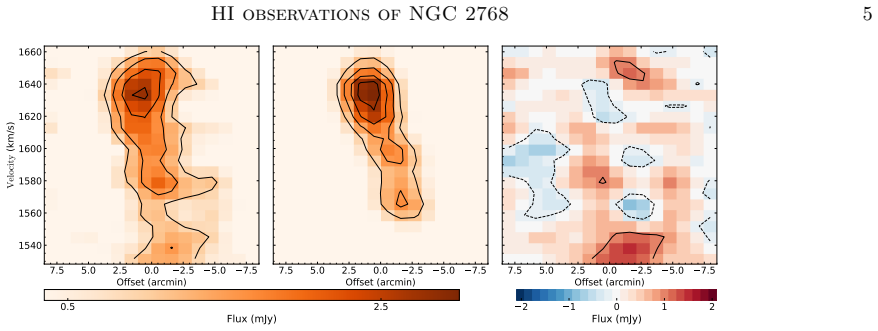
The central object is Clump B, a resolved hydrogen clump roughly 32 kpc north of NGC 2768's center, visible in the data cube as a high-velocity plume at 1570-1660 km/s. The argument is carried by three-dimensional tilted-ring modeling, which fits the gas as concentric rotating rings and yields a rotation velocity of $V_{\rm rot}=58.7$ km/s and a velocity dispersion of $\delta_v=7.5$ km/s; combined with an adopted HI radius of $R_{\rm HI}=9.5$ kpc, these enter the formula $M=(V_{\rm rot}^2+3\delta_v^2)R_{\rm HI}/G$ to give about $7.9\times10^9$ solar masses. The dark-matter-dominated conclusion follows by subtracting the hydrogen mass ($7.8\times10^7$ solar masses) and the stellar-mass upper limit of about $10^6$ solar masses, the latter estimated from non-detections in deep optical and ultraviolet images using adopted mass-to-light ratios. A separate kinematic relation between the projected separation of 33 kpc and the line-of-sight velocity difference of 200 km/s places the encounter 0.38 Gyr in the past.
What would settle it
A deep image of Clump B's position that resolves a stellar counterpart with an R-band magnitude brighter than about 20.5, or a higher-resolution HI map showing a chaotic, non-rotating velocity field instead of a coherent rotation gradient, would overturn the dark-matter-dominated satellite interpretation.
Extended reading notes
Core claim
Clump B is argued to be a genuine satellite galaxy of NGC 2768 rather than a tidal dwarf or a purely gaseous cloud. The evidence is that its dynamical mass is roughly $7.9\times10^9$ solar masses, while its baryonic budget is tiny: about $7.8\times10^7$ solar masses of hydrogen and a stellar mass no larger than about $10^6$ solar masses, so dark matter contributes more than $7.8\times10^9$ solar masses and more than 99 percent of the total. A tidal dwarf origin is rejected because tidal dwarfs are dark-matter-poor and should move at the mean velocity of their parent galaxies, whereas Clump B is velocity-offset from both NGC 2768 and PGC 2599651. The paper dates the collision to roughly 0.38 Gyr ago, consistent with earlier estimates that a recent interaction supplied the cool gas now seen as a polar CO and dust disk, and interprets the redshifted asymmetry and 32-kpc offset of the HI disk as the lasting imprint of this encounter.
Load-bearing premise
The argument assumes Clump B is a settled, orderly rotating disk of gas rather than a loose stream of debris; if the clump is not an equilibrium rotator, the inferred dynamical mass, the more-than-99-percent dark-matter fraction, and the rejection of a tidal-dwarf origin all collapse.
Editorial extensions
If this is right
- The previously measured hydrogen mass in this system is only a small fraction of the true reservoir: about 90 percent of the detected atomic gas is diffuse gas below a column density of $10^{19}$ cm$^{-2}$.
- NGC 2768's HI disk has been disturbed recently, with its gas center offset 32 kpc from the optical center and more gas redshifted than blueshifted.
- Clump B is a dark-matter-dominated dwarf galaxy whose dark mass exceeds its baryonic mass by an order of magnitude, making it a candidate probe of how low-mass dark halos accrete gas.
- The 0.38-Gyr-old collision supplies a plausible gas reservoir for the polar CO and dust disk and supports the interpretation that NGC 2768 is transforming from a spiral progenitor into an S0 galaxy.
- The deep hydrogen view places NGC 2768 in a small interacting network, with tidal streams linking Clump B to PGC 2599651 and NGC 2768 to UGC 4808, illustrating hierarchical gas accretion.
Reading between the lines
- If the equilibrium-disk assumption holds, a straightforward prediction is that higher-resolution HI synthesis observations should resolve a monotonic velocity gradient across Clump B on sub-kiloparsec scales, which would independently confirm the rotation velocity used in the mass estimate.
- The same deep 21-cm mapping strategy applied to other isolated S0 galaxies could test whether dark-matter-dominated satellites below $10^9$ solar masses are a common, rather than exceptional, driver of spiral-to-S0 transitions.
- A numerical simulation of a minor merger with the adopted 0.38-Gyr timescale could check whether the observed one-sided redshifted asymmetry and the gas bridge between Clump A and Clump B arise naturally, without needing to invoke additional mass in the clump.
Editorial analysis
A structured set of objections, weighed in public.
Referee Report
Summary. The paper presents deep FAST 21-cm observations of the early-type galaxy NGC 2768, reporting a total H I mass of 8.1e8 M_sun, about an order of magnitude larger than earlier WSRT measurements, and a large diffuse H I envelope. The authors identify two previously known WSRT clumps within this envelope, argue that Clump A is part of the galaxy's disturbed H I disk, and propose that Clump B is a newly discovered, dark-matter-dominated satellite galaxy that collided with NGC 2768 about 0.38 Gyr ago, driving the galaxy's proposed transition from a spiral progenitor to an S0 system. They also claim tidal interactions between Clump B, PGC 2599651, and UGC 4808, and use these to sketch a hierarchical accretion history for NGC 2768.
Significance. The observational material is genuinely valuable: the FAST data increase the measured H I mass by an order of magnitude, reveal a low-column-density envelope, and identify a high-velocity H I component (Clump B) with no apparent optical counterpart. If Clump B were confirmed as a dark-matter-dominated satellite, it would be a striking example of a gas-rich, optically dark dwarf galaxy participating in a minor merger, with implications for hierarchical assembly in early-type galaxies. The paper does not provide machine-checked proofs or reproducible code, but it presents a plausible observational case. The main caveat is that the quantitative claims—the dynamical mass, dark-matter fraction, and interaction timescale—currently rest on assumptions and parameter choices that are not yet validated, so the interpretation overreaches the data in its present form.
major comments (4)
- [§3.2, Fig. 3] The tilted-ring model is fitted to a source that is barely resolved by FAST: the beam is 2.9 arcmin (18.4 kpc at D=21.8 Mpc), while the WSRT clump has an apparent size of about 0.4x0.6 arcmin (2.5-3.8 kpc), and the adopted R_HI=9.5 kpc is close to the beam half-power radius. For such a source, TiRiFiC cannot uniquely separate a rotating disk from a beam-smoothed velocity gradient, noise, or a stream-like geometry. The residual map in Fig. 3 is only shown qualitatively, and no uncertainties are reported for V_rot, delta_v, inclination, PA, or R_HI. No alternative non-rotating model is compared. Because M_dyn and the dark-matter fraction are derived from these fitted values, this is the load-bearing step for the claim that Clump B is a dark-matter-dominated satellite; it needs to be redone with WSRT-resolution constraints and a model comparison.
- [§3.2, Eq. (3)] The interaction timescale of 0.38 Gyr is obtained from Eq. (3), but delta_group is never defined or quantified, and the units are not stated. Using delta_R=33 kpc and delta_Vsys=200 km/s, the quoted timescale requires delta_group ~ 218 km/s, an ad hoc choice; no uncertainty or source for this value is given. The formula also assumes that the projected separation and the line-of-sight velocity difference are good proxies for the orbital state, which is not shown. The agreement with Crocker et al. (2008) is not an independent check, because that paper's 0.2-0.7 Gyr estimate referred to UGC 4808, not to Clump B.
- [§3.2, dark matter estimate] The dynamical mass M_dyn=7.9e9 M_sun and the conclusion that Clump B contains more than 7.8e9 M_sun of dark matter rest on R_HI=9.5 kpc ('chosen' from Fig. 3) and V_rot=58.7 km/s. Because R_HI is essentially the FAST beam radius and no uncertainty is propagated, the specific values M_dyn and the '>99% dark matter' statement are not secure; even reducing R_HI to the WSRT scale (~2 kpc) would lower M_dyn to ~1.7e9 M_sun and the dark-matter fraction to ~95%. If the source is pressure-supported or an unrelaxed gas stream, the formula M=(V_rot^2+3 delta_v^2) R_HI / G is not applicable, and the dark-matter-dominated interpretation would collapse. An error budget and alternative mass models are needed before this claim can be accepted.
- [§3.2, TDG exclusion] The argument that Clump B is not a tidal dwarf galaxy because its velocity is redshifted relative to both NGC 2768 and PGC 2599651 is not rigorous. Tidal debris can have line-of-sight velocities outside the simple mean of the two progenitors depending on projection, orbital phase, and the formation details of the tidal tail. Without a dynamical model of the interaction, this argument cannot exclude a tidal origin. This matters because the exclusion of a TDG is one of the pillars for the 'primordial dwarf' interpretation.
minor comments (6)
- [Throughout] The text uses 'Hi' instead of the standard 'H I' notation in several places, including the abstract and Section 3.1.
- [§3.1] 'If we smooth the beam to spacial resolution' contains a typo; it should read 'spatial resolution.'
- [§4] The heading 'CONCLUTIONS' should be 'CONCLUSIONS.'
- [§3.2] 'C3 shows like a tail striped by Clump B' should read 'stripped by Clump B' (i.e., the past participle of 'strip').
- [Eq. (1)] The factor 2.35 is described as the mean atomic weight, but the standard H I mass conversion (2.36e5 D^2 S) does not include a helium correction; please clarify the formula and explicitly state the units of each term.
- [§3.1] The total H I mass of 8.1e8 M_sun is quoted without an uncertainty; please provide an error estimate that includes flux calibration and baseline systematic uncertainties.
Circularity Check
No significant circularity: the satellite/dark-matter conclusion is a model-dependent observational inference, not a definitional reduction; self-citations are technical rather than load-bearing.
full rationale
The paper's load-bearing chain is: FAST H I detection (Sec. 2-3.1) -> PV decomposition identifying Clump B (Fig. 1c) -> TiRiFiC tilted-ring fitting yielding V_rot=58.7 km/s and delta_v=7.5 km/s (Sec. 3.2) -> adopted R_HI=9.5 kpc -> dynamical mass M=7.9e9 Msun -> optical non-detection with SDSS/DESI/MATLAS/GALEX -> stellar mass upper limit <1e6 Msun -> dark matter >7.8e9 Msun. Each step uses measured or fitted quantities; the dark matter fraction is arithmetic from these, not defined into them. The TiRiFiC model does assume a rotating disk, and R_HI is chosen from the model rather than independently measured, but that is a modeling/beam-resolution caveat, not a case where the conclusion equals an input by construction. The paper's self-citations (Jiang et al. 2019/2020; Zhang et al. 2024; Jing et al. 2024; Zhu et al. 2021) are to instrumentation, pipeline, survey, and a luminosity-limit method; they do not smuggle in the target 'dark-matter-dominated satellite' result. The Zhu et al. (2021) method supplies an upper-limit luminosity transformation, not the dynamical mass or dark matter fraction, so the central claim retains independent content. Score 2 reflects one self-cited method in the stellar-mass step, but no circular reduction is present.
Assumptions & free parameters
free parameters (4)
- TiRiFiC fitted rotation velocity V_rot of Clump B =
58.7 km/s
- TiRiFiC fitted velocity dispersion delta_v of Clump B =
7.5 km/s
- HI radius R_HI of Clump B =
9.5 kpc
- Group velocity dispersion delta_group in Eq. (3) =
Not stated in the paper; a value near 217 km/s would be needed to yield 0.38 Gyr with the quoted Delta_R and Delta_Vsys
assumptions (5)
- standard math The 21 cm HI emission is optically thin, so the column density and mass conversions in Eqs. (1) and (2) are valid.
- domain assumption Clump B lies at the same distance as NGC 2768, D = 21.8 Mpc.
- domain assumption Clump B is a relaxed, rotating disk well described by a tilted-ring model, so the fitted V_rot is the circular velocity.
- domain assumption Optical and UV non-detections, together with assumed mass-to-light ratios, place the stellar mass of Clump B below about 1e6 solar masses.
- ad hoc to paper Eq. (3) relates the projected separation and line-of-sight velocity difference to the time since collision, with an unstated group velocity dispersion.
invented entities (2)
-
Clump B as a dark-matter-dominated satellite galaxy of NGC 2768
-
C3, a new HI cloud described as a tidal tail stripped from PGC 2599651 by Clump B
Cite this review
Pith. "Pith review of Deep neutral hydrogen observations of the early-type galaxy NGC 2768: collided by a newly discovered satellite galaxy?." pith.science (2026). https://pith.science/paper/3DY22B3I
@misc{pith2026250704703,
  author       = {Pith},
  title        = {Pith review of: Deep neutral hydrogen observations of the early-type galaxy NGC 2768: collided by a newly discovered satellite galaxy?},
  year         = {2026},
  howpublished = {\url{https://pith.science/paper/3DY22B3I}},
  note         = {Machine review of arXiv:2507.04703}
}
read the original abstract
We present the results of a deep neutral hydrogen (Hi) observation of the early-type galaxy NGC 2768 using the Five-hundred-meter Aperture Spherical radio Telescope (FAST). Leveraging the high sensitivity of FAST, we discover an extended gas envelope around NGC 2768. The total Hi mass is measured to be 8.1 x 10^8 M_sun , representing a magnitude increase compared to previous Westerbork Synthesis Radio Telescope (WSRT) studies. Position-velocity (PV) diagram indicates the envelope mainly involves two components: an Hi disk of NGC 2768 and a newly discovered satellite galaxy without detectable counterparts in currently deep optical surveys. The center of the gas disk is mis-aligned with the optical disk of NGC 2768, with more gas redshifted, indicating it has been disturbed. Our study indicates NGC 2768 is currently undergoing a transition from a spiral galaxy to an S0. Previous deep WSRT observations reveal two dense clumps (named as Clumps A and Clump B throughout this paper) in the center of the envelope. We find Clump A corresponds to the densest part of the disk, while Clump B might be a newly discovered satellite galaxy which probably collided NGC 2768 about 0.38 Gyr ago. We also find tidal interactions between Clump B and PGC 2599651, NGC 2768 and UGC 4808. Based on these new findings, we finally analyze hierarchical accretion history of NGC 2768.
Figures


Figures from the paper (1 more)

Reference graph
Works this paper leans on
- [1]
- [2]
- [3]
-
[4]
Clemens M. S., Baxter K. M., Alexander P., Green D. A., 1999, MNRAS, 308, 364
work page 1999
-
[5]
Crocker A. F., Bureau M., Young L. M., and Combes F., 2008, MNRAS, 386, 1811
work page 2008
-
[6]
de Vaucouleurs G., de Vaucouleurs A., Corwin H. G., Buta R. J., Paturel G., Fouque P., 1991, Third Reference Catalogue of Bright Galaxies. Springer-Verlag, Berlin (RC3)
work page 1991
-
[7]
Duc P.A., Cuillandre J.C., Serra P., et al. 2011, MNRAS, 417, 863
work page 2011
- [8]
Show all 32 references
-
[9]
Faber, M., & Gallagher, J. S. 1979, ARA & A, 17, 135
1979
-
[10]
V., Chornock R., 2000, Int
Filippenko A. V., Chornock R., 2000, Int. Astron. Union Circ., 7511, 2
2000
-
[11]
Fobes D.A., Cortesi A., Pota V., Foster C., Romanowsky A.J. et al. 2012, MNRAS, 426, 975
2012
-
[12]
Garcia A., 1993, A & AS, 100, 47
1993
-
[13]
A., Petrosian A
Hakobyan A. A., Petrosian A. R., McLean B., Kunth D., Allen R. J., Turatto M., Barbon R., 2008, A & A, 488, 523
2008
-
[14]
P., 1926, ApJ, 64, 321
Hubble E. P., 1926, ApJ, 64, 321
1926
-
[15]
Huchtmeier W.K., Sage L.J., and Henkel C., 1995, A & A, 300, 675
1995
-
[16]
Y., Hou L
Jiang P., Tang N. Y., Hou L. G., et al. 2020, RAA, 20, 064
2020
-
[17]
L., Gan H
Jiang P., Yue Y. L., Gan H. Q., et al. 2019, SCPMA, 62, 959502
2019
-
[18]
et al., 2024, SCPMA, 67, 259514
Jing Y. et al., 2024, SCPMA, 67, 259514
2024
-
[19]
Koch-Hansen A., Pasquali A., Rich R.M., Gerhard O., and M u ller O., 2024, A & A, 682, A95
2024
-
[20]
et al., 2010, MNRAS, 408, 97
Kuntschner H. et al., 2010, MNRAS, 408, 97
2010
-
[21]
R., Habas R., Poulain M., et al
Marleau F. R., Habas R., Poulain M., et al. 2021, A & A, 654, A105
2021
-
[22]
Martel A.R., Ford H.C., Bradley L.D. et al. 2004, AJ, 128, 2758
2004
-
[23]
et al., 2006, MNRAS, 371, 157
Morganti R. et al., 2006, MNRAS, 371, 157
2006
-
[24]
2004, PASA, 21, 144
Portinari, L., Sommer-Larsen, J., & Tantalo, R. 2004, PASA, 21, 144
2004
-
[25]
Carnegie Institution of Washington with the Flintridge Foundation, Washington, DC
Sandage A., Bedke J., 1994, The Carnegie Atlas of Galaxies. Carnegie Institution of Washington with the Flintridge Foundation, Washington, DC
1994
-
[26]
A., van den Bergh S., 1981, J
Sandage A., Tammann G. A., van den Bergh S., 1981, J. R. Astron. Soc. Canada, 75, 267
1981
-
[27]
2012, MNRAS, 422, 1835
Serra P., Oosterloo T., Morganti R., et al. 2012, MNRAS, 422, 1835
2012
-
[28]
C., Solanes J
Toribio M. C., Solanes J. M., Giovanelli R., et al. 2011, ApJ, 732, 93
2011
-
[29]
Zanatta E. J. B., Cortesi A., Chies-Santos A. L., et al. 2018, MNRAS, 479, 5124
2018
-
[30]
P., Zhu M., Jiang, P
Zhang C. P., Zhu M., Jiang, P. et al. 2024, SCPMA, 67, 219511
2024
-
[31]
2021, ApJL, 922, L21
Zhu M., Yu H., Wang J., et al. 2021, ApJL, 922, L21
2021
-
[32]
Zwicky, F., 1956, Ergeb. Exact. Nat., 26, 344
1956
Reviewed August 6, 2026 · model on record in the stance chip above.
Discussion (0). Sign in to comment.