Improving deep neural network performance through sampling
Pith reviewed 2026-05-19 05:42 UTC · model grok-4.3
The pith
Multiple samples from probabilistic networks can deliver superior accuracy in deep neural networks.
A machine-rendered reading of the paper's core claim, the machinery that carries it, and where it could break.
Core claim
It is feasible to obtain superior accuracy through the use of multiple samples generated by probabilistic networks. This possibility raises the question of which option is energetically preferable for improving accuracy: generating more samples, or adding more bits to a single deterministic sample. The authors provide a simple expression that can be used to estimate these energy tradeoffs and illustrate it with results for different algorithms and architectures.
What carries the argument
A simple closed-form expression that equates the accuracy gain from additional probabilistic samples to the accuracy gain from additional bits in a deterministic neuron and solves for the energy crossover point.
If this is right
- Accuracy in feedforward DNNs can be raised by drawing multiple low-precision probabilistic samples instead of widening a single deterministic sample.
- Hardware designers can use the given expression to decide whether to allocate resources to faster sampling or to higher bit precision.
- The same sampling approach shown for Boltzmann machines can be carried over to modern generative models without changing the core network topology.
- Energy accounting for AI inference can now include sample count as a tunable parameter alongside bit width.
Where Pith is reading between the lines
- If the expression holds on real p-bit hardware, chip architects may shift some resources from wider multipliers toward faster random-number generation and sampling circuitry.
- Training procedures may need to be modified so that the network learns to produce useful diversity across its probabilistic samples rather than converging to a single high-confidence output.
- The tradeoff analysis could be repeated for other model families such as transformers or graph networks to see whether the same sample-versus-bit crossover appears.
Load-bearing premise
The accuracy gains observed with probabilistic sampling and the energy costs of p-bit hardware can be compared directly via a simple closed-form expression without hidden implementation overheads or training differences.
What would settle it
A side-by-side measurement on the same task and hardware that records both final accuracy and total energy for (a) one deterministic network with increasing bit width and (b) a probabilistic network with increasing number of independent samples, then checks whether the measured crossover matches the paper's closed-form prediction.
Figures


read the original abstract
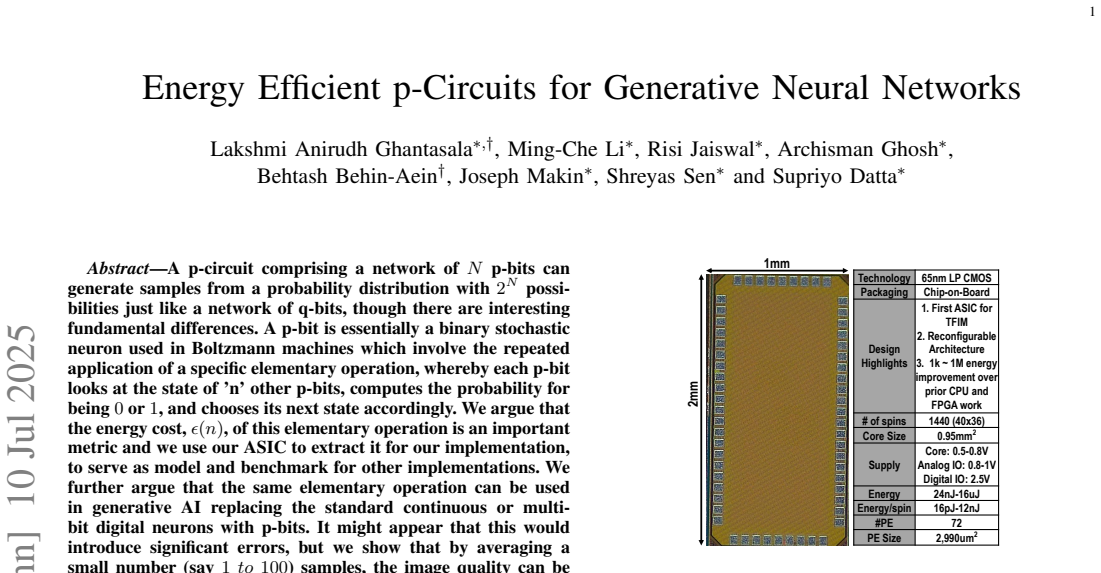
Energy efficient sampling with probabilistic neurons or p-bits has been demonstrated in the context of Boltzmann machines and it is natural to ask if these approaches can be extended to the field of generative AI where energy costs have become prohibitively large. However, this very active field is dominated by feedforward deep neural networks (DNNs) which primarily use multi-bit deterministic neurons with no role for sampling. In this paper we first show that it is feasible to obtain superior accuracy through the use of multiple samples generated by probabilistic networks. This possibility raises the question of which option is energetically preferable for improving accuracy: generating more samples, or adding more bits to a single deterministic sample. We provide a simple expression that can be used to estimate these energy tradeoffs and illustrate it with results for different algorithms and architectures.
Editorial analysis
A structured set of objections, weighed in public.
Referee Report
Summary. The manuscript proposes extending probabilistic sampling with p-bits (previously shown in Boltzmann machines) to feedforward deep neural networks for generative AI. It asserts that multiple samples from probabilistic networks can deliver superior accuracy relative to deterministic multi-bit neurons, then introduces a simple closed-form expression to compare the energy cost of generating additional samples versus increasing bit precision in a single deterministic sample; the expression is illustrated with results across algorithms and architectures.
Significance. If the quantitative results and the energy expression hold under matched training budgets, the work could provide a useful framework for energy-accuracy tradeoffs in AI hardware, highlighting a potential advantage of probabilistic p-bit implementations over conventional precision scaling.
major comments (2)
- [Abstract] Abstract: the central feasibility claim ('it is feasible to obtain superior accuracy through the use of multiple samples generated by probabilistic networks') is stated without any numerical accuracy deltas, error bars, baseline comparisons, or dataset details; the claim is therefore load-bearing yet unsupported in the given text.
- [Energy tradeoff expression] Energy tradeoff expression: the simple expression is presented as directly usable for ranking 'more samples' versus 'more bits,' but the manuscript does not indicate whether the underlying accuracy gains were obtained under matched training epochs or whether p-bit sampling incurs unmodeled control/communication overhead; if either is true the ranking is no longer reliable.
minor comments (2)
- Add explicit statements of the training protocol (epochs, optimizer, loss) used for the probabilistic networks so that readers can judge whether the accuracy gains are fairly compared to deterministic baselines.
- Clarify the exact functional form of the energy expression (including any normalization or fitted constants) and state the hardware assumptions (e.g., energy per p-bit sample versus energy per additional bit).
Simulated Author's Rebuttal
We thank the referee for the constructive comments on our manuscript. Below we respond point by point to the major comments and indicate the planned revisions.
read point-by-point responses
-
Referee: [Abstract] Abstract: the central feasibility claim ('it is feasible to obtain superior accuracy through the use of multiple samples generated by probabilistic networks') is stated without any numerical accuracy deltas, error bars, baseline comparisons, or dataset details; the claim is therefore load-bearing yet unsupported in the given text.
Authors: We agree that the abstract would be strengthened by the inclusion of quantitative support for the central claim. In the revised manuscript we will incorporate specific accuracy improvements, error bars, baseline comparisons, and dataset details into the abstract while preserving its brevity. revision: yes
-
Referee: [Energy tradeoff expression] Energy tradeoff expression: the simple expression is presented as directly usable for ranking 'more samples' versus 'more bits,' but the manuscript does not indicate whether the underlying accuracy gains were obtained under matched training epochs or whether p-bit sampling incurs unmodeled control/communication overhead; if either is true the ranking is no longer reliable.
Authors: The reported accuracy gains are obtained from the same trained networks, with the only difference being the inference procedure (multiple probabilistic samples versus a single higher-precision deterministic sample); training epochs and conditions are therefore matched by construction. We will add an explicit statement clarifying this point. The energy expression focuses on neuron-level computational cost and does not include control or communication overhead for sampling; we will revise the text to note this limitation explicitly and describe the expression as providing a baseline tradeoff estimate under the assumption that such overheads are either comparable or accounted for separately in a full hardware implementation. revision: partial
Circularity Check
No significant circularity in derivation chain
full rationale
The paper claims superior accuracy from multiple probabilistic samples and introduces a simple closed-form energy tradeoff expression illustrated across algorithms and architectures. No quoted equations, self-citations, or steps in the provided abstract or description reduce a prediction to a fitted input by construction, import uniqueness from prior author work, or smuggle an ansatz via citation. The central comparison of sampling versus bit-precision appears as an independent estimation tool rather than a self-referential loop, making the derivation self-contained.
Axiom & Free-Parameter Ledger
axioms (1)
- domain assumption Probabilistic p-bit networks can be run repeatedly to produce independent samples whose combination improves accuracy over a single deterministic neuron.
Lean theorems connected to this paper
-
IndisputableMonolith/Cost/FunctionalEquation.leanwashburn_uniqueness_aczel unclear?
unclearRelation between the paper passage and the cited Recognition theorem.
We provide a simple expression that can be used to estimate these energy tradeoffs and illustrate it with results for different algorithms and architectures.
-
IndisputableMonolith/Foundation/ArithmeticFromLogic.leanembed_strictMono_of_one_lt unclear?
unclearRelation between the paper passage and the cited Recognition theorem.
averaging over 100 samples creates a hint of recognizable facial images... with sample-aware training
What do these tags mean?
- matches
- The paper's claim is directly supported by a theorem in the formal canon.
- supports
- The theorem supports part of the paper's argument, but the paper may add assumptions or extra steps.
- extends
- The paper goes beyond the formal theorem; the theorem is a base layer rather than the whole result.
- uses
- The paper appears to rely on the theorem as machinery.
- contradicts
- The paper's claim conflicts with a theorem or certificate in the canon.
- unclear
- Pith found a possible connection, but the passage is too broad, indirect, or ambiguous to say the theorem truly supports the claim.
Reference graph
Works this paper leans on
-
[1]
M.-C. Li, A. Ghosh, R. Jaiswal, L. A. Ghantasala, B. Behin-Aein, S. Sen, and S. Datta, ``12.2 p- Circuits : Neither Digital Nor Analog ,'' in 2025 IEEE International Solid - State Circuits Conference ( ISSCC ) , vol. 68, Feb. 2025, pp. 1--3, iSSN: 2376-8606. [Online]. Available: https://ieeexplore.ieee.org/abstract/document/10904553
-
[2]
S. Chowdhury, K. Y. Camsari, and S. Datta, `` en Accelerated quantum Monte Carlo with probabilistic computers ,'' en Communications Physics , vol. 6, no. 1, pp. 1--9, Apr. 2023, 1 citations (Semantic Scholar/DOI) [2023-06-05] Number: 1 Publisher: Nature Publishing Group. [Online]. Available: https://www.nature.com/articles/s42005-023-01202-3
work page 2023
- [3]
-
[4]
M. O'Connor, N. Chatterjee, D. Lee, J. Wilson, A. Agrawal, S. W. Keckler, and W. J. Dally, `` en Fine-grained DRAM : energy-efficient DRAM for extreme bandwidth systems ,'' in en Proceedings of the 50th Annual IEEE / ACM International Symposium on Microarchitecture . 1em plus 0.5em minus 0.4em Cambridge Massachusetts: ACM, Oct. 2017, pp. 41--54. [Online]....
-
[5]
M. Letourneau and J. W. Sharp, AMS-StyleGuide-online.pdf, American Mathematical Society, Providence, RI, USA, [Online]. Available: http://www.ams.org/arc/styleguide/index.html
-
[6]
11em plus .33em minus .07em 4000 4000 100 4000 4000 500 `\.=1000 = #1 \@IEEEnotcompsoconly \@IEEEcompsoconly #1 * [1] 0pt [0pt][0pt] #1 * [1] 0pt [0pt][0pt] #1 * \| ** #1 \@IEEEauthorblockNstyle \@IEEEcompsocnotconfonly \@IEEEauthorblockAstyle \@IEEEcompsocnotconfonly \@IEEEcompsocconfonly \@IEEEauthordefaulttextstyle \@IEEEcompsocnotconfonly \@IEEEauthor...
discussion (0)
Sign in with ORCID, Apple, or X to comment. Anyone can read and Pith papers without signing in.