REVIEW 3 major objections 6 minor 34 references
Stephenson 2 DFK 52: Discovery of an exotic red supergiant in the massive stellar cluster RSGC2
T0 review · 3 major / 6 minor · reviewed 2026-08-06 · deepseek-v4-flash
Pith's one-line read DFK 52, a seemingly ordinary red supergiant in the cluster RSGC2, is surrounded by a 50,000-au circumstellar outflow, the largest seen around an evolved star, and its low luminosity points to a mass-ejection mechanism unlike any known…
desk verdict Solid ALMA detection of an unprecedentedly large circumstellar envelope around DFK 52, but the exotic interpretation hinges on an assumed cluster distance and a model that fits only 15% of the flux. read the letter →
The pith
A machine-rendered reading of the paper's core claim, the machinery that carries it, and where it could break.
The reading
What carries the argument
The two-component radiative-transfer model built with the LIME code is the central analytical object. It combines a spherically symmetric present-day wind (mass-loss rate $3\times10^{-6}\,M_\odot\,\mathrm{yr}^{-1}$, expansion velocity 10 km s$^{-1}$) with a detached equatorial density enhancement, an edge-on torus parameterized as a two-dimensional Gaussian in radius and height, holding $0.05\,M_\odot$ centered at 23,000 au and expanding at 27 km s$^{-1}$. Fitting this model to the position-velocity diagram along the bar yields the 4,000-year age of the ejection; scaling the same component to the other extended structures gives roughly $0.35\,M_\odot$ of detached material, and a momentum-budget analysis using the same geometry supplies the argument that radiation pressure alone cannot explain the event.
What would settle it
Measure DFK 52's distance directly, for example with a parallax or an improved cluster distance with uncertainty well below 20%. At 1.5 kpc the outflow radius would shrink to about 13,000 au, placing the object on the scale of VY CMa and undermining the unprecedented-size claim, while a distance larger than 5.8 kpc would make the envelope even more extreme; the paper itself states that such a measurement is needed.
Extended reading notes
Core claim
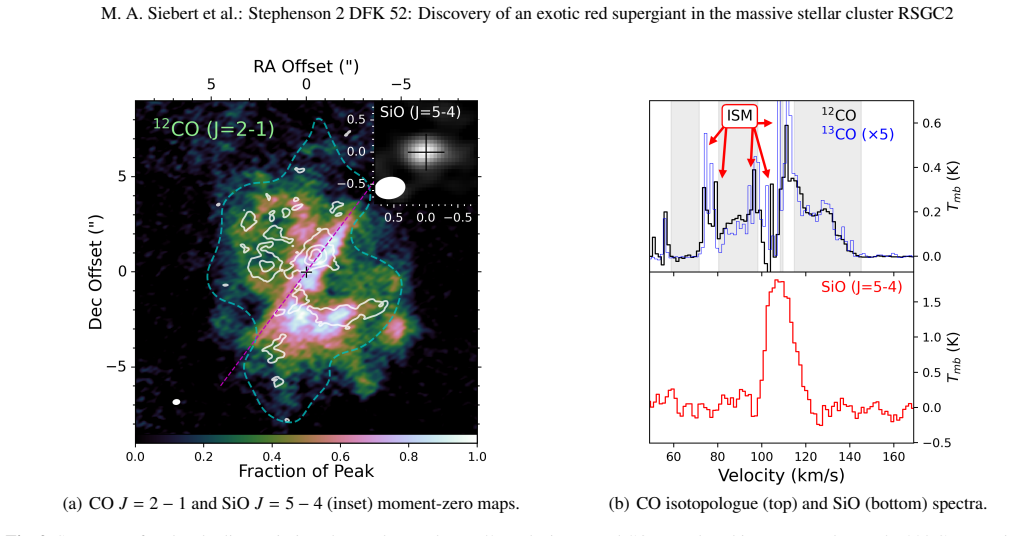
On its own terms, the paper's claim is that DFK 52 is an exotic red supergiant whose circumstellar environment is unlike any previously observed. ALMA 1.3 mm images show continuum emission reaching a radius of about 50,000 au (at the assumed 5.8 kpc distance) and $^{12}$CO $J=2-1$ emission reaching about 45,000 au, with no central continuum peak at the stellar position. The morphology is organized into arcs, loops, a detached bar-like structure that appears in position-velocity space as an edge-on equatorial ring expanding at 27 km s$^{-1}$, and a compact slow central wind; the low $^{12}$CO/$^{13}$CO ratio of about 5 supports a stellar, CNO-processed origin for the material. The paper interprets the structure as a massive ejection event about 4,000 years ago, followed by a return to slower, more symmetric mass loss, and it argues that neither the current radiation pressure nor standard single-star evolution can easily produce the inferred momentum.
Load-bearing premise
The load-bearing premise is that DFK 52 is a member of RSGC2 and therefore lies at the cluster distance of 5.8 kpc; every physical size, mass, luminosity, and comparison with other extreme red supergiants is scaled by that distance.
Editorial extensions
If this is right
- DFK 52 demonstrates that a red supergiant can undergo a short, violent mass-loss episode and then return to a much slower wind, so dramatic mass loss need not mark the end of the star's life.
- The $0.1$ to $1$ $M_\odot$ of cold material at radii beyond $10^{17}$ cm will surround the star when it explodes, so DFK 52 is a concrete example of the dense circumstellar medium invoked to shape some Type II supernova light curves.
- If the ejected ring was produced by a superwind, the episode ended without a supernova, constraining how superwind phases relate to core collapse.
- If it was instead produced by a companion interaction or merger, DFK 52 may be a direct progenitor candidate for ultra-stripped supernovae or a gravitational-wave compact binary.
Reading between the lines
- Beyond the paper: a binary or merger origin could be tested by looking for a surviving companion or merger remnant through high-angular-resolution imaging or radial-velocity monitoring of DFK 52.
- The paper's own model reproduces only 15% of the total CO flux, so a full 3D non-LTE model of all channel maps would test whether the mass estimate of $0.1$ to $1$ $M_\odot$ holds or needs revision.
- The unusually cold, detached dust and double-peaked SED suggest that episodic mass loss can occur in lower-luminosity RSGs; a millimetre survey of other cluster members could reveal whether DFK 52 is truly unique or the first recognized member of a class.
Signed reviews
Editorial analysis
A structured set of objections, weighed in public.
Referee Report
Summary. This paper presents ALMA 1.3 mm continuum and CO/SiO line observations of the red supergiant DFK 52 in the cluster RSGC2. The authors detect an extended, complex circumstellar envelope reaching ~8 arcsec (claimed ~50,000 au at the assumed 5.8 kpc cluster distance), with a bar-like CO structure whose position-velocity diagram suggests an edge-on detached equatorial component moving at ±27 km/s. A two-component LIME radiative transfer model — a slow spherical wind (3e-6 Msun/yr, 10 km/s) plus a detached equatorial density enhancement (0.05 Msun, 27 km/s, centered at 23,000 au) — reproduces the PV diagram along one position angle but only 15% of the total CO flux. The authors infer a dramatic mass-loss event about 4000 years ago, estimate a total outflow mass of 0.1–1 Msun, and argue that the size and low luminosity make DFK 52 unique among extreme red supergiants.
Significance. If the distance and membership assumption holds, this is a potentially important discovery of an RSG with an outflow roughly four times larger than those of VY CMa and NML Cyg and with a much lower luminosity, which would challenge current understanding of RSG mass loss and supernova progenitor scenarios. The observations are of high quality, reduced with standard ALMA procedures, and the kinematic evidence for a detached fast component is visually compelling. The paper is commendably transparent about the two main caveats: the dependence of all physical scales on the assumed cluster distance (Appendix D) and the fact that the radiative transfer model reproduces only a small fraction of the CO flux (§3.2). The low 12CO/13CO ratio supporting a stellar origin is a nice check. However, because the 'exotic' classification and the inferred mass-loss history both rest on these caveats, the quantitative claims need to be presented with explicit systematic uncertainties.
major comments (3)
- [§3.1, Appendix D] All physical quantities that make DFK 52 exotic — the ~50,000 au envelope radius, the 4000 yr ejection age, the 0.1–1 Msun envelope mass, the 2×10^4 Lsun luminosity, and the factor 3–4 size comparison with VY CMa and NML Cyg — are directly proportional to the assumed cluster distance d = 5.8 kpc from Davies et al. (2007). The paper itself notes in Appendix D that the quoted distance uncertainty alone changes the 8 arcsec extent from ~40,000 au (d=5.04 kpc) to ~62,000 au (d=7.71 kpc), and that a foreground star at d=2 kpc would reduce the envelope to ~16,000 au and the luminosity to ~2400 Lsun, which would challenge the RSG classification. The radial-velocity argument (v_lsr = 109 km/s vs. <30 km/s expected for d<2 kpc) makes such a foreground interloper improbable, but not impossible. Because the central claim of an unprecedented outflow rests on this distance, I request that the paper present the key physical quantities explicitly as functions of d (e.g., R = 8 arcsec × d), and that the abstract and conclusions be worded conditionally on the membership assumption. Stronger membership confirmation (e.g., Gaia astrometry or a cluster parallax) would strengthen the claim.
- [§3.2, Table B.1, Appendix B] The inferred mass-loss event — an equatorial component with M=0.05 Msun ejected ~4000 yr ago at 27 km/s — is derived from the LIME model parameters (r_EDE = 23,000 au, v_EDE = 27 km/s, M_EDE = 0.05 Msun) that were chosen to reproduce the PV diagram along PA=143°. The age follows essentially as r_EDE/v_EDE, so it is not an independent measurement. The model reproduces only 15% of the total CO flux and requires an unmodeled azimuthal density asymmetry to account for the missing blueshifted torus emission. The paper should explicitly label the 4000-yr mass-loss event as a model-dependent interpretation and should provide a sensitivity test showing how the derived mass and age vary when the model's free parameters (opening angle, radial width, abundance, temperature) are varied within plausible ranges.
- [§3.1, §5] The abstract's total outflow mass of 0.1–1 Msun rests on two extrapolations: the continuum dust mass (Md ~ 6.6×10^-3 Msun at T=50 K, beta=0.9, gas-to-dust=200) and the CO model scaled to the unmodeled flux (M~0.35 Msun assuming common excitation conditions). Both estimates assume optically thin emission and adopt a single dust temperature and fixed gas-to-dust ratio; the systematic uncertainties from these choices are not propagated. Since the mass range is one of the headline results, the paper should provide a conservative systematic error budget or explicitly state that the quoted range is an order-of-magnitude estimate rather than a measured value.
minor comments (6)
- [§3.1] The sentence 'Together, these structures account for ~15% of the total flux' is ambiguous: it is not clear whether 'these structures' refers to the compact components A/B/C or to the extended low-brightness component. Please rephrase.
- [Abstract and §3.1] The abstract states 'up to 50,000 au in radius,' while the maximum angular extent is 8 arcsec (46,000 au at 5.8 kpc) for the continuum and 7.5 arcsec for CO. Please specify that 50,000 au is a rounded value that includes the distance uncertainty, or quote the angular sizes as the primary measurement.
- [§4] The comparison of the envelope extent with 'the smallest observed galactic clumps (0.1 pc; Urquhart et al. 2021)' is misleading because 0.1 pc = 20,600 au, about a factor of two smaller than the claimed 45,000–50,000 au extent. Please quantify the comparison in the same units.
- [Appendix B] The notation for the temperature power law is inconsistent: the text says the log-slope alpha = 1, while Table B.1 lists Tkin = T⋆ (r/R⋆)^(−α) without giving a numeric value for alpha. Please make the notation uniform.
- [§3.2] The statement that the CO extent is 'roughly four times larger than the farthest components observed in this line for VY CMa... and NML Cyg' should specify the assumed distances of VY CMa and NML Cyg and confirm that the comparison is in physical size, not angular size.
- [§2] There is a typo in 'di fferent' in the Observations section.
Circularity Check
No significant circularity: the model parameters are data-constrained and the inferred 4000 yr age is a derived timescale, not a fitted prediction.
full rationale
The claimed derivation chain from ALMA data to physical conclusions is not circular. The 50,000 au extent is the observed 8'' continuum radius converted at the assumed cluster distance (5.8 kpc; Appendix D), and the paper explicitly flags that distance is an assumption needing confirmation. The 4000 yr ejection age is computed as r_EDE/v_EDE from the fitted LIME model (r_EDE = 23,000 au, v_EDE = 27 km/s; Table B.1), but these parameters are constrained by the observed PV diagram and line profiles; the age is a derived timescale, not a separately fitted quantity presented as an independent prediction. The paper also states the RT model reproduces only 15% of the total CO flux, so the mass-loss history is presented as a suggestion, not an overclaimed prediction. The only overlapping-author citation (De Beck et al. 2025) is used as a comparison/method reference for NML Cyg and is not load-bearing. No equation is equivalent to its input by construction.
Assumptions & free parameters
free parameters (13)
- Equatorial density enhancement mass (M_EDE) =
0.05 M_sun
- Equatorial component expansion velocity (v_EDE) =
27 km/s
- Equatorial component center radius (r_EDE) =
23000 au (4 arcsec)
- Equatorial component radial width (sigma_EDE) =
6000 au
- Equatorial opening angle (theta_EDE) =
10 deg
- Slow spherical wind mass-loss rate (Mdot_sph) =
3e-6 M_sun/yr
- Slow wind expansion velocity (v_sph) =
10 km/s
- 12CO abundance relative to H2 =
2e-4
- Minimum kinetic temperature (Tmin) =
15 K
- Dust temperature of the cold envelope =
50 K
- Dust emissivity index (beta) =
0.9
- Gas-to-dust ratio =
200
- Cluster distance =
5.8 kpc
assumptions (6)
- domain assumption DFK 52 is a member of RSGC2 and lies at the cluster distance of 5.8 kpc (Appendix D; Section 3.1).
- domain assumption The detected extended CO and continuum emission is circumstellar rather than interstellar, outside the explicitly excluded ISM-contaminated channels.
- domain assumption The dust emission is optically thin, cold (about 50 K), and follows a fixed gas-to-dust ratio of 200.
- ad hoc to paper The LIME two-component model parameters are a valid representation of the dominant physical structures.
- domain assumption Constant radial expansion since ejection.
- domain assumption The equatorial and spherical components do not interact radiatively.
Cite this review
Pith. "Pith review of Stephenson 2 DFK 52: Discovery of an exotic red supergiant in the massive stellar cluster RSGC2." pith.science (2026). https://pith.science/paper/MAFOAOAT
@misc{pith2026250711609,
  author       = {Pith},
  title        = {Pith review of: Stephenson 2 DFK 52: Discovery of an exotic red supergiant in the massive stellar cluster RSGC2},
  year         = {2026},
  howpublished = {\url{https://pith.science/paper/MAFOAOAT}},
  note         = {Machine review of arXiv:2507.11609}
}
abstract
Atacama Large Millimeter/submillimeter Array (ALMA) observations at 1.3mm have recently revealed surprising complexity in the circumstellar environment of DFK 52, a red supergiant (RSG) located in the Stephenson 2 massive open cluster. We provide an initial characterisation of the star's mass-loss properties by studying its circumstellar emission in continuum, $^{12}$CO, $^{13}$CO, and SiO rotational lines. We find that DFK 52 is surrounded by an extremely large outflow (up to 50,000 au in radius) that shows complex morphologies in both its molecular and dust emission. The size of the circumstellar medium is unprecedented, even when compared with other known extreme RSGs, and its lower luminosity indicates that its mass ejection mechanism may be unique among this population. The molecular emission can be partially reproduced by a two-component model consisting of a fast (27 km/s) detached equatorial component with $M{\sim}0.05$ $M_{\odot}$ and a slow (10 km/s) spherical envelope with $\dot{M}\sim3\times10^{-6}$ $M_{\odot}$ yr$^{-1}$. This suggests that DFK 52 underwent a dramatic mass-loss event $\sim$4000 years ago, but has since transitioned into having a slower more symmetric mass loss. We conservatively estimate a total mass of $0.1-1$ $M_{\odot}$ in the complex extended regions of the outflow. The uncertain nature of the dramatic mass loss warrants extensive follow-up of this likely supernova progenitor.
Figures


Reference graph
Works this paper leans on
-
[1]
Boothroyd , A. I., Sackmann , I. J., & Ahern , S. C. 1993, , 416, 762
work page 1993
- [2]
-
[3]
Bujarrabal , V., Castro-Carrizo , A., Alcolea , J., & S \'a nchez Contreras , C. 2001, , 377, 868
work page 2001
-
[4]
Davies , B., Figer , D. F., Kudritzki , R.-P., et al. 2007, , 671, 781
work page 2007
- [5]
-
[6]
De Beck , E., Andrews , H., Quintana-Lacaci , G., & Vlemmings , W. H. T. 2025, , 698, A179
work page 2025
-
[7]
A., Carter , M., Cheng , J., et al
Ediss , G. A., Carter , M., Cheng , J., et al. 2004, in Fifteenth International Symposium on Space Terahertz Technology, ed. G. Narayanan , 181--188
work page 2004
-
[8]
F., Niccolini , G., Su \'a rez , O., et al
G \'o mez , J. F., Niccolini , G., Su \'a rez , O., et al. 2018, , 480, 4991
work page 2018
Show all 34 references
-
[9]
& Negueruela , I
Gonz \'a lez-Fern \'a ndez , C. & Negueruela , I. 2012, , 539, A100
2012
-
[10]
M., Helmel , G., Jones , T
Humphreys , R. M., Helmel , G., Jones , T. J., & Gordon , M. S. 2020, , 160, 145
2020
-
[11]
Humphreys , R. M. & Jones , T. J. 2022, , 163, 103
2022
-
[12]
M., Richards , A
Humphreys , R. M., Richards , A. M. S., Davidson , K., et al. 2024, , 167, 94
2024
-
[13]
R., Indebetouw , R., Brogan , C
Hunter , T. R., Indebetouw , R., Brogan , C. L., et al. 2023, , 135, 074501
2023
-
[14]
P., et al
Justtanont , K., de Jong , T., Helmich , F. P., et al. 1996, , 315, L217
1996
-
[15]
2019, , 627, A114
Kami \'n ski , T. 2019, , 627, A114
2019
-
[16]
2018, , 617, A129
Kami \'n ski , T., Steffen , W., Tylenda , R., et al. 2018, , 617, A129
2018
-
[17]
Khouri , T., Vlemmings , W. H. T., Tafoya , D., et al. 2021, Nature Astronomy, 6, 275
2021
-
[18]
G., & Chruslinska , M
Klencki , J., Nelemans , G., Istrate , A. G., & Chruslinska , M. 2021, , 645, A54
2021
-
[19]
2011, , 417, 32
Lagadec , E., Verhoelst , T., M \'e karnia , D., et al. 2011, , 417, 32
2011
-
[20]
2024, , 688, A203
Marton , G., Gezer , I., Madar \'a sz , M., et al. 2024, , 688, A203
2024
-
[21]
J., Yoon , S.-C., Gr \"a fener , G., & Blinnikov , S
Moriya , T. J., Yoon , S.-C., Gr \"a fener , G., & Blinnikov , S. I. 2017, , 469, L108
2017
-
[22]
2012, , 547, A15
Negueruela , I., Marco , A., Gonz \'a lez-Fern \'a ndez , C., et al. 2012, , 547, A15
2012
-
[23]
O'Gorman , E., Vlemmings , W., Richards , A. M. S., et al. 2015, , 573, L1
2015
-
[24]
2019, , 623, A153
Olofsson , H., Khouri , T., Maercker , M., et al. 2019, , 623, A153
2019
-
[25]
S., Scibelli , S., et al
Sahai , R., Huang , P. S., Scibelli , S., et al. 2022, , 929, 59
2022
-
[26]
Schneider , F. R. N., Ohlmann , S. T., Podsiadlowski , P., et al. 2020, , 495, 2796
2020
-
[27]
P., Richards , A
Singh , A. P., Richards , A. M. S., Humphreys , R. M., Decin , L., & Ziurys , L. M. 2023, , 954, L1
2023
-
[28]
2019, , 886, 15
Tokuda , K., Fukui , Y., Harada , R., et al. 2019, , 886, 15
2019
-
[29]
S., Figura , C., Cross , J
Urquhart , J. S., Figura , C., Cross , J. R., et al. 2021, , 500, 3050
2021
-
[30]
Wei , D., Schneider , F. R. N., Podsiadlowski , P., et al. 2024, , 688, A87
2024
-
[31]
A., Gal-Yam , A., et al
Yaron , O., Perley , D. A., Gal-Yam , A., et al. 2017, Nature Physics, 13, 510
2017
-
[32]
2025, , 697, A167
Zapartas , E., de Wit , S., Antoniadis , K., et al. 2025, , 697, A167
2025
-
[33]
, " * write output.state after.block = add.period write newline
ENTRY address archiveprefix author booktitle chapter edition editor howpublished institution eprint journal key month note number organization pages publisher school series title type volume year label extra.label sort.label short.list INTEGERS output.state before.all mid.sent...
-
[34]
write newline
" write newline "" before.all 'output.state := FUNCTION n.dashify 't := "" t empty not t #1 #1 substring "-" = t #1 #2 substring "--" = not "--" * t #2 global.max substring 't := t #1 #1 substring "-" = "-" * t #2 global.max substring 't := while if t #1 #1 substring * t #2 gl...
Reviewed August 6, 2026 · model on record in the stance chip above.
Discussion (0). Continue with ORCID to comment.