Wide-Angle Reflection Suppression of Dielectric Slabs Using Nonlocal Metasurface Coatings
Pith reviewed 2026-05-19 05:03 UTC · model grok-4.3
The pith
Nonlocal metasurface coatings suppress reflection from dielectric slabs of any thickness over wide angles.
A machine-rendered reading of the paper's core claim, the machinery that carries it, and where it could break.
Core claim
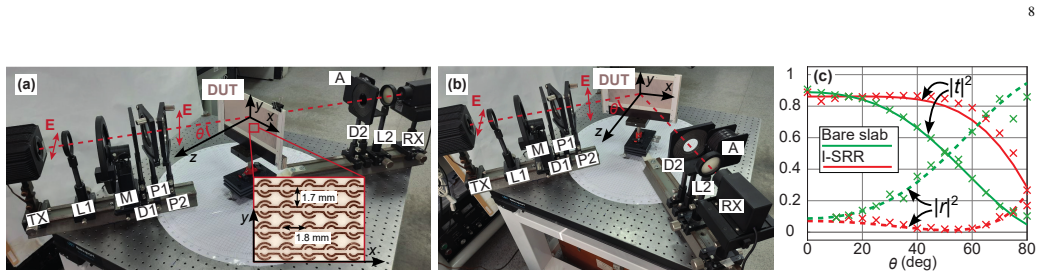
Coating a dielectric slab from both sides with identical nonlocal metasurfaces whose grid impedance varies with incident angle removes the strong angle dependence of reflection that appears for large electrical thicknesses. Nonlocality supplies the additional degree of freedom needed to meet the generalized Huygens condition for arbitrary slab thickness, so that a plane wave experiences enhanced transmission and suppressed reflection over a wide angular spectrum, as verified by both simulation and measurement on a physical prototype.
What carries the argument
The spatially dispersive grid impedance of the nonlocal metasurface, realized as an interconnected split-ring resonator array that approximates the required angular dependence.
If this is right
- Transmittance through the coated slab increases across a broad range of incident angles.
- Reflection suppression holds for optically thick slabs where local metasurface coatings fail.
- The anti-reflective coatings remain optically thin and relatively simple to fabricate.
- The same nonlocal principle applies to both numerical models and measured prototypes.
Where Pith is reading between the lines
- The approach could extend to suppressing scattering from multilayer dielectric stacks or interfaces with varying thicknesses.
- Similar angle-dependent impedance designs might improve performance in radomes, optical windows, or protective covers subject to oblique illumination.
- Testing the coatings at different frequencies or with curved slabs would check how far the planar, single-frequency approximation carries.
Load-bearing premise
The interconnected split-ring resonator pattern can accurately reproduce the exact angular dependence of grid impedance demanded by the nonlocal design for slabs of different thicknesses.
What would settle it
If transmission measurements on a thick dielectric slab coated with the proposed metasurface show no improvement over the uncoated case at large incident angles, the central claim would be falsified.
Figures


read the original abstract
Any discontinuity of constitutive parameters along a wave propagation path causes scattering. For a plane wave incident onto a flat dielectric slab, reflection becomes strongly dependent on the incident angle as the electrical thickness becomes large. This behavior limits the applicability of conventional single- and multilayer anti-reflective coatings. Recently, inspired by the generalized Huygens' condition, synthesized admittance sheets implemented as metasurfaces with local response have been shown to remove reflection from a dielectric slab in a wide range of incident angles, applicable, however, only in the case of small optical slab thickness. In this work, we study plane wave transmission through dielectric slabs with arbitrary thickness coated from both sides by identical metasurfaces with nonlocal response, whose grid impedance is angularly dependent (spatially dispersive). Nonlocality is shown to play a key role in obtaining wide-angle reflection suppression in the case of optically thick slabs. To validate our approach, we study a metasurface realization composed of Interconnected Split-Ring Resonators that approximates the predicted spatial dispersion law. As demonstrated numerically and experimentally, such properly devised nonlocal metasurface coatings indeed provide transmittance enhancement (and reflectance suppression) of thick dielectric slabs across a broad range of angles, paving the path to optically thin and easy-to-fabricate anti-reflective coatings efficiently operating in a wide angular range even for optically thick dielectric slabs.
Editorial analysis
A structured set of objections, weighed in public.
Referee Report
Summary. The paper claims that dielectric slabs of arbitrary (including large) electrical thickness can be coated on both sides with identical nonlocal metasurface layers whose grid impedance Z_g is spatially dispersive (angularly dependent) to achieve wide-angle reflection suppression and transmittance enhancement. This is supported by a nonlocal design rule derived from generalized Huygens conditions, a specific metasurface realization using interconnected split-ring resonators (ISRs) that approximates the required Z_g(k_x), and validation via numerical simulations and experimental measurements showing improved performance over a broad angular range.
Significance. If the central result holds, the work provides a practical route to thin, fabricable anti-reflective coatings that function for optically thick slabs where conventional local metasurfaces or multilayer coatings fail due to angle-dependent reflections. The explicit use of nonlocality to cancel the slab's angle-dependent reflection coefficient, combined with both simulation and experiment, represents a meaningful extension beyond prior local-response approaches.
major comments (1)
- [Metasurface realization section] Metasurface realization section: The manuscript states that the ISR lattice 'approximates the predicted spatial dispersion law' but provides no direct extraction or quantitative comparison of the effective oblique-incidence grid impedance Z_g(k_x) (obtained from full-wave simulation or measurement of the fabricated structure) against the analytically required Z_g(k_x) function that cancels the slab reflection coefficient. For thick slabs this match is load-bearing, because multiple internal reflections make transmittance exponentially sensitive to even small angular mismatches in Z_g; without this check the observed gains could arise from residual local effects or parameter tuning rather than the intended nonlocal mechanism.
minor comments (2)
- [Experimental results] Experimental results: Include quantitative error bars or repeatability data on the measured transmittance curves to allow readers to assess the statistical significance of the reported gains relative to the uncoated slab.
- [Figures] Figure captions and text: Ensure consistent notation for the grid impedance (e.g., always Z_g(k_x) or equivalent) and explicitly label which curves correspond to the required nonlocal target versus the realized ISR response.
Simulated Author's Rebuttal
We thank the referee for the constructive feedback and positive assessment of the work's significance. We address the major comment on the metasurface realization below. The requested quantitative comparison has been added to the revised manuscript to strengthen the evidence for the nonlocal mechanism.
read point-by-point responses
-
Referee: Metasurface realization section: The manuscript states that the ISR lattice 'approximates the predicted spatial dispersion law' but provides no direct extraction or quantitative comparison of the effective oblique-incidence grid impedance Z_g(k_x) (obtained from full-wave simulation or measurement of the fabricated structure) against the analytically required Z_g(k_x) function that cancels the slab reflection coefficient. For thick slabs this match is load-bearing, because multiple internal reflections make transmittance exponentially sensitive to even small angular mismatches in Z_g; without this check the observed gains could arise from residual local effects or parameter tuning rather than the intended nonlocal mechanism.
Authors: We agree that a direct quantitative comparison of the extracted Z_g(k_x) strengthens the claim, especially given the sensitivity for thick slabs. In the revised manuscript we have added this analysis to the Metasurface realization section. Using full-wave simulations of the isolated ISR metasurface, we extract the effective grid impedance Z_g(k_x) at oblique incidences via the standard retrieval procedure for a subwavelength sheet. We then overlay this extracted Z_g(k_x) against the analytically required function derived from the generalized Huygens condition that nulls the slab reflection coefficient. The comparison (new Figure X) shows close agreement across 0–60° for both real and imaginary parts within the design bandwidth, with relative deviations below 10% in the relevant range. This match confirms that the observed wide-angle transmittance enhancement in both simulations and experiments of the coated thick slab originates from the intended spatial dispersion rather than local effects or incidental tuning. We also include a brief sensitivity study showing that the achieved approximation level is sufficient to suppress the multiple-reflection contributions that would otherwise dominate for large electrical thickness. Direct extraction from the fabricated sample is not reported because the experiment measured the complete coated-slab transmittance; however, the excellent agreement between measured and simulated slab performance indirectly corroborates the simulated Z_g(k_x). revision: yes
Circularity Check
No significant circularity; derivation and validation are independent
full rationale
The paper first derives the required angularly dispersive grid impedance Z_g(k_x) from the generalized Huygens condition to cancel angle-dependent reflection for arbitrary slab thickness. It then selects an ISR lattice as an approximation to that dispersion law and validates the overall approach through independent numerical simulations and physical experiments on fabricated samples. No equation reduces the central transmittance-enhancement result to a fitted parameter, self-citation, or input by construction; the experimental data constitute external evidence that does not presuppose the outcome. The design rule and its realization therefore remain self-contained against external benchmarks.
Axiom & Free-Parameter Ledger
free parameters (1)
- angular dependence parameters of grid impedance
axioms (1)
- domain assumption Generalized Huygens' condition for metasurface admittance sheets
Lean theorems connected to this paper
-
IndisputableMonolith/Cost/FunctionalEquation.leanwashburn_uniqueness_aczel unclear?
unclearRelation between the paper passage and the cited Recognition theorem.
Zs of both MSs at each incidence angle should be designed to take a suitable value such that the amplitude of t equals unity
What do these tags mean?
- matches
- The paper's claim is directly supported by a theorem in the formal canon.
- supports
- The theorem supports part of the paper's argument, but the paper may add assumptions or extra steps.
- extends
- The paper goes beyond the formal theorem; the theorem is a base layer rather than the whole result.
- uses
- The paper appears to rely on the theorem as machinery.
- contradicts
- The paper's claim conflicts with a theorem or certificate in the canon.
- unclear
- Pith found a possible connection, but the passage is too broad, indirect, or ambiguous to say the theorem truly supports the claim.
Reference graph
Works this paper leans on
-
[1]
Kozakoff, Analysis of Radome Enclosed Antennas
D. Kozakoff, Analysis of Radome Enclosed Antennas . Artech, 2009
work page 2009
-
[2]
Anti-reflective coatings: A critical, in-depth review,
H. Raut, A. G. Venkatesan, S. Nair, and S. Ramakrishna, “Anti-reflective coatings: A critical, in-depth review,” Energy Environ. Sci. , vol. 4, pp. 3779–3804, 08 2011
work page 2011
-
[3]
Optically-transparent EM skins for outdoor-to-indoor mm-wave wireless communications,
G. Oliveri, F. Zardi, G. Gottardi, and A. Massa, “Optically-transparent EM skins for outdoor-to-indoor mm-wave wireless communications,” IEEE Access, vol. 12, pp. 65178–65191, 2024
work page 2024
-
[4]
Multilayer antireflection coatings: theoret- ical model and design parameters,
K. Rabinovitch and A. Pagis, “Multilayer antireflection coatings: theoret- ical model and design parameters,” Appl. Opt., vol. 14, pp. 1326–1334, Jun 1975
work page 1975
-
[5]
Quarterwave layers: simulation by three thin layers of two materials.,
R. Herrmann, “Quarterwave layers: simulation by three thin layers of two materials.,” Appl. Opt., vol. 24 8, p. 1183, 1985. 3We assume that nearfield coupling effects are negligible, which is naturally expected for the optically thick substrates considered herein. 9
work page 1985
-
[6]
Design of three-layer antireflection coatings: a generalized approach.,
C. L. Nagendra and G. K. M. Thutupalli, “Design of three-layer antireflection coatings: a generalized approach.,” Appl. Opt., vol. 27 11, pp. 2320–33, 1988
work page 1988
-
[7]
Realization and modeling of multilayer antire- flection coatings for solar cells application,
N. Sahouane, N. Ammar, A. Ziane, R. Dabou, A. Bouraiou, M. Moste- faoui, and A. Rouabhia, “Realization and modeling of multilayer antire- flection coatings for solar cells application,” Mater. Res. Express, vol. 5, 2018
work page 2018
-
[8]
Wideband radomes for millimeter-wave automotive radars,
M. Hossain, S. A. N. Saqueb, A. Arage, J. Cabigao, C. Velasquez, K. Sertel, and N. K. Nahar, “Wideband radomes for millimeter-wave automotive radars,” IEEE Trans. Antennas Propag. , vol. 70, pp. 1178– 1186, 2021
work page 2021
-
[9]
Toward perfect antireflection coatings: numerical investigation,
J. A. Dobrowolski, D. Poitras, P. Ma, H. Vakil, and M. Acree, “Toward perfect antireflection coatings: numerical investigation,” Appl. Opt. , vol. 41, pp. 3075–3083, Jun 2002
work page 2002
-
[10]
Antireflection coating using metamaterials and identification of its mechanism,
H.-T. Chen, J. Zhou, J. F. O’Hara, F. Chen, A. K. Azad, and A. J. Taylor, “Antireflection coating using metamaterials and identification of its mechanism,” Phys. Rev. Lett., vol. 105, p. 073901, Aug 2010
work page 2010
-
[11]
T. R. Cameron and G. V . Eleftheriades, “Analysis and characterization of a wide-angle impedance matching metasurface for dipole phased arrays,” IEEE Trans. Antennas Propag. , vol. 63, no. 9, pp. 3928–3938, 2015
work page 2015
-
[12]
Magnetoelectric uniaxial metamaterials as wide-angle polarization-insensitive matching layers,
Y . He and G. V . Eleftheriades, “Magnetoelectric uniaxial metamaterials as wide-angle polarization-insensitive matching layers,” Phys. Rev. B , vol. 98, p. 205404, Nov 2018
work page 2018
-
[13]
Universal impedance matching and the perfect transmission of white light,
K. Im, J.-H. Kang, and Q.-H. Park, “Universal impedance matching and the perfect transmission of white light,” Nat. Photon., vol. 12, 03 2018
work page 2018
-
[14]
A. Shaham and A. Epstein, “Generalized Huygens’ condition as the fulcrum of planar nonlocal omnidirectional transparency: From meta- atoms to metasurfaces,” Adv. Opt. Mater., vol. 12, no. 28, p. 2401127, 2024
work page 2024
-
[15]
A. Shaham and A. Epstein, “All-angle nonlocal metasurfaces on demand: Universal realization of normal susceptibilities via multilayered printed- circuit-board (PCB) cascades,” IEEE Trans. Antennas Propag., pp. 1–1, 2025
work page 2025
-
[16]
Simovski, Composite Media with Weak Spatial Dispersion
K. Simovski, Composite Media with Weak Spatial Dispersion . Jenny Stanford Publishing, 2018
work page 2018
-
[17]
High-impedance surfaces having stable resonance with respect to polarization and incidence angle,
C. Simovski, P. de Maagt, and I. Melchakova, “High-impedance surfaces having stable resonance with respect to polarization and incidence angle,” IEEE Trans. Antennas Propag. , vol. 53, no. 3, pp. 908–914, 2005
work page 2005
-
[18]
C. Yepes, M. Faenzi, S. Maci, and E. Martini, “Perfect non-specular reflection with polarization control by using a locally passive metasur- face sheet on a grounded dielectric slab,” Appl. Phys. Lett. , vol. 118, p. 231601, 06 2021
work page 2021
-
[19]
On the role of spatial dispersion in boundary conditions for perfect non-specular reflection,
C. Yepes, S. Maci, S. A. Tretyakov, and E. Martini, “On the role of spatial dispersion in boundary conditions for perfect non-specular reflection,” EPJ Appl. Metamat. , vol. 9, p. ”17”, 2022
work page 2022
-
[20]
Mushroom high-impedance metasurfaces for perfect absorption at two angles of incidence,
D. Zhirihin, C. Simovski, P. Belov, and S. Glybovski, “Mushroom high-impedance metasurfaces for perfect absorption at two angles of incidence,” IEEE AWP Letters., vol. 16, pp. 2626–2629, 2017
work page 2017
-
[21]
Single-layer, all-metallic metasurface filter with nearly 90° angularly stable resonance,
N. Goshen and Y . Mazor, “Single-layer, all-metallic metasurface filter with nearly 90° angularly stable resonance,” IEEE Trans. Antennas Propag., vol. 72, no. 5, pp. 4212–4220, 2024
work page 2024
-
[22]
Canalization of sub- wavelength images by electromagnetic crystals,
P. A. Belov, C. R. Simovski, and P. Ikonen, “Canalization of sub- wavelength images by electromagnetic crystals,” Phys. Rev. B , vol. 71, p. 193105, May 2005
work page 2005
-
[23]
Near-field imaging with a loaded wire medium,
C. S. R. Kaipa, A. B. Yakovlev, S. I. Maslovski, and M. G. Silveirinha, “Near-field imaging with a loaded wire medium,” Phys. Rev. B, vol. 86, p. 155103, Oct 2012
work page 2012
-
[24]
Nonlocal metasurfaces for optical signal processing,
H. Kwon, D. Sounas, A. Cordaro, A. Polman, and A. Al `u, “Nonlocal metasurfaces for optical signal processing,” Phys. Rev. Lett. , vol. 121, p. 173004, Oct 2018
work page 2018
-
[25]
Perfect control of reflection and refraction using spatially dispersive metasurfaces,
V . S. Asadchy, M. Albooyeh, S. N. Tcvetkova, A. D ´ıaz-Rubio, Y . Ra’di, and S. A. Tretyakov, “Perfect control of reflection and refraction using spatially dispersive metasurfaces,” Phys. Rev. B, vol. 94, p. 075142, Aug 2016
work page 2016
-
[26]
A. Epstein and G. V . Eleftheriades, “Synthesis of passive lossless metasurfaces using auxiliary fields for reflectionless beam splitting and perfect reflection,” Phys. Rev. Lett., vol. 117, p. 256103, Dec 2016
work page 2016
-
[27]
Emulating nonreciprocity with spatially dispersive metasurfaces excited at oblique incidence,
C. Pfeiffer and A. Grbic, “Emulating nonreciprocity with spatially dispersive metasurfaces excited at oblique incidence,” Phys. Rev. Lett. , vol. 117, p. 077401, Aug 2016
work page 2016
-
[28]
Radiation-pattern synthesis with uniform nonlocal meta- surfaces,
A. Zhuravlev, Y . Kurenkov, X. Wang, F. Dushko, V . Zalipaev, and S. Glybovski, “Radiation-pattern synthesis with uniform nonlocal meta- surfaces,” Phys. Rev. Appl., vol. 23, p. 044052, Apr 2025
work page 2025
-
[29]
O. Luukkonen, C. Simovski, G. Granet, G. Goussetis, D. Lioubtchenko, A. V . Raisanen, and S. A. Tretyakov, “Simple and accurate analytical model of planar grids and high-impedance surfaces comprising metal strips or patches,” IEEE Trans. Antennas Propag. , vol. 56, no. 6, pp. 1624–1632, 2008
work page 2008
-
[30]
R. E. Collin, Field Theory of Guided Waves . IEEE/OUP series on electromagnetic wave theory, IEEE Press, 1990
work page 1990
-
[31]
C. Menzel, J. Sperrhake, and T. Pertsch, “Efficient treatment of stacked metasurfaces for optimizing and enhancing the range of accessible optical functionalities,” Phys. Rev. A, vol. 93, p. 063832, 2016
work page 2016
-
[32]
Averaged transition conditions for electromagnetic fields at a metafilm,
E. Kuester, M. Mohamed, M. Piket-May, and C. Holloway, “Averaged transition conditions for electromagnetic fields at a metafilm,” IEEE Trans. Antennas Propag., vol. 51, no. 10, pp. 2641–2651, 2003
work page 2003
-
[33]
Revisiting substrate-induced bianisotropy in metasurfaces,
M. Albooyeh, R. Alaee, C. Rockstuhl, and C. Simovski, “Revisiting substrate-induced bianisotropy in metasurfaces,” Phys. Rev. B , vol. 91, p. 195304, May 2015
work page 2015
-
[34]
Huygens metasurfaces via the equivalence principle: design and applications,
A. Epstein and G. V . Eleftheriades, “Huygens metasurfaces via the equivalence principle: design and applications,” J. Opt. Soc. Am. B , vol. 33, pp. A31–A50, Feb 2016
work page 2016
-
[35]
Spatial angular filtering by FSSs made of chains of interconnected SRRs and CSRRs,
J. D. Ortiz, J. D. Baena, V . Losada, F. Medina, and J. L. Araque, “Spatial angular filtering by FSSs made of chains of interconnected SRRs and CSRRs,” IEEE MWCL, vol. 23, no. 9, pp. 477–479, 2013
work page 2013
-
[36]
Efficient anomalous refraction of THz beams with a multilayer metal–polymer huygens’ metasurface,
S. Kuznetsov, M. Tumashov, V . K. Killamsetty, P. Lazorskiy, A. Epstein, and S. Glybovski, “Efficient anomalous refraction of THz beams with a multilayer metal–polymer huygens’ metasurface,” IEEE T THZ SCI TECHN., vol. 14, no. 1, pp. 109–121, 2024
work page 2024
-
[37]
Methods of terahertz-subterahertz bwo spectroscopy of conducting materials,
B. Gorshunov, A. V olkov, A. Prokhorov, and I. Spektor, “Methods of terahertz-subterahertz bwo spectroscopy of conducting materials,” Solid State Phys., vol. 50, pp. 2001–2012, 11 2008
work page 2001
discussion (0)
Sign in with ORCID, Apple, or X to comment. Anyone can read and Pith papers without signing in.