REVIEW 5 major objections 5 minor 48 references
CARTS: Cooperative and Adaptive Resource Triggering and Stitching for 5G ISAC
T0 review · 5 major / 5 minor · reviewed 2026-08-06 · deepseek-v4-flash
Pith's one-line read CARTS fuses the two 5G uplink reference signals—traffic-borne DMRS and on-demand SRS—into a single stitched channel estimate, letting a base station serve twice as many sensing users at the same accuracy.
desk verdict A useful, well-scoped 5G ISAC paper whose main claims likely hold in the tested regime, but the stitching equations have a real gap and the evaluation is too gentle to fully stress them. read the letter →
The pith
A machine-rendered reading of the paper's core claim, the machinery that carries it, and where it could break.
The reading
What carries the argument
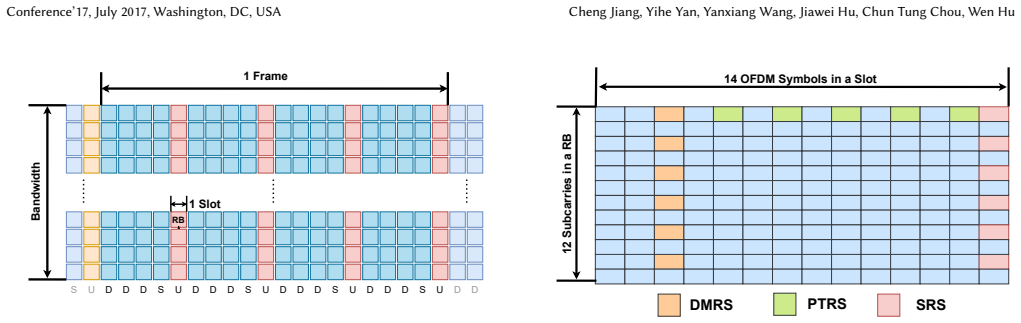
The mechanism that carries the argument is the slope-removal stitching and compensation pipeline of Section 4.2. Each partial measurement is a tuple storing the complex CSI matrix, the subcarrier set, and the measurement time of one sub-band. The pipeline first projects all sub-bands onto the principal eigenvector of a time-weighted spatial covariance matrix so they share one spatial reference; then it fits and removes each sub-band's linear phase slope, deliberately keeping the reference band's slope and intercept; then it aligns each sub-band to the reference with a single complex scaling factor estimated from overlapping or boundary subcarriers; finally it stitches outward iteratively, preferring adjacent sub-bands and keeping the newest measurement in any overlap, with spline interpolation restoring uniform sampling. The load-bearing idea is that under mobility a moving user changes spatial signatures, path delays, and fading simultaneously, so all three corrections must work together for the fused estimate to behave like a real full-band measurement.
What would settle it
Measure the stitched channel's NMSE against full-band SRS ground truth while systematically widening the time gap between a DMRS capture and the SRS reference capture, first at the paper's 3 km/h indoor setting and then at vehicular speeds: if NMSE stays well below the 0.25 threshold as the gap grows, the single-gain alignment is robust, while a sharp rise with gap size pinpoints temporal staleness as the weak link. A second decisive check is error growth as a function of stitched sub-band count, comparing two-sub-band stitching against six-sub-band stitching, where superlinear growth would confirm that errors accumulate across iterative stitching and would quantify how much of the reported accuracy depends on the number of SRS resources per user.
Extended reading notes
Core claim
The paper's central claim is that asynchronous DMRS and SRS measurements, each covering only part of the band at different times, can be stitched into a coherent full-band channel estimate nearly as accurate as full-band SRS sounding. The stitching pipeline works in three stages: spatial smoothing projects each sub-band's CSI onto the dominant spatial mode of a time-weighted covariance matrix; time alignment removes each sub-band's linear phase slope instead of shifting channel-impulse-response peaks, which the paper argues is unreliable for narrow sub-bands and accumulates errors when stitched repeatedly; and frequency compensation scales and re-phases each sub-band by a single complex factor estimated from overlapping or boundary subcarriers, applied iteratively outward from a reference SRS sub-band with the most recent measurement kept in overlaps. A second claim is that the unavoidable DMRS stream can be treated as free sensing opportunity: a greedy priority-based scheduler, working within the standard aperiodic-SRS trigger mechanism and per-user target estimation rates, fills only the gaps DMRS leaves. The evaluation, combining real uplink-scheduling traces from three traffic environments with full-band CSI collected at roughly 3 km/h movement, reports NMSE 0.167 and 85 cm tracking accuracy at 10 users, on par with the periodic SRS baseline's accuracy at 5 users.
Load-bearing premise
The scheme rests on the assumption that after each sub-band's linear phase slope is stripped off, the leftover phase differences between DMRS and SRS measurements can be absorbed by a single complex gain, an assumption that quietly goes stale if a user moves quickly between measurements or if rich multipath makes the phase profile much more than a straight line.
Editorial extensions
If this is right
- A standard-compliant base station can raise its CSI update rate without spending extra radio resources, because DMRS already accompanies data traffic and SRS is triggered through the standard aperiodic-SRS control field.
- Sensing opportunity spreads to more users: CARTS reports NMSE 0.167 and tracking accuracy 0.85 m at 10 users, where the periodic SRS-only baseline reaches similar numbers at just 5 users.
- Timing-advance integrity holds as load grows: average CIR peak error stays near one sample (about 16.3 ns at 30 kHz subcarrier spacing) even with 100 users, so uplink synchronization does not become the bottleneck.
- The error decomposition (ranging error growing 47% versus angular error 24% as users rise from 5 to 100) indicates that improving CSI amplitude fidelity is the higher-leverage path to better positioning.
Reading between the lines
- A stress test the paper leaves open: raising UE speed from 3 km/h toward vehicular rates, or deliberately lengthening the DMRS-to-SRS delay, would find how large the temporal gap can be before the single-gain alignment goes stale.
- The same slope-removal stitching could transfer to carrier aggregation or non-contiguous spectrum chunks, where partial CSI from separate bands must be combined under user motion.
- Because every aperiodic SRS firing consumes a downlink control grant, dense-cell control-channel capacity could become the next bottleneck; the paper's evaluation does not model DCI channel loading.
- The fixed DMRS/SRS power offset the paper measures suggests a cheap practical refinement: pre-calibrating the reference-signal power difference before stitching would relieve the amplitude-scaling factor and directly shrink the ranging error that dominates tracking error.
Signed reviews
Editorial analysis
A structured set of objections, weighed in public.
Referee Report
Summary. CARTS is a framework for 5G uplink ISAC that fuses DMRS and SRS CSI streams to increase the frequency of channel estimates and extend sensing opportunities to more users. The paper proposes (i) a priority-based aperiodic SRS triggering algorithm (Algorithm 1) that complements the uncontrollable DMRS schedule, and (ii) a channel stitching and compensation method (§4.2) that aligns asynchronous, partially overlapping CSI sub-bands by spatial smoothing, slope removal, and complex scaling. The authors evaluate CARTS in a trace-driven emulation using CSI collected from an OAI/USRP testbed and PUSCH allocation traces sniffed from commercial 4G networks, reporting an NMSE of 0.167, a CIR peak error of about one sample, a UE tracking error of 85 cm, and support for roughly twice as many users as a periodic SRS-only baseline at similar performance. The paper claims that CARTS is standard-compliant and requires no additional radio resources.
Significance. If the quantitative claims hold, CARTS would be a practical and inexpensive way to improve uplink sensing scalability in 5G networks without new hardware or radio resources. The paper's strengths include a clearly specified algorithm, a reproducible emulation pipeline, and direct comparisons against ToneTrack and a periodic-SRS baseline, as well as the useful spatial-smoothing step. However, the current evaluation is undermined by a partially circular ground truth (the reference sub-band is drawn from the same full-band SRS used as H_true), an incomplete specification of how the reference phase slope is restored, an alignment step that relies on a single boundary subcarrier, and an arbitrary scaling of 4G traces to 5G bandwidth. These issues must be resolved before the reported numbers can be considered reliable.
major comments (5)
- [§5.1, Fig. 9] The NMSE ground truth H_true is the full-band SRS measurement, and the stitching reference sub-band b_ref is itself a subset of that same measurement chosen via the SRS allocation mask in Fig. 9. Consequently, the estimate is exactly equal to the ground truth on the reference subcarriers, and the reported NMSE values (e.g., 0.167 at N=10) measure how well the other sub-bands can be aligned to a reference that is known by construction, not how well the full channel is estimated independently. The claim that CARTS achieves a given NMSE therefore needs a non-circular evaluation, e.g., a held-out full-band measurement from a different SRS occasion, or a ground truth derived from an independent full-band channel estimate.
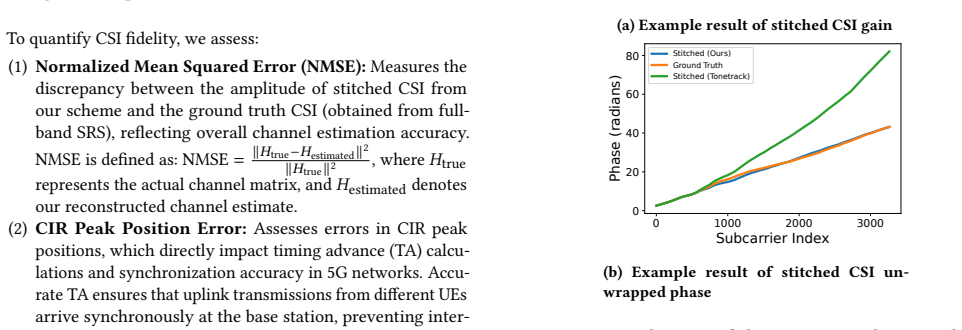
- [§4.2.2, Eqs. (7)-(8), Fig. 11b] Equations (7)-(8) remove the linear phase slope from every sub-band, and the text says the reference slope α_b_ref and intercept φ_b_ref,0 are 'retained,' but no equation in §4.2 shows how these quantities are re-added to the final stitched estimate. If Eq. (8) is applied to b_ref exactly as written, the absolute delay (timing advance) information is destroyed, which contradicts the CIR peak position results of §5.1.2; if a re-add step exists, it is undocumented. The large phase slope visible in the 'Stitched (Ours)' trace in Fig. 11b suggests some restoration occurs, so the manuscript needs an explicit equation completing the stitching operation.
- [§4.2.3, Eqs. (12)-(13), §4.2.4, §5] When there is no overlap between a sub-band and the reference, the alignment scalar γ_b is estimated from a single boundary subcarrier pair (Eqs. 12-13). In a frequency-selective channel, the ratio Ĥ_b_ref(n)/Ĥ_b(n) is not constant across n, so this estimate is noise-dominated and biased; the iterative outward stitching of §4.2.4 then propagates that bias to every subsequently stitched sub-band. The evaluation only covers 3 km/h indoor motion in three settings (office, open floor, NLOS), with sub-bands as narrow as 5 RBs (Fig. 7), so the single-subcarrier boundary estimate and the effects of larger DMRS-to-SRS time gaps or richer multipath are not exercised. A higher-mobility or stronger-multipath test, or an estimator using multiple boundary subcarriers, is needed to support the claimed generalizability.
- [§5, data collection, Fig. 9] The PUSCH allocation traces are collected from a 4G network and scaled from 100 RBs to 272 RBs by an arbitrary factor of 2.72, rounded to a multiple of 4. This scaling changes the burst size distribution and the resulting SRS triggering decisions, yet no justification or sensitivity analysis is provided. Because the 'twice as many users' claim is derived from these traces, the emulation should either use a 5G-based mapping (e.g., from 5G NR schedulers or standardized traffic models) or demonstrate that the conclusions are invariant to the scaling factor.
- [Abstract, §4.1, §5] CARTS is described in the abstract as a 'real-time SRS triggering algorithm,' but the evaluation is entirely offline because OAI lacks aperiodic SRS triggering. The SRS allocation decisions are computed from pre-recorded PUSCH traces, so the loop's latency, jitter, and its coupling with the actual PUSCH scheduler are never measured. This limitation is acknowledged in §5, but the phrasing of the abstract and §4.1 should be revised to distinguish the algorithm's design from its offline validation, or supplemented with a latency and signaling-overhead analysis.
minor comments (5)
- [Algorithm 1, line 12] The pseudocode uses 'arg max(value_matrix)' but the variable is named 'urgency_matrix' throughout; this should be corrected for reproducibility.
- [§5.1.1] The text states 'median NMSE values well below 0.25 (i.e., 3 dB)', but 10 log10(0.25) is approximately -6 dB, not 3 dB; the conversion should be fixed.
- [§5.1.3] The phrase 'In spit of more complex fading processes' contains a typo and should read 'In spite of'.
- [§4.1.1] The parameter 'maxNrofSRS-TriggerStates-1' is described as limiting the number of resource sets, but the 3GPP parameter name suggests it controls trigger states; the authors should verify the exact parameter and its meaning in TS 38.331.
- [Fig. 12a] The legend entry '100% RR Traffic' is ambiguous and appears inconsistent with the caption's 'Baseline - Periodic SRS' label; the legend and caption should be aligned.
Circularity Check
The headline NMSE is partly self-referential: the stitched estimate's reference sub-band and its fitted compensation gains come from the same full-band SRS trace that is later used as ground truth, so the reported error is partly an in-sample identity rather than an independent prediction.
-
fitted input called prediction
[Section 4.2.3, Eqs. (12)-(14); Section 5.1.1, NMSE definition]
"β_b = |H_b_ref(n_boundary)| / |H_b(n_boundary)|, (12); φ_b = arg H_b_ref(n_boundary) − arg H_b(n_boundary). (13); Once β_b and φ_b are determined, we align sub-band b to the reference b_ref using: H'_b(n) = γ_b H_b(n) = β_b e^{jφ_b} H_b(n). (14); NMSE = ||H_true − H_estimated||^2 / ||H_true||^2, where H_true represents the actual channel matrix, and H_estimated denotes our reconstructed channel estimate."
The complex gain γ_b in Eq. 14 is computed from the boundary (or overlapping) subcarriers via Eqs. 12-13, which forces those subcarriers of sub-band b to match the corresponding subcarriers of the reference band with zero alignment error. The NMSE in Section 5.1.1 is then evaluated against H_true, the full-band SRS trace from which the reference band and the SRS snippets were masked in the first place. Hence the reported NMSE is an in-sample residual over the very samples used to fit γ_b and the per-band phase slopes in Eq. 8, not an out-of-sample prediction of the stitched channel. Interior subcarriers are still genuinely predicted, so the circularity is partial rather than total.
-
self definitional
[Section 4.2.3, Eq. (15); Section 5 data-collection and emulation description]
"H_ref'(n) = ... H_b_ref(n), if n in N_b_ref ∖ N_b ... (15) ... full-band CSI was collected by assigning all RBs to a single UE, enabling the retrieval of complete-band CSI from both DMRS and SRS. ... we extract the SRS CSI for the target UE from the full-band SRS CSI measurements using its SRS allocation as a mask."
By construction, Eq. 15 keeps the reference sub-band subcarriers H_b_ref unchanged when forming the stitched full-band estimate. Those H_b_ref values are masked directly out of the same full-band SRS trace that is later designated H_true in the NMSE definition. Therefore the reference sub-band contributes exactly zero error to the aggregate NMSE, so a substantial fraction of the reported 0.167 figure is an identity (input copied into output) rather than a stitched prediction. The non-reference sub-bands are genuinely stitched, which is why the circularity is partial.
full rationale
The core algorithm—aperiodic SRS triggering plus DMRS/SRS stitching—is not derived from its own output, and there is no load-bearing self-citation: the cited prior work (ToneTrack, HiSAC, ElaSe, SpotFi) is external, and ToneTrack is used as a comparison baseline rather than as authority. No uniqueness theorem is imported from the authors' own earlier papers. The internal inconsistency about whether the reference band's phase slope α_b_ref and intercept φ_b_ref,0 are re-added after Eq. 8 is a correctness risk, not a circularity. What raises the score is the evaluation design: the stitched estimate's reference sub-band is copied verbatim from the same full-band SRS measurement that serves as ground truth, and the per-sub-band alignment gains are estimated from the same snapshot on which NMSE is reported. That makes the headline NMSE—and the "twice the number of users" comparison that rests on it—partially an in-sample identity rather than an independent validation of the stitching prediction. The UE-tracking results are less affected because the true trajectory is an external ground truth, and the non-reference sub-bands are genuinely predicted; hence the circularity is partial, not total.
Assumptions & free parameters
free parameters (4)
- alpha (decay parameter)
- tgt_rate for high-mobility/bursty UEs =
200 estimates/s
- tgt_rate for stationary/low-traffic UEs =
50 estimates/s
- 4G-to-5G RB scaling factor =
2.72
assumptions (5)
- domain assumption The phase of each sub-band channel is approximately linear in subcarrier index.
- domain assumption A single complex scaling factor (beta, phi) aligns DMRS and SRS sub-bands over time.
- domain assumption 4G PUSCH allocation traces, after scaling, represent 5G uplink scheduling.
- domain assumption Full-band CSI from a single UE can be masked to emulate each UE in an N-user scenario.
- domain assumption All UEs share the same pre-configured SRS resource sets (3 sets, 2 resources per set).
Cite this review
Pith. "Pith review of CARTS: Cooperative and Adaptive Resource Triggering and Stitching for 5G ISAC." pith.science (2026). https://pith.science/paper/HFLF7PKU
@misc{pith2026250713676,
  author       = {Pith},
  title        = {Pith review of: CARTS: Cooperative and Adaptive Resource Triggering and Stitching for 5G ISAC},
  year         = {2026},
  howpublished = {\url{https://pith.science/paper/HFLF7PKU}},
  note         = {Machine review of arXiv:2507.13676}
}
read the original abstract
This paper presents CARTS, an adaptive 5G uplink sensing scheme designed to provide Integrated Sensing and Communication (ISAC) services. The performance of both communication and sensing fundamentally depends on the availability of accurate and up-to-date channel state information (CSI). In modern 5G networks, uplink CSI is derived from two reference signals: the demodulation reference signal (DMRS) and the sounding reference signal (SRS). However, current base station implementations treat these CSI measurements as separate information streams. The key innovation of CARTS is to fuse these two CSI streams, thereby increasing the frequency of CSI updates and extending sensing opportunities to more users. CARTS addresses two key challenges: (i) a novel channel stitching and compensation method that integrates asynchronous CSI estimates from DMRS and SRS, despite their different time and frequency allocations, and (ii) a real-time SRS triggering algorithm that complements the inherently uncontrollable DMRS schedule, ensuring sufficient and non-redundant sensing opportunities for all users. Our trace-driven evaluation shows that CARTS significantly improves scalability, achieving a channel estimation error (NMSE) of 0.167 and UE tracking accuracy of 85 cm while supporting twice the number of users as a periodic SRS-only baseline with similar performance. By opportunistically combining DMRS and SRS, CARTS therefore provides a practical, standard-compliant solution to improve CSI availability for ISAC without requiring additional radio resources.
Figures


Figures from the paper (9 more)




Reference graph
Works this paper leans on
-
[1]
3rd Generation Partnership Project (3GPP). 2022. NR; Radio Resource Control (RRC); Protocol specification . Technical Specification TS 38.331. 3GPP. https://www.etsi.org/deliver/etsi_ts/138300_138399/138331/17.01.00_60/ ts_138331v170100p.pdf
work page 2022
-
[2]
3rd Generation Partnership Project (3GPP). 2022. Study on scenarios and requirements for next generation access technologies . Technical Report 38.913. https://www.etsi.org/deliver/etsi_tr/138900_138999/138913/17.00.00_ 60/tr_138913v170000p.pdf
work page 2022
-
[3]
3rd Generation Partnership Project (3GPP). 2023. NR; User Equipment (UE) radio access capabilities. Technical Specification TS 38.306. 3GPP. https://www.etsi. org/deliver/etsi_ts/138300_138399/138306/17.06.00_60/ts_138306v170600p.pdf
work page 2023
-
[4]
Heba Abdelnasser, Moustafa Youssef, and Khaled A Harras. 2015. Wigest: A ubiquitous wifi-based gesture recognition system. In 2015 IEEE conference on computer communications (INFOCOM). IEEE, 1472–1480
work page 2015
-
[5]
Fadel Adib and Dina Katabi. 2013. See through walls with WiFi!. In Proceedings of the ACM SIGCOMM 2013 conference on SIGCOMM . 75–86
work page 2013
-
[6]
Oscar Bejarano, Roger Pierre Fabris Hoefel, and Edward W Knightly. 2016. Re- silient multi-user beamforming WLANs: Mobility, interference, and imperfect CSI. In IEEE INFOCOM 2016-The 35th Annual IEEE International Conference on Computer Communications. IEEE, 1–9
work page 2016
-
[7]
Hyun-Su Cha, Gilsoo Lee, Amitava Ghosh, Matthew Baker, Sean Kelley, and Juergen Hofmann. 2025. 5G NR Positioning Enhancements in 3GPP Release-I8. IEEE Communications Standards Magazine 9, 1 (2025), 22–27
work page 2025
-
[8]
Yulong Chen, Junchen Guo, Yimiao Sun, Haipeng Yao, Yunhao Liu, and Yuan He
Show all 48 references
-
[9]
Yunfei Chen, Jie Zhang, Wei Feng, and Mohamed-Slim Alouini. 2021. Radio sensing using 5G signals: Concepts, state of the art, and challenges. IEEE Internet of Things Journal 9, 2 (2021), 1037–1052
2021
-
[10]
Fuwang Dong, Fan Liu, Yuanhao Cui, Wei Wang, Kaifeng Han, and Zhiqin Wang
-
[11]
ETSI. 2024. Evolved Universal Terrestrial Radio Access Network (E-UTRAN); Radio Resource Control (RRC); Protocol Specification . Technical Report ETSI TR 136 942 V18.0.0. European Telecommunications Standards Institute (ETSI). https://www.etsi.org/deliver/etsi_TR/136900_136999...
2024
-
[12]
Claudio Fiandrino, Giulia Attanasio, Marco Fiore, and Joerg Widmer. 2021. Traffic- driven sounding reference signal resource allocation in (beyond) 5G networks. In 2021 18th Annual IEEE International Conference on Sensing, Communication, and Networking (SECON). IEEE, 1–9
2021
-
[13]
Kaixuan Gao, Huiqiang Wang, Hongwu Lv, and Wenxue Liu. 2022. Toward 5G NR high-precision indoor positioning via channel frequency response: A new paradigm and dataset generation method. IEEE Journal on Selected Areas in Communications 40, 7 (2022), 2233–2247
2022
-
[14]
Sofonias Hailu, Mikko Saily, and Olav Tirkkonen. 2018. RRC state handling for 5G. IEEE Communications Magazine 57, 1 (2018), 106–113
2018
-
[15]
Jingyang Hu, Hongbo Jiang, Tianyue Zheng, Jingzhi Hu, Hongbo Wang, Hangcheng Cao, Zhe Chen, and Jun Luo. 2024. M 2-Fi: Multi-person Respi- ration Monitoring via Handheld WiFi Devices. In IEEE INFOCOM 2024-IEEE Conference on Computer Communications . IEEE, 1221–1230
2024
-
[16]
Wenjun Jiang, Hongfei Xue, Chenglin Miao, Shiyang Wang, Sen Lin, Chong Tian, Srinivasan Murali, Haochen Hu, Zhi Sun, and Lu Su. 2020. Towards 3D human pose construction using WiFi. In Proceedings of the 26th Annual International Conference on Mobile Computing and Networking . 1–14
2020
-
[17]
Zhi-Ping Jiang, Wei Xi, Xiangyang Li, Shaojie Tang, Ji-Zhong Zhao, Jin-Song Han, Kun Zhao, Zhi Wang, and Bo Xiao. 2014. Communicating is crowdsourcing: Wi-Fi indoor localization with CSI-based speed estimation. Journal of Computer Science and Technology 29, 4 (2014), 589–604
2014
-
[18]
Chitra R Karanam, Belal Korany, and Yasamin Mostofi. 2019. Tracking from one side: Multi-person passive tracking with WiFi magnitude measurements. In Proceedings of the 18th International Conference on Information Processing in Sensor Networks. 181–192
2019
-
[19]
Tarik Kazaz, Gerard JM Janssen, Jac Romme, and Alle-Jan Van der Veen. 2021. Delay estimation for ranging and localization using multiband channel state information. IEEE Transactions on Wireless Communications 21, 4 (2021), 2591– 2607
2021
-
[20]
Manikanta Kotaru, Kiran Joshi, Dinesh Bharadia, and Sachin Katti. 2015. Spotfi: Decimeter level localization using wifi. In Proceedings of the 2015 ACM conference on special interest group on data communication . 269–282
2015
-
[21]
Bofan Li, Yili Ren, Yichao Wang, and Jie Yang. 2024. SpaceBeat: Identity-aware Multi-person Vital Signs Monitoring Using Commodity WiFi. Proceedings of the ACM on Interactive, Mobile, Wearable and Ubiquitous Technologies 8, 3 (2024), 1–23
2024
-
[22]
Xin Li, Hongbo Wang, Zhe Chen, Zhiping Jiang, and Jun Luo. 2024. Uwb-fi: Pushing wi-fi towards ultra-wideband for fine-granularity sensing. InProceedings of the 22nd Annual International Conference on Mobile Systems, Applications and Services. 42–55
2024
-
[23]
Yunxin Li, Fan Liu, Zhen Du, Weijie Yuan, Qingjiang Shi, and Christos Masouros
-
[24]
Fan Liu, Yuanhao Cui, Christos Masouros, Jie Xu, Tony Xiao Han, Yonina C Eldar, and Stefano Buzzi. 2022. Integrated sensing and communications: Toward dual-functional wireless networks for 6G and beyond. IEEE journal on selected areas in communications 40, 6 (2022), 1728–1767
2022
-
[25]
Jian Liu, Yan Wang, Yingying Chen, Jie Yang, Xu Chen, and Jerry Cheng. 2015. Tracking vital signs during sleep leveraging off-the-shelf wifi. In Proceedings of the 16th ACM international symposium on mobile ad hoc networking and computing. 267–276
2015
-
[26]
IEEE Transactions on Mobile Computing (2024)
Frame structure and protocol design for sensing-assisted NR-V2X commu- nications. IEEE Transactions on Mobile Computing (2024)
2024
-
[27]
Ludant, P
N. Ludant, P. Robyns, and G. Noubir. 2023. From 5G Sniffing to Harvesting Leakages of Privacy-Preserving Messengers. In 2023 IEEE Symposium on Security and Privacy (SP)
2023
-
[28]
Matteo Noschese, Fulvio Babich, Massimiliano Comisso, and Chris Marshall. 2020. Multi-band time of arrival estimation for long term evolution (LTE) signals. IEEE Transactions on Mobile Computing 20, 12 (2020), 3383–3394
2020
-
[29]
Xiang Liu, Tianyao Huang, Nir Shlezinger, Yimin Liu, Jie Zhou, and Yonina C Eldar. 2020. Joint transmit beamforming for multiuser MIMO communications and MIMO radar. IEEE Transactions on Signal Processing 68 (2020), 3929–3944
2020
-
[30]
Kun Qian, Chenshu Wu, Zheng Yang, Yunhao Liu, and Kyle Jamieson. 2017. Widar: Decimeter-level passive tracking via velocity monitoring with commodity Wi-Fi. In Proceedings of the 18th ACM international symposium on mobile ad hoc networking and computing. 1–10
2017
-
[31]
Yili Ren, Zi Wang, Yichao Wang, Sheng Tan, Yingying Chen, and Jie Yang. 2021. 3D human pose estimation using WiFi signals. In Proceedings of the 19th ACM Conference on Embedded Networked Sensor Systems . 363–364
2021
-
[32]
Jacopo Pegoraro, Jesus O Lacruz, Michele Rossi, and Joerg Widmer. 2024. HiSAC: high-resolution sensing with multiband communication signals. In Proceedings of the 22nd ACM Conference on Embedded Networked Sensor Systems . 549–563
2024
-
[33]
Yanlin Ruan, Liang Chen, Xin Zhou, Zhaoliang Liu, Xiaoyan Liu, Guangyi Guo, and Ruizhi Chen. 2022. iPos-5G: Indoor positioning via commercial 5G NR CSI. IEEE Internet of Things Journal 10, 10 (2022), 8718–8733
2022
-
[34]
Walid Saad, Mehdi Bennis, and Mingzhe Chen. 2019. A vision of 6G wireless systems: Applications, trends, technologies, and open research problems. IEEE network 34, 3 (2019), 134–142
2019
-
[35]
Yili Ren, Zi Wang, Yichao Wang, Sheng Tan, Yingying Chen, and Jie Yang. 2022. GoPose: 3D human pose estimation using WiFi. Proceedings of the ACM on Interactive, Mobile, Wearable and Ubiquitous Technologies 6, 2 (2022), 1–25
2022
-
[36]
Daniel Uvaydov, Milin Zhang, Clifton Paul Robinson, Salvatore D’Oro, Tommaso Melodia, and Francesco Restuccia. 2024. Stitching the Spectrum: Semantic Spec- trum Segmentation with Wideband Signal Stitching. InIEEE INFOCOM 2024-IEEE Conference on Computer Communications . IEEE, ...
2024
-
[37]
Haoran Wan, Xuyang Cao, Alexander Marder, and Kyle Jamieson. 2024. NR-Scope: A Practical 5G Standalone Telemetry Tool. InProceedings of the 20th International Conference on emerging Networking EXperiments and Technologies . 73–80
2024
-
[38]
Elahe Soltanaghaei, Avinash Kalyanaraman, and Kamin Whitehouse. 2018. Multi- path triangulation: Decimeter-level wifi localization and orientation with a single unaided receiver. In Proceedings of the 16th annual international conference on mobile systems, applications, and se...
2018
-
[39]
Dan Wu, Youwei Zeng, Ruiyang Gao, Shenjie Li, Yang Li, Rahul C Shah, Hong Lu, and Daqing Zhang. 2021. WiTraj: Robust indoor motion tracking with WiFi signals. IEEE Transactions on Mobile Computing 22, 5 (2021), 3062–3078
2021
-
[40]
Yaxiong Xie and Kyle Jamieson. 2022. Ng-scope: Fine-grained telemetry for nextg cellular networks. Proceedings of the ACM on Measurement and Analysis of Computing Systems 6, 1 (2022), 1–26
2022
-
[41]
Zhiqing Wei, Yuan Wang, Liang Ma, Shaoshi Yang, Zhiyong Feng, Chengkang Pan, Qixun Zhang, Yajuan Wang, Huici Wu, and Ping Zhang. 2022. 5G PRS-based sensing: A sensing reference signal approach for joint sensing and communication system. IEEE Transactions on Vehicular Technolog...
2022
-
[42]
Zhiyun Yao, Xuanzhi Wang, Kai Niu, Rong Zheng, Junzhe Wang, and Daqing Zhang. 2024. Wiprofile: Unlocking diffraction effects for sub-centimeter tar- get profiling using commodity wifi devices. In Proceedings of the 30th Annual International Conference on Mobile Computing and N...
2024
-
[43]
Feng Zhang, Chenshu Wu, Beibei Wang, Hung-Quoc Lai, Yi Han, and KJ Ray Liu. 2019. WiDetect: Robust motion detection with a statistical electromagnetic model. Proceedings of the ACM on Interactive, Mobile, Wearable and Ubiquitous Technologies 3, 3 (2019), 1–24
2019
-
[44]
Jie Xiong, Karthikeyan SUNDARESAN, and Kyle JAMIESON. [n. d.]. ToneTrack: Leveraging frequency-agile radios for time-based indoor wireless.(2015). In Mo- biCom, Vol. 15. 7–11
2015
-
[45]
Jian Zheng, Ping Chu, Xiaoye Wang, and Zhaocheng Yang. 2023. Inner-frame time division multiplexing waveform design of integrated sensing and communication in 5G NR system. Sensors 23, 15 (2023), 6855. 14
2023
-
[47]
J Andrew Zhang, Md Lushanur Rahman, Kai Wu, Xiaojing Huang, Y Jay Guo, Shanzhi Chen, and Jinhong Yuan. 2021. Enabling joint communication and radar sensing in mobile networks—A survey. IEEE Communications Surveys & Tutorials 13 Conference’17, July 2017, Washington, DC, USA Che...
2021
-
[2022]
IEEE Transactions on Wireless Communications 22, 5 (2022), 3522–3536
Sensing as a service in 6G perceptive networks: A unified framework for ISAC resource allocation. IEEE Transactions on Wireless Communications 22, 5 (2022), 3522–3536
2022
-
[2024]
In 2024 IEEE/ACM 32nd International Symposium on Quality of Service (IWQoS)
ELASE: Enabling real-time elastic sensing resource scheduling in 5G vRAN. In 2024 IEEE/ACM 32nd International Symposium on Quality of Service (IWQoS) . IEEE, 1–10
2024
Reviewed August 6, 2026 · model on record in the stance chip above.
Discussion (0). Continue with ORCID to comment.