REVIEW 3 major objections 5 minor 76 references
Experimental and theoretical characterisation of Stokes polarimetry of the potassium D1 line with neon buffer gas broadening
T0 review · 3 major / 5 minor · reviewed 2026-08-15 · deepseek-v4-flash
Pith's one-line read All four Stokes signals for potassium D1 light in neon buffer gas are reproduced by a single susceptibility model.
desk verdict A careful Stokes polarimetry dataset for K D1 with neon buffer gas, honestly modelled by ElecSus, but the uniform-field assumption at low B and the absence of reported fit parameters weaken the validation claim. read the letter →
The pith
A machine-rendered reading of the paper's core claim, the machinery that carries it, and where it could break.
The reading
What carries the argument
The load-bearing object is the complex electric susceptibility tensor $\chi(\omega)$ as computed by the ElecSus software package, a program that builds the susceptibility of an alkali vapour from hyperfine structure, Zeeman shifts, Doppler width, and collisional broadening and shift. From that tensor the model constructs refractive indices and absorption coefficients for the two circular eigenmodes, $\sigma_+$ and $\sigma_-$, and propagates them through the cell with a transfer-matrix approach. The Stokes parameters are read out from the propagated field: S0 and S3 are governed by absorption differences (imaginary $\chi$), while S1 and S2 are governed by phase differences (real $\chi$). A differential-evolution fit varies stem temperature, cell temperature, pressure shift, and broadening against the experimental spectra.
What would settle it
Measure the same cell's Stokes spectra with a deliberately stronger field gradient, or at the widest magnet separation, and compare the single-field ElecSus fit against a model that slices the cell into zones with individually measured fields; if the single-field residuals grow with the RMS field variation and the fitted field drifts away from the measured mean, the uniform-field premise is false.
Extended reading notes
Core claim
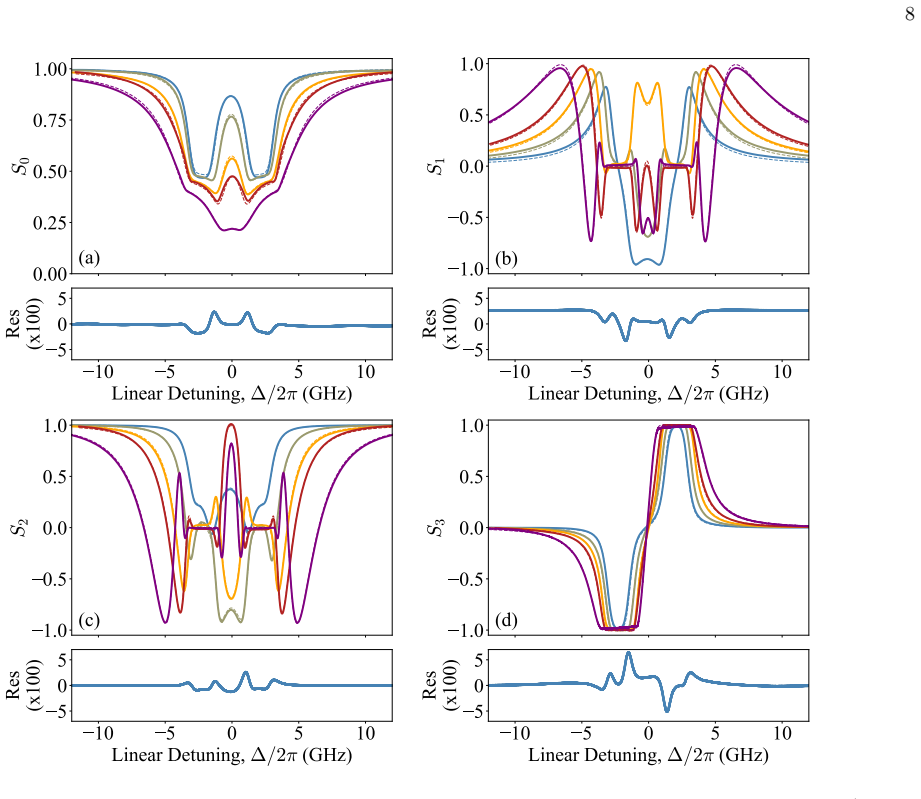
The central claim is that ElecSus, extended to include buffer-gas collisions, accounts for the full polarisation evolution of D1 light transmitted through a 25 mm potassium cell containing 60 Torr of neon. The measured S0 and S3 profiles follow the imaginary part of the susceptibility (absorption and circular dichroism), while S1 and S2 follow the real part (birefringence and Faraday rotation); the paper shows that both classes of features are captured by a single fit that allows stem temperature, cell temperature, line shift, and broadening to vary. Agreement is claimed for five temperatures at 1160 G and for three field strengths at 120 °C, with fitted field values matching the applied fields. This is the first application of ElecSus to buffer-gas polarimetry of the potassium D1 line.
Load-bearing premise
The fits assume a single, uniform magnetic field along the cell even though the real field varies by up to 23% RMS along the sample; if that inhomogeneity materially changes how the polarisation evolves, the fitted field, shift, and broadening are biased and the validation would not be complete.
Editorial extensions
If this is right
- If the model is right, potassium D1 buffer-gas cells can have their Stokes spectra predicted from cell parameters rather than calibrated by measurement.
- The sensitive oscillatory zero-crossings in S1 and S2 imply that temperature drift changes optical-rotation features, so laser locks based on these crossings must stabilise cell temperature.
- S3 at line centre gives a sharp, temperature-driven measure of the buffer-gas pressure shift, offering a practical way to characterise filling pressure.
- The demonstrated fits at fields with up to 23% RMS axial variation suggest that the uniform-field approximation is adequate at these high fields, extending confidence to magneto-optical filter designs.
Reading between the lines
- A natural extension is to repeat the measurement at lower fields or with deliberately engineered field gradients; if residuals grow as the RMS variation rises, a multi-zone propagation model may be needed, which would constrain how far the single-field approximation reaches.
- The fitted pressure-shift values could be checked against independent line-shift measurements, which would separate collisional physics from magnetic-field inhomogeneity; the paper does not perform that check.
- The same Stokes-polarimetry protocol could be applied to the potassium D2 line or to other noble gases; success on D1 does not guarantee equal accuracy for D2 fine-structure collisions.
- If the model generalises, instrument builders could design wing-selector magneto-optical filters for potassium without empirical iteration, since the dispersive and absorptive responses would both be predictable.
Signed reviews
Editorial analysis
A structured set of objections, weighed in public.
Referee Report
Summary. The manuscript reports an experimental and theoretical study of Stokes polarimetry of the potassium D1 line in a 25 mm vapour cell containing 60 Torr of neon buffer gas, with magnetic fields in the range 750–1200 G in Faraday geometry and vapour temperatures of 93–129 °C. The authors measure all four Stokes parameters in the weak-probe regime and compare them with theoretical spectra computed using the ElecSus package, extended to include buffer-gas collisions. The central claim is that ElecSus, with the buffer-gas terms included, reproduces the experimental spectra across the full investigated range, thereby validating both the real and imaginary parts of the electric susceptibility for this system. This is stated as the first application of ElecSus to buffer-gas polarimetry of the potassium D1 line.
Significance. If the central claim is substantiated, the work provides a useful benchmark for modelling polarimetric signals in buffer-gas-filled potassium cells, with direct relevance to solar magnetometry, magneto-optical filters, and frequency-stabilisation applications. The experiment is carefully designed: it operates in a well-characterised weak-probe regime, uses a calibrated polarimetry setup, and the data are made openly available. The use of an established, independently developed package (ElecSus) is a strength, and the paper contains helpful theoretical survey figures that map out the expected behaviour of the Stokes parameters as functions of temperature, field, and buffer-gas pressure. However, the validation claim is weakened by the fact that the comparison is made through fits in which several physical parameters are free, by the absence of reported fitted parameter values and uncertainties, and by the acknowledged but unmodelled inhomogeneity of the magnetic field. These issues do not undermine the experimental observations, but they do limit the strength of the conclusion that the model is fully validated for both the real and imaginary susceptibility.
major comments (3)
- [Section IV.B, Figure 6] The manuscript reports axial RMS magnetic-field variations of 23%, 13%, and 3% over the vapour cell at the three magnet separations, yet the ElecSus fits treat the field as a single uniform value. At the 767 G setting, a 23% RMS variation corresponds to roughly ±180 G, and with the σ± Zeeman shifts scaling at about 1.4 MHz/G the resonance positions vary by several hundred MHz along the cell, which is an appreciable fraction of the spectral linewidth. Since the Stokes parameters S1 and S2 accumulate Faraday rotation through the entire cell, a single-B transfer matrix is not obviously a valid description. This is particularly concerning because the magnetic field values quoted in Figure 6 are themselves obtained by fitting ElecSus to the spectra, so the fit can absorb the field inhomogeneity into B, the collision shift, and the broadening. The paper's conclusion in Section V that ElecSus 'fully accounted for' both real and imaginary susceptibility is therefore not established at the 767 G setting. The authors should either incorporate the measured field profile into the model, demonstrate explicitly that the fitted parameters are insensitive to the inhomogeneity, or substantially soften the validation claim.
- [Section IV, fitting procedure] The fitting procedure allows the stem temperature, cell temperature, shift, and broadening to vary, and the magnetic field is also extracted from the spectra, but no values or uncertainties are reported for any of these fitted quantities. Without this information, the reader cannot assess whether the agreement between the dashed curves and the data reflects genuine model physics or merely the flexibility of a five-parameter fit. The residuals shown in Figure 5 are only for one temperature (Ts = 93 °C), and Figure 6 shows no residuals at all. Quantitative goodness-of-fit measures, such as RMS residuals or a reduced chi-squared value, should be reported for every spectrum, and the fitted values of B, shift, and broadening should be tabulated and compared with independent measurements or literature values where available. This is load-bearing because the central claim is a model validation, not simply a demonstration that curves can be made to overlap.
- [Section V, conclusions] The statement that the results confirm that 'both the real and imaginary components of the electric susceptibility are fully accounted for in the model' goes beyond what the data and analysis demonstrate. While it is true that S0 and S3 are governed by the imaginary part and S1 and S2 by the real part, the same fitted parameters are used to match all four spectra simultaneously, so the agreement is partly guaranteed by construction and does not constitute an independent cross-validation of the two components. A stronger test would be to fit the model to one subset of the Stokes parameters and then predict the remaining ones, or to compare the extracted pressure-shift and broadening rates with existing measurements for K–Ne collisions. As written, the conclusion is not proportionate to the evidence presented.
minor comments (5)
- [Section III, experimental setup] There is a typographical error in the description of the vapour cell: 'constructured' should read 'constructed'.
- [Section IV.A, text near Eq. (4)] The sentence 'to measure the S1 parameter, as defined in Eqn. 4' is incorrect; S1 is defined in Eq. (2), not Eq. (4).
- [Section II, Fig. 1 caption and text] The word 'pressence' appears in the caption of Figure 1 and should be 'presence'; similarly, 'dichrosim' in the description of Figure 1(d) should be 'dichroism'.
- [Section IV.B, magnetic field discussion] The sentence 'Irrespective of this, the spectra agree well with ElecSus, as confirmed by the residuals' is not a substitute for a quantitative treatment of the field inhomogeneity; this sentence should either be removed or replaced with a supporting analysis.
- [General] Several other typographical errors occur in the text, including 'though' for 'through' in the introduction and 'Fig. 4' being referenced with a space before the number in one place; a careful proofreading pass is recommended.
Circularity Check
In-sample fits are relabeled as validation: the ElecSus curves in Figs. 5-6 use parameters (including B) fitted to the same spectra, so the claim that both susceptibility components are 'fully accounted for' is not an independent prediction.
-
fitted input called prediction
[Section IV.A (fitting procedure) and Section V (conclusion)]
"We fitted the experimental spectra using ElecSus by means of a differential evolution algorithm, allowing the stem temperature, cell temperature, shift and broadening to vary. ... By incorporating temperature-dependent atomic density, Doppler broadening, and, crucially, the effects of neon buffer gas (pressure broadening and shifts), the theoretical predictions generated by ElecSus showed excellent agreement with our experimental spectra across varying conditions, ... confirming that both the real and imaginary components of the electric susceptibility are fully accounted for in the model."
The agreement displayed in Figs. 5-6 is not a prediction from fixed, independently known parameters: Ts, Tc, the collisional shift and the broadening are all estimated by fitting ElecSus to those same spectra. Calling the resulting curves 'theoretical predictions' and using them to validate the model and to assert that both real and imaginary parts of the susceptibility are fully accounted for converts an in-sample goodness-of-fit into an apparent confirmation. Because the free parameters can absorb part of the data, the residuals do not by themselves establish the model's correctness or the uniqueness of the extracted parameters.
-
fitted input called prediction
[Section IV.B (magnetic field dependence)]
"The spectra are recorded at three different magnetic field strengths that are measured by fitting the spectra to ElecSus. ... Theoretical modelling of the magnetic field profile at these three permanent magnetic separations gives mean field values in agreement with experiment and predicts axial root-mean-square magnetic field variations of 23%, 13% and 3% over the vapour cell length, respectively."
The B values labelling the field-dependence data and used to generate the ElecSus curves are themselves obtained by fitting ElecSus to those very spectra, so the field axis is not an independent control variable. The agreement in Fig. 6 is therefore partly guaranteed by construction of the fitted B. This is aggravated by the reported 23% axial RMS field variation at the 767 G setting: a single-B fit can absorb the inhomogeneity into an effective B and into the fitted shift and broadening, so the residuals do not independently validate the model at that setting.
full rationale
The paper is not circular in the definitional sense: ElecSus computes the complex susceptibility from atomic physics, and the Stokes parameters are forward-modeled from it; the key formulas are not defined in terms of the experimental outputs. The circularity is instead the pattern-2 variety. The parameters that enter the theoretical curves—stem temperature, cell temperature, shift, broadening, and, in Fig. 6, the magnetic field itself—are extracted by fitting ElecSus to the same data that the conclusion then cites as 'excellent agreement' and as validation that both the real and imaginary components of the susceptibility are fully accounted for. In-sample agreement is a consistency check, not an out-of-sample prediction, and the paper does not report the fitted shift and broadening values against external references, so the possibility of overfitting or of absorbing the known field inhomogeneity into effective parameters is not excluded. The self-citations to ElecSus and to the authors' earlier buffer-gas paper [44] do not by themselves create circularity, because the software is code-based and the buffer-gas coefficients are re-fitted here; however, the absence of any fixed, independently measured parameter in the validation means the central claim leans on the fit. The reported 23% axial RMS B variation at the lowest field is a separate correctness risk but not a circular step. Score 6 reflects partial circularity: the 'predictions' reduce to fitted values, while the underlying spectral model remains independently grounded.
Assumptions & free parameters
free parameters (5)
- Stem temperature Ts =
93, 103, 110, 118, 129 C (fit results; individual uncertainties not reported)
- Cell body temperature Tc =
Not quoted; maintained near Ts + 20 C, fit bounds +/- 5 C
- Buffer gas frequency shift =
Not reported
- Buffer gas pressure broadening rate =
Not reported
- Magnetic field B =
(767 +/- 3), (950 +/- 3), (1160 +/- 4) G for field-dependence runs
assumptions (5)
- domain assumption Weak-probe regime: laser intensity is low enough that the probe does not perturb ground-state populations, so the response is linear in the electric susceptibility.
- domain assumption Faraday geometry with axial field, so only left- and right-circular eigenmodes are excited; no pi transitions because there is no electric field component parallel to B.
- domain assumption The applied field is deep in the Hyperfine Paschen-Back regime (B > B_HPB ~165 G for 39K), justifying the simplified eigenbasis used in the model.
- domain assumption ElecSus's collisional broadening and shift parameterization for Ne on K D1 is correct for the operating conditions.
- ad hoc to paper The magnetic field is effectively uniform over the cell length at the fitted B value.
Cite this review
Pith. "Pith review of Experimental and theoretical characterisation of Stokes polarimetry of the potassium D1 line with neon buffer gas broadening." pith.science (2026). https://pith.science/paper/2GZU3ERW
@misc{pith2026250718353,
  author       = {Pith},
  title        = {Pith review of: Experimental and theoretical characterisation of Stokes polarimetry of the potassium D1 line with neon buffer gas broadening},
  year         = {2026},
  howpublished = {\url{https://pith.science/paper/2GZU3ERW}},
  note         = {Machine review of arXiv:2507.18353}
}
abstract
This study presents a comprehensive experimental and theoretical characterisation of Stokes polarimetry in potassium (K) vapour on the D1 line. Measurements were performed in the weak-probe regime, investigating the influence of neon buffer gas in the presence of an applied magnetic field in the Faraday geometry. While previous Stokes polarimetry studies in alkali-metal vapours have been conducted, the specific effects of buffer gas-induced broadening and shifts on the observed Stokes parameters remained largely underexplored. Here, experimental measurements of absolute absorption and dispersion were compared with a theoretical model for the electric susceptibility of the vapour, calculated using the established software package $ElecSus$. This work marks the first application of $ElecSus$ to model buffer gas polarimetry of the potassium D1 line, with validation performed against experimental spectra for magnetic fields up to 1.2 kG. Our findings provide new insight into how the presence of buffer gas influences the observed Stokes parameters, thereby enhancing the predictive capabilities of theoretical frameworks for atom-light interactions in buffer-gas environments.
Figures


Figures from the paper (4 more)



Reference graph
Works this paper leans on
-
[1]
Oberthaler, Ro- man Schmied, and Philipp Treutlein
Luca Pezz´ e, Augusto Smerzi, Markus K. Oberthaler, Ro- man Schmied, and Philipp Treutlein. Quantum metrol- ogy with nonclassical states of atomic ensembles.Reviews of Modern Physics , 90(3), Sep 2018
work page 2018
-
[2]
The solar activity monitor network–samnet, 2022
Robertus Erd´ elyi, Marianna B Kors´ os, Xin Huang, Yong Yang, Danielle Pizzey, Steven A Wrathmall, Ifan G Hughes, Martin J Dyer, Vikram S Dhillon, Bernadett Belucz, et al. The solar activity monitor network–samnet, 2022
work page 2022
-
[3]
F Vargas, A Liu, G Swenson, et al. Mesosphere and lower thermosphere changes associated with the July 2, 2019 total eclipse in South America over the Andes Lidar Ob- servatory, Cerro Pachon, Chile. Journal of Geophysical Research: Atmospheres, 127:e2021JD035064, 2022
work page 2019
-
[4]
A Cacciani and M Fofi. The magneto-optical filter. Solar Physics, 59(1):179–189, 1978
work page 1978
-
[5]
R. Zhang et al. Recording brain activities in unshielded Earth’s field with optically pumped atomic magnetome- ters. Sci. Adv., 6(24):eaba8792, 2020
work page 2020
-
[6]
E. Boto et al. A new generation of magnetoencephalogra- phy: Room temperature measurements using optically- pumped magnetometers. NeuroImage, 149:404–414, 2017
work page 2017
-
[7]
Atom-Photon Interactions: Basic Process and Applications
Gilbert Grynberg Claude Cohen-Tannoudji, Jacques Dupont-Roc. Atom-Photon Interactions: Basic Process and Applications. WILEY-VCH, 1998
work page 1998
-
[8]
Higgins, Danielle Pizzey, Ifan G
Sphinx Svensson, Clare R. Higgins, Danielle Pizzey, Ifan G. Hughes, and Sonja Franke-Arnold. Visualizing strongly focused 3D light fields in an atomic vapor. arXiv preprint arXiv:2506.01680, 2025
arXiv 2025
Show all 76 references
-
[9]
Landi Degl’Innocenti and M
E. Landi Degl’Innocenti and M. Landolfi. Polarization in Spectral Lines. Springer Nature Link, 2004
2004
-
[10]
Resonant nonlinear magneto-optical effects in atoms
Dmitry Budker, Wojciech Gawlik, DF Kimball, SM Rochester, VV Yashchuk, and A Weis. Resonant nonlinear magneto-optical effects in atoms. Reviews of modern physics, 74(4):1153, 2002
2002
-
[11]
Optical magne- tometry
Dmitry Budker and Michael Romalis. Optical magne- tometry. Nature Physics, 3(4):227–234, Apr 2007
2007
-
[12]
How to build a magnetometer with thermal atomic vapor: a tutorial
Anne Fabricant, Irina Novikova, and Georg Bison. How to build a magnetometer with thermal atomic vapor: a tutorial. New Journal of Physics , 25(2):025001, 2023
2023
-
[13]
A practical guide to electromagnetically in- duced transparency in atomic vapor
Ran Finkelstein, Samir Bali, Ofer Firstenberg, and Irina Novikova. A practical guide to electromagnetically in- duced transparency in atomic vapor. New Journal of Physics, 25(3):035001, 2023
2023
-
[14]
A practical guide to terahertz imaging us- ing thermal atomic vapour
Lucy A Downes, Lara Torralbo-Campo, and Kevin J Weatherill. A practical guide to terahertz imaging us- ing thermal atomic vapour. New Journal of Physics , 25(3):035002, 2023
2023
-
[15]
Hot atomic vapors for nonlinear and quan- tum optics
Quentin Glorieux, Tangui Aladjidi, Paul D Lett, and Robin Kaiser. Hot atomic vapors for nonlinear and quan- tum optics. New Journal of Physics , 25(5):051201, 2023
2023
-
[16]
Manipulating the dipolar interac- tions and cooperative effects in confined geometries
Hadiseh Alaeian, Artur Skljarow, Stefan Scheel, Tilman Pfau, and Robert L¨ ow. Manipulating the dipolar interac- tions and cooperative effects in confined geometries. New Journal of Physics , 2024
2024
-
[17]
In- terplay of electromagnetically induced transparency and doppler broadening in hot atomic vapors
Lida Zhang, Nina Stiesdal, Hannes Busche, Mikkel Gaard Hansen, Thomas Pohl, and Sebastian Hofferberth. In- terplay of electromagnetically induced transparency and doppler broadening in hot atomic vapors. New Journal of Physics, 26(7):075002, 2024
2024
-
[18]
Tu- torial on laser locking techniques and the manufacturing of vapor cells for spectroscopy
Max M¨ ausezahl, Fabian Munkes, and Robert L¨ ow. Tu- torial on laser locking techniques and the manufacturing of vapor cells for spectroscopy. New Journal of Physics , 26(10):105002, 2024
2024
-
[19]
How to build an optical filter with an atomic vapor cell
Denis Uhland, Helena Dillmann, Yijun Wang, and Ilja Gerhardt. How to build an optical filter with an atomic vapor cell. New Journal of Physics , 25(12):125001, 2023
2023
-
[20]
Laser spectroscopy of hot atomic vapours: from’scope to theoretical fit
D Pizzey, JD Briscoe, FD Logue, FS Ponciano-Ojeda, SA Wrathmall, and IG Hughes. Laser spectroscopy of hot atomic vapours: from’scope to theoretical fit. New Journal of Physics , 24(12):125001, 2022
2022
-
[21]
Measuring the Stokes pa- rameters for light transmitted by a high-density rubid- ium vapour in large magnetic fields
Lee Weller, Toryn Dalton, Paul Siddons, Charles S Adams, and Ifan G Hughes. Measuring the Stokes pa- rameters for light transmitted by a high-density rubid- ium vapour in large magnetic fields. Journal of Physics B: Atomic, Molecular and Optical Physics , 45(5):055001, feb 2012
2012
-
[22]
Absorption spectroscopy and stokes polarime- try in a 87rb vapour in the voigt geometry with a 1.5 t external magnetic field
Francisco S Ponciano-Ojeda, Fraser D Logue, and Ifan G Hughes. Absorption spectroscopy and stokes polarime- try in a 87rb vapour in the voigt geometry with a 1.5 t external magnetic field. Journal of Physics B: Atomic, Molecular and Optical Physics , 54(1):015401, 2020
2020
-
[23]
One- dimensional mixtures of several ultracold atoms: a re- view
Tomasz Sowi´ nski and Miguel´Angel Garc´ ıa-March. One- dimensional mixtures of several ultracold atoms: a re- view. Reports on Progress in Physics , 82(10):104401, 2019
2019
-
[24]
Collective flow of fermionic impurities immersed in a bose–einstein condensate
Zoe Z Yan, Yiqi Ni, Alexander Chuang, Pavel E Dolgirev, Kushal Seetharam, Eugene Demler, Carsten Robens, and Martin Zwierlein. Collective flow of fermionic impurities immersed in a bose–einstein condensate. Nature Physics, 20(9):1395–1400, 2024. 11
2024
-
[25]
Simultaneous sub-doppler laser cool- ing of fermionic li 6 and k 40 on the d 1 line: Theory and experiment
Franz Sievers, Norman Kretzschmar, Diogo Rio Fer- nandes, Daniel Suchet, Michael Rabinovic, Saijun Wu, Colin V Parker, Lev Khaykovich, Christophe Salomon, and Fr´ ed´ eric Chevy. Simultaneous sub-doppler laser cool- ing of fermionic li 6 and k 40 on the d 1 line: Theory and ex...
2015
-
[26]
Sub-doppler laser cooling of fermionic 40k atoms in three- dimensional gray optical molasses
D Rio Fernandes, Franz Sievers, Norman Kretzschmar, Saijun Wu, Christophe Salomon, and Fr´ ed´ eric Chevy. Sub-doppler laser cooling of fermionic 40k atoms in three- dimensional gray optical molasses. Europhysics Letters, 100(6):63001, 2012
2012
-
[27]
Quantum-interference-enhanced deep sub-doppler cooling of 39 k atoms in gray mo- lasses
Dipankar Nath, R Kollengode Easwaran, G Rajalakshmi, and CS Unnikrishnan. Quantum-interference-enhanced deep sub-doppler cooling of 39 k atoms in gray mo- lasses. Physical Review A—Atomic, Molecular, and Op- tical Physics, 88(5):053407, 2013
2013
-
[28]
Buffer- gas-induced linewidth reduction of coherent dark reso- nances to below 50 hz
S Brandt, A Nagel, R Wynands, and D Meschede. Buffer- gas-induced linewidth reduction of coherent dark reso- nances to below 50 hz. Physical Review A, 56(2):R1063, 1997
1997
-
[29]
Atomic clocks based on coherent popula- tion trapping: a review
Jacques Vanier. Atomic clocks based on coherent popula- tion trapping: a review. Applied Physics B , 81:421–442, 2005
2005
-
[30]
Kroemer, M
E. Kroemer, M. Abdel Hafiz, V. Maurice, B. Fouilland, C. Gorecki, and R. Boudot. Cs vapor microcells with Ne-He buffer gas mixture for high operation-temperature miniature atomic clocks. Opt. Express , 23(14):18373– 18380, Jul 2015
2015
-
[31]
The effect of neutral nonresonant collisions on atomic spectral lines
Nicole Allard and John Kielkopf. The effect of neutral nonresonant collisions on atomic spectral lines. Reviews of modern physics , 54(4):1103, 1982
1982
-
[32]
Cusp Kernels for Velocity-Changing Collisions
McGuyer B H, Marsland R, Olsen B A, and Happer W. Cusp Kernels for Velocity-Changing Collisions. Phys. Rev. Lett., 108:183202, May 2012
2012
-
[33]
Fine-structure changing collisions in 87rb upon d2 ex- citation in the hyperfine paschen-back regime
Clare R Higgins, Danielle Pizzey, and Ifan G Hughes. Fine-structure changing collisions in 87rb upon d2 ex- citation in the hyperfine paschen-back regime. Journal of Physics B: Atomic, Molecular and Optical Physics , 57(23):235002, nov 2024
2024
-
[34]
Collisional broadening and shift of the rubidium d1 and d2 lines (52s12→ 52p12, 52p32) by rare gases, h2, d2, n2, ch4 and cf4
Matthew D Rotondaro and Glen P Perram. Collisional broadening and shift of the rubidium d1 and d2 lines (52s12→ 52p12, 52p32) by rare gases, h2, d2, n2, ch4 and cf4. Journal of Quantitative Spectroscopy and Radiative Transfer, 57(4):497–507, 1997
1997
-
[35]
Collision- induced transitions between the zeeman-split (j, m) lev- els of rb (5 2 p 1/2, 5 2 p 3/2)
Matthew D Rotondaro and Glen P Perram. Collision- induced transitions between the zeeman-split (j, m) lev- els of rb (5 2 p 1/2, 5 2 p 3/2). Physical Review A , 58(3):2023, 1998
2023
-
[36]
Pressure broadening and shift of the potassium D1 transition by the noble gases and N 2, H 2, HD, D 2, CH 4, C 2H6, C 3H8, and n-C 4H10 with compar- ison to other alkali rates
Pitz G A, Sandoval A J, Zameroski N D, Klennert W L, and Hostutler D A. Pressure broadening and shift of the potassium D1 transition by the noble gases and N 2, H 2, HD, D 2, CH 4, C 2H6, C 3H8, and n-C 4H10 with compar- ison to other alkali rates. Journal of Quantitative Spec...
2012
-
[37]
Pressure broadening and shift of the cesium D1 transition by the noble gases and N 2, H 2, HD, D 2, CH 4, C 2H6, CF 4, and 3He
Pitz G A, Wertepny D E, and Perram G P. Pressure broadening and shift of the cesium D1 transition by the noble gases and N 2, H 2, HD, D 2, CH 4, C 2H6, CF 4, and 3He. Physical Review A, 80(6):062718, 2009
2009
-
[38]
Pressure broadening and collisional shift of the Rb D2 absorption line by CH 4, C2H6, C3H8, n-C4H10, and He
Zameroski N D, Hager G D, Rudolph W, Erickson C J, and Hostutler D A. Pressure broadening and collisional shift of the Rb D2 absorption line by CH 4, C2H6, C3H8, n-C4H10, and He. Journal of Quantitative Spectroscopy and Radiative Transfer, 112(1):59–67, 2011
2011
-
[39]
High-resolution mea- surement of the pressure broadening and shift of the Cs D1 and D2 lines by N 2 and He buffer gases
Andalkar A and Warrington R B. High-resolution mea- surement of the pressure broadening and shift of the Cs D1 and D2 lines by N 2 and He buffer gases. Physical review A, 65(3):032708, 2002
2002
-
[40]
Atomic and laser spectroscopy
Alan Corney. Atomic and laser spectroscopy. Clarendon Press Oxford, 1978
1978
-
[41]
Collisional relaxation of atomic excited states, line broadening and interatomic interactions.Physics Re- ports, 58(1):1–71, 1980
EL Lewis. Collisional relaxation of atomic excited states, line broadening and interatomic interactions.Physics Re- ports, 58(1):1–71, 1980
1980
-
[42]
Springer Science & Business Media, 1999
Anne Thorne, Ulf Litz´ en, and Sveneric Johansson.Spec- trophysics: principles and applications . Springer Science & Business Media, 1999
1999
-
[43]
Pressure broadening and shift of K D1 and D2 lines in the presence of 3He and 21Ne
Li R, Li Y, Jiang L, Quan W, Ding M, and Fang J. Pressure broadening and shift of K D1 and D2 lines in the presence of 3He and 21Ne. The European Physical Journal D, 70:1–7, 2016
2016
-
[44]
The role of buffer gas in shap- ing the d1 line spectrum of potassium vapour
Sharaa A Alqarni, Danielle Pizzey, Steven A Wrathmall, and Ifan G Hughes. The role of buffer gas in shap- ing the d1 line spectrum of potassium vapour. Jour- nal of Physics B: Atomic, Molecular and Optical Physics , 58(13):135201, jul 2025
2025
-
[45]
Zentile, James Keaveney, Lee Weller, Daniel J
Mark A. Zentile, James Keaveney, Lee Weller, Daniel J. Whiting, Charles S. Adams, and Ifan G. Hughes. Elec- Sus: A program to calculate the electric susceptibility of an atomic ensemble. Comput. Phys. Commun. , 189:162– 174, apr 2015
2015
-
[46]
ElecSus: Ex- tension to arbitrary geometry magneto-optics
Keaveney J, Adams C S, and Hughes I G. ElecSus: Ex- tension to arbitrary geometry magneto-optics. Computer physics communications, 224:311–324, 2018
2018
-
[47]
Selective reflection of potas- sium vapor nanolayers in a magnetic field
A Sargsyan, A Tonoyan, J Keaveney, IG Hughes, CS Adams, and D Sarkisyan. Selective reflection of potas- sium vapor nanolayers in a magnetic field. Journal of Ex- perimental and Theoretical Physics, 126:293–301, 2018
2018
-
[48]
Modelling the response of potassium vapour in resonance scattering spectroscopy
Hale SJ, Chaplin WJ, Davies GR, and Elsworth YP. Modelling the response of potassium vapour in resonance scattering spectroscopy. Journal of Physics B: Atomic, Molecular and Optical Physics , 53(8):085003, 2020
2020
-
[49]
The first light of the Solar Activity MOF Monitor Tele- scope (SAMM)
Speziali R, Di Paola A., Centrone M, Oliviero M, Calia D B, Dal Sasso L, Faccini M, Mauriello V, and Terranegra L. The first light of the Solar Activity MOF Monitor Tele- scope (SAMM). J. Space Weather Space Clim. , 11:22, 2021
2021
-
[50]
Data re- duction pipeline for MOF-based synoptic telescopes
Forte R, Berrilli F, Calchetti D, Del Moro D, Fleck B, Giebink C, Giebink W, Giovannelli L, Jefferies S M, Knox A, Magr` ı M, Murphy N, Nitta G, Oliviero M, Pietropaolo E, Rodgers W, Scardigli S, and Viavattene G. Data re- duction pipeline for MOF-based synoptic telescopes. J....
2020
-
[51]
The Tor Vergata Synoptic Solar Telescope (TSST): a robotic, compact facility for solar full disk imaging
Luca Giovannelli, Francesco Berrilli, Daniele Calchetti, et al. The Tor Vergata Synoptic Solar Telescope (TSST): a robotic, compact facility for solar full disk imaging. Journal of Space Weather and Space Climate , 10:58, 2020
2020
-
[52]
Indirect measurement of atomic magneto-optical rotation via hilbert transform
Jack D Briscoe, Danielle Pizzey, Steven A Wrathmall, and Ifan G Hughes. Indirect measurement of atomic magneto-optical rotation via hilbert transform. Jour- nal of Physics B: Atomic, Molecular and Optical Physics , 57(17):175401, 2024
2024
-
[53]
Absolute absorption on the potassium d lines: theory and experiment
Ryan K Hanley, Philip D Gregory, Ifan G Hughes, and Simon L Cornish. Absolute absorption on the potassium d lines: theory and experiment. Journal of Physics B: Atomic, Molecular and Optical Physics , 48(19):195004, 2015
2015
-
[54]
Smith and Ifan G
David A. Smith and Ifan G. Hughes. The role of hyper- fine pumping in multilevel systems exhibiting saturated 12 absorption. American Journal of Physics, 72(5):631–637, 2004
2004
-
[55]
Sherlock and Ifan G
Ben E. Sherlock and Ifan G. Hughes. How weak is a weak probe in laser spectroscopy? American Journal of Physics, 77(2):111–115, 2009
2009
-
[56]
Briscoe, Danielle Pizzey, Robert M
Jack D. Briscoe, Danielle Pizzey, Robert M. Potvliege, Steven A. Wrathmall, and Ifan G. Hughes. Light prop- agation through an atomic vapor in the presence of a magnetic field of arbitrary direction: taking the non- orthogonality of the electric field modes into account. Opt. ...
2025
-
[57]
Principles of optics: electro- magnetic theory of propagation, interference and diffrac- tion of light
Max Born and Emil Wolf. Principles of optics: electro- magnetic theory of propagation, interference and diffrac- tion of light . Elsevier, 2013
2013
-
[58]
On the composition and resolu- tion of streams of polarized light from different sources
George Gabriel Stokes. On the composition and resolu- tion of streams of polarized light from different sources. Transactions of the Cambridge Philosophical Society , 9:399, 1851
-
[59]
Polarization in Spectral Lines
Marco Landolfi. Polarization in Spectral Lines . Kluwer Academic, 2004
2004
-
[60]
Measuring the stokes po- larization parameters
Beth Schaefer, Edward Collett, Robert Smyth, Daniel Barrett, and Beth Fraher. Measuring the stokes po- larization parameters. American Journal of Physics , 75(2):163–168, 2007
2007
-
[61]
Optically polarized atoms: understanding light-atom in- teractions
Marcis Auzinsh, Dmitry Budker, and Simon Rochester. Optically polarized atoms: understanding light-atom in- teractions. Oxford University Press, 2010
2010
-
[62]
C. S. Adams and I. G. Hughes. Optics f2f - From Fourier to Fresnel. Oxford University Press, Oxford, UK, 2019
2019
-
[63]
Off- resonance absorption and dispersion in vapours of hot alkali-metal atoms
Paul Siddons, Charles S Adams, and Ifan G Hughes. Off- resonance absorption and dispersion in vapours of hot alkali-metal atoms. Journal of Physics B: Atomic, Molec- ular and Optical Physics , 42(17):175004, 2009
2009
-
[64]
A gigahertz-bandwidth atomic probe based on the slow-light faraday effect
Paul Siddons, Nia C Bell, Yifei Cai, Charles S Adams, and Ifan G Hughes. A gigahertz-bandwidth atomic probe based on the slow-light faraday effect. Nature Photonics, 3(4):225–229, 2009
2009
-
[65]
An analytical model of off-resonant faraday rotation in hot alkali metal vapours
Stefan L Kemp, Ifan G Hughes, and Simon L Cornish. An analytical model of off-resonant faraday rotation in hot alkali metal vapours. Journal of Physics B: Atomic, Molecular and Optical Physics , 44(23):235004, 2011
2011
-
[66]
Laser offset stabilization with chip-scale atomic diffractive ele- ments
Heleni Krelman, Ori Nefesh, Kfir Levi, Douglas G Bopp, Songbai Kang, John E Kitching, and Liron Stern. Laser offset stabilization with chip-scale atomic diffractive ele- ments. Physical Review Applied, 23(3):034011, 2025
2025
-
[67]
Laser frequency stabilization using zeeman effect
B Ch´ eron, H Gilles, J Hamel, O Moreau, and H Sorel. Laser frequency stabilization using zeeman effect. Jour- nal de Physique III , 4(2):401–406, 1994
1994
-
[68]
Frequency- stabilized diode laser with the zeeman shift in an atomic vapor
Kristan L Corwin, Zheng-Tian Lu, Carter F Hand, Ryan J Epstein, and Carl E Wieman. Frequency- stabilized diode laser with the zeeman shift in an atomic vapor. Applied optics, 37(15):3295–3298, 1998
1998
-
[69]
Zeeman effect spectroscopically locked cs diode laser system for atomic physics
KR Overstreet, J Franklin, and JP Shaffer. Zeeman effect spectroscopically locked cs diode laser system for atomic physics. Review of scientific instruments , 75(11):4749– 4753, 2004
2004
-
[70]
Davll lineshapes in atomic ru- bidium
Alfred Millett-Sikking, Ifan G Hughes, Patrick Tierney, and Simon L Cornish. Davll lineshapes in atomic ru- bidium. Journal of Physics B: Atomic, Molecular and Optical Physics, 40(1):187, 2006
2006
-
[71]
Temperature stability of a dichroic atomic vapor laser lock
Jessica M Reeves, Ofir Garcia, and Charles A Sackett. Temperature stability of a dichroic atomic vapor laser lock. Applied Optics, 45(2):372–376, 2006
2006
-
[72]
Quantum electronics for atomic physics and telecommunication
Warren Nagourney. Quantum electronics for atomic physics and telecommunication. OUP Oxford, 2014
2014
-
[73]
Off-resonance laser frequency stabilization using the faraday effect
Anna L Marchant, Sylvi H¨ andel, Timothy P Wiles, Stephen A Hopkins, Charles S Adams, and Simon L Cor- nish. Off-resonance laser frequency stabilization using the faraday effect. Optics letters, 36(1):64–66, 2010
2010
-
[74]
The hy- perfine Paschen–Back Faraday effect
Mark A Zentile, Rebecca Andrews, Lee Weller, Svenja Knappe, Charles S Adams, and Ifan G Hughes. The hy- perfine Paschen–Back Faraday effect. Journal of Physics B: Atomic, Molecular and Optical Physics , 47(7):075005, mar 2014
2014
-
[75]
Tunable homogeneous kG magnetic field pro- duction using permanent magnets
Pizzey D. Tunable homogeneous kG magnetic field pro- duction using permanent magnets. Review of Scientific Instruments, 92(12):123002, 2021
2021
-
[76]
Measurements and their uncertainties: a practical guide to modern error analysis
Ifan Hughes and Thomas Hase. Measurements and their uncertainties: a practical guide to modern error analysis . OUP Oxford, 2010
2010
Reviewed August 15, 2026 · model on record in the stance chip above.
Discussion (0). Continue with ORCID to comment.