REVIEW 3 major objections 6 minor 76 references
The phase spiral's origin and evolution: indications from its varying properties across the Milky Way disk
T0 review · 3 major / 6 minor · reviewed 2026-08-15 · deepseek-v4-flash
Pith's one-line read The Milky Way's phase spiral was likely set by a global perturbation, because its rotation phase is uniform across the disk.
desk verdict Genuinely new maps of phase-spiral morphology across the disk, with a plausible but not airtight case for a global-perturbation origin; worth refereeing, but it needs error bars and a harder look at selection systematics. read the letter →
The pith
A machine-rendered reading of the paper's core claim, the machinery that carries it, and where it could break.
The reading
What carries the argument
The argument runs on a morphological parametrization of the spiral that avoids degeneracies between physical quantities. The model writes the spiral as a small relative overdensity on a smooth background, with a phase function $\varphi(E_z)=\varphi_{\rm init.}+2\pi t_\omega/P(E_z)$ that advances with vertical period $P(E_z)$; the fitted parameters are the vertical potential scaling $A_\Phi$, the winding $\omega$ between anchor heights 300 and 800 pc, the rotation phase $\varphi_{600}$ at 600 pc, and the one- and two-armed amplitudes $\alpha$ and $\beta$. The data side uses two complementary binnings: a hexagonal spatial grid with 400 pc spacing reaching 4 kpc, built from Gaia proper motions plus neural-network-predicted line-of-sight velocities where needed, and a nearby sample split in $v_R$ and $v_\phi$ into 508 phase-space bins. Selection effects are handled by renormalizing each vertical phase-space histogram to a fixed density profile in $z$, under the assumption that incompleteness is mostly a function of height. This lets the authors extract the spiral's shape even where dust and crowding remove many stars, and then interpret the fitted morphology in terms of winding time using the vertical potential at each radius.
What would settle it
Restrict the analysis at distances beyond 1.6 kpc to stars with directly measured line-of-sight velocities, or redo the fit with a deeper future data release, and compare the inferred $\varphi_{600}$ radial profile to the one obtained with predicted velocities; a flat profile that persists would support the global-perturbation claim, while a radial trend appearing in the velocity-confirmed sample would show the flatness was a selection artifact.
Extended reading notes
Core claim
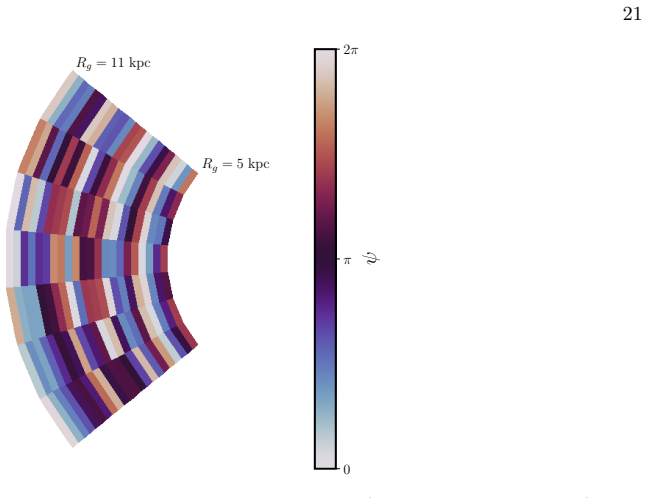
The paper's central claim is that the phase spiral's present-day morphology is set by a globally sourced perturbation. Fitting the relative density perturbation $S(E_z,\theta_z)=\alpha\cos(\theta_z-\varphi(E_z))+\beta\cos(2\theta_z-2\varphi(E_z))$, with vertical energy $E_z$ and phase angle $\theta_z$, the authors measure the winding $\omega$ between heights 300 and 800 pc and the rotation phase $\varphi_{600}$ at height 600 pc across the disk. Both parameters are close to flat in Galactocentric radius over roughly 6 to 11 kpc, with only small-scale excursions, most notably a high-winding band near $R\simeq 9$ kpc that lines up with the Local Arm. The uniformity of $\varphi_{600}$ is the paper's key evidence that the spiral was sourced by one or many global perturbations: local stochastic sources would not produce a correlated rotation phase over such a large area. A direct corollary is that the winding time has a strong radial slope, increasing from roughly 150 Myr at 7 kpc to 600 Myr at 9 kpc, which the paper notes cannot be explained by a single uniform perturbation time in one-dimensional vertical dynamics.
Load-bearing premise
The flat radial profile of the rotation phase, and with it the global-perturbation conclusion, assumes that dust extinction, stellar crowding, and the 25–30 km/s uncertainties of predicted line-of-sight velocities bias only the spiral's amplitude and not its measured phase.
Editorial extensions
If this is right
- If the rotation phase is truly uniform, the phase spiral was seeded by a global event or several events acting coherently, rather than by many independent small-scale perturbations; this disfavors dark-matter subhalo or gas-turbulence sourcing as the dominant mechanism.
- The inferred winding-time gradient means the same spiral is younger in the inner disk: about 150 Myr at 7 kpc versus 600 Myr at 9 kpc, so simple uniform-age models for the spiral must be revised.
- The high-winding band near $R\simeq 9$ kpc, aligned with the Local Arm, implies that local variations in the vertical potential's anharmonicity, possibly from cold gas, modulate how quickly the spiral winds.
- The maps give quantitative benchmarks: any self-consistent simulation of a satellite or bar perturbation should reproduce the smooth rotation phase and the steep winding-time gradient, not just the spiral's existence.
Reading between the lines
- If the global-perturbation interpretation is right, the smooth gradient of rotation phase across azimuth could encode the propagation of the perturbation through the disk; comparing it with back-propagated star positions might pin down the event time more precisely than current estimates.
- A perturbation time that scales inversely with disk surface density would naturally produce flat $\omega$ and $\varphi_{600}$ profiles; this is a concrete, testable rule for self-consistent simulations of satellite encounters.
- Because the winding responds to the vertical potential's anharmonicity, the measured winding map could be inverted, in combination with density maps, to constrain the cold-gas distribution across the disk.
- The same analysis applied to deeper proper-motion catalogs could extend the flat-rotation-phase test beyond 4 kpc and separate the global source from outer-disk warps or tidal effects.
Signed reviews
Editorial analysis
A structured set of objections, weighed in public.
Referee Report
Summary. The paper maps the vertical phase spiral's properties across the Milky Way disk using Gaia DR3 proper motions with BNN-predicted line-of-sight velocities, together with a spatially local sample requiring measured line-of-sight velocities. For each spatial or phase-space bin, the authors fit a mixture-model background plus a spiral perturbation, extracting the potential scaling AΦ, winding ω, rotation phase φ600, and single/double-arm amplitudes. They report that ω and especially φ600 vary smoothly with close-to-flat radial profiles over roughly 6 kpc in Galactocentric radius, which they interpret as evidence that the phase spiral was sourced by one or many global perturbations. They further derive that the implied winding time increases strongly with radius, from about 150 Myr at 7 kpc to about 600 Myr at 9 kpc. The paper includes comparisons with a test-particle simulation and with prior observational work, and emphasizes the complementary nature of the spatial and phase-space binning schemes.
Significance. If the reported uniformity of the rotation phase is real, it is a strong and direct observational constraint on the origin of the phase spiral, favoring global perturbations (e.g., a satellite or large-scale disk response) over spatially local stochastic sources. The paper's use of two complementary binning schemes, its detailed morphological parametrization, and the explicit comparison with a test-particle simulation in Appendix B are notable strengths, and the derived winding-time profile offers a falsifiable benchmark for future self-consistent simulations. However, the central quantitative claim is currently supported without reported parameter uncertainties, and the distant-bin phase-bias assumption is validated only indirectly through earlier work. These issues are load-bearing for the flatness and global-perturbation conclusions.
major comments (3)
- [§5.1, Figs. 4 and 6] The central claim that the winding ω and rotation phase φ600 have close-to-flat radial profiles is not supported by any reported uncertainty on the fitted parameters. Figures 4 and 6 show scatter points with no error bars, and Section 5 states that fits were selected by eye and 'dubious' fits omitted; Figure 9 additionally excludes seven high-winding-time outliers. Without a quantitative slope fit and a per-bin uncertainty budget (including the systematic contribution from selection), it is not possible to assess whether the data are actually inconsistent with the steep idealized-model profiles shown in Figure 8. Please provide parameter uncertainties and a statistical test of the flatness claim.
- [§3, §4.2, Appendix C, Eq. (16)] The global-perturbation conclusion rests on the assumption that spatial selection effects in the distant bins (dust, crowding, BNN v_l.o.s. uncertainties of 25–30 km/s) bias only the spiral amplitude and not its phase. The paper cites tests in Widmark et al. (2022a,b) for this claim, but those tests were designed for gravitational-potential inference, not for rotation-phase morphology at distances up to 4 kpc. Appendix C and Figure 12 show a discontinuity in the inferred amplitude α+β exactly at the 1.6 kpc v_l.o.s. cut, demonstrating that the two sample classes have different spatially varying systematics. The renormalization in Eq. (16) only enforces a fixed z-marginal density profile and cannot remove phase-dependent incompleteness. A quantitative phase-bias test (e.g., injecting a synthetic spiral into the distant samples and recovering φ600 as a function of distance and extinction) is needed before the flat φ600 profile can be used as evidence for a global perturbation.
- [§5.3–5.4, Eq. (28), Fig. 9] The inferred strong slope of the winding time (150 Myr at R=7 kpc to 600 Myr at R=9 kpc) is not a direct observable but is derived from the fitted ω, the fixed shape of the vertical potential, and the paper's own fitted exponential disk scale length of 2.9 kpc. The text acknowledges that the anharmonicity parameter Γ can vary with radius, but only states that this affects ω by 'a few ten per cent' without evaluating the impact on the derived tω slope. Since the claimed slope spans a factor of roughly four, a 30% radial variation in Γ could absorb a substantial part of it. Please quantify the sensitivity of the winding-time profile to the assumed potential shape and disk scale length, and show the resulting range of tω(R).
minor comments (6)
- [Section 1] The word 'complimentary' should be 'complementary' in the description of the two binning schemes.
- [§5.2 and Figure 6] The amplitude threshold α+β≥0.14 applied to the phase-space-binned results is not justified in the text; please state how many data samples are removed and whether Figures 6 and 9 are robust to the chosen threshold.
- [Figure 9 caption and Section 5] The seven excluded high-winding-time outliers and the 'dubious' fits should be explicitly counted and, where possible, listed, so the reader can assess how much of the radial profile is determined by the retained samples.
- [Equation (28)] The numerical constant 71.9 Myr/rad is introduced without derivation; it should be derived from the assumed vertical potential and anchor heights, or referenced to an appendix equation.
- [Figure 6 caption] The 'small Gaussian noise' added to Rg and vR should be described as a plotting jitter applied for visibility, not as measurement uncertainty, to avoid confusion.
- [Section 5.4] The statement that a uniform perturbation time cannot be reconciled with the data assumes self-gravity acts only in the vertical dimension; stating this assumption is useful, but a test against a three-dimensional simulation would strengthen the argument.
Circularity Check
No significant circularity: the central measurements are independent free-parameter fits, and the interpretive claims are transparent deductions rather than disguised inputs.
full rationale
I walked the derivation chain and found no step where a claimed prediction reduces by construction to a fitted input or to a self-citation. The quantities ω and φ600 are free parameters fitted separately and independently to each spatial or phase-space bin; no constraint in the model forces their radial profiles to be flat, so the reported uniformity is a genuine data-driven result. The renormalization in Eq. (16) imposes only a z-marginal sech^2 profile and does not fix either the winding or the rotation phase, so it cannot manufacture the flat φ600 pattern by construction. The inference that uniform φ600 indicates a global perturbation follows from the paper's stated premise that global perturbations produce longer correlation lengths; it is an interpretation, not a tautology. The winding-time slope is computed explicitly via Eq. (28) from the measured ω and the independently fitted AΦ profile, and the paper states this assumption openly ('We calculate tω assuming a disk surface density that decays according to the exponential function shown in Figure 5'); it is a model-dependent conversion rather than a prediction against held-out data, so it does not qualify as a fitted input renamed as a prediction. Self-citations to Widmark et al. (2022a,b) and Naik & Widmark (2022, 2024) are prior published, externally testable results (simulation tests and blind prediction tests) that support the selection-effect and BNN-velocity assumptions; they are independent support under the rules and are not load-bearing unverified imports. Concerns about distant-bin selection effects biasing φ600 are correctness risks, not circularity, because the paper does not define φ600 in terms of those effects or fit it to the conclusion.
Assumptions & free parameters
free parameters (7)
- AΦ =
varies per bin; close to 1 at solar radius
- ω =
roughly π/2 to 2π
- φ600 =
varies; smooth nearly uniform field
- α and β =
up to >0.5 for α+β in phase-space bins
- Bulk mixture parameters (a_k, σ_z,k, σ_w,k) =
not reported
- W⊙ =
fitted for spatially binned samples; fixed at 7.25 km/s otherwise
- Disk scale length =
2.9 kpc
assumptions (7)
- domain assumption The vertical dynamics are separable from disk-plane motion, so the vertical potential can be treated as Φ(z).
- domain assumption The gravitational potential is static and the spiral has no self-gravity winding delay in the idealized model (later discussed as a caveat).
- ad hoc to paper Selection effects in the histogram are corrected by renormalizing each z-bin so that the vertical density profile is sech^2(z/300 pc).
- domain assumption The vertical potential shape is fixed to the solar neighborhood model Φ⊙(z) from Schutz et al. (2018) and only its amplitude AΦ is fitted.
- domain assumption The disk surface density decays exponentially with radius with the fitted scale length 2.9 kpc when computing winding times (Eq. 28).
- domain assumption Vertical energy Ez (or Jz) is conserved along a star's epicyclic in-plane motion when computing winding times for phase-space binned samples.
- domain assumption The in-plane potential is axisymmetric with a linear rotation curve vc(R)=234-2(R-R⊙) km/s.
Cite this review
Pith. "Pith review of The phase spiral's origin and evolution: indications from its varying properties across the Milky Way disk." pith.science (2026). https://pith.science/paper/RDBIOTYU
@misc{pith2026250719579,
  author       = {Pith},
  title        = {Pith review of: The phase spiral's origin and evolution: indications from its varying properties across the Milky Way disk},
  year         = {2026},
  howpublished = {\url{https://pith.science/paper/RDBIOTYU}},
  note         = {Machine review of arXiv:2507.19579}
}
read the original abstract
The phase spiral is a perturbation to the vertical phase-space distribution of stars in the Milky Way disk. We study the phase spiral's properties and how they vary with spatial position, in order to constrain its origin and evolution, as well as properties of the disk itself. We produce high resolution maps using two complementary data processing schemes: (a) we bin the Gaia proper motion sample in a disk parallel spatial grid, reaching distances up to 4 kpc; (b) we bin the spatially nearby line-of-sight velocity sample in terms of disk parallel orbital parameters. We find complex structure, most significantly with respect to Galactocentric radius and guiding radius, but also in Galactic azimuth and epicyclic action and phase. We find that spiral winding and rotation phase vary smoothly across the disk, with close-to-flat radial profiles. This uniform structure, in particular for the rotation phase, indicates that the phase spiral was sourced by one or many global perturbations. Curiously, this also implies that the winding time has a strong slope with respect to Galactocentric radius, with low values for the inner disk.
Figures


Figures from the paper (15 more)




Reference graph
Works this paper leans on
-
[1]
, " * write output.state after.block = add.period write newline
ENTRY address archivePrefix author booktitle chapter doi edition editor eprint howpublished institution journal key month number organization pages publisher school series title misctitle type volume year version url label extra.label sort.label short.list INTEGERS output.state before.all mid.sentence after.sentence after.block FUNCTION init.state.consts ...
-
[2]
write newline
" write newline "" before.all 'output.state := FUNCTION format.url url empty "" new.block "" url * "" * if FUNCTION format.eprint eprint empty "" archivePrefix empty "" archivePrefix "arXiv" = new.block " " eprint * " " * new.block " " eprint * " " * if if if FUNCTION format.doi doi empty "" " " doi * " " * if FUNCTION format.pid doi empty eprint empty ur...
-
[3]
- [1] #1 = = ^ ^ ^ .\!\!^ d .\!\!^ h .\!\!^ m .\!\!^ s .\!\!^ @mss
thebibliography [1] 20pt to REFERENCES 6pt =0pt -12pt 10pt plus 3pt =0pt =0pt =1pt plus 1pt =0pt =0pt -12pt =13pt plus 1pt =20pt =13pt plus 1pt \@M =10000 =-1.0em =0pt =0pt 0pt =0pt =1.0em @enumiv\@empty 10000 10000 `\.\@m \@noitemerr \@latex@warning Empty `thebibliography' environment \@ifnextchar \@reference \@latexerr Missing key on reference command E...
2021
-
[4]
2015, TensorFlow : Large-Scale Machine Learning on Heterogeneous Systems
Abadi, M., Agarwal, A., Barham, P., et al. 2015, TensorFlow : Large-Scale Machine Learning on Heterogeneous Systems. http://tensorflow.org/
work page 2015
-
[5]
Alinder , S., McMillan , P. J., & Bensby , T. 2023, , 678, A46, 10.1051/0004-6361/202346560
-
[6]
2024, , 690, A15, 10.1051/0004-6361/202451387
---. 2024, , 690, A15, 10.1051/0004-6361/202451387
-
[7]
2023, , 673, A115, 10.1051/0004-6361/202245518
Antoja , T., Ramos , P., Garc \' a-Conde , B., et al. 2023, , 673, A115, 10.1051/0004-6361/202245518
-
[8]
2018, , 561, 360, 10.1038/s41586-018-0510-7
Antoja , T., Helmi , A., Romero-G \'o mez , M., et al. 2018, , 561, 360, 10.1038/s41586-018-0510-7
Show all 76 references
- [9]
-
[10]
C., & Weinberg , M
Banik , U., van den Bosch , F. C., & Weinberg , M. D. 2023, , 952, 65, 10.3847/1538-4357/acd641
2023 doi
-
[11]
2019, , 482, 1417, 10.1093/mnras/sty2813
Bennett , M., & Bovy , J. 2019, , 482, 1417, 10.1093/mnras/sty2813
2019 doi
-
[12]
2008, Galactic Dynamics: Second Edition
Binney , J., & Tremaine , S. 2008, Galactic Dynamics: Second Edition
2008
-
[13]
2016, ARA&A, 54, 529, 10.1146/annurev-astro-081915-023441
Bland-Hawthorn , J., & Gerhard , O. 2016, ARA&A, 54, 529, 10.1146/annurev-astro-081915-023441
2016 doi
-
[14]
2019, , 486, 1167, 10.1093/mnras/stz217
Bland-Hawthorn , J., Sharma , S., Tepper-Garcia , T., et al. 2019, , 486, 1167, 10.1093/mnras/stz217
2019 doi
-
[15]
D., Wolfire , M., & Leroy , A
Bolatto , A. D., Wolfire , M., & Leroy , A. K. 2013, , 51, 207, 10.1146/annurev-astro-082812-140944
2013 doi
-
[16]
Darling , K., & Widrow , L. M. 2019, , 484, 1050, 10.1093/mnras/sty3508
2019 doi
-
[17]
Darragh-Ford , E., Hunt , J. A. S., Price-Whelan , A. M., & Johnston , K. V. 2023, , 955, 74, 10.3847/1538-4357/acf1fc
2023 doi
-
[18]
F., & Widmark , A
de Salas , P. F., & Widmark , A. 2021, Reports on Progress in Physics, 84, 104901, 10.1088/1361-6633/ac24e7
2021 doi
-
[19]
2006, Mon
Flynn, C., Holmberg, J., Portinari, L., Fuchs, B., & Jahreiss, H. 2006, Mon. Not. Roy. Astron. Soc., 372, 1149, 10.1111/j.1365-2966.2006.10911.x
2006
-
[20]
Frankel , N., Bovy , J., Tremaine , S., & Hogg , D. W. 2023, , 521, 5917, 10.1093/mnras/stad908
2023 doi
- [21]
-
[22]
2016, , 595, A1, 10.1051/0004-6361/201629272
Gaia Collaboration , et al. 2016, , 595, A1, 10.1051/0004-6361/201629272
2016 doi
-
[23]
2023, , 674, A38, 10.1051/0004-6361/202243511
Gaia Collaboration , Recio-Blanco , A., Kordopatis , G., et al. 2023, , 674, A38, 10.1051/0004-6361/202243511
2023 doi
-
[24]
S., Johnston , K
Gandhi , S. S., Johnston , K. V., Hunt , J. A. S., et al. 2022, , 928, 80, 10.3847/1538-4357/ac47f7
2022 doi
-
[25]
2025, , 980, 24, 10.3847/1538-4357/ada963
Gilman , D., Bovy , J., Frankel , N., & Benson , A. 2025, , 980, 24, 10.3847/1538-4357/ada963
2025 doi
-
[26]
Grand , R. J. J., Pakmor , R., Fragkoudi , F., et al. 2023, , 524, 801, 10.1093/mnras/stad1969
2023 doi
-
[27]
2019, , 625, L10, 10.1051/0004-6361/201935656
GRAVITY Collaboration , Abuter , R., Amorim , A., et al. 2019, , 625, L10, 10.1051/0004-6361/201935656
2019 doi
-
[28]
A., Casandjian , J.-M., & Terrier , R
Grenier , I. A., Casandjian , J.-M., & Terrier , R. 2005, Science, 307, 1292, 10.1126/science.1106924
2005 doi
-
[29]
R., Millman, K
Harris, C. R., Millman, K. J., van der Walt, S. J., et al. 2020, Nature, 585, 357, 10.1038/s41586-020-2649-2
2020 doi
-
[30]
Heyer , M., & Dame , T. M. 2015, , 53, 583, 10.1146/annurev-astro-082214-122324
2015 doi
-
[31]
L., & Reffert , S
Hunt , E. L., & Reffert , S. 2023, , 673, A114, 10.1051/0004-6361/202346285
2023 doi
-
[32]
Hunt , J. A. S., Price-Whelan , A. M., Johnston , K. V., & Darragh-Ford , E. 2022, , 516, L7, 10.1093/mnrasl/slac082
2022 doi
-
[33]
Hunt , J. A. S., Stelea , I. A., Johnston , K. V., et al. 2021, , 508, 1459, 10.1093/mnras/stab2580
2021 doi
-
[34]
Hunt , J. A. S., & Vasiliev , E. 2025, , 100, 101721, 10.1016/j.newar.2024.101721
2025
-
[35]
Hunter, J. D. 2007, Computing In Science & Engineering, 9, 90, 10.1109/MCSE.2007.55
2007 doi
-
[36]
2023, arXiv e-prints, arXiv:2311.17202
Ibata , R., et al. 2023, arXiv e-prints, arXiv:2311.17202. 2311.17202
2023 arXiv
- [37]
-
[38]
Kalberla , P. M. W., & Kerp , J. 2009, , 47, 27, 10.1146/annurev-astro-082708-101823
2009 doi
-
[39]
2019, , 489, 4962, 10.1093/mnras/stz2462
Khanna , S., Sharma , S., Tepper-Garcia , T., et al. 2019, , 489, 4962, 10.1093/mnras/stz2462
2019 doi
-
[40]
2019, , 622, L6, 10.1051/0004-6361/201834707
Khoperskov , S., Di Matteo , P., Gerhard , O., et al. 2019, , 622, L6, 10.1051/0004-6361/201834707
2019 doi
-
[41]
D., & Randall, L
Kramer, E. D., & Randall, L. 2016, The Astrophysical Journal, 829, 126. http://stacks.iop.org/0004-637X/829/i=2/a=126
2016
-
[42]
Laporte , C. F. P., Minchev , I., Johnston , K. V., & G \'o mez , F. A. 2019, , 485, 3134, 10.1093/mnras/stz583
2019 doi
-
[43]
2023, , 524, 6331, 10.1093/mnras/stad2199
Li , C., Siebert , A., Monari , G., Famaey , B., & Rozier , S. 2023, , 524, 6331, 10.1093/mnras/stad2199
2023 doi
-
[44]
2021, , 911, 107, 10.3847/1538-4357/abea17
Li , Z.-Y. 2021, , 911, 107, 10.3847/1538-4357/abea17
2021 doi
- [45]
-
[46]
F., Parravano , A., & Hollenbach , D
McKee , C. F., Parravano , A., & Hollenbach , D. J. 2015, , 814, 13, 10.1088/0004-637X/814/1/13
2015 doi
- [47]
- [48]
-
[49]
2024, , 528, 693, 10.1093/mnras/stae034
Ou , X., Eilers , A.-C., Necib , L., & Frebel , A. 2024, , 528, 693, 10.1093/mnras/stae034
2024 doi
-
[50]
2021, , 651, A104, 10.1051/0004-6361/202140687
Poggio , E., et al. 2021, , 651, A104, 10.1051/0004-6361/202140687
2021 doi
-
[51]
A., et al
Poggio , E., Recio-Blanco , A., Palicio , P. A., et al. 2022, , 666, L4, 10.1051/0004-6361/202244361
2022 doi
-
[52]
Price-Whelan, A. M. 2017, The Journal of Open Source Software, 2, 10.21105/joss.00388
2017 doi
-
[53]
T., Heiles , C., & Bernard , J.-P
Reach , W. T., Heiles , C., & Bernard , J.-P. 2017, , 834, 63, 10.3847/1538-4357/834/1/63
2017 doi
-
[54]
J., Menten , K
Reid , M. J., Menten , K. M., Brunthaler , A., et al. 2014, , 783, 130, 10.1088/0004-637X/783/2/130
2014 doi
- [55]
-
[56]
2010, , 403, 1829, 10.1111/j.1365-2966.2010.16253.x
Sch \"o nrich , R., Binney , J., & Dehnen , W. 2010, , 403, 1829, 10.1111/j.1365-2966.2010.16253.x
2010
-
[57]
R., & Wu, C.-L
Schutz, K., Lin, T., Safdi, B. R., & Wu, C.-L. 2018, Phys. Rev. Lett., 121, 081101, 10.1103/PhysRevLett.121.081101
2018 doi
-
[58]
2016, , 593, A42, 10.1051/0004-6361/201528055
Tang , N., Li , D., Heiles , C., et al. 2016, , 593, A42, 10.1051/0004-6361/201528055
2016 doi
- [59]
-
[60]
2023, , 521, 114, 10.1093/mnras/stad577
Tremaine , S., Frankel , N., & Bovy , J. 2023, , 521, 114, 10.1093/mnras/stad577
2023 doi
-
[61]
E., et al
Virtanen, P., Gommers, R., Oliphant, T. E., et al. 2020, Nature Methods, 17, 261, 10.1038/s41592-019-0686-2
2020 doi
-
[62]
2022, , 510, 2242, 10.1093/mnras/stab3258
Wang , J., Hammer , F., & Yang , Y. 2022, , 510, 2242, 10.1093/mnras/stab3258
2022 doi
-
[63]
2010, in P roceedings of the 9th P ython in S cience C onference, ed
W es M c K inney. 2010, in P roceedings of the 9th P ython in S cience C onference, ed. S t\'efan van der W alt & J arrod M illman, 56 -- 61, 10.25080/Majora-92bf1922-00a
2010 doi
-
[64]
Widmark , A., Hunt , J. A. S., Laporte , C. F. P., & Monari , G. 2022 a , , 663, A16, 10.1051/0004-6361/202243173
2022 doi
-
[65]
2023, , 130, 161002, 10.1103/PhysRevLett.130.161002
Widmark , A., Korsmeier , M., & Linden , T. 2023, , 130, 161002, 10.1103/PhysRevLett.130.161002
2023 doi
-
[66]
Widmark , A., Laporte , C., & de Salas , P. F. 2021 a , , 650, A124, 10.1051/0004-6361/202140650
2021 doi
-
[67]
Widmark , A., Laporte , C. F. P., de Salas , P. F., & Monari , G. 2021 b , , 653, A86, 10.1051/0004-6361/202141466
2021 doi
-
[68]
Widmark , A., Laporte , C. F. P., & Monari , G. 2022 b , , 663, A15, 10.1051/0004-6361/202142819
2022 doi
-
[69]
Widmark , A., & Naik , A. P. 2024, , 686, A70, 10.1051/0004-6361/202449199
2024 doi
-
[70]
Widrow , L. M. 2023, , 522, 477, 10.1093/mnras/stad973
2023 doi
-
[71]
G., Hollenbach , D., & McKee , C
Wolfire , M. G., Hollenbach , D., & McKee , C. F. 2010, , 716, 1191, 10.1088/0004-637X/716/2/1191
2010 doi
-
[72]
2016, Science Advances, 2, e1600878, 10.1126/sciadv.1600878
Xu , Y., Reid , M., Dame , T., et al. 2016, Science Advances, 2, e1600878, 10.1126/sciadv.1600878
2016 doi
-
[73]
2020, , 905, 6, 10.3847/1538-4357/abc2cb
Xu , Y., Liu , C., Tian , H., et al. 2020, , 905, 6, 10.3847/1538-4357/abc2cb
2020 doi
-
[74]
M., Manchester , R
Yao , J. M., Manchester , R. N., & Wang , N. 2017, , 468, 3289, 10.1093/mnras/stx729
2017 doi
-
[75]
M., & Rix , H.-W
Zhang , X., Green , G. M., & Rix , H.-W. 2023, , 524, 1855, 10.1093/mnras/stad1941
2023 doi
-
[76]
2023, , 946, 73, 10.3847/1538-4357/acadd9
Zhou , Y., Li , X., Huang , Y., & Zhang , H. 2023, , 946, 73, 10.3847/1538-4357/acadd9
2023 doi
Reviewed August 15, 2026 · model on record in the stance chip above.
Discussion (0). Continue with ORCID to comment.