Towards direct nonlinear compression of energetic sub-nanosecond pulses to the ultrafast regime
Pith reviewed 2026-05-22 00:45 UTC · model grok-4.3
The pith
Multi-mirror multi-pass cells enable direct compression of 100-mJ sub-nanosecond pulses to sub-picosecond durations via air-based spectral broadening.
A machine-rendered reading of the paper's core claim, the machinery that carries it, and where it could break.
Core claim
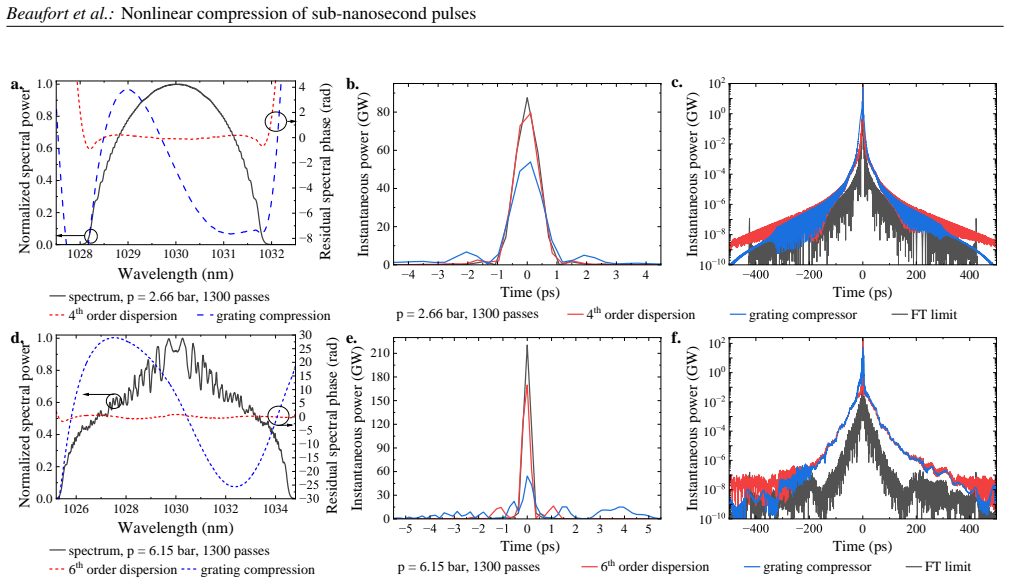
We propose using multi-mirror multi-pass cells as a compact and cost-efficient solution for the direct post-compression of sub-nanosecond pulses into the femtosecond regime. We simulate spectral broadening of 100-mJ, 300-ps pulses to a sub-ps Fourier transform-limit in a 1-m diameter multi-pass cell. Furthermore, an 11-mirror cell for about 300 passes was set-up for proof-of-concept. To reach a spectral broadening factor of 15 in air, only 260 MW of peak power were required. The proposed scheme can efficiently transform industrially mature high-power, high-energy lasers into unique ultrafast sources.
What carries the argument
Multi-mirror multi-pass cell that accumulates nonlinear phase through many passes in air to produce spectral broadening by self-phase modulation.
If this is right
- Terawatt-class lasers can produce pulse trains at kilohertz repetition rates.
- High-power high-energy lasers can be converted directly into ultrafast sources without intermediate amplification stages.
- Only 260 MW peak power suffices for substantial spectral broadening in air inside a compact cell.
- Sub-nanosecond industrial lasers become viable seeds for high-average-power ultrafast applications.
Where Pith is reading between the lines
- Increasing cell diameter or mirror count could support still higher pulse energies while keeping intensities below damage limits.
- The same geometry might be adapted for other gases or liquids to tailor the broadening factor or final pulse duration.
- Integration with existing kW-class amplifiers could produce new high-repetition-rate sources for material processing or high-field experiments.
- Real-time monitoring of beam quality after many passes would help quantify any cumulative wavefront distortions.
Load-bearing premise
The nonlinear propagation model used in the simulation accurately captures all relevant effects without unaccounted losses or damage thresholds being exceeded at the stated energies and intensities.
What would settle it
Experimental measurement of a factor-of-15 spectral broadening for 100-mJ 300-ps pulses after approximately 300 passes in the 1-m cell, with no optical damage and transmission losses below a few percent.
Figures


read the original abstract
Applications of terawatt-class lasers can enormously benefit from pulse trains with kHz repetition rates. The associated unprecedented combinations of peak and average powers require the development of new concepts for scalable ultrashort pulse generation. We propose using multi-mirror multi-pass cells as a compact and cost-efficient solution for the direct post-compression of sub-nanosecond pulses into the femtosecond regime. We simulate spectral broadening of 100-mJ, 300-ps pulses to a sub-ps Fourier transform-limit in a 1-m diameter multi-pass cell. Furthermore, an 11-mirror cell for about 300 passes was set-up for proof-of-concept. To reach a spectral broadening factor of 15 in air, only 260 MW of peak power were required. The proposed scheme can efficiently transform industrially mature high-power, high-energy lasers into unique ultrafast sources.
Editorial analysis
A structured set of objections, weighed in public.
Referee Report
Summary. The paper proposes multi-mirror multi-pass cells as a compact method for direct nonlinear post-compression of sub-nanosecond, high-energy pulses into the femtosecond regime. It reports simulations showing that 100-mJ, 300-ps pulses can be spectrally broadened to a sub-ps Fourier-transform limit in a 1-m diameter cell, and presents a proof-of-concept 11-mirror setup achieving a factor-of-15 broadening in air with only 260 MW peak power.
Significance. If validated, the approach could enable scalable conversion of mature high-energy industrial lasers into high-peak-power ultrafast sources at high repetition rates, addressing needs for combined high peak and average power in applications such as laser-driven particle acceleration or high-field physics. The simulation of large B-integral accumulation over hundreds of passes and the low-power threshold for broadening in air are notable strengths if the model holds.
major comments (2)
- [Simulation results] Simulation section: The central performance claim (sub-ps compressibility after factor-15 broadening with 260 MW peak power) depends on the nonlinear propagation model remaining in the pure SPM regime. No quantitative assessment is provided of whether local intensities approach air ionization thresholds for ~300-ps pulses, which could introduce plasma defocusing, absorption, or higher-order effects omitted from a Kerr-only model; this directly affects the predicted spectrum width and compressibility.
- [Experimental setup] Proof-of-concept experiment: The reported broadening factor of 15 is presented without error bars, quantitative comparison to the simulation output, or analysis of potential losses, beam quality degradation, or damage thresholds over the ~300 passes; this leaves the experimental support for the simulated performance only qualitative.
minor comments (2)
- [Abstract] The abstract and introduction could more clearly distinguish the simulated performance from the experimental demonstration to avoid implying direct experimental validation of the 100-mJ, sub-ps result.
- [Methods] Notation for the multi-pass geometry (cell diameter, number of passes, focusing) should be defined consistently between simulation and experiment sections.
Simulated Author's Rebuttal
We thank the referee for the positive assessment of the significance of our proposed approach and for the detailed comments on the simulation and experimental sections. We address each major comment below and will incorporate revisions to strengthen the manuscript.
read point-by-point responses
-
Referee: [Simulation results] Simulation section: The central performance claim (sub-ps compressibility after factor-15 broadening with 260 MW peak power) depends on the nonlinear propagation model remaining in the pure SPM regime. No quantitative assessment is provided of whether local intensities approach air ionization thresholds for ~300-ps pulses, which could introduce plasma defocusing, absorption, or higher-order effects omitted from a Kerr-only model; this directly affects the predicted spectrum width and compressibility.
Authors: We agree that an explicit comparison of peak intensity to the air ionization threshold is required to confirm the validity of the Kerr-only model for the simulated 300-ps pulses. In the revised manuscript we will add a quantitative assessment in the simulation section, calculating the on-axis peak intensity for the 100-mJ, 300-ps case inside the 1-m-diameter cell and comparing it directly to the known multiphoton ionization threshold for air at this pulse duration. Our internal checks show the intensity remains more than an order of magnitude below threshold, supporting the pure SPM assumption, but we will include this analysis and a brief discussion of possible higher-order effects to address the concern. revision: yes
-
Referee: [Experimental setup] Proof-of-concept experiment: The reported broadening factor of 15 is presented without error bars, quantitative comparison to the simulation output, or analysis of potential losses, beam quality degradation, or damage thresholds over the ~300 passes; this leaves the experimental support for the simulated performance only qualitative.
Authors: We acknowledge that the experimental results are currently presented qualitatively. In the revised manuscript we will add error bars derived from repeated spectral measurements, include a direct overlay of the measured and simulated broadened spectra for quantitative comparison, and provide a short discussion of measured transmission losses, beam-quality evolution (M^{2}), and mirror damage thresholds after ~300 passes. These additions will make the experimental support more rigorous while remaining consistent with the proof-of-concept nature of the 11-mirror setup. revision: yes
Circularity Check
No significant circularity; result follows from independent numerical simulation
full rationale
The paper's central claim is a numerical simulation result for spectral broadening of specified input pulses (100 mJ, 300 ps) in a defined multi-pass cell geometry, using a standard nonlinear propagation model. Inputs are physical parameters (energy, duration, cell diameter, number of passes, medium); outputs are computed spectrum width and Fourier-transform limit. No step reduces the target broadening factor or power requirement to a fitted parameter, self-definition, or self-citation chain by construction. The derivation remains self-contained against external benchmarks such as the Kerr nonlinearity and dispersion relations.
Axiom & Free-Parameter Ledger
free parameters (2)
- cell diameter
- number of passes
axioms (1)
- domain assumption Spectral broadening is dominated by self-phase modulation in the propagation medium (air or gas).
Lean theorems connected to this paper
-
IndisputableMonolith/Cost/FunctionalEquation.leanwashburn_uniqueness_aczel unclear?
unclearRelation between the paper passage and the cited Recognition theorem.
We simulate spectral broadening of 100-mJ, 300-ps pulses to a sub-ps Fourier transform-limit in a 1-m diameter multi-pass cell... self-phase modulation (SPM)... SISYFOS simulation package
-
IndisputableMonolith/Foundation/AlphaCoordinateFixation.leanJ_uniquely_calibrated_via_higher_derivative unclear?
unclearRelation between the paper passage and the cited Recognition theorem.
The nonlinear propagation model used in the simulation accurately captures all relevant effects (self-phase modulation, dispersion, and possible ionization)
What do these tags mean?
- matches
- The paper's claim is directly supported by a theorem in the formal canon.
- supports
- The theorem supports part of the paper's argument, but the paper may add assumptions or extra steps.
- extends
- The paper goes beyond the formal theorem; the theorem is a base layer rather than the whole result.
- uses
- The paper appears to rely on the theorem as machinery.
- contradicts
- The paper's claim conflicts with a theorem or certificate in the canon.
- unclear
- Pith found a possible connection, but the passage is too broad, indirect, or ambiguous to say the theorem truly supports the claim.
Reference graph
Works this paper leans on
-
[1]
Nobel Lecture: Extreme light physics and application
Gerard Mourou. Nobel Lecture: Extreme light physics and application. Reviews of Modern Physics , 91(3):030501, July 2019
work page 2019
-
[2]
Barros, Martin Gorjan, Thomas Nubbemeyer, Bidoor Alsaif, Catherine Y
Hanieh Fattahi, Helena G. Barros, Martin Gorjan, Thomas Nubbemeyer, Bidoor Alsaif, Catherine Y. Teis- set, Marcel Schultze, Stephan Prinz, Matthias Haefner, Moritz Ueffing, Ayman Alismail, L ´en´ard V ´amos, Alexander Schwarz, Oleg Pronin, Jonathan Brons, Xiao Tao Geng, Gunnar Arisholm, Marcelo Ciappina, Vladislav S. Yakovlev, Dong-Eon Kim, Abdallah M. Az...
work page 2014
-
[3]
Jiexi Zuo and Xuechun Lin. High-Power Laser Systems. Laser & Photonics Reviews, 16(5):2100741, may 2022
work page 2022
-
[4]
Clemens Herkommer, Peter Kr ¨otz, Robert Jung, Sandro Klingebiel, Christoph Wandt, Robert Bessing, Pierre Walch, Thomas Produit, Knut Michel, Dominik Bauer, Reinhard Kienberger, and Thomas Metzger. Ultrafast thin-disk multipass amplifier with 720 mJ operating at kilohertz repetition rate for applications in atmo- spheric research. Optics Express, 28(20):3...
work page 2020
-
[5]
Zhong-Wei Fan, Ji-Si Qiu, Zhi-Jun Kang, Yan-Zhong Chen, Wen-Qi Ge, and Xiong-Xin Tang. High beam quality 5 J, 200 Hz Nd:YAG laser system.Light: Science & Applications, 6(3):e17004–e17004, March 2017
work page 2017
-
[6]
Meadows, Aaron Davenport, Gabe Murray, Brendan A
Yong Wang, Han Chi, Cory Baumgarten, Kristian Dehne, Alexander R. Meadows, Aaron Davenport, Gabe Murray, Brendan A. Reagan, Carmen S. Menoni, and Jorge J. Rocca. 1.1 J Yb:YAG picosecond laser at 1 kHz repetition rate. Optics Letters, 45(24):6615, December 2020
work page 2020
-
[7]
Smith, Martin Divoky, Jan Pilar, Ondrej Denk, Thomas J
Mariastefania De Vido, Gary Quinn, Danielle Clarke, Luke McHugh, Paul Mason, Jacob Spear, Jodie M. Smith, Martin Divoky, Jan Pilar, Ondrej Denk, Thomas J. Butcher, Chris Edwards, Tomas Mocek, and John L. Collier. Demonstration of stable, long-term operation of a nanosecond pulsed DPSSL at 10 J, 100 Hz. Optics Express, 32(7):11907–11915, March 2024. Publis...
work page 2024
-
[8]
Prospects and directions of CO2 laser-driven acceler- ators
Sergei Tochitsky, Frederico Fiuza, and Chan Joshi. Prospects and directions of CO2 laser-driven acceler- ators. AIP Conference Proceedings , 1777(1):020005, October 2016
work page 2016
-
[9]
W. J. Tomlinson, R. H. Stolen, and C. V. Shank. Com- pression of optical pulses chirped by self-phase mod- ulation in fibers. JOSA B, 1(2):139–149, April 1984. Publisher: Optica Publishing Group
work page 1984
-
[10]
Jean-Claude Diels and Wolfgang Rudolph. Pulse Shap- ing. In Ultrashort Laser Pulse Phenomena, pages 433–
-
[11]
Nonlinear pulse compression in a multi-pass cell
Jan Schulte, Thomas Sartorius, Johannes Weitenberg, Andreas Vernaleken, and Peter Russbueldt. Nonlinear pulse compression in a multi-pass cell. Optics Letters, 41(19):4511, October 2016
work page 2016
-
[12]
Eric Numkam Fokoua, Seyed Abokhamis Mousavi, Gre- gory T. Jasion, David J. Richardson, and Francesco Po- letti. Loss in hollow-core optical fibers: mechanisms, scaling rules, and limits. Advances in Optics and Pho- tonics, 15(1):1, March 2023
work page 2023
-
[13]
Martin Kaumanns, Dmitrii Kormin, Thomas Nubbe- meyer, Vladimir Pervak, and Stefan Karsch. Spectral broadening of 112 mJ, 13 ps pulses at 5 kHz in a LG 10 multipass cell with compressibility to 37 fs. Optics Letters, 46(5):929, March 2021
work page 2021
-
[14]
Teisset, Haochuan Wang, Robert Jung, Jasna Jaksic, Abel H
Yanik Pfaff, Gaia Barbiero, Michael Rampp, San- dro Klingebiel, Jonathan Brons, Catherine Y. Teisset, Haochuan Wang, Robert Jung, Jasna Jaksic, Abel H. Woldegeorgis, Maximilian Trunk, Andreas R. Maier, Clara J. Saraceno, and Thomas Metzger. Nonlinear pulse compression of a 200 mJ and 1 kW ultrafast thin-disk amplifier. Optics Express, 31(14):22740, July 2023
work page 2023
-
[15]
Leemans, Ingmar Hartl, and Christoph M
Anne-Lise Viotti, Marcus Seidel, Esmerando Escoto, Supriya Rajhans, Wim P. Leemans, Ingmar Hartl, and Christoph M. Heyl. Multi-pass cells for post- compression of ultrashort laser pulses.Optica, 9(2):197, February 2022
work page 2022
-
[16]
Simulation Sys- tem For Optical Science (SISYFOS) – tutorial , volume 21/01183 of FFI-rapport
Gunnar Arisholm and Helge Fonnum. Simulation Sys- tem For Optical Science (SISYFOS) – tutorial , volume 21/01183 of FFI-rapport. Norwegian Defence Research Establishment (FFI), 2nd edition, June 2021
work page 2021
-
[17]
Marcus Seidel, Prannay Balla, Chen Li, Gunnar Arisholm, Lutz Winkelmann, Ingmar Hartl, and 14 Beaufort et al.: Nonlinear compression of sub-nanosecond pulses Christoph M. Heyl. Factor 30 Pulse Compression by Hybrid Multipass Multiplate Spectral Broadening. Ul- trafast Science, 2022:1–10, April 2022
work page 2022
-
[18]
Anne-Lise Viotti, Chen Li, Gunnar Arisholm, Lutz Winkelmann, Ingmar Hartl, Christoph M Heyl, and Mar- cus Seidel. Few-cycle pulse generation by double-stage hybrid multi-pass multi-plate nonlinear pulse compres- sion. Optics Letters, 48(4):984–987, 2023
work page 2023
-
[19]
Travers, Wonkeun Chang, Johannes Nold, Nico- las Y
John C. Travers, Wonkeun Chang, Johannes Nold, Nico- las Y. Joly, and Philip St. J. Russell. Ultrafast nonlinear optics in gas-filled hollow-core photonic crystal fibers [Invited]. Journal of the Optical Society of America B , 28(12):A11, December 2011
work page 2011
- [20]
-
[21]
Dudley, Bertrand Kibler, David J
Christophe Finot, John M. Dudley, Bertrand Kibler, David J. Richardson, and Guy Millot. Optical Parabolic Pulse Generation and Applications. IEEE Journal of Quantum Electronics , 45(11):1482–1489, November 2009
work page 2009
-
[22]
Andrew M. Weiner. Ultrafast optical pulse shaping: A tutorial review.Optics Communications, 284(15):3669– 3692, July 2011
work page 2011
-
[23]
Fangming Liu, Senlin Huang, Shangyu Si, Gang Zhao, Kexin Liu, and Shukui Zhang. Generation of picosec- ond pulses with variable temporal profiles and linear polarization by coherent pulse stacking in a birefringent crystal shaper. Optics Express, 27(2):1467–1478, Jan- uary 2019. Publisher: Optica Publishing Group
work page 2019
-
[24]
Velpula, Bonaventura Farace, Uwe Grosse-Wortmann, Rob J
Supriya Rajhans, Esmerando Escoto, Nikita Kho- dakovskiy, Praveen K. Velpula, Bonaventura Farace, Uwe Grosse-Wortmann, Rob J. Shalloo, Cord L. Arnold, Kristjan P ˜oder, Jens Osterhoff, Wim P. Lee- mans, Ingmar Hartl, and Christoph M. Heyl. Post- compression of multi-millijoule picosecond pulses to few-cycles approaching the terawatt regime.Optics Let- ter...
work page 2023
-
[25]
Marcus Seidel, Federico Pressacco, Oender Akcaalan, Thomas Binhammer, John Darvill, Nagitha Ekanayake, Maik Frede, Uwe Grosse-Wortmann, Michael Heber, Christoph M. Heyl, Dmytro Kutnyakhov, Chen Li, Christian Mohr, Jost M¨ uller, Oliver Puncken, Har- ald Redlin, Nora Schirmel, Sebastian Schulz, Angad Swiderski, Hamed Tavakol, Henrik T¨ unnermann, Cate- rin...
work page 2022
-
[26]
Teisset, Haochuan Wang, Robert Jung, Jasna Jaksic, Abel H
Yanik Pfaff, Carola Forster, Gaia Barbiero, Michael Rampp, Sandro Klingebiel, Jonathan Brons, Cather- ine Y. Teisset, Haochuan Wang, Robert Jung, Jasna Jaksic, Abel H. Woldegeorgis, Clara J. Saraceno, and Thomas Metzger. Nonlinear pulse compression of a thin-disk amplifier and contrast enhancement via non- linear ellipse rotation. Optics Express , 30(7):1...
work page 2022
-
[27]
Multipass spectral broadening of 18 mJ pulses compressible from 13 ps to 41 fs
Martin Kaumanns, Vladimir Pervak, Dmitrii Kormin, Vyacheslav Leshchenko, Alexander Kessel, Moritz Ueffing, Yu Chen, and Thomas Nubbemeyer. Multipass spectral broadening of 18 mJ pulses compressible from 13 ps to 41 fs. Optics Letters, 43(23):5877, December 2018
work page 2018
-
[28]
Donald R. Herriott and Harry J. Schulte. Folded Optical Delay Lines. Applied Optics, 4(8):883, August 1965
work page 1965
-
[29]
Francis Arthur Jenkins and Harvey Elliott White. Fun- damentals of Optics. McGraw-Hill, 4th edition, 1976
work page 1976
-
[30]
Arkadiusz Hudzikowski, Aleksander G luszek, Karol Krzempek, and Jaros law Sotor. Compact, spherical mirror-based dense astigmatic-like pattern multipass cell design aided by a genetic algorithm. Optics Ex- press, 29(16):26127, August 2021
work page 2021
-
[31]
Rong Kong, Peng Liu, and Xin Zhou. Optical design of Lissajous pattern multipass cells with multiple spherical mirrors based on particle swarm optimization. Optics Express, 30(14):24443, July 2022
work page 2022
- [32]
-
[33]
Arthur Sch ¨onberg, Supriya Rajhans, Esmerando Es- coto, Nikita Khodakovskiy, Victor Hariton, Bonaven- tura Farace, Kristjan P ˜oder, Ann-Kathrin Raab, Saga Westerberg, Mekan Merdanov, Anne-Lise Viotti, Cord L. Arnold, Wim P. Leemans, Ingmar Hartl, and Christoph M. Heyl. Compact, folded multi-pass cells for energy scaling of post-compression. Photonics Re...
work page 2025
-
[34]
Schmidt, Zhanna Rodnova, George Gibson, Nora Berrah, and Carlos Trallero
Kevin Watson, Tobias Saule, Maksym Ivanov, Bruno E. Schmidt, Zhanna Rodnova, George Gibson, Nora Berrah, and Carlos Trallero. High-power femtosecond molecular broadening and the effects of ro-vibrational coupling. Optica, 12(1):5–10, Jan 2025. 15 Beaufort et al.: Nonlinear compression of sub-nanosecond pulses
work page 2025
-
[35]
John E. Beetar, M. Nrisimhamurty, Tran-Chau Truong, Garima C. Nagar, Yangyang Liu, Jonathan Nesper, Omar Suarez, Federico Rivas, Yi Wu, Bonggu Shim, and Michael Chini. Multioctave supercontinuum generation and frequency conversion based on rotational nonlinear- ity. Science Advances, 6(34):eabb5375, August 2020
work page 2020
-
[36]
Matthew Reichert, Peng Zhao, Jennifer M. Reed, Tren- ton R. Ensley, David J. Hagan, and Eric W. Van Stryland. Beam deflection measurement of bound-electronic and rotational nonlinear refraction in molecular gases: erra- tum. Opt. Express, 24(17):19122–19122, Aug 2016
work page 2016
-
[37]
H. C. H. Mulvad, S. Abokhamis Mousavi, V. Zuba, L. Xu, H. Sakr, T. D. Bradley, J. R. Hayes, G. T. Jasion, E. Numkam Fokoua, A. Taranta, S.-U. Alam, D. J. Richardson, and F. Poletti. Kilowatt-average-power single-mode laser light transmission over kilometre- scale hollow-core fibre. Nature Photonics, 16(6):448– 453, June 2022
work page 2022
-
[38]
Davidson, Francesco Poletti, and John C
Athanasios Lekosiotis, Federico Belli, Christian Brahms, Mohammed Sabbah, Hesham Sakr, Ian A. Davidson, Francesco Poletti, and John C. Travers. On-target delivery of intense ultrafast laser pulses through hollow-core anti-resonant fibers. Optics Ex- press, 31(19):30227–30238, September 2023. Pub- lisher: Optica Publishing Group
work page 2023
-
[39]
Delivery of nanosecond laser pulses by multi-mode anti-resonant hollow core fiber at 1 µm wavelength
Meng Zhao, Fei Yu, Dakun Wu, Xinyue Zhu, Si Chen, Meng Wang, Minzhe Liu, Kun Zhao, Ruizhan Zhai, Zhongqing Jia, and Jonathan Knight. Delivery of nanosecond laser pulses by multi-mode anti-resonant hollow core fiber at 1 µm wavelength. Optics Express, 32(10):17229–17238, May 2024. Publisher: Optica Publishing Group
work page 2024
-
[40]
Beno ˆıt Debord, Foued Amrani, Luca Vincetti, Fr´ed´eric G´erˆome, and Fetah Benabid. Hollow-Core Fiber Tech- nology: The Rising of “Gas Photonics”.Fibers, 7(2):16, February 2019
work page 2019
-
[41]
Multiply charged ions induced by multiphoton absorp- tion processes in rare-gas atoms at 1.064𝜇m
A L ’Huillier, L A Lompre, G Mainfray, and C Manus. Multiply charged ions induced by multiphoton absorp- tion processes in rare-gas atoms at 1.064𝜇m. Journal of Physics B: Atomic and Molecular Physics, 16(8):1363– 1381, April 1983
work page 1983
- [42]
-
[43]
P. St. J. Russell, P. H ¨olzer, W. Chang, A. Abdolvand, and J. C. Travers. Hollow-core photonic crystal fibres for gas-based nonlinear optics.Nature Photonics, 8(4):278– 286, April 2014
work page 2014
-
[44]
Nonlinear beam matching to gas-filled multipass cells
Marc Hanna, Louis Daniault, Florent Guichard, Nour Daher, Xavier D ´elen, Rodrigo Lopez-Martens, and Patrick Georges. Nonlinear beam matching to gas-filled multipass cells. OSA Continuum , 4(2):732, February 2021. 16
work page 2021
discussion (0)
Sign in with ORCID, Apple, or X to comment. Anyone can read and Pith papers without signing in.