Low energy excitations in A-site ordered SmBaMn2O6
Pith reviewed 2026-05-21 23:25 UTC · model grok-4.3
The pith
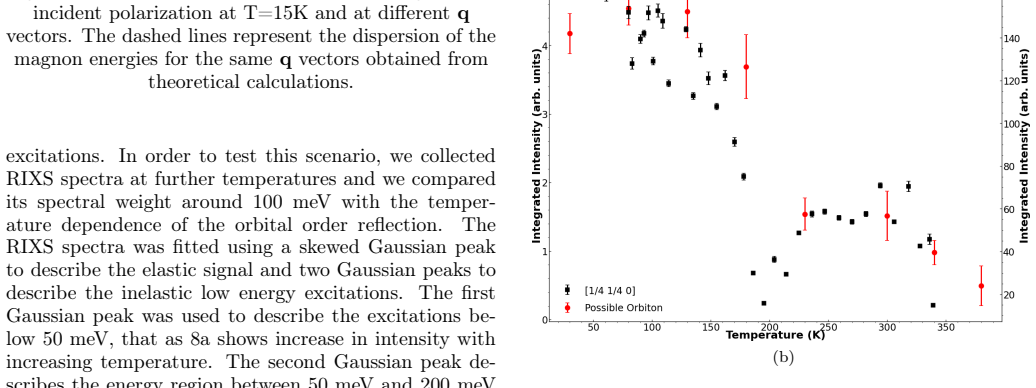
In SmBaMn2O6 a group of excitations between 80 and 200 meV tracks the temperature dependence of orbital order and may be orbital excitations.
A machine-rendered reading of the paper's core claim, the machinery that carries it, and where it could break.
Core claim
In A-site ordered SmBaMn2O6 the orbital order is confirmed at q = (0.25, 0.25, 0) by resonant elastic x-ray scattering. Resonant inelastic x-ray scattering detects multiple low-energy excitations below 200 meV. While some are assigned magnetic or phononic character, the excitations between 80 and 200 meV exhibit a temperature dependence that distinctly follows the orbital order, identifying them as possible orbital excitations.
What carries the argument
Temperature dependence of the 80-200 meV excitations measured by soft x-ray resonant inelastic scattering (RIXS), compared against orbital order established by resonant elastic x-ray scattering (REXS).
If this is right
- Orbital order can be tracked indirectly through associated low-energy excitations observed in RIXS.
- A subset of excitations can be separated from magnetic and phononic modes by their distinct temperature evolution.
- Direct experimental access to orbital dynamics becomes feasible in manganites without requiring complete theoretical spectra first.
Where Pith is reading between the lines
- The same temperature-tracking method could be tested on other half-doped manganites to locate orbital excitations systematically.
- If the assignment holds, models of orbital-spin coupling in these materials can be refined using the measured excitation energies.
- The approach suggests a route to study orbitons in related transition-metal oxides where orbital order is present but hard to probe.
Load-bearing premise
Matching temperature dependence is enough to identify the 80-200 meV excitations specifically as orbital rather than other modes coupled to the orbital order.
What would settle it
A calculation or measurement showing that orbital excitations in this material lie outside the 80-200 meV window or that the observed temperature dependence appears in modes known to be non-orbital.
Figures


read the original abstract
The electron in a solid can be considered a bound state of the three independent, fundamental degrees of freedom creating quasi-particles: spinons, carrying the electron spin; plasmons carrying the collective charge mode and orbitons carrying its orbital degree of freedom. These fundamental degrees of freedom could form ordering states in which dynamics or collective motions could occurr and manifest as low-energy excitations. The exotic properties that appear in the materials exhibiting these electronic orderings are associated with these low-energy excitations. Although the orbital order (OO) and its coupling to the spin system creates very interesting phenomena, the microscopic origin of OO has been much less explored than other electronic properties as it is very difficult to directly access experimental information from OO. Due to the recent improvement in energy resolution and flux, soft x-ray resonant inelastic scattering (RIXS) allows for a re-examination of orbital excitations in manganites. Here, we present a study of low energy excitations in half doped A-site ordered SmBaMn_{2}O_{6} through a combination of RIXS and soft x-ray resonant elastic scattering (REXS) measurements. The obtained experimental data confirm the OO at \mathbf{q} = (0.25, 0.25, 0) and find various low energy excitations below 200 meV. while several excitations can be assigned to be of magnetic and phononic origin, a group of excitations between 80 and 200 meV show a temperature dependence distinctively following that of the OO making them possible candidates for orbital excitations.
Editorial analysis
A structured set of objections, weighed in public.
Referee Report
Summary. The manuscript reports combined soft x-ray RIXS and REXS measurements on A-site ordered half-doped SmBaMn2O6. It confirms orbital order at wavevector q = (0.25, 0.25, 0) and identifies multiple low-energy excitations below 200 meV. Several features are assigned to magnetic or phononic modes on the basis of their energies and dispersion, while a subset of excitations between 80 and 200 meV is proposed as possible orbital excitations because their intensity or position tracks the temperature dependence of the orbital order parameter extracted from REXS.
Significance. If the proposed assignment of the 80-200 meV features holds, the work supplies direct experimental access to orbital dynamics in a strongly coupled manganite system where OO, spin order, and lattice distortions are intertwined. The use of improved RIXS energy resolution to separate these modes from the elastic line is a technical strength, and the temperature-dependent data provide a falsifiable link between the excitations and the OO order parameter.
major comments (2)
- [Results (temperature series)] Results section on temperature-dependent RIXS: the claim that the 80-200 meV group 'distinctively' follows the OO temperature dependence is load-bearing for the orbital-excitation assignment, yet the manuscript presents only qualitative visual comparison without a quantitative correlation analysis, error bars on the extracted intensities, or explicit subtraction of possible phonon/magnon contributions that inherit OO temperature dependence through lattice-spin coupling.
- [Discussion] Discussion of mode assignment: no polarization dependence, momentum dispersion, or comparison to orbiton calculations (superexchange or Jahn-Teller models) is provided to exclude coupled modes. In A-site ordered half-doped manganites this coupling is known to be strong, so temperature tracking alone does not uniquely establish orbital character.
minor comments (2)
- [Abstract] Abstract: 'occurr' should read 'occur'; the sentence beginning 'while several excitations' should start with a capital 'While'.
- [Throughout] Notation: the wavevector is written as q = (0.25, 0.25, 0) in the abstract but should be consistently bolded or indexed as a reciprocal-space vector throughout the text and figures.
Simulated Author's Rebuttal
We thank the referee for the careful reading of our manuscript and the constructive comments. We address the major points below and have revised the manuscript to strengthen the presentation of our results.
read point-by-point responses
-
Referee: [Results (temperature series)] Results section on temperature-dependent RIXS: the claim that the 80-200 meV group 'distinctively' follows the OO temperature dependence is load-bearing for the orbital-excitation assignment, yet the manuscript presents only qualitative visual comparison without a quantitative correlation analysis, error bars on the extracted intensities, or explicit subtraction of possible phonon/magnon contributions that inherit OO temperature dependence through lattice-spin coupling.
Authors: We agree that a quantitative analysis strengthens the orbital-excitation assignment. In the revised manuscript we have added error bars to the extracted intensities of the 80-200 meV features and included a correlation analysis (Pearson coefficient) between these intensities and the OO order parameter obtained from REXS. We also discuss the possibility that phonon or magnon modes could inherit temperature dependence via lattice-spin coupling and note that the observed evolution in this specific energy window remains distinct from the lower-energy modes we assign to magnetic and phononic excitations. A complete background subtraction of all coupled contributions is not possible with the present data set owing to spectral overlap, and we now state this limitation explicitly. revision: yes
-
Referee: [Discussion] Discussion of mode assignment: no polarization dependence, momentum dispersion, or comparison to orbiton calculations (superexchange or Jahn-Teller models) is provided to exclude coupled modes. In A-site ordered half-doped manganites this coupling is known to be strong, so temperature tracking alone does not uniquely establish orbital character.
Authors: We acknowledge that polarization dependence and momentum dispersion would provide stronger constraints on mode character. These measurements were outside the scope of the allocated beam time. We have expanded the discussion to reference both superexchange and Jahn-Teller orbiton models for half-doped manganites and to compare the observed energies with theoretical expectations. While temperature tracking alone is not conclusive, the combination of energy scale, temperature evolution that tracks the OO parameter, and consistency with prior RIXS reports on related compounds supports our proposal of these features as candidate orbital excitations. We now explicitly note that definitive mode identification would benefit from the additional data suggested by the referee. revision: partial
Circularity Check
No circularity: pure experimental observations without derivation chain
full rationale
This is an experimental RIXS/REXS study reporting measured excitations in SmBaMn2O6 and their temperature dependence. The central claim assigns 80-200 meV features as possible orbital excitations solely because their intensity tracks the OO order parameter, while other features are labeled magnetic or phononic. No equations, fitted parameters, predictions, or self-citations are invoked to derive any result from prior inputs; the analysis consists of direct data interpretation against external benchmarks (known OO wavevector and typical mode energies). The paper is therefore self-contained with no reduction of claims to inputs by construction.
Axiom & Free-Parameter Ledger
axioms (1)
- domain assumption Orbital ordering occurs in half-doped A-site ordered manganites at wavevector q = (0.25, 0.25, 0)
Lean theorems connected to this paper
-
IndisputableMonolith/Cost/FunctionalEquation.leanwashburn_uniqueness_aczel unclear?
unclearRelation between the paper passage and the cited Recognition theorem.
a group of excitations between 80 and 200 meV show a temperature dependence distinctively following that of the OO making them possible candidates for orbital excitations
-
IndisputableMonolith/Foundation/AbsoluteFloorClosure.leanabsolute_floor_iff_bare_distinguishability unclear?
unclearRelation between the paper passage and the cited Recognition theorem.
Comparing to the results obtained from Raman scattering and inelastic neutron scattering, the RIXS lower-energy excitations comprise at least magnons and phonons.
What do these tags mean?
- matches
- The paper's claim is directly supported by a theorem in the formal canon.
- supports
- The theorem supports part of the paper's argument, but the paper may add assumptions or extra steps.
- extends
- The paper goes beyond the formal theorem; the theorem is a base layer rather than the whole result.
- uses
- The paper appears to rely on the theorem as machinery.
- contradicts
- The paper's claim conflicts with a theorem or certificate in the canon.
- unclear
- Pith found a possible connection, but the passage is too broad, indirect, or ambiguous to say the theorem truly supports the claim.
Reference graph
Works this paper leans on
-
[1]
studied SBMO using optical conductivity and Ra- man scattering. These techniques are restricted to collect data at q = 0 and are not sensitive to the dispersion of the observed excitations. Two major peaks are observed in the Raman spectra around 500 and 620 cm−1 (62 and 77 meV) that are assigned to the Jahn-Teller (JT) and breathing modes respectively. T...
-
[2]
J. van den Brink, G. Khaliullin, and D. Khomskii, Phys- ical Review Letters83, 5118 (1999)
work page 1999
- [3]
- [4]
- [5]
-
[6]
Y. Murakami, H. Kawada, H. Kawata, M. Tanaka, T. Arima, Y. Moritomo, and Y. Tokura, Physical Re- view Letters 80, 1932 (1998)
work page 1932
-
[7]
S. B. Wilkins, P. D. Spencer, P. D. Hatton, S. P. Collins, M. D. Roper, D. Prabhakaran, and A. T. Boothroyd, Physical Review Letters91, 167205 (2003)
work page 2003
-
[8]
K. J. Thomas, J. P. Hill, S. Grenier, Y.-J. Kim, P. Abba- monte, L. Venema, A. Rusydi, Y. Tomioka, Y. Tokura, D. F. McMorrow, G. Sawatzky, and M. van Veenendaal, Physical Review Letters92, 237204 (2004)
work page 2004
-
[9]
S. S. Dhesi, A. Mirone, C. De Nadaï, P. Ohresser, P. Ben- cok, N. B. Brookes, P. Reutler, A. Revcolevschi, A. Tagli- aferri, O. Toulemonde, and G. van der Laan, Physical Review Letters 92, 056403 (2004)
work page 2004
- [10]
-
[11]
M. García-Fernández, U. Staub, Y. Bodenthin, S. M. Lawrence, A. M. Mulders, C. E. Buckley, S. Weyeneth, E. Pomjakushina, and K. Conder, Phys. Rev. B 77, 060402 (2008)
work page 2008
-
[12]
M. García-Fernández, U. Staub, Y. Bodenthin, V. Scagnoli, V. Pomjakushin, S. W. Lovesey, A. Mirone, J. Herrero-Martín, C. Piamonteze, and E. Pom- jakushina, Phys. Rev. Lett.103, 097205 (2009)
work page 2009
-
[13]
T. A. W. Beale, S. R. Bland, R. D. Johnson, P. D. Hatton, J. C. Cezar, S. S. Dhesi, M. v. Zimmermann, D. Prabhakaran, and A. T. Boothroyd, Physical Review B 79, 054433 (2009)
work page 2009
- [14]
-
[15]
M. García-Fernández, U. Staub, Y. Bodenthin, V. Pomjakushin, A. Mirone, J. Fernández-Rodríguez, V. Scagnoli, A. M. Mulders, S. M. Lawrence, and E. Pomjakushina, Phys. Rev. B82, 235108 (2010)
work page 2010
- [16]
-
[17]
S. Ishihara, H. Kondoh, and S. Maekawa, Physica B: Condensed Matter 345, 15 (2004), proceedings of the ConferenceonPolarisedNeutronandSynchrotronX-rays for Magnetism
work page 2004
- [18]
-
[19]
J. Schlappa, K. Wohlfeld, K. J. Zhou, M. Mourigal, M. W. Haverkort, V. N. Strocov, L. Hozoi, C. Mon- ney, S. Nishimoto, S. Singh, A. Revcolevschi, J. S. Caux, L. Patthey, H. M. Rønnow, J. van den Brink, and T. Schmitt, Nature485, 82 (2012)
work page 2012
- [20]
- [21]
- [22]
-
[23]
S. Grenier, J. P. Hill, V. Kiryukhin, W. Ku, Y.-J. Kim, K. J. Thomas, S.-W. Cheong, Y. Tokura, Y. Tomioka, D.Casa, andT.Gog,Phys.Rev.Lett. 94,047203(2005)
work page 2005
-
[24]
T. Nakajima, H. Yoshizawa, and Y. Ueda, Jour- nal of the Physical Society of Japan 73, 2283 (2004), https://doi.org/10.1143/JPSJ.73.2283
-
[25]
M. Uchida, D. Akahoshi, R. Kumai, Y. Tomioka, T.-h. Arima, Y. Tokura, and Y. Matsui, Journal of the Physical Society of Japan 71, 2605 (2002), https://doi.org/10.1143/JPSJ.71.2605
-
[26]
H. Kageyama, T. Nakajima, M. Ichihara, Y. Ueda, H. Yoshizawa, and K. Ohoyama, Journal of the Physical Society of Japan 72, 241 (2003), https://doi.org/10.1143/JPSJ.72.241
-
[27]
T. Nakajima, H. Kageyama, M. Ichihara, K. Ohoyama, H. Yoshizawa, and Y. Ueda, Journal of Solid State Chemistry 177, 987 (2004)
work page 2004
- [28]
-
[29]
D. Akahoshi, Y. Okimoto, M. Kubota, R. Kumai, T. Arima, Y. Tomioka, and Y. Tokura, Phys. Rev. B 70, 064418 (2004)
work page 2004
-
[30]
D. Morikawa, K. Tsuda, Y. Maeda, S. Yamada, and T.- h. Arima, Journal of the Physical Society of Japan81, 093602 (2012), https://doi.org/10.1143/JPSJ.81.093602
-
[31]
Y. Tokunaga, T. Lottermoser, Y. Lee, R. Kumai, M. Uchida, T. Arima, and Y. Tokura, Nature Materials 5, 937 (2006)
work page 2006
-
[32]
K.-J. Zhou, A. Walters, M. Garcia-Fernandez, T. Rice, M. Hand, A. Nag, J. Li, S. Agrestini, P. Garland, H. Wang, S. Alcock, I. Nistea, B. Nutter, N. Rubies, G. Knap, M. Gaughran, F. Yuan, P. Chang, J. Emmins, and G. Howell, Journal of Synchrotron Radiation29, 563 (2022)
work page 2022
-
[33]
R. A. Ewings, T. G. Perring, O. Sikora, D. L. Abernathy, Y. Tomioka, and Y. Tokura, Phys. Rev. B94, 014405 (2016)
work page 2016
-
[34]
S. Ishihara, Y. Murakami, T. Inami, K. Ishii, J. Mizuki, K. Hirota, S. Maekawa, and Y. Endoh, New Journal of Physics 7, 119 (2005)
work page 2005
-
[35]
van den Brink, Physical Review Letters87, 217202 (2001)
J. van den Brink, Physical Review Letters87, 217202 (2001)
work page 2001
-
[36]
P. B. Allen and V. Perebeinos, Physical Review Letters 83, 4828 (1999)
work page 1999
-
[37]
K. P. Schmidt, M. Grüninger, and G. S. Uhrig, Physical Review B 76, 075108 (2007). 8
work page 2007
discussion (0)
Sign in with ORCID, Apple, or X to comment. Anyone can read and Pith papers without signing in.