REVIEW 3 major objections 5 minor 114 references
The ALMA REBELS survey: [OIII]$_{88\mu \text{m}}$ line scans of UV-bright $z \gtrsim 7.6$ galaxies
T0 review · 3 major / 5 minor · reviewed 2026-08-06 · deepseek-v4-flash
Pith's one-line read This paper reports ALMA spectral scans that find no [OIII] 88 micron emission in any of four z>7.6 galaxies, and shows that for REBELS-04 the non-detection is unexpected given its redshift coverage and star formation rate.
desk verdict Careful non-detection paper whose headline 'unexpected' [OIII] deficit for REBELS-04 only holds for a 100 km/s line width; at 400 km/s the limit is consistent with expectations. read the letter →
The pith
A machine-rendered reading of the paper's core claim, the machinery that carries it, and where it could break.
The reading
What carries the argument
The load-bearing tool is the coverage fraction of the photometric redshift likelihood distribution P(z) by the ALMA spectral windows: only when that fraction is high (at least 92 percent for REBELS-04) does a non-detection translate into a physical upper limit on the line luminosity. The second element is the [OIII] 88 micron line itself, a far-infrared fine-structure transition from HII regions with critical density n_crit ~ 510 $cm^{-3}$; above that density, collisional de-excitation suppresses the line, and the line also weakens at low ionization parameter and low metallicity, making it a density and ionization diagnostic. The combination of P(z) coverage and the line's physical sensitivity is what turns a blank ALMA scan into a claim about ISM conditions.
What would settle it
Measure a spectroscopic redshift for REBELS-04, for example through [CII] 158 micron with ALMA Band 6 or through JWST spectroscopy: if the redshift falls outside the scanned range z=8.10-9.39, the non-detection is a coverage effect, not evidence of suppressed [OIII] emission. A deeper ALMA observation that detects the line at the expected frequency would likewise falsify the suppression claim.
Extended reading notes
Core claim
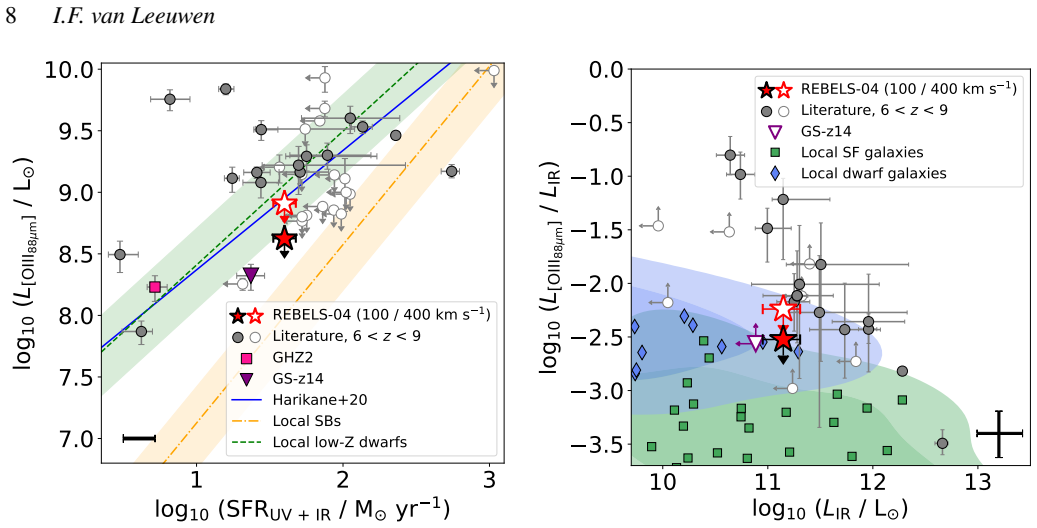
The central claim is that [OIII] 88 micron emission is unexpectedly faint in REBELS-04. Given a photometric redshift of z = 8.57 (+0.10/-0.09), or 8.43 when a circumgalactic medium correction is applied, the ALMA scan covers at least 92 percent of the redshift likelihood yet no line is seen; the 5-$\sigma$ limit is L[OIII] < 4.2 x $10^{8}$ Lsun for a FWHM of 100 km/s, or 8.1 x $10^{8}$ Lsun for 400 km/s, corresponding to star formation rate limits of 18 and 36 solar masses per year. Because the total star formation rate is about 40 solar masses per year, the line is at least 0.33 dex fainter than the SFR-scaled expectation. The paper claims this can be explained by ISM densities above the critical density n_crit ~ 510 $cm^{-3}$, by log10 U_ion <= -2.5, or by low metallicity, and argues the dust detection makes the first two more likely. For the other targets, REBELS-37 is explained by a [CII]-measured redshift (z = 7.643) outside the scan; REBELS-11 and REBELS-13 remain ambiguous because only 40-50 percent of their redshift distributions were covered.
Load-bearing premise
The argument for REBELS-04 collapses if its photometric redshift is wrong, because the claim that at least 92 percent of the true redshift probability lies in the scanned range is what makes the non-detection meaningful.
Editorial extensions
If this is right
- If REBELS-04's [OIII] deficit is real, then at least some UV-bright, dust-rich galaxies at z~8 are much fainter in [OIII] 88 micron than the z=6-9 SFR relation predicts, so [OIII] scans alone will miss such sources.
- The preferred explanations (gas densities above about 510 cm^-3 or log10 U_ion below about -2.5) imply that the ionized gas in at least one reionization-era galaxy is denser or less ionized than typical high-redshift systems, with consequences for how far-infrared lines are used as star formation tracers.
- If the photometric redshift holds, REBELS-04 becomes the most distant dust-continuum-detected galaxy known with ALMA, making it a priority target for JWST and deeper ALMA follow-up.
- The REBELS-37 result shows the value of switching from [OIII] to [CII] when new HST data shifted the expected redshift, securing a spectroscopic redshift and excluding very cold dust; the same flexibility would benefit future z>8 surveys.
Reading between the lines
- If this pattern generalizes, z>8 [OIII] luminosity functions built from targeted scans could be biased low, and the true [OIII]/[CII] ratio in reionization-era galaxies may be closer to 1-1.5 than the factor of about 3.5 assumed when the survey depth was set.
- The quoted limits assume line FWHMs of 100 or 400 km/s; if typical z>8 lines are broader, double-peaked, or offset from the assumed centroid, the upper limits would be optimistic, and a spectrally resolved stacking analysis of the four cubes could test this.
- Observing the [OIII] 52 micron line or [OIII] 5007 with JWST would break the degeneracy between high density and low ionization parameter for REBELS-04, since these lines respond differently to electron density; this follows from the paper's own ISM discussion but is not presented as a specific prediction.
Editorial analysis
A structured set of objections, weighed in public.
Referee Report
Summary. This paper reports ALMA Band 7 spectral scans of [OIII] 88 micron emission in four z > 7.6 REBELS galaxies over 326.4-373.0 GHz. No credible line is detected in any target. For REBELS-04, which has >=92% redshift-likelihood coverage and a UV+IR SFR of about 40 Msun/yr, the non-detection is interpreted as unexpected and used to discuss possible ISM conditions (high density, low ionization parameter, low metallicity) under an assumed line FWHM of 100 km/s. The paper also presents Band 7 dust continuum detections for REBELS-04 and REBELS-37, and uses Band 6 data for REBELS-37 to exclude cold dust temperatures (<28 K) at 3 sigma. The non-detection analysis is carefully executed with mf3d matched filtering, purity thresholds, aperture photometry with noise from 1000 random apertures, and two explicit FWHM assumptions; the paper is transparent about coverage fractions and caveats.
Significance. If the REBELS-04 non-detection is a genuine [OIII] deficit, it would extend studies of the [OIII] deficit to z ~ 8.6 and provide useful constraints on ISM density and ionization parameter at very high redshift. The paper ships public ALMA data and a reproducible analysis pipeline, and the non-detection treatment is more careful than is typical for survey papers. However, the headline 'unexpected' claim is sensitive to the assumed line width: at FWHM = 400 km/s the quoted upper limit is within ~0.04 dex of the Harikane et al. (2020) expectation, so the ISM interpretation is not robust without a line-width prior. The dust continuum results and the REBELS-37 temperature lower limit are solid additions.
major comments (3)
- [§4.1.1, Fig. 3, Table 3] The claim that the REBELS-04 non-detection is 'unexpected' is entirely carried by the FWHM = 100 km/s limit. With FWHM = 400 km/s, the 5 sigma upper limit is L[OIII] < 8.1e8 Lsun, while the Harikane et al. (2020) relation for SFR_UV+IR = 40 Msun/yr predicts about 9e8 Lsun; the limit is only ~0.04 dex below the prediction and is fully consistent within the relation's scatter. Since the line is not detected, its width is unmeasured, and z > 7 [OIII] emitters include systems with FWHM > 300 km/s (e.g., B14-65666 and A1689-zD1), the non-detection cannot be called unexpected without adopting a narrow-line prior. Please reframe the abstract and conclusions to present the deficit as conditional on a narrow intrinsic line width, or marginalize the luminosity limit over the observed FWHM distribution.
- [§4.1.1, Fig. 7] The ISM constraints on hydrogen density (n_H > ~510 cm^-3) and ionization parameter (log10 U_ion < -2.5) are derived from the FWHM = 100 km/s upper limit. At FWHM = 400 km/s, the limit lies on the Harikane et al. (2020) relation, so the density and ionization-parameter constraints are not supported. This is not a minor quantitative change: it removes the primary physical motivation for the ISM interpretation. The discussion should either be explicitly restricted to the narrow-line scenario or replaced with a treatment that acknowledges the full range of allowed line widths.
- [§2.3, Appendix A] The statement that the scan covers >=92% of the REBELS-04 redshift likelihood depends on the photometric redshift and, in particular, on the CGM absorption correction of Asada et al. (2025), which shifts z_phot from 8.57 to 8.43 and reduces the coverage from 99% to 92%. The paper does acknowledge this caveat, but the abstract and Section 5 restate the 'unexpected' conclusion without carrying the same caveat forward. Since a systematic error in the photometric redshift would make the non-detection uninformative, the conditional nature of the claim should be made prominent in both the abstract and conclusions.
minor comments (5)
- [Fig. 1 caption] The caption lists coverage as '98.68% (91.9%)' while the text (§2.3) quotes 99% and 92%; please unify these numbers and specify which corresponds to the CGM-corrected distribution.
- [§2.2, abstract] The quoted frequency range 326.4-373.0 GHz is the scanned range, but the SPW around 368.5 GHz is unusable because of an atmospheric line. Please state explicitly in the abstract or Section 2 that the coverage contains a gap, so readers do not infer continuous coverage.
- [§3.1 footnote] The footnote saying that the De Looze et al. (2014) relation gives SFRs a 'factor 0.8 smaller' is ambiguous; specify whether this means 0.8 times the Harikane values or 20% smaller.
- [Table 2] For REBELS-11 and REBELS-13, the table provides [OIII] flux upper limits but no explicit reminder in the table itself that these limits assume the line lies inside the observed frequency range. Adding a footnote to the table would improve clarity.
- [Appendix C] The sentence 'This yields a dust temperature of T_dust >= 28 K for REBELS-37' should be phrased as a lower limit, not a point estimate, to match the preceding discussion of the flux-ratio analysis.
Circularity Check
No significant circularity: the [OIII]88 non-detection is an observational measurement compared against external calibrations, with self-citations used only as independent photometric and line constraints.
full rationale
The paper's central result is an absence of a line in ALMA Band 7 cubes. That is a direct observational product reduced with standard tools (CASA, mf3d), not derived from the quantities it is compared against. The 'unexpected' characterization for REBELS-04 rests on (i) a photometric redshift coverage estimate (Section 2.3, Appendix A) and (ii) a comparison of 5-sigma upper limits (Table 3, Eq. 1) with the external Harikane et al. (2020) L[OIII]-SFR relation. The photometric redshift is obtained from HST/IRAC photometry and a Lyman-break plus [OIII]4959,5007 excess; it is not constructed from the [OIII]88 scan. The SFR used in the comparison is derived from UV luminosity (Bouwens et al. 2022) and the Band 7 dust continuum, which are independent of the line measurement. The paper explicitly reports both FWHM=100 and 400 km/s limits and states that the deficit interpretation applies for FWHM=100 km/s; the FWHM=400 km/s limit is consistent with the relation. This is a sensitivity and robustness caveat, not a reduction by construction. Self-citations to Bouwens et al. (2022), Inami et al. (2022), Sommovigo et al. (2022), and Schouws et al. (in preparation) provide photometric redshifts, continuum fluxes, dust temperature assumptions, and the [CII] redshift of REBELS-37; these are independent inputs that do not presuppose the [OIII]88 non-detection. No equation in the paper defines the predicted luminosity in terms of the measured upper limit, and no fitted parameter is renamed as a prediction. The analysis is therefore self-contained with respect to its input data; score 1 reflects minor reliance on in-preparation and self-cited calibrations, not circularity.
Assumptions & free parameters
free parameters (4)
- Assumed FWHM of [OIII] 88 micron line =
100 and 400 km/s
- Dust temperature for IR luminosity conversion =
47 K (with 70 K alternative)
- Dust emissivity index beta_IR =
2.03 (with 1.5 and 2.5 alternatives in Figure 6)
- CGM absorption shift in photometric redshift =
delta_z = -0.14 for REBELS-04
assumptions (4)
- domain assumption The photometric redshift likelihood distributions from Bouwens et al. (2022) and the updated eazy-py fits are accurate representations of the true redshift probability.
- domain assumption The Harikane et al. (2020) L[OIII] 88 micron to SFR relation derived from z=6-9 galaxies applies to z about 8.6 galaxies.
- domain assumption The assumed modified blackbody dust SED with T_dust = 47 K and beta_IR = 2.03 represents the dust emission of these galaxies.
- domain assumption The 3.8-sigma Band 7 continuum detection of REBELS-04 is real and associated with the galaxy.
Cite this review
Pith. "Pith review of The ALMA REBELS survey: [OIII]$_{88\mu \text{m}}$ line scans of UV-bright $z \gtrsim 7.6$ galaxies." pith.science (2026). https://pith.science/paper/PY35XQWQ
@misc{pith2026250802390,
  author       = {Pith},
  title        = {Pith review of: The ALMA REBELS survey: [OIII]$_88\mu \textm$ line scans of UV-bright $z \gtrsim 7.6$ galaxies},
  year         = {2026},
  howpublished = {\url{https://pith.science/paper/PY35XQWQ}},
  note         = {Machine review of arXiv:2508.02390}
}
abstract
We present the [OIII]$_{88\mu \text{m}}$ spectral scan results from the ALMA Large Program REBELS (Reionization Era Bright Emission Line Survey). The generally high luminosity of [OIII]$_{88\mu \text{m}}$ and ALMA's Band 7 efficiency motivated its use for line scans of REBELS targets at $z>8$. Spectral scans of four sources covered 326.4-373.0 GHz ($z=8.10$-9.39), reaching [OIII]$_{88\mu \text{m}}$ luminosities of $\mathrm{\sim7.6\times10^8\ L_{\odot}}$ ($5\sigma$) for a FWHM of 400 km s$^{-1}$. No credible lines are detected for the four targets. For REBELS-04, the non-detection is unexpected given the $\geq92\%$ coverage of the redshift likelihood distribution and its estimated SFR of 40 $\text{M}_{\odot}\ \text{yr}^{-1}$. Possible explanations for the faint [OIII]$_{88\mu \text{m}}$ emission (assuming a FWHM of 100 km s$^{-1}$) include high ISM densities ($>n_{\text{crit}} \approx 510\ \text{cm}^{-3}$) and low ionization parameters ($\mathrm{log_{10}\ U_{ion}\lesssim -2.5}$). For REBELS-37, a subsequent detection of [CII]$_{158\mu \text{m}}$ ($z=7.643$) confirmed it lay outside our scan range. For REBELS-11 and REBELS-13, it remains unclear if the non-detection is due to the depth of the line scan or redshift coverage. REBELS-04 and REBELS-37 show significant ($\geq3.8\sigma$) dust continuum emission in Band 7. If the photometric redshift of REBELS-04 is accurate, i.e., $z_{\mathrm{phot}}=8.57^{+0.10}_{-0.09}$ or $z_{\mathrm{phot}}=8.43^{+0.10}_{-0.10}$ accounting for additional neutral hydrogen in the circumgalactic medium, REBELS-04 would constitute the most distant dust-detected galaxy identified with ALMA to date. Additional Band 6 dust observations of REBELS-37 constrain the shape of the far-IR SED, ruling out cold dust temperatures ($\lesssim28$ K) at $3\sigma$. Further insight into these galaxies will require spectroscopic redshifts and deeper multi-band dust observations.
Figures


Figures from the paper (3 more)


Reference graph
Works this paper leans on
-
[1]
Adamo A., et al., 2024, @doi [arXiv e-prints] 10.48550/arXiv.2405.21054 , https://ui.adsabs.harvard.edu/abs/2024arXiv240521054A p. arXiv:2405.21054
-
[2]
Aihara H., et al., 2018a, @doi [ ] 10.1093/pasj/psx066 , https://ui.adsabs.harvard.edu/abs/2018PASJ...70S...4A 70, S4
-
[3]
Aihara H., et al., 2018b, @doi [ ] 10.1093/pasj/psx081 , https://ui.adsabs.harvard.edu/abs/2018PASJ...70S...8A 70, S8
-
[4]
Akins H. B., et al., 2022, @doi [ ] 10.3847/1538-4357/ac795b , https://ui.adsabs.harvard.edu/abs/2022ApJ...934...64A 934, 64
-
[5]
Algera H. S. B., et al., 2023, @doi [ ] 10.1093/mnras/stac3195 , https://ui.adsabs.harvard.edu/abs/2023MNRAS.518.6142A 518, 6142
-
[6]
Algera H. S. B., et al., 2024a, @doi [ ] 10.1093/mnras/stad3111 , https://ui.adsabs.harvard.edu/abs/2024MNRAS.527.6867A 527, 6867
-
[7]
Algera H. S. B., et al., 2024b, @doi [ ] 10.1093/mnras/stae1994 , https://ui.adsabs.harvard.edu/abs/2024MNRAS.533.3098A 533, 3098
-
[8]
Algera H., et al., 2025, @doi [arXiv e-prints] 10.48550/arXiv.2501.10508 , https://ui.adsabs.harvard.edu/abs/2025arXiv250110508A p. arXiv:2501.10508
Show all 114 references
-
[9]
Aravena M., et al., 2024, @doi [ ] 10.1051/0004-6361/202347281 , https://ui.adsabs.harvard.edu/abs/2024A&A...682A..24A 682, A24
2024 doi
-
[10]
Asada Y., et al., 2025, @doi [ ] 10.3847/2041-8213/adc388 , https://ui.adsabs.harvard.edu/abs/2025ApJ...983L...2A 983, L2
2025 doi
-
[11]
J., Scott P., 2009, @doi [ ] 10.1146/annurev.astro.46.060407.145222 , https://ui.adsabs.harvard.edu/abs/2009ARA&A..47..481A 47, 481
Asplund M., Grevesse N., Sauval A. J., Scott P., 2009, @doi [ ] 10.1146/annurev.astro.46.060407.145222 , https://ui.adsabs.harvard.edu/abs/2009ARA&A..47..481A 47, 481
2009
-
[12]
Bakx T. J. L. C., et al., 2020, @doi [ ] 10.1093/mnras/staa509 , https://ui.adsabs.harvard.edu/abs/2020MNRAS.493.4294B 493, 4294
2020 doi
-
[13]
Bakx T. J. L. C., et al., 2021, @doi [ ] 10.1093/mnrasl/slab104 , https://ui.adsabs.harvard.edu/abs/2021MNRAS.508L..58B 508, L58
2021 doi
-
[14]
Bakx T. J. L. C., et al., 2024, @doi [ ] 10.1093/mnras/stae1613 , https://ui.adsabs.harvard.edu/abs/2024MNRAS.532.2270B 532, 2270
2024 doi
-
[15]
Barrufet L., et al., 2023, @doi [ ] 10.1093/mnras/stad1259 , https://ui.adsabs.harvard.edu/abs/2023MNRAS.522.3926B 522, 3926
2023 doi
-
[16]
Behrens C., Pallottini A., Ferrara A., Gallerani S., Vallini L., 2018, @doi [ ] 10.1093/mnras/sty552 , https://ui.adsabs.harvard.edu/abs/2018MNRAS.477..552B 477, 552
2018 doi
-
[17]
Bertin E., Arnouts S., 1996, @doi [ ] 10.1051/aas:1996164 , http://adsabs.harvard.edu/abs/1996A
1996 doi
-
[18]
B \'e thermin M., et al., 2020, @doi [ ] 10.1051/0004-6361/202037649 , https://ui.adsabs.harvard.edu/abs/2020A&A...643A...2B 643, A2
2020 doi
-
[19]
Binggeli C., et al., 2021, @doi [ ] 10.1051/0004-6361/202038180 , https://ui.adsabs.harvard.edu/abs/2021A&A...646A..26B 646, A26
2021 doi
-
[20]
Bouwens R., et al., 2020, @doi [ ] 10.3847/1538-4357/abb830 , https://ui.adsabs.harvard.edu/abs/2020ApJ...902..112B 902, 112
2020 doi
-
[21]
J., et al., 2022, @doi [ ] 10.3847/1538-4357/ac5a4a , https://ui.adsabs.harvard.edu/abs/2022ApJ...931..160B 931, 160
Bouwens R. J., et al., 2022, @doi [ ] 10.3847/1538-4357/ac5a4a , https://ui.adsabs.harvard.edu/abs/2022ApJ...931..160B 931, 160
2022 doi
-
[22]
Bowler R. A. A., Cullen F., McLure R. J., Dunlop J. S., Avison A., 2022, @doi [ ] 10.1093/mnras/stab3744 , https://ui.adsabs.harvard.edu/abs/2022MNRAS.510.5088B 510, 5088
2022 doi
-
[23]
Bowler R. A. A., et al., 2024, @doi [ ] 10.1093/mnras/stad3578 , https://ui.adsabs.harvard.edu/abs/2024MNRAS.527.5808B 527, 5808
2024 doi
-
[24]
Brammer G., 2021, eazy-py , @doi 10.5281/zenodo.5012704 , https://github.com/gbrammer/eazy-py
2021 doi
-
[25]
B., van Dokkum P
Brammer G. B., van Dokkum P. G., Coppi P., 2008, @doi [ ] 10.1086/591786 , https://ui.adsabs.harvard.edu/abs/2008ApJ...686.1503B 686, 1503
2008 doi
-
[26]
CASA Team et al., 2022, @doi [ ] 10.1088/1538-3873/ac9642 , https://ui.adsabs.harvard.edu/abs/2022PASP..134k4501C 134, 114501
2022 doi
-
[27]
L., et al., 2015, @doi [ ] 10.1038/nature14500 , https://ui.adsabs.harvard.edu/abs/2015Natur.522..455C 522, 455
Capak P. L., et al., 2015, @doi [ ] 10.1038/nature14500 , https://ui.adsabs.harvard.edu/abs/2015Natur.522..455C 522, 455
2015 doi
-
[28]
Carniani S., et al., 2017, @doi [ ] 10.1051/0004-6361/201630366 , https://ui.adsabs.harvard.edu/abs/2017A&A...605A..42C 605, A42
2017 doi
-
[29]
Carniani S., et al., 2025, @doi [ ] 10.1051/0004-6361/202452451 , https://ui.adsabs.harvard.edu/abs/2025A&A...696A..87C 696, A87
2025 doi
-
[30]
Chabrier G., 2003, @doi [ ] 10.1086/376392 , https://ui.adsabs.harvard.edu/abs/2003PASP..115..763C 115, 763
2003 doi
-
[31]
Cormier D., et al., 2012, @doi [ ] 10.1051/0004-6361/201219818 , https://ui.adsabs.harvard.edu/abs/2012A&A...548A..20C 548, A20
2012 doi
-
[32]
Cormier D., et al., 2015, @doi [ ] 10.1051/0004-6361/201425207 , https://ui.adsabs.harvard.edu/abs/2015A&A...578A..53C 578, A53
2015 doi
-
[33]
Dayal P., Ferrara A., 2018, @doi [ ] 10.1016/j.physrep.2018.10.002 , https://ui.adsabs.harvard.edu/abs/2018PhR...780....1D 780, 1
2018 doi
-
[34]
Dayal P., et al., 2022, @doi [ ] 10.1093/mnras/stac537 , https://ui.adsabs.harvard.edu/abs/2022MNRAS.512..989D 512, 989
2022 doi
-
[35]
De Looze I., et al., 2014, @doi [ ] 10.1051/0004-6361/201322489 , https://ui.adsabs.harvard.edu/abs/2014A&A...568A..62D 568, A62
2014 doi
-
[36]
Endsley R., et al., 2022, @doi [ ] 10.1093/mnras/stac3064 , https://ui.adsabs.harvard.edu/abs/2022MNRAS.517.5642E 517, 5642
2022 doi
-
[37]
Erben T., et al., 2009, @doi [ ] 10.1051/0004-6361:200810426 , https://ui.adsabs.harvard.edu/abs/2009A&A...493.1197E 493, 1197
2009 doi
-
[38]
Ferrara A., et al., 2022, @doi [ ] 10.1093/mnras/stac460 , https://ui.adsabs.harvard.edu/abs/2022MNRAS.512...58F 512, 58
2022 doi
-
[39]
Fudamoto Y., et al., 2021, @doi [ ] 10.1038/s41586-021-03846-z , https://ui.adsabs.harvard.edu/abs/2021Natur.597..489F 597, 489
2021 doi
-
[40]
Fudamoto Y., et al., 2022, @doi [ ] 10.3847/1538-4357/ac7a47 , https://ui.adsabs.harvard.edu/abs/2022ApJ...934..144F 934, 144
2022 doi
-
[41]
K., Sugahara Y., 2023, @doi [ ] 10.1093/mnras/stad743 , https://ui.adsabs.harvard.edu/abs/2023MNRAS.521.2962F 521, 2962
Fudamoto Y., Inoue A. K., Sugahara Y., 2023, @doi [ ] 10.1093/mnras/stad743 , https://ui.adsabs.harvard.edu/abs/2023MNRAS.521.2962F 521, 2962
2023 doi
-
[42]
Fujimoto S., et al., 2024, @doi [ ] 10.3847/1538-4357/ad235c , https://ui.adsabs.harvard.edu/abs/2024ApJ...964..146F 964, 146
2024 doi
-
[43]
Harikane Y., et al., 2020, @doi [ ] 10.3847/1538-4357/ab94bd , https://ui.adsabs.harvard.edu/abs/2020ApJ...896...93H 896, 93
2020 doi
-
[44]
Harikane Y., et al., 2025, @doi [ ] 10.3847/1538-4357/ad9b2c , https://ui.adsabs.harvard.edu/abs/2025ApJ...980..138H 980, 138
2025 doi
-
[45]
Hashimoto T., et al., 2018, @doi [ ] 10.1038/s41586-018-0117-z , https://ui.adsabs.harvard.edu/abs/2018Natur.557..392H 557, 392
2018 doi
-
[46]
Hashimoto T., et al., 2019a, @doi [ ] 10.1093/pasj/psz049 , https://ui.adsabs.harvard.edu/abs/2019PASJ...71...71H 71, 71
-
[47]
K., Tamura Y., Matsuo H., Mawatari K., Yamaguchi Y., 2019b, @doi [ ] 10.1093/pasj/psz094 , https://ui.adsabs.harvard.edu/abs/2019PASJ...71..109H 71, 109
Hashimoto T., Inoue A. K., Tamura Y., Matsuo H., Mawatari K., Yamaguchi Y., 2019b, @doi [ ] 10.1093/pasj/psz094 , https://ui.adsabs.harvard.edu/abs/2019PASJ...71..109H 71, 109
-
[48]
E., et al., 2022, @doi [ ] 10.3847/2041-8213/ac8057 , https://ui.adsabs.harvard.edu/abs/2022ApJ...934L..27H 934, L27
Heintz K. E., et al., 2022, @doi [ ] 10.3847/2041-8213/ac8057 , https://ui.adsabs.harvard.edu/abs/2022ApJ...934L..27H 934, L27
2022 doi
-
[49]
Herrera-Camus R., et al., 2018a, @doi [ ] 10.3847/1538-4357/aac0f6 , https://ui.adsabs.harvard.edu/abs/2018ApJ...861...94H 861, 94
-
[50]
Herrera-Camus R., et al., 2018b, @doi [ ] 10.3847/1538-4357/aac0f9 , https://ui.adsabs.harvard.edu/abs/2018ApJ...861...95H 861, 95
-
[51]
Hildebrandt H., Pielorz J., Erben T., van Waerbeke L., Simon P., Capak P., 2009, @doi [ ] 10.1051/0004-6361/200811042 , http://adsabs.harvard.edu/abs/2009A
2009 doi
-
[52]
A., da Cunha E., 2020, @doi [Royal Society Open Science] 10.1098/rsos.200556 , https://ui.adsabs.harvard.edu/abs/2020RSOS....700556H 7, 200556
Hodge J. A., da Cunha E., 2020, @doi [Royal Society Open Science] 10.1098/rsos.200556 , https://ui.adsabs.harvard.edu/abs/2020RSOS....700556H 7, 200556
2020 doi
-
[53]
Hygate A. P. S., et al., 2023, @doi [ ] 10.1093/mnras/stad1212 , https://ui.adsabs.harvard.edu/abs/2023MNRAS.524.1775H 524, 1775
2023 doi
-
[54]
Inami H., et al., 2022, @doi [ ] 10.1093/mnras/stac1779 , https://ui.adsabs.harvard.edu/abs/2022MNRAS.515.3126I 515, 3126
2022 doi
-
[55]
K., Shimizu I., Iwata I., Tanaka M., 2014a, @doi [ ] 10.1093/mnras/stu936 , https://ui.adsabs.harvard.edu/abs/2014MNRAS.442.1805I 442, 1805
Inoue A. K., Shimizu I., Iwata I., Tanaka M., 2014a, @doi [ ] 10.1093/mnras/stu936 , https://ui.adsabs.harvard.edu/abs/2014MNRAS.442.1805I 442, 1805
-
[56]
K., Shimizu I., Tamura Y., Matsuo H., Okamoto T., Yoshida N., 2014b, @doi [ ] 10.1088/2041-8205/780/2/L18 , https://ui.adsabs.harvard.edu/abs/2014ApJ...780L..18I 780, L18
Inoue A. K., Shimizu I., Tamura Y., Matsuo H., Okamoto T., Yoshida N., 2014b, @doi [ ] 10.1088/2041-8205/780/2/L18 , https://ui.adsabs.harvard.edu/abs/2014ApJ...780L..18I 780, L18
-
[57]
K., et al., 2016, @doi [Science] 10.1126/science.aaf0714 , https://ui.adsabs.harvard.edu/abs/2016Sci...352.1559I 352, 1559
Inoue A. K., et al., 2016, @doi [Science] 10.1126/science.aaf0714 , https://ui.adsabs.harvard.edu/abs/2016Sci...352.1559I 352, 1559
2016 doi
-
[58]
K., Hashimoto T., Chihara H., Koike C., 2020, @doi [ ] 10.1093/mnras/staa1203 , https://ui.adsabs.harvard.edu/abs/2020MNRAS.495.1577I 495, 1577
Inoue A. K., Hashimoto T., Chihara H., Koike C., 2020, @doi [ ] 10.1093/mnras/staa1203 , https://ui.adsabs.harvard.edu/abs/2020MNRAS.495.1577I 495, 1577
2020 doi
-
[59]
Isobe Y., Ouchi M., Nakajima K., Harikane Y., Ono Y., Xu Y., Zhang Y., Umeda H., 2023, @doi [ ] 10.3847/1538-4357/acf376 , https://ui.adsabs.harvard.edu/abs/2023ApJ...956..139I 956, 139
2023 doi
-
[60]
J., et al., 2013, @doi [ ] 10.1093/mnras/sts118 , https://ui.adsabs.harvard.edu/abs/2013MNRAS.428.1281J 428, 1281
Jarvis M. J., et al., 2013, @doi [ ] 10.1093/mnras/sts118 , https://ui.adsabs.harvard.edu/abs/2013MNRAS.428.1281J 428, 1281
2013 doi
-
[61]
S., Laporte N., Treu T., Harikane Y., 2020, @doi [ ] 10.3847/1538-4357/abb943 , https://ui.adsabs.harvard.edu/abs/2020ApJ...903..150J 903, 150
Jones T., Sanders R., Roberts-Borsani G., Ellis R. S., Laporte N., Treu T., Harikane Y., 2020, @doi [ ] 10.3847/1538-4357/abb943 , https://ui.adsabs.harvard.edu/abs/2020ApJ...903..150J 903, 150
2020 doi
-
[62]
Katz H., et al., 2020, @doi [ ] 10.1093/mnras/staa2355 , https://ui.adsabs.harvard.edu/abs/2020MNRAS.498..164K 498, 164
2020 doi
-
[63]
Katz H., et al., 2022, @doi [ ] 10.1093/mnras/stac028 , https://ui.adsabs.harvard.edu/abs/2022MNRAS.510.5603K 510, 5603
2022 doi
-
[64]
Kennicutt Jr. R. C., 1998, @doi [ ] 10.1146/annurev.astro.36.1.189 , https://ui.adsabs.harvard.edu/abs/1998ARA&A..36..189K 36, 189
1998 doi
-
[65]
A., Tsutsumi T., Brogan C
Kepley A. A., Tsutsumi T., Brogan C. L., Indebetouw R., Yoon I., Mason B., Donovan Meyer J., 2020, @doi [ ] 10.1088/1538-3873/ab5e14 , https://ui.adsabs.harvard.edu/abs/2020PASP..132b4505K 132, 024505
2020 doi
-
[66]
M., Fruchter A
Koekemoer A. M., Fruchter A. S., Hook R. N., Hack W., 2003, in Arribas S., Koekemoer A., Whitmore B., eds, HST Calibration Workshop : Hubble after the Installation of the ACS and the NICMOS Cooling System. p. 337
2003
-
[67]
Kohandel M., Ferrara A., Pallottini A., Vallini L., Sommovigo L., Ziparo F., 2023, @doi [ ] 10.1093/mnrasl/slac166 , https://ui.adsabs.harvard.edu/abs/2023MNRAS.520L..16K 520, L16
2023 doi
-
[68]
D., Franx M., 2006, @doi [ ] 10.1086/508512 , http://adsabs.harvard.edu/abs/2006ApJ...649L..67L 649, L67
Labb \'e I., Bouwens R., Illingworth G. D., Franx M., 2006, @doi [ ] 10.1086/508512 , http://adsabs.harvard.edu/abs/2006ApJ...649L..67L 649, L67
2006 doi
-
[69]
Labb \'e I., et al., 2010a, @doi [ ] 10.1088/2041-8205/708/1/L26 , http://adsabs.harvard.edu/abs/2010ApJ...708L..26L 708, L26
-
[70]
Labb \'e I., et al., 2010b, @doi [ ] 10.1088/2041-8205/716/2/L103 , http://adsabs.harvard.edu/abs/2010ApJ...716L.103L 716, L103
-
[71]
Labb \'e I., et al., 2013, @doi [ ] 10.1088/2041-8205/777/2/L19 , http://adsabs.harvard.edu/abs/2013ApJ...777L..19L 777, L19
2013 doi
-
[72]
Labb \'e I., et al., 2015, @doi [ ] 10.1088/0067-0049/221/2/23 , http://adsabs.harvard.edu/abs/2015ApJS..221...23L 221, 23
2015 doi
-
[73]
Lawrence A., et al., 2007, @doi [ ] 10.1111/j.1365-2966.2007.12040.x , https://ui.adsabs.harvard.edu/abs/2007MNRAS.379.1599L 379, 1599
2007
-
[74]
Le F \`e vre O., et al., 2020, @doi [ ] 10.1051/0004-6361/201936965 , https://ui.adsabs.harvard.edu/abs/2020A&A...643A...1L 643, A1
2020 doi
-
[75]
Liang L., et al., 2019, @doi [ ] 10.1093/mnras/stz2134 , https://ui.adsabs.harvard.edu/abs/2019MNRAS.489.1397L 489, 1397
2019 doi
-
[76]
C., et al., 2013, @doi [ ] 10.1086/671138 , https://ui.adsabs.harvard.edu/abs/2013PASP..125..600M 125, 600
Madden S. C., et al., 2013, @doi [ ] 10.1086/671138 , https://ui.adsabs.harvard.edu/abs/2013PASP..125..600M 125, 600
2013 doi
-
[77]
Malhotra S., et al., 2001, @doi [ ] 10.1086/323046 , https://ui.adsabs.harvard.edu/abs/2001ApJ...561..766M 561, 766
2001 doi
-
[78]
P., et al., 2018, @doi [ ] 10.1038/nature24629 , https://ui.adsabs.harvard.edu/abs/2018Natur.553...51M 553, 51
Marrone D. P., et al., 2018, @doi [ ] 10.1038/nature24629 , https://ui.adsabs.harvard.edu/abs/2018Natur.553...51M 553, 51
2018 doi
-
[79]
Mauduit J.-C., Lacy M., Farrah D., Surace J., Jarvis M., Oliver S., Maraston C., SERVS Team 2012, in American Astronomical Society Meeting Abstracts \#219. p. 446.19
2012
-
[80]
Mitsuhashi I., et al., 2024, @doi [ ] 10.3847/1538-4357/ad5675 , https://ui.adsabs.harvard.edu/abs/2024ApJ...971..161M 971, 161
2024 doi
-
[81]
Mohan N., Rafferty D., 2015, PyBDSF: Python Blob Detection and Source Finder , Astrophysics Source Code Library, record ascl:1502.007
2015
-
[82]
Moriwaki K., et al., 2018, @doi [ ] 10.1093/mnrasl/sly167 , https://ui.adsabs.harvard.edu/abs/2018MNRAS.481L..84M 481, L84
2018 doi
-
[83]
Nakazato Y., Yoshida N., Ceverino D., 2023, @doi [ ] 10.3847/1538-4357/ace25a , https://ui.adsabs.harvard.edu/abs/2023ApJ...953..140N 953, 140
2023 doi
-
[84]
Palla M., et al., 2024, @doi [ ] 10.1093/mnras/stae160 , https://ui.adsabs.harvard.edu/abs/2024MNRAS.528.2407P 528, 2407
2024 doi
-
[85]
Pallottini A., et al., 2022, @doi [ ] 10.1093/mnras/stac1281 , https://ui.adsabs.harvard.edu/abs/2022MNRAS.513.5621P 513, 5621
2022 doi
-
[86]
Pavesi R., et al., 2018, @doi [ ] 10.3847/1538-4357/aacb79 , https://ui.adsabs.harvard.edu/abs/2018ApJ...864...49P 864, 49
2018 doi
-
[87]
Popping G., 2023, @doi [ ] 10.1051/0004-6361/202244831 , https://ui.adsabs.harvard.edu/abs/2023A&A...669L...8P 669, L8
2023 doi
-
[88]
W., et al., 2023, @doi [ ] 10.3847/1538-4357/acb8ab , https://ui.adsabs.harvard.edu/abs/2023ApJ...945...69R 945, 69
Ren Y. W., et al., 2023, @doi [ ] 10.3847/1538-4357/acb8ab , https://ui.adsabs.harvard.edu/abs/2023ApJ...945...69R 945, 69
2023 doi
-
[89]
W., et al., 2016, @doi [ ] 10.3847/0004-637X/823/2/143 , https://ui.adsabs.harvard.edu/abs/2016ApJ...823..143R 823, 143
Roberts-Borsani G. W., et al., 2016, @doi [ ] 10.3847/0004-637X/823/2/143 , https://ui.adsabs.harvard.edu/abs/2016ApJ...823..143R 823, 143
2016 doi
-
[90]
E., 2022, @doi [ ] 10.1146/annurev-astro-120221-044656 , https://ui.adsabs.harvard.edu/abs/2022ARA&A..60..121R 60, 121
Robertson B. E., 2022, @doi [ ] 10.1146/annurev-astro-120221-044656 , https://ui.adsabs.harvard.edu/abs/2022ARA&A..60..121R 60, 121
2022 doi
-
[91]
E., et al., 2024, @doi [ ] 10.1093/mnras/stae2217 , https://ui.adsabs.harvard.edu/abs/2024MNRAS.535.2068R 535, 2068
Rowland L. E., et al., 2024, @doi [ ] 10.1093/mnras/stae2217 , https://ui.adsabs.harvard.edu/abs/2024MNRAS.535.2068R 535, 2068
2024 doi
- [92]
-
[93]
E., 1955, @doi [ ] 10.1086/145971 , https://ui.adsabs.harvard.edu/abs/1955ApJ...121..161S 121, 161
Salpeter E. E., 1955, @doi [ ] 10.1086/145971 , https://ui.adsabs.harvard.edu/abs/1955ApJ...121..161S 121, 161
1955 doi
-
[94]
Schimek A., et al., 2024, @doi [ ] 10.1051/0004-6361/202346945 , https://ui.adsabs.harvard.edu/abs/2024A&A...682A..98S 682, A98
2024 doi
-
[95]
Schouws S., et al., 2023, @doi [ ] 10.3847/1538-4357/ace10c , https://ui.adsabs.harvard.edu/abs/2023ApJ...954..103S 954, 103
2023 doi
-
[96]
Schouws S., et al., 2025, @doi [ ] 10.3847/1538-4357/adbf1b , https://ui.adsabs.harvard.edu/abs/2025ApJ...988...19S 988, 19
2025 doi
-
[97]
Schreiber C., Elbaz D., Pannella M., Ciesla L., Wang T., Franco M., 2018, @doi [ ] 10.1051/0004-6361/201731506 , https://ui.adsabs.harvard.edu/abs/2018A&A...609A..30S 609, A30
2018 doi
-
[98]
Smit R., et al., 2018, @doi [ ] 10.1038/nature24631 , https://ui.adsabs.harvard.edu/abs/2018Natur.553..178S 553, 178
2018 doi
-
[99]
M., Downes D., Radford S
Solomon P. M., Downes D., Radford S. J. E., 1992, @doi [ ] 10.1086/186569 , https://ui.adsabs.harvard.edu/abs/1992ApJ...398L..29S 398, L29
1992 doi
-
[100]
Sommovigo L., et al., 2022, @doi [ ] 10.1093/mnras/stac2997 , https://ui.adsabs.harvard.edu/abs/2022MNRAS.517.5930S 517, 5930
2022 doi
-
[101]
Stefanon M., et al., 2019, @doi [ ] 10.3847/1538-4357/ab3792 , https://ui.adsabs.harvard.edu/abs/2019ApJ...883...99S 883, 99
2019 doi
-
[102]
L., et al., 2014, @doi [ ] 10.1088/2041-8205/791/2/L25 , http://adsabs.harvard.edu/abs/2014ApJ...791L..25S 791, L25
Steinhardt C. L., et al., 2014, @doi [ ] 10.1088/2041-8205/791/2/L25 , http://adsabs.harvard.edu/abs/2014ApJ...791L..25S 791, L25
2014 doi
-
[103]
Tadaki K.-i., et al., 2022, @doi [ ] 10.1093/pasj/psac018 , https://ui.adsabs.harvard.edu/abs/2022PASJ...74L...9T 74, L9
2022 doi
-
[104]
Tamura Y., et al., 2019, @doi [ ] 10.3847/1538-4357/ab0374 , https://ui.adsabs.harvard.edu/abs/2019ApJ...874...27T 874, 27
2019 doi
-
[105]
Tamura Y., et al., 2023, @doi [ ] 10.3847/1538-4357/acd637 , https://ui.adsabs.harvard.edu/abs/2023ApJ...952....9T 952, 9
2023 doi
-
[106]
Tang M., et al., 2023, @doi [ ] 10.1093/mnras/stad2763 , https://ui.adsabs.harvard.edu/abs/2023MNRAS.526.1657T 526, 1657
2023 doi
-
[107]
W., et al., 2022, @doi [ ] 10.1093/mnras/stac2291 , https://ui.adsabs.harvard.edu/abs/2022MNRAS.516..975T 516, 975
Topping M. W., et al., 2022, @doi [ ] 10.1093/mnras/stac2291 , https://ui.adsabs.harvard.edu/abs/2022MNRAS.516..975T 516, 975
2022 doi
-
[108]
P., et al., 2020, @doi [ ] 10.3847/1538-4357/abc563 , https://ui.adsabs.harvard.edu/abs/2020ApJ...904..130V 904, 130
Venemans B. P., et al., 2020, @doi [ ] 10.3847/1538-4357/abc563 , https://ui.adsabs.harvard.edu/abs/2020ApJ...904..130V 904, 130
2020 doi
-
[109]
Walter F., et al., 2018, @doi [ ] 10.3847/2041-8213/aaf4fa , https://ui.adsabs.harvard.edu/abs/2018ApJ...869L..22W 869, L22
2018 doi
-
[110]
Witstok J., et al., 2022, @doi [ ] 10.1093/mnras/stac1905 , https://ui.adsabs.harvard.edu/abs/2022MNRAS.515.1751W 515, 1751
2022 doi
-
[111]
G., McKee C
Wolfire M. G., McKee C. F., Hollenbach D., Tielens A. G. G. M., 2003, @doi [ ] 10.1086/368016 , https://ui.adsabs.harvard.edu/abs/2003ApJ...587..278W 587, 278
2003 doi
-
[112]
Wong Y. H. V., et al., 2022, @doi [ ] 10.3847/1538-4357/ac5cc7 , https://ui.adsabs.harvard.edu/abs/2022ApJ...929..161W 929, 161
2022 doi
-
[113]
A., et al., 2024, @doi [ ] 10.3847/2041-8213/ad8f38 , https://ui.adsabs.harvard.edu/abs/2024ApJ...977L...9Z 977, L9
Zavala J. A., et al., 2024, @doi [ ] 10.3847/2041-8213/ad8f38 , https://ui.adsabs.harvard.edu/abs/2024ApJ...977L...9Z 977, L9
2024 doi
-
[114]
da Cunha E., et al., 2013, @doi [ ] 10.1088/0004-637X/766/1/13 , https://ui.adsabs.harvard.edu/abs/2013ApJ...766...13D 766, 13
2013 doi
Reviewed August 6, 2026 · model on record in the stance chip above.
Discussion (0). Sign in to comment.