REVIEW 2 major objections 6 minor 86 references
Skeptik: A Hybrid Framework for Combating Potential Misinformation in Journalism
T0 review · 2 major / 6 minor · reviewed 2026-08-05 · deepseek-v4-flash
Pith's one-line read Skeptik claims an LLM-powered browser extension can flag and explain logical fallacies in online news, and that less reliable, more biased articles contain more of them.
desk verdict A well-built HCI system with honest limitations, but the core detection claim rests on an unvalidated LLM scoring function and needs a benchmark against labeled fallacy data. read the letter →
The pith
A machine-rendered reading of the paper's core claim, the machinery that carries it, and where it could break.
The reading
What carries the argument
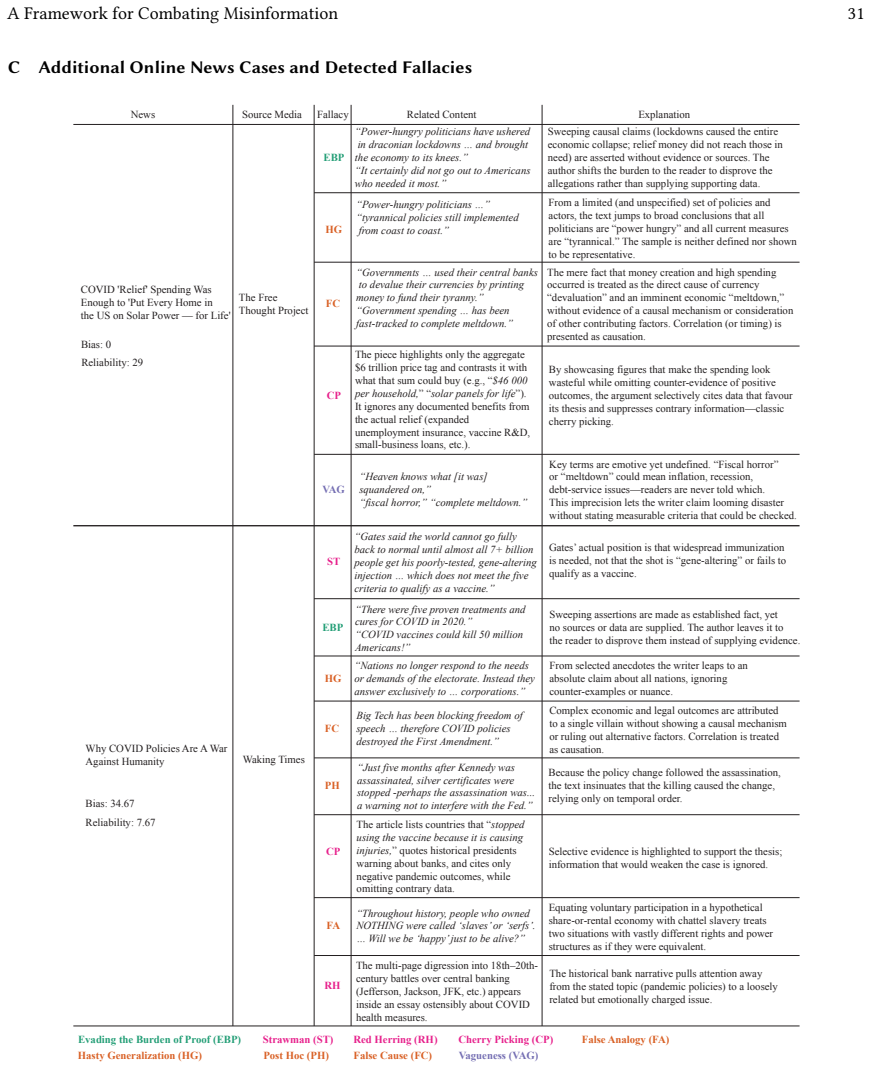
The load-bearing mechanism is the LLM layer with its prompt engine: the model is given definitions and examples of the nine fallacies and asked to output a JSON object listing each detected fallacy, the sentence range where it occurs, and a three-level correction (basic clarification, evidence-based correction, preemptive education). The browser extension then renders these results with inline underlines, color-coded Bézier curve links to fallacy tags, and a popup panel with explanation, corrective layers, external search links, and live chat. A heuristic content extractor based on paragraph-tag analysis feeds clean article text into this pipeline, and modular API design lets new LLMs and fa
What would settle it
Take a random sample of articles Skeptik flags and ask independent expert logicians or trained annotators to mark every sentence that actually contains one of the nine fallacies. If Skeptik's flags agree with expert labels no better than chance, or if fallacies per 1,000 words stop correlating with reliability and bias when article length, topic, and outlet style are controlled, the central claim fails.
Extended reading notes
Core claim
The paper's central claim is that integrating LLMs with lightweight heuristics yields a working system for spotting the logical structure of misinformation: Skeptik extracts an article's text, runs a fallacies-specific LLM prompt over nine named fallacy types, and returns machine-readable annotations with sentence ranges and three levels of explanation. The authors argue that this moves beyond fact-checking, because an argument can be assembled from factually true statements and still mislead through strawman, cherry-picking, or false-cause reasoning. As quantitative support, they compute that articles rated less reliable by a professional media-rating dataset contain more detected fallacies
Load-bearing premise
The quantitative evaluation assumes that expert ratings of an article's bias and reliability are a reliable stand-in for how many real logical fallacies it contains, and the detected fallacies themselves are never checked against human experts.
Editorial extensions
If this is right
- If Skeptik works as reported, fact-checking pipelines gain a complementary layer that catches misleading reasoning in articles whose individual facts are accurate.
- Fallacy density could be used as a weak—but automated and scalable—signal for media bias and reliability screening before human review.
- Embedding annotation and multi-level interventions directly in the reading view offers a practical route to inoculation-style media-literacy training.
- The modular design means detection quality should improve automatically as LLMs become more reliable at fallacy reasoning, without redesigning the interface.
- The observed correlations support using Skeptik in newsroom or platform triage, while the low explained variance warns that fallacy counts alone cannot rate an article.
Reading between the lines
- Because the paper's correlational evidence uses bias and reliability ratings as a proxy rather than expert-verified fallacy labels, the most direct next test is a human-annotation benchmark: without such a check, the UI and education benefits stand, but the detection validity remains open.
- The tentative wording and layered corrections are a testable design hypothesis: measuring whether 'potential fallacy' framing reduces reader resistance better than direct flags, especially among readers who disagree with the article's stance.
- A natural extension the paper gestures toward but does not test is adding retrieval of external context for context-dependent fallacies like cherry-picking and false cause, which should improve precision on exactly the fallacy types where the current prompt relies on internal knowledge.
- If the reliability correlations replicate across languages and domains, Skeptik-style annotation could double as a diagnostic for media bias rather than only a reader aid.
Signed reviews
Editorial analysis
A structured set of objections, weighed in public.
Referee Report
Summary. The paper presents Skeptik, a browser-extension framework that combines LLM-based detection with heuristic content extraction to identify and annotate nine logical fallacies in online news. The system provides three phases—detection, annotation, and intervention—and a user interface with dynamic links, fallacy tags, and tiered corrective explanations. The evaluation consists of three case studies, a correlation study on 3,825 Ad Fontes articles (H1/H2), a crowdsourced usability survey (N=50), and five expert interviews. The authors report positive correlations between detected fallacy counts and source bias/unreliability, and generally positive usability ratings, while explicitly acknowledging the absence of a ground-truth benchmark for fallacy detection.
Significance. If the detection component were validated, Skeptik would be a useful HCI contribution: it operationalizes inoculation theory, provides a modular and extensible framework, and addresses an underexplored aspect of misinformation—logical coherence rather than factual accuracy. The paper is transparent about limitations, ships source code and full prompts, and offers rich case-study material. However, the central mechanism—LLM-based fallacy identification—is not validated against human labels, and the human evaluation measures self-reported experience rather than actual gains in critical reading. As a system/interface paper the contribution is credible; as a demonstration of effective fallacy detection it is currently under-supported.
major comments (2)
- [§6.1, §7.2, Appendix A.1] The central claim that Skeptik can 'analyze and annotate potential logical fallacies' and 'demonstrate effectiveness in identifying' misleading information rests on an unvalidated detector. The only large-scale quantitative evidence is the correlation between LLM-detected fallacy counts and Ad Fontes reliability/bias. Because the independent variable is generated by the same prompt under evaluation, the observed correlations (e.g., r=-0.30 for fallacies/1000 words vs. reliability; r=0.27 vs. absolute bias, Fig. 9) may reflect superficial stylistic correlates of low-quality journalism—sensationalism, absolutist phrasing, topic-specific vocabulary—rather than genuine fallacy identification. Section 7.2 concedes 'we have not proven that the fallacies detected are indeed present in the articles.' The related work cites labeled fallacy datasets (Jin et al. 2022; Sahai et al. 2021), but no ben
- [§6.2, Fig. 11, §8] The conclusion that Skeptik is 'effective in enhancing readers' critical examination of news content and promoting media literacy' is not supported by the crowdsourced evaluation. The survey in §6.2 is a self-reported usability and acceptance instrument (UTAUT-inspired Likert items), not a measure of critical thinking or media literacy. It does not compare pre/post reading behavior, comprehension, or fallacy identification ability, nor does it include a control condition. Mean scores around 4/5 (Fig. 11) show positive reception, but reception is not efficacy. The abstract and conclusion should be scaled back to 'perceived usefulness' or supplemented with a behavioral outcome measure.
minor comments (6)
- [§6.2] 'Language Learning Models' should be 'Large Language Models'.
- [§5] 'adFontis' should be 'Ad Fontes'.
- [§6.1, Figs. 9–10] Given N=3,825, p<0.0001 is unsurprising; report 95% confidence intervals for the correlations and for the regression coefficients. The adjusted R² values (0.21–0.24) are acknowledged but should be discussed as evidence that fallacy features explain a small share of variance, weakening the inferred practical strength of the signal.
- [§7.2] The sentence 'Given the satisfactory reasoning ability of GPT and the examples provided, we are fairly confident that the detected fallacies correspond to actual fallacies' is an assertion, not evidence. If retained, it should be explicitly labeled as a conjecture.
- [References] The in-text citation 'Chen et al. [56]' appears to refer to ChartAccent, but the reference list entry is Ren et al. Please reconcile.
- [Appendix A.1] The prompt requests 'all logical fallacies' from a fixed list of nine. There is no instruction for abstaining when a sentence is borderline or when none apply, which may inflate false positives. This should be discussed as a design choice.
Circularity Check
No circular derivation; the Ad Fontes correlation is an external proxy, not a self-validating construction.
full rationale
Skeptik's claimed capability ('analyze and annotate potential logical fallacies') is not derived from its evaluation or vice versa. The detector is an LLM prompt built from an external fallacy taxonomy (Musi and Reed [48]); the evaluation correlates the detector's outputs against external Ad Fontes reliability/bias ratings. These are independent measurements, so the H1/H2 correlations are not forced by construction: the LLM could in principle produce no fallacies for any article, or flat counts, and the correlations would vanish. The paper explicitly states there is no ground-truth fallacy dataset (Sec. 6.1: 'there is no ground truth dataset that explicitly states which sentences in an article contain a specific fallacy') and uses Ad Fontes only as a proxy. It also honestly concedes in Sec. 7.2: 'we have not proven that the fallacies detected are indeed present in the articles.' That is a validation gap (the detector is not benchmarked against human labels; the correlation could reflect stylistic correlates of low-quality journalism rather than genuine fallacy detection), but it is not circularity in the derivation sense: no fitted parameter is renamed as a prediction, no result is assumed by definition, and no load-bearing claim rests on a self-citation. The only self-citations ([34] linter-inspired UI linkage; [35] narrative-visualization related work) are design inspirations and related-work context, not evidence for the fallacy-detection mechanism. Accordingly, no circular step can be exhibited, and the score is 0.
Assumptions & free parameters
free parameters (4)
- Fallacy taxonomy and definitions (9 fallacies)
- LLM model choice, temperature, and prompt phrasing =
GPT model, unspecified parameters
- Correlation study sample: 3,825 articles from 80,000 =
3,825
- Ad Fontes bias and reliability scores as ground-truth labels
assumptions (4)
- domain assumption LLM outputs are a reliable signal of logical fallacies in news text.
- domain assumption Article reliability and absolute bias scores from Ad Fontes are valid proxies for the presence of logical fallacies.
- domain assumption Inoculation theory applies to a tool that highlights fallacies in a single reading.
- domain assumption Self-reported Likert scores measure actual improvements in critical reading and media literacy.
Cite this review
Pith. "Pith review of Skeptik: A Hybrid Framework for Combating Potential Misinformation in Journalism." pith.science (2026). https://pith.science/paper/BSNO4D3F
@misc{pith2026250818499,
  author       = {Pith},
  title        = {Pith review of: Skeptik: A Hybrid Framework for Combating Potential Misinformation in Journalism},
  year         = {2026},
  howpublished = {\url{https://pith.science/paper/BSNO4D3F}},
  note         = {Machine review of arXiv:2508.18499}
}
read the original abstract
The proliferation of misinformation in journalism, often stemming from flawed reasoning and logical fallacies, poses significant challenges to public understanding and trust in news media. Traditional fact-checking methods, while valuable, are insufficient for detecting the subtle logical inconsistencies that can mislead readers within seemingly factual content. To address this gap, we introduce Skeptik, a hybrid framework that integrates Large Language Models (LLMs) with heuristic approaches to analyze and annotate potential logical fallacies and reasoning errors in online news articles. Operating as a web browser extension, Skeptik automatically highlights sentences that may contain logical fallacies, provides detailed explanations, and offers multi-layered interventions to help readers critically assess the information presented. The system is designed to be extensible, accommodating a wide range of fallacy types and adapting to evolving misinformation tactics. Through comprehensive case studies, quantitative analyses, usability experiments, and expert evaluations, we demonstrate the effectiveness of Skeptik in enhancing readers' critical examination of news content and promoting media literacy. Our contributions include the development of an expandable classification system for logical fallacies, the innovative integration of LLMs for real-time analysis and annotation, and the creation of an interactive user interface that fosters user engagement and close reading. By emphasizing the logical integrity of textual content rather than relying solely on factual accuracy, Skeptik offers a comprehensive solution to combat potential misinformation in journalism. Ultimately, our framework aims to improve critical reading and protect the public from deceptive information online and enhance the overall credibility of news media.
Figures


Figures from the paper (10 more)


Reference graph
Works this paper leans on
-
[1]
Gary D Bond, Rebecka D Holman, Jamie-Ann L Eggert, Lassiter F Speller, Olivia N Garcia, Sasha C Mejia, Kohlby W Mcinnes, Eleny C Ceniceros, and Rebecca Rustige. 2017. ‘Lyin’Ted’, ‘Crooked Hillary’, and ‘Deceptive Donald’: Language of Lies in the 2016 US Presidential Debates.Applied Cognitive Psychology 31, 6 (2017), 668–677. https://doi.org/10.1002/acp.3376
-
[2]
Michael Bostock, Vadim Ogievetsky, and Jeffrey Heer. 2011. D3 Data-Driven Documents. IEEE Transactions on Visualization and Computer Graphics 17, 12 (2011), 2301–2309. https://doi.org/10.1109/TVCG.2011.185
-
[3]
Tom Brown, Benjamin Mann, Nick Ryder, Melanie Subbiah, Jared D Kaplan, Prafulla Dhariwal, Arvind Neelakantan, Pranav Shyam, Girish Sastry, Amanda Askell, et al. 2020. Language models are few-shot learners. Advances in Neural Information Processing Systems 33 (2020), 1877–1901. https://doi.org/10.48550/arXiv.2005.14165
-
[4]
Howard J. Carey and Milos Manic. 2016. Proceedings of the HTML web content extraction using paragraph tags. In IEEE International Symposium on Industrial Electronics. IEEE, Santa Clara, 1099–1105. https://doi.org/10.1109/ISIE.2016.7745047
-
[5]
Carlos Castillo, Marcelo Mendoza, and Barbara Poblete. 2011. Information credibility on twitter. In Proceedings of the International Conference on World Wide Web. ACM, New York, 675–684. https://doi.org/10.1145/1963405.1963500
arXiv 2011
-
[6]
Abhijnan Chakraborty, Bhargavi Paranjape, Sourya Kakarla, and Niloy Ganguly. 2016. Stop clickbait: Detecting and preventing clickbaits in online news media. In Proceedings of the IEEE/ACM International Conference on Advances in Social Networks Analysis and Mining . IEEE, Davis, 9–16. https://doi.org/10.1109/ASONAM.2016.7752207
-
[7]
Siming Chen, Jie Li, Gennady Andrienko, Natalia Andrienko, Yun Wang, Phong H. Nguyen, and Cagatay Turkay. 2020. Supporting Story Synthesis: Bridging the Gap between Visual Analytics and Storytelling. IEEE Transactions on Visualization and Computer Graphics 26, 7 (2020), 2499–2516. https://doi.org/10.1109/TVCG.2018.2889054
arXiv 2020
-
[8]
Weisi Chen, Zoran Milosevic, Fethi A Rabhi, and Andrew Berry. 2023. Real-Time Analytics: Concepts, Architectures and ML/AI Considerations. IEEE Access 11 (2023), 71634–71657. https://doi.org/10.1109/ACCESS.2023.3295694 Manuscript submitted to ACM A Framework for Combating Misinformation 25
Show all 86 references
-
[9]
Anton Chernyavskiy, Dmitry Ilvovsky, and Preslav Nakov. 2021. Whatthewikifact: Fact-checking claims against wikipedia. InProceedings of the 30th ACM International Conference on Information & Knowledge Management . 4690–4695
2021
-
[10]
Arjun Choudhry, Mandar Sharma, Pramod Chundury, Thomas Kapler, Derek WS Gray, Naren Ramakrishnan, and Niklas Elmqvist. 2020. Once Upon A Time In Visualization: Understanding the Use of Textual Narratives for Causality. IEEE Transactions on Visualization and Computer Graphics (...
2020
-
[11]
John Cook, Ullrich Ecker, and Stephan Lewandowsky. 2015. Misinformation and how to correct it. Emerging Trends in the Social and Behavioral Sciences (2015), 1–17. https://doi.org/10.1002/9781118900772.etrds0222
2015 doi
-
[12]
Tim Draws, Alisa Rieger, Oana Inel, Ujwal Gadiraju, and Nava Tintarev. 2021. A Checklist to Combat Cognitive Biases in Crowdsourcing.Proceedings of the AAAI Conference on Human Computation and Crowdsourcing 9, 1 (Oct. 2021), 48–59. https://doi.org/10.1609/hcomp.v9i1.18939
2021 doi
-
[13]
Ullrich KH Ecker, Stephan Lewandowsky, John Cook, Philipp Schmid, Lisa K Fazio, Nadia Brashier, Panayiota Kendeou, Emily K Vraga, and Michelle A Amazeen. 2022. The psychological drivers of misinformation belief and its resistance to correction. Nature Reviews Psychology 1, 1 (...
2022
-
[14]
The Economist. 2024. How the Iowa caucuses are changing in 2024. https://www.economist.com/the-economist-explains/2024/01/10/how-the- iowa-caucuses-are-changing-in-2024
2024
-
[15]
Aaron C Elkins, Norah E Dunbar, Bradley Adame, and Jay F Nunamaker. 2013. Are users threatened by credibility assessment systems? Journal of Management Information Systems 29, 4 (2013), 249–262. https://doi.org/10.2753/MIS0742-1222290409
2013 doi
-
[16]
Zhijiang Guo, Michael Schlichtkrull, and Andreas Vlachos. 2022. A Survey on Automated Fact-Checking. Transactions of the Association for Computational Linguistics 10 (02 2022), 178–206. https://doi.org/10.1162/tacl_a_00454
2022 doi
-
[17]
Ivan Habernal, Raffael Hannemann, Christian Pollak, Christopher Klamm, Patrick Pauli, and Iryna Gurevych. 2017. Argotario: Computa- tional Argumentation Meets Serious Games. In Proceedings of the 2017 Conference on Empirical Methods in Natural Language Processing: Sys- tem Dem...
2017 doi
-
[18]
Mark Harrower and Cynthia A. Brewer. 2003. ColorBrewer.org: An online tool for selecting colour schemes for maps. The Cartographic Journal 40, 1 (2003), 27–37. https://doi.org/10.1179/000870403235002042
2003 doi
-
[19]
Sandra G Hart. 2006. NASA-task load index (NASA-TLX); 20 years later. In Proceedings of the human factors and ergonomics society annual meeting , Vol. 50. Sage publications Sage CA: Los Angeles, CA, 904–908
2006
-
[20]
Naeemul Hassan, Gensheng Zhang, Fatma Arslan, Josue Caraballo, Damian Jimenez, Siddhant Gawsane, Shohedul Hasan, Minumol Joseph, Aaditya Kulkarni, Anil Kumar Nayak, et al. 2017. Claimbuster: The first-ever end-to-end fact-checking system. Proceedings of the VLDB Endowment 10, ...
2017
-
[21]
Danny Holten. 2006. Hierarchical edge bundles: Visualization of adjacency relations in hierarchical data. IEEE Transactions on Visualization and Computer Graphics 12, 5 (2006), 741–748. https://doi.org/10.1109/TVCG.2006.147
2006 doi
-
[22]
Timon MJ Hruschka and Markus Appel. 2023. Learning about informal fallacies and the detection of fake news: An experimental intervention. PLoS One 18, 3 (2023), e0283238
2023
-
[23]
Lei Huang, Weijiang Yu, Weitao Ma, Weihong Zhong, Zhangyin Feng, Haotian Wang, Qianglong Chen, Weihua Peng, Xiaocheng Feng, Bing Qin, and Ting Liu. 2025. A Survey on Hallucination in Large Language Models: Principles, Taxonomy, Challenges, and Open Questions. ACM Trans. Inf. S...
2025 doi
-
[24]
Jessica Hullman and Nick Diakopoulos. 2011. Visualization Rhetoric: Framing Effects in Narrative Visualization. IEEE Transactions on Visualization and Computer Graphics 17, 12 (2011), 2231–2240. https://doi.org/10.1109/TVCG.2011.255
2011 doi
-
[25]
Farnaz Jahanbakhsh and David R Karger. 2024. A browser extension for in-place signaling and assessment of misinformation. In Proceedings of the ACM Conference on Human Factors in Computing Systems . ACM, Honolulu, 1–21. https://doi.org/10.1145/3613904.3642473
2024
-
[26]
Farnaz Jahanbakhsh, Amy X Zhang, Karrie Karahalios, and David R Karger. 2022. Our browser extension lets readers change the headlines on news articles, and you won’t believe what they did! Proceedings of the ACM Conference on Human-Computer Interaction 6, CSCW2 (2022), 1–33. h...
2022 doi
-
[27]
Jiwon Jeong, Hyeju Jang, and Hogun Park. 2025. Large Language Models Are Better Logical Fallacy Reasoners with Counterargument, Explanation, and Goal-Aware Prompt Formulation. In Findings of the Association for Computational Linguistics: NAACL 2025 . Association for Computatio...
2025
-
[28]
Zhijing Jin, Abhinav Lalwani, Tejas Vaidhya, Xiaoyu Shen, Yiwen Ding, Zhiheng Lyu, Mrinmaya Sachan, Rada Mihalcea, and Bernhard Schoelkopf
-
[29]
Alireza Karduni, Isaac Cho, Ryan Wesslen, Sashank Santhanam, Svitlana Volkova, Dustin L Arendt, Samira Shaikh, and Wenwen Dou. 2019. Vulnerable to misinformation? Verifi!. In Proceedings of the International Conference on Intelligent User Interfaces . ACM, Marina del Ray Calif...
2019
-
[30]
Steve M.D. Karp. 2021. The medical profession implodes. American Thinker (13 Dec 2021). https://www.americanthinker.com/articles/2021/12/the_ medical_profession_implodes.html Manuscript submitted to ACM 26 Fan and Lei, et al
2021
-
[31]
Steven Koonin. 2022. Greenland melting ice: Panic, sheets, global warming variance, seal level rise, climate change, carbon, fossil fuel. The Wall Street Journal (2022). https://www.wsj.com/articles/greenland-melting-ice-panic-sheets-global-warming-variance-seal-level-rise-cli...
2022
-
[32]
Robert Kosara and Jock Mackinlay. 2013. Storytelling: The Next Step for Visualization. Computer 46, 5 (2013), 44–50. https://doi.org/10.1109/MC. 2013.36
2013 doi
-
[33]
Chufan Lai, Zhixian Lin, Ruike Jiang, Yun Han, Can Liu, and Xiaoru Yuan. 2020. Automatic Annotation Synchronizing with Textual Description for Visualization. Proceedings of the ACM Conference on Human Factors in Computing Systems (2020), 1–13. https://doi.org/10.1145/3313831.3376443
2020
-
[34]
MacEachren, and Ross Maciejewski
Fan Lei, Arlen Fan, Alan M. MacEachren, and Ross Maciejewski. 2024. GeoLinter: A linting framework for choropleth maps. IEEE Transactions on Visualization and Computer Graphics 30, 2 (2024), 1592–1607. https://doi.org/10.1109/TVCG.2023.3322372
2024
-
[35]
Fan Lei, Yuxin Ma, A Stewart Fotheringham, Elizabeth A Mack, Ziqi Li, Mehak Sachdeva, Sarah Bardin, and Ross Maciejewski. 2023. GeoExplainer: A visual analytics framework for spatial modeling contextualization and report generation. IEEE Transactions on Visualization and Compu...
2023
-
[36]
Yanda Li, Dixuan Wang, Jiaqing Liang, Guochao Jiang, Qianyu He, Yanghua Xiao, and Deqing Yang. 2024. Reason from Fallacy: Enhancing Large Language Models’ Logical Reasoning through Logical Fallacy Understanding. In Findings of the Association for Computational Linguistics: NAA...
2024 doi
-
[37]
Stephanie Lin, Jacob Hilton, and Owain Evans. 2022. TruthfulQA: Measuring How Models Mimic Human Falsehoods. In Proceedings of the 60th Annual Meeting of the Association for Computational Linguistics (Volume 1: Long Papers) . Association for Computational Linguistics, Dublin, ...
2022 doi
-
[38]
Shian-Hua Lin and Jan-Ming Ho. 2002. Discovering informative content blocks from Web documents. In Proceedings of the ACM Conference on Knowledge Discovery and Data Mining . ACM, Edmonton, 588–593. https://doi.org/10.1145/775047.775134
2002
-
[39]
Maxim Lisnic, Cole Polychronis, Alexander Lex, and Marina Kogan. 2023. Misleading beyond visual tricks: How people actually lie with charts. In Proceedings of the ACM Conference on Human Factors in Computing Systems . ACM, Hamburg, 1–21. https://doi.org/10.1145/3544548.3580910
2023
-
[40]
Can Liu, Liwenhan Xie, Yun Han, Atong Wei, and Xiaoru Yuan. 2020. AutoCaption: An Approach to Generate Natural Language Description from Visualization Automatically. IEEE Pacific Symposium on Visualization 2020-June (2020), 191–195. https://doi.org/10.1109/PacificVis48177.2020.1043
2020
-
[41]
Sonia Livingstone. 2004. What is media literacy? Intermedia 32, 3 (2004), 18–20
2004
-
[42]
Kristin M Lord and Katya Vogt. 2021. Strengthen media literacy to win the fight against misinformation. Stanford Social Innovation Review (2021). https://doi.org/10.48558/PY1B-3G51
2021 doi
-
[43]
Jing Ma, Wei Gao, and Kam-Fai Wong. 2018. Rumor detection on twitter with tree-structured recursive neural networks. InProceedings of the Annual Meeting of the Association for Computational Linguistics . ACL, Melbourne, 1980–1989
2018
-
[44]
John Manoogian III and Buster Benson. 2020. The cognitive bias codex—180+ biases
2020
-
[45]
Aydin Mohseni, Cailin O’Connor, and James Owen Weatherall. 2022. The Best Paper You’ll Read Today.philosophical topics 50, 2 (2022), 127–153
2022
-
[46]
Steven Moore, Richard Tong, Anjali Singh, Zitao Liu, Xiangen Hu, Yu Lu, Joleen Liang, Chen Cao, Hassan Khosravi, Paul Denny, et al . 2023. Empowering education with llms-the next-gen interface and content generation. In Proceedings of the International Conference on Artificial...
2023 doi
-
[47]
Elena Musi, Myrto Aloumpi, Elinor Carmi, Simeon Yates, and Kay O’Halloran. 2022. Developing fake news immunity: Fallacies as misinformation triggers during the pandemic. Online Journal of Communication and Media Technologies 12, 3 (2022)
2022
-
[48]
Elena Musi and Chris Reed. 2022. From fallacies to semi-fake news: Improving the identification of misinformation triggers across digital media. Discourse & Society 33, 3 (2022), 349–370. https://doi.org/10.1177/095792652210766
2022 doi
-
[49]
An T Nguyen, Aditya Kharosekar, Saumyaa Krishnan, Siddhesh Krishnan, Elizabeth Tate, Byron C Wallace, and Matthew Lease. 2018. Believe it or not: Designing a human-ai partnership for mixed-initiative fact-checking. In Proceedings of the ACM Symposium on User Interface Software...
2018
-
[50]
Brendan Nyhan. 2021. Why the backfire effect does not explain the durability of political misperceptions. Proceedings of the National Academy of Sciences 118, 15 (2021), e1912440117. https://doi.org/10.1073/pnas.1912440117
2021 doi
-
[51]
Brendan Nyhan and Jason Reifler. 2010. When corrections fail: The persistence of political misperceptions. Political Behavior 32, 2 (2010), 303–330. https://doi.org/10.1007/s11109-010-9112-2
2010 doi
-
[52]
Normand, and Merritt J
Triton Ong, Matthew P. Normand, and Merritt J. Schenk. 2018. Using equivalence-based instruction to teach college students to identify logical fallacies. Behavioral Interventions 33, 2 (2018), 122–135. https://doi.org/10.1002/bin.1512
2018 doi
-
[53]
Michael Pfau and Michael Burgoon. 1988. Inoculation in political campaign communication. Human Communication Research 15, 1 (1988), 91–111. https://doi.org/10.1111/j.1468-2958.1988.tb00172.x
1988
-
[54]
Dialogue 2017
Dina Pisarevskaya. 2017. Rhetorical structure theory as a feature for deception detection in news reports in the Russian language. In Proceedings of the International Conference on Computational Linguistics and Intellectual Technologies "Dialogue 2017" . Moscow, 191–200
2017
-
[55]
Shaina Raza, Drai Paulen-Patterson, and Chen Ding. 2025. Fake news detection: comparative evaluation of BERT-like models and large language models with generative AI-annotated data. Knowledge and Information Systems 67, 4 (2025), 3267–3292
2025
-
[56]
Donghao Ren, Matthew Brehmer, Bongshin Lee, Tobias Höllerer, and Eun Kyoung Choe. 2017. ChartAccent: Annotation for Data-Driven Storytelling. In IEEE Pacific Symposium on Visualization . 230–239. https://doi.org/10.1109/PACIFICVIS.2017.8031599 Manuscript submitted to ACM A Fra...
2017
-
[57]
Vincent Robbemond, Oana Inel, and Ujwal Gadiraju. 2022. Understanding the Role of Explanation Modality in AI-assisted Decision-making. In Proceedings of the 30th ACM Conference on User Modeling, Adaptation and Personalization (Barcelona, Spain) (UMAP ’22). Association for Comp...
2022
-
[58]
Francisco-Javier Rodrigo-Ginés, Jorge Carrillo-de Albornoz, and Laura Plaza. 2023. A systematic review on media bias detection: What is media bias, how it is expressed, and how to detect it. Expert Systems with Applications 237, PC (2023), 121641. https://doi.org/10.1016/j.esw...
2023
-
[59]
Md Main Uddin Rony, Naeemul Hassan, and Mohammad Yousuf. 2018. BaitBuster: a clickbait identification framework. In Proceedings of the AAAI Conference on Artificial Intelligence, Vol. 32. AAAI Press, New Orleans. https://doi.org/10.1609/aaai.v32i1.11378
2018 doi
-
[60]
Saumya Yashmohini Sahai, Oana Balalau, and Roxana Horincar. 2021. Breaking down the invisible wall of informal fallacies in online discussions. In ACL-IJCNLP 2021-Joint Conference of the 59th Annual Meeting of the Association for Computational Linguistics and the 11th Internat...
2021
-
[61]
Angeline Sangalang, Yotam Ophir, and Joseph N Cappella. 2019. The potential for narrative correctives to combat misinformation. Journal of Communication 69, 3 (04 2019), 298–319. https://doi.org/10.1093/joc/jqz014
2019 doi
-
[62]
Arvind Satyanarayan and Jeffrey Heer. 2014. Authoring Narrative Visualizations with Ellipsis. Computer Graphics Forum 33, 3 (2014), 361–370. https://doi.org/10.1111/cgf.12392
2014 doi
-
[63]
Philipp Schmid and Cornelia Betsch. 2019. Effective strategies for rebutting science denialism in public discussions. Nature Human Behaviour 3, 9 (2019), 931–939
2019
-
[64]
Edward Segel and Jeffrey Heer. 2010. Narrative Visualization: Telling Stories with Data. IEEE Transactions on Visualization and Computer Graphics 16, 6 (2010), 1139–1148. https://doi.org/10.1109/TVCG.2010.179
2010 doi
-
[65]
Drucker, Alex Endert, and John Stasko
Arjun Srinivasan, Steven M. Drucker, Alex Endert, and John Stasko. 2019. Augmenting Visualizations with Interactive Data Facts to Facilitate Interpretation and Communication. IEEE Transactions on Visualization and Computer Graphics 25, 1 (2019), 672–681. https://doi.org/10.110...
2019
-
[66]
Markus Steinberger, Manuela Waldner, Marc Streit, Alexander Lex, and Dieter Schmalstieg. 2011. Context-preserving visual links. IEEE Transactions on Visualization and Computer Graphics 17, 12 (2011), 2249–2258. https://doi.org/10.1109/TVCG.2011.183
2011 doi
-
[67]
Lichao Sun, Yue Huang, Haoran Wang, Siyuan Wu, Qihui Zhang, Chujie Gao, Yixin Huang, Wenhan Lyu, Yixuan Zhang, Xiner Li, et al . 2024. Trustllm: Trustworthiness in large language models. In Proceedings of the International Conference on Machine Learning . PMLR, Vienna. https: ...
2024
-
[68]
2018.ELEVEN Misinformation and Its Correction: Cognitive Mechanisms and Recommendations for Mass Communication
Briony Swire and Ullrich Ecker. 2018.ELEVEN Misinformation and Its Correction: Cognitive Mechanisms and Recommendations for Mass Communication. University of Texas Press, New York, USA, 195–211. https://doi.org/10.7560/314555-013
2018 doi
-
[69]
Christopher W Tindale. 2007. Fallacies and Argument Appraisal. Cambridge University Press
2007
-
[70]
Laramee, Kodzo Wegba, Aidong Lu, Yun Wang, Huamin Qu, Qiong Luo, and Xiaojuan Ma
Chao Tong, Richard Roberts, Rita Borgo, Sean Walton, Robert S. Laramee, Kodzo Wegba, Aidong Lu, Yun Wang, Huamin Qu, Qiong Luo, and Xiaojuan Ma. 2018. Storytelling and Visualization: An Extended Survey. Information 9, 3 (2018), 1–42. https://doi.org/10.3390/info9030065
2018 doi
-
[71]
Mykola Trokhymovych and Diego Saez-Trumper. 2021. Wikicheck: An end-to-end open source automatic fact-checking api based on wikipedia. In Proceedings of the ACM International Conference on Information & Knowledge Management . ACM, Queensland, 4155–4164. https://doi.org/10.1145...
2021
-
[72]
Viswanath Venkatesh and Hillol Bala. 2008. Technology acceptance model 3 and a research agenda on interventions. Decision Sciences 39, 2 (2008), 273–315. https://doi.org/10.1111/j.1540-5915.2008.00192.x
2008
-
[73]
Marco Viviani and Gabriella Pasi. 2017. Credibility in social media: opinions, news, and health information—a survey. Wiley Interdisciplinary Reviews: Data Mining and Knowledge Discovery 7, 5 (2017), e1209. https://doi.org/10.1002/widm.1209
2017 doi
-
[74]
Soroush Vosoughi, Deb Roy, and Sinan Aral. 2018. The spread of true and false news online. Science 359, 6380 (2018), 1146–1151. https: //doi.org/10.1126/science.aap9559
2018 doi
-
[75]
Henning Wachsmuth, Nona Naderi, Yufang Hou, Yonatan Bilu, Vinodkumar Prabhakaran, Tim Alberdingk Thijm, Graeme Hirst, and Benno Stein
-
[76]
Ran Wang, Kehan Du, Qianhe Chen, Yifei Zhao, Mojie Tang, Hongxi Tao, Shipan Wang, Yiyao Li, and Yong Wang. 2022. RumorLens: Interactive analysis and validation of suspected rumors on social media. In Proceedings of the ACM Conference on Human Factors in Computing Systems Exten...
2022
-
[77]
Claire Wardle and Hossein Derakhshan. 2017. Information disorder: Toward an interdisciplinary framework for research and policymaking . Vol. 27. Council of Europe Strasbourg
2017
-
[78]
Ke Wu, Song Yang, and Kenny Q Zhu. 2015. False rumors detection on Sina Weibo by propagation structures. InProceedings of the IEEE International Conference on Data Engineering . IEEE, Seoul, 651–662. https://doi.org/10.1109/ICDE.2015.7113322
2015
-
[79]
Francisco Zanartu, John Cook, Markus Wagner, and Julian García. 2024. A technocognitive approach to detecting fallacies in climate misinformation. Scientific Reports 14, 1 (2024), 27647
2024
-
[80]
Liudmila Zavolokina, Kilian Sprenkamp, Zoya Katashinskaya, Daniel Gordon Jones, and Gerhard Schwabe. 2024. Think fast, think slow, think critical: designing an automated propaganda detection tool. In Proceedings of the ACM Conference on Human Factors in Computing Systems . ACM...
2024
-
[81]
Amy X Zhang, Aditya Ranganathan, Sarah Emlen Metz, Scott Appling, Connie Moon Sehat, Norman Gilmore, Nick B Adams, Emmanuel Vincent, Jennifer Lee, Martin Robbins, et al. 2018. A structured response to misinformation: Defining and annotating credibility indicators in news artic...
2018
-
[82]
Jiawei Zhang, Bowen Dong, and S Yu Philip. 2020. Fakedetector: Effective fake news detection with deep diffusive neural network. In Proceedings of the IEEE International Conference on Data Engineering . IEEE, Dallas, 1826–1829. https://doi.org/10.1109/ICDE48307.2020.00180
2020
-
[83]
Xinyi Zhou and Reza Zafarani. 2019. Fake news detection: An interdisciplinary research. In Proceedings of The World Wide Web Conference . ACM, San Francisco, 1292. https://doi.org/10.1145/3308560.3316476
2019
-
[84]
make the economy better
Ethan Zuckerman. 2021. Why study media ecosystems? Information, Communication & Society 24, 10 (2021), 1495–1513. https://doi.org/10.4324/ 9781003369363-10 A LLM Prompts A.1 Prompt for Detecting Logical Fallacies You are an expert skilled in detecting logical fallacies and exp...
2021
-
[2017]
In Proceedings of the 15th Conference of the European Chapter of the Association for Computational Linguistics: Volume 1, Long Papers
Computational argumentation quality assessment in natural language. In Proceedings of the 15th Conference of the European Chapter of the Association for Computational Linguistics: Volume 1, Long Papers . 176–187
-
[2022]
In Findings of the Association for Computational Linguistics: EMNLP 2022 , Yoav Goldberg, Zornitsa Kozareva, and Yue Zhang (Eds.)
Logical Fallacy Detection. In Findings of the Association for Computational Linguistics: EMNLP 2022 , Yoav Goldberg, Zornitsa Kozareva, and Yue Zhang (Eds.). Association for Computational Linguistics, Abu Dhabi, United Arab Emirates, 7180–7198. https://doi.org/10.18653/v1/2022...
2022 doi
Reviewed August 5, 2026 · model on record in the stance chip above.
Discussion (0). Continue with ORCID to comment.