REVIEW 4 major objections 4 minor 16 references
Cell-Free Massive MIMO-Based Physical-Layer Authentication
T0 review · 4 major / 4 minor · reviewed 2026-08-05 · deepseek-v4-flash
Pith's one-line read Cell-free massive MIMO can authenticate many users simultaneously by checking secret-key tags hidden in their uplink signals, with closed-form detection and false-alarm probabilities for each user.
desk verdict Useful combination, but the central 'closed-form' result is incomplete because the key variances are never computed, and the numerics don't independently validate the detection claims. read the letter →
The pith
A machine-rendered reading of the paper's core claim, the machinery that carries it, and where it could break.
The reading
What carries the argument
The core object is the per-user test statistic λ_k = Re{t̃_k^H r_k}: the expected tag t̃_k is regenerated from the decoded message and secret key, r_k is the residual signal after message cancellation, and the CPU thresholds the match. Around this statistic the paper builds MMSE channel estimation, local zero-forcing combining across distributed access points, and a Neyman-Pearson threshold; the central-limit-theorem approximation of λ_k turns detection into Q-function formulas for every user.
What would settle it
Run the same system over a real channel code and hash function, and compare simulated detection probability to equation (27) on blocks where the recovered message has bit errors; the point where the two curves separate marks the limit of the perfect-recovery assumption. Alternatively, Monte Carlo simulation with small M, N, and K can test whether the Gaussian approximation for λ_k holds in the tails.
Extended reading notes
Core claim
The paper establishes that a tag-based physical-layer authentication test can be carried out per user in a cell-free massive MIMO system, even while an attacker impersonates legitimate users. The CPU reconstructs the expected authentication tag from the decoded message and the shared secret key, then match-filters that tag against the residual received signal left after subtracting the estimated message. Under a Gaussian approximation of the test statistic, Proposition 1 gives closed-form expressions for PFA, PD, and the Neyman-Pearson optimal threshold for each user. The detection probability scales with the number of access points, the number of antennas per access point, the tag length, a
Load-bearing premise
The derivation assumes every decoded message is bit-exact, so the regenerated tag always equals the transmitted tag; any bit errors break the match and lower the real detection probability.
Editorial extensions
If this is right
- Operators can compute per-user detection probability and set thresholds in closed form, without running Monte Carlo simulations for every channel realization.
- More distributed access points substitute for longer tags: raising the number of APs from 1 to 8 lifts detection probability by about 20 percent at a fixed tag length.
- More antennas per access point offset multi-user interference: with 15 users, increasing antennas from 5 to 30 improves detection by 34 percent and keeps it above 50 percent.
- The scheme authenticates all users within the same time-frequency resources, avoiding the orthogonal-resource scaling problem of single-receiver physical-layer authentication.
- The formulas reduce to known single-receiver, single-user results when M = N = K = 1, so the framework generalizes earlier tag-based authentication analysis.
Reading between the lines
- The perfect-recovery assumption means the paper's detection probabilities are an upper envelope; a real channel code with residual bit errors would bend the curves down, so the practical gain depends on how error-robust the hash function is.
- The same closed-form machinery could be extended to user-specific power allocation, since detection depends directly on the message-tag power split ρ_s and ρ_t; optimizing per user could improve fairness without changing the test.
- Attacker models beyond impersonation, such as replaying a captured tag or an attacker with channel knowledge, would add extra variance terms to λ_k, so extending the variance expression ξ_k is a natural next step.
- The Gaussian approximation is asymptotic in the numbers of access points, antennas, and users; for very small networks the Q-function formulas may miss tail behavior, so Monte Carlo validation in that regime would be a cheap check of Proposition 1.
Signed reviews
Editorial analysis
A structured set of objections, weighed in public.
Referee Report
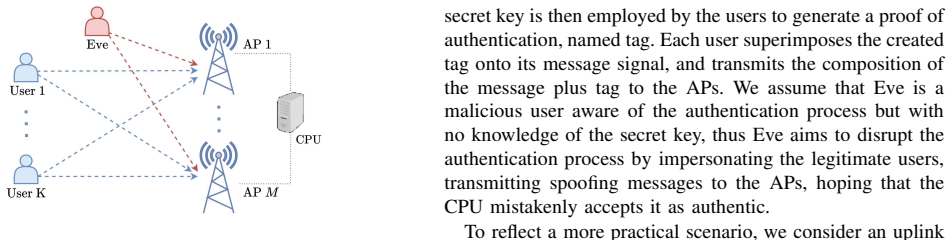
Summary. The paper proposes a tag-based physical-layer authentication scheme for cell-free massive MIMO systems. Each legitimate user superimposes a secret-key-dependent tag on its data, APs perform local ZF combining, and the CPU tests, per user, whether the expected tag appears in the residual signal. The authors formulate a binary hypothesis test and, using a Gaussian approximation, derive purported closed-form expressions for the probability of false alarm, probability of detection, and the optimal threshold for each user. Numerical results are presented for PD as functions of tag length, number of APs, number of users, and power allocation. The central claim is that these expressions constitute a complete, evaluable performance analysis of the proposed authentication framework.
Significance. If the analysis were complete and correct, the paper would make a useful contribution: it extends active physical-layer authentication from single-receiver MIMO to the distributed cell-free massive MIMO architecture, allowing simultaneous authentication of multiple users. The conceptual framework—channel estimation, ZF combining, tag-based hypothesis testing, and per-user Neyman-Pearson thresholds—is well motivated, and the possibility of deriving closed-form PFA/PD expressions for such a system is of genuine interest. The paper does not fit free parameters to data; it is a mathematical derivation, which is a strength. However, the completeness and correctness of the derivation are not currently established: the key variance terms in the main result are never computed, and the numerical section evaluates only the derived expressions themselves without independent simulation. Credit should be given for the clear system model and the explicit identification of the hypothesis-testing framework, but the missing moment derivations and the real-part inconsistency block evaluation of the paper's central contribution.
major comments (4)
- [Section IV, Proposition 1 and Eq. (29)] The claimed closed-form expressions are incomplete. The quantities σ²_{k,k}, σ²_{k,k′}, σ²_{k,e}, and Tr(C_{nk}) in Eq. (29) are introduced as variances and a covariance, but they are never derived. Appendix A stops at Eq. (38), which merely writes Var(λ_k|H0) in terms of these symbols. The difficult part—computing the moments of the ZF-combined effective channels after MMSE channel estimation—is omitted. Consequently, Eqs. (26)–(28) cannot be evaluated by a reader, and the main result of the paper is not actually closed-form. Please provide these moment derivations or, if they are not analytically tractable, state clearly that the expressions require numerical evaluation of these moments.
- [Section V, Figs. 2–4] The numerical results are self-referential and do not validate the model. The text states that θ_k^* and PD,k are computed according to Proposition 1, so the figures verify only the algebra of the proposed formulas, not the accuracy of the Gaussian/CLT approximation or the system model. No independent Monte Carlo simulation of the received signal, channel estimation, residual computation, and hypothesis test is reported, and the text does not state whether the variances in Eq. (29) were evaluated analytically, by Monte Carlo averaging, or by fitting. Thus the >90% PD claim for M=8 (Fig. 2) and the comparative claims in Figs. 3 and 4 are unsupported as presented. At minimum, add a Monte Carlo simulation of the full detection procedure to confirm the analytic expressions.
- [Eq. (20) vs. Eqs. (24)–(25) and Appendix A] There is a notationally important inconsistency. The test statistic is defined as λ_k = Re{ t̃_k^H r_k } in Eq. (20), but Eqs. (24)–(25) and Appendix A treat λ_k as the complex quantity t_k^H r_k. For proper complex Gaussian terms, Var(Re{z}) = (1/2)Var(z), so the variance expression in Eq. (38) and hence ξ_k in Eq. (29) are off by a factor of 2 if the real-part definition is used. This changes the PFA, PD, and optimal threshold formulas. Please make the real-part extraction explicit throughout the derivation and adjust the variance computation accordingly.
- [Section III-B, perfect message recovery assumption] The derivation assumes perfect message recovery (ŝ_k = s_k) and perfect tag regeneration (t̃_k = t_k). The paper states this is feasible because robust hash functions can tolerate errors, but no model quantifies the effect of bit errors in ŝ_k on the regenerated tag. If the recovered message contains errors, the regenerated tag t̃_k differs from the transmitted tag t_k, changing the distribution of λ_k under H1 and degrading the detection probability. Since the numerical claims concern practical authentication performance, this error propagation is load-bearing and should be either analyzed (e.g., via a BER-aware tag-distribution model) or demonstrated by simulation. If the scope is deliberately limited to perfect recovery, that limitation should be stated and its practical impact discussed.
minor comments (4)
- [Eq. (24)] Under H0, when the user transmits only the message (ρ_s = 1), the expression still contains ρ_t in the denominators and treats the transmitted signal as ρ_s s_k. Please clarify the normalization conventions when ρ_t → 0, or define H0 as the case ρ_s = 1, ρ_t = 0 separately from the limit used in the algebra.
- [Eq. (29) and Appendix A] The notation σ²_{k,k}, σ²_{k,k′}, σ²_{k,e} is ambiguous for complex quantities. Define whether these are E{|a|²} − |E{a}|² or simply E{|a|²}, since a_{k,k} may have a nonzero mean under MMSE estimation.
- [Section II-A] The pilot length τ_p = 20 is used in the numerical setup while K is varied up to 15; orthogonality requires τ_p ≥ K, which holds, but the text should state this explicitly when discussing scalability.
- [Section V] In Fig. 4, ρ_s is varied; please state how ρ_t is chosen for each ρ_s (since ρ_s² + ρ_t² = 1), and how the power allocation affects the numerical results.
Circularity Check
No significant circularity: the PFA/PD/threshold derivation is an analytical derivation, not a fit or a renaming of inputs; omitted variance computations are a completeness gap, not circular reasoning.
full rationale
The paper's central result, Proposition 1, is obtained by formulating a binary hypothesis test for the tag-based residual signal, applying the central limit theorem to the test statistic in (20), and then computing the conditional mean E[λ_k|H1]=ML and the conditional variance Var(λ_k|H0)=L ξ_k in Appendix A. These are standard analytical steps: the test statistic is built from the system model, the mean is evaluated using the ZF combining property and MMSE channel estimation, and the variance is expanded from the signal/interference/noise terms in (24). Nothing is fitted to data, and no measured quantity is relabeled as a prediction. The optimal threshold in (28) is obtained by inverting the derived PFA expression, which is the standard Neyman-Pearson procedure, not a circular definition. The paper does leave the variance terms σ²_{k,k}, σ²_{k,k′}, σ²_{k,e}, and Tr(C_nk) unevaluated, so the expressions in (26)-(29) are not fully closed-form as claimed and the numerical results cannot be independently checked from the text. However, an omitted derivation is not a circular reduction. Similarly, the numerical section appears to evaluate the derived expressions rather than report an independent Monte Carlo simulation of the detection procedure; this is a verification and reproducibility gap, but it does not make the derivation equivalent to its inputs. The self-citations to standard cell-free massive MIMO channel estimation and path-loss results are appropriate and not load-bearing: they supply widely used MMSE and path-loss models, not the authentication conclusion. No circularity pattern—self-definitional, fitted-input-called-prediction, load-bearing self-citation, imported uniqueness, ansatz-by-citation, or renaming—is present in the paper's derivation chain.
Assumptions & free parameters
assumptions (4)
- domain assumption Perfect message recovery (ŝ_k = s_k) and perfect tag estimation (t̃_k = t_k) during hypothesis testing
- domain assumption Test statistic λ_k is Gaussian due to the central limit theorem
- standard math MMSE channel estimation with i.i.d. CN(0,1) small-scale fading and known large-scale coefficients
- domain assumption Secret keys are independent, unknown to Eve, and generated tags are uncorrelated with messages and other tags
Cite this review
Pith. "Pith review of Cell-Free Massive MIMO-Based Physical-Layer Authentication." pith.science (2026). https://pith.science/paper/K7WS4M4E
@misc{pith2026250819931,
  author       = {Pith},
  title        = {Pith review of: Cell-Free Massive MIMO-Based Physical-Layer Authentication},
  year         = {2026},
  howpublished = {\url{https://pith.science/paper/K7WS4M4E}},
  note         = {Machine review of arXiv:2508.19931}
}
read the original abstract
In this paper, we exploit the cell-free massive multiple-input multiple-output (CF-mMIMO) architecture to design a physical-layer authentication (PLA) framework that can simultaneously authenticate multiple distributed users across the coverage area. Our proposed scheme remains effective even in the presence of active adversaries attempting impersonation attacks to disrupt the authentication process. Specifically, we introduce a tag-based PLA CFmMIMO system, wherein the access points (APs) first estimate their channels with the legitimate users during an uplink training phase. Subsequently, a unique secret key is generated and securely shared between each user and the APs. We then formulate a hypothesis testing problem and derive a closed-form expression for the probability of detection for each user in the network. Numerical results validate the effectiveness of the proposed approach, demonstrating that it maintains a high detection probability even as the number of users in the system increases.
Figures


Reference graph
Works this paper leans on
-
[1]
A survey of physical-layer auth entication in wireless communications,
N. Xie, Z. Li, and H. Tan, “A survey of physical-layer auth entication in wireless communications,” IEEE Commun. Surv. Tutor ., vol. 23, no. 1, pp. 282–310, Firstquarter 2021
work page 2021
-
[2]
Wireless-p owered full- duplex relay and friendly jamming for secure cooperative co mmunica- tions,
Z. Mobini, M. Mohammadi, and C. Tellambura, “Wireless-p owered full- duplex relay and friendly jamming for secure cooperative co mmunica- tions,” IEEE Trans. Inf. F orensics Security, vol. 14, no. 3, pp. 621–634, Mar. 2019
work page 2019
-
[3]
Physical layer au thentication for massive MIMO systems with hardware impairments,
P . Zhang, T. Taleb, X. Jiang, and B. Wu, “Physical layer au thentication for massive MIMO systems with hardware impairments,” IEEE Trans. Wireless Commun., vol. 19, no. 3, pp. 1563–1576, Mar. 2020
work page 2020
-
[4]
AoA-based physical layer authentication in analog arrays under impersonation attacks,
M. Srinivasan, L. Senigagliesi, H. Chen, A. Chorti, M. Ba ldi, and H. Wymeersch, “AoA-based physical layer authentication in analog arrays under impersonation attacks,” in Proc. IEEE SPAWC, Sep. 2024, pp. 496–500
work page 2024
-
[5]
Tag-based PHY-layer authentication for RIS-assisted communication systems,
P . Zhang, Y . Teng, Y . Shen, X. Jiang, and F. Xiao, “Tag-based PHY-layer authentication for RIS-assisted communication systems,” IEEE Trans. Dependable Secure Comput. , vol. 20, no. 6, pp. 4778–4792, Nov. 2023
work page 2023
-
[6]
Multi-user physical-la yer authen- tication and classification,
N. Xie, M. Sha, T. Hu, and H. Tan, “Multi-user physical-la yer authen- tication and classification,” IEEE Trans. Wireless Commun. , vol. 22, no. 9, pp. 6171–6184, Sep. 2023
work page 2023
-
[7]
Precoder design for physical-layer security and authentication in m assive MIMO UA V communications,
S. J. Maeng, Y . Y apıcı, ˙ I. G¨ uvenc ¸, A. Bhuyan, and H. Dai, “Precoder design for physical-layer security and authentication in m assive MIMO UA V communications,” IEEE Trans. on V eh. Technol. , vol. 71, no. 3, pp. 2949–2964, Mar. 2022
work page 2022
-
[8]
MIMO authentication via delibe rate fingerprinting at the physical layer,
P . L. Y u and B. M. Sadler, “MIMO authentication via delibe rate fingerprinting at the physical layer,” IEEE Trans. Inf. F orensics and Secur ., vol. 6, no. 3, pp. 606–615, Sep. 2011
work page 2011
Show all 16 references
-
[9]
Next- generation multiple access with cell-free massive MIMO,
M. Mohammadi, Z. Mobini, H. Ngo, and M. Matthaiou, “Next- generation multiple access with cell-free massive MIMO,” Proc. IEEE , vol. 112, no. 9, pp. 1372–1420, Sept. 2024
2024
-
[10]
Security model of authenti cation at the physical layer and performance analysis over fading channe ls,
N. Xie, C. Chen, and Z. Ming, “Security model of authenti cation at the physical layer and performance analysis over fading channe ls,” IEEE Trans. Dependable Secure Comput. , vol. 18, no. 1, pp. 253–268, Jan. 2021
2021
-
[11]
A. J. Menezes, P . C. V an Oorschot, and S. A. V anstone, Handbook of Applied Cryptography. CRC press, 2018
2018
-
[12]
Physical-layer a uthentication,
P . L. Y u, J. S. Baras, and B. M. Sadler, “Physical-layer a uthentication,” IEEE Trans. Inf. F orensics and Secur . , vol. 3, no. 1, pp. 38–51, Mar. 2008
2008
-
[13]
Wireless physical l ayer authenti- cation via fingerprint embedding,
P . L. Y u, G. V erma, and B. M. Sadler, “Wireless physical l ayer authenti- cation via fingerprint embedding,” IEEE Commun. Mag. , vol. 53, no. 6, pp. 48–53, Jun. 2015
2015
-
[14]
Authentication theory and hypothesis test ing,
U. Maurer, “Authentication theory and hypothesis test ing,” IEEE Trans. Inf. Theory , vol. 46, no. 4, pp. 1350–1356, July 2000
2000
-
[15]
Cell-free massive MIMO versus small cells,
H. Q. Ngo, A. Ashikhmin, H. Y ang, E. G. Larsson, and T. L. M arzetta, “Cell-free massive MIMO versus small cells,” IEEE Trans. Wireless Commun., vol. 16, no. 3, pp. 1834–1850, Jan. 2017
2017
-
[16]
Massive MU- MIMO downlink TDD systems with linear precoding and downlink pil ots,
H. Q. Ngo, E. G. Larsson, and T. L. Marzetta, “Massive MU- MIMO downlink TDD systems with linear precoding and downlink pil ots,” in Proc. IEEE ALLERTON , Oct. 2013, pp. 293–298
2013
Reviewed August 5, 2026 · model on record in the stance chip above.
Discussion (0). Continue with ORCID to comment.