REVIEW 3 major objections 4 minor 1 cited by
Tropical linear series and matroids
T0 review · 3 major / 4 minor · reviewed 2026-08-05 · deepseek-v4-flash
Pith's one-line read This paper proves that every tropical linear series is locally the Bergman fan of a matroid, and uses that to characterize when canonical linear series tropicalize to the realizable locus.
desk verdict A substantial and honest paper on tropical linear series with a genuinely new local matroid theorem, but the proof of Theorem 1.14 has an unproved slope constraint that needs attention before I'd trust the central identification. read the letter →
The pith
A machine-rendered reading of the paper's core claim, the machinery that carries it, and where it could break.
The reading
What carries the argument
The central object is the local matroid M_Σ. For a tropical linear series Σ ⊆ R(D) and a nondegenerate divisor D, the ground set is the set E of connected components of Γ minus the support of D; each function φ ∈ Σ contributes the flat F_φ, namely the components not contained in φ's minimizer. The key mechanism is that these sets form a matroid lattice of flats, and that evaluation at one point per component gives local coordinates identifying Star(D) with the Bergman fan of M_Σ. The technical condition of big minimizers—every minimizer contains a whole component—allows the matroid to be defined even when D is not in |Σ|. Valuated matroids enter as the tropical modules that parametrize matro
What would settle it
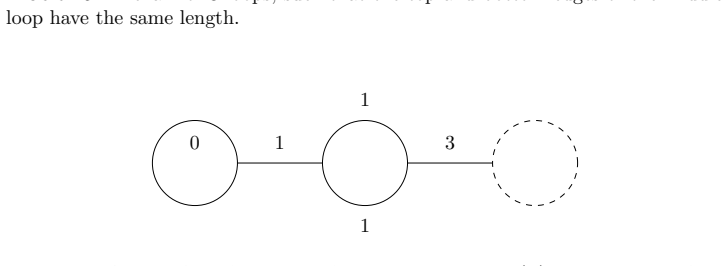
Take a tropical linear series on an interval such as the degree-2 complete series R(2v) with the uniform matroid U2,3 parametrization, and examine a divisor in the interior of |Σ|. If the link of that divisor is not the three-ray Bergman fan of U2,3, or if two distinct nearby divisors give the same evaluation at points in each component outside the support, then Theorem 1.14 fails.
Extended reading notes
Core claim
The paper's main theorem states that if Σ is a tropical linear series of dimension r and D is a nondegenerate divisor in |Σ|, then the collection {F_φ : φ ∈ Σ} ∪ {E}, where E is the set of connected components of Γ ∖ supp(D) and F_φ is the set of components not contained in the minimizer of φ, is the lattice of flats of a matroid M_Σ of rank r+1. Moreover, evaluation at one point in each component embeds the local space Star(D) into R^E/(1,…,1), and the image is exactly the support of the Bergman fan of M_Σ. The same construction gives an invariant local matroid whenever the series has big minimizers, i.e., every minimizer contains a whole connected component. The paper further proves that e
Load-bearing premise
The proof assumes that, near a nondegenerate divisor, each function in the tropical linear series is completely determined by its values at one chosen point in each connected component of the graph outside the divisor's support; the two nondegeneracy conditions—maximal support count and minimal valence-1 degree—are what make this local-coordinate injectivity hold.
Editorial extensions
If this is right
- Every tropical linear series has pure dimension equal to its Baker–Norine rank, so the projectivized series has no higher-dimensional whiskers.
- If a tropical linear series is realizable, then every local matroid at a nondegenerate divisor is realizable; a non-realizable local matroid is therefore an explicit obstruction to lifting to an algebraic linear series.
- Every loopless matroid appears as the local matroid of a tropical linear series at a nondegenerate divisor, both on an interval and on a loop, so all Bergman fans occur as local fans in divisor spaces.
- For a curve X with skeleton Γ in equicharacteristic zero, Trop(|K_X|) = Real(|KΓ|) if and only if Real(|KΓ|) has dimension g−1; when this holds, every curve with that skeleton has the same canonical tropicalization.
- Inclusions among tropical linear series are rigid: if Σ ⊆ Σ′ and both are tropical linear series of the same dimension, then Σ = Σ′, giving a maximality property for these modules.
Reading between the lines
- If the local-matroid construction extends to degenerate divisors, the local structure of a tropical linear series would become a stratification by matroid quotients, potentially leading to a global parametrization and answering Question 9.1 for intervals and loops.
- Because every loopless matroid is a local matroid on an interval, tropical linear series on an interval could serve as a universal combinatorial model in which any Bergman fan embeds as a local fan inside a complete linear system.
- Theorem 1.15 suggests a computational recipe: compute the dimension of Real(|KΓ|) from the Möller–Ulirsch–Werner conditions; equality with g−1 then identifies exactly the curves whose canonical tropicalization is the full realizable locus.
- The Vámos-based examples indicate that failure of the recursive incidence properties is a matroidal phenomenon rather than a special pathology of tropical linear series, and such examples could be used to test whether every tropical linear series is matroidal.
Signed reviews
Editorial analysis
A structured set of objections, weighed in public.
Referee Report
Summary. The paper develops a theory of tropical linear series on metric graphs, defined as finitely generated tropical submodules Σ ⊆ R(D) satisfying rind(Σ) = rBN(Σ) + 1. The main structural result is Theorem 1.14: at a nondegenerate divisor D, the local geometry of |Σ| is the Bergman fan of a matroid MΣ, whose flats are read off from the minimizers of functions in Σ. The paper also proves pure dimensionality (Theorem 1.5), relates matroidal linear series to valuated matroids (Theorem 1.7, Theorem 6.1), characterizes when the tropicalization of the canonical linear series of a single curve equals the realizable locus Real(|KΓ|) (Theorem 1.15), proves that every loopless matroid arises as a local matroid (Theorem 1.18), and revisits Cartwright divisors and matroid adjoints (Theorems 7.1, 7.3). The exposition includes many examples, a streamlined proof of Dupraz's equidimensionality theorem, and an appendix proving that tropicalizations of algebraic linear series are matroidal.
Significance. If the proofs are completed, this is a significant contribution: it gives a unified local-global picture in which tropical linear series are controlled by matroids and valuated matroids, and it resolves a previous question about equidimensionality. The paper is largely self-contained: Appendix A gives a full proof that tropicalizations are matroidal; Corollary 4.10 is an elegant maximality statement; and the explicit constructions of non-realizable matroidal linear series (Examples 6.6 and 6.8) are valuable. However, the central local structure theorem (Theorem 1.14) contains an unproved slope-injectivity assertion that is load-bearing, and several auxiliary claims are terse. These gaps are patchable in principle, but they need to be addressed before the main theorem is established.
major comments (3)
- [§4, proof of Theorem 1.14] The injectivity step, beginning 'Since D has locally maximal support, the slope of φ on any tangent vector ζ at x is either 0 or the multiplicity D(x)', is asserted without proof. This is the bridge from the lattice of minimizers to the actual local fan structure: it is exactly what makes the evaluation map injective and identifies Star(D) with B(MΣ). The implication is not immediate when D(x) > 1, because two tangent directions with slopes +a and −a contribute ord_x(φ) = 0 and can be hidden from the divisor condition. The proof must rule out such cancellations using effectiveness of D + div(φ) and the local minimality of the valence-1 degree, including coincident support points. Without a detailed argument, Theorem 1.14—and hence the paper's central claim—is not fully established.
- [§3, Lemma 3.8] The complement-closure step in the proof of Lemma 3.8 is very terse. Starting with φ ∈ Σ, the paper considers D_ε = div(min{φ, ε}) and asserts that, because D lies in the relative interior of a maximal face τ, 'the opposite of any such chip-firing move is well-defined in Σ'. This is a nontrivial statement: it requires that for every sufficiently small such ε there exists φ' ∈ Σ with div(φ') equal to the opposite divisor, and that the resulting construction is compatible with the face τ. This step is needed to conclude that L ∪ {E} is closed under complements and hence is a Boolean lattice, which in turn is used to bound dim |Σ|. Please expand this argument with a precise local-coordinate or chip-firing proof.
- [§5, Proposition 5.2] The proof of polyhedrality of Real(|KΓ|) invokes elimination of quantifiers and definability in algebraically closed valued fields, then compactness of S_Γ to obtain a closed polyhedral set. The model-theoretic argument is sketched in four sentences. Since this proposition is a key input to Theorem 1.15, either give a more detailed derivation of the definable/polyhedral statement or cite a specific reference for the quantifier-elimination step in this exact setting. As written, the reader cannot check the claim that the image is a finite Boolean combination of polyhedra rather than a more general definable set.
minor comments (4)
- [§8, Example 8.4] The text explicitly says 'We omit the cumbersome case analysis' when asserting that every rank-1 degree-3 divisor on the loop of loops is equivalent to a divisor of the form v1 + w3 + w. For a self-contained example, this case analysis should be supplied or at least summarized, especially since the example is used to illustrate uniqueness of a tropical linear series.
- [§1, Remark 1.3] In the derivation of equation (1), the dimension inequality rind(Σ) = dim |Σ| + 1 is used before Corollary 3.9 is stated. This is acceptable logically since the text refers forward, but the forward reference should be explicit at that point.
- [§6, Theorem 6.1] In the proof of uniqueness and continuity of the section σ, the existence of an open dense subset U' over which π is a homeomorphism is asserted without proof. This follows from piecewise-linearity and equality of dimensions, but a brief justification would improve readability.
- [Throughout] The notation eΦ is used for the evaluation map in the proof of Theorem 1.14, but it is never defined in the text; presumably it should be the map φ ↦ (φ(p1), …, φ(p_s)). Please clarify.
Circularity Check
No significant circularity: the main derivation chain is self-contained; only minor discount for the density of self-authored citations.
full rationale
I find no step in which a claimed prediction or derivation is equivalent to its inputs by construction. The central theorems (1.5, 1.14, 1.15, 1.16, 1.18) are proved from definitions, standard matroid facts, and internal lemmas. The paper repeatedly cites prior work by its own authors ([JP16], [FJP25], [Dup24], [JP22]), but these are either published peer-reviewed results with independent proofs, or are re-proved in the paper itself (e.g., Appendix A gives a self-contained proof of Theorem 1.7, and Section 3.4 gives a streamlined proof of Dupraz's theorem). No parameter fitting, normalization, or data subset is used to force the Bergman-fan conclusions. The notable weakness is an unproved local-slope assertion in the injectivity part of Theorem 1.14 ('Since D has locally maximal support, the slope of φ on any tangent vector ζ at x is either 0 or the multiplicity D(x) ... there is at most one tangent vector ...'), and a similarly terse local-isomorphism claim in Theorem 1.18. These are potential correctness gaps, not circularity: they do not reduce the conclusion to the hypothesis, and they do not make the derivation self-referential. Accordingly, the circularity score is minimal.
Assumptions & free parameters
assumptions (7)
- standard math Tropical independence certificate theorem ([FJP25, Theorem 1.6])
- standard math Baker-Norine Riemann-Roch and specialization ([BN07], [Bak08])
- standard math Tropical rank equals dimension for tropical convex hulls ([MS15, Theorem 5.3.23])
- standard math Valuated matroid and valuated covector axioms, including stable intersection ([MT01], [BEZ21], [Spe08])
- domain assumption MUW realizability classification of canonical divisors via multiscale differentials ([MUW21], [BCG+18])
- domain assumption Berkovich and semistable-reduction structure of curves over valued fields ([BPR13], [BR15])
- standard math Dhar burning algorithm characterization of reduced divisors ([Luo11], [BS13])
Cite this review
Pith. "Pith review of Tropical linear series and matroids." pith.science (2026). https://pith.science/paper/AJJUNBTA
@misc{pith2026250820062,
  author       = {Pith},
  title        = {Pith review of: Tropical linear series and matroids},
  year         = {2026},
  howpublished = {\url{https://pith.science/paper/AJJUNBTA}},
  note         = {Machine review of arXiv:2508.20062}
}
read the original abstract
We study a notion of tropical linear series on metric graphs that combines two essential properties of tropicalizations of linear series on algebraic curves: the Baker-Norine rank and the independence rank. Our main results relate the local and global geometry of these tropical linear series to the combinatorial geometry of matroids and valuated matroids, respectively. As an application, we characterize exactly when the tropicalization of the canonical linear series on a single curve is equal to the locus of realizable tropical canonical divisors determined by M\"oller, Ulirsch, and Werner. We also illustrate our results with a wealth of examples; in particular, we show that the Bergman fan of every matroid appears as the local fan of a tropical linear series on a metric graph. The paper concludes with a list of ten open questions for future investigation.
Figures


Figures from the paper (12 more)




Forward citations
Cited by 1 Pith paper
-
Relating Different Definitions of Linear Series on Tropical Curves
A tropical linear series is combinatorial limit if and only if it is structured, and every strongly recursive tropical linear series is combinatorial limit; the reverse inclusion fails from rank three onward.
Reference graph
Works this paper leans on
- [1]
-
[2]
D. Abramovich, L. Caporaso, and S. Payne. The tropicalization of the moduli space of curves. Ann. Sci. \'Ec. Norm. Sup\'er. (4) , 48(4):765--809, 2015
work page 2015
- [3]
-
[4]
M. Baker. Specialization of linear systems from curves to graphs. Algebra Number Theory , 2(6):613--653, 2008
2008
-
[5]
M. Bainbridge, D. Chen, Q. Gendron, S. Grushevsky, and M. M\"oller. Compactification of strata of A belian differentials. Duke Math. J. , 167(12):2347--2416, 2018
work page 2018
-
[6]
M. Barbosa, M. Christ, and M. Melo. Clifford representatives via the uniform algebraic rank. J. Lond. Math. Soc. (2) , 111(6):Paper No. e70193, 24, 2025
work page 2025
- [7]
-
[8]
A. Bachem and W. Kern. Extension equivalence of oriented matroids. Eur. J. Comb. , 7(3):193--197, 1986
work page 1986
Show all 42 references
-
[9]
Baker and S
M. Baker and S. Norine. R iemann- R och and A bel- J acobi theory on a finite graph. Adv. Math. , 215(2):766--788, 2007
2007
-
[10]
Baker, S
M. Baker, S. Payne, and J. Rabinoff. On the structure of non- A rchimedean analytic curves. In Tropical and non- A rchimedean geometry , volume 605 of Contemp. Math. , pages 93--121. Amer. Math. Soc., Providence, RI, 2013
2013
-
[11]
Baker and J
M. Baker and J. Rabinoff. The skeleton of the J acobian, the J acobian of the skeleton, and lifting meromorphic functions from tropical to algebraic curves. Int. Math. Res. Not. IMRN , 2015(16):7436--7472, 2015
2015
-
[12]
Baker and F
M. Baker and F. Shokrieh. Chip-firing games, potential theory on graphs, and spanning trees. J. Combin. Theory Ser. A , 120(1):164--182, 2013
2013
-
[13]
Cartwright
D. Cartwright. Lifting matroid divisors on tropical curves. Res. Math. Sci. , 2:Art. 23, 24, 2015
2015
-
[14]
Cools, J
F. Cools, J. Draisma, S. Payne, and E. Robeva. A tropical proof of the B rill- N oether theorem. Adv. Math. , 230(2):759--776, 2012
2012
-
[15]
Caporaso, Y
L. Caporaso, Y. Len, and M. Melo. Algebraic and combinatorial rank of divisors on finite graphs. J. Math. Pures Appl. (9) , 104(2):227--257, 2015
2015
-
[16]
M. Dupraz. Tropical linear systems and the realizability problem. Master's thesis, \'Ecole Polytechnique F\'ed\'erale de Lausanne, 2024. arXiv:2506.21268
2024 arXiv
-
[17]
M. Dupraz. Visualization of tropical submodules of the complete linear system of degree 2 on an interval, June 2025. Available at https://doi.org/10.5281/zenodo.15736970
2025 doi
-
[18]
Farkas, D
G. Farkas, D. Jensen, and S. Payne. The nonabelian B rill- N oether divisor on M _ 13 and the K odaira dimension of R _ 13 . Geom. Topol. , 28(2):803--866, 2024
2024
-
[19]
Farkas, D
G. Farkas, D. Jensen, and S. Payne. The K odaira dimensions of M _ 22 and M _ 23 . Cambridge J. Math. , 13(3):431--607, 2025
2025
-
[20]
Fomin and P
S. Fomin and P. Pylyavskyy. Incidences and tilings. Preprint, arXiv:2305.07728, 2023
2023 arXiv
-
[21]
H. Fu, C. Tang, and S. Wang. Adjoints of matroids. Advances in Applied Mathematics , 156:102690, 2024
2024
-
[22]
Gathmann and M
A. Gathmann and M. Kerber. A R iemann- R och theorem in tropical geometry. Math. Z. , 259(1):217--230, 2008
2008
-
[23]
Gross, F
A. Gross, F. Shokrieh, and L. T\'othm\'er\'esz. Effective divisor classes on metric graphs. Math. Z. , 302(2):663--685, 2022
2022
-
[24]
D. A. Higgs. Strong maps of geometries. Journal of Combinatorial Theory , 5(2):185--191, 1968
1968
-
[25]
Haase, G
C. Haase, G. Musiker, and J. Yu. Linear systems on tropical curves. Math. Z. , 270(3-4):1111--1140, 2012
2012
-
[26]
The locus of B rill- N oether general graphs is not dense
David Jensen. The locus of B rill- N oether general graphs is not dense. Port. Math. , 73(3):177--182, 2016
2016
-
[27]
Jensen and S
D. Jensen and S. Payne. Tropical independence I : S hapes of divisors and a proof of the G ieseker- P etri theorem. Algebra Number Theory , 8(9):2043--2066, 2014
-
[28]
Jensen and S
D. Jensen and S. Payne. Tropical independence II : T he maximal rank conjecture for quadrics. Algebra Number Theory , 10(8):1601--1640, 2016
2016
-
[29]
Jensen and S
D. Jensen and S. Payne. Combinatorial and inductive methods for the tropical maximal rank conjecture. J. Combin. Theory Ser. A , 152:138--158, 2017
2017
-
[30]
Jensen and S
D. Jensen and S. Payne. Tropical linear series and tropical independence. arXiv:2209.15478, 2022
2022 arXiv
-
[31]
C. M. Lim, S. Payne, and N. Potashnik. A note on B rill- N oether theory and rank-determining sets for metric graphs. Int. Math. Res. Not. IMRN , 2012(23):5484--5504, 2012
2012
-
[32]
Y. Luo. Rank-determining sets of metric graphs. J. Combin. Theory Ser. A , 118(6):1775--1793, 2011
2011
-
[33]
Y. Luo. Idempotent analysis, tropical convexity, and reduced divisors. Preprint, arXiv:1808.01987, 2018
2018 arXiv
-
[34]
Maclagan and B
D. Maclagan and B. Sturmfels. Introduction to tropical geometry , volume 161 of Graduate Studies in Mathematics . American Mathematical Society, Providence, RI, 2015
2015
-
[35]
Murota and A
K. Murota and A. Tamura. On circuit valuation of matroids. Adv. in Appl. Math. , 26(3):192--225, 2001
2001
-
[36]
M\" o ller, M
M. M\" o ller, M. Ulirsch, and A. Werner. Realizability of tropical canonical divisors. J. Eur. Math. Soc. (JEMS) , 23(1):185--217, 2021
2021
-
[37]
Mikhalkin and I
G. Mikhalkin and I. Zharkov. Tropical curves, their J acobians and theta functions. In Curves and abelian varieties , volume 465 of Contemp. Math. , pages 203--230. Amer. Math. Soc., Providence, RI, 2008
2008
-
[38]
J. G. Oxley. Matroid theory , volume 3. Oxford University Press, USA, 2006
2006
-
[39]
Robinson
A. Robinson. Complete theories . North-Holland Publishing Co., Amsterdam, 1956
1956
-
[40]
D. Speyer. Tropical linear spaces. SIAM J. Discrete Math. , 22(4):1527--1558, 2008
2008
-
[41]
J. Wang. L orentzian polynomials and the incidence geometry of tropical linear spaces. Preprint, 2024
2024
-
[42]
White, editor
N. White, editor. Theory of matroids , volume 26 of Encyclopedia of Mathematics and its Applications . Cambridge University Press, Cambridge, 1986
1986
Reviewed August 5, 2026 · model on record in the stance chip above.
Discussion (0). Continue with ORCID to comment.