REVIEW 3 major objections 5 minor 54 references
AdaDPCC: Adaptive Rate Control and Rate-Distortion-Complexity Optimization for Dynamic Point Cloud Compression
T0 review · 3 major / 5 minor · reviewed 2026-08-05 · deepseek-v4-flash
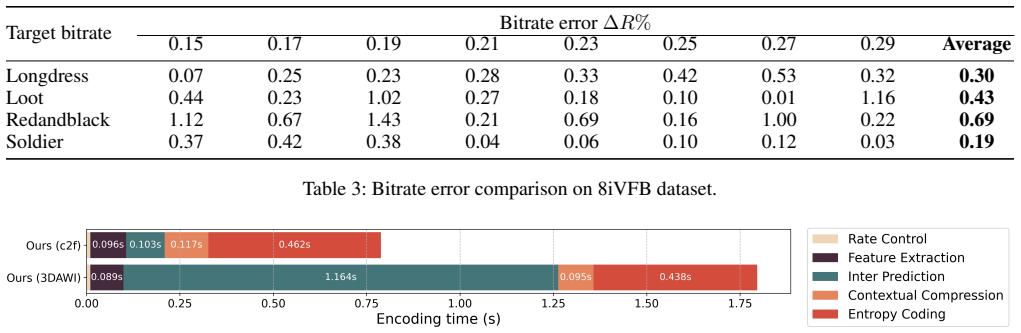
Pith's one-line read AdaDPCC claims a single slimmable dynamic point cloud codec that adaptively routes each frame to meet target bitrates, cutting bitrate by 5.81% and coding time by up to 44.6% against state-of-the-art baselines.
desk verdict Slimmable multi-route DPCC with a clever rate-control module, but the headline SOTA gain over patchDPCC rests on the original paper's numbers and is not verifiable from this submission. read the letter →
The pith
A machine-rendered reading of the paper's core claim, the machinery that carries it, and where it could break.
The reading
What carries the argument
The load-bearing mechanism is the slimmable convolution operator, which prunes channel dimensions to create K overlapping sub-networks (routes) inside one encoder-decoder supernet. Each route takes a partial share of the computational load and yields a distinct rate-distortion trade-off, all jointly trained with a cumulative loss over decreasing Lagrange multipliers. Alongside this sits the coarse-to-fine inter-frame prediction module: it computes a coarse motion embedding with stride-2 sparse convolutions, then a fine embedding, and performs motion compensation by quantizing the motion vector to a 2x-downsampled grid, warping coordinates, and deconstructing geometric features from the refer
What would settle it
Train the same architecture but with each route trained as an independently tuned model (or with different lambda schedules) on the Owlii training set, then compare BD-Rate, BD-PSNR, and bitrate error on the 8iVFB sequences; if an independent or alternative schedule beats the proposed joint schedule on RD or rate control accuracy, the 'optimal RD at each complexity' claim fails. A second falsifier is to run the rate control module on an out-of-distribution dynamic point cloud sequence (e.g., LiDAR-like sparse frames) and check whether the average bitrate error stays near 0.40%; a large diverge
Extended reading notes
Core claim
The central claim is that rate-distortion-complexity optimization for dynamic point clouds is achievable within a single dynamic coding network. The paper's framework, AdaDPCC, trains a supernet with K slimmable coding routes jointly, each route using a subset of channels to produce a distinct RD trade-off while sharing parameters. The claim is that this joint training gives near-optimal RD performance at every complexity level, so the same model can cover variable bitrates. On the temporal side, the paper claims its coarse-to-fine inter-frame prediction - using coarse block-wise motion vectors, geometric deconstruction of the reference latent, and fine voxel-wise motion refinement - outperf
Load-bearing premise
The claim that jointly training subnets in one network achieves optimal rate-distortion performance at every complexity level rests on a heuristic schedule of decreasing Lagrange multipliers, not on a proof; if this schedule yields suboptimal routes, the reported RD trade-offs and route-selection behavior may not generalize to other sequences or training settings.
Editorial extensions
If this is right
- A single trained dynamic point cloud codec can operate at several bitrate and complexity operating points, replacing per-target retraining and making deployment on bandwidth- or compute-constrained devices more practical.
- Replacing KNN-based motion search with sparse-convolution coarse-to-fine prediction materially reduces inter-frame coding latency, which matters for real-time AR/VR and autonomous-driving pipelines.
- Frame-level rate control with average bitrate error around 0.4% enables predictable bitrate compliance in streaming, where hitting a negotiated bandwidth is as important as reconstruction quality.
- The same slimmable-route design could be transferred to other learned 3D compression tasks that need adaptive complexity, such as static point cloud geometry coding or LiDAR compression.
- The ablations attribute roughly 3.4% BD-Rate reduction to coarse-to-fine inter prediction and 2.9% to the hyperprior context, indicating both temporal modeling and spatial context conditioning contribute to the reported gains.
Reading between the lines
- The rate estimation module could plausibly be reused at a coarser granularity, such as scene-level or group-of-frames bitrate ladders, since it estimates each route's cost from frame content with negligible latency (about 0.01 s); the paper does not test that extension.
- The paper selects routes based only on estimated bitrate, not estimated distortion; adding a per-route distortion estimator would be a natural testable extension that could make the allocation choice better match perceptual or MSE quality under a fixed budget.
- The coarse-to-fine anchor-based motion compensation is a generic idea for sparse 3D data and might generalize beyond compression to point cloud flow or temporal interpolation; the paper reports only its use inside the codec.
- Because the joint training strategy is an empirical heuristic, its claim of 'optimal RD performance at each complexity' is not proven; a fair ablation would train each route independently with the same lambda list and compare RD curves, which the paper does not include.
Editorial analysis
A structured set of objections, weighed in public.
Referee Report
Summary. The paper proposes AdaDPCC, a learned dynamic point cloud codec with slimmable multi-route encoder/decoder, coarse-to-fine motion estimation and compensation, conditional inter-frame coding, and a content-adaptive rate control module. The framework is designed to offer variable bitrate and computational complexity within a single model. On the MPEG 8iVFB dataset, the authors report an average BD-Rate reduction of 5.81% and a BD-PSNR improvement of 0.423 dB over patchDPCC, an average bitrate error of 0.40% against target rates from 0.15 to 0.29 bpp, and up to 44.6% coding time reduction compared to D-DPCC. The code is claimed to be available at an OpenI repository.
Significance. If fully substantiated, the multi-route RDCO design and the low-latency rate control module would be useful contributions to learned dynamic point cloud compression, and the release of code is a clear strength. The measured gains against the rerun baselines (D-DPCC, PCGCv2, V-PCC) are credible and internally consistent. However, the headline advantage over patchDPCC rests on externally reported numbers that cannot be independently verified, and the optimality claim for the joint route training is an unproven heuristic. These issues are central to the paper's main claims and need to be addressed before the comparison can be accepted.
major comments (3)
- [Experiments, 'Benchmark models'; Table 1] The headline 5.81% BD-Rate / 0.423 dB BD-PSNR advantage over patchDPCC is taken directly from the original paper because patchDPCC's source code is unavailable. The statement that 'identical testing conditions' are maintained is not verifiable. Differences in I-frame coding (the paper uses PCGCv2 with the same lambda), 10-bit quantization, RD sample points, or D1-PSNR computation could materially change BD-Rate values. Please either obtain and rerun patchDPCC under the authors' pipeline, provide independent confirmation, or clearly separate 'rerun baselines' from 'reported baseline' and temper the state-of-the-art claim.
- [Methodology, 'Dynamic Inference Routes'; Algorithm 1] The paper asserts that joint routes training 'achieves optimal RD performance at each level of complexity.' Algorithm 1 is a sequential decreasing-lambda heuristic with no proof and no comparison to alternatives such as independent route training or sandwich-rule sampling. Since the RDCO contribution and the route-selection behavior of the rate control module depend on this assertion, please add an ablation or revise the claim to 'near-optimal' or 'empirically effective.'
- [Methodology, 'Rate Control Module'] The Rate Estimation module is central to the 0.40% bitrate error claim, but the paper gives no architectural or training details: no input features, layer sizes, loss function, or per-route estimation accuracy. Figure 1 only shows generic FC/Conv blocks. This prevents reproduction and validation that the estimator is content-adaptive. Please specify this module explicitly or remove the equation-free description.
minor comments (5)
- [Algorithm 1] The Loss accumulator is not initialized to zero at the start of each outer loop; as written, losses accumulate across iterations. Add 'Loss ← 0' after line 4.
- [Eq. (12)] The convolution kernel is written as U(-1/2, -1/2); this should presumably be U(-1/2, 1/2) as in the accompanying text.
- [Implementation Details] The choices K=4 and lambda=[3,7,10,20] are said to be finalized 'through numerous trials'; a sensitivity study or a brief justification of these values would improve reproducibility.
- [Experimental Results] No error bars or multiple-seed results are reported. For the small BD-Rate margins over a non-rerun baseline, a single run is difficult to interpret; at minimum, report variance across training runs or state that this is standard practice.
- [Abstract / URL] The OpenI URL in the abstract contains a space ('Ada DPCC'); fix the link formatting.
Circularity Check
No significant circularity; results are empirically measured and benchmarked against external methods.
full rationale
The paper's central claims are empirical: RD performance, coding time, and rate-control error are all measured end-to-end on a held-out dataset (8iVFB) after training on Owlii. The rate-control module's bitrate error is a direct measurement of prediction accuracy against actual coded bitrates, not a fitted parameter renamed as a prediction. The BD-Rate/BD-PSNR comparison against patchDPCC uses numbers taken from the original patchDPCC paper because its code is unavailable; this is a comparability/verifiability concern, not circularity, since the baseline is external and not derived from the present method's assumptions. The joint training strategy's claim of 'optimal RD performance at each level of complexity' is an unsupported heuristic assertion, but it is not a self-referential derivation. Self-citations in related work (e.g., Zhang and Gao 2024) are background and not load-bearing: no uniqueness theorem or key architectural choice is justified solely by the authors' prior work. The method's equations (e.g., sliding-window bit allocation and route selection) are standard operational definitions, not inputs masquerading as outputs. Therefore, no circular step can be exhibited with the required specificity, and the appropriate score is 0.
Assumptions & free parameters
free parameters (4)
- Lagrange multiplier list =
[3, 7, 10, 20]
- Number of routes K =
4
- Sliding window length SW =
not specified
- Post-training lambda_0 schedule =
not specified
assumptions (4)
- ad hoc to paper Joint sequential training of subnets with decreasing lambda yields near-optimal RD at each complexity level
- domain assumption Training on Owlii dataset generalizes to MPEG 8iVFB
- domain assumption Rate estimation network accurately predicts bitrates for unseen content
- domain assumption PCGCv2 I-frame encoding with the same lambda provides a fair reference
Cite this review
Pith. "Pith review of AdaDPCC: Adaptive Rate Control and Rate-Distortion-Complexity Optimization for Dynamic Point Cloud Compression." pith.science (2026). https://pith.science/paper/VQFPGQZ2
@misc{pith2026250820741,
  author       = {Pith},
  title        = {Pith review of: AdaDPCC: Adaptive Rate Control and Rate-Distortion-Complexity Optimization for Dynamic Point Cloud Compression},
  year         = {2026},
  howpublished = {\url{https://pith.science/paper/VQFPGQZ2}},
  note         = {Machine review of arXiv:2508.20741}
}
read the original abstract
Dynamic point cloud compression (DPCC) is crucial in applications like autonomous driving and AR/VR. Current compression methods face challenges with complexity management and rate control. This paper introduces a novel dynamic coding framework that supports variable bitrate and computational complexities. Our approach includes a slimmable framework with multiple coding routes, allowing for efficient Rate-Distortion-Complexity Optimization (RDCO) within a single model. To address data sparsity in inter-frame prediction, we propose the coarse-to-fine motion estimation and compensation module that deconstructs geometric information while expanding the perceptive field. Additionally, we propose a precise rate control module that content-adaptively navigates point cloud frames through various coding routes to meet target bitrates. The experimental results demonstrate that our approach reduces the average BD-Rate by 5.81% and improves the BD-PSNR by 0.42 dB compared to the state-of-the-art method, while keeping the average bitrate error at 0.40%. Moreover, the average coding time is reduced by up to 44.6% compared to D-DPCC, underscoring its efficiency in real-time and bitrate-constrained DPCC scenarios. Our code is available at https://git.openi.org.cn/OpenPointCloud/Ada_DPCC.
Figures


Figures from the paper (2 more)

Reference graph
Works this paper leans on
-
[1]
, " * write output.state after.block = add.period write newline
ENTRY address archivePrefix author booktitle chapter edition editor eid eprint howpublished institution isbn journal key month note number organization pages publisher school series title type volume year label extra.label sort.label short.list INTEGERS output.state before.all mid.sentence after.sentence after.block FUNCTION init.state.consts #0 'before.a...
-
[2]
write newline
" write newline "" before.all 'output.state := FUNCTION n.dashify 't := "" t empty not t #1 #1 substring "-" = t #1 #2 substring "--" = not "--" * t #2 global.max substring 't := t #1 #1 substring "-" = "-" * t #2 global.max substring 't := while if t #1 #1 substring * t #2 global.max substring 't := if while FUNCTION word.in bbl.in capitalize " " * FUNCT...
-
[3]
Ahn, J.; Pang, J.; Lodhi, M. A.; and Tian, D. 2023. DDA-Net: Deep Distribution-Aware Network for Point Cloud Compression. In IEEE International Symposium on Circuits and Systems, 1--5
work page 2023
-
[4]
Akhtar, A.; Li, Z.; and Auwera, G. V. D. 2024. Inter-Frame Compression for Dynamic Point Cloud Geometry Coding. IEEE Trans. Image Process., 33: 584--594
work page 2024
-
[5]
A.; Minnen, D.; Singh, S.; Johnston, N.; Agustsson, E.; Hwang, S
Ball \' e , J.; Chou, P. A.; Minnen, D.; Singh, S.; Johnston, N.; Agustsson, E.; Hwang, S. J.; and Toderici, G. 2021. Nonlinear Transform Coding. IEEE J. Sel. Top. Signal Process. , 15(2): 339--353
work page 2021
-
[6]
Ball \' e , J.; Minnen, D.; Singh, S.; Hwang, S. J.; and Johnston, N. 2018. Variational image compression with a scale hyperprior. In Int. Conf. Learn. Represent
work page 2018
-
[7]
Cao, K.; Xu, Y.; Lu, Y.; and Wen, Z. 2018. Owlii Dynamic Human Mesh Sequence Dataset . Presented at the 122th MPEG Meeting, ISO/IEC JTC1/SC29/WG11 m42816
work page 2018
-
[8]
A.; Koroteev, M.; and Krivokuca, M
Chou, P. A.; Koroteev, M.; and Krivokuca, M. 2020. A Volumetric Approach to Point Cloud Compression - Part I: Attribute Compression. IEEE Trans. Image Process., 29: 2203--2216
work page 2020
Show all 54 references
-
[9]
B.; Gwak, J.; and Savarese, S
Choy, C. B.; Gwak, J.; and Savarese, S. 2019. 4D Spatio-Temporal ConvNets: Minkowski Convolutional Neural Networks. In IEEE Conf. Comput. Vis. Pattern Recog., 3075--3084
2019
-
[10]
Cui, M.; Long, J.; Feng, M.; Li, B.; and Kai, H. 2023. OctFormer: Efficient Octree-Based Transformer for Point Cloud Compression with Local Enhancement. In Williams, B.; Chen, Y.; and Neville, J., eds., AAAI, 470--478
2023
-
[11]
d'Eon, E.; Harrison, B.; Myers, T.; and Chou, P. A. 2017. 8i Voxelized Full Bodies: A Voxelized Point Cloud Dataset . ISO/IEC JTC1/SC29 Joint WG11/WG1 (MPEG/JPEG) input document WG11M40059/WG1M74006
2017
-
[12]
Fan, T.; Gao, L.; Xu, Y.; Li, Z.; and Wang, D. 2022. D-DPCC: Deep Dynamic Point Cloud Compression via 3D Motion Prediction. In Raedt, L. D., ed., IJCAI, 898--904
2022
-
[13]
Fu, C.; Li, G.; Song, R.; Gao, W.; and Liu, S. 2022. OctAttention: Octree-Based Large-Scale Contexts Model for Point Cloud Compression. In AAAI, 625--633
2022
-
[14]
Gao, L.; Fan, T.; Wan, J.; Xu, Y.; Sun, J.; and Ma, Z. 2021. Point Cloud Geometry Compression Via Neural Graph Sampling. In IEEE Int. Conf. Image Process., 3373--3377. IEEE
2021
-
[15]
Goyal, V. K. 2001. Theoretical foundations of transform coding. IEEE Signal Process. Mag. , 18(5): 9--21
2001
-
[16]
He, Y.; Ren, X.; Tang, D.; Zhang, Y.; Xue, X.; and Fu, Y. 2022. Density-preserving Deep Point Cloud Compression. In IEEE Conf. Comput. Vis. Pattern Recog., 2323--2332. IEEE
2022
-
[17]
Hu, Z.; and Xu, D. 2023. Complexity-guided Slimmable Decoder for Efficient Deep Video Compression. In IEEE Conf. Comput. Vis. Pattern Recog., 14358--14367
2023
-
[18]
Huang, L.; Wang, S.; Wong, K.; Liu, J.; and Urtasun, R. 2020. OctSqueeze: Octree-Structured Entropy Model for LiDAR Compression. In IEEE Conf. Comput. Vis. Pattern Recog., 1310--1320
2020
-
[19]
Huang, T.; and Liu, Y. 2019. 3D Point Cloud Geometry Compression on Deep Learning. In Amsaleg, L.; Huet, B.; Larson, M. A.; Gravier, G.; Hung, H.; Ngo, C.; and Ooi, W. T., eds., ACM Int. Conf. Multimedia, 890--898
2019
-
[20]
Li, Z.; Wang, W.; Wang, Z.; and Lei, N. 2024. Point Cloud Compression via Constrained Optimal Transport. CoRR, abs/2403.08236
2024 arXiv
-
[21]
Liang, Z.; and Liang, F. 2022. TransPCC: Towards Deep Point Cloud Compression via Transformers. In Oria, V.; Sapino, M. L.; Satoh, S.; Kerherv \' e , B.; Cheng, W.; Ide, I.; and Singh, V. K., eds., International Conference on Multimedia Retrieval, 1--5
2022
-
[22]
Liu, L.; Hu, Z.; and Zhang, J. 2023. PCHM-Net: A New Point Cloud Compression Framework for Both Human Vision and Machine Vision. In Int. Conf. Multimedia and Expo, 1997--2002
2023
-
[23]
Mekuria, R.; Blom, K.; and C \' e sar, P. 2017. Design, Implementation, and Evaluation of a Point Cloud Codec for Tele-Immersive Video. IEEE Trans. Circuit Syst. Video Technol., 27(4): 828--842
2017
-
[24]
Minnen, D.; Ball \' e , J.; and Toderici, G. 2018. Joint Autoregressive and Hierarchical Priors for Learned Image Compression. In Adv. Neural Inform. Process. Syst., 10794--10803
2018
-
[25]
T.; Quach, M.; Valenzise, G.; and Duhamel, P
Nguyen, D. T.; Quach, M.; Valenzise, G.; and Duhamel, P. 2021. Lossless Coding of Point Cloud Geometry Using a Deep Generative Model. IEEE Trans. Circuit Syst. Video Technol., 31(12)
2021
-
[26]
Pan, Z.; Xiao, M.; Han, X.; Yu, D.; Zhang, G.; and Liu, Y. 2024. patchDPCC: A Patchwise Deep Compression Framework for Dynamic Point Clouds. In AAAI, 4406--4414
2024
-
[27]
Qi, Y.; He, Y.; Qi, X.; Zhang, Y.; and Yang, G. 2023. Dynamic Snake Convolution based on Topological Geometric Constraints for Tubular Structure Segmentation. In Int. Conf. Comput. Vis., 6047--6056
2023
-
[28]
Quach, M.; Valenzise, G.; and Dufaux, F. 2019. Learning Convolutional Transforms for Lossy Point Cloud Geometry Compression. In IEEE Int. Conf. Image Process., 4320--4324
2019
-
[29]
Quach, M.; Valenzise, G.; and Dufaux, F. 2020. Improved Deep Point Cloud Geometry Compression. In International Workshop on Multimedia Signal Processing, 1--6
2020
-
[30]
Que, Z.; Lu, G.; and Xu, D. 2021. VoxelContext-Net: An Octree Based Framework for Point Cloud Compression. In IEEE Conf. Comput. Vis. Pattern Recog., 6042--6051
2021
-
[31]
A.; Cohen, R
Schwarz, S.; Preda, M.; Baroncini, V.; Budagavi, M.; C \' e sar, P.; Chou, P. A.; Cohen, R. A.; Krivokuca, M.; Lasserre, S.; Li, Z.; Llach, J.; Mammou, K.; Mekuria, R.; Nakagami, O.; Siahaan, E.; Tabatabai, A. J.; Tourapis, A. M.; and Zakharchenko, V. 2019. Emerging MPEG Stand...
2019
-
[32]
Song, R.; Fu, C.; Liu, S.; and Li, G. 2023. Efficient Hierarchical Entropy Model for Learned Point Cloud Compression. In IEEE Conf. Comput. Vis. Pattern Recog., 14368--14377
2023
-
[33]
Tang, H.; Yang, S.; Liu, Z.; Hong, K.; Yu, Z.; Li, X.; Dai, G.; Wang, Y.; and Han, S. 2023. TorchSparse++: Efficient Training and Inference Framework for Sparse Convolution on GPUs. In Proceedings of the 56th Annual IEEE/ACM International Symposium on Microarchitecture , 225--239
2023
-
[34]
Tao, L.; Gao, W.; Li, G.; and Zhang, C. 2023. AdaNIC: Towards Practical Neural Image Compression via Dynamic Transform Routing. In Int. Conf. Comput. Vis., 16833--16842
2023
-
[35]
A.; and Frossard, P
Thanou, D.; Chou, P. A.; and Frossard, P. 2016. Graph-Based Compression of Dynamic 3D Point Cloud Sequences. IEEE Trans. Image Process., 25(4): 1765--1778
2016
-
[36]
Veit, A.; and Belongie, S. J. 2020. Convolutional Networks with Adaptive Inference Graphs. Int. J. Comput. Vis., 128(3): 730--741
2020
-
[37]
Wang, J.; Ding, D.; Chen, H.; and Ma, Z. 2023 a . Dynamic Point Cloud Geometry Compression Using Multiscale Inter Conditional Coding. CoRR, abs/2301.12165
2023 arXiv
-
[38]
Wang, J.; Ding, D.; Li, Z.; Feng, X.; Cao, C.; and Ma, Z. 2023 b . Sparse Tensor-Based Multiscale Representation for Point Cloud Geometry Compression. IEEE Trans. Pattern Anal. Mach. Intell., 45(7)
2023
-
[39]
Wang, J.; Ding, D.; Li, Z.; and Ma, Z. 2021 a . Multiscale Point Cloud Geometry Compression. In Bilgin, A.; Marcellin, M. W.; Serra - Sagrist \` a , J.; and Storer, J. A., eds., Data Compression Conference, 73--82
2021
-
[40]
Wang, J.; Zhu, H.; Liu, H.; and Ma, Z. 2021 b . Lossy Point Cloud Geometry Compression via End-to-End Learning. IEEE Trans. Circuit Syst. Video Technol., 31(12): 4909--4923
2021
-
[41]
Wang, W.; Dai, J.; Chen, Z.; Huang, Z.; Li, Z.; Zhu, X.; Hu, X.; Lu, T.; Lu, L.; Li, H.; Wang, X.; and Qiao, Y. 2023 c . InternImage: Exploring Large-Scale Vision Foundation Models with Deformable Convolutions. In IEEE Conf. Comput. Vis. Pattern Recog., 14408--14419
2023
-
[42]
Xia, S.; Fan, T.; Xu, Y.; Hwang, J.; and Li, Z. 2023. Learning Dynamic Point Cloud Compression via Hierarchical Inter-frame Block Matching. In El - Saddik, A.; Mei, T.; Cucchiara, R.; Bertini, M.; Vallejo, D. P. T.; Atrey, P. K.; and Hossain, M. S., eds., ACM Int. Conf. Multim...
2023
-
[43]
Xie, L.; and Gao, W. 2024 a . LearningPCC: A PyTorch Library for Learning-Based Point Cloud Compression. In ACM Int. Conf. Multimedia
2024
-
[44]
Xie, L.; and Gao, W. 2024 b . PCHMVision: An Open-Source Library of Point Cloud Compression for Human and Machine Vision. In ACM Int. Conf. Multimedia
2024
-
[45]
Xie, L.; Gao, W.; Zheng, H.; and Li, G. 2024 a . ROI-Guided Point Cloud Geometry Compression Towards Human and Machine Vision. In ACM Int. Conf. Multimedia
2024
-
[46]
Xie, L.; Gao, W.; Zheng, H.; and Li, G. 2024 b . SPCGC: Scalable Point Cloud Geometry Compression for Machine Vision . In IEEE International Conference on Robotics and Automation, 594--595
2024
-
[47]
Xie, L.; Gao, W.; Zheng, H.; and Ye, H. 2024 c . Semantic-Aware Visual Decomposition for Point Cloud Geometry Compression. In 2024 Data Compression Conference (DCC), 595--595
2024
-
[48]
Xie, L.; Mu, X.; and Gao, W. 2024. PKU-DPCC: A New Dataset for Dynamic Point Cloud Compression. In APSIPA Transactions on Signal and Information Processing
2024
-
[49]
H.; Li, Z.; and Li, G
Yan, W.; Shao, Y.; Liu, S.; Li, T. H.; Li, Z.; and Li, G. 2019. Deep AutoEncoder-based Lossy Geometry Compression for Point Clouds. CoRR, abs/1905.03691
2019 arXiv
-
[50]
Yang, C.; Wang, X.; Yao, L.; Long, G.; and Xu, G. 2024. Dyformer: A dynamic transformer-based architecture for multivariate time series classification. Inf. Sci., 656: 119881
2024
-
[51]
Yang, F.; Herranz, L.; Cheng, Y.; and Mozerov, M. G. 2021. Slimmable Compressive Autoencoders for Practical Neural Image Compression. In IEEE Conf. Comput. Vis. Pattern Recog
2021
-
[52]
Zhang, C.; and Gao, W. 2024. Learned Rate Control for Frame-Level Adaptive Neural Video Compression via Dynamic Neural Network. In Eur. Conf. Comput. Vis. Springer
2024
-
[53]
Zhang, J.; Chen, T.; Ding, D.; and Ma, Z. 2023. YOGA: Yet Another Geometry-based Point Cloud Compressor. In El - Saddik, A.; Mei, T.; Cucchiara, R.; Bertini, M.; Vallejo, D. P. T.; Atrey, P. K.; and Hossain, M. S., eds., ACM Int. Conf. Multimedia, 9070--9081. ACM
2023
-
[54]
Zuo, D.; Yu, P.; Huang, R.; Huang, Y.; Sun, W.; and Liang, F. 2023. Diverse Context Model for Large-Scale Dynamic Point Cloud Compression. In VCIP, 1--5
2023
Reviewed August 5, 2026 · model on record in the stance chip above.
Discussion (0). Sign in to comment.