REVIEW 4 major objections 6 minor 3 references
Integrated photonic neuromorphic computing: device, architecture, chip, algorithm
T0 review · 4 major / 6 minor · reviewed 2026-08-05 · deepseek-v4-flash
Pith's one-line read This review argues that integrated photonic neuromorphic computing can overcome the memory wall and power wall of electronic AI chips and, by around 2030, become the core pillar of intelligent computing.
desk verdict A useful, broad review of photonic neuromorphic computing, but the abstract's power-wall claim lacks the system-level energy accounting it would need, and the paper is better as an overview than as evidence. read the letter →
The pith
A machine-rendered reading of the paper's core claim, the machinery that carries it, and where it could break.
The reading
What carries the argument
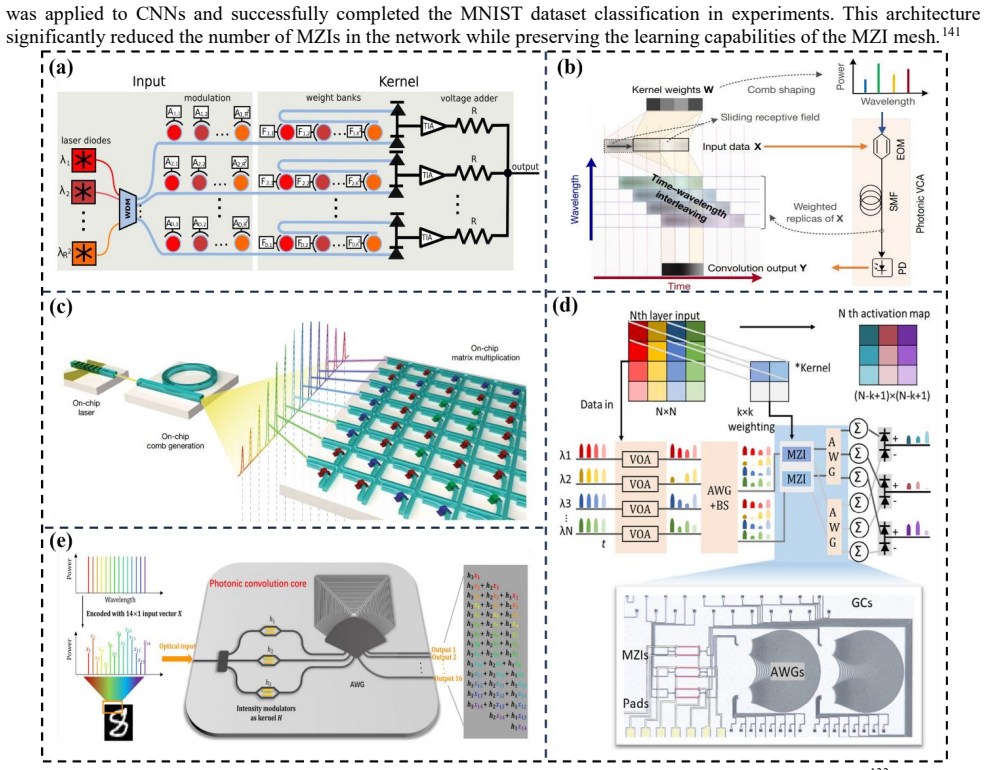
The argument is carried by two types of photonic devices standing in for biological neurons and synapses. Photonic synapses perform linear weighted operations: MZIs use interference of light to form programmable matrix transformations; MRRs use wavelength-selective resonance for broadcast-and-weight summation; PCMs use reversible crystalline-amorphous phase changes to store and modulate weights; SOAs/VCSOAs use gain modulation for all-optical weighting and STDP. Photonic neurons supply nonlinearity: spiking neurons based on lasers with saturable absorbers (FP-SA, DFB-SA, VCSEL-SA) emulate threshold, temporal integration, and refractory behavior, while continuous-value nonlinear activation us
What would settle it
Measure the end-to-end energy per multiply-accumulate (MAC) and per inference for a published photonic accelerator—for example the 128×128 MZI photonic AI processor or the Taichi chip—including laser power, driver electronics, ADCs/DACs, control logic, and packaging. If the total exceeds the per-MAC energy of a comparable electronic AI accelerator (roughly 0.1 to 1 pJ/MAC for digital CMOS at similar precision), the paper's power-wall claim is falsified for that architecture.
Extended reading notes
Core claim
The paper's central claim is that integrated photonic neuromorphic computing has reached a point where its components—photonic synapses for linear operations and photonic neurons for nonlinearity—can be assembled into chips that exploit the speed, bandwidth, and parallelism of light, thereby bypassing the von Neumann memory wall and the power wall of electronic processors. It catalogues concrete demonstrations, from coherent MZI meshes that implement matrix multiplications, to microring weight banks and phase-change-memory synapses, to laser-based spiking neurons with saturable absorbers, to reservoir computers and large-scale packaged photonic AI accelerators. The intended conclusion is not
Load-bearing premise
The optimistic trajectory assumes that the engineering bottlenecks listed in Section V—low-threshold nonlinearity, large-scale integration and packaging, optoelectronic collaboration, software-hardware adaptation, and unclear application scenarios—can be resolved without eroding photonic systems' energy and speed advantages; in particular, if optoelectronic conversion overheads remain as severe as the paper itself describes, the claim of overcoming the power wall loses credib
Editorial extensions
If this is right
- If photonic neuromorphic computing fulfills the review's trajectory, AI inference and training workloads could shift from electronic accelerators to optical processors that carry data as light, removing the need for repeated digital-analog conversion in the data path.
- The demonstrated reservoir-computing and spiking-neuron chips suggest that time-series tasks (channel equalization, chaos prediction, pattern recognition) are near-term entry points before general-purpose programmable PNNs mature.
- In-situ training methods based on optical backpropagation imply future PNNs could be self-calibrating on-chip, adapting weights without external digital gradients, which would cut training energy and latency.
- Large-scale packaged systems (2.5D/3D heterogeneous integration of photonic cores with CMOS control) indicate that the path to industrial deployment runs through co-packaging and co-design with electronics, not through replacing electronics entirely.
- The review's forecast implies a shift in research priorities toward low-threshold all-optical nonlinearity and standardized packaging/interface, since these are the identified bottlenecks.
Reading between the lines
- I infer that the near-term practical wins for photonic neuromorphic computing are likely to be in high-speed signal-processing niches—optical fiber equalization, real-time decision-making, and low-latency inference—where photonics' bandwidth advantage matters more than absolute precision, before general AI workloads.
- A testable extension suggested by the review's own challenge list: a standardized benchmark that reports end-to-end energy per MAC including lasers, drivers, ADCs/DACs, and cooling would reveal whether the power-wall advantage survives system-level accounting; the review itself does not supply such numbers.
- If the co-design direction is right, the field may converge on hybrid optoelectronic architectures where photons do linear algebra and electrons do control and nonlinearity, rather than on fully all-optical systems; this is an editorial extrapolation from the paper's emphasis on optoelectronic collaboration as a challenge to be improved, not eliminated.
- The review's catalog implies a road-map: devices first (low-threshold nonlinear neurons), then packaging (large-scale integration and standardized interfaces), then software-hardware co-design, and finally application expansion; researchers could test this ordering by tracking which bottlenecks get resolved in published chips over the next few years.
Signed reviews
Editorial analysis
A structured set of objections, weighed in public.
Referee Report
Summary. This paper is a review of integrated photonic neuromorphic computing, organized into fundamental devices (linear synapses, nonlinear neurons), network architectures and chips (FCN, CNN, SNN, DONN, reservoir computing, large-scale processors, and other emerging architectures), and training methods (ex-situ and in-situ). It also lists current challenges and an outlook, culminating in the claim that photonic neuromorphic computing will overcome the memory and power walls of electronic chips and become a core pillar of intelligent computing around 2030.
Significance. The manuscript compiles an up-to-date, broad set of results across devices, architectures, and algorithms, with many 2024–2025 references and useful summary tables. If the factual content is carefully corrected, this could serve as a useful entry point to the field. However, the strongest claims in the abstract and outlook go beyond what the body establishes: no system-level energy or latency accounting is provided, and the paper's own challenge section concedes that optoelectronic conversion and electronic nonlinearity/pooling remain unresolved. The review also has several citation and metric inconsistencies that currently reduce its reliability.
major comments (4)
- [Section II.B; Table V; Section III.C] Reference [100] is used for two different works: in Section II.B it denotes Q. Zhang et al.'s thermodynamic LIF neuron, while in Table V it denotes R. Amin's ITO-based EAM. Section III.C additionally cites [100] for N. Jiang et al.'s ADRMR/PCM work. A review whose tables and text disagree on the meaning of a reference is not reliably usable. Please renumber and verify every reference assignment, and correct the broken range '242-242' in Section III.G.
- [Abstract; Section V; Section VI(2)] The abstract asserts that photonic neuromorphic computing can 'overcome the memory wall and power wall' of electronic chips, and Section VI predicts that it will become 'the core pillar of intelligent computing' around 2030. Yet Section V lists unresolved problems in optoelectronic conversion ('signal loss, delay, and noise interference'), Section III.F names persistent bottlenecks in 'optoelectronic interfaces, thermal stability, and manufacturing uniformity,' and Section VI(2) admits that current systems rely on electronic nonlinear/pooling layers and frequent O/E-O and ADC/DAC conversions that 'severely limit performance... introducing additional latency and power consumption.' No end-to-end energy model or system-level power budget (including laser wall-plug efficiency, converters, thermal control, packaging) is provided. The headline claim is therefore an extrapolation over exactly
- [Tables VI, XII and throughout] Metrics in the tables are not comparable: some entries are simulations, others are experiments; platforms differ (silicon, InP, VCSEL, PCM, free-space); and definitions such as TOPS/W, MAC, and energy per spike are used without specifying what is included. A concrete example: Section III.F text reports Ahmed et al. as '65.5 TOPS at 78W electronic power,' while Table XII lists 'Energy efficiency of 65.5 TOPS/W'; these differ by a factor of ~78 and cannot both be right. The review should add a 'metrics and comparability' discussion and normalize or clearly label each table entry (measured vs simulated, included components, benchmark conditions).
- [Sections III.C and III.E] A substantial fraction of the cited evidence in the spiking-network and reservoir-computing sections comes from the corresponding author's own group (e.g., refs 50, 74, 86, 91–93, 152–157, 166–169, 208, 213–219). This is not in itself improper, but for a review that aims to summarize the field it risks over-weighting one laboratory's approaches. Please either include independent corroborating references for the central claims in those sections or explicitly state the selection criteria used for including works.
minor comments (6)
- [Section III.G] '242-242' appears to be a broken reference range; it should likely be '242–245' or similar.
- [Section III.C] 'N. Alexander et al.' should be 'A. N. Tait et al.' for the broadcast-and-weight architecture (ref 17).
- [Section III.E.1] The text attributes the 2024 BPD-based reservoir computing work to 'C. Huang et al.,' but Table X assigns ref [198] to D. Wang; please reconcile the author attribution.
- [Section II.A.1] Typo 'In addtion' should be 'In addition.'
- [Section VI(4)] The 2030 prediction is stated without supporting evidence; consider adding a citation or softening the language.
- [General] Some figure callouts are ambiguous (e.g., 'Fig. 1 5' in Section III.F); fix spacing and unify figure-reference formatting.
Circularity Check
No significant circularity: the review's claims are supported by an independent survey, and its speculative outlook is not derived from its own inputs.
full rationale
This paper is a literature review, not a derivation or prediction chain, so the standard circularity patterns (self-definitional equations, fitted inputs renamed as predictions, imported uniqueness theorems, ansatz smuggled via citation) do not apply. The central claims—that photonic neuromorphic computing has potential and may become a core pillar of intelligent computing around 2030—are presented as an assessment of the surveyed literature and an explicitly forward-looking outlook, not as results derived from equations or from the authors' own prior results. Although a substantial number of cited works in Sections III.C and III.E come from the corresponding author's group, these are peer-reviewed experimental and simulation studies with independent benchmarks (e.g., MNIST and Iris accuracies, energy-per-spike figures), and the review also cites many external groups (Feldmann, Chakraborty, Hurtado, Brunner, Bhaskaran, Vandoorne, and others). The paper itself identifies unresolved system-level issues in Section V and Section VI—optoelectronic conversion losses, lack of mature optoelectronic collaboration, persistent bottlenecks in interfaces and packaging—so the 2030 outlook is an opinion conditioned on overcoming those challenges, not a conclusion forced by a self-citation chain or by construction. Self-citation density is a legitimate visibility concern, but under the provided rules it does not constitute circularity unless the load-bearing argument reduces to an unverified self-citation. Here the load-bearing evidence is the independent external literature and the paper's own challenge inventory. Therefore no circular step can be exhibited with the required specificity, and the honest finding is no significant circularity (score 0).
Assumptions & free parameters
assumptions (3)
- domain assumption The cited references accurately describe the reported devices, architectures, and metrics.
- domain assumption The field's reported performance metrics (e.g., TOPS/W, accuracy, latency) are measured under comparable conditions and can be meaningfully compared across different systems.
- ad hoc to paper Current limitations listed in Section V are engineering problems that can be solved without fundamental physics barriers.
Cite this review
Pith. "Pith review of Integrated photonic neuromorphic computing: device, architecture, chip, algorithm." pith.science (2026). https://pith.science/paper/QR7U72H7
@misc{pith2026250901262,
  author       = {Pith},
  title        = {Pith review of: Integrated photonic neuromorphic computing: device, architecture, chip, algorithm},
  year         = {2026},
  howpublished = {\url{https://pith.science/paper/QR7U72H7}},
  note         = {Machine review of arXiv:2509.01262}
}
read the original abstract
Artificial intelligence (AI) has experienced explosive growth in recent years. The large models have been widely applied in various fields, including natural language processing, image generation, and complex decision-making systems, revolutionizing technological paradigms across multiple industries. Nevertheless, the substantial data processing demands during model training and inference result in the computing power bottleneck. Traditional electronic chips based on the von Neumann architecture struggle to meet the growing demands for computing power and power efficiency amid the continuous development of AI. Photonic neuromorphic computing, an emerging solution in the post-Moore era, exhibits significant development potential. Leveraging the high-speed and large-bandwidth characteristics of photons in signal transmission, as well as the low-power consumption advantages of optical devices, photonic integrated computing chips have the potential to overcome the memory wall and power wall issues of electronic chips. In recent years, remarkable advancements have been made in photonic neuromorphic computing. This article presents a systematic review of the latest research achievements. It focuses on fundamental principles and novel neuromorphic photonic devices, such as photonic neurons and photonic synapses. Additionally, it comprehensively summarizes the network architectures and photonic integrated neuromorphic chips, as well as the optimization algorithms of photonic neural networks. In addition, combining with the current status and challenges of this field, this article conducts an in-depth discussion on the future development trends of photonic neuromorphic computing in the directions of device integration, algorithm collaborative optimization, and application scenario expansion, providing a reference for subsequent research in the field of photonic neuromorphic computing.
Figures


Figures from the paper (3 more)


Reference graph
Works this paper leans on
-
[1]
Roadmapping the next generation of silicon photonics,
1 S. Shekhar et al., “Roadmapping the next generation of silicon photonics,” Nat. Commun. 15, 751 (2024). 2 G. Wetzstein et al., “Inference in artificial intelligence with deep optics and photonics,” Nature 588, 39-47 (2020). 3 M. Reck, A. Zeilinger, H.J. Bernstein, and P. Bertani, “Experimental realization of any discrete unitary operator,” Phys. Rev. Le...
work page 2024
-
[12]
Towards On-Chip Optical FFTs for Convolutional Neural Networks
110 M. Miscuglio et al., “All-optical nonlinear activation function for photonic neural networks,” Opt. Mater. Express 8, 3851-3863 (2018). 111 C. Chen et al., “Ultra-broadband all-optical nonlinear activation function enabled by MoTe₂/optical waveguide integrated devices,” Nat. Commun. 15, 9047 (2024). 112 Y . Tian et al., “Photonic neural networks with ...
work page Pith review arXiv 2018
-
[2025]
Diffractive optical computing in free space,
177 J. Hu, D. Mengu, D. C. Tzarouchis et al., “Diffractive optical computing in free space,” Nat. Commun. 15, 1525 (2024). 178 Z. Xue, T. Zhou, Z. Xu et al., “Fully forward mode training for optical neural networks,” Nature, 632, 280–286 (2024). 179 X. Y uan, Y . Wang, Z. Xu et al., “Training large-scale optoelectronic neural networks with dual-neuron opt...
work page 2024
Reviewed August 5, 2026 · model on record in the stance chip above.
Discussion (0). Continue with ORCID to comment.