REVIEW 4 major objections 5 minor 6 cited by
WenetSpeech-Yue: A Large-scale Cantonese Speech Corpus with Multi-dimensional Annotation
T0 review · 4 major / 5 minor · reviewed 2026-08-05 · deepseek-v4-flash
Pith's one-line read The paper releases WenetSpeech-Yue, a 21,800-hour Cantonese speech corpus with multi-dimensional automatic annotations, and reports that ASR and TTS models trained on it rival or beat state-of-the-art systems.
desk verdict A genuinely useful 21.8k-hour Cantonese corpus, but the SOTA claims and label validation need scrutiny before you trust the numbers. read the letter →
The pith
A machine-rendered reading of the paper's core claim, the machinery that carries it, and where it could break.
The reading
What carries the argument
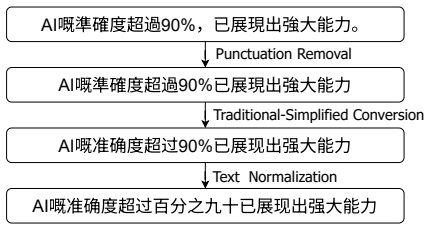
The load-bearing mechanism is WenetSpeech-Pipe, an automated six-module data-curation pipeline: audio collection with voice-activity detection; speaker diarization (pyannote) and age/gender estimation (Vox-Profile); speech-quality annotation via SNR (Brouhaha), DNSMOS, and bandwidth detection; transcription by three diverse ASR systems; text postprocessing; and ROVER-based voting with candidate filtering plus a Qwen3-4B minimal-correction stage. The pipeline's key product is the per-utterance text-confidence score, which partitions the corpus into strong, moderate, and weak labels and drives the two-stage training strategy.
What would settle it
Take a random sample of segments from the weak-label subset (confidence 0.6–0.8), have native Cantonese speakers independently transcribe them, and compare against the released transcripts. If human agreement falls well below the claimed confidence scores, or if retraining on human-corrected labels removes the reported MER gains, the annotation-quality premise collapses.
Extended reading notes
Core claim
The paper's central claim is that a large-scale, richly annotated Cantonese speech corpus can be built automatically and is sufficient to train competitive ASR and TTS systems. WenetSpeech-Yue contains 21,800 hours of speech across ten domains, with transcripts produced by a three-system ensemble (SenseVoice, Whisper, and TeleASR) fused via extended ROVER voting and minimally corrected by the Qwen3-4B language model. Every utterance also carries a text-confidence score, a jyutping-confidence score, speaker identity, age, gender, SNR, DNSMOS, sampling rate, and character-level timestamps. The authors introduce WSYue-eval, with a manually annotated ASR test set covering short and long utteranc
Load-bearing premise
The premise that the 21,800 hours of training transcripts are accurate enough to serve as ground truth: all labels come from three recognizers plus a language-model correction, with no large-scale human verification.
Editorial extensions
If this is right
- A 21,800-hour, ten-domain Cantonese corpus with speaker and quality metadata becomes available as the largest open resource of its kind.
- ASR models trained on the corpus, including a 130M-parameter Conformer, beat larger baselines on most Cantonese test sets, including commercial and LLM-based systems.
- TTS models fine-tuned on the quality-filtered 12,000-hour subset achieve noticeably better intelligibility, similarity, and naturalness than their zero-shot counterparts.
- The two-stage training recipe—mixed-confidence labels first, high-confidence labels second—offers a reusable strategy for training on automatically annotated speech.
- The release of WSYue-eval gives Cantonese ASR and TTS a shared, human-annotated benchmark covering short/long utterances, code-switching, and acoustic diversity.
Reading between the lines
- The confidence-threshold scheme (0.6/0.8/0.9) could be transferred as a tunable recipe to other low-resource dialects, provided the three recognizers are sufficiently independent.
- Because the corpus records speaker identity, age, gender, and quality scores per utterance, it can directly support multi-speaker TTS, voice conversion, and style-controllable synthesis in Cantonese—applications the paper mentions but does not train.
- The WSYue-TTS-eval Coverage subset includes LLM-expanded texts, so part of the TTS benchmark measures performance on machine-generated prompts; separating human-curated and LLM-generated test sentences would clarify how well gains transfer to native usage.
- If the three ASR systems share systematic error patterns, a portion of the reported gains could reflect label bias rather than genuine improvement; a human-verified random sample would settle the question.
Editorial analysis
A structured set of objections, weighed in public.
Referee Report
Summary. The paper introduces WenetSpeech-Pipe, an automated six-module pipeline for building a large-scale Cantonese speech corpus with multi-dimensional annotations, and releases WenetSpeech-Yue (21,800 hours, 10 domains) with ASR transcriptions, confidence scores, speaker attributes, speech-quality scores, and timestamps. It also releases WSYue-eval, a benchmark with a manually annotated ASR set (WSYue-ASR-eval) and a TTS set (WSYue-TTS-eval). ASR and TTS models trained on the corpus are evaluated against public and in-house test sets, including CommonVoice, MDCC, Daily_Use, Commands, and the new WSYue-ASR-eval, and are reported to reach competitive or SOTA results. The central empirical claim is that the corpus and pipeline enable strong Cantonese ASR and TTS performance.
Significance. If the corpus is released as described, it would be a substantial and useful resource: it is an order of magnitude larger than existing open Cantonese corpora, spans diverse domains, and provides metadata that is rarely available at this scale. The external-test improvements (e.g., MDCC, CommonVoice yue, Daily_Use, Commands in Table 3) provide independent evidence that the automatically produced labels carry useful signal, and the human-collected WSYue-ASR-eval and MOS evaluations are valuable additions. The main risk is that the 'high-quality multi-dimensional annotation' claim rests on unvalidated machine transcriptions, and that one of the TTS objective metrics is evaluated with an ASR trained on the same data. These points are addressable but currently condition the paper's headline conclusions.
major comments (4)
- [Sections 3D-3F and 4.1] The corpus's high-quality annotation claim rests on labels produced entirely by ROVER voting over SenseVoice, Whisper, and TeleASR, followed by Qwen3-4B correction. The reported 'text confidence' is an average voting frequency, which is an inter-system agreement score rather than an accuracy measure. No CER/MER of the pipeline labels against human references is reported, and no confidence-stratified label-quality analysis is given. If the three recognizers share systematic Cantonese errors (homophones, proper nouns, code-switching boundaries), ROVER preserves them and the LLM corrector may reinforce them from the same context. The external test-set gains mitigate this concern substantially, but they do not measure training-label quality. Please add a human-audited label-quality audit, e.g., CER/MER on a held-out human-transcribed sample of WenetSpeech-Yue, broken down by confidence bucke
- [Table 3 and Section 5.1] The paper states that models trained on WenetSpeech-Yue achieve SOTA performance, but Table 3 does not support this uniformly. On zh-HK, SenseVoice-small-Yue (MER 8.68) is worse than the unadapted SenseVoice-small (7.34), and U2pp-Conformer-Yue (11.42) is much worse. On Commands, SenseVoice-small-Yue (6.93) is slightly worse than SenseVoice-small (6.65). Since differences of 0.5-4.0 MER points are meaningful in this regime, the SOTA claim should be restricted to the test sets where the comparison actually holds, accompanied by confidence intervals or significance tests, or explicitly discussed as a trade-off.
- [Section 5.2, Evaluation Metrics] The TTS intelligibility metric MER is computed by transcribing synthetic audio with U2pp-Conformer-Yue, a model fine-tuned on the same WenetSpeech-Yue corpus used to fine-tune the TTS systems. This creates a circularity: the ASR may have adapted to the corpus's pronunciation, lexical choices, and label conventions, making the fine-tuned TTS outputs easier to transcribe than the zero-shot baselines. The human I-MOS results provide independent support for the intelligibility conclusion, but the objective MER column in Table 5 should be recomputed with an independent ASR (e.g., Whisper-large-v3, a commercial API, or another Cantonese model not trained on WenetSpeech-Yue), or reported with an explicit caveat and as secondary to I-MOS.
- [Section 4.2, WSYue-ASR-eval] The benchmark is described as manually annotated in multiple rounds, but the paper does not state whether the audio, speakers, or source programs are disjoint from the WenetSpeech-Yue training set, nor does it report inter-annotator agreement. If WSYue-ASR-eval is drawn from the same distribution or the same programs as the training corpus, the in-house gains in Tables 3 and 4 would partly reflect domain overlap rather than generalizable improvement. Please add a data-contamination statement and basic annotation-quality statistics (e.g., agreement or adjudication details) for both Short and Long subsets.
minor comments (5)
- [Abstract and Section 1] The abstract says the corpus covers '10 domains,' while Section 1 says 'eleven domains.' Figure 2 lists ten categories. Please make the count consistent.
- [Section 3F] The confidence score is described as the average voting frequency across aligned positions, but no equation or precise definition is given, and the parallel 'jyutping_confidence' measure mentioned in the appendix is not defined in the main text. Please provide formal definitions and specify the ROVER candidate-filtering threshold.
- [Figure 3] The subplot labels repeat 'Hours' in a way that appears to be a rendering issue (e.g., 'Hours Hours' in several panels). Please clean the figure labels.
- [Appendix B.1] The text uses 'an2cn' for the numerical conversion tool, while the footnote and reference list use 'cn2an.' Please unify the naming.
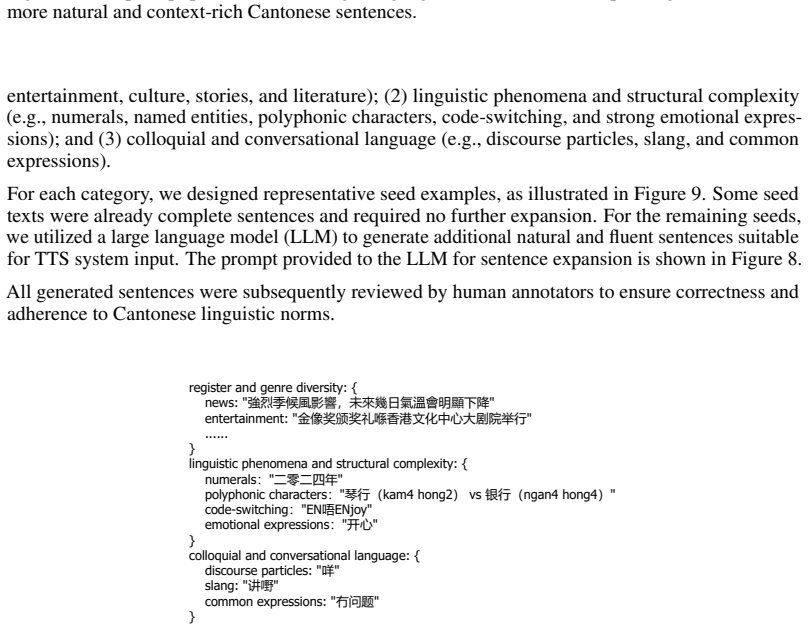
- [Appendix C] The LLM used for Coverage-subset expansion is shown in a prompt screenshot labeled 'ChatGPT,' but the version and access date are not stated. Please specify the model version for reproducibility.
Circularity Check
One concrete circularity: the TTS objective intelligibility metric (MER) is computed with an ASR model trained on the very corpus used to fine-tune the TTS systems under comparison; otherwise the corpus and ASR claims are externally benchmarked.
-
other
[Section 5.2, 'Evaluation Metrics' paragraph]
"For MER, we transcribe the generated audio using U2pp-Conformer-Yue, our state-of-the-art Cantonese ASR model, and compute MER against the reference text."
The objective intelligibility metric used to claim TTS improvements is computed by U2pp-Conformer-Yue, which is itself trained on WenetSpeech-Yue (Section 5.1: 'U2pp-Conformer-Yue, a U2pp-Conformer ... trained from scratch' on the dataset). The TTS models being compared (Llasa-1B-Yue, CosyVoice2-Yue) are fine-tuned on the same corpus's TTS subset. Therefore, the recognizer has been optimized on the same distribution, text-normalization conventions, and speaker/acoustic conditions as the synthesized audio; its errors will be systematically lower for systems that reproduce corpus speech patterns. The reported MER gap between fine-tuned and zero-shot models is partly a measure of the evaluator's fit to the training distribution, not solely general intelligibility. This is a circular evaluatio
full rationale
The central claims are not broadly circular. ASR results are benchmarked against external test sets (Common Voice yue/zh-HK, MDCC, Daily_Use, Commands) and WSYue-ASR-eval, which is described as manually annotated; the corpus's utility is therefore independently grounded. The TTS benchmark also includes subjective MOS from native speakers and UTMOSv2, which are external to the corpus. The one concrete circular step is the objective MER metric in Section 5.2: the recognizer used to measure intelligibility of the fine-tuned TTS systems was itself trained on the same WenetSpeech-Yue corpus, making this single metric partly self-referential. This affects only one of several metrics and does not reduce the central resource claim to its inputs, so the overall score is moderate rather than high. The automated label generation and confidence-based partitioning are a data-quality concern (voting agreement is not human-verified accuracy), but they are not a circular derivation and are not scored as such.
Assumptions & free parameters
free parameters (4)
- text confidence threshold =
0.6
- TTS quality filters =
DNSMOS > 2.5, SNR > 25 dB
- ROVER candidate filtering threshold =
not disclosed
- Stage 1 confidence mixing ratio =
not disclosed
assumptions (6)
- domain assumption The three base ASR systems (SenseVoice, Whisper, TeleASR) have complementary error profiles, so ROVER voting improves transcription accuracy.
- domain assumption The Qwen3-4B LLM corrector only fixes proper nouns and homophone errors and preserves the spoken content.
- domain assumption Vox-Profile age and gender predictions are accurate enough for the corpus annotations.
- domain assumption The manual annotations in WSYue-ASR-eval are accurate.
- domain assumption DNSMOS and Brouhaha SNR scores are valid perceptual quality measures for Cantonese in-the-wild audio.
- domain assumption The forced-alignment model yields reliable character-level timestamps.
Cite this review
Pith. "Pith review of WenetSpeech-Yue: A Large-scale Cantonese Speech Corpus with Multi-dimensional Annotation." pith.science (2026). https://pith.science/paper/NKSWGSTK
@misc{pith2026250903959,
  author       = {Pith},
  title        = {Pith review of: WenetSpeech-Yue: A Large-scale Cantonese Speech Corpus with Multi-dimensional Annotation},
  year         = {2026},
  howpublished = {\url{https://pith.science/paper/NKSWGSTK}},
  note         = {Machine review of arXiv:2509.03959}
}
read the original abstract
The development of speech understanding and generation has been significantly accelerated by the availability of large-scale, high-quality speech datasets. Among these, ASR and TTS are regarded as the most established and fundamental tasks. However, for Cantonese (Yue Chinese), spoken by approximately 84.9 million native speakers worldwide, limited annotated resources have hindered progress and resulted in suboptimal ASR and TTS performance. To address this challenge, we propose WenetSpeech-Pipe, an integrated pipeline for building large-scale speech corpus with multi-dimensional annotation tailored for speech understanding and generation. It comprises six modules: Audio Collection, Speaker Attributes Annotation, Speech Quality Annotation, Automatic Speech Recognition, Text Postprocessing and Recognizer Output Voting, enabling rich and high-quality annotations. Based on this pipeline, we release WenetSpeech-Yue, the first large-scale Cantonese speech corpus with multi-dimensional annotation for ASR and TTS, covering 21,800 hours across 10 domains with annotations including ASR transcription, text confidence, speaker identity, age, gender, speech quality scores, among other annotations. We also release WSYue-eval, a comprehensive Cantonese benchmark with two components: WSYue-ASR-eval, a manually annotated set for evaluating ASR on short and long utterances, code-switching, and diverse acoustic conditions, and WSYue-TTS-eval, with base and coverage subsets for standard and generalization testing. Experimental results show that models trained on WenetSpeech-Yue achieve competitive results against state-of-the-art (SOTA) Cantonese ASR and TTS systems, including commercial and LLM-based models, highlighting the value of our dataset and pipeline.
Figures


Figures from the paper (7 more)




Forward citations
Cited by 6 Pith papers
-
PolySpeech-100: A Large-Scale Benchmark for Speech Understanding Across 100+ Languages and Dialects
PolySpeech-100 is a new benchmark for native-level speech comprehension across 110 linguistic variants that evaluates 22 models and reports E2E advantages on dialects, robustness gaps on low-resource languages, and de...
-
UrduSpeech: A 156-Hour Urdu Speech Corpus with 12-Dimension Paralinguistic Annotations
UrduSpeech is a 156-hour high-fidelity Urdu speech corpus with 12-dimension paralinguistic annotations, a 9-hour manually corrected benchmark, and open-source release to support speech technology for an under-resource...
-
OmniVoice: Towards Omnilingual Zero-Shot Text-to-Speech with Diffusion Language Models
OmniVoice introduces a diffusion language model-style non-autoregressive TTS system that directly maps text to multi-codebook acoustic tokens, scaling zero-shot synthesis to over 600 languages with SOTA results on mul...
-
WildElder: A Chinese Elderly Speech Dataset from the Wild with Fine-Grained Manual Annotations
A new 23,701-utterance Mandarin elderly speech corpus harvested from online videos, manually annotated and benchmarked for ASR, shows that elderly speech remains difficult for current models.
-
NIM4-ASR: Towards Efficient, Robust, and Customizable Real-Time LLM-Based ASR
NIM4-ASR delivers SOTA ASR performance on public benchmarks using a 2.3B-parameter LLM with multi-stage training, real-time streaming, and million-scale hotword customization via RAG.
-
NIM4-ASR: Towards Efficient, Robust, and Customizable Real-Time LLM-Based ASR
A 2.3B-parameter LLM-based ASR system achieves competitive recognition accuracy and reduced hallucination through a multi-stage training paradigm with asynchronous encoder updates, ASR-specialized RL, and phoneme-leve...
Reference graph
Works this paper leans on
-
[1]
K. An, Q. Chen, C. Deng, Z. Du, C. Gao, Z. Gao, Y. Gu, T. He, H. Hu, K. Hu, S. Ji, Y. Li, Z. Li, H. Lu, H. Luo, X. Lv, B. Ma, Z. Ma, C. Ni, C. Song, J. Shi, X. Shi, H. Wang, W. Wang, Y. Wang, Z. Xiao, Z. Yan, Y. Yang, B. Zhang, Q. Zhang, S. Zhang, N. Zhao, and S. Zheng. Funaudiollm: Voice understanding and generation foundation models for natural interact...
arXiv 2024
- [2]
-
[3]
K. Baba, W. Nakata, Y. Saito, and H. Saruwatari. The T05 system for the voicemos challenge 2024: Transfer learning from deep image classifier to naturalness MOS prediction of high-quality synthetic speech. In SLT , pages 818--824. IEEE , 2024
work page 2024
-
[4]
H. Bredin. pyannote.audio 2.1 speaker diarization pipeline: principle, benchmark, and recipe. In INTERSPEECH , pages 1983--1987. ISCA , 2023
work page 1983
-
[5]
H. Chen, Z. Li, G. Xia, B. Liu, Y. Yang, J. Kang, and J. Li. TeleSpeechPT: Large-Scale Chinese Multi-dialect and Multi-accent Speech Pre-training, pages 183--190. Springer, 12 2024. ISBN 978-981-96-1044-0. doi:10.1007/978-981-96-1045-7_15
-
[6]
Z. Du, Y. Wang, Q. Chen, X. Shi, X. Lv, T. Zhao, Z. Gao, Y. Yang, C. Gao, H. Wang, F. Yu, H. Liu, Z. Sheng, Y. Gu, C. Deng, W. Wang, S. Zhang, Z. Yan, and J. Zhou. Cosyvoice 2: Scalable streaming speech synthesis with large language models. CoRR, abs/2412.10117, 2024
arXiv 2024
-
[7]
T. Feng, J. Lee, A. Xu, Y. Lee, T. Lertpetchpun, X. Shi, H. Wang, T. Thebaud, L. Moro - Vel \' a zquez, D. Byrd, N. Dehak, and S. Narayanan. Vox-profile: A speech foundation model benchmark for characterizing diverse speaker and speech traits. CoRR, abs/2505.14648, 2025
arXiv 2025
-
[8]
J. Fiscus. A post-processing system to yield reduced word error rates: Recognizer output voting error reduction (rover). In 1997 IEEE Workshop on Automatic Speech Recognition and Understanding Proceedings, 1997
work page 1997
Show all 30 references
-
[9]
Z. Gao, S. Zhang, I. McLoughlin, and Z. Yan. Paraformer: Fast and accurate parallel transformer for non-autoregressive end-to-end speech recognition. In INTERSPEECH , pages 2063--2067. ISCA , 2022
-
[10]
H. He, Z. Shang, C. Wang, X. Li, Y. Gu, H. Hua, L. Liu, C. Yang, J. Li, P. Shi, Y. Wang, K. Chen, P. Zhang, and Z. Wu. Emilia: A large-scale, extensive, multilingual, and diverse dataset for speech generation. CoRR, abs/2501.15907, 2025
2025
-
[11]
Huang, B
A. Huang, B. Wu, B. Wang, C. Yan, C. Hu, C. Feng, F. Tian, F. Shen, J. Li, and et al. Step-audio: Unified understanding and generation in intelligent speech interaction. CoRR, abs/2502.11946, 2025
2025 arXiv
-
[12]
KimiTeam, D. Ding, Z. Ju, Y. Leng, S. Liu, T. Liu, Z. Shang, K. Shen, W. Song, X. Tan, H. Tang, Z. Wang, C. Wei, Y. Xin, X. Xu, J. Yu, Y. Zhang, X. Zhou, Y. Charles, J. Chen, Y. Chen, Y. Du, W. He, Z. Hu, G. Lai, Q. Li, Y. Liu, W. Sun, J. Wang, Y. Wang, Y. Wu, Y. Wu, D. Yang, ...
2025 arXiv
-
[13]
Lavechin, M
M. Lavechin, M. M \' e tais, H. Titeux, A. Boissonnet, J. Copet, M. Rivi \` e re, E. Bergelson, A. Cristi \` a , E. Dupoux, and H. Bredin. Brouhaha: Multi-task training for voice activity detection, speech-to-noise ratio, and C50 room acoustics estimation. In ASRU , pages 1--7...
2023
-
[14]
L. Li, Y. Li, H. Xue, J. Liu, S. Fang, K. Wang, and L. Xie. Delayed-kd: Delayed knowledge distillation based CTC for low-latency streaming ASR . CoRR, abs/2505.22069, 2025
2025 arXiv
-
[15]
L. Ma, D. Guo, K. Song, Y. Jiang, S. Wang, L. Xue, W. Xu, H. Zhao, B. Zhang, and L. Xie. Wenetspeech4tts: A 12, 800-hour mandarin TTS corpus for large speech generation model benchmark. In INTERSPEECH . ISCA , 2024
2024
-
[16]
Y. Meng, J. Li, G. Lin, Y. Pu, G. Wang, H. Du, Z. Shao, Y. Huang, K. Li, and W. Zhang. Dolphin: A large-scale automatic speech recognition model for eastern languages. CoRR, abs/2503.20212, 2025
2025 arXiv
-
[17]
Panayotov, G
V. Panayotov, G. Chen, D. Povey, and S. Khudanpur. Librispeech: An ASR corpus based on public domain audio books. In ICASSP , pages 5206--5210. IEEE , 2015
2015
-
[18]
Radford, J
A. Radford, J. W. Kim, T. Xu, G. Brockman, C. McLeavey, and I. Sutskever. Robust speech recognition via large-scale weak supervision. In ICML , volume 202 of Proceedings of Machine Learning Research, pages 28492--28518. PMLR , 2023
2023
-
[19]
C. K. A. Reddy, V. Gopal, and R. Cutler. Dnsmos P.835: A non-intrusive perceptual objective speech quality metric to evaluate noise suppressors. In ICASSP , pages 886--890. IEEE , 2022
2022
-
[20]
M. Shao, X. Zhu, C. Wang, B. Mu, H. Li, Y. Yan, J. Liu, D. Xie, and L. Xie. Weakly supervised data refinement and flexible sequence compression for efficient thai llm-based ASR . CoRR, abs/2505.22063, 2025
2025 arXiv
-
[21]
C. Wang, S. Chen, Y. Wu, Z. Zhang, L. Zhou, S. Liu, Z. Chen, Y. Liu, H. Wang, J. Li, L. He, S. Zhao, and F. Wei. Neural codec language models are zero-shot text to speech synthesizers. CoRR, abs/2301.02111, 2023 a
2023 arXiv
-
[22]
H. Wang, C. Liang, S. Wang, Z. Chen, B. Zhang, X. Xiang, Y. Deng, and Y. Qian. Wespeaker: A research and production oriented speaker embedding learning toolkit. In ICASSP , pages 1--5. IEEE , 2023 b
2023
-
[23]
D. Wu, B. Zhang, C. Yang, Z. Peng, W. Xia, X. Chen, and X. Lei. U2++: unified two-pass bidirectional end-to-end model for speech recognition. CoRR, abs/2106.05642, 2021
2021 arXiv
-
[24]
Xiang, H
R. Xiang, H. Tan, J. Li, M. Wan, and K.-F. Wong. When C antonese NLP meets pre-training: Progress and challenges. In Proceedings of the 2nd Conference of the Asia-Pacific Chapter of the Association for Computational Linguistics and the 12th International Joint Conference on Na...
2022
-
[25]
J. Xu, Z. Guo, J. He, H. Hu, T. He, S. Bai, K. Chen, J. Wang, Y. Fan, K. Dang, B. Zhang, X. Wang, Y. Chu, and J. Lin. Qwen2.5-omni technical report. CoRR, abs/2503.20215, 2025 a
2025 arXiv
-
[26]
K. Xu, F. Xie, X. Tang, and Y. Hu. Fireredasr: Open-source industrial-grade mandarin speech recognition models from encoder-decoder to LLM integration. CoRR, abs/2501.14350, 2025 b
2025 arXiv
-
[27]
A. Yang, A. Li, B. Yang, B. Zhang, B. Hui, B. Zheng, B. Yu, C. Gao, C. Huang, C. Lv, C. Zheng, D. Liu, F. Zhou, F. Huang, F. Hu, H. Ge, H. Wei, H. Lin, J. Tang, J. Yang, J. Tu, J. Zhang, J. Yang, J. Yang, J. Zhou, J. Zhou, J. Lin, K. Dang, K. Bao, K. Yang, L. Yu, L. Deng, M. L...
2025 arXiv
-
[28]
Y. Yang, Z. Song, J. Zhuo, M. Cui, J. Li, B. Yang, Y. Du, Z. Ma, X. Liu, Z. Wang, K. Li, S. Fan, K. Yu, W. Zhang, G. Chen, and X. Chen. Gigaspeech 2: An evolving, large-scale and multi-domain ASR corpus for low-resource languages with automated crawling, transcription and refi...
2024 arXiv
-
[29]
T. Yu, R. Frieske, P. Xu, S. Cahyawijaya, C. T. S. Yiu, H. Lovenia, W. Dai, E. J. Barezi, Q. Chen, X. Ma, B. E. Shi, and P. Fung. Automatic speech recognition datasets in cantonese: A survey and new dataset. In LREC , pages 6487--6494. European Language Resources Association, 2022
2022
-
[30]
Zhang, H
B. Zhang, H. Lv, P. Guo, Q. Shao, C. Yang, L. Xie, X. Xu, H. Bu, X. Chen, C. Zeng, D. Wu, and Z. Peng. WENETSPEECH: A 10000+ hours multi-domain mandarin corpus for speech recognition. In ICASSP , pages 6182--6186. IEEE , 2022
2022
Reviewed August 5, 2026 · model on record in the stance chip above.
Discussion (0). Sign in to comment.