REVIEW 4 major objections 4 minor 11 references
Efficient Catalytic Graph Algorithms
T0 review · 4 major / 4 minor · reviewed 2026-08-15 · deepseek-v4-flash
Pith's one-line read Catalytic algorithms that borrow and restore memory solve graph reachability and random-walk estimation with explicit runtime bounds, including a randomized algorithm that uses near-linear catalytic space.
desk verdict New catalytic algorithms with a genuinely elegant random walk simulation and a novel randomized connectivity technique; the main theorem's proof has two large but fixable typos. read the letter →
The pith
A machine-rendered reading of the paper's core claim, the machinery that carries it, and where it could break.
The reading
What carries the argument
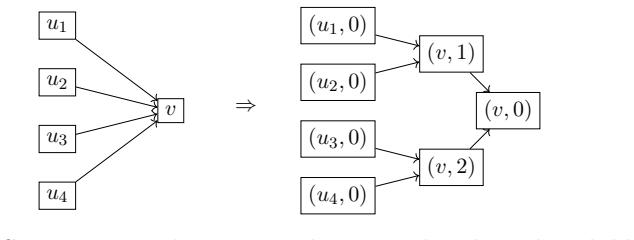
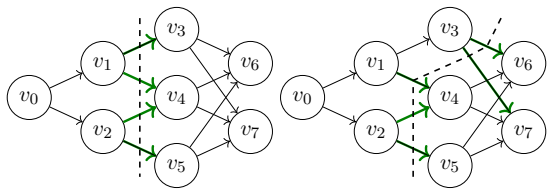
The load-bearing mechanism is the edge-push operation on catalytic registers arranged by layer and vertex (the optimized version alternates between two registers per vertex). For each edge $(i,u) \to (i+1,v)$ in a layered graph, the algorithm sets $R_{i+1,v} \leftarrow R_{i+1,v} + R_{i,u}$ modulo $q$; because this is linear, running the pushes once with a $+1$ seed at $s$ and once without, and subtracting, isolates the number of $s$-$t$ paths modulo $q$. A random small modulus $q$ with a random additive shift of all registers lets arbitrary tape contents be treated as valid $q$-ary registers in near-linear time. The random-walk argument uses the same per-vertex register idea as a balancing counter: each visit increments the register, so outgoing edges are used almost equally often, and the local-consistency induction over topological cuts bounds total error by $2m$.
What would settle it
Measure the cost of one addition of two large numbers in the algorithm's register format; if the cost grows much faster than the number of bits, the central runtime claim is false. Or run the random-walk simulator on a small directed acyclic graph with a chosen starting tape and check whether any vertex is visited more often than expected plus $2m$; if so, the $\varepsilon$-additive-error guarantee fails.
Extended reading notes
Core claim
The central discovery is a simple register-pushing scheme that lets a catalytic machine count and detect paths and random-walk probabilities while still restoring its tape. For connectivity, the graph is lifted into $T+1$ layers; each layer/vertex pair carries a catalytic register (the optimized version keeps two registers per vertex, alternating by parity), and for every edge the algorithm adds the source register into the target register modulo $q$. A $+1$ seed at $s$ gives a final register whose difference from the unseeded run equals the number of length-$T$ paths from $s$ to $t$ modulo $q$. Choosing $q$ at random from a large interval makes a nonzero path count detectable with high probability using $O(\log n)$-bit registers. For random walks, one register per vertex is incremented at each visit, and the next outgoing edge is chosen from the register value modulo the outdegree; a cut-based induction shows every vertex's visit count is within $2m$ of expectation, so $K = \lceil 2m/\varepsilon \rceil$ walks estimate the target probability with additive error at most $\varepsilon$, and the same walks run in reverse restore every register.
Load-bearing premise
The runtime bounds assume the algorithm can add two stored numbers of the size it uses in time roughly proportional to the number of bits in the number; if that addition is slower, every stated runtime gets worse.
Editorial extensions
If this is right
- Catalytic logspace algorithms for the two canonical complete problems of $\mathsf{NL}$ and $\mathsf{BPL}$ now come with explicit runtimes, so the catalytic-space model can be evaluated as an algorithmic model rather than only a complexity class.
- The randomized connectivity algorithm shows randomness can serve as a speedup tool inside catalytic computation, not only as a route to class containment.
- For estimating a $T$-step random walk to inverse-polynomial error $\varepsilon$, the new algorithm runs in nearly linear time $m^{1+o(1)}$ when $T$ and $1/\varepsilon$ are subpolynomial.
- Local revertibility, defined and achieved in the paper, means a catalytic computation can share borrowed memory with its owner: the original tape contents remain readable with polylogarithmic latency at all times.
- The randomized algorithm's $\widetilde{O}(n)$ catalytic space is optimal up to polylog factors under conjectured time-space tradeoffs for connectivity, even for algorithms with much larger polynomial runtime.
Reading between the lines
- The edge-push counting scheme is essentially a catalytic implementation of iterative path-counting by dynamic programming; the same scheme could be adapted to other dynamic-programming graph properties, such as counting walks with forbidden labels or estimating all-pairs reachability, at similar cost per property.
- The random-walk simulator suggests a general derandomization recipe for Markov-chain simulation: use one catalytic counter per state to force balanced edge usage, then prove concentration by a local-consistency induction; this may extend to estimating mixing times or hitting probabilities of more general Markov chains.
- If the register-arithmetic subroutine can be implemented even faster, the connectivity runtime would improve correspondingly; conversely, an instance where modulo-$q$ addition on $\ell$-bit valid registers requires superlinear time would invalidate the stated $\widetilde{O}(nm)$ bound and point to a different trade-off between register size and iteration count.
- The locally revertible version hints that catalytic memory with read access during computation could be treated as a shared resource, potentially changing how catalytic algorithms are scheduled in memory-constrained systems.
Signed reviews
Editorial analysis
A structured set of objections, weighed in public.
Referee Report
Summary. The paper proposes catalytic logspace algorithms for two graph problems. First, it gives deterministic and randomized catalytic algorithms for s-to-t connectivity: the deterministic algorithm runs in \tilde{O}(n^3 m) time with \tilde{O}(n^2) catalytic space, the randomized algorithm in \tilde{O}(nm) time with \tilde{O}(n) catalytic space, and a locally revertible randomized variant in \tilde{O}(nm) time with \tilde{O}(n^3) catalytic space. The technique is to lift the graph into layers, store one register per vertex (or per vertex and parity), and propagate values by "edge pushes"; a nonzero propagated value modulo a random prime witnesses a path. Second, the paper gives a catalytic algorithm for estimating random-walk hitting probabilities on a DAG in \tilde{O}(nm/\varepsilon) time, extended to general graphs by a layered construction at \tilde{O}(mT^2/\varepsilon) time, and a non-catalytic variant for the stationary distribution. The random-walk analysis is built on a local-consistency argument comparing visit counts with true visit probabilities.
Significance. The results, if correct, would be a meaningful step toward understanding catalytic space from an algorithmic perspective: they give explicit polynomial runtime bounds where previous catalytic algorithms only had unspecified polynomial bounds, they introduce randomization as a tool for algorithmic speedup within CL, and they propose and achieve a notion of local revertibility that strengthens the practical motivation for catalytic computing. The DAG random-walk proof (Lemmas 22-24 and Corollary 26) is a genuine technical contribution: the cut-based error induction is careful and self-contained. The paper is also honest about limitations, notably that cycles break the random-walk restoration property. However, the connectivity section contains several load-bearing errors: the two-parity push in Theorem 17 is irreversible as written, the register size in Theorem 2 contradicts the stated space bound, and a key inequality in Theorem 5 does not follow from the stated parameters. These are fixable within the manuscript's scope, but the central claims are not yet supported by the text.
major comments (4)
- [Section 3, Theorem 17] The layer-push operation as displayed is not reversible. The forward update R_{¬σ,v} ← R_{σ,v} + R_{σ,u} overwrites R_{¬σ,v}, discarding its previous value, and the stated reverse operation R_{¬σ,v} ← R_{σ,v} − R_{σ,u} is applied after σ has flipped, so it reads from the newly written parity rather than the original source parity. For the two-vertex graph with one edge (1,2) and initial registers (R_{0,1},R_{0,2},R_{1,1},R_{1,2})=(a,b,c,d), incStart(1) followed by the forward push gives R_{1,2}=b+a+1, and the stated reverse gives R_{0,2}=b+a+1−c, not the initial b. Lemma 19's recurrence α_{(0,v),i+1,b} ≡ α_{(0,v),i−1,b} + Σ_u α_{(1,u),i,b} corresponds instead to the incremental update R_{¬σ,v} ← R_{¬σ,v} + R_{σ,u}. Since Theorems 1, 2, and 5 all invoke Theorem 17 and rely on its tape-restoring property, this needs to be corrected explicitly, for example by adopting the incremental operation.
- [Section 3.1, Theorem 2 proof] The register size is set to ℓ = 5⌈log B_n⌉, where B_n = (n+1)^n + 1. Since log B_n = Θ(n log n), the 2n registers occupy Θ(n^2 log n) bits, contradicting the theorem's stated eO(n) catalytic space. Moreover, the algorithm draws a random shift β ∈ [2^ℓ] and stores it on the worktape, which would require Θ(n log n) bits and violate the O(log n) workspace bound. The subsequent inequality d ≥ 2^ℓ/(2q) > n^3 only needs ℓ = Θ(log log B_n); with the displayed value the space claim fails. The proof should be corrected, likely by taking ℓ = 5⌈log log B_n⌉ (or another O(log n) value), and the theorem statement and space analysis updated accordingly.
- [Section 3.1, Theorem 5 proof] The claim d ≥ 2^ℓ/(2q) ≥ m^3/2 does not follow from the stated parameters. Here p_{n'} = ⌈log P_{n'}⌉ = ⌈T log n'⌉ = eO(n log n), q ≤ p_{n'}^2, and ℓ = 5⌈log p_{n'}⌉, so 2^ℓ/(2q) = Ω(p_{n'}^3) = n^{O(1)} log^{O(1)} n. When m = Θ(n^2), this is far smaller than m^3/2, so the union-bound estimate in the success-probability argument is not justified as written. The proof should either choose a larger but still O(log n) register size, such as ℓ = Θ(log m + log p_{n'}), or use a different bound on d; with such a change the eO(n^3) space claim would still hold.
- [Section 3, Lemma 16] The local revertibility proof only handles two cases: the register is in its initial state, or some complete push sequence P_b has been executed. If a query arrives in the middle of a layerPush, some in-neighbor contributions have not yet been added to R_a, so subtracting the current values of all previous-layer registers does not recover τ_a. Since Definition 4 requires queries at any point during the execution, the proof needs to address partial layer pushes, or the algorithm must be structured to answer queries only at safe points and the theorem statement adjusted accordingly.
minor comments (4)
- [Section 4.2, Lemma 24 proof] The induction step says "assume σ_i ≤ 2(i+1)" but the subsequent inequality uses D_i; the intended hypothesis is σ_i ≤ 2D_i. Also, the transitions removed when moving from cut i to cut i+1 are incoming to v_{i+1}, not v_i; the text appears to have an off-by-one typo.
- [Section 4, Algorithm 1 and Algorithm 2] Algorithm 1 line 4 calls "walk once(M,x,s,forward)" with undefined variables M and x; it should call "walk once(G,s,forward)". In Algorithm 2, the parameter m for the mode shadows the edge count m used elsewhere; consider renaming the mode to avoid confusion.
- [Section 4.6, Algorithm 3] Algorithm 3 line 10 increments R_v modulo 2^ℓ, but the surrounding text states that registers store values in [d_out(v)]. The proof that outgoing-edge counts differ by at most one relies on incrementing modulo d_out(v); the algorithm should be updated accordingly.
- [Throughout] There are several typos: in Theorem 2 proof, "store in on the worktape" should be "store it on the worktape"; in Theorem 5 proof, "corresond" should be "correspond"; in Theorem 6, "from s sends at t" should likely be "from s ends at t"; and in Theorem 28 and Algorithm 3, the parameter v* is duplicated in the header.
Circularity Check
No circularity found: the connectivity and random-walk algorithms are proved from explicit algorithms and inductive invariants, with no fitted parameters or predictions that reduce to their inputs.
full rationale
The paper's central claims are self-contained derivations. Theorem 17 defines the path-count quantity zeta recursively and then proves by induction (Lemma 19) that the register differences after the push sequence are congruent to zeta modulo q; no quantity in the proof is defined in terms of the target answer, and no empirically fitted value is renamed as a prediction. The randomized modulus and shift arguments (Fact 9 and Lemma 10) are proved in the text from standard number-theoretic facts, and the runtime bounds follow directly from the stated register-size and loop-count parameters. The only self-citation, [Coo25], is disclosed in a footnote as subsumed prior work and is not used to justify any theorem; the random-walk simulation and its correctness proof are given in full in Lemmas 22-26 and Corollary 26. The locally revertible construction and the acyclic-to-general graph reduction for random walks are also proved in place. The skeptical concern about Theorem 17's two-parity reverse operation being irreversible as written is a correctness or proof-gap issue, not a circular reduction of the sort this pass is tasked to detect; accordingly, it does not raise the circularity score.
Assumptions & free parameters
free parameters (1)
- constant factor 5 in register size ell =
5
assumptions (4)
- standard math Prime Number Theorem
- domain assumption Catalytic RAM model with constant-time query access to the catalytic tape
- domain assumption Oracle access to the input graph via InDeg, OutDeg, InNbr, OutNbr queries
- domain assumption For Theorem 28, the random walk has a unique stationary distribution and mixes in time T with error epsilon
Cite this review
Pith. "Pith review of Efficient Catalytic Graph Algorithms." pith.science (2026). https://pith.science/paper/JZ6JP5JM
@misc{pith2026250906209,
  author       = {Pith},
  title        = {Pith review of: Efficient Catalytic Graph Algorithms},
  year         = {2026},
  howpublished = {\url{https://pith.science/paper/JZ6JP5JM}},
  note         = {Machine review of arXiv:2509.06209}
}
abstract
We give fast, simple, and implementable catalytic logspace algorithms for two fundamental graph problems. First, a randomized catalytic algorithm for $s\to t$ connectivity running in $\widetilde{O}(nm)$ time, and a deterministic catalytic algorithm for the same running in $\widetilde{O}(n^3 m)$ time. The former algorithm is the first algorithmic use of randomization in $\mathsf{CL}$. The algorithm uses one register per vertex and repeatedly ``pushes'' values along the edges in the graph. Second, a deterministic catalytic algorithm for simulating random walks which in $\widetilde{O}( m T^2 / \varepsilon )$ time estimates the probability a $T$-step random walk ends at a given vertex within $\varepsilon$ additive error. The algorithm uses one register for each vertex and increments it at each visit to ensure repeated visits follow different outgoing edges. Prior catalytic algorithms for both problems did not have explicit runtime bounds beyond being polynomial in $n$.
Figures


Figures from the paper (2 more)

Reference graph
Works this paper leans on
-
[1]
Computing with a full memory: catalytic space
Harry Buhrman, Richard Cleve, Michal Kouck\' y , Bruno Loff, and Florian Speelman. Computing with a full memory: catalytic space. In Proceedings of the Forty-Sixth Annual ACM Symposium on Theory of Computing , STOC '14, page 857–866, New York, NY, USA, 2014. Association for Computing Machinery
work page 2014
-
[2]
Kuan Cheng and William M. Hoza. Hitting sets give two-sided derandomization of small space. Adv. Math. Commun. , 18:1--32, 2022
work page 2022
-
[3]
The structure of catalytic space: Capturing randomness and time via compression
James Cook, Jiatu Li, Ian Mertz, and Edward Pyne. The structure of catalytic space: Capturing randomness and time via compression. Electronic Colloquium on Computational Complexity: ECCC , 2024
work page 2024
-
[4]
James Cook. How to borrow memory. https://www.falsifian.org/blog/2021/06/04/catalytic/
work page 2021
-
[5]
Another way to show BPL and BPL P
James Cook. Another way to show BPL and BPL P . Electron. Colloquium Comput. Complex. , TR25-016 , 2025
work page 2025
-
[6]
Dean Doron, Edward Pyne, and Roei Tell. Opening up the distinguisher: A hardness to randomness approach for BPL=L that uses properties of BPL . In Proceedings of the 56th Annual ACM Symposium on Theory of Computing , STOC 2024, page 2039–2049, New York, NY, USA, 2024. Association for Computing Machinery
work page 2024
-
[7]
Michal Kouck \' y , Ian Mertz, Edward Pyne, and Sasha Sami. Collapsing catalytic classes. Electron. Colloquium Comput. Complex. , TR25-019 , 2025
work page 2025
-
[8]
Reusing space: Techniques and open problems
Ian Mertz. Reusing space: Techniques and open problems. Bulletin of EATCS , 141(3), 2023
work page 2023
Show all 11 references
-
[9]
On read once vs
Noam Nisan. On read once vs. multiple access to randomness in logspace. Theoretical Computer Science , 107(1):135--144, 1993
1993
-
[10]
Derandomizing Logspace with a Small Shared Hard Drive
Edward Pyne. Derandomizing Logspace with a Small Shared Hard Drive . In Rahul Santhanam, editor, 39th Computational Complexity Conference (CCC 2024) , volume 300 of Leibniz International Proceedings in Informatics (LIPIcs) , pages 4:1--4:20, Dagstuhl, Germany, 2024. Schloss Da...
2024
-
[11]
The complexity of graph connectivity
Avi Wigderson. The complexity of graph connectivity. In Mathematical Foundations of Computer Science (MFCS) , volume 629 of Lecture Notes in Computer Science , pages 112--132. Springer, 1992
1992
Reviewed August 15, 2026 · model on record in the stance chip above.
Discussion (0). Continue with ORCID to comment.