Small-time asymptotics and the emergence of complex singularities for the KdV equation
Pith reviewed 2026-05-18 18:41 UTC · model grok-4.3
The pith
Complex singularities emerge from double-pole singularities in the KdV initial condition at early times, moving at speed O(t^{-2/3}) with directions from a Painlevé II problem.
A machine-rendered reading of the paper's core claim, the machinery that carries it, and where it could break.
Core claim
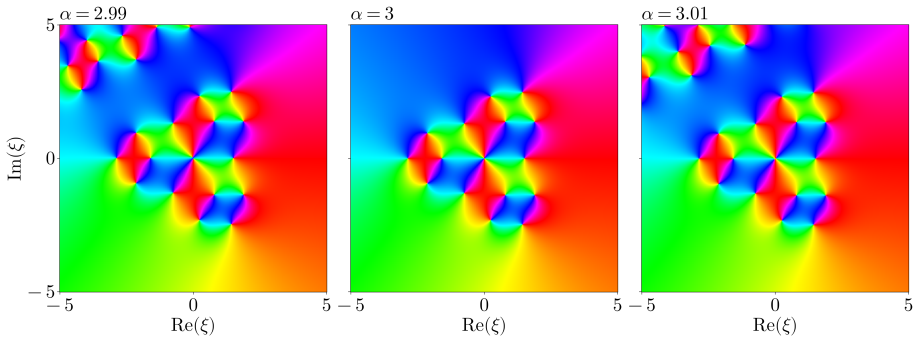
Using matched asymptotic expansions in the limit t approaching 0 from above, we show how complex singularities of the time-dependent solution of the KdV equation emerge from double-pole singularities. Generically, their speed as they move from their initial position is of order t to the minus two thirds, while the direction in which these singularities propagate initially is dictated by a Painlevé II problem with decreasing tritronquée solutions. The well-known N-soliton solutions of KdV correspond to rational solutions of Painlevé II with a finite number of singularities; otherwise, we postulate that infinitely many complex-plane singularities of KdV solutions are born at each double-pole 0
What carries the argument
Matched asymptotic expansions in the small-time limit that track the emergence and motion of complex singularities from initial double-pole singularities, with propagation directions given by a Painlevé II problem with decreasing tritronquée solutions.
If this is right
- The amplitude, wavelength and speed of dispersive waves on the real line depend on the strength and location of double-pole singularities of the initial condition.
- N-soliton solutions correspond to rational solutions of the Painlevé II problem with only a finite number of singularities.
- In non-generic cases singularities propagate more slowly than the generic order t to the minus two thirds.
Where Pith is reading between the lines
- This small-time description could be extended to other integrable equations to follow the dynamics of their complex singularities.
- Accounting for the birth of infinitely many singularities may improve numerical methods that track analytic continuation of KdV solutions.
Load-bearing premise
The initial condition possesses double-pole singularities in the complex plane that permit analytic continuation and the application of exponential asymptotics to track the birth and motion of new singularities.
What would settle it
Numerically solve the KdV equation for small positive time starting from an initial condition with a known double-pole singularity in the complex plane and check whether new singularities appear and move at speed scaling as t to the minus two thirds in the direction predicted by the tritronquée solution.
Figures


read the original abstract
While real-valued solutions of the Korteweg--de Vries (KdV) equation have been studied extensively over the past 50 years, much less attention has been devoted to solution behaviour in the complex plane. Here we consider the analytic continuation of real solutions of KdV and investigate the role that complex-plane singularities play in early-time solutions on the real line. We apply techniques of exponential asymptotics to derive the small-time behaviour for dispersive waves that propagate in one direction, and demonstrate how the amplitude, wavelength and speed of these waves depend on the strength and location of double-pole singularities of the initial condition in the complex plane. Using matched asymptotic expansions in the limit $t\rightarrow 0^+$, we show how complex singularities of the time-dependent solution of the KdV equation emerge from these double-pole singularities. Generically, their speed as they move from their initial position is of $\mathcal{O}(t^{-2/3})$, while the direction in which these singularities propagate initially is dictated by a Painlev\'{e} II (P$_{\mathrm{II}}$) problem with decreasing tritronqu\'{e}e solutions. The well-known $N$-soliton solutions of KdV correspond to rational solutions of P$_{\mathrm{II}}$ with a finite number of singularities; otherwise, we postulate that infinitely many complex-plane singularities of KdV solutions are born at each double-pole singularity of the initial condition. We also provide asymptotic results for some non-generic cases in which singularities propagate more slowly than in the generic case. Our study makes progress towards the goal of providing a complete description of KdV solutions in the complex plane and, in turn, of relating this behaviour to the solution on the real line.
Editorial analysis
A structured set of objections, weighed in public.
Referee Report
Summary. The manuscript analyzes the analytic continuation of real KdV solutions into the complex plane. It applies exponential asymptotics and matched asymptotic expansions in the small-time limit t→0+ to show that complex singularities of the time-dependent solution emerge from double-pole singularities of the initial condition. Generically these singularities propagate at speed O(t^{-2/3}), with initial direction fixed by a local Painlevé II problem whose solution is the decreasing tritronquée function; the N-soliton case reduces to rational P_II solutions with finitely many singularities, while the generic case is postulated to generate infinitely many singularities. Non-generic regimes with slower propagation are also treated.
Significance. If the formal derivations hold, the work supplies a concrete mechanism linking initial-data singularities to the birth and motion of complex singularities in KdV, thereby relating complex-plane structure to real-line dispersive behavior. The explicit reduction to a P_II tritronquée problem and the consistency check against known N-soliton solutions are notable strengths; the approach also yields concrete scalings for wave amplitude, wavelength and speed that could be tested numerically or against other integrable equations.
major comments (2)
- [§4] §4, around the inner-region scaling (leading to Eq. (4.3)): the reduction to the Painlevé II equation with decreasing tritronquée solution is stated after a formal matched expansion, but the precise choice of Stokes sector and the verification that the outer solution remains consistent with the assumed double-pole residue are not shown; this step is load-bearing for the claimed O(t^{-2/3}) speed and direction.
- [§5.2] §5.2: the postulate that infinitely many singularities are born at each generic double pole is presented without an explicit count or recurrence relation derived from the P_II asymptotics; while the N-soliton (rational) case is recovered correctly, the generic infinite-count claim requires at least a leading-order argument or numerical illustration to support the central narrative.
minor comments (3)
- [§2] The notation for the complex singularity locations (z_j(t)) is introduced without an explicit statement of the branch cuts chosen for the square-root terms that appear in the exponential asymptotics.
- [Figure 2] Figure 2 caption refers to 'the first few singularities' but the plotted curves are not labeled with the corresponding P_II parameter values.
- [Introduction] A short paragraph comparing the present small-time results with existing large-time complex-plane analyses (e.g., via Riemann-Hilbert methods) would help situate the contribution.
Simulated Author's Rebuttal
We thank the referee for their careful reading of the manuscript and for the constructive major comments. These have identified places where the exposition of the matched asymptotics and the supporting arguments for the singularity count can be strengthened. We respond to each point below and indicate the revisions we will make.
read point-by-point responses
-
Referee: §4, around the inner-region scaling (leading to Eq. (4.3)): the reduction to the Painlevé II equation with decreasing tritronquée solution is stated after a formal matched expansion, but the precise choice of Stokes sector and the verification that the outer solution remains consistent with the assumed double-pole residue are not shown; this step is load-bearing for the claimed O(t^{-2/3}) speed and direction.
Authors: We agree that the choice of Stokes sector and the consistency verification merit explicit discussion. In the revised manuscript we will expand the paragraph following Eq. (4.3) to specify that the decreasing tritronquée solution is selected because its exponential decay in the sector arg(ζ) ∈ (−π/3, π/3) matches the outer solution’s regular analytic continuation away from the double pole. We will also insert a short calculation showing that the residue of the outer solution at the initial double-pole location is preserved under the inner scaling, thereby confirming that the O(t^{-2/3}) propagation speed and initial direction are compatible with the assumed singularity structure. These additions will be placed immediately after the formal matching statement. revision: yes
-
Referee: §5.2: the postulate that infinitely many singularities are born at each generic double pole is presented without an explicit count or recurrence relation derived from the P_II asymptotics; while the N-soliton (rational) case is recovered correctly, the generic infinite-count claim requires at least a leading-order argument or numerical illustration to support the central narrative.
Authors: The infinite-singularity claim is indeed presented as a postulate resting on the known pole asymptotics of the tritronquée solution. To address the request for a leading-order argument, the revised §5.2 will include a brief derivation based on the large-|z| expansion of the decreasing tritronquée function in the sector of interest. This yields a recurrence for successive pole locations of the form z_{n+1} − z_n ∼ (3/2) log n + const, implying infinitely many poles accumulate along the ray determined by the local scaling. We will also cite existing numerical plots of P_II solutions that visually confirm the infinite sequence. The finite-pole rational solutions recovered for the N-soliton case remain unchanged and serve as a consistency check. revision: yes
Circularity Check
No significant circularity in the derivation chain
full rationale
The paper applies standard matched asymptotic expansions and exponential asymptotics to derive small-time behavior of KdV solutions from assumed double-pole singularities in the initial condition. The emergence and motion of new complex singularities, including the O(t^{-2/3}) speed scaling and initial direction governed by a Painlevé II problem with decreasing tritronquée solutions, follows directly from local asymptotic matching without reducing to fitted parameters or self-referential definitions. The analysis distinguishes generic and non-generic regimes and notes consistency with known N-soliton cases as rational P_II solutions, but these are external benchmarks rather than internal loops. The explicit postulate of infinitely many singularities is presented as such, and no load-bearing step equates outputs to inputs by construction or via self-citation chains.
Axiom & Free-Parameter Ledger
axioms (2)
- domain assumption KdV solutions admit analytic continuation into the complex plane with double-pole singularities in the initial data.
- standard math Exponential asymptotics and matched asymptotic expansions are valid in the small-time limit t→0+.
Lean theorems connected to this paper
-
IndisputableMonolith/Cost/FunctionalEquation.leanwashburn_uniqueness_aczel unclear?
unclearRelation between the paper passage and the cited Recognition theorem.
Using matched asymptotic expansions in the limit t→0+, we show how complex singularities ... dictated by a Painlevé II (P_II) problem with decreasing tritronquée solutions.
-
IndisputableMonolith/Foundation/DimensionForcing.leanreality_from_one_distinction unclear?
unclearRelation between the paper passage and the cited Recognition theorem.
the direction in which these singularities propagate initially is dictated by a Painlevé II (P_II) problem with decreasing tritronquée solutions
What do these tags mean?
- matches
- The paper's claim is directly supported by a theorem in the formal canon.
- supports
- The theorem supports part of the paper's argument, but the paper may add assumptions or extra steps.
- extends
- The paper goes beyond the formal theorem; the theorem is a base layer rather than the whole result.
- uses
- The paper appears to rely on the theorem as machinery.
- contradicts
- The paper's claim conflicts with a theorem or certificate in the canon.
- unclear
- Pith found a possible connection, but the passage is too broad, indirect, or ambiguous to say the theorem truly supports the claim.
Reference graph
Works this paper leans on
-
[1]
Ablowitz M J & Segur H (1977) Asymptotic solutions of the Korteweg–de Vries equation,Stud. Appl. Math.57, 13-44
work page 1977
-
[2]
Ablowitz M J & Clarkson P A (1991)Solitons, Nonlinear Evolution Equations and Inverse Scattering, London Mathematical Society Lecture Note Series 149, Cambridge University Press
work page 1991
-
[3]
Ablowitz M J (2011)Nonlinear dispersive waves: asymptotic analysis and solitons, Cambridge Univer- sity Press
work page 2011
- [4]
-
[5]
Aniceto I & Schiappa R (2015) Nonperturbative ambiguities and the reality of resurgent transseries, Comm. Math. Phys.335, 183–245
work page 2015
-
[6]
Baker G R, Li X & Morlet A C (1996) Analytic structure of two 1D-transport equations with fluxes, Phys. D91349–375
work page 1996
-
[7]
Baldino S, Schiappa R, Schwick M & Vega R (2023) Resurgent Stokes data for Painlev´ e equations and two-dimensional quantum (super) gravity,Comm. Num. Theory Phys.17, 385–552
work page 2023
-
[8]
Berry M V (1989) Uniform asymptotic smoothing of Stokes’s discontinuities,Proc. R. Soc. Lond. A 422, 7–21
work page 1989
-
[9]
Bessis D & Fournier J D (1984) Pole condensation and the Riemann surface associated with a shock in Burgers’ equation,J. Phys. Lett.45, 833–841
work page 1984
-
[10]
Boiti M & Pempinelli F (1979) Similarity solutions of the Korteweg–de Vries equation,Il Nuovo Cimento B51, 70–78
work page 1979
-
[11]
Bona J L & Weissler F B (2009) Pole dynamics of interacting solitons and blowup of complex-valued solutions of KdV,Nonlinearity22, 311–349
work page 2009
-
[12]
Bona J L, Vento S & Weissler F B (2013) Singularity formation and blowup of complex-valued solutions of the modified KdV equation,Disc. Cont. Dyn. Sys.33, 4811–4840
work page 2013
-
[13]
Bona J L & Weissler F B (2023) Blowup and ill-posedness for the complex, periodic KdV equation, Comm. Cont. Math.25, 2250044
work page 2023
-
[14]
Painlev´ e et l’etude asymptotique des equations differentielles du second ordre,Ann
Boutroux P (1913) Recherches sur les transcendantes de M. Painlev´ e et l’etude asymptotique des equations differentielles du second ordre,Ann. Sci. ´Ec. Norm. Super.30, 255–375
work page 1913
-
[15]
Caflisch R, Gargano F, Sammartino M & Sciacca V (2015) Complex singularities and pdes,Rivista di Matematica della Universita di Parma6, 69–133
work page 2015
-
[16]
Chapman S J, King J R & Adams K L (1998) Exponential asymptotics and Stokes lines in nonlinear ordinary differential equations,Proc. Roy. Soc. A454, 2733–2755
work page 1998
-
[17]
Chapman S J & Vanden-Broeck J-M (2002) Exponential asymptotics and capillary waves,SIAM J. Appl. Math.62, 1872–1898
work page 2002
-
[18]
Chapman S J, Howls C J, King J R & Olde Daalhuis A B (2007) Why is a shock not a caustic? The higher-order Stokes phenomenon and smoothed shock formation,Nonlinearity20, 2425–2452
work page 2007
- [19]
-
[20]
Claeys T & Grava T (2010) Solitonic asymptotics for the Korteweg–de Vries equation in the small dispersion limit,SIAM J. Math. Anal.42, 2132–2154
work page 2010
-
[21]
Clarkson P A (2006) Special polynomials associated with rational solutions of the Painlev´ e equations and applications to soliton equations,Comp. Meth. Funct. Theory6, 329–401
work page 2006
-
[22]
Clarkson P A & Mansfield E L (2003) The second Painlev´ e equation, its hierarchy and associated special polynomials,Nonlinearity16, R1–R26
work page 2003
- [23]
-
[24]
Costin O & Costin R D (2001) On the formation of singularities of solutions of nonlinear differential systems in antistokes directions,Invent. math.145, 425–485
work page 2001
-
[25]
Costin O & Tanveer S (2004) Analyzability in the context of PDEs and applications,Annales de la Facult´ e des Sciences de Toulouse13, 539–549
work page 2004
-
[26]
Costin O & Tanveer S (2006) Complex singularity analysis for a nonlinear PDE,Comm. Part. Diff. Eqns31, 593–637
work page 2006
-
[27]
Costin O, Luo G & Tanveer S (2008) Divergent expansion, Borel summability and three-dimensional Navier-Stokes equation,Phil. Trans. Roy. Soc. A366, 2775–2788
work page 2008
-
[28]
Cowley S, Baker G & Tanveer S (1999) On the formation of Moore curvature singularities in vortex sheets,J. Fluid Mech.378, 233–267
work page 1999
-
[29]
Deconinck B & Segur H (2000) Pole dynamics for elliptic solutions of the Korteweg–de Vries equation, Math. Phys. Anal. Geom.3, 49–74
work page 2000
-
[30]
Deconinck B, Kimura Y & Segur H (2007) The pole dynamics of rational solutions of the viscous Burgers equation,J. Phys. A40, 5459–5467
work page 2007
-
[31]
Deng G, Biondini G & Trillo S (2016) Small dispersion limit of the Korteweg–de Vries equation with periodic initial conditions and analytical description of the Zabusky-Kruskal experiment,Phys. D333, 137–147
work page 2016
-
[32]
Academic Press, New York, NY, USA, 1973
Dingle R B (1973)Asymptotic Expansions: Their Derivation and Interpretation. Academic Press, New York, NY, USA, 1973
work page 1973
-
[33]
DLMF, NIST Digital Library of Mathematical Functions, 2021
work page 2021
-
[34]
Drazin P G & Johnson R S (1989) Solitons: an introduction, Cambridge University Press
work page 1989
-
[35]
Driscoll T A, Hale N & Trefethen L N (2014)Chebfun Guide, Pafnuty Publications, Oxford, 2014. 57
work page 2014
-
[36]
Fasondini M, King J R, Weideman J A C (2023) Blow up in a periodic semilinear heat equation,Phys. D446, 133660
work page 2023
-
[37]
Fasondini M, King J R, Weideman J A C (2024) Complex-plane singularity dynamics for blow up in a nonlinear heat equation: analysis and computation,Nonlinearity37, 105005
work page 2024
-
[38]
Fokas A S, Its A R, Kapaev A A & Novokshenov V Y (2006)Painlev´ e Transcendents: The Riemann- Hilbert Approach, American Mathematical Society
work page 2006
-
[39]
Fornberg B & Weideman J A C (2011) A numerical methodology for the Painlev´ e equations,J. Comp. Phys.230, 5957–5973
work page 2011
-
[40]
Fornberg B & Weideman J A C (2014) A computational exploration of the second Painlev´ e equation, Found. Comput. Math.14, 985–1016
work page 2014
-
[41]
Fornberg B & Weideman J A C (2015) A computational overview of the solution space of the imaginary Painlev´ e II equation,Phys D309, 108–118
work page 2015
-
[42]
Gardner C S, Greene J M, Kruskal M D & Miura R M (1967) Method for solving the Korteweg–de Vries equation,Phys. Rev. Lett.19, 1095–1097
work page 1967
-
[43]
Gargano F, Sammartino M, Sciacca V & Cassel K W (2014) Analysis of complex singularities in high-Reynolds-number Navier-Stokes solutions,J. Fluid Mech.747, 381–421
work page 2014
-
[44]
Gargano F, Ponetti G, Sammartino M & Sciacca V (2016) Complex singularities in KdV solutions, Ricerche Mat.65, 479–490
work page 2016
-
[45]
Grava T & Klein C (2007) Numerical solution of the small dispersion limit of Korteweg–de Vries and Whitham equations,Pure Appl. Math.60, 1623–1664
work page 2007
-
[46]
Gruji´ c Z & Kalisch H (2002) Local well-posedness of the generalized Korteweg-de Vries equation in spaces of analytic functions,Diff. Int. Eqns15, 1325–1334
work page 2002
-
[47]
Grunert K & Teschl G (2009) Long-time asymptotics for the Korteweg–de Vries equation via nonlinear steepest descent,Math. Phys. Anal. Geom.12, 287–324
work page 2009
-
[48]
Hastings S P & McLeod J B (1980) A boundary value problem associated with the second Painlev´ e transcendent and the Korteweg–de Vries equation,Arch. Rat. Mech. Anal.73, 31–51
work page 1980
-
[49]
Hayashi N (1991) Analyticity of solutions of the Korteweg-de Vries equation,SIAM J. Math. Anal.22, 1738–1743
work page 1991
-
[50]
Hirota R (1971) Exact solution of the Korteweg–de Vries equation for multiple collisions of solitons, Phys. Rev. Lett.27, 1192–1194. 58
work page 1971
-
[51]
Its A R & Kapaev A A (2003) Quasi-linear Stokes phenomenon for the second Painlev´ e transcendent, Nonlinearity16, 363–386
work page 2003
-
[52]
Joshi N (2004) The second Painlev´ e hierarchy and the stationary KdV hierarchy,Publ. RIMS40, 1039–1061
work page 2004
-
[53]
Joshi N & Kruskal M D (1988) An asymptotic approach to the connection problem for the first and the second Painlev´ e equations,Phys. Lett. A130, 129–137
work page 1988
-
[54]
Joshi N & Kruskal M D (1992) The Painlev´ e Connection Problem: An Asymptotic Approach. I,Stud. Appl. Math.86, 315–376
work page 1992
-
[55]
Korteweg D J & de Vries G (1895) On the change of form of long waves advancing in a rectangular canal, and on a new type of long stationary waves,Phil. Mag.39, 422–443
-
[56]
(A75-14987 04-70) Providence, R.I., American Mathematical Society, pp
Kruskal M D (1974) The Korteweg–de Vries equation and related evolution equations, in: Nonlinear wave motion. (A75-14987 04-70) Providence, R.I., American Mathematical Society, pp. 61–83
work page 1974
-
[57]
Lustri C J, McCue S W & Binder B J (2012) Free surface flow past topography: A beyond-all-orders approach,Euro. J. Appl. Math.23, 441–467
work page 2012
-
[58]
Lustri C J & Chapman S J (2013) Steady gravity waves due to a submerged source,J. Fluid Mech. 732, 660–686
work page 2013
-
[59]
Lustri C J, McCue S W & Chapman S J (2013) Exponential asymptotics of free surface flow due to a line source,IMA J. Appl Math.78, 697–713
work page 2013
-
[60]
Lustri C J, Aniceto I, VandenHeuvel D J & McCue S W (2023) Locating complex singularities of Burgers’ equation using exponential asymptotics and transseries,Proc. Roy. Soc. A479, 20230516
work page 2023
-
[61]
Mari˜ no M (2008) Nonperturbative effects and nonperturbative definitions in matrix models and topo- logical strings,J High Energy Phys.2008, 114
work page 2008
-
[62]
Miles J W (1981) The Korteweg–de Vries equation: a historical essay,J. Fluid Mech.106, 131–147
work page 1981
-
[63]
Miller P D & Sheng Y (2017) Rational solutions of the Painlev´ e-II equation revisited,SIGMA13, 065
work page 2017
-
[64]
Miller P D (2018) On the increasing tritronqu´ ee solutions of the Painlev´ e equation,SIGMA14, 125
work page 2018
-
[65]
Matsumoto T, Bec J & Frisch U (2008) Complex-space singularities of 2D Euler flow in Lagrangian coordinates,Phys. D237, 1951–1955
work page 2008
-
[66]
Montanelli H & Bootland N (2020) Solving periodic semilinear stiff PDEs in 1D, 2D and 3D with exponential integrators,Math. Comp. Sim.178, 307–327
work page 2020
-
[67]
Nakatsukasa Y, S` ete O & Trefethen L N (2018) The AAA algorithm for rational approximation,SIAM J. Sci. Comp.40, A1494–A1522. 59
work page 2018
- [68]
-
[69]
(2024), The On-Line Encyclopedia of Integer Sequences, published electronically athttps://oeis.org
OEIS Foundation Inc. (2024), The On-Line Encyclopedia of Integer Sequences, published electronically athttps://oeis.org
work page 2024
-
[70]
Olde Daalhuis A B, Chapman S J, King J R, Ockendon J R & Tew R H (1995) Stokes phenomenon and matched asymptotic expansions,SIAM J. Appl. Math.55, 1469–1483
work page 1995
-
[71]
Rosales R R (1978) The similarity solution for the Korteweg–de Vries equation and the related Painlev´ e transcendent,Proc. Roy. Soc. Lond. A361, 265–275
work page 1978
-
[72]
Schiappa R & Vaz R (2014) The resurgence of instantons: multi-cut Stokes phases and the Painlev´ e II equation,Comm. Math. Phys.330, 655–721
work page 2014
-
[73]
Segur H & Ablowitz M J (1981) Asymptotic solutions of nonlinear evolution equations and a Painlev´ e transcedent,Phys. D3, 165–184
work page 1981
-
[74]
Senouf D (1997) Dynamics and condensation of complex singularities for Burgers’ equation I,SIAM J. Math. Anal.28, 1457–1489
work page 1997
-
[75]
Shen S S (2012)A Course on Nonlinear Waves, Volume 3 of Nonlinear Topics in the Mathematical Sciences, Springer Netherlands
work page 2012
-
[76]
Siegel M, Caflisch R E (2009) Calculation of complex singular solutions to the 3D incompressible Euler equations,Phys. D238, 2368–2379
work page 2009
-
[77]
Tanveer S (1993) Evolution of Hele-Shaw interface for small surface tension,Phil. Trans. Roy. Soc. Lond. A343, 155–204
work page 1993
-
[78]
Tanveer S (1993) Singularities in the classical Rayleigh-Taylor flow: formation and subsequent motion, Proc. Roy. Soc. Lond. A441, 501–525
work page 1993
-
[79]
Thickstun W R (1976) A system of particles equivalent to solitons,J. Math. Anal. Appl.55, 335–346
work page 1976
-
[80]
Trinh P H, Chapman S J & Vanden-Broeck J-M (2011) Do waveless ships exist? Results for single- cornered hulls,J. Fluid Mech.685, 413–439
work page 2011
discussion (0)
Sign in with ORCID, Apple, or X to comment. Anyone can read and Pith papers without signing in.