Impact of stochastic star-formation histories and dust on selecting quiescent galaxies with JWST photometry
Pith reviewed 2026-05-18 17:47 UTC · model grok-4.3
The pith
Assumptions about star-formation histories cause the number of photometrically selected quiescent galaxies to vary from 171 to 224 out of 13000, rising by up to 45 percent when mid-infrared data are added.
A machine-rendered reading of the paper's core claim, the machinery that carries it, and where it could break.
Core claim
When three different star-formation history models are applied to spectral energy distribution fitting of galaxies observed with the James Webb Space Telescope, the count of quiescent galaxy candidates selected by color, specific star-formation rate, and offset from the main sequence ranges from 171 to 224. This count rises to between 222 and 327 when mid-infrared photometry is included. Roughly 13 percent of these candidates have dust attenuation greater than 0.5 magnitudes, and a clear trend links higher stellar mass to stronger attenuation.
What carries the argument
Comparison of three star-formation history prescriptions—flexible delayed, nonparametric, and extended regulator—applied with and without mid-infrared data to determine how they alter quiescence criteria based on rest-frame colors and star-formation rates.
If this is right
- Different assumptions about star-formation histories lead to different sizes of the quiescent galaxy population at early cosmic times.
- Mid-infrared observations help reduce uncertainties from dust, resulting in more robust selection of quiescent candidates.
- A substantial fraction of photometrically selected quiescent galaxies are affected by dust obscuration.
- Stellar mass correlates positively with the amount of dust attenuation in quiescent systems.
Where Pith is reading between the lines
- Surveys relying on a single star-formation history model may under- or over-estimate the true number of quiescent galaxies.
- The presence of dust in some quiescent candidates implies that dust removal or heating processes operate even after star formation has largely ceased.
- Extending the analysis to higher redshifts could reveal whether the mass-attenuation relation strengthens or weakens over time.
Load-bearing premise
The three star-formation history models together with the chosen dust emission prescriptions are enough to represent the actual variety of star-formation and dust properties present in galaxies at these redshifts.
What would settle it
Obtaining spectroscopic measurements of star-formation rates or independent estimates of dust content for the same galaxies to check whether the photometrically selected quiescent candidates are truly quiescent and how dusty they are.
Figures




read the original abstract
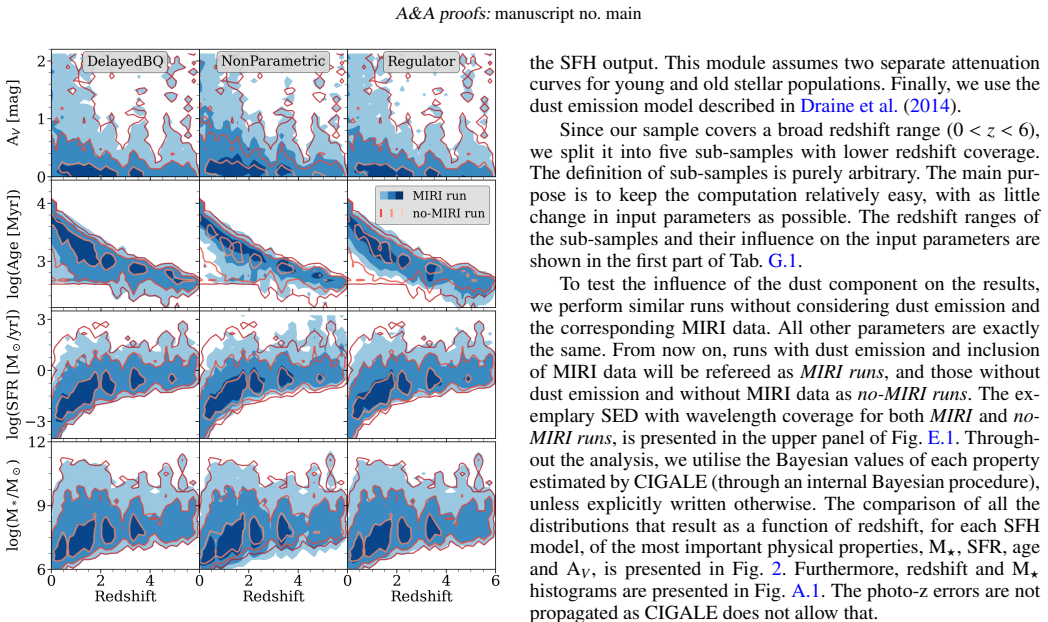
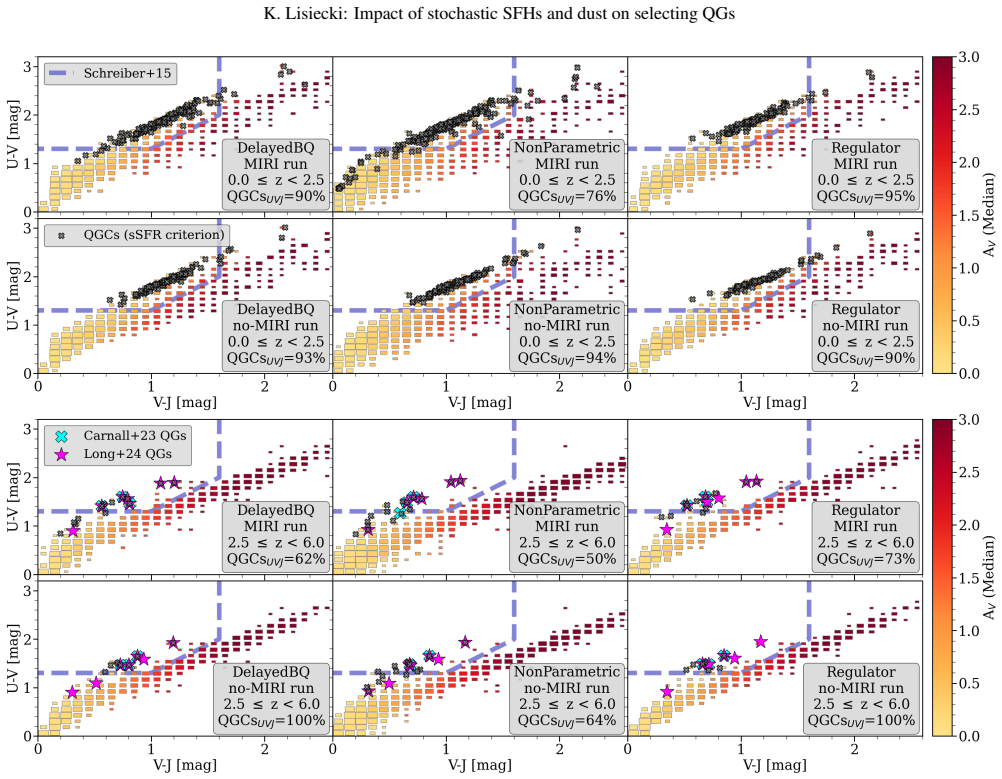
While the James Webb Space Telescope (JWST) now allows identifying quiescent galaxies (QGs) out to early epochs, the photometric selection of quiescent galaxy candidates (QGCs) and the derivation of key physical quantities are highly sensitive to the assumed star-formation histories (SFHs). We aim to quantify how the inclusion of JWST/MIRI data and different SFH models impacts the selection and characterisation of QGCs. We test the robustness of the physical properties inferred from the spectral energy distribution (SED) fitting, such as M*, age, star formation rate (SFR), and AV, and study how they impact the quiescence criteria of the galaxies across cosmic time. We perform SED fitting for ~13000 galaxies at z<6 from the CEERS/MIRI fields with up to 20 optical-mid infrared (MIR) broadband coverage. We implement three SFH prescriptions: flexible delayed, NonParametric, and extended Regulator. For each model, we compare results obtained with and without MIRI photometry and dust emission models. We evaluate the impact of these configurations on the number of candidate QGCs, selected based on rest UVJ colours, sSFR and main-sequence offset, and on their key physical properties such as M*, AV, and stellar ages. The number of QGCs selected varies significantly with the choice of SFH from 171 to 224 out of 13000 galaxies, depending on the model. This number increases to 222-327 when MIRI data are used (up to ~45% more QGCs). This enhancement is driven by improved constraints on dust attenuation and M*. We find a strong correlation between AV and M*, with massive galaxies (M*~10^11 M\odot) being 1.5-4.2 times more attenuated in magnitude than low-mass systems (M*~10^9 M\odot), depending on SFH. Regardless of the SFH assumption, ~13% of QGCs exhibit significant attenuation (AV > 0.5) in support of recent JWST studies challenging the notion that quiescent galaxies are uniformly dust-free.
Editorial analysis
A structured set of objections, weighed in public.
Referee Report
Summary. The paper performs SED fitting on ~13,000 galaxies at z<6 from CEERS/MIRI fields using up to 20-band photometry to quantify the effects of three SFH prescriptions (flexible delayed, NonParametric, extended Regulator) and the inclusion/exclusion of MIRI data plus dust emission models on the selection of quiescent galaxy candidates (QGCs) via UVJ colors, sSFR, and main-sequence offset. It reports that QGC counts range from 171–224 depending on SFH, rise to 222–327 (up to ~45% increase) with MIRI data, show a strong A_V–M* correlation, and that ~13% of QGCs have A_V > 0.5 irrespective of the SFH model adopted.
Significance. If the central numerical results hold, the work provides a useful systematic quantification of modeling sensitivity in JWST-based QG selection at z<6 and supplies concrete evidence that a non-negligible fraction of photometrically selected quiescent systems are dust-attenuated, consistent with other recent JWST studies. The explicit comparison of three SFH families with and without MIRI data is a clear methodological strength.
major comments (2)
- [Abstract and §4] Abstract and §4 (results on A_V statistics): the claim that '~13% of QGCs exhibit significant attenuation (A_V > 0.5) regardless of the SFH assumption' is load-bearing for the paper's interpretation yet rests only on the three tested prescriptions. If these models share limitations in reproducing highly stochastic or burst-dominated SFHs (increasingly indicated by JWST spectroscopy at z~2–6), the derived A_V distribution and the 13% fraction could shift systematically; an explicit test against at least one additional bursty or non-parametric SFH with higher time-resolution would directly address this.
- [§3] §3 (methods, data selection): the robustness of the reported 45% increase in QGC counts when MIRI is added depends on the precise definition of the quiescence criteria (UVJ, sSFR, MS offset) and on how photometric uncertainties and upper limits are propagated; without tabulated error budgets or jackknife tests on the selection thresholds it is difficult to judge whether the count variation is dominated by improved dust constraints or by changes in the underlying galaxy sample.
minor comments (2)
- A summary table listing the exact number of QGCs, median A_V, and median stellar age for each of the six configurations (3 SFH × with/without MIRI) would improve readability and allow direct comparison of the reported ranges.
- The paper should clarify whether the dust emission models are held fixed across all SFH runs or allowed to vary, as this choice directly affects the A_V–M* correlation strength quoted in the abstract.
Simulated Author's Rebuttal
We thank the referee for their constructive and detailed review. We address each major comment below and describe the revisions we will make to improve the manuscript.
read point-by-point responses
-
Referee: [Abstract and §4] Abstract and §4 (results on A_V statistics): the claim that '~13% of QGCs exhibit significant attenuation (A_V > 0.5) regardless of the SFH assumption' is load-bearing for the paper's interpretation yet rests only on the three tested prescriptions. If these models share limitations in reproducing highly stochastic or burst-dominated SFHs (increasingly indicated by JWST spectroscopy at z~2–6), the derived A_V distribution and the 13% fraction could shift systematically; an explicit test against at least one additional bursty or non-parametric SFH with higher time-resolution would directly address this.
Authors: We selected the three SFH prescriptions to span a range of modeling approaches, with the NonParametric model already permitting multiple discrete star-formation episodes and the extended Regulator model incorporating stochastic variations in the star-formation rate. The fact that the ~13% fraction with A_V > 0.5 remains consistent across these models is the central result we report. We nevertheless agree that more bursty histories with finer time resolution could in principle alter the A_V distribution. In the revised manuscript we will expand the discussion in §4 (and the corresponding abstract sentence) to explicitly acknowledge this potential systematic uncertainty, reference recent JWST spectroscopic indications of burstiness at z~2–6, and note that the present photometric analysis cannot fully exclude such effects. revision: yes
-
Referee: [§3] §3 (methods, data selection): the robustness of the reported 45% increase in QGC counts when MIRI is added depends on the precise definition of the quiescence criteria (UVJ, sSFR, MS offset) and on how photometric uncertainties and upper limits are propagated; without tabulated error budgets or jackknife tests on the selection thresholds it is difficult to judge whether the count variation is dominated by improved dust constraints or by changes in the underlying galaxy sample.
Authors: We agree that additional documentation of uncertainty propagation and threshold sensitivity would strengthen the methods section. In the revised version we will add a table in §3 that tabulates the adopted photometric uncertainties, describes the treatment of upper limits in the SED fits, and reports the resulting error budgets on sSFR and UVJ colors. We will also include a brief jackknife test that varies the quiescence thresholds within their uncertainties and shows that the ~45% increase in QGC counts persists and is driven primarily by the tighter constraints on dust attenuation and stellar mass provided by the MIRI bands. revision: yes
- Performing a complete re-analysis of the full ~13,000-galaxy sample with an additional high-time-resolution bursty SFH model, which would require substantial new computational resources.
Circularity Check
No significant circularity; results are direct outputs from SED fits to independent photometry
full rationale
The paper performs SED fitting on ~13000 galaxies using three SFH prescriptions (flexible delayed, NonParametric, extended Regulator) and reports empirical counts of QGCs (171-224 without MIRI, 222-327 with MIRI) plus the ~13% fraction with AV>0.5. These quantities are computed directly from the posterior distributions of the fits to external JWST photometry; no equation reduces the reported numbers or AV values to a quantity defined by the selection criteria themselves, and no load-bearing self-citation or uniqueness theorem is invoked to force the outcomes. The analysis is therefore self-contained against the photometric data.
Axiom & Free-Parameter Ledger
free parameters (1)
- SFH model parameters
axioms (1)
- domain assumption The chosen SFH prescriptions and dust emission models are adequate representations of real high-redshift galaxy properties.
Lean theorems connected to this paper
-
IndisputableMonolith/Cost/FunctionalEquation.leanwashburn_uniqueness_aczel unclear?
unclearRelation between the paper passage and the cited Recognition theorem.
We implement three SFH prescriptions: flexible delayed, NonParametric, and extended Regulator... The number of QGCs selected varies significantly with the choice of SFH from 171 to 224 out of 13000 galaxies... Regardless of the SFH assumption, ~13% of QGCs exhibit significant attenuation (AV > 0.5)
-
IndisputableMonolith/Foundation/RealityFromDistinction.leanreality_from_one_distinction unclear?
unclearRelation between the paper passage and the cited Recognition theorem.
We perform SED fitting for ~13000 galaxies at z<6 from the CEERS/MIRI fields with up to 20 optical-mid infrared broadband coverage
What do these tags mean?
- matches
- The paper's claim is directly supported by a theorem in the formal canon.
- supports
- The theorem supports part of the paper's argument, but the paper may add assumptions or extra steps.
- extends
- The paper goes beyond the formal theorem; the theorem is a base layer rather than the whole result.
- uses
- The paper appears to rely on the theorem as machinery.
- contradicts
- The paper's claim conflicts with a theorem or certificate in the canon.
- unclear
- Pith found a possible connection, but the passage is too broad, indirect, or ambiguous to say the theorem truly supports the claim.
Forward citations
Cited by 2 Pith papers
-
Massive Galaxies Form Early and Gray: Stellar Assembly and Dust Attenuation at $\mathbf{z>3.5}$ from CAPERS
Massive galaxies at z>3.5 assembled stars earlier than theoretical models predict and exhibit gray dust attenuation, especially at the highest masses.
-
From DES to KiDS: Domain adaptation for cross-survey detection of low-surface-brightness galaxies
Domain adaptation with an ensemble of CNN and transformer models trained on DES detects 20,180 LSBGs and 434 UDGs in KiDS DR5, with structural parameters and environmental trends consistent with known samples.
Reference graph
Works this paper leans on
-
[1]
, " * write output.state after.block = add.period write newline
ENTRY address archiveprefix author booktitle chapter edition editor howpublished institution eprint journal key month note number organization pages publisher school series title type volume year label extra.label sort.label short.list INTEGERS output.state before.all mid.sentence after.sentence after.block FUNCTION init.state.consts #0 'before.all := #1 ...
-
[2]
" write newline "" before.all 'output.state := FUNCTION n.dashify 't := "" t empty not t #1 #1 substring "-" = t #1 #2 substring "--" = not "--" * t #2 global.max substring 't := t #1 #1 substring "-" = "-" * t #2 global.max substring 't := while if t #1 #1 substring * t #2 global.max substring 't := if while FUNCTION word.in bbl.in " " * FUNCTION format....
-
[3]
Akhshik , M., Whitaker , K. E., Leja , J., et al. 2023, , 943, 179
work page 2023
-
[4]
B., Narayanan , D., Whitaker , K
Akins , H. B., Narayanan , D., Whitaker , K. E., et al. 2022, , 929, 94
work page 2022
- [5]
-
[6]
Appleby , S., Dav \'e , R., Kraljic , K., Angl \'e s-Alc \'a zar , D., & Narayanan , D. 2020, , 494, 6053
work page 2020
-
[7]
Arnouts , S., Le Floc'h , E., Chevallard , J., et al. 2013, , 558, A67
work page 2013
-
[8]
Arnouts , S., Walcher , C. J., Le F \`e vre , O., et al. 2007, , 476, 137
work page 2007
- [9]
-
[10]
Balogh , M. L., Morris , S. L., Yee , H. K. C., Carlberg , R. G., & Ellingson , E. 1999, , 527, 54
work page 1999
-
[11]
A., Rieke , M., Eisenstein , D., et al
Beichman , C. A., Rieke , M., Eisenstein , D., et al. 2012, in Society of Photo-Optical Instrumentation Engineers (SPIE) Conference Series, Vol. 8442, Space Telescopes and Instrumentation 2012: Optical, Infrared, and Millimeter Wave, ed. M. C. Clampin , G. G. Fazio , H. A. MacEwen , & J. M. Oschmann , Jr., 84422N
work page 2012
- [12]
-
[13]
J-PAS: The Javalambre-Physics of the Accelerated Universe Astrophysical Survey
Benitez , N., Dupke , R., Moles , M., et al. 2014, arXiv e-prints, arXiv:1403.5237
work page internal anchor Pith review Pith/arXiv arXiv 2014
-
[14]
2011, in Astronomical Society of the Pacific Conference Series, Vol
Bertin , E. 2011, in Astronomical Society of the Pacific Conference Series, Vol. 442, Astronomical Data Analysis Software and Systems XX, ed. I. N. Evans , A. Accomazzi , D. J. Mink , & A. H. Rots , 435
work page 2011
- [15]
-
[16]
B \'e thermin , M., Daddi , E., Magdis , G., et al. 2015, , 573, A113
work page 2015
-
[17]
2025, arXiv e-prints, arXiv:2501.07291
Bevacqua , D., Saracco , P., La Barbera , F., et al. 2025, arXiv e-prints, arXiv:2501.07291
- [18]
-
[19]
Boquien , M., Burgarella , D., Roehlly , Y., et al. 2019, , 622, A103
work page 2019
- [20]
-
[21]
2023, astropy/photutils: 1.10.0
Bradley , L., Sip o cz , B., Robitaille , T., et al. 2023, astropy/photutils: 1.10.0
work page 2023
-
[22]
B., S \'a nchez-Janssen , R., Labb \'e , I., et al
Brammer , G. B., S \'a nchez-Janssen , R., Labb \'e , I., et al. 2012, , 758, L17
work page 2012
- [23]
-
[24]
Bruzual A. , G. 1983, , 273, 105
work page 1983
-
[25]
Carnall , A. C., Leja , J., Johnson , B. D., et al. 2019, , 873, 44
work page 2019
-
[26]
Carnall , A. C., McLeod , D. J., McLure , R. J., et al. 2023 a , , 520, 3974
work page 2023
-
[27]
Carnall , A. C., McLure , R. J., Dunlop , J. S., & Dav \'e , R. 2018, , 480, 4379
work page 2018
-
[28]
Carnall , A. C., McLure , R. J., Dunlop , J. S., et al. 2023 b , , 619, 716
work page 2023
- [29]
- [30]
-
[31]
Cheng , C. M., Kriek , M., Beverage , A. G., et al. 2025, , 540, 1527
work page 2025
-
[32]
Chien , T. C. C., Ling , C.-T., Goto , T., et al. 2024, , 532, 719
work page 2024
- [33]
- [34]
-
[35]
Ciesla , L., G \'o mez-Guijarro , C., Buat , V., et al. 2023, , 672, A191
work page 2023
- [36]
-
[37]
Cutler , S. E., Whitaker , K. E., Weaver , J. R., et al. 2024, , 967, L23
work page 2024
- [38]
-
[39]
Dav \'e , R., Angl \'e s-Alc \'a zar , D., Narayanan , D., et al. 2019, , 486, 2827
work page 2019
-
[40]
Dav \'e , R., Thompson , R., & Hopkins , P. F. 2016, , 462, 3265
work page 2016
- [41]
- [42]
-
[43]
Donnari , M., Pillepich , A., Nelson , D., et al. 2019, , 485, 4817
work page 2019
-
[44]
T., Aniano , G., Krause , O., et al
Draine , B. T., Aniano , G., Krause , O., et al. 2014, , 780, 172
work page 2014
- [45]
- [46]
-
[47]
Faber , S. M., Willmer , C. N. A., Wolf , C., et al. 2007, , 665, 265
work page 2007
- [48]
- [49]
-
[50]
Finkelstein , S. L., Bagley , M. B., Arrabal Haro , P., et al. 2022, , 940, L55
work page 2022
-
[51]
Finlator , K., Dav \'e , R., & Oppenheimer , B. D. 2007, , 376, 1861
work page 2007
-
[52]
Franzetti , P., Scodeggio , M., Garilli , B., et al. 2007, , 465, 711
work page 2007
- [53]
- [54]
-
[55]
Glazebrook , K., Schreiber , C., Labb \'e , I., et al. 2017, , 544, 71
work page 2017
-
[56]
2018, Nature Astronomy, 2, 239
Gobat , R., Daddi , E., Magdis , G., et al. 2018, Nature Astronomy, 2, 239
work page 2018
-
[57]
Gould , K. M. L., Brammer , G., Valentino , F., et al. 2023, , 165, 248
work page 2023
-
[58]
P., Iovino , A., Krywult , J., et al
Haines , C. P., Iovino , A., Krywult , J., et al. 2017, , 605, A4
work page 2017
-
[59]
Iglesias-Navarro , P., Huertas-Company , M., Mart \' n-Navarro , I., Knapen , J. H., & Pernet , E. 2024, , 689, A58
work page 2024
-
[60]
Ilbert , O., McCracken , H. J., Le F \`e vre , O., et al. 2013, , 556, A55
work page 2013
- [61]
-
[62]
Iyer , K. G., Gawiser , E., Faber , S. M., et al. 2019, , 879, 116
work page 2019
- [63]
-
[64]
G., Tacchella , S., Genel , S., et al
Iyer , K. G., Tacchella , S., Genel , S., et al. 2020 a , , 498, 430
work page 2020
-
[65]
G., Tacchella , S., Genel , S., et al
Iyer , K. G., Tacchella , S., Genel , S., et al. 2020 b , , 498, 430
work page 2020
-
[66]
D., Leja , J., Conroy , C., & Speagle , J
Johnson , B. D., Leja , J., Conroy , C., & Speagle , J. S. 2021, , 254, 22
work page 2021
-
[67]
Kauffmann , G., Heckman , T. M., White , S. D. M., et al. 2003, , 341, 33
work page 2003
-
[68]
Kennicutt , Jr., R. C. 1992, , 388, 310
work page 1992
-
[69]
Koprowski , M. P., Wijesekera , J. V., Dunlop , J. S., et al. 2024, , 691, A164
work page 2024
-
[70]
G., Franx , M., & Illingworth , G
Kriek , M., van der Wel , A., van Dokkum , P. G., Franx , M., & Illingworth , G. D. 2008, , 682, 896
work page 2008
-
[71]
Krywult , J., Tasca , L. A. M., Pollo , A., et al. 2017, , 598, A120
work page 2017
- [72]
-
[73]
Leja , J., Carnall , A. C., Johnson , B. D., Conroy , C., & Speagle , J. S. 2019 a , , 876, 3
work page 2019
- [74]
- [75]
-
[76]
S., Antwi-Danso , J., Lambrides , E
Long , A. S., Antwi-Danso , J., Lambrides , E. L., et al. 2024, , 970, 68
work page 2024
-
[77]
J., D'Eugenio , F., Maiolino , R., et al
Looser , T. J., D'Eugenio , F., Maiolino , R., et al. 2024, , 629, 53
work page 2024
-
[78]
Lorenzon , G., Donevski , D., Lisiecki , K., et al. 2025, , 693, A118
work page 2025
-
[79]
Lovell , C. C., Roper , W., Vijayan , A. P., et al. 2023, , 525, 5520
work page 2023
- [80]
discussion (0)
Sign in with ORCID, Apple, or X to comment. Anyone can read and Pith papers without signing in.