REVIEW 2 major objections 4 minor 1 cited by
First operation of the FAMU experiment at the RIKEN-RAL high intensity muon beam facility
T0 review · 2 major / 4 minor · reviewed 2026-08-04 · deepseek-v4-flash
Pith's one-line read The FAMU experiment has taken its final setup into operation at a pulsed muon facility, scanning the predicted muonic-hydrogen hyperfine resonance with 29 laser wavelengths and collecting 49 days of data; the first physics result is deferre
desk verdict Honest commissioning report: the integrated FAMU apparatus ran and took 49 days of data, but no physics result yet; the main fragility is the unverified in-situ laser-cavity alignment. read the letter →
The pith
A machine-rendered reading of the paper's core claim, the machinery that carries it, and where it could break.
The reading
What carries the argument
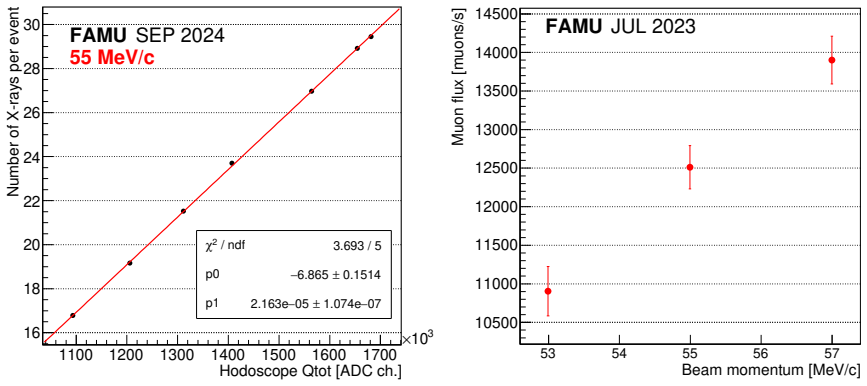
The observable is not the excitation itself but its aftermath: a laser-excited muonic hydrogen atom in the triplet state gains about 0.12 eV of kinetic energy through subsequent collisions, and because the rate of muon transfer from hydrogen to oxygen rises sharply with collision energy, the time distribution of muonic-oxygen X-rays shifts relative to the no-laser case. The multi-pass optical cavity, with mirror reflectivity of about 99.89%, multiplies the transition probability by roughly 1/(1-R), making the weak magnetic-dipole excitation detectable. A beam hodoscope measures the muon flux for normalization, and the laser wavelength and energy are recorded shot-by-shot to build the resonan
What would settle it
Compare the delayed muonic-oxygen X-ray time spectra from laser-on and laser-off spills, batch by batch, across 6788.400–6789.050 nm. If no batch shows a statistically significant perturbation in the transfer-time distribution, the laser is not exciting muonic hydrogen in the target, contradicting the operational claim that the cavity illuminates the gas.
Extended reading notes
Core claim
On its own terms, the paper claims that the fully assembled apparatus—a cryogenic gas target with a multi-pass optical cavity, a tunable mid-infrared laser, and a mosaic of X-ray detectors—performed as designed during its first beam exposure, and that the resulting wavelength scan spans the region where theory places the 1S-hyperfine transition of muonic hydrogen. The measurement itself is not yet claimed: the separation of laser-on and laser-off data is under investigation, and a first value of the hyperfine splitting is promised to follow. What is established here is technical readiness and a dataset large enough (about 8.5 million triggers over four periods) for the planned resonance sear
Load-bearing premise
That the optical path of the infrared laser inside the cold, pressurized gas target is identical to the path through an external reference cavity, so the laser genuinely illuminates the hydrogen-oxygen gas.
Editorial extensions
If this is right
- A resonance will appear as the wavelength at which the delayed muonic-oxygen X-ray time distribution deviates most from the no-laser distribution.
- Once located, the resonance wavelength gives the 1S hyperfine splitting, from which the proton's Zemach radius can be extracted using the Fermi-energy relation and known QED corrections.
- The reported gain stability and wavelength stabilization (a few percent and about 0.1 nm over hours) make the 2023-2024 dataset usable for the blinded analysis now being prepared.
- The 2024 detector upgrade increases X-ray yield per trigger by about 25%, so future beam time can accumulate statistics faster than the 2023 runs.
Reading between the lines
- Because the final physics result is explicitly deferred, the paper's present claim should be read as technical readiness; the decisive test is the upcoming blinded analysis, not the scan coverage itself.
- The twin-cavity alignment assumption—that a reference cavity outside the target reproduces the optical path inside the target at 80 K and 7 bar—is unverified in situ; a direct measurement of infrared power leaving the target cavity during beam time would settle whether the laser actually illuminates the gas.
- The unidentified ~110 keV peak seen in both hydrogen and hydrogen-oxygen delayed spectra could interfere with the oxygen X-ray selection if its origin is not resolved before unblinding.
Editorial analysis
A structured set of objections, weighed in public.
Referee Report
Summary. This paper reports the first operation of the FAMU experiment in its final configuration at Port 1 of the RIKEN-RAL muon beam facility. It describes the detection principle (laser excitation of the muonic-hydrogen ground-state hyperfine transition, followed by muon transfer to oxygen and detection of characteristic X-rays), the full setup (beam monitor, cryogenic gas target with a multipass optical cavity, 6.8 µm laser, LaBr3:Ce detectors, and DAQ), and results from the July 2023 commissioning and four 2023–2024 physics runs. The paper explicitly defers the physics result: the laser/no-laser separation is still under investigation, and no resonance signal is claimed.
Significance. If the operational claims hold, this is an important technical milestone: it demonstrates a working apparatus for a difficult measurement of the muonic-hydrogen 1S hyperfine splitting, a quantity sensitive to the proton Zemach radius. The paper provides valuable characterisation data: target temperature/pressure control, detector gain stability and energy resolution, beam-momentum optimisation, laser wavelength/energy stability, and a 29-wavelength scan covering the predicted resonance region. The honest separation of technical readiness from physics results and the planned blinded analysis are strengths.
major comments (2)
- [Sec. 3.2 and Sec. 4.1] The in-target multipass-cavity alignment is inferred exclusively from the external 'twin' cavity. The text in Sec. 3.2 states the procedure 'guarantees'/'warrants' that the optical path in the target cavity is the same, but no quantitative in-situ verification is reported. Sec. 4.1 says the stepwise refilling is used 'to verify the optical cavity alignment,' but no measurement (e.g., transmitted or reflected laser power from the target cavity, or an alignment-sensitive signal) is shown. Because the physics scan requires the 6.8 µm beam to actually multipass through the cold, 7-bar gas, this is load-bearing for the claim of successful full-apparatus operation. Please either provide such evidence or explicitly state this as a residual limitation.
- [Sec. 5] The conclusion states that the laser 'enable[s] the excitation of a large number of muonic hydrogen atoms' and that the runs confirmed 'flawless operation of the experimental setup.' However, Sec. 4.2 reports that the laser/no-laser separation is 'currently under investigation' and no resonance signal is presented. The data so far demonstrate stable operation of the laser system and detectors, but not end-to-end laser-gas coupling. Please temper the conclusion to match the demonstrated scope.
minor comments (4)
- [Sec. 3.2 (Fig. 8 caption)] The caption states the red and 6.8 µm beams are 'well overlapped,' but no quantitative overlap measurement is described; please specify the procedure or tolerance.
- [Sec. 4.2 (Fig. 19)] The theory labels ('Ruth '24', 'Hagelstein '23', etc.) are not matched to references in the bibliography; please add citations.
- [Table 1] Caption: 'Average detectors performances' should read 'Average detector performances.'
- [Sec. 3.2] 'with warranty that' should be 'with the guarantee that' or 'ensuring that'; also 'merging' should be 'emerging' in the alignment description.
Circularity Check
No significant circularity: the paper reports new operational data; its physics claim is explicitly deferred, and its self-citations to prior FAMU measurements are independent support rather than constructional inputs.
full rationale
The paper's central claim is that the final FAMU apparatus was installed at RIKEN-RAL Port 1 and operated for 49 days, with all subdetectors characterized, the laser scanned over 29 wavelengths (6788.400-6789.050 nm), and data collected (Sec. 4.1, 4.2, Tab. 2). This is new empirical material, not derived from the cited inputs. The 1S-hfs result is explicitly deferred: Sec. 4.2 states laser/no-laser separation is 'currently under investigation' and a first result 'will then follow', so no measured resonance is being claimed. The detection principle uses the energy-dependent muon-transfer rate λpO(E) from Ref. [16] (Stoilov et al., Phys. Rev. A 107, 032823), an externally published measurement by collaboration members; this is real independent evidence, not a self-citation chain. Similarly, the 1.5% O2, 7 bar, 80 K target choice cites Ref. [12] (Pizzolotto et al., EPJ A 56, 185), again prior FAMU work that is externally validated. Beam-monitor calibration uses Eq. 6 with experimentally determined Qµ and a simulated geometric correction; the linearity plot (Fig. 6) checks it against an independent X-ray count, not against the quantity being predicted. The only genuinely weak point is the external 'twin' cavity alignment (Sec. 3.2): in-target 6.8 µm multipassing is inferred from a 632 nm alignment of a reference cavity, and no in-situ quantitative verification is reported. That is a correctness/verification limitation, not a circular reduction: the claim that wavelengths were scanned and data collected does not require the resonance to be present, and the paper does not use the twin-cavity assumption to define its observable. Therefore no step reduces to its own inputs by definition.
Assumptions & free parameters
free parameters (3)
- flux calibration constant k =
not stated numerically; derived from measured Q_mu and simulated W_j
- beam momentum working point =
55 MeV/c
- target composition and pressure =
1.5% O2 in H2 at 7 bar
assumptions (4)
- domain assumption Energy dependence of the muon transfer rate lambda_pO(E)
- domain assumption Theoretical predictions of the 1S-hfs wavelength define the scan range
- domain assumption Twin-cavity alignment replicates the in-situ target cavity
- standard math Simulated fiber hit fractions W_j in flux calibration
Cite this review
Pith. "Pith review of First operation of the FAMU experiment at the RIKEN-RAL high intensity muon beam facility." pith.science (2026). https://pith.science/paper/B5C7C52P
@misc{pith2026250910350,
  author       = {Pith},
  title        = {Pith review of: First operation of the FAMU experiment at the RIKEN-RAL high intensity muon beam facility},
  year         = {2026},
  howpublished = {\url{https://pith.science/paper/B5C7C52P}},
  note         = {Machine review of arXiv:2509.10350}
}
abstract
The FAMU experiment, supported and funded by the Italian Institute of Nuclear Physics (INFN) and by the Science and Technology Facilities Council (STFC), aims to perform the first measurement of the ground-state hyperfine splitting (1S-hfs) of muonic hydrogen ($\mu H$). This quantity is highly sensitive to the proton's Zemach radius $R_Z$. An experimental determination of $R_Z$ provides significant constraints on the parametrization of the proton form factors as well as on theoretical models describing the proton's electromagnetic structure. Following years of technological and methodological development, the FAMU experiment began operations in 2023 at Port 1 of the RIKEN-RAL muon beam line at the ISIS Neutron and Muon Source facility (Didcot, UK). In this paper, we first describe the unique detection technique employed by FAMU to determine the 1S-hfs of muonic hydrogen, followed by a detailed presentation of the final experimental layout. Finally, we report the first outcome from the 2023 commissioning run and from the initial physics runs performed in 2023 and 2024.
Figures


Figures from the paper (19 more)




Forward citations
Cited by 1 Pith paper
-
Hadronic vacuum polarization in hydrogen-like atoms and ions amid the interplay of recoil and finite-size effects
The hVP contribution to the HFS in muonic hydrogen is 2.153(11) µeV, deviating from previous evaluations by ~10x the anticipated experimental precision, due to corrected recoil and finite-size interplay.
Reference graph
Works this paper leans on
-
[1]
Antognini et al., Proton Structure from the Measurement of 2S-2P Transition Frequencies of Muonic Hydrogen , Science 339, 417–420 (2013)
A. Antognini et al., Proton Structure from the Measurement of 2S-2P Transition Frequencies of Muonic Hydrogen , Science 339, 417–420 (2013)
2013
-
[2]
Pohl et al., Muonic Hydrogen and the Proton Radius Puzzle , Annu
R. Pohl et al., Muonic Hydrogen and the Proton Radius Puzzle , Annu. Rev. Nucl. Part. Sci. 63, 175–204 (2013)
2013
-
[3]
Bakalov et al., Experimental method to measure the hyperfine splitting of muomic hydrogen ( µ-p)1S, Phys
D. Bakalov et al., Experimental method to measure the hyperfine splitting of muomic hydrogen ( µ-p)1S, Phys. Lett. A172, 277–280 (1993)
1993
-
[4]
Dupays et al., Proton Zemach radius from measurements of the hyperfine splitting of hydrogen and muonic hydrogen, Phys
A. Dupays et al., Proton Zemach radius from measurements of the hyperfine splitting of hydrogen and muonic hydrogen, Phys. Rev. A68, 052503 (2003)
2003
-
[5]
Antognini et al., The proton structure in and out of muonic hydrogen , Annual Review of Nuclear and Particle Science 72 (2022)
A. Antognini et al., The proton structure in and out of muonic hydrogen , Annual Review of Nuclear and Particle Science 72 (2022)
2022
-
[6]
A. C. Zemach, Proton Structure and the Hyperfine Shift in Hydrogen , Phys. Rev. 104 1771 (1956)
1956
-
[7]
Pascalutsa et al., Theoretical discrepancies in the nucleon spin structure and the hyperfine splitting of muonic hydrogen, Proceedings of Science CD2021 102 (2024)
V. Pascalutsa et al., Theoretical discrepancies in the nucleon spin structure and the hyperfine splitting of muonic hydrogen, Proceedings of Science CD2021 102 (2024)
2024
-
[8]
Carlson et al., Proton-structure corrections to hyperfine splitting in muonic hydrogen , Phys
C.E. Carlson et al., Proton-structure corrections to hyperfine splitting in muonic hydrogen , Phys. Rev. A83, 042509 (2011)
2011
Show all 47 references
-
[9]
S. G. Karshenboim, Precision physics of simple atoms: QED tests, nuclear structure and fundamental constants , Phys. Rep. 422, 1 (2005)
2005
-
[10]
Adamczak et al., On the Use of a H 2-O2 Gas Target in Muonic Hydrogen Atom Hyperfine Splitting Experiments, Hyperfine Interactions 136, 1 (2001)
A. Adamczak et al., On the Use of a H 2-O2 Gas Target in Muonic Hydrogen Atom Hyperfine Splitting Experiments, Hyperfine Interactions 136, 1 (2001)
2001
-
[11]
Adamczak et al., Hyperfine spectroscopy of muonic hydrogen and the PSI Lamb shift experiment , Nucl
A. Adamczak et al., Hyperfine spectroscopy of muonic hydrogen and the PSI Lamb shift experiment , Nucl. Instr. Meth. B281, 72–76 (2012)
2012
-
[12]
Pizzolotto et al
C. Pizzolotto et al. (F AMU Collaboration), The F AMU experiment: muonic hydrogen high precision spectroscopy studies, Eur. Phys. J. A56, 185 (2020)
2020
-
[13]
Kanda et al., Measurement of the proton Zemach radius from the hyperfine splitting in muonic hydrogen atom , J
S. Kanda et al., Measurement of the proton Zemach radius from the hyperfine splitting in muonic hydrogen atom , J. Phys. Conf. Ser. 1138, 012009 (2018)
2018
-
[14]
Amaro et al., Laser excitation of the 1s-hyperfine transition in muonic hydrogen , SciPost Phys
P. Amaro et al., Laser excitation of the 1s-hyperfine transition in muonic hydrogen , SciPost Phys. 13, 020 (2022). 20
2022
-
[15]
Adamczak et al., The F AMU experiment at RIKEN-RAL to study the muon transfer rate from hydrogen to other gases , JINST 13, P12033 (2018)
A. Adamczak et al., The F AMU experiment at RIKEN-RAL to study the muon transfer rate from hydrogen to other gases , JINST 13, P12033 (2018)
2018
-
[16]
M. Stoilov et al., Experimental determination of the energy dependence of the rate of the muon transfer reaction from muonic hydrogen to oxygen for collision energies up to 0.1 eV , Phys. Rev. A107, 032823 (2023)
2023
-
[17]
Antognini, International Conference on Laser Spectroscopy, ICOLS 2015, Singapore
A. Antognini, International Conference on Laser Spectroscopy, ICOLS 2015, Singapore. (2015). arXiv:1512.01765
2015 arXiv
-
[18]
Sato et al., Proceedings of the 20th Particles and Nuclei International Conference, Hamburg, 2014
M. Sato et al., Proceedings of the 20th Particles and Nuclei International Conference, Hamburg, 2014. https://doi.org/10.3204/DESY-PROC-2014-04/67
2014 doi
-
[19]
Adamczak et al
A. Adamczak et al. (F AMU Collaboration), Steps towards the hyperfine splitting measurement of the muonic hydrogen ground state: pulsed muon beam and detection system characterization JINST 11, P05007 (2016)
2016
-
[20]
Vacchi et al
A. Vacchi et al. (F AMU Collaboration), RIKEN Accel Prog Rep 49 (2016)
2016
-
[21]
Vacchi et al
A. Vacchi et al. (F AMU Collaboration), RIKEN Accel. Prog. Rep. 50 (2017)
2017
-
[22]
Mocchiutti et al
E. Mocchiutti et al. (F AMU Collaboration), F AMU: study of the energy dependent transfer rate Λµp→µO, J. Phys. Conf. Ser. 1138 012017 (2018)
2018
-
[23]
Mocchiutti et al
E. Mocchiutti et al. (F AMU Collaboration), First measurement of the temperature dependence of muon transfer rate from muonic hydrogen atoms to oxygen Phys. Lett. A384, 126667 (2020)
2020
-
[24]
Pizzolotto et al
C. Pizzolotto et al. (F AMU Collaboration), Measurement of the muon transfer rate from muonic hydrogen to oxygen in the range 70-336 K , Phys. Lett. A403, 127401 (2021)
2021
-
[25]
A. D. Hillier et al., Muons at ISIS , Philosophical Transactions of the Royal Society A377.2137, 20180064 (2019)
2019
-
[26]
J. W. G. Thomason, The ISIS Spallation Neutron and Muon Source - The first thirty-three years , Nucl. Instr. Meth A917, 61 (2019)
2019
-
[27]
Carbone et al., The fiber-SiPMT beam monitor of the R484 experiment at the RIKEN-RAL muon facility , JINST 12, C03007 (2015)
R. Carbone et al., The fiber-SiPMT beam monitor of the R484 experiment at the RIKEN-RAL muon facility , JINST 12, C03007 (2015)
2015
-
[28]
Bonesini et al., The construction of the Fiber-SiPM beam monitor system of the R484 and R582 experiments at the RIKEN-RAL muon facility , JINST 12, C03035 (2017)
M. Bonesini et al., The construction of the Fiber-SiPM beam monitor system of the R484 and R582 experiments at the RIKEN-RAL muon facility , JINST 12, C03035 (2017)
2017
-
[29]
Bonesini et al., The upgraded beam monitor system of the F AMU experiment at RIKEN–RAL , Nucl
M. Bonesini et al., The upgraded beam monitor system of the F AMU experiment at RIKEN–RAL , Nucl. Instr. Meth. A936, 592 (2019)
2019
-
[30]
Rossini et al
R. Rossini et al. (F AMU Collaboration), The muon beam monitor for the F AMU experiment: design, simulation, test, and operation , Front. Detect. Sci. Technol. 2, 1438902 (2024)
2024
-
[31]
Baruzzo et al., A mid-IR laser source for muonic hydrogen spectroscopy: The F AMU laser system , Optics and Laser Technology, 179, 111375 (2024)
M. Baruzzo et al., A mid-IR laser source for muonic hydrogen spectroscopy: The F AMU laser system , Optics and Laser Technology, 179, 111375 (2024)
2024
-
[32]
Stoychev et al., DFG-based mid-IR laser system for muounic-hydrogen spectroscopy , Laser Sources and Applications II, Proceeding volume 9135, 91350J (2014)
L.I. Stoychev et al., DFG-based mid-IR laser system for muounic-hydrogen spectroscopy , Laser Sources and Applications II, Proceeding volume 9135, 91350J (2014)
2014
-
[33]
Stoychev et al., Increasing the output energy of MID-IR laser system for muounic-hydrogen spectroscopy , 2015 Fotonica AEIT Ital
L.I. Stoychev et al., Increasing the output energy of MID-IR laser system for muounic-hydrogen spectroscopy , 2015 Fotonica AEIT Ital. Conf. Photonics Technol. Turin Italy May 6-8, 2015
2015
-
[34]
Stoychev et al., Pulse amplification in a Cr4+:forsterite single longitudinal mode (SLM) multi-pass amplifier , Laser Phys
L.I. Stoychev et al., Pulse amplification in a Cr4+:forsterite single longitudinal mode (SLM) multi-pass amplifier , Laser Phys. 29, 065801 (2019)
2019
-
[35]
Stoychev et al., DFG-based mid-IR tunable source with 0.5 mJ energy and a 30 pm linewidth , Optics Letters 45, 5526 (2020)
L.I. Stoychev et al., DFG-based mid-IR tunable source with 0.5 mJ energy and a 30 pm linewidth , Optics Letters 45, 5526 (2020)
2020
-
[36]
Baldazzi et al., The LaBr 3(Ce) based detection system for the F AMU experiment , JINST 12, C03067 (2017)
G. Baldazzi et al., The LaBr 3(Ce) based detection system for the F AMU experiment , JINST 12, C03067 (2017)
2017
-
[37]
Bonesini et al., Large area LaBr3:Ce crystals read by SiPM arrays with improved timing and temperature gain drift control, Nucl
M. Bonesini et al., Large area LaBr3:Ce crystals read by SiPM arrays with improved timing and temperature gain drift control, Nucl. Instr. Meth. A1046, 167677 (2022)
2022
-
[38]
Bonesini et al., One inch LaBr3:Ce detectors, with temperature control and improved time resolution for low energy X-rays spectroscopy, PoS (EPS-HEP2023), 547 (2023)
M. Bonesini et al., One inch LaBr3:Ce detectors, with temperature control and improved time resolution for low energy X-rays spectroscopy, PoS (EPS-HEP2023), 547 (2023)
2023
-
[39]
Bonesini et al., Ce:LaBr3 crystals with SiPM array readout and temperature control for the F AMU experiment at RAL , JINST 15 C05065 (2020)
M. Bonesini et al., Ce:LaBr3 crystals with SiPM array readout and temperature control for the F AMU experiment at RAL , JINST 15 C05065 (2020)
2020
-
[40]
Bonesini et al., Detection of low-energy X-rays with 1/2 and 1 inch LaBr3:Ce crystals read by SIPM arrays , PoS (EPS-HEP2021), 770 (2021)
M. Bonesini et al., Detection of low-energy X-rays with 1/2 and 1 inch LaBr3:Ce crystals read by SIPM arrays , PoS (EPS-HEP2021), 770 (2021)
2021
-
[41]
R. Rossini et al., Status of the detector setup for the F AMU experiment at RIKEN-RAL for a precision mea- surement of the Zemach radius of the proton in muonic hydrogen , JINST 19 C02034 (2024). 21
2024
-
[42]
Rossini et al
R. Rossini et al. (F AMU Collaboration), The 2024 LaBr(Ce) detector setup for the F AMU experiment , Nucl. Instr. Meth. A1069 169953 (2024)
2024
-
[43]
Bonesini et al., Improving the time resolution of large area LaBr3:Ce detectors with SiPM array readout , Condens
M. Bonesini et al., Improving the time resolution of large area LaBr3:Ce detectors with SiPM array readout , Condens. Matter 8, 99 (2023)
2023
-
[44]
Otte et al., Characterization of three high efficiency and blue sensitive silicon photomultipliers , Nucl
N. Otte et al., Characterization of three high efficiency and blue sensitive silicon photomultipliers , Nucl. Instr. Meth. A846, 106 (2017)
2017
-
[45]
Bonesini et al., Online control of the gain drift with temperature of SiPM arrays used for the readout of LaBr3:Ce crystals , JINST 17, C10004 (2022)
M. Bonesini et al., Online control of the gain drift with temperature of SiPM arrays used for the readout of LaBr3:Ce crystals , JINST 17, C10004 (2022)
2022
-
[46]
Bonesini, The fast X-ray detector system of the F AMU experiment at RAL , Nucl
M. Bonesini, The fast X-ray detector system of the F AMU experiment at RAL , Nucl. Instr. Meth. A1080, 170780 (2025)
2025
-
[47]
Soldani et al., High performance DAQ for muon spectroscopy experiments , Nucl
M. Soldani et al., High performance DAQ for muon spectroscopy experiments , Nucl. Instr. Meth. A936, 327 (2019). 22
2019
Reviewed August 4, 2026 · model on record in the stance chip above.
Discussion (0). Continue with ORCID to comment.