NuGraph2 with Context-Aware Inputs: Physics-Inspired Improvements in Semantic Segmentation
Pith reviewed 2026-05-18 16:57 UTC · model grok-4.3
The pith
Enriching graph neural network inputs with physics context improves Michel electron identification in neutrino detectors.
A machine-rendered reading of the paper's core claim, the machinery that carries it, and where it could break.
Core claim
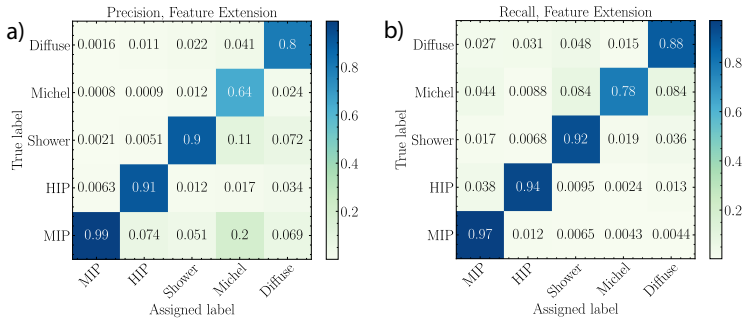
By augmenting the node features in NuGraph2 with context-aware inputs derived from detector geometry and track continuity, the model achieves significant improvements in semantic segmentation, particularly increasing precision and recall for Michel electrons by disentangling overlapping regions in the latent space. In comparison, introducing auxiliary decoders for class correlations and energy-based regularization terms motivated by Michel electron distributions provide only limited benefits, which is attributed to the hit-level nature of the architecture lacking explicit particle or event representations. The results suggest that embedding physics context at the input level is moreeffective
What carries the argument
Context-aware feature augmentation of node inputs using detector geometry and track continuity, which enriches hit representations to improve separation in the network's latent space.
If this is right
- Direct physics-informed input features can enhance detection of underrepresented particle classes like Michel electrons without architectural overhauls.
- The hit-level design of NuGraph2 limits the effectiveness of auxiliary task decoders and regularization.
- Future versions with hierarchical particle- and event-level reasoning, such as NuGraph3, would be better suited for advanced decoders and physics regularization.
- Overall semantic segmentation accuracy in LArTPC event reconstruction can be improved by prioritizing input enrichment.
Where Pith is reading between the lines
- Similar feature augmentation strategies could apply to other graph-based reconstruction tasks in high-energy physics where class imbalance is an issue.
- Testing whether the gains persist when controlling for input dimension increase would clarify if the physics content is key.
- Integration with larger datasets or different detectors might reveal if these improvements generalize beyond MicroBooNE.
Load-bearing premise
The performance gains result from the specific physics information in the added features rather than merely from increased input size or variations in training.
What would settle it
An experiment that adds non-physics random features of equivalent dimensionality to the inputs and measures whether the Michel electron precision and recall gains are absent or reduced compared to the physics-derived features.
Figures




read the original abstract
Graph neural networks have recently shown strong promise for event reconstruction tasks in Liquid Argon Time Projection Chambers, yet their performance remains limited for underrepresented classes of particles, such as Michel electrons. In this work, we investigate physics-informed strategies to improve semantic segmentation within the NuGraph2 architecture. We explore three complementary approaches: (i) enriching the input representation with context-aware features derived from detector geometry and track continuity, (ii) introducing auxiliary decoders to capture class-level correlations, and (iii) incorporating energy-based regularization terms motivated by Michel electron energy distributions. Experiments on MicroBooNE public datasets show that physics-inspired feature augmentation yields the largest gains, particularly boosting Michel electron precision and recall by disentangling overlapping latent space regions. In contrast, auxiliary decoders and energy-regularization terms provided limited improvements, partly due to the hit-level nature of NuGraph2, which lacks explicit particle- or event-level representations. Our findings highlight that embedding physics context directly into node-level inputs is more effective than imposing task-specific auxiliary losses, and suggest that future hierarchical architectures such as NuGraph3, with explicit particle- and event-level reasoning, will provide a more natural setting for advanced decoders and physics-based regularization. The code for this work is publicly available on Github at https://github.com/vitorgrizzi/nugraph_phys/tree/main_phys.
Editorial analysis
A structured set of objections, weighed in public.
Referee Report
Summary. The paper extends the NuGraph2 graph neural network for semantic segmentation of neutrino interactions in LArTPCs. It evaluates three physics-inspired modifications: (i) context-aware node features derived from detector geometry and track continuity, (ii) auxiliary decoders for class correlations, and (iii) energy-based regularization motivated by Michel electron spectra. On MicroBooNE public data, the context-aware feature augmentation produces the largest reported gains, especially in Michel electron precision and recall, which the authors attribute to better separation of overlapping latent-space regions. The work concludes that direct embedding of physics context at the node level is more effective than auxiliary losses for this architecture and points toward hierarchical models such as NuGraph3.
Significance. If the performance gains can be robustly attributed to the physical content of the added features rather than to increased input dimensionality or unstated training differences, the result would provide concrete guidance on input representation design for GNN-based reconstruction in neutrino experiments. The public release of the code is a clear strength that supports reproducibility.
major comments (2)
- The central claim that physics-inspired feature augmentation is responsible for the largest gains (particularly Michel electron precision/recall) rests on comparisons among the three proposed methods but lacks a control that adds an equal number of non-physics features (random noise, generic embeddings, or shuffled coordinates) while freezing all other experimental factors. Without this isolation, it remains unclear whether the observed lift arises from the physical motivation or simply from higher input dimensionality. This directly affects the attribution in the abstract and the discussion of why feature augmentation outperforms the other two approaches.
- No error bars, multiple random seeds, or statistical significance tests are reported for the precision, recall, or F1 improvements. Given that the soundness assessment already flags the absence of baselines and ablation details, the lack of uncertainty quantification makes it difficult to judge whether the reported directional gains are robust or sensitive to hyperparameter choices.
minor comments (2)
- The manuscript would benefit from an explicit statement of the total number of input features before and after augmentation, together with the precise definition of each context-aware feature (e.g., how track continuity is quantified at the hit level).
- Figure captions and the text should clarify whether the latent-space visualizations are from a single training run or aggregated; if single-run, the risk of cherry-picking should be addressed.
Simulated Author's Rebuttal
We thank the referee for the constructive and detailed feedback on our manuscript. We address each major comment below and will revise the manuscript accordingly to improve the robustness and clarity of our results.
read point-by-point responses
-
Referee: The central claim that physics-inspired feature augmentation is responsible for the largest gains (particularly Michel electron precision/recall) rests on comparisons among the three proposed methods but lacks a control that adds an equal number of non-physics features (random noise, generic embeddings, or shuffled coordinates) while freezing all other experimental factors. Without this isolation, it remains unclear whether the observed lift arises from the physical motivation or simply from higher input dimensionality. This directly affects the attribution in the abstract and the discussion of why feature augmentation outperforms the other two approaches.
Authors: We agree that an explicit control with non-physics features of matched dimensionality is necessary to isolate the contribution of the physical content. Our context-aware features are constructed from detector geometry and track continuity to target specific latent-space overlaps for Michel electrons, but without the proposed control the attribution remains incomplete. In the revised manuscript we will add an ablation that augments the input node features with an equal number of random Gaussian noise dimensions while keeping all other training factors fixed, and we will report the resulting precision, recall, and F1 scores for direct comparison. revision: yes
-
Referee: No error bars, multiple random seeds, or statistical significance tests are reported for the precision, recall, or F1 improvements. Given that the soundness assessment already flags the absence of baselines and ablation details, the lack of uncertainty quantification makes it difficult to judge whether the reported directional gains are robust or sensitive to hyperparameter choices.
Authors: We concur that uncertainty quantification is required to assess robustness. The present results are from single training runs. In the revised version we will repeat all experiments with at least three independent random seeds, report mean and standard deviation for every metric, add error bars to the relevant tables and figures, and include a brief discussion of statistical significance for the observed improvements. revision: yes
Circularity Check
No circularity: empirical results grounded in public datasets and direct measurements
full rationale
The paper reports experimental comparisons of input feature augmentations, auxiliary decoders, and regularization terms within the NuGraph2 architecture, evaluated on MicroBooNE public datasets using standard segmentation metrics such as precision and recall. No derivation chain, first-principles prediction, or mathematical reduction is presented; all claims rest on measured performance differences after training. The work is self-contained against external benchmarks, with public code, and does not invoke self-citations or fitted parameters renamed as predictions. The central finding that physics-inspired features yield the largest gains is an empirical observation, not a tautology constructed from the inputs.
Axiom & Free-Parameter Ledger
Lean theorems connected to this paper
-
IndisputableMonolith/Cost/FunctionalEquation.leanwashburn_uniqueness_aczel unclear?
unclearRelation between the paper passage and the cited Recognition theorem.
We extended the original four input features of NuGraph2 planar nodes... The additional features are: Node degree. Shortest edge length... Δwire... Δtime.
-
IndisputableMonolith/Foundation/RealityFromDistinction.leanreality_from_one_distinction unclear?
unclearRelation between the paper passage and the cited Recognition theorem.
Experiments on MicroBooNE public datasets show that physics-inspired feature augmentation yields the largest gains
What do these tags mean?
- matches
- The paper's claim is directly supported by a theorem in the formal canon.
- supports
- The theorem supports part of the paper's argument, but the paper may add assumptions or extra steps.
- extends
- The paper goes beyond the formal theorem; the theorem is a base layer rather than the whole result.
- uses
- The paper appears to rely on the theorem as machinery.
- contradicts
- The paper's claim conflicts with a theorem or certificate in the canon.
- unclear
- Pith found a possible connection, but the passage is too broad, indirect, or ambiguous to say the theorem truly supports the claim.
Reference graph
Works this paper leans on
-
[1]
Geometric deep learning: going beyond euclidean data,
M. M. Bronstein, J. Bruna, Y . LeCun, A. Szlam, and P. Vandergheynst, “Geometric deep learning: going beyond euclidean data,”IEEE Signal Processing Magazine, vol. 34, no. 4, pp. 18–42, 2017
work page 2017
-
[2]
A comprehensive survey on geometric deep learning,
W. Cao, Z. Yan, Z. He, and Z. He, “A comprehensive survey on geometric deep learning,”IEEE Access, vol. 8, pp. 35 929–35 949, 2020
work page 2020
-
[3]
Geometric deep learning on molecular representations,
K. Atz, F. Grisoni, and G. Schneider, “Geometric deep learning on molecular representations,”Nature Machine Intelligence, vol. 3, no. 12, pp. 1023–1032, 2021
work page 2021
- [4]
-
[5]
A review of some techniques for inclusion of domain-knowledge into deep neural networks,
T. Dash, S. Chitlangia, A. Ahuja, and A. Srinivasan, “A review of some techniques for inclusion of domain-knowledge into deep neural networks,”Scientific Reports, vol. 12, no. 1, p. 1040, 2022
work page 2022
-
[6]
F. Drielsma, Q. Lin, P. C. de Soux, L. Dominé, R. Itay, D. H. Koh, B. J. Nelson, K. Terao, K. V . Tsang, T. L. Usheret al., “Clustering of electromagnetic showers and particle interactions with graph neural networks in liquid argon time projection chambers,”Physical Review D, vol. 104, no. 7, p. 072004, 2021
work page 2021
-
[7]
Calorimetric measurement of multi-tev muons via deep regression,
J. Kieseler, G. C. Strong, F. Chiandotto, T. Dorigo, and L. Layer, “Calorimetric measurement of multi-tev muons via deep regression,”The European Physical Journal C, vol. 82, no. 1, pp. 1–26, 2022
work page 2022
-
[8]
Neutrino interaction classification with a convolutional neural network in the dune far detector,
B. Abi, R. Acciarri, M. Acero, G. Adamov, D. Adams, M. Adinolfi, Z. Ahmad, J. Ahmed, T. Alion, S. Alonso Monsalveet al., “Neutrino interaction classification with a convolutional neural network in the dune far detector,”Physical Review D, vol. 102, no. 9, p. 092003, 2020
work page 2020
-
[9]
Physics-driven regularization of deep neural networks for enhanced engineering design and analysis,
M. A. Nabian and H. Meidani, “Physics-driven regularization of deep neural networks for enhanced engineering design and analysis,”Journal of Computing and Information Science in Engineering, vol. 20, no. 1, p. 011006, 2020
work page 2020
-
[10]
Efficient training of physics-informed neural networks via importance sampling,
M. A. Nabian, R. J. Gladstone, and H. Meidani, “Efficient training of physics-informed neural networks via importance sampling,”Computer-Aided Civil and Infrastructure Engineering, vol. 36, no. 8, pp. 962–977, 2021
work page 2021
-
[11]
Neural networks with physics-informed architectures and constraints for dynamical systems modeling,
F. Djeumou, C. Neary, E. Goubault, S. Putot, and U. Topcu, “Neural networks with physics-informed architectures and constraints for dynamical systems modeling,” inLearning for Dynamics and Control Conference. PMLR, 2022, pp. 263–277
work page 2022
-
[12]
M. Raissi, P. Perdikaris, and G. E. Karniadakis, “Physics-informed neural networks: A deep learning framework for solving forward and inverse problems involving nonlinear partial differential equations,” Journal of Computational physics, vol. 378, pp. 686–707, 2019
work page 2019
-
[13]
Unravelling the performance of physics-informed graph neural networks for dynamical systems,
A. Thangamuthu, G. Kumar, S. Bishnoi, R. Bhattoo, N. Krishnan, and S. Ranu, “Unravelling the performance of physics-informed graph neural networks for dynamical systems,”Advances in Neural Information Processing Systems, vol. 35, pp. 3691–3702, 2022
work page 2022
-
[14]
arXiv preprint arXiv:2501.07373 , year =
V . Sharma and O. Fink, “Dynami-cal graphnet: A physics-informed graph neural network conserving linear and angular momentum for dynamical systems,”arXiv preprint arXiv:2501.07373, 2025
-
[15]
Graph neural network for neutrino physics event reconstruction,
A. Aurisano, V . Hewes, G. Cerati, J. Kowalkowski, C. S. Lee, W. Liao, D. Grzenda, K. Gumpula, and X. Zhang, “Graph neural network for neutrino physics event reconstruction,”Phys. Rev. D, vol. 110, no. 3, p. 032008, 2024
work page 2024
-
[16]
Nugraph2 with explainability: Post-hoc explanations for geometric neural network predictions,
M. V oetberg, V . F. Grizzi, G. Cerati, and H. Meidani, “Nugraph2 with explainability: Post-hoc explanations for geometric neural network predictions,” 2025. [Online]. Available: https://arxiv.org/abs/2509.10676
-
[17]
Michel Electron Reconstruction Using Cosmic-Ray Data from the MicroBooNE LArTPC,
R. Acciarriet al., “Michel Electron Reconstruction Using Cosmic-Ray Data from the MicroBooNE LArTPC,”JINST, vol. 12, no. 09, p. P09014, 2017
work page 2017
-
[18]
P. Abratenkoet al., “Electromagnetic shower reconstruction and energy validation with Michel electrons and π0 samples for the deep-learning-based analyses in MicroBooNE,”JINST, vol. 16, no. 12, p. T12017, 2021. 13
work page 2021
-
[19]
Neutrino mass ordering at DUNE: An extraνbonus,
C. A. Ternes, S. Gariazzo, R. Hajjar, O. Mena, M. Sorel, and M. Tórtola, “Neutrino mass ordering at DUNE: An extraνbonus,”Phys. Rev. D, vol. 100, no. 9, p. 093004, 2019
work page 2019
-
[20]
MicroBooNE BNB Inclusive Overlay Sample (No Wire Info),
P. Abratenkoet al., “MicroBooNE BNB Inclusive Overlay Sample (No Wire Info),” Sep. 2023. [Online]. Available: https://doi.org/10.5281/zenodo.8370883
-
[21]
MicroBooNE BNB Electron Neutrino Overlay Sample (No Wire Info),
P. Abratenkoet al., “MicroBooNE BNB Electron Neutrino Overlay Sample (No Wire Info),” Nov. 2022. [Online]. Available: https://doi.org/10.5281/zenodo.7261921
-
[22]
Design and construction of the microboone detector,
R. Acciarri, C. Adams, R. An, A. Aparicio, S. Aponte, J. Asaadi, M. Auger, N. Ayoub, L. Bagby, B. Balleret al., “Design and construction of the microboone detector,”Journal of Instrumentation, vol. 12, no. 02, p. P02017, 2017
work page 2017
-
[23]
MicroBooNE Public Data Sets: A Collaborative Tool for LArTPC Software Development,
G. Cerati, “MicroBooNE Public Data Sets: A Collaborative Tool for LArTPC Software Development,” EPJ Web Conf., vol. 295, p. 08012, 2024
work page 2024
-
[24]
Improving graph neural network expressivity via subgraph isomorphism counting,
G. Bouritsas, F. Frasca, S. Zafeiriou, and M. M. Bronstein, “Improving graph neural network expressivity via subgraph isomorphism counting,”IEEE Transactions on Pattern Analysis and Machine Intelligence, vol. 45, no. 1, pp. 657–668, 2022
work page 2022
-
[25]
S. Navaset al., “Review of particle physics,”Phys. Rev. D, vol. 110, no. 3, p. 030001, 2024
work page 2024
-
[26]
GEANT4 - A Simulation Toolkit,
S. Agostinelliet al., “GEANT4 - A Simulation Toolkit,”Nucl. Instrum. Meth. A, vol. 506, pp. 250–303, 2003
work page 2003
-
[27]
LArSoft: Toolkit for Simulation, Reconstruction and Analysis of Liquid Argon TPC Neutrino Detectors,
E. L. Snider and G. Petrillo, “LArSoft: Toolkit for Simulation, Reconstruction and Analysis of Liquid Argon TPC Neutrino Detectors,”J. Phys. Conf. Ser., vol. 898, no. 4, p. 042057, 2017
work page 2017
-
[28]
A Study of Electron Recombination Using Highly Ionizing Particles in the ArgoNeuT Liquid Argon TPC,
R. Acciarriet al., “A Study of Electron Recombination Using Highly Ionizing Particles in the ArgoNeuT Liquid Argon TPC,”JINST, vol. 8, p. P08005, 2013
work page 2013
-
[29]
C. Adamset al., “A method to determine the electric field of liquid argon time projection chambers using a UV laser system and its application in MicroBooNE,”JINST, vol. 15, no. 07, p. P07010, 2020
work page 2020
-
[30]
Measurement of space charge effects in the MicroBooNE LArTPC using cosmic muons,
P. Abratenkoet al., “Measurement of space charge effects in the MicroBooNE LArTPC using cosmic muons,”JINST, vol. 15, no. 12, p. P12037, 2020
work page 2020
-
[31]
C. Adamset al., “Ionization electron signal processing in single phase LArTPCs. Part I. Algorithm Description and quantitative evaluation with MicroBooNE simulation,”JINST, vol. 13, no. 07, p. P07006, 2018
work page 2018
-
[32]
C. Adamset al., “Ionization electron signal processing in single phase LArTPCs. Part II. Data/simulation comparison and performance in MicroBooNE,”JINST, vol. 13, no. 07, p. P07007, 2018
work page 2018
-
[33]
Noise Characterization and Filtering in the MicroBooNE Liquid Argon TPC,
R. Acciarriet al., “Noise Characterization and Filtering in the MicroBooNE Liquid Argon TPC,”JINST, vol. 12, no. 08, p. P08003, 2017
work page 2017
-
[34]
Liquid argon TPC signal formation, signal processing and reconstruction techniques,
B. Baller, “Liquid argon TPC signal formation, signal processing and reconstruction techniques,”JINST, vol. 12, no. 07, p. P07010, 2017
work page 2017
-
[35]
S. Berkman, G. Cerati, K. Knoepfel, M. Mengel, A. R. Hall, M. Wang, B. Gravelle, and B. Norris, “Optimizing the hit finding algorithm for liquid argon TPC neutrino detectors using parallel architectures,” JINST, vol. 17, no. 01, p. P01026, 2022. 14
work page 2022
discussion (0)
Sign in with ORCID, Apple, or X to comment. Anyone can read and Pith papers without signing in.