Rethinking User Empowerment in AI Recommender System: Innovating Transparent and Controllable Interfaces
Pith reviewed 2026-05-18 17:07 UTC · model grok-4.3
The pith
A provotype with new interface features shows how transparency and control can reduce information and power asymmetries in AI recommender systems.
A machine-rendered reading of the paper's core claim, the machinery that carries it, and where it could break.
Core claim
By building a provotype that integrates transparency with actionable control through features for data management, content variety, and configurable modes, the study finds that users become better able to interpret personalization signals, understand how their actions shape outcomes, address concerns ranging from unwanted inference to narrow feeds such as filter bubbles, and build trust in the recommender system while also surfacing practical strategies for feature adoption and awareness.
What carries the argument
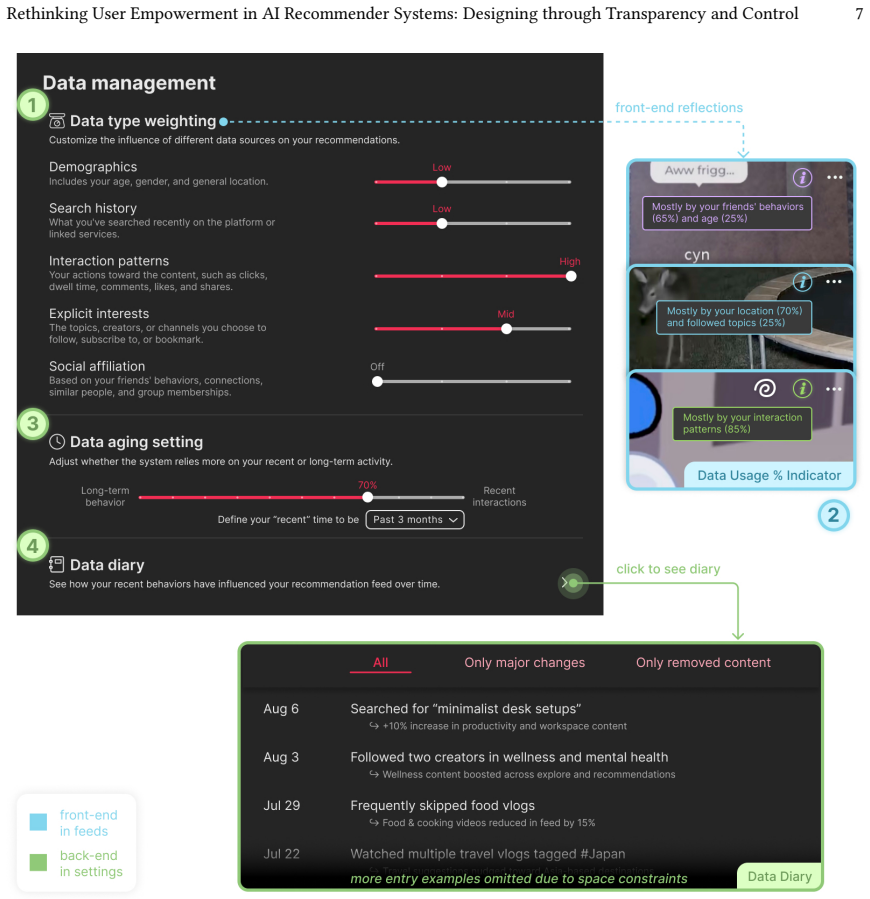
The provotype, an interface prototype that adds features for managing data use, discovering varied content, and configuring context-based recommending modes.
If this is right
- Users can more directly address concerns about filter bubbles and unwanted inferences by switching recommendation modes.
- Trust in the system rises when users see clear links between their data and the content they receive.
- Concrete adoption strategies can increase awareness and use of agency-enhancing controls.
- Recommender systems can be redesigned to foreground user autonomy rather than defaulting to opaque personalization.
Where Pith is reading between the lines
- Comparable controls could be tested in adjacent AI systems such as search or social feeds that rely on similar personalization logic.
- Large-scale A/B tests in live platforms would show whether the observed benefits hold when users encounter the features at population scale.
- These mechanisms may offer a practical route for platforms to meet emerging expectations around user control without sacrificing core recommendation performance.
Load-bearing premise
Insights from walkthroughs and interviews with a sample of 19 participants will generalize to effective designs and user needs in real-world, large-scale AI recommender systems.
What would settle it
A deployment of similar features inside a production recommender system in which users show no measurable gains in reported understanding of personalization signals or perceived control over outcomes would falsify the core claim.
Figures




read the original abstract
AI-driven recommender systems are often perceived as personalization black boxes, limiting users' ability to understand how their data shapes content (information asymmetry) or to influence system behavior meaningfully (power asymmetry). This study explores how design can strengthen user agency by integrating transparency with actionable control. We developed a provotype that introduces new interface features for managing data use, discovering varied content, and configuring context-based recommending modes. The walkthroughs and interviews with 19 participants show how these features help users interpret personalization signals, understand how their actions influence outcomes, address concerns from unwanted inference to narrow feeds (e.g., filter bubbles), and build trust in the system. We also identify strategies for promoting adoption and awareness of agency-enhancing features. Overall, our findings reaffirm users' desire for active influence over personalization and contribute concrete interface mechanisms with empirical insights for designing recommender systems that foreground user autonomy and fairness in AI-driven content delivery.
Editorial analysis
A structured set of objections, weighed in public.
Referee Report
Summary. The paper claims that AI recommender systems suffer from information and power asymmetries that limit user agency, and that a provotype integrating transparency and actionable control features (for data management, varied content discovery, and context-based modes) can address this. Walkthroughs and interviews with 19 participants are presented as evidence that these features help users interpret personalization signals, understand action-outcome links, mitigate filter-bubble concerns, and build trust, while also surfacing adoption strategies.
Significance. If the interpretive findings hold, the work supplies concrete, user-validated interface mechanisms for foregrounding autonomy and fairness in recommender systems, directly responding to documented user desires for influence over personalization and offering practical design guidance beyond abstract calls for transparency.
major comments (3)
- Methods section: The account of the qualitative study provides no details on participant recruitment criteria or sampling strategy, the precise walkthrough and interview protocols, the thematic coding process (including who coded and how disagreements were resolved), or steps taken to mitigate demand characteristics and novelty effects. Because the central claims rest entirely on these interpretive insights, the absence of this information prevents verification that the reported benefits are attributable to the provotype features rather than study artifacts.
- Findings section: No behavioral metrics (e.g., logs of control usage, pre/post measures of content diversity consumed) or control condition are reported to corroborate the self-reported benefits. Without such triangulation, the claims that the features 'help users interpret signals' and 'address concerns from unwanted inference' remain vulnerable to alternative explanations such as social desirability bias.
- Discussion section: The paper does not explicitly discuss the limitations of generalizing from a sample of 19 participants to large-scale production recommender systems, nor does it address how the provotype's features would scale or interact with existing platform constraints. This omission weakens the practical implications drawn from the empirical insights.
minor comments (2)
- Abstract and introduction: The term 'provotype' is introduced without a concise definition or reference to prior HCI literature on the concept, which may confuse readers unfamiliar with the term.
- Figure captions (if present): Any interface screenshots or diagrams illustrating the provotype features would benefit from explicit callouts linking visual elements to the specific user benefits claimed in the findings.
Simulated Author's Rebuttal
We thank the referee for the detailed and constructive feedback, which has helped us identify areas for strengthening the manuscript. We address each major comment below and indicate revisions where we have updated or will update the paper.
read point-by-point responses
-
Referee: Methods section: The account of the qualitative study provides no details on participant recruitment criteria or sampling strategy, the precise walkthrough and interview protocols, the thematic coding process (including who coded and how disagreements were resolved), or steps taken to mitigate demand characteristics and novelty effects. Because the central claims rest entirely on these interpretive insights, the absence of this information prevents verification that the reported benefits are attributable to the provotype features rather than study artifacts.
Authors: We agree that greater methodological transparency is necessary to support the interpretive claims. In the revised manuscript we will expand the Methods section with explicit details on recruitment criteria (e.g., age range, familiarity with recommender systems), purposive sampling strategy, full walkthrough and interview protocols, the reflexive thematic analysis process (following Braun & Clarke, with two independent coders and consensus discussions to resolve disagreements), and steps taken to address demand characteristics and novelty effects (neutral question phrasing, pilot testing, and familiarization time). revision: yes
-
Referee: Findings section: No behavioral metrics (e.g., logs of control usage, pre/post measures of content diversity consumed) or control condition are reported to corroborate the self-reported benefits. Without such triangulation, the claims that the features 'help users interpret signals' and 'address concerns from unwanted inference' remain vulnerable to alternative explanations such as social desirability bias.
Authors: The study was designed as an exploratory qualitative investigation of a provotype; behavioral logs and a control condition were therefore outside its scope. We acknowledge that this leaves the findings open to alternative explanations such as social desirability bias. In the revised Discussion we will add an explicit paragraph on this limitation, the absence of quantitative triangulation, and the need for future mixed-methods work to strengthen causal claims. revision: partial
-
Referee: Discussion section: The paper does not explicitly discuss the limitations of generalizing from a sample of 19 participants to large-scale production recommender systems, nor does it address how the provotype's features would scale or interact with existing platform constraints. This omission weakens the practical implications drawn from the empirical insights.
Authors: We accept this observation. The revised manuscript will extend the Limitations and Future Work subsection to directly address the constraints of generalizing from a small qualitative sample of 19 participants and to discuss scalability challenges, including integration with production platforms, computational and business-model constraints, and the role of the provotype as a design probe rather than a ready-to-deploy solution. revision: yes
Circularity Check
No circularity: empirical claims rest on primary interview data
full rationale
The paper reports findings from walkthroughs and interviews with 19 participants to evaluate a provotype interface for recommender systems. No equations, derivations, fitted parameters, or predictions appear in the provided text. Central claims about user interpretation, influence, filter-bubble concerns, and trust are presented as direct observations from the study rather than reductions to prior inputs or self-citations by construction. The work is self-contained as a qualitative HCI study with no load-bearing self-referential steps.
Axiom & Free-Parameter Ledger
Lean theorems connected to this paper
-
IndisputableMonolith/Cost/FunctionalEquation.leanwashburn_uniqueness_aczel unclear?
unclearRelation between the paper passage and the cited Recognition theorem.
We developed a provotype that introduces new interface features for managing data use, discovering varied content, and configuring context-based recommending modes... walkthroughs and interviews with 19 participants
-
IndisputableMonolith/Foundation/DimensionForcing.leanalexander_duality_circle_linking unclear?
unclearRelation between the paper passage and the cited Recognition theorem.
Adventure Content... Disruption Content... Personal Modes
What do these tags mean?
- matches
- The paper's claim is directly supported by a theorem in the formal canon.
- supports
- The theorem supports part of the paper's argument, but the paper may add assumptions or extra steps.
- extends
- The paper goes beyond the formal theorem; the theorem is a base layer rather than the whole result.
- uses
- The paper appears to rely on the theorem as machinery.
- contradicts
- The paper's claim conflicts with a theorem or certificate in the canon.
- unclear
- Pith found a possible connection, but the passage is too broad, indirect, or ambiguous to say the theorem truly supports the claim.
Forward citations
Cited by 1 Pith paper
-
Omakase: proactive assistance with actionable suggestions for evolving scientific research projects
Omakase monitors project documents to infer timely queries and distills research reports into actionable suggestions that users rated significantly more useful than raw reports.
Reference graph
Works this paper leans on
-
[1]
Panagiotis Adamopoulos and Alexander Tuzhilin. 2014. On over-specialization and concentration bias of recommendations: Probabilistic neighbor- hood selection in collaborative filtering systems. InProceedings of the 8th ACM Conference on Recommender systems. 153–160. Manuscript submitted to ACM Rethinking User Empowerment in AI Recommender Systems: Designi...
work page 2014
-
[2]
Gediminas Adomavicius and YoungOk Kwon. 2009. Toward more diverse recommendations: Item re-ranking methods for recommender systems. In Workshop on Information Technologies and Systems. 79–84
work page 2009
-
[3]
Adam Alley and Jody Hanshew. 2022. A long article about short videos: A content analysis of US academic libraries’ use of TikTok.The Journal of Academic Librarianship48, 6 (2022), 102611
work page 2022
-
[4]
Saleema Amershi, Maya Cakmak, William Bradley Knox, and Todd Kulesza. 2014. Power to the people: The role of humans in interactive machine learning.AI magazine35, 4 (2014), 105–120
work page 2014
-
[5]
Saleema Amershi, Dan Weld, Mihaela Vorvoreanu, Adam Fourney, Besmira Nushi, Penny Collisson, Jina Suh, Shamsi Iqbal, Paul N Bennett, Kori Inkpen, et al. 2019. Guidelines for human-AI interaction. InProceedings of the 2019 chi conference on human factors in computing systems. 1–13
work page 2019
-
[6]
Mike Ananny and Kate Crawford. 2018. Seeing without knowing: Limitations of the transparency ideal and its application to algorithmic accountability.new media & society20, 3 (2018), 973–989
work page 2018
-
[7]
Guy Aridor, Duarte Goncalves, and Shan Sikdar. 2020. Deconstructing the filter bubble: User decision-making and recommender systems. In Proceedings of the 14th ACM conference on recommender systems. 82–91
work page 2020
-
[8]
Fedor Bakalov, Marie-Jean Meurs, Birgitta König-Ries, Bahar Sateli, René Witte, Greg Butler, and Adrian Tsang. 2013. An approach to controlling user models and personalization effects in recommender systems. InProceedings of the 2013 international conference on Intelligent user interfaces. 49–56
work page 2013
-
[9]
Florian Bemmann, Helena Stoll, and Sven Mayer. 2024. Privacy Slider: Fine-Grain Privacy Control for Smartphones.Proceedings of the ACM on Human-Computer Interaction8, MHCI (2024), 1–31
work page 2024
-
[10]
Benjamin Maximilian Berens, Mark Bohlender, Heike Dietmann, Chiara Krisam, Oksana Kulyk, and Melanie Volkamer. 2024. Cookie disclaimers: Dark patterns and lack of transparency.Computers & Security136 (2024), 103507
work page 2024
-
[11]
Maximilian Boeker and Aleksandra Urman. 2022. An empirical investigation of personalization factors on TikTok. InProceedings of the ACM web conference 2022. 2298–2309
work page 2022
-
[12]
Laurens Boer and Jared Donovan. 2012. Provotypes for participatory innovation. InProceedings of the designing interactive systems conference. 388–397
work page 2012
-
[13]
Eva Brandt, Thomas Binder, and Elizabeth B-N Sanders. 2012. Tools and techniques: Ways to engage telling, making and enacting. InRoutledge international handbook of participatory design. Routledge, 145–181
work page 2012
-
[14]
Virginia Braun and Victoria Clarke. 2024. Thematic analysis. InEncyclopedia of quality of life and well-being research. Springer, 7187–7193
work page 2024
-
[15]
Jenna Burrell. 2016. How the machine ‘thinks’: Understanding opacity in machine learning algorithms.Big data & society3, 1 (2016), 2053951715622512
work page 2016
-
[16]
Hillary Carey and Suzanne Gibbs Howard. 2009. Tangible steps toward tomorrow: Designing a vision for early childhood education. InEthnographic Praxis in Industry Conference Proceedings, Vol. 2009. Wiley Online Library, 268–283
work page 2009
-
[17]
Pablo Castells, Neil Hurley, and Saul Vargas. 2021. Novelty and diversity in recommender systems. InRecommender systems handbook. Springer, 603–646
work page 2021
-
[18]
Tsai-Wei Chen and S Shyam Sundar. 2018. This app would like to use your current location to better serve you: Importance of user assent and system transparency in personalized mobile services. InProceedings of the 2018 CHI Conference on Human Factors in Computing Systems. ACM, USA, 1–13
work page 2018
-
[19]
Lingwei Cheng and Alexandra Chouldechova. 2023. Overcoming Algorithm Aversion: A Comparison between Process and Outcome Control. In Proceedings of the 2023 CHI Conference on Human Factors in Computing Systems. ACM, USA, 1–27
work page 2023
-
[20]
Peizhe Cheng, Shuaiqiang Wang, Jun Ma, Jiankai Sun, and Hui Xiong. 2017. Learning to recommend accurate and diverse items. InProceedings of the 26th international conference on World Wide Web. 183–192
work page 2017
-
[21]
Michael Conover, Jacob Ratkiewicz, Matthew Francisco, Bruno Gonçalves, Filippo Menczer, and Alessandro Flammini. 2011. Political polarization on twitter. InProceedings of the International AAAI Conference on Web and Social Media, Vol. 5-1. AAAI, USA, 89–96
work page 2011
-
[22]
Henriette Cramer, Vanessa Evers, Satyan Ramlal, Maarten Van Someren, Lloyd Rutledge, Natalia Stash, Lora Aroyo, and Bob Wielinga. 2008. The effects of transparency on trust in and acceptance of a content-based art recommender.User Modeling and User-adapted Interaction18 (2008), 455–496
work page 2008
-
[23]
Yashar Deldjoo, Vito Walter Anelli, Hamed Zamani, Alejandro Bellogin, and Tommaso Di Noia. 2021. A flexible framework for evaluating user and item fairness in recommender systems.User Modeling & User-Adapted Interaction31, 3 (2021)
work page 2021
-
[24]
Lakshita Dodeja, Pradyumna Tambwekar, Erin Hedlund-Botti, and Matthew Gombolay. 2024. Towards the design of user-centric strategy recommendation systems for collaborative Human–AI tasks.International journal of human-computer studies184 (2024), 103216
work page 2024
-
[25]
Upol Ehsan, Philipp Wintersberger, Q Vera Liao, Martina Mara, Marc Streit, Sandra Wachter, Andreas Riener, and Mark O Riedl. 2021. Operationalizing human-centered perspectives in explainable AI. InExtended abstracts of the 2021 CHI conference on human factors in computing systems. 1–6
work page 2021
-
[26]
Malin Eiband, Hanna Schneider, Mark Bilandzic, Julian Fazekas-Con, Mareike Haug, and Heinrich Hussmann. 2018. Bringing transparency design into practice. In23rd international conference on intelligent user interfaces. ACM, USA, 211–223
work page 2018
-
[27]
Mica R Endsley. 2023. Supporting Human-AI Teams: Transparency, explainability, and situation awareness.Computers in Human Behavior140 (2023), 107574
work page 2023
-
[28]
Heike Felzmann, Eduard Fosch-Villaronga, Christoph Lutz, and Aurelia Tamò-Larrieux. 2020. Towards transparency by design for artificial intelligence.Science and Engineering Ethics26, 6 (2020), 3333–3361. Manuscript submitted to ACM 26 Wu et al
work page 2020
-
[29]
Jaron Harambam, Dimitrios Bountouridis, Mykola Makhortykh, and Joris Van Hoboken. 2019. Designing for the better by taking users into account: A qualitative evaluation of user control mechanisms in (news) recommender systems. InProceedings of the 13th ACM conference on recommender systems. 69–77
work page 2019
-
[30]
Eddie Harmon-Jones and Judson Mills. 2019. An introduction to cognitive dissonance theory and an overview of current perspectives on the theory. American Psychological Association(2019)
work page 2019
-
[31]
F Maxwell Harper, Funing Xu, Harmanpreet Kaur, Kyle Condiff, Shuo Chang, and Loren Terveen. 2015. Putting users in control of their recommen- dations. InProceedings of the 9th ACM Conference on Recommender Systems. 3–10
work page 2015
-
[32]
Eelco Herder and Claus Atzenbeck. 7. Feedback loops and mutual reinforcement in personalized interaction.Personalized Human-Computer Interaction(7), 153
-
[33]
Leo Iaquinta, Marco De Gemmis, Pasquale Lops, Giovanni Semeraro, Michele Filannino, and Piero Molino. 2008. Introducing serendipity in a content-based recommender system. In2008 eighth international conference on hybrid intelligent systems. IEEE, 168–173
work page 2008
-
[34]
Dietmar Jannach, Michael Jugovac, and Ingrid Nunes. 2019. Explanations and user control in recommender systems. InProceedings of the 23rd International Workshop on Personalization and Recommendation on the Web and Beyond. 31–31
work page 2019
-
[35]
Dietmar Jannach, Sidra Naveed, and Michael Jugovac. 2017. User control in recommender systems: Overview and interaction challenges. In E-Commerce and Web Technologies: 17th International Conference, EC-Web 2016, Porto, Portugal, September 5-8, 2016, Revised Selected Papers 17. Springer, 21–33
work page 2017
-
[36]
Yucheng Jin, Li Chen, Wanling Cai, and Pearl Pu. 2021. Key qualities of conversational recommender systems: From users’ perspective. InProceedings of the 9th International Conference on Human-Agent Interaction. 93–102
work page 2021
-
[37]
Yucheng Jin, Nava Tintarev, Nyi Nyi Htun, and Katrien Verbert. 2020. Effects of personal characteristics in control-oriented user interfaces for music recommender systems.User Modeling and User-Adapted Interaction30, 2 (2020), 199–249
work page 2020
-
[38]
Marius Kaminskas and Derek Bridge. 2016. Diversity, serendipity, novelty, and coverage: a survey and empirical analysis of beyond-accuracy objectives in recommender systems.ACM Transactions on Interactive Intelligent Systems (TiiS)7, 1 (2016), 1–42
work page 2016
-
[39]
René F Kizilcec. 2016. How much information? Effects of transparency on trust in an algorithmic interface. InProceedings of the 2016 CHI Conference on Human Factors in Computing Systems. ACM, USA, 2390–2395
work page 2016
-
[40]
Bart P Knijnenburg, Martijn C Willemsen, Zeno Gantner, Hakan Soncu, and Chris Newell. 2012. Explaining the user experience of recommender systems.User modeling and user-adapted interaction22 (2012), 441–504
work page 2012
-
[41]
Karl Krauth, Yixin Wang, and Michael Jordan. 2025. Breaking feedback loops in recommender systems with causal inference.ACM Transactions on Recommender Systems4, 1 (2025), 1–20
work page 2025
-
[42]
Guy Laban and Theo Araujo. 2020. The effect of personalization techniques in users’ perceptions of conversational recommender systems. In Proceedings of the 20th ACM international conference on intelligent virtual agents. 1–3
work page 2020
-
[43]
Vivian Lai, Chacha Chen, Alison Smith-Renner, Q Vera Liao, and Chenhao Tan. 2023. Towards a Science of Human-AI Decision Making: An Overview of Design Space in Empirical Human-Subject Studies. InProceedings of the 2023 ACM Conference on Fairness, Accountability, and Transparency. ACM, USA, 1369–1385
work page 2023
-
[44]
Marianne W Lewis. 2000. Exploring paradox: Toward a more comprehensive guide.Academy of Management review25, 4 (2000), 760–776
work page 2000
-
[45]
Q Vera Liao, Daniel Gruen, and Sarah Miller. 2020. Questioning the AI: informing design practices for explainable AI user experiences. InProceedings of the 2020 CHI conference on human factors in computing systems. 1–15
work page 2020
-
[46]
Michal Luria. 2023. Co-design perspectives on algorithm transparency reporting: Guidelines and prototypes. InProceedings of the 2023 ACM Conference on Fairness, Accountability, and Transparency. 1076–1087
work page 2023
-
[47]
Lynette I Millett, Batya Friedman, and Edward Felten. 2001. Cookies and web browser design: Toward realizing informed consent online. In Proceedings of the SIGCHI conference on Human factors in computing systems. ACM, USA, 46–52
work page 2001
-
[48]
Joanna Misztal-Radecka and Bipin Indurkhya. 2021. Bias-Aware Hierarchical Clustering for detecting the discriminated groups of users in recommendation systems.Information Processing & Management58, 3 (2021), 102519
work page 2021
-
[49]
Maria D Molina and S Shyam Sundar. 2022. When AI moderates online content: effects of human collaboration and interactive transparency on user trust.Journal of Computer-Mediated Communication27, 4 (2022), zmac010
work page 2022
-
[50]
Tien T Nguyen, Pik-Mai Hui, F Maxwell Harper, Loren Terveen, and Joseph A Konstan. 2014. Exploring the filter bubble: the effect of using recommender systems on content diversity. InProceedings of the 23rd International Conference on World Wide Web. ACM, USA, 677–686
work page 2014
-
[51]
Sandeep Pandey, Mohamed Aly, Abraham Bagherjeiran, Andrew Hatch, Peter Ciccolo, Adwait Ratnaparkhi, and Martin Zinkevich. 2011. Learning to target: what works for behavioral targeting. InProceedings of the 20th ACM international conference on Information and knowledge management. 1805–1814
work page 2011
-
[52]
2011.The filter bubble: What the Internet is hiding from you
Eli Pariser. 2011.The filter bubble: What the Internet is hiding from you. penguin UK
work page 2011
-
[53]
2015.The black box society: The secret algorithms that control money and information
Frank Pasquale. 2015.The black box society: The secret algorithms that control money and information. Harvard University Press, USA
work page 2015
-
[54]
Jan Pennekamp, Martin Henze, and Klaus Wehrle. 2017. A survey on the evolution of privacy enforcement on smartphones and the road ahead. Pervasive and Mobile Computing42 (2017), 58–76
work page 2017
-
[55]
Pearl Pu, Li Chen, and Rong Hu. 2011. A user-centric evaluation framework for recommender systems. InProceedings of the fifth ACM conference on Recommender systems. ACM, USA, 157–164. Manuscript submitted to ACM Rethinking User Empowerment in AI Recommender Systems: Designing through Transparency and Control 27
work page 2011
-
[56]
Emilee Rader, Kelley Cotter, and Janghee Cho. 2018. Explanations as mechanisms for supporting algorithmic transparency. InProceedings of the 2018 CHI Conference on Human Factors in Computing Systems. ACM, USA, 1–13
work page 2018
-
[57]
Gabriëlle Ras, Marcel van Gerven, and Pim Haselager. 2018. Explanation methods in deep learning: Users, values, concerns and challenges. Explainable and interpretable models in computer vision and machine learning(2018), 19–36
work page 2018
-
[58]
Al Mamunur Rashid, Istvan Albert, Dan Cosley, Shyong K Lam, Sean M McNee, Joseph A Konstan, and John Riedl. 2002. Getting to know you: learning new user preferences in recommender systems. InProceedings of the 7th international conference on Intelligent user interfaces. ACM, USA, 127–134
work page 2002
-
[59]
Laurens Rook, Adem Sabic, and Markus Zanker. 2020. Engagement in proactive recommendations: The role of recommendation accuracy, information privacy concerns and personality traits.Journal of Intelligent Information Systems54, 1 (2020), 79–100
work page 2020
-
[60]
Alexander Rühr, Benedikt Berger, and Thomas Hess. 2023. Intelligent IT Systems in Business Application: Control and Transparency as Means of Building Trust in AI. InWork and AI 2030: Challenges and Strategies for Tomorrow’s Work. Springer, USA, 125–132
work page 2023
-
[61]
J Ben Schafer, Joseph A Konstan, and John Riedl. 2002. Meta-recommendation systems: user-controlled integration of diverse recommendations. In Proceedings of the eleventh international conference on Information and knowledge management. 43–51
work page 2002
-
[62]
Max Schemmer, Patrick Hemmer, Maximilian Nitsche, Niklas Kühl, and Michael Vössing. 2022. A meta-analysis of the utility of explainable artificial intelligence in human-AI decision-making. InProceedings of the 2022 AAAI/ACM Conference on AI, Ethics, and Society. ACM, USA, 617–626
work page 2022
-
[63]
Claire M Segijn, Joanna Strycharz, Amy Riegelman, and Cody Hennesy. 2021. A literature review of personalization transparency and control: introducing the transparency–awareness–control Framework.Media and Communication9, 4 (2021), 120–133
work page 2021
-
[64]
Donghee Shin and Yong Jin Park. 2019. Role of fairness, accountability, and transparency in algorithmic affordance.Computers in Human Behavior 98 (2019), 277–284
work page 2019
-
[65]
Ashudeep Singh and Thorsten Joachims. 2018. Fairness of exposure in rankings. InProceedings of the 24th ACM SIGKDD international conference on knowledge discovery & data mining. 2219–2228
work page 2018
-
[66]
Nasim Sonboli, Jessie J Smith, Florencia Cabral Berenfus, Robin Burke, and Casey Fiesler. 2021. Fairness and transparency in recommendation: The users’ perspective. InProceedings of the 29th ACM Conference on User Modeling, Adaptation and Personalization. ACM, USA, 274–279
work page 2021
-
[67]
Elias Storms, Oscar Alvarado, and Luciana Monteiro-Krebs. 2022. ’Transparency is Meant for Control’and Vice Versa: Learning from Co-designing and Evaluating Algorithmic News Recommenders.Proceedings of the ACM on Human-Computer Interaction6, CSCW2 (2022), 1–24
work page 2022
-
[68]
S Shyam Sundar. 2020. Rise of machine agency: A framework for studying the psychology of human-AI interaction (HAII).Journal of Computer- Mediated Communication25, 1 (2020), 74–88
work page 2020
-
[69]
Christopher Thompson, Maritza Johnson, Serge Egelman, David Wagner, and Jennifer King. 2013. When it’s better to ask forgiveness than get permission: attribution mechanisms for smartphone resources. InProceedings of the Ninth Symposium on Usable Privacy and Security. 1–14
work page 2013
-
[70]
Jenifer Tidwell. 2010.Designing interfaces: Patterns for effective interaction design. " O’Reilly Media, Inc. "
work page 2010
-
[71]
Alexandra To, Hillary Carey, Riya Shrivastava, Jessica Hammer, and Geoff Kaufman. 2022. Interactive fiction provotypes for coping with interpersonal racism. InProceedings of the 2022 CHI conference on human factors in computing systems. 1–14
work page 2022
-
[72]
Chun-Hua Tsai and Peter Brusilovsky. 2021. The effects of controllability and explainability in a social recommender system.User Modeling and User-Adapted Interaction31 (2021), 591–627
work page 2021
-
[73]
Syed Ubaid, Mohammed Talha Alam, Shahab Saquib Sohail, Imran Khan Saifi, Tabish Mufti, Asfia Aziz, Md Tabrez Nafis, et al. 2021. The impact of randomized algorithm over recommender system.Procedia Computer Science194 (2021), 218–223
work page 2021
-
[74]
Maarten W Van Someren, Yvonne F Barnard, Jacobijn AC Sandberg, et al. 1994. The think aloud method: a practical approach to modelling cognitive processes.London: AcademicPress11, 6 (1994)
work page 1994
-
[75]
Ge Wang, Jun Zhao, Samantha-Kaye Johnston, Zhilin Zhang, Max Van Kleek, and Nigel Shadbolt. 2024. CHAITok: A proof-of-concept system supporting children’s sense of data autonomy on social media. InProceedings of the 2024 CHI Conference on Human Factors in Computing Systems. 1–19
work page 2024
-
[76]
Ruotong Wang, F Maxwell Harper, and Haiyi Zhu. 2020. Factors influencing perceived fairness in algorithmic decision-making: Algorithm outcomes, development procedures, and individual differences. InProceedings of the 2020 CHI conference on human factors in computing systems. 1–14
work page 2020
-
[77]
Wenjie Wang, Fuli Feng, Liqiang Nie, and Tat-Seng Chua. 2022. User-controllable recommendation against filter bubbles. InProceedings of the 45th international ACM SIGIR conference on research and development in information retrieval. 1251–1261
work page 2022
-
[78]
Adrian Weller. 2019. Transparency: motivations and challenges. InExplainable AI: Interpreting, Explaining and Visualizing Deep Learning. Springer, USA, 23–40
work page 2019
-
[79]
Mark Wilhelm, Ajith Ramanathan, Alexander Bonomo, Sagar Jain, Ed H Chi, and Jennifer Gillenwater. 2018. Practical diversified recommendations on youtube with determinantal point processes. InProceedings of the 27th ACM International Conference on Information and Knowledge Management. 2165–2173
work page 2018
-
[80]
Christine T Wolf. 2019. Explainability scenarios: towards scenario-based XAI design. InProceedings of the 24th International Conference on Intelligent User Interfaces. ACM, USA, 252–257
work page 2019
discussion (0)
Sign in with ORCID, Apple, or X to comment. Anyone can read and Pith papers without signing in.