A Doppler backscattering diagnostic for the EXL-50U spherical tokamak: plasma considerations and preliminary quasioptical design
Pith reviewed 2026-05-18 15:13 UTC · model grok-4.3
The pith
A Doppler backscattering diagnostic for EXL-50U can access scattering locations from 0.15 to 1 in normalized radius with wavenumbers 2.47 to 9.49 cm^{-1}.
A machine-rendered reading of the paper's core claim, the machinery that carries it, and where it could break.
Core claim
Using SCOTTY beam-tracing for several EXL-50U plasma scenarios, the design calculations demonstrate that a DBS system can measure scattering at normalized radii 0.15 < ρ < 1 with corresponding perpendicular wavenumbers 2.47 cm^{-1} < k_⊥ < 9.49 cm^{-1}, provided toroidal launch angles are chosen to align the probe beam perpendicular to the local magnetic field.
What carries the argument
SCOTTY beam-tracing code that predicts cutoff locations and scattering wavenumbers for given density, magnetic field profiles, and launch conditions, combined with toroidal steering and tunable frequencies in a 40-60 GHz quasioptical system.
If this is right
- The diagnostic can obtain turbulence data from near the core edge to the plasma boundary in multiple operating scenarios.
- Toroidal steering and frequency tuning will be required to maximize signal strength given the high pitch angle.
- The U-band quasioptical hardware must be compatible with available port windows and in-vessel constraints.
- Measured turbulence spectra can inform transport studies relevant to the device's proton-boron fusion goals.
Where Pith is reading between the lines
- If the predicted coverage is realized, the diagnostic could help identify which turbulence scales dominate energy losses in compact spherical tokamaks.
- The same beam-tracing approach might be adapted to check DBS feasibility on other high-pitch-angle devices before hardware installation.
- Comparing measured cutoff positions against the SCOTTY predictions would provide a direct test of the plasma equilibrium assumptions used in the design.
Load-bearing premise
The plasma density and magnetic field profiles assumed in the SCOTTY calculations match the actual operating conditions that will be achieved in EXL-50U.
What would settle it
If actual plasma profiles in EXL-50U produce cutoff locations or scattering wavenumbers outside the predicted intervals, or if the backscattered power drops sharply when the toroidal angle is set according to the design, the coverage claims would not hold.
Figures



read the original abstract
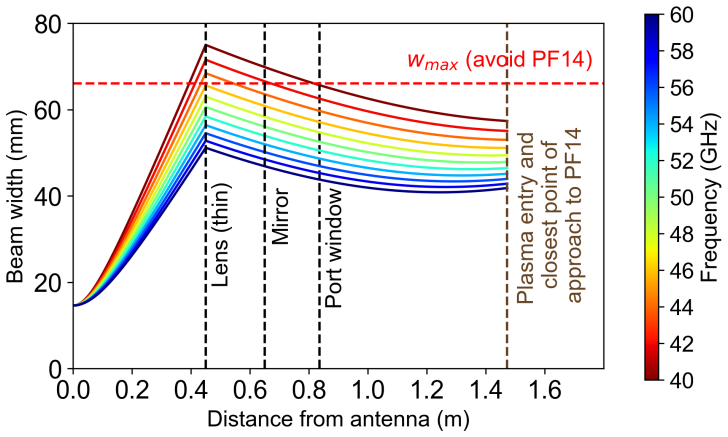
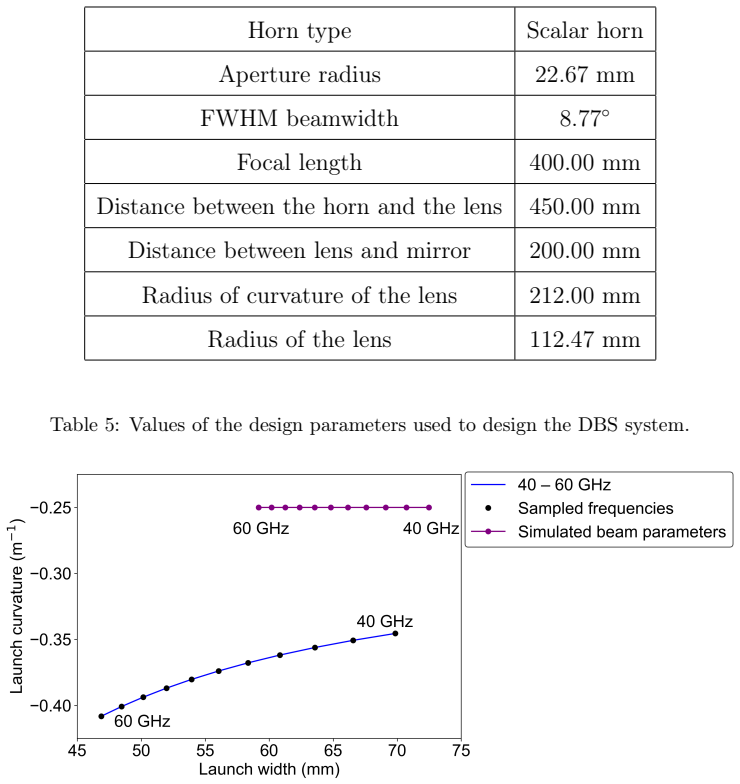
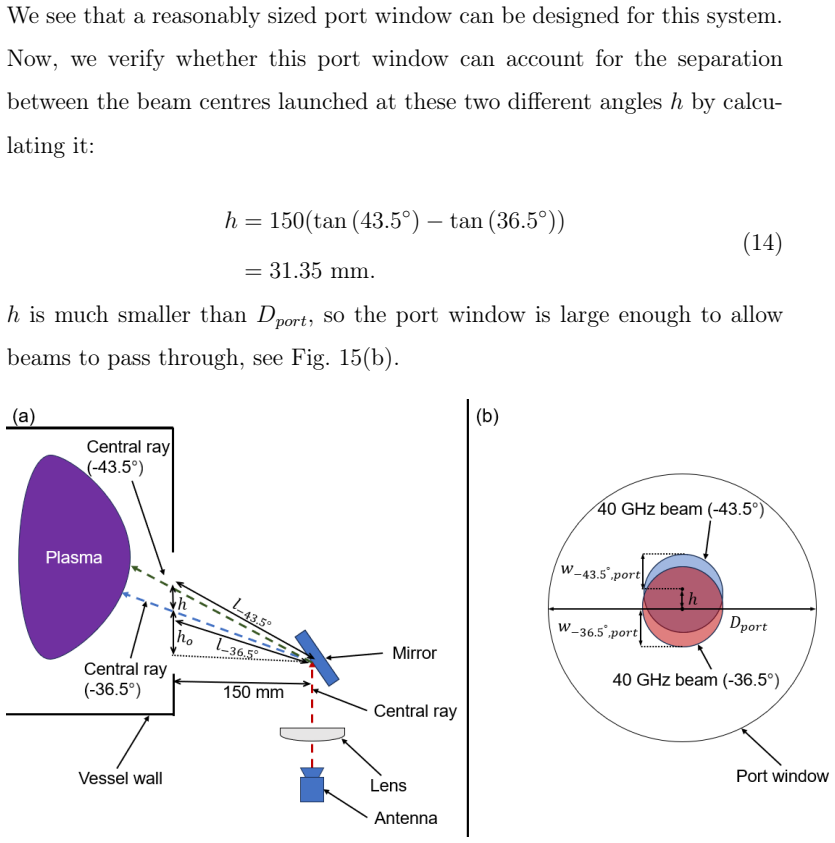
The EXL-50U spherical tokamak was built by Energy iNNovation to develop technologies for proton-boron fusion in spherical tokamaks (Liu et al., Phys. Plasmas 2024). We present a conceptual design of the Doppler backscattering (DBS) diagnostic for the EXL-50U spherical tokamak. DBS is a diagnostic capable of measuring plasma turbulence, which is especially important for transport in tokamaks. Starting from a set of physical design constraints, such as port window availability and in-vessel space, we used SCOTTY (Hall-Chen et al., PPCF 2022), an in-house beam tracing code, to predict the location of the cutoffs and the corresponding scattering wavenumbers for several EXL-50U plasma scenarios. We find that we are able to measure scattering locations of 0.15 $<$ $\rho$ $<$ 1, with corresponding turbulent wavenumbers of 2.47 cm$^{-1}$$<$ $k_{\perp}$ $<$ 9.49 cm$^{-1}$. Here, $\rho$ is the normalised radial coordinate of the scattering location, and $k_{\perp}$ is the corresponding turbulent wavenumber. We then determine the optimal toroidal launch angles to ensure that the probe beam's wavevector is perpendicular to the magnetic field at the cutoff location, thereby maximising the backscattered signal. This matching is crucial due to the EXL-50U's high magnetic pitch angle, $\sim35^{\circ}$ at the outboard midplane. Given our results, we propose the use of toroidal steering and tunable frequency channels to ensure beams are well-matched with the magnetic pitch angle. We propose a quasioptical system that covers the U-band range (40--60 GHz).
Editorial analysis
A structured set of objections, weighed in public.
Referee Report
Summary. The manuscript outlines a conceptual design for a Doppler backscattering (DBS) diagnostic for the EXL-50U spherical tokamak. The authors use the SCOTTY beam-tracing code to predict cutoff locations and scattering wavenumbers for multiple plasma scenarios, reporting accessible normalized radii in the range 0.15 < ρ < 1 and turbulent wavenumbers 2.47 cm^{-1} < k_⊥ < 9.49 cm^{-1}. They propose a quasioptical system in the U-band (40-60 GHz) incorporating toroidal steering and tunable frequency channels to ensure the probe beam is perpendicular to the magnetic field at the cutoff, accounting for the high magnetic pitch angle of approximately 35 degrees at the outboard midplane.
Significance. This design study is significant as it provides specific predictions for turbulence measurements in a new spherical tokamak focused on proton-boron fusion. The use of SCOTTY for beam tracing offers quantitative insights into accessible measurement locations and wavenumbers. The emphasis on matching the beam to the magnetic pitch angle addresses a key challenge in spherical tokamaks. However, the reliance on projected plasma profiles means the results are preliminary and would benefit from validation once the device operates.
major comments (1)
- [Plasma scenarios] The headline result on the accessible ρ and k_⊥ ranges is obtained by launching beams into model density and magnetic field profiles for EXL-50U. The manuscript should include an analysis of how uncertainties or variations in these input profiles (e.g., central density or scale length) propagate to the predicted ranges, as shifts of 15-20% could alter the quoted intervals substantially.
minor comments (2)
- Clarify the exact plasma parameters (density, temperature, B-field) for each scenario considered in the SCOTTY simulations to allow reproducibility.
- [Quasioptical design] Provide more details on the port window availability and in-vessel space constraints that informed the design choices.
Simulated Author's Rebuttal
We thank the referee for their constructive review and for recognizing the significance of our conceptual DBS diagnostic design for the EXL-50U spherical tokamak. We address the major comment below and will incorporate the requested analysis into the revised manuscript.
read point-by-point responses
-
Referee: The headline result on the accessible ρ and k_⊥ ranges is obtained by launching beams into model density and magnetic field profiles for EXL-50U. The manuscript should include an analysis of how uncertainties or variations in these input profiles (e.g., central density or scale length) propagate to the predicted ranges, as shifts of 15-20% could alter the quoted intervals substantially.
Authors: We agree that quantifying the sensitivity of the predicted ρ and k_⊥ ranges to uncertainties in the input profiles would improve the robustness of our results. The manuscript already examines several distinct plasma scenarios to sample variations in density and magnetic field. To address the referee's specific request, we will add a dedicated sensitivity study in the revised version. This will include systematic variations of central density by ±20% and corresponding adjustments to the density scale length, followed by recomputation of cutoff locations and scattering wavenumbers using SCOTTY. The outcomes will be summarized in an additional table or figure, with explicit discussion of how the quoted intervals (0.15 < ρ < 1 and 2.47 cm^{-1} < k_⊥ < 9.49 cm^{-1}) may shift under these perturbations. We believe this addition will directly respond to the concern while remaining consistent with the preliminary nature of the projected profiles. revision: yes
Circularity Check
No significant circularity; results from external code on stated profiles
full rationale
The paper computes scattering locations (0.15 < ρ < 1) and wavenumbers (2.47 cm^{-1} < k_⊥ < 9.49 cm^{-1}) by launching beams at chosen frequencies and angles into assumed EXL-50U density and B profiles using the SCOTTY beam-tracing code. These outputs are direct numerical results of the code application rather than quantities defined in terms of themselves or fitted parameters renamed as predictions. The citation to Hall-Chen et al. (PPCF 2022) describes the code tool and is not load-bearing for the central claims, which consist of new calculations for this device; the derivation remains self-contained against the explicitly stated input profiles and does not reduce to tautology or self-referential construction.
Axiom & Free-Parameter Ledger
free parameters (1)
- Plasma density and temperature profiles
axioms (1)
- domain assumption SCOTTY beam-tracing code accurately predicts cutoff locations and scattering wavenumbers in spherical tokamak geometry
Reference graph
Works this paper leans on
-
[1]
J. C. Hillesheim, Studies of turbulence and flows in the diii-d tokamak, Ph.D. thesis (2012). 41
work page 2012
- [2]
- [3]
- [4]
-
[5]
URLhttps://www.iaea.org/publications/8879/fusion-physics
Fusion Physics, Non-serial Publications, International Atomic Energy Agency, Vienna, 2012. URLhttps://www.iaea.org/publications/8879/fusion-physics
work page 2012
-
[6]
M. Wade, J. Leuer, Cost drivers for a tokamak-based compact pilot plant, Fusion Science and Technology 77 (2) (2021) 119–143
work page 2021
- [7]
-
[8]
S. Yuejiang, S. Xianming, G. Dong, G. Xiang, D. Lili, W. Xueyun, S. Tiantian, T. Muzhi, C. Zhengyuan, Y. Guang, et al., Strategy and experimental progress of the exl-50u spherical torus in support of the ehl-2 project, Plasma Science and Technology 27 (2) (2025) 024003
work page 2025
-
[9]
S. M. Kaye, J. W. Connor, C. M. Roach, Thermal confinement and 42 transport in spherical tokamaks: a review, Plasma Physics and Con- trolled Fusion 63 (12) (2021) 123001
work page 2021
-
[10]
S. Bingren, Toroidicity dependence of tokamak edge safety factor and shear, Plasma Science and Technology 5 (4) (2003) 1849
work page 2003
- [11]
-
[12]
S. Maeyama, Y. Idomura, T.-H. Watanabe, M. Nakata, M. Yagi, N. Miy- ato, A. Ishizawa, M. Nunami, Cross-scale interactions between electron and ion scale turbulence in a tokamak plasma, Physical review letters 114 (25) (2015) 255002
work page 2015
-
[13]
S. Maeyama, T.-H. Watanabe, Y. Idomura, M. Nakata, A. Ishizawa, M. Nunami, Cross-scale interactions between turbulence driven by elec- tron and ion temperature gradients via sub-ion-scale structures, Nuclear Fusion 57 (6) (2017) 066036
work page 2017
-
[14]
P. Hennequin, C. Honoré, A. Truc, A. Quéméneur, N. Lemoine, J.-M. Chareau, R. Sabot, Doppler backscattering system for measuring fluctuations and their perpendicular veloc- ity on tore supra, Review of Scientific Instruments 75 (10) (2004) 3881–3883. arXiv:https://pubs.aip.org/aip/rsi/article- pdf/75/10/3881/19310531/3881_1_online.pdf, doi:10.1063/1.17879...
- [15]
-
[16]
C. Zhou, A. Liu, X. Zhang, J. Hu, M. Wang, H. Li, T. Lan, J. Xie, X. Sun, W. Ding, et al., Microwave doppler reflectometer system in the experimental advanced superconducting tokamak, Review of Scientific Instruments 84 (10) (2013)
work page 2013
-
[17]
Z. Shi, W. Zhong, M. Jiang, Z. Yang, B. Zhang, P. Shi, W. Chen, J. Wen, C. Chen, B. Fu, Z. Liu, X. Ding, Q. Yang, X. Duan, A novel multi-channel quadrature doppler backward scattering reflectometer on the hl-2a tokamak, Review of Scientific Instruments 87 (11) (Nov. 2016). doi:10.1063/1.4966680. URLhttp://dx.doi.org/10.1063/1.4966680
- [18]
-
[19]
J. Hu, C. Zhou, A. Liu, M. Wang, E. Doyle, W. Peebles, G. Wang, X. Zhang, J. Zhang, X. Feng, et al., An eight-channel doppler backscat- tering system in the experimental advanced superconducting tokamak, Review of Scientific Instruments 88 (7) (2017)
work page 2017
-
[20]
T.Tokuzawa, H.Tsuchiya, T.Tsujimura, M.Emoto, H.Nakanishi, S.In- agaki, K. Ida, H. Yamada, A. Ejiri, K. Watanabe, et al., Microwave fre- 44 quency comb doppler reflectometer applying fast digital data acquisition system in lhd, Review of Scientific Instruments 89 (10) (2018)
work page 2018
-
[21]
P. Molina Cabrera, S. Coda, L. Porte, A. Smolders, T. Team, et al., V-band nanosecond-scale pulse reflectometer diagnostic in the tcv toka- mak, Review of Scientific Instruments 90 (12) (2019)
work page 2019
-
[22]
J. Wen, Z. Shi, W. Zhong, Z. Yang, Z. Yang, B. Wang, M. Jiang, P. Shi, J. Hillesheim, S. Freethy, et al., A remote gain controlled and polariza- tion angle tunable doppler backward scattering reflectometer, Review of Scientific Instruments 92 (6) (2021)
work page 2021
-
[23]
T. Tokuzawa, K. Tanaka, T. Tsujimura, S. Kubo, M. Emoto, S. Ina- gaki, K. Ida, M. Yoshinuma, K. Watanabe, H. Tsuchiya, et al., W-band millimeter-wave back-scattering system for high wavenumber turbulence measurements in lhd, Review of Scientific Instruments 92 (4) (2021)
work page 2021
-
[24]
D. Carralero, T. Happel, T. Estrada, T. Tokuzawa, J. Martínez, E. De La Luna, A. Cappa, J. García, A feasibility study for a doppler reflectometer system in the jt-60sa tokamak, Fusion Engineering and Design 173 (2021) 112803
work page 2021
- [25]
- [26]
-
[27]
Q. Pratt, V. Hall-Chen, T. F. Neiser, R. Hong, J. Damba, T. L. Rhodes, K.E.Thome, J.Yang, S.R.Haskey, T.Cote, etal., Densitywavenumber spectrum measurements, synthetic diagnostic development, and tests of quasilinear turbulence modeling in the core of electron-heated diii-d h- mode plasmas, Nuclear Fusion 64 (1) (2023) 016001
work page 2023
-
[28]
V. H. Hall-Chen, F. I. Parra, J. C. Hillesheim, Beam model of doppler backscattering, Plasma Physics and Controlled Fusion 64 (9) (2022) 095002
work page 2022
- [29]
- [30]
-
[31]
V. H. Hall-Chen, J. Damba, F. I. Parra, Q. T. Pratt, C. A. Michael, S. Peng, T. L. Rhodes, N. A. Crocker, J. C. Hillesheim, R. Hong, et al., Validating and optimizing mismatch tolerance of doppler backscattering measurements with the beam model, Review of Scientific Instruments 93 (10) (2022). 46
work page 2022
-
[32]
Hall-Chen, Beam model of doppler backscattering: theory and ex- periment, Ph.D
V. Hall-Chen, Beam model of doppler backscattering: theory and ex- periment, Ph.D. thesis, University of Oxford (2021)
work page 2021
- [33]
-
[34]
N. Lopez, Exact boundary-value solution for an electromagnetic wave propagating in a linearly varying index of refraction, Journal of Plasma Physics 90 (6) (2024) 995900602
work page 2024
- [35]
- [36]
-
[37]
E. Gusakov, A. Surkov, Spatial and wavenumber resolution of doppler reflectometry, Plasma physics and controlled fusion 46 (7) (2004) 1143
work page 2004
-
[38]
L. W. Casperson, Gaussian light beams in inhomogeneous media, Ap- plied optics 12 (10) (1973) 2434–2441
work page 1973
-
[39]
V. Červen` y, M. M. Popov, I. Pšenčík, Computation of wave fields in inhomogeneous media—gaussian beam approach, Geophysical Journal International 70 (1) (1982) 109–128
work page 1982
-
[40]
Y. A. Kravtsov, P. Berczynski, Gaussian beams in inhomogeneous me- dia: a review, Studia Geophysica et Geodaetica 51 (1) (2007) 1–36. 47
work page 2007
-
[41]
G. Pereverzev, Use of the multidimensional wkb method to describe propagation of lower hybrid waves in tokamak plasma, Nuclear fusion 32 (7) (1992) 1091
work page 1992
-
[42]
G.V.Pereverzev, Paraxialwkbsolutionofascalarwaveequation(1993)
work page 1993
-
[43]
Pereverzev, Paraxial wkb solution of a scalar wave equation, in: B
G. Pereverzev, Paraxial wkb solution of a scalar wave equation, in: B. B. Kadomtsev (Ed.), Reviews of Plasma Physics, Vol. 19, Springer New York, NY, 1996, pp. 1–48
work page 1996
-
[44]
G. Pereverzev, Beam tracing in inhomogeneous anisotropic plasmas, Physics of Plasmas 5 (10) (1998) 3529–3541
work page 1998
- [45]
-
[46]
O. Maj, G. V. Pereverzev, E. Poli, Validation of the paraxial beam- tracing method in critical cases, Physics of Plasmas 16 (6) (2009)
work page 2009
-
[47]
J. R. Ruiz, F. I. Parra, V. H. Hall-Chen, N. Belrhali, C. Giroud, J. C. Hillesheim, N. A. Lopez, et al., Beam focusing and consequences for doppler backscattering measurements, Journal of Plasma Physics 91 (2) (2025) E60
work page 2025
-
[48]
V. H. Hall-Chen, Scotty,https://github.com/beam-tracing/Scotty (2022). 48
work page 2022
-
[49]
J. Chen, X. Jian, V. S. Chan, Z. Li, Z. Deng, G. Li, W. Guo, N. Shi, X. Chen, et al., Self-consistent modeling of cfetr baseline scenarios for steady-state operation, Plasma Physics and Controlled Fusion 59 (7) (2017) 075005
work page 2017
-
[50]
L. L. Lao, H. S. John, R. Stambaugh, A. Kellman, W. Pfeiffer, Recon- struction of current profile parameters and plasma shapes in tokamaks, Nuclear fusion 25 (11) (1985) 1611
work page 1985
- [51]
- [52]
- [53]
-
[54]
A. Smirnov, R. Harvey, K. Kupfer, A general ray tracing code genray, Bull Amer. Phys. Soc 39 (7) (1994) 1626
work page 1994
-
[55]
J. Hillesheim, N. Crocker, W. Peebles, H. Meyer, A. Meakins, A. Field, D. Dunai, M. Carr, N. Hawkes, M. Team, et al., Doppler backscattering for spherical tokamaks and measurement of high-k density fluctuation wavenumber spectrum in mast, Nuclear Fusion 55 (7) (2015) 073024. 49
work page 2015
-
[56]
H. Bindslev, Relativistic effects in plasma reflectometry, Plasma physics and controlled fusion 34 (11) (1992) 1601
work page 1992
-
[57]
G. Wang, T. Rhodes, W. Peebles, R. Harvey, R. Budny, Refractive and relativistic effects on iter low field side reflectometer design, Review of Scientific Instruments 81 (10) (2010)
work page 2010
- [58]
-
[59]
W. Guttenfelder, J. Candy, Resolving electron scale turbulence in spher- ical tokamaks with flow shear, Physics of Plasmas 18 (2) (2011)
work page 2011
-
[60]
E. Mazzucato, D. Smith, R. Bell, S. Kaye, J. Hosea, B. LeBlanc, J. Wil- son, P. Ryan, C. Domier, N. Luhmann Jr, et al., Short-scale turbu- lent fluctuations driven by the electron-temperature gradient in the na- tionalsphericaltorusexperiment, PhysicalReviewLetters101(7)(2008) 075001
work page 2008
-
[61]
S. Maeyama, N. Howard, J. Citrin, T.-H. Watanabe, T. Tokuzawa, Overview of multiscale turbulence studies covering ion-to-electron scales in magnetically confined fusion plasma, Nuclear Fusion 64 (11) (2024) 112007
work page 2024
-
[62]
S. Maeyama, T.-H. Watanabe, A. Ishizawa, Suppression of ion-scale microtearing modes by electron-scale turbulence via cross-scale nonlin- 50 ear interactions in tokamak plasmas, Physical Review Letters 119 (19) (2017) 195002
work page 2017
-
[63]
V. Bulanin, M. Yafanov, Spatial and spectral resolution of the plasma doppler reflectometry, Plasma Physics Reports 32 (1) (2006) 47–55. 51
work page 2006
discussion (0)
Sign in with ORCID, Apple, or X to comment. Anyone can read and Pith papers without signing in.